Mae Elise Cannon's Blog, page 5
April 10, 2020
Just Spirituality: How Faith Practices Fuel Social Action

Throughout history, Christians have been called by God to active engagement in society on behalf of the poor and oppressed. Christian leaders have been instrumental in caring for people who are poor, fighting injustice and advocating for social change. But they have never done so on their own power. Their energy and zeal were fueled by inner spiritual practices that propelled them forward into the world.
Activist and historian Mae Elise Cannon explores the direct connection between Christians’ personal relationship with God and outward actions of kindness, mercy, compassion and advocacy. She looks at how notable Christian leaders were able to face societal challenges because of the rich depths of their spiritual practices. For example:
Mother Teresa’s practice of silence compelled her to service.Dietrich Bonhoeffer’s prayer life equipped his discipleship.Martin Luther King Jr.’s beloved community empowered his proclamation.Oscar Romero’s discipline of submission prepared him to face martyrdom.
Biographical profiles of these and other key figures from around the world give us concrete examples of how activism and advocacy can be sustained over the long haul. Cannon also describes modern-day activists who embody the synergy of faith and action, with practical lessons for our own lives.
Find yourself spiritually transformed by these examples, and follow in their footsteps in just service to the world.
Buy Here


April 8, 2020
Eastertide Meditations: Calls to Spiritual Activism from the Middle East

Rev. Dr. Mae Elise Cannon, executive director of Churches for Middle East Peace (CMEP), gathers with Christian leaders from across the Middle East weekly for Eastertide Meditations, a series of conversations designed to bring us from the resurrection of Easter Sunday to Pentecost.
Rev. Dr. Cannon and her guests will discuss how Christians in the Middle East are doing during this challenging time and answer the question: What is the need that American Christians can help with in your work? You’ll leave each session with practical steps that will point to ways you can advocate for peace and justice. Each session will end with a led prayer.
Join her from your home on Tuesdays, April 14-May 19, 11:30am-12pm Eastern Time, via Zoom.
Register in advance for this webinar:
https://us04web.zoom.us/webinar/register/WN_KyMPQ8tUQ96KQp6Cj-LsPA
April 3, 2020
November 14, 2019
November 12, 2019

May 2, 2018
Pilgrimage to Peace Tours
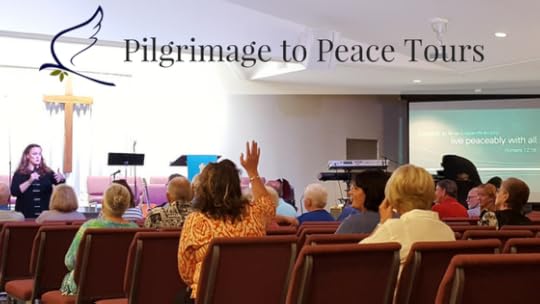
Pilgrimage to Peace (P2P) are 1-3 week speaking tours in the US where Churches for Middle East Peace (CMEP) Staff and peacemakers from Israel and Palestine speak to churches, schools, community groups, and other religious organizations. CMEP hosts one or two P2P tours each year, bringing the message that Peace is Possible to locations across the United States.
Find more information on the next Pilgrimage to Peace Tour here: http://cmep.org/events/p2p/
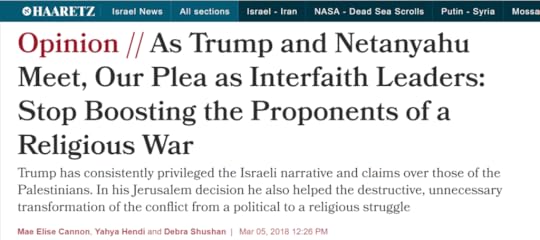
As Trump and Netanyahu Meet, Our Plea as Interfaith Leaders: Stop Boosting the Proponents of a Religious War
As Trump and Netanyahu Meet, Our Plea as Interfaith Leaders: Stop Boosting the Proponents of a Religious War, Rev. Dr. Mae Elise Cannon, Imam Yahya Hendi, Debra Shushan, Haaretz, March 5, 2018 (May require subscription.)
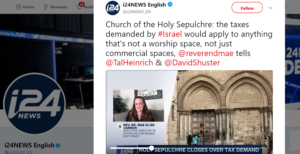
Video Interview: Holy Sepulchre closes over tax demand
Video Interview: Holy Sepulchre closes over tax demand, Rev. Dr. Mae Elise Cannon, i24NEWS, February 26, 2018
April 20, 2016
Mutual Submission: The Holy Spirit Works Through Women, Too
As we observe Holy Week, we are reminded that women were the ones who stood by the cross and were first to preach the Good News of Christ’s resurrection. Throughout the Scriptures, women have played a significant role in contributing to the kingdom of God.
In the 21st century, many who choose to follow Christ continue to question the posture of Jesus toward women. Some more traditional interpretations of Scripture use verses from the Bible to say that women should be in specific roles in relationship to their families and greater society. These interpretations often prevent women from having leadership roles in homes, churches, and/or society at large.
Yet, when we look at the overall trajectory of the New Testament, Jesus was one of the most liberating leaders in his relationship with women. Consider some of the interactions between Jesus and women: Jesus’ ministry was funded by women (Luke 8:3); women followed Jesus and the disciples and were responsible for “caring for his needs” (Matthew 27:55); it was a Samaritan woman to whom Jesus first identified Himself as the Messiah and she went back and introduced her whole community to him (John 4); women were the ones who revealed that Jesus had resurrected and was gone from the grave after He had been buried (Matthew 28:5-6); women were present at the Upper Room when the Holy Spirit revealed itself during Pentecost (Acts1:14); and women were called and gifted as evangelists and missionaries in the early church (Romans 16:3).
Despite the many verses that talk about the role of women in both following Jesus and helping to establish the early church, there are verses in the New Testament that have been used to limit the role of women.
One of the most prevalent passages is Ephesians 5:21-33 which begins with the statement “Submit to one another in Christ” (5:21). In the original Greek there is one verb in this entire passage which speaks of mutual submission – the way that both husbands and wives should submit to one another. Nonetheless, this passage has been used to say that women should submit to their husbands (5:22) only – and that as such, women are less than men and their roles should be determined by gender in the context of marriage. But the heart of the passage is about mutual submission – where both men and women are called to lay themselves down for the sake of another.
Rather than looking to the few places in the New Testament where women’s roles are seemingly limited, I would encourage a much more thorough study of verses that emphasize – for both men and women – the use of their spiritual gifts. Passages such as 1 Corinthians 12 speak to both “brothers and sisters” in the Lord. The gifts that are addressed include: apostles, prophets, teachers, miracles, healing, helping, guidance, and different kinds of tongues. These gifts are not limited according to gender.
Follow Rev. Dr. Mae Elise Cannon on Twitter: www.twitter.com/reverendmae