Beth Cato's Blog, page 157
November 18, 2012
Sunday Quote Gears Up for Thanksgiving
“Don’t think about why you question, simply don’t stop questioning. Don’t worry about what you can’t answer, and don’t try to explain what you can’t know. Curiosity is its own reason. Aren’t you in awe when you contemplate the mysteries of eternity, of life, of the marvelous structure behind reality? And this is the miracle of the human mind—to use its constructions, concepts, and formulas as tools to explain what man sees, feels and touches. Try to comprehend a little more each day. Have holy curiosity.” ~ Albert Einstein


November 16, 2012
Guest Post from E. C. Ambrose: Researching the Middle Ages
Researching the Middle Ages
If there is one period of time most associated with fantasy fiction, it's the Medieval—from about 1100—castles, crusades, and courtly love—to the middle 1500's, at the cusp of the European transformation through its interactions with the plants, peoples and products of the New World. But many authors rely upon vague knowledge of the period from some distant World History course, reading a few of the Canterbury Tales, or watching a lot of the History Channel. Many fantasy manuscripts owe their world building to the bastard offspring of "Braveheart" and N. C. Wyeth's The Boy's King Arthur. Or, heaven forbid, only from reading other fantasy novels.
No, this is not the blog where I will chide you all (and you likely know who you are) or catalog the failings of a subgenre we love. Rather, I would like to help you find the tools to make it better, without getting a degree in Medieval History. Though, if you have the time and inclination, that could be a lot of fun. There are some good books out there to give you an overview, so I’m going to suggest some offbeat, more interesting approaches to research.
If you can, fly to Europe. Visit a few castles and cathedrals, tour some period houses, find exhibits, artifacts and museums to study. Do some research in advance—find out if there are special open days, historical re-enactments, lectures or exhibits that would be of use to you. Look for specific places or buildings that will help with your fantasy project. Hire a guide to tell you all about it while you're there on the ground. Take notes, take pictures of details they don't put in books, ask questions. If you can't get there from here, look for some local museums: try the Cloisters and the Metropolitan Museum of Art or the Higgins Armory in Worcester.
Yes, many castles, cathedrals and museums have great websites where you can learn many things. Some of them are even putting their audio tours on-line, which is invaluable. However, what I'm talking about here is the material culture of the Middle Ages. What kind of stuff did they have? How is it made? How does it look, feel or smell? Experiential learning is great if you can get it. Take a falconry workshop (yes, you really can—I took mine here). Ride a horse. Sew something by hand. Cook a medieval meal (No, those lovely big turkey legs at the Renn Faire are *not* period).
Now that you have a little more grounding in the physical realm of the Middle Ages, what about entering the mindset and cultures of the people you're portraying? Check out the Internet Medieval Sourcebook hosted by Fordham University where you can find hundreds of translated documents on-line, ranging from trial transcripts and laws, to papal decrees and poetry. Read the stories they knew and consider the implications of the laws they enacted. What frightened and inspired them? What metaphors and images drew their attention? What behaviors did they condemn and how harshly? This part is about primary sources, the written matter that captures the time.
Find some enthusiasts. There are researchers, re-enactors and museum curators who love their subject matter. This is especially handy if you are researching a specific, narrow topic. Likely someone out there has a blog just for that—introduce yourself and ask questions.
And, if you can, my personal favorite: the International Medieval Congress at Kalamazoo. This annual event happens around Mother's Day weekend in May, and features thousands of scholars and students in a huge array of specialties, organized into groups like the Societas Magica (for the study of magic in the Middle Ages) or the Richard III Society. You can select from thousands of sessions where these scholars present papers about obscure and often fascinating topics. You can pursue a particular area of interest (like Norse studies through literature and archaeology) or sit in on a broad array of presentations, as if you compressed that entire degree in Medieval History into a single long weekend. It's tiring—and incredibly stimulating at the same time.
Join me in rehabilitating the medieval fantasy into a genre we can be proud of—and have a great time doing it!
____________
E. C. Ambrose is the author of The Dark Apostle historical fantasy series about a medieval barber surgeon to start in July 2013 with DAW books. E. C. blogs about history, fantasy and writing at http://ecambrose.wordpress.com/ and can also be found at www.ecambrose.com, on twitter @ecambrose, or in a tiny office in New England with a mournful black lab lurking under the desk.
If there is one period of time most associated with fantasy fiction, it's the Medieval—from about 1100—castles, crusades, and courtly love—to the middle 1500's, at the cusp of the European transformation through its interactions with the plants, peoples and products of the New World. But many authors rely upon vague knowledge of the period from some distant World History course, reading a few of the Canterbury Tales, or watching a lot of the History Channel. Many fantasy manuscripts owe their world building to the bastard offspring of "Braveheart" and N. C. Wyeth's The Boy's King Arthur. Or, heaven forbid, only from reading other fantasy novels.
No, this is not the blog where I will chide you all (and you likely know who you are) or catalog the failings of a subgenre we love. Rather, I would like to help you find the tools to make it better, without getting a degree in Medieval History. Though, if you have the time and inclination, that could be a lot of fun. There are some good books out there to give you an overview, so I’m going to suggest some offbeat, more interesting approaches to research.
If you can, fly to Europe. Visit a few castles and cathedrals, tour some period houses, find exhibits, artifacts and museums to study. Do some research in advance—find out if there are special open days, historical re-enactments, lectures or exhibits that would be of use to you. Look for specific places or buildings that will help with your fantasy project. Hire a guide to tell you all about it while you're there on the ground. Take notes, take pictures of details they don't put in books, ask questions. If you can't get there from here, look for some local museums: try the Cloisters and the Metropolitan Museum of Art or the Higgins Armory in Worcester.
Yes, many castles, cathedrals and museums have great websites where you can learn many things. Some of them are even putting their audio tours on-line, which is invaluable. However, what I'm talking about here is the material culture of the Middle Ages. What kind of stuff did they have? How is it made? How does it look, feel or smell? Experiential learning is great if you can get it. Take a falconry workshop (yes, you really can—I took mine here). Ride a horse. Sew something by hand. Cook a medieval meal (No, those lovely big turkey legs at the Renn Faire are *not* period).
Now that you have a little more grounding in the physical realm of the Middle Ages, what about entering the mindset and cultures of the people you're portraying? Check out the Internet Medieval Sourcebook hosted by Fordham University where you can find hundreds of translated documents on-line, ranging from trial transcripts and laws, to papal decrees and poetry. Read the stories they knew and consider the implications of the laws they enacted. What frightened and inspired them? What metaphors and images drew their attention? What behaviors did they condemn and how harshly? This part is about primary sources, the written matter that captures the time.
Find some enthusiasts. There are researchers, re-enactors and museum curators who love their subject matter. This is especially handy if you are researching a specific, narrow topic. Likely someone out there has a blog just for that—introduce yourself and ask questions.
And, if you can, my personal favorite: the International Medieval Congress at Kalamazoo. This annual event happens around Mother's Day weekend in May, and features thousands of scholars and students in a huge array of specialties, organized into groups like the Societas Magica (for the study of magic in the Middle Ages) or the Richard III Society. You can select from thousands of sessions where these scholars present papers about obscure and often fascinating topics. You can pursue a particular area of interest (like Norse studies through literature and archaeology) or sit in on a broad array of presentations, as if you compressed that entire degree in Medieval History into a single long weekend. It's tiring—and incredibly stimulating at the same time.
Join me in rehabilitating the medieval fantasy into a genre we can be proud of—and have a great time doing it!
____________
E. C. Ambrose is the author of The Dark Apostle historical fantasy series about a medieval barber surgeon to start in July 2013 with DAW books. E. C. blogs about history, fantasy and writing at http://ecambrose.wordpress.com/ and can also be found at www.ecambrose.com, on twitter @ecambrose, or in a tiny office in New England with a mournful black lab lurking under the desk.
November 15, 2012
"Pigeons in Heaven" at Every Day Fiction
Whew. Again, I say whew.
This is a weird, weird week. Last weekend we did a four day trip, flying to Arkansas to see some of my in-laws. This was Critter's first time on an airplane and we really didn't know how things would go. It turns out he travels by plane as well as he does by car (he's the best road trip kid EVER). He wore his noise-canceling headphones and had the iPad for games, and all was well!
Now that I'm home, of course, that means major catch-up on writing stuff, plus a myriad of preparations for Thanksgiving. Everything hits at once.
While I was traveling, I had a new story published as well! "Pigeons in Heaven" is up at Every Day Fiction.
This is a story I wrote during Codex Writers' Weekend Warrior Contest earlier this year. It runs for about a month, and every weekend you're supplied a list of story prompts. The word limit is 750, and the story must be written in a matter of days. It's hard, let me tell you, but it pays off: this is the third story (of five) I've had published.
Never underestimate the value of a hard deadline and peer pressure!
This is a weird, weird week. Last weekend we did a four day trip, flying to Arkansas to see some of my in-laws. This was Critter's first time on an airplane and we really didn't know how things would go. It turns out he travels by plane as well as he does by car (he's the best road trip kid EVER). He wore his noise-canceling headphones and had the iPad for games, and all was well!
Now that I'm home, of course, that means major catch-up on writing stuff, plus a myriad of preparations for Thanksgiving. Everything hits at once.
While I was traveling, I had a new story published as well! "Pigeons in Heaven" is up at Every Day Fiction.
This is a story I wrote during Codex Writers' Weekend Warrior Contest earlier this year. It runs for about a month, and every weekend you're supplied a list of story prompts. The word limit is 750, and the story must be written in a matter of days. It's hard, let me tell you, but it pays off: this is the third story (of five) I've had published.
Never underestimate the value of a hard deadline and peer pressure!
November 14, 2012
Bready or Not: Pumpkin Roll Bars
I am not a particularly adventurous baker.
Sure, I bake a lot, but I'm also frugal. I've had my share of failures that make me shy away from certain ingredients or techniques. I don't want to read over a recipe and think, "I have to buy a new pan? Where would I find that special sugar? How much does it cost?" I also want the end result to be either 1) healthy enough to keep around for me to eat, or freezable for portion sizes, or 2) portable for my husband to take to work.
Which brings me to the matter of pumpkin rolls.
Every holiday season, I see pumpkin rolls in magazines or on TV. They look delicious and beautiful, and the second I look at the recipe I go, "Um... I would so screw this up." There's something about flouring a towel (I don't think I even have the right kind!) and rolling it up that screams of imminent disaster.
I follow Six Sisters Stuff on Facebook because they tend to make a lot of food I like. When I saw their recipe for pumpkin roll BARS, I perked up like a cat hearing a can opener. Could I, at long last, attempt a pumpkin roll without all my inner alarm bells going off?
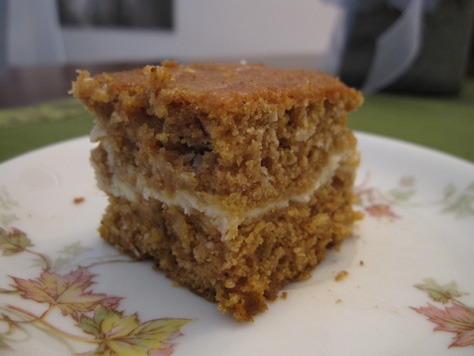
The answer is, "Yes," followed by, "OM NOM NOM."
My husband adores pumpkin pie, and he loved these bars. They taste like a pumpkin pie with the slightest touch of creaminess because of that thin cream cheese layer.
If you're not up for the challenge of rolling, give these bars a try!
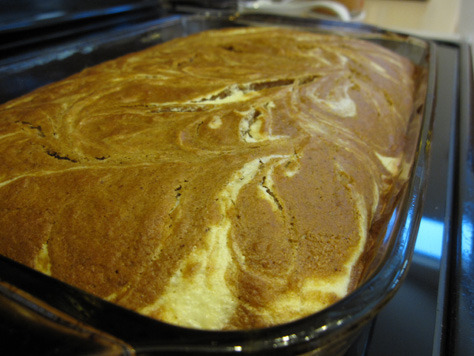
Pumpkin Roll Bars
From Six Sisters Stuff
Ingredients:
Cake:
6 tablespoons unsalted butter, melted
1 1/2 cups granulated sugar
2 large eggs, room temperature
1 (15 oz.) can pumpkin
1/4 cup water
2 cups all-purpose flour
2 teaspoons ground cinnamon
1/2 teaspoon ground cloves
1/2 teaspoon ground ginger
1/2 teaspoon ground nutmeg
1 teaspoon vanilla
1 teaspoon baking soda
1/2 teaspoon baking powder
1/4 teaspoon salt
Cream Cheese Filling:
8 ounces cream cheese, softened
1/4 cup granulated sugar
1/2 teaspoon vanilla
1 large egg
Directions:
Preheat oven to 350 degrees. Spray a 9 x 13 inch baking pan with non-stick cooking spray.
In a bowl, with an electric mixer on medium speed, beat butter and 1 1/2 cups sugar until smooth. Beat in 2 eggs, pumpkin, 1 teaspoon of vanilla and water until well blended.
In a separate bowl, mix flour, cinnamon, cloves, ginger, nutmeg, baking soda, baking powder, and salt; add the dry ingredients to the pumpkin/butter mixture and combine until well blended.
Spread about 2/3 of the batter evenly into the prepared pan.
In a bowl, with an electric mixer on medium speed, beat cream cheese, 1 egg, 1/4 cup sugar, and 1/2 teaspoon of vanilla until smooth. Spread cream cheese mixture evenly over the pumpkin batter. Dollop the remaining pumpkin batter over the cream cheese batter and spread out as evenly as possible. Use a table knife to swirl together the cream cheese and top layer of pumpkin batter.
Bake for 30-35 minutes, or until the center of the pumpkin batter springs back when touched. Cool completely in pan, then cut into bars.
Serve cold.
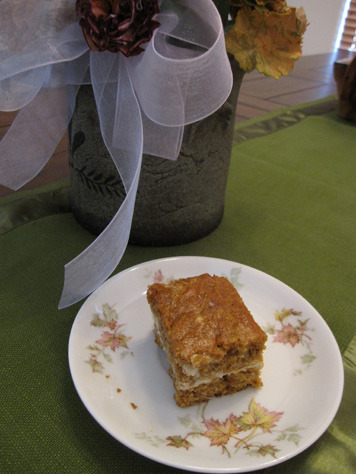
OM NOM NOM.
Sure, I bake a lot, but I'm also frugal. I've had my share of failures that make me shy away from certain ingredients or techniques. I don't want to read over a recipe and think, "I have to buy a new pan? Where would I find that special sugar? How much does it cost?" I also want the end result to be either 1) healthy enough to keep around for me to eat, or freezable for portion sizes, or 2) portable for my husband to take to work.
Which brings me to the matter of pumpkin rolls.
Every holiday season, I see pumpkin rolls in magazines or on TV. They look delicious and beautiful, and the second I look at the recipe I go, "Um... I would so screw this up." There's something about flouring a towel (I don't think I even have the right kind!) and rolling it up that screams of imminent disaster.
I follow Six Sisters Stuff on Facebook because they tend to make a lot of food I like. When I saw their recipe for pumpkin roll BARS, I perked up like a cat hearing a can opener. Could I, at long last, attempt a pumpkin roll without all my inner alarm bells going off?
The answer is, "Yes," followed by, "OM NOM NOM."
My husband adores pumpkin pie, and he loved these bars. They taste like a pumpkin pie with the slightest touch of creaminess because of that thin cream cheese layer.
If you're not up for the challenge of rolling, give these bars a try!
Pumpkin Roll Bars
From Six Sisters Stuff
Ingredients:
Cake:
6 tablespoons unsalted butter, melted
1 1/2 cups granulated sugar
2 large eggs, room temperature
1 (15 oz.) can pumpkin
1/4 cup water
2 cups all-purpose flour
2 teaspoons ground cinnamon
1/2 teaspoon ground cloves
1/2 teaspoon ground ginger
1/2 teaspoon ground nutmeg
1 teaspoon vanilla
1 teaspoon baking soda
1/2 teaspoon baking powder
1/4 teaspoon salt
Cream Cheese Filling:
8 ounces cream cheese, softened
1/4 cup granulated sugar
1/2 teaspoon vanilla
1 large egg
Directions:
Preheat oven to 350 degrees. Spray a 9 x 13 inch baking pan with non-stick cooking spray.
In a bowl, with an electric mixer on medium speed, beat butter and 1 1/2 cups sugar until smooth. Beat in 2 eggs, pumpkin, 1 teaspoon of vanilla and water until well blended.
In a separate bowl, mix flour, cinnamon, cloves, ginger, nutmeg, baking soda, baking powder, and salt; add the dry ingredients to the pumpkin/butter mixture and combine until well blended.
Spread about 2/3 of the batter evenly into the prepared pan.
In a bowl, with an electric mixer on medium speed, beat cream cheese, 1 egg, 1/4 cup sugar, and 1/2 teaspoon of vanilla until smooth. Spread cream cheese mixture evenly over the pumpkin batter. Dollop the remaining pumpkin batter over the cream cheese batter and spread out as evenly as possible. Use a table knife to swirl together the cream cheese and top layer of pumpkin batter.
Bake for 30-35 minutes, or until the center of the pumpkin batter springs back when touched. Cool completely in pan, then cut into bars.
Serve cold.
OM NOM NOM.
November 11, 2012
Sunday Quote is somewhere strange and cold
"To me, everything in a novel comes down to people making choices. You must figure out in advance what those choices are going to be." ~ Marion Zimmer Bradley
November 9, 2012
Guest Post from Rick Novy: How I Wrote a Novel in 7 Weeks
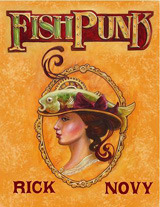
If you participate in NaNoWriMo and/or write year-round, you've learned it takes discipline to make that word count grow. This guest post from author Rick Novy explores his journey and how his process has changed. Rick has published numerous speculative works and has a fondness for fish, and combined the two elements for his new novel, Fishpunk.
How I Wrote a Novel in 7 Weeks
Once in a while, it’s necessary to reflect upon the road already gone by in any journey. Today, I’m thinking about the journey of becoming a writer, and more specifically, a novelist.
Looking Back
I started writing novels in junior high, and continued into high school. It fell away for many years as I used my time studying in college and just plain being a single guy, then a married guy.
I began to get serious when I came into some extra cash after starting as an engineer at Philips Semiconductors in Sunnyvale. I used it to take the Long Ridge Writers Group correspondence course Breaking into Print.
Whether taking the course was worth the money, I can’t really say. I took an extra two years to complete the course, basically stopping while I was working on my masters degree. I did finally finish it, however.
On to Novels
Usually, I would start a novel, get thirty pages into it, then it would peter out and fizzle away into the depths of forgotten things. It took until 2004 before I got serious about writing a novel. I told myself I would finish it, no matter what. No matter how crappy, I would finish it.
And I did. And it was not great, but I proved to myself I could do it. I rewrote it from scratch a couple years later, greatly improving it, but I sat on it for many years.
After that, I began another novel, which sat incomplete for quite a long time. That was due to a number of factors simultaneously adding stress to my life.
NaNoWriMo
In 2009, I decided to embark upon NaNoWriMo for the first time. If you have not heard of that, it is a challenge to write a novel length work in a month. 50,000 words in 30 days, to be specific.
I had never written more than 1000 words in a day, and usually less. So, I was skeptical of my chances at success in NaNoWriMo, but I did it. That novel sat for two years at 53,000 words.
In August of 2011, I decided to finish both novels, and did it in about 2 months. See, NaNoWriMo taught me the value of butt-in-chair time. I finished one novel at 1000 words a day, then I upped it to 1500 for the other.
A Novel in Seven Weeks
When I started writing my fourth novel at the end of February 2012, it was a late start on the first of what I pledged to be four novels in a year. I had to move. I like the pace of NaNoWriMo, which is about 1667 words per day. I used 1500 again on this one, and I pounded it out in seven weeks, cover to cover.
Doubt has been replaced by confidence, and it’s amazing what a little confidence can do for your game. I plan to begin my fifth novel within the next week or two, and I am going to up my quota to 1750, making it faster than NaNoWriMo pace.
That’s how you do it. You ease yourself upward with every project. It’s necessary in this new publishing environment, where there are many unknowns. But an independent writer has the power, and producing work faster means it’s available faster, and it sells earlier. That’s the how and the why.
Originally posted at Rick's Blog, Frothing At the Mouth.
How I Wrote a Novel in 7 Weeks
Once in a while, it’s necessary to reflect upon the road already gone by in any journey. Today, I’m thinking about the journey of becoming a writer, and more specifically, a novelist.
Looking Back
I started writing novels in junior high, and continued into high school. It fell away for many years as I used my time studying in college and just plain being a single guy, then a married guy.
I began to get serious when I came into some extra cash after starting as an engineer at Philips Semiconductors in Sunnyvale. I used it to take the Long Ridge Writers Group correspondence course Breaking into Print.
Whether taking the course was worth the money, I can’t really say. I took an extra two years to complete the course, basically stopping while I was working on my masters degree. I did finally finish it, however.
On to Novels
Usually, I would start a novel, get thirty pages into it, then it would peter out and fizzle away into the depths of forgotten things. It took until 2004 before I got serious about writing a novel. I told myself I would finish it, no matter what. No matter how crappy, I would finish it.
And I did. And it was not great, but I proved to myself I could do it. I rewrote it from scratch a couple years later, greatly improving it, but I sat on it for many years.
After that, I began another novel, which sat incomplete for quite a long time. That was due to a number of factors simultaneously adding stress to my life.
NaNoWriMo
In 2009, I decided to embark upon NaNoWriMo for the first time. If you have not heard of that, it is a challenge to write a novel length work in a month. 50,000 words in 30 days, to be specific.
I had never written more than 1000 words in a day, and usually less. So, I was skeptical of my chances at success in NaNoWriMo, but I did it. That novel sat for two years at 53,000 words.
In August of 2011, I decided to finish both novels, and did it in about 2 months. See, NaNoWriMo taught me the value of butt-in-chair time. I finished one novel at 1000 words a day, then I upped it to 1500 for the other.
A Novel in Seven Weeks
When I started writing my fourth novel at the end of February 2012, it was a late start on the first of what I pledged to be four novels in a year. I had to move. I like the pace of NaNoWriMo, which is about 1667 words per day. I used 1500 again on this one, and I pounded it out in seven weeks, cover to cover.
Doubt has been replaced by confidence, and it’s amazing what a little confidence can do for your game. I plan to begin my fifth novel within the next week or two, and I am going to up my quota to 1750, making it faster than NaNoWriMo pace.
That’s how you do it. You ease yourself upward with every project. It’s necessary in this new publishing environment, where there are many unknowns. But an independent writer has the power, and producing work faster means it’s available faster, and it sells earlier. That’s the how and the why.
Originally posted at Rick's Blog, Frothing At the Mouth.
November 8, 2012
Toasted Cake
Okay, as much as I loved baked goods, this post isn't about the making and/or eating of toasted cake. It's about listening to it.
My first professional sale (from back in December 2009, ack!), "Biding Time," has now been read by the lovely Tina Connolly over at Toasted Cake. If you're not familiar with Toasted Cake, it's a podcast featuring flash fiction that tends towards the dark or weird. Mine is most definitely on the dark side (the side with cookies... and in this case, toasted cake).
It's so surreal to hear someone else read my story, and Tina's reading gave me chills.
In other news, tomorrow the blog's going to feature a guest post from author Rick Novy. The next two Fridays will also feature guest posts from other authors with advice on topics from historical research to writer's block. Fun stuff!
November is a busy month and it's zooming by! Keep making those words.
My first professional sale (from back in December 2009, ack!), "Biding Time," has now been read by the lovely Tina Connolly over at Toasted Cake. If you're not familiar with Toasted Cake, it's a podcast featuring flash fiction that tends towards the dark or weird. Mine is most definitely on the dark side (the side with cookies... and in this case, toasted cake).
It's so surreal to hear someone else read my story, and Tina's reading gave me chills.
In other news, tomorrow the blog's going to feature a guest post from author Rick Novy. The next two Fridays will also feature guest posts from other authors with advice on topics from historical research to writer's block. Fun stuff!
November is a busy month and it's zooming by! Keep making those words.
November 7, 2012
Bready or Not: Pumpkin Cranberry Breakfast Cookies
Pumpkin is pretty darn versatile. So far I've presented pumpkin in bar form, cake, and pie. How about something a little bit healthier that can be eaten for breakfast? This recipe has a full can of pumpkin puree, olive oil, whole wheat flour, and dried cranberries. Healthy! Good for you! And delicious!
Don't arch your eyebrow and point accusingly at that two cups of sugar. Well, okay. That might factor into the deliciousness quotient, but put it in context: this recipe makes a LOT of cookies. That sugar is distributed, and otherwise this is incredibly healthy. I actually want to try this recipe with a sugar/stevia blend to see how it turns out.
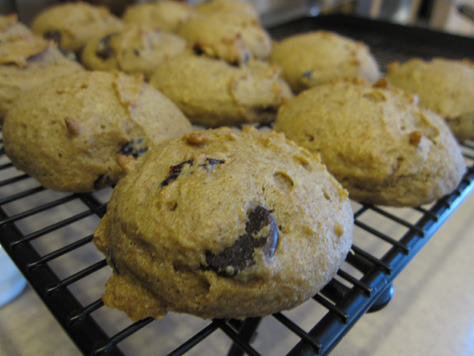
These really are phenomenally good cookies. They don't have a bland whole wheat taste. The flavors meld very well together. Another awesome thing? These cookies freeze and thaw wonderfully. Just freeze them flat on wax paper, and after they are solid, bag'em up. The night before, take out however many you want in the morning, and place them in a covered container like a cookie jar. Ta-da! Grab and go breakfast in the morning.
Like other pumpkin products, these can get sticky if they are left out for more than a day. Therefore, freezing them will do a lot to make them last longer.
Pumpkin Cranberry Breakfast Cookies
Modified from "Baked Breakfast Bars Rise, Shine" in the Arizona Republic; direct link to the recipe
Ingredients:
15-ounce can of pumpkin puree
2 large eggs, room temperature
2 cups granulated sugar
2 teaspoons vanilla extract
3/4 cup olive oil
4 cups whole-wheat flour
1 heaping teaspoon cinnamon
1 teaspoon baking soda
1 teaspoon baking powder
1 teaspoon kosher salt
1/2 cup dried cranberries
1 cup chocolate chips [optional]
Preheat oven to 350 degrees. In a mixer, combine pumpkin, eggs, sugar, vanilla and olive oil. Don't over mix.
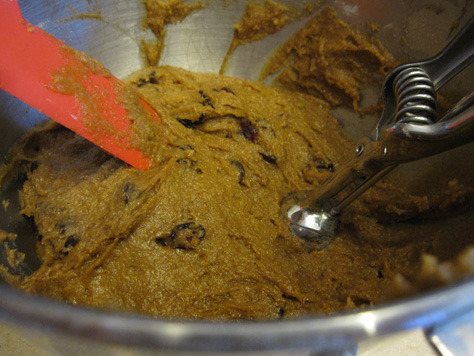
In a large bowl combine flour, cinnamon, baking soda, baking powder and salt. Add flour mixture to the pumpkin mixture in 1-cup batches, scraping the sides of the bowl between each round. Once all of the flour is combined, gently fold in dried cranberries and chocolate chips, if using.
Using a large spoon, drop balls of dough onto a sheet pan lined with parchment paper or a seasoned sheet of stoneware, spacing cookies a few inches apart. Bake for approximately 13 to 15 minutes. Let cool on sheet for 10 minutes to set, then move them to a rack.
Makes about 3 to 4 dozen tablespoon-size cookies.
OM NOM NOM.
Don't arch your eyebrow and point accusingly at that two cups of sugar. Well, okay. That might factor into the deliciousness quotient, but put it in context: this recipe makes a LOT of cookies. That sugar is distributed, and otherwise this is incredibly healthy. I actually want to try this recipe with a sugar/stevia blend to see how it turns out.
These really are phenomenally good cookies. They don't have a bland whole wheat taste. The flavors meld very well together. Another awesome thing? These cookies freeze and thaw wonderfully. Just freeze them flat on wax paper, and after they are solid, bag'em up. The night before, take out however many you want in the morning, and place them in a covered container like a cookie jar. Ta-da! Grab and go breakfast in the morning.
Like other pumpkin products, these can get sticky if they are left out for more than a day. Therefore, freezing them will do a lot to make them last longer.
Pumpkin Cranberry Breakfast Cookies
Modified from "Baked Breakfast Bars Rise, Shine" in the Arizona Republic; direct link to the recipe
Ingredients:
15-ounce can of pumpkin puree
2 large eggs, room temperature
2 cups granulated sugar
2 teaspoons vanilla extract
3/4 cup olive oil
4 cups whole-wheat flour
1 heaping teaspoon cinnamon
1 teaspoon baking soda
1 teaspoon baking powder
1 teaspoon kosher salt
1/2 cup dried cranberries
1 cup chocolate chips [optional]
Preheat oven to 350 degrees. In a mixer, combine pumpkin, eggs, sugar, vanilla and olive oil. Don't over mix.
In a large bowl combine flour, cinnamon, baking soda, baking powder and salt. Add flour mixture to the pumpkin mixture in 1-cup batches, scraping the sides of the bowl between each round. Once all of the flour is combined, gently fold in dried cranberries and chocolate chips, if using.
Using a large spoon, drop balls of dough onto a sheet pan lined with parchment paper or a seasoned sheet of stoneware, spacing cookies a few inches apart. Bake for approximately 13 to 15 minutes. Let cool on sheet for 10 minutes to set, then move them to a rack.
Makes about 3 to 4 dozen tablespoon-size cookies.
OM NOM NOM.
November 4, 2012
Sunday Quote cheers NaNoWriters onward!
“My therapist told me the way to achieve true inner peace is to finish what I start. So far today, I have finished 2 bags of M&M's and a chocolate cake. I feel better already.” ~ Dave Barry
November 2, 2012
Poem a Day: Tips for the Journey
I've participated in the Poem a Day Challenge for several years now, often writing in both April and November. The prospect of a daily poem is rather daunting, but if you're up to the challenge, here are some things I've learned along the way.
1) NaNoWriMo and PAD are doable at the same time.
Yes, you can do this. I survived that double whammy a few years ago. "Didn't it drive you crazy?" some people asked. After I paused for maniacal laughter, I had to say, "No." That actually came as a surprise to me. Poetry seems to work a different part of my brain. I could be exhausted from shoving out my daily allotment for NaNo, but working on the daily poem felt... different. Like taking a drink of water instead of lemonade. It's not the same kind of writing.
2) Don't take the prompt literally.
No one is judging you on adherence to the prompt. It's a seed. Take whatever grows from it. If the prompt is "light" and you write about darkness, go for it. You can also use the prompt as the starting point and then remove it in revisions. No one is going to reach across the internet and slap your hand. If they do, scream like a little girl and GET OUT OF THERE.
3) Start the day with the prompt.
During PAD, I look at the prompt first thing in the morning as I check my email and do other basic stuff. I open a document in Word, type the date and the prompt, and then let that document sit there. Use this time to think. Stare at that blank document. Ponder. Let hours pass. Go wash dishes. Wax the cat. You'll find the muse in those moments of idleness. Usually by early afternoon, a poem will trickle into my mind.
4) Give yourself permission to suck.
This is true of NaNoWriMo. It's true of Poem a Day. Some days are just rotten. The prompt just doesn't bring anything to mind. That's okay. Write a verse about how much the prompt sucks. A few years ago, the prompt was to write a sestina. I tried, I really did. After I swept up the jagged shards of my brain, I wrote a poem about how much I hated sestinas. I counted that as my poem for the day, and moved along.
5) Use a theme to inspire you.
For me, the daily prompts aren't enough. I like to keep most of my poems along a certain theme--in my case, fantasy or science fiction. I know these poetic markets. (I've created some literary poems I really love that I just can't sell, nor do I know where to send them.) Choose a certain genre for the month, or an emotional theme, or a setting. Having a narrower focus can really help you with each daily prompt.
6) You don't need to create epics.
Crammed for time? Write short poems. You don't need to do haiku or anything fancy like that. A lot of markets will only take poems under 100 lines or a few pages. There are some markets specifically for poems under 10 lines. Heck, this poem by Ogden Nash has been a favorite of mine since I was a kid. Most of my poems tend to be 10-30 lines.
7) Have fun with it.
Yes, I'm trying to create poems I can market, but I also know that probably only half of them will be submittable. I like those odds. You don't have to submit a single poem--not to a market, not to Robert Lee Brewer's chapbook contest, not to a single soul. Just write.
No matter what you do, let that be your mantra: just write.
1) NaNoWriMo and PAD are doable at the same time.
Yes, you can do this. I survived that double whammy a few years ago. "Didn't it drive you crazy?" some people asked. After I paused for maniacal laughter, I had to say, "No." That actually came as a surprise to me. Poetry seems to work a different part of my brain. I could be exhausted from shoving out my daily allotment for NaNo, but working on the daily poem felt... different. Like taking a drink of water instead of lemonade. It's not the same kind of writing.
2) Don't take the prompt literally.
No one is judging you on adherence to the prompt. It's a seed. Take whatever grows from it. If the prompt is "light" and you write about darkness, go for it. You can also use the prompt as the starting point and then remove it in revisions. No one is going to reach across the internet and slap your hand. If they do, scream like a little girl and GET OUT OF THERE.
3) Start the day with the prompt.
During PAD, I look at the prompt first thing in the morning as I check my email and do other basic stuff. I open a document in Word, type the date and the prompt, and then let that document sit there. Use this time to think. Stare at that blank document. Ponder. Let hours pass. Go wash dishes. Wax the cat. You'll find the muse in those moments of idleness. Usually by early afternoon, a poem will trickle into my mind.
4) Give yourself permission to suck.
This is true of NaNoWriMo. It's true of Poem a Day. Some days are just rotten. The prompt just doesn't bring anything to mind. That's okay. Write a verse about how much the prompt sucks. A few years ago, the prompt was to write a sestina. I tried, I really did. After I swept up the jagged shards of my brain, I wrote a poem about how much I hated sestinas. I counted that as my poem for the day, and moved along.
5) Use a theme to inspire you.
For me, the daily prompts aren't enough. I like to keep most of my poems along a certain theme--in my case, fantasy or science fiction. I know these poetic markets. (I've created some literary poems I really love that I just can't sell, nor do I know where to send them.) Choose a certain genre for the month, or an emotional theme, or a setting. Having a narrower focus can really help you with each daily prompt.
6) You don't need to create epics.
Crammed for time? Write short poems. You don't need to do haiku or anything fancy like that. A lot of markets will only take poems under 100 lines or a few pages. There are some markets specifically for poems under 10 lines. Heck, this poem by Ogden Nash has been a favorite of mine since I was a kid. Most of my poems tend to be 10-30 lines.
7) Have fun with it.
Yes, I'm trying to create poems I can market, but I also know that probably only half of them will be submittable. I like those odds. You don't have to submit a single poem--not to a market, not to Robert Lee Brewer's chapbook contest, not to a single soul. Just write.
No matter what you do, let that be your mantra: just write.