
Tom Kaczynski's Blog, page 8
February 7, 2013
Beta Testing Reviewed by Miami Herald
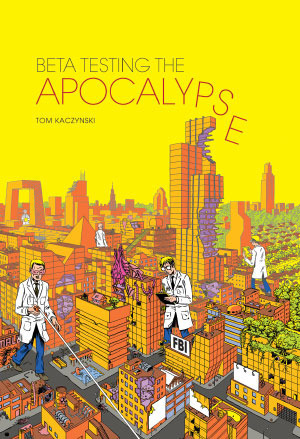
This one is a short capsule review, so I’ll post the whole thing here:
His functional and utilitarian art is often reminiscent of the insanely proper illustrations in Jack Chick’s religious tracts, but Kaczynski’s own wildly anarchic imagination fuels his insightful and unsettling narrative. He combines socioeconomic fact, fantasy and farce in this seriously paranoid criticism of modernity, and the result is a disturbing but hilarious tale of identity loss and consumerism run amok.
Via.


February 6, 2013
Democratizing Objects: A Discussion with Tom Kaczynski

Another fun interview, this time with Nick Hanover at The Comics Bulletin. We meander around a variety of topics: music, science-fiction, architecture, Quest for Fire, and much more. Here’s an exchange about the genesis of “100,000 Miles,” the lead story from Beta Testing The Apocalypse, and the story that was ultimately the genesis of the book itself:
CB: There’s a lot of flexibility in terms of perspective in your writing, too. For instance, “100,000 Miles” is mostly written from the perspective of a car.
TK: [laughs]
CB: It’s hard to describe to people, but that’s such a cool idea, it really worked. How do you get into the mind frame of something like that? How do you make yourself think like that? Because it worked perfectly, it had almost this semi-autistic bent, which made perfect sense to me for a vehicle.
TK: With that particular one, that story was based on the time I lived in DC. And I had this murderous commute, that was 45 minutes to an hour. I would just sit there in this commute and think about this stuff. It was kind of interesting, because you got to drive in the city, Washington D.C. itself, and then out into this corridor by Dulles International Airport, this sort of tech corridor that was out there. You’d drive through the suburbs and these communities and I wanted to create some kind of narrative about the city and its surroundings, just kind of an essay. So this journey in a car became the structure for that. The way it’s written, a lot of it is kind of not stolen, but influenced by a lot of architectural texts, and the way they write about these things. Some architects tend to be more imaginative than others and get metaphorical, or whatever. So that’s kind of the genesis for this thing.
It also has some process art, like this big splash page from “The New:”


Read the rest fo the interview here.
February 5, 2013
Beta Testing Reviewed by The Comics Journal
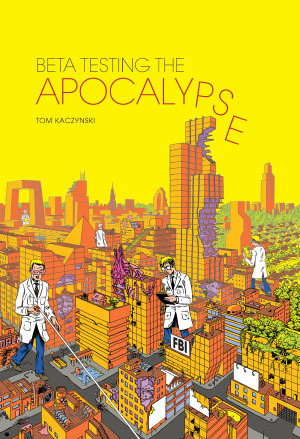
A new review of Beta Testing the Apocalypse, this time by The Comics Journal! As a reader of The Comics Journal since issue 148 (Charles Burns Interview. I miss the paper issues!), I’m pleased as punch. Here’s an excerpt:
[...] One of the pleasures of reading Beta Testing, as in other watershed collections like Caricature,Curses, or Everything Together, lies in watching a cartoonist become less mindful of his precursors, less rote in his treatment of subject matter, both freer and more assured. As the book progresses, Kaczynski sloughs off influence, just as his characters slip away from civilization. A breakthrough story like 2008’s “Million Year Boom” nearly brings the book to a halt halfway through with its impressive and authentic weirdness, yet still retains the stamp of millenarian systems novelists, still partakes of the old dead-eyed Clowesian aloofness. By the time we reach the concluding story, “The New”—at once an ode to modernist architecture and an allegory literalizing the decline of the west, created uniquely for this volume—Kaczynski’s layouts have exploded into space, cities and buildings splayed out on the page in startling and diagrammatic splashes.
Also, the review delves into the index, which is personally very satisfying. I’m always curious how people will react to it:
To his credit, Kaczynski acknowledges as much, duly footnoting his book’s debt to J.G. Ballard’s drowned worlds and concrete islands in an index that records other oblique references to Jane Jacobs and Slavoj Žižek—though entries for “Gibson, William,” or “DeLillo, Don” remain curiously absent. Kaczynski’s looming dread and sub/urban automata owe at least as much to White Noise as his vision of mechanized, entropic modernity does to The Atrocity Exhibition, not to mention his pontifications on gleaming consumerism: “Consider the modern bathroom. … How did this antiseptic room where excrement magically disappears come to be?” In such revelations of the science-fictional in the everyday—Kaczynski also invokes grain silos and utilitarian office buildings as totems of some alien race—the cartoonist conducts a kind of archaeology of the future from among our commonplace existence, in much the same way the Godard of Alphaville or the Tarkovsky of Stalkercalled forth the otherworldly moonscapes that have always been dormant in what our culture has erected or let fall into ruin.
William Gibson should’ve been there, but Don DeLillo I’ve never read. Here’s hoping there’s a second edition so I can tinker with the index some more!
The rest of the review is here.
February 4, 2013
Tom Kaczynski Interviewed by The Rumpus

This was a fun interview. Greg Hunter (interrogating on behalf of The Rumpus) asked a lot of good questions I haven’t been asked before. It definitely left me stumped a couple of times:
Rumpus: “Cozy Apocalypse” from Beta Testing engages with masculinity, and “masculinity in crisis,” more overtly than your other works, and I was wondering if masculinity was the starting point of that story—something you knew you wanted to tackle—or if it was something you found yourself tackling as you went.
Kaczynski: It was not the starting point, but it kind of became [the focal point]. Like, I didn’t really realize what I was writing until I was deeply into it. The story’s about a pending apocalypse, but there’s also these weird marital things going on. And I find that those two things can be intertwined: the twilight of masculinity and this apocalyptic imagining of our world falling apart. I think those thing must be unconsciously connected in the story. Now that you mention it, I’m like, “Oh yeah, duh,” but that wasn’t my primary exploration.
Rumpus: And I’m sure there are things at, as a reader, I look for and project.
Kaczynski: No, it’s good. Because most people, when they talk about that story, they talk about the apocalypse part of it. You’ve pulled out something else…which seems obvious in retrospect.
Read the whole interview here. Oh, and check out a 3 page preview of ‘Million Year Boom’ from the book.
February 3, 2013
Beta Testing Reviewed at Comics Bulletin
Another review of Beta Testing The Apocalypse surfaced a little while ago. This one was fun to read:
Kaczynski’s new collection Beta Testing the Apocalypse is weird as all fuck and funny as all shit, a Singles Going Steady for the art comix crowd that merges Burroughs’ cut-up commentary with Ballard’s keen tech consumer insight and siliconic wit. Working in a style that is a perplexing mix of dot matrix detailing, architectural blue print exactness and razor blade xeroxing looseness, Kaczynski uses Beta Testing the Apocalypse as a platform for his interest in the anxieties of the ever shifting expansiveness of 21st century life, a life Kaczynski obviously inhabits, too, but somehow does so with a verve and clarity the rest of us lack.
See the the rest here.
January 18, 2013
Beta Testing Civilization

BETA TESTING CIVILIZATION
TOM KACZYNSKI
ZAK SALLY . VINCENT STALL . DAN WIEKEN . DEREK VAN GIESON . PETER WARTMAN
You’re invited to celebrate, with cartoonist / publisher Tom Kaczynski, the release of his book Beta Testing the Apocalypse (Fantagraphics) and the unveiling of the Uncivilized Books’ Five Year Plan. He also invited the entire Twin Cities Uncivilized Books artist roster. We know you won’t mind. Many copies of Beta Testing The Apocalypse have been specially released from the bunker and a commemorative red ink will be used in authorizing your copies. After the event, there will be mandatory fun at the Downtown Grumpy’s.
THURSDAY JANUARY, 24. 2013
5 TO 7 PM
BIG BRAIN COMICS
1027 Washington Avenue South
Minneapolis, MN 55415 (612) 338-4390

January 16, 2013
Comics Reporter Interview
I can’t believe this never got posted on my blog. I’m my own worst enemy! If you haven’t already seen it, I was interviewed by Tom Spurgeon at Comics Reporter. Tom’s questions tended to broader than usual and it felt like looking of my whole comics trajectory from a birds-eye point of view. It was fun conversation. Here’s a sample:
SPURGEON: There’s an anxiety present in a lot of your stories. It seems like the kind of deliberate planning you talk about would be a comfort to a lot of people, that these things are planned. So I find the anxiousness curious. The fact that these thoughts are more arbitrary, or might reflect not-friendly impulses, is that maybe the source of the anxiety?
KACZYNSKI: I think the knowledge is comforting, but the anxiety… it’s not even my anxiety but a general anxiety that in the US has been palpable since at least 9/11. There was an apocalyptic mindset. Things are falling apart. Things are coming to a head. There’s a clash of civilizations going on. With the financial crisis, capitalism is cracking, and what does that all mean? I feel like I’m tapping into a little bit of that general anxiety.
Personally I’m interested in utopias as well. That’s something I’m going to be more visible in my other book, the Trans Terra book that’s going to be coming out next year. There’s all this anxiety, and it’s very apocalyptic, and it feels like most people would prefer to see it all crumble as opposed to doing a few small things here and there to make things better. It’s more of a frustration for me more than anxiety. It does come out in the comics as an anxiety. I think it’s difficult to talk about. In the comics, especially the MOME stuff, they’re more literary in that I’m trying to get into the mindset of certain characters and people and how they would react to things where they don’t know there’s an underlying structure.
SPURGEON: Your comics are more focused on the mindset than the breakaway from the structured norm. There is a false apocalypse — you’re not as interested in seeing things fall down as exploring the mindset that believe that things are about to.
KACZYNSKI: Yeah, that’s partly why the book is called Beta-Testing The Apocalypse. [laughter] It’s not the actual apocalypse. We’re feeling it out. It’s hard to say exactly. It’s more like the anxiety of the apocalypse than the apocalypse itself. There’s a whole post-apocalyptic genre, and that’s something I used to be into, but I feel it’s more interesting to find out how it came about. What happens before the apocalypse? Right before it. What needs to happen to society for that to happen. I don’t know if you’ve read Jared Diamond‘s work — the scientist that wrote Guns, Germs and Steel. He also wrote a book about collapses of civilizations. That’s another interest of mine — ancient civilizations, and trying to imagine ourselves as a civilization that could end. How that could come about, and what mind set we’d need to get into to release and let go and let the whole thing crumble.
January 10, 2013
Beta Testing Big Brain Comics

Beta Testing the Apocalypse sighted at Minneapolis’ finest comics store: Big Brain Comics. Couldn’t ask for better company!
January 9, 2013
Beta Testing the Apocalypse is here!
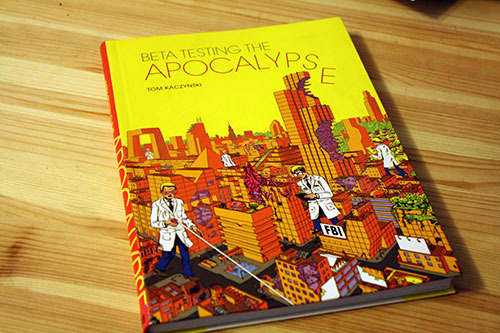
I’m excited to finally be able to say that Beta Testing the Apocalypse is now available in stores! Check it out at your favorite comics or book store.
December 22, 2012
The Comics Journal Interview
I was interviewed over at The Comics Journal. We talked a lot about a variety of topics: Beta Testing the Apocalypse, Trans Terra, what’s new at Uncivilized Books, Marxism, crime fiction, the art of indexing and more! Here’s a taste:
Now, your upcoming Trans Terrabook is basically a collection of the four minicomics?
It’s the four original Trans mini-comics, plus a bunch of new material that wraps up that whole train of thought… or train wreck of thought or something. [Laughter.]
Those books seem to be part of a tradition in comics you don’t see that often any more—the kind of free-flowing rant or essay comics with the cartoonist walking around and acting as the narrator, like Clowes used to do, and Crumb and Peter Bagge. Were you consciously engaging with that tradition?
All those guys are big influences on me. I wasn’t consciously trying to do that, but when I’m looking back, I’m like, “Oh, yeah, well, duh, they were doing similar things.”[Hodler laughs.] I maybe get a little bit more overtly intellectual on mine —where I quote actual books and people — whereas they were a little bit more casual with their pontificating or whatever. [Laughter.] What I was doing originally with the Trans books… basically the first book was a kind of panicked, “I need to do something for the first MoCCA festival!” And I just kind of regurgitated all this stuff I was thinking about at that time very quickly. I got a pretty good response to it, and I was like, “Well, I might as well follow up, ‘cause I didn’t really finish my train of thought on the first one,” and I just kept going with that. Each book is more and more carefully thought out. I’ve been searching very slowly… hopefully when this book is out, I will have found something resembling a coherent thesis. [Laughter.]
The first three you did pretty close together?
Yeah, the first three were pretty close. I think they all came out within a year, year and a half. In the middle of that I got the opportunity to contribute to Mome, so that derailed the production on the Transbooks for a long time. I always thought of these Trans books as a little bit more casual, little bit more off-the-cuff, but the more I got into it, the more fascinated I got with using comics to explicate ideas. The more Mome stuff I was doing, the more I wanted to go back to the Trans comics and do more of that kind of work.
Did you ever consider doing that kind of thing for Mome?
I didn’t think it would fit. I thought about it, but I got in this very specific groove for Mome, that was a little bit Ballardian, a little bit science-fiction, and I just wanted to keep that going. If Mome had continued past issue 22, I may have done more of that kind of work in the future, but yeah, in Mome I wanted to keep a certain… a different level of work… a different kind of me. [Laughs.]
A Polish author you briefly mention in one of the minis, Witold Gombrowicz, wrote a novel—which I haven’t read—called Trans-Atlantyk, and I was wondering: Does that have anything to do with the titles of those minis?
No and yes. [Laughter.] I had read pretty much everything that Gombrowicz had written way before I didTrans Alaska. I read Trans-Atlantyk but it’s something that I had forgotten, and it wasn’t a conscious influence at first. When I did the Trans Alaska book, the title actually came last. I didn’t know what it was gonna be, so I was like “part of it is set in Alaska, so I’m just gonna call it Trans Alaska.” I decided to keep the “Trans” for the other books. I was writing about Atlantis in the third book, and I remembered that Gombrowicz did Trans-Atlantyk. I ended up calling the third book Trans-Atlantis. It wasn’t a specific reference, but more of a happy coincidence. But Gombrowicz definitely influenced me quite a bit, he’s one of my favorite authors. Just in terms of how he writes and more importantly his diaries. He was an émigré author, he left Poland at the beginning of World War II, and ended up living in Argentina for many years. If you read his diaries, it’s all about being a Polish person in the New World and his struggles with that. That was really important for me when I was younger. I identified with that kind of struggle.
I’ve meant to read him for a long time.
Ferdydurke, his first novel, is amazing I think.
Check out the rest here.


