
Tom Kaczynski's Blog, page 3
December 29, 2018
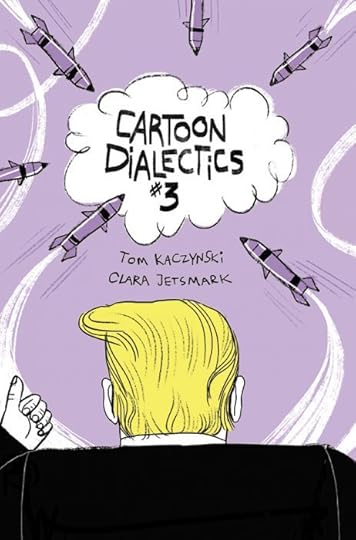
Cartoon Dialectics Vol. 3 | Best of 2018 | Preview
It’s difficult to hype your own work. I should know, I started a whole publishing company just to avoid hyping my own work! But, it’s very gratifying to see your own work on any best of list. When the list written by a writer you admire, well that’s even better! Cartoon Dialectics Vol. 3 makes it on the Best of 2018 list at Your Chicken Enemy. Here’s what they have to say:
Cartoon Dialectics #3 looks like a humble, unobtrusive work– it’s packaged like a zine, printed in purple, black and white with an occasional splash of yellow on somewhat thick, matte paper. But what Tom Kaczynski and Clara Jetsmark provide between its covers is powerful, invigorating stuff, connecting the dots between our society’s retromania and the rise of neo-fascism, while also acknowledging how easy it is for anyone to fall prey to the dangerous allure of nostalgia.
[…]
Bold in its aesthetic and literal simplicity and paradoxically educational and surreal, Cartoon Dialectics #3 did a far better job investigating where we are now and why in its few pages than the entirety of the New York Times this year.
Nick Hanover
A big thank you goes to The Nib for commissioning the piece in the first place. Another big thank you goes to Clara Jetsmark who bravely agreed to draw it on a very tight deadline when I ended swamped with other work.
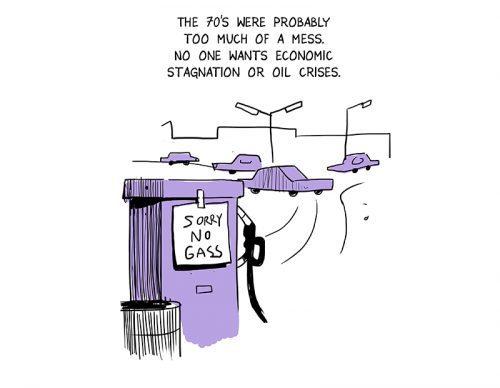
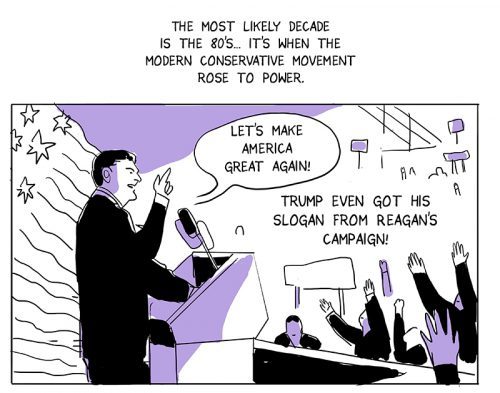
Here’s a short few page preview of this comic for those who haven’t seen it yet:


You can order a copy here:
Order Cartoon Dialectics Vol. 3
The post Cartoon Dialectics Vol. 3 | Best of 2018 | Preview appeared first on Trans Atlantis.


December 23, 2018
Science Fiction, Music, Comics. The Secret Origin of Comics Criticism.
I stumbled on the following a while ago on Blissblog:
“Along with the many cross-contaminations between rock-etc and s.f., one thing that Heller’s book reminded me of was that many of the very earliest rock criticism publications were started by people who had previously done science fiction fanzines.
Simon Reynolds | Blissblog
Intensely self-reflexive fields, rock criticism and science fiction share a strange mix of inferiority and superiority complexes. Painfully aware of their marginal position vis-à-vis “proper” journalism and “respectable” literature, they nonetheless believe that they are doing the Most Crucial Writing of Our Time. I can remember from my own days as an adolescent s.f. fanatic being struck by the s.f. writer’s culture of workshops and conventions – by how the writers loved to write essays defining s.f. as a genre, proclaiming its unique contribution to literature. There were even a few volumes of essays by s.f. writers debating s.f. that I remember reading.
This. This exactly describes me during High School. Except replace music with comics. I took pains to let everyone know that comics were the most important thing. I’m sure it was very annoying. Whenever I had to write essays about books in English class, I tried to convince my teachers to let me write about X-Men, Spider-Man, Fantastic Four, and whatever else I was reading at that time. Most of the time I was shut down, but a few teachers indulged as long as I could ‘prove’ to them that comics weren’t just kid’s stuff. Actually that was crucial. It challenged me to look at comics somewhat differently, and probably lead to my actively seeking out better comics to impress my teachers.
Every Page a Painting

I have a pretty intense memory of showing Kid Eternity to my teacher. This is the Grant Morrison & Duncan Fegredo 90’s revamp with fully painted art. I remember challenging my teacher to look closely at the art. “It’s all painted” I’d say. “EVERY page is a full painting! Imagine if Michaelangelo had to paint the Sistine Chapel, over and over again, and tell the whole story in that famous painting.” I was definitely already a Science Fiction fan at this point. In Poland, I’d collected the magazine Fantasyka, which serialized sci-fi novels and comics. In the US, I read whatever sci-fi my library had on hand. Harry Harrison, Asimov, Pohl, Piers Anthony, David Eddings, Heinlein, Lem, etc.
Sub-Genre of Utopia
To speculate wildly here… if we follow Fredrick Jameson’s assertion from Archaeologies of the Future, and think of Science Fiction as a sub-genre of the utopian novel (not the other way around), then sci-fi retains a utopian imaginary somewhere underneath all of the technological dress up. Sci-fi at it’s core imagines and extrapolates different worlds/futures based on different customs, different technologies, different environments (planets), etc. It’s easy to imagine young brains blown to bits by science fictional speculations.
I don’t think that I was consciously doing this at the time, but in retrospect, I must have been thinking about comics as some kind of major human innovation. The comics I was reading were not perfect, but I imagined a different future, where comics were the dominant literature. It’s a science fictional extrapolation. Take something small and insignificant from today, and imagine it as a dominant form in the future. Or at least, as something that has the capacity to become that.
Inventing a Future
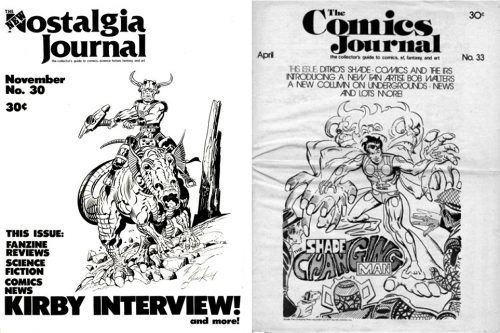
I imagine young Gary Groth in a similar mode. He takes over The Nostalgia Journal, a fantasy, sci-fi, comics, fanzine, and turns it into The Comics Journal, the most important magazine in the world. There was an inkling there already, a belligerent insistence on the importance of the medium. And all this without clear evidence for that importance, as The Comics Journal kept reminding us, while frequently berating the industry for failing to make great comics. It comes out of that same era. Sci-fi fanzines, pop/rock fan-zines, comics fanzines – popping up everywhere – creating new critical appreciation for debased art forms; art forms that were new and vital and popular. There was no rule book on how to write about these things. They had to invent it in real time. They were inventing the future in real time.
The post Science Fiction, Music, Comics. The Secret Origin of Comics Criticism. appeared first on Trans Atlantis.
December 9, 2018
Highrise Mayhem Poster feat. Judge Dredd
My brief was to do a poster for Highrise Mayhem, a double bill featuring Dredd (2012) and The Raid: Redemption (2011) (coming to the Trylon Jan 18-20)… it turned into a bit more of a Judge Dredd Poster.
I’d never seen The Raid, so I focused on Dredd. I wanted to show off the roots of Judge Dredd by drawing a more comic book version of him. Specifically, I was looking at the Brendan McCarthy version. McCarthy drew the Judge helmet much more flared out on the bottom. It has a bit more impossible look common to most comic book costumes. When they translate to film, they become ‘practical’ and often lose what made them distinctive in the first place.
In the background I just wanted to add some bonkers multistory ‘mayhem.’ It’s no secret I enjoy drawing large architectural scenes when I can find the time.
Anyway, I hope you enjoy looking at this Judge Dredd Poster as much as I enjoyed drawing it.

The post Highrise Mayhem Poster feat. Judge Dredd appeared first on Trans Atlantis.
July 17, 2018
Superheroes & Cities
If you’ve read my Comics Journal column on Ted McKeever’s Eddy Current, you probably saw a brief detour I took to discuss the relationship between superheroes and cities. I’ve expanded that topic a little more on my twitter account. Check out this thread:
0/ I’m going to attempt one of those protean @HeerJeet style threads that bring together disparate topics. I’m going to bring together architecture, urbanism, Capitalism, suburbanization, and American superhero comics. pic.twitter.com/WlYTrhQpCM
— Tom Kaczynski (@BetaTestingTomK) July 16, 2018
July 13, 2018
Black & White Urban Noir

My Comics Journal column about Ted McKeever’s Eddy Current is live! See how Eddy fits into the 1985-87 Event. Also, I couldn’t help myself, but I go into a fun tangent on the portrayal of cities in superhero comics. Here’s a taste:
As required by superhero conventions, Eddy lives in a fictional city with a ridiculous name: Chad. The city resembles New York, especially the New York of the 80’s: grimy, with underfunded infrastructure, populated by lowlives and criminals, and loomed-over by gleaming towers of the ultra wealthy ruling elites. Chad is Metropolis and Gotham in one. This is where McKeever really shines. His keen eye really brings the city to life. He finds moments of stillness and quiet beauty in studied depictions of abandoned warehouses, gas stations, desolate alleys, and diners. Clean lines, attention to detail, exquisite framing. These moments make Eddy stand out from other comics of the Event.
Read the whole column here. Oh and check out some Eddy Current art outtakes in my previous post.

July 8, 2018
Event Horizon Column: Eddy Current Outtakes

Some of you probably have seen it, some of might not have, but I have a column, called Event Horizon, on The Comics Journal where I write about comics from the Event. What is the Event? Here’s my explanation from the inaugural column:
For a while now I’ve had the idea that something unusual happened in American comics between 1985 and 1987. The period was marked by a unique set of circumstances that encouraged a new level of seriousness about comics as an art form. Comics from this short timespan are something else. The direct market was booming. Marvel and DC were joined by a legion of smaller publishers which released comics in a dizzying array of genres and art styles. Foreign comics became much more available through European graphic novels, and they were joined by some of the first instances of serialized manga, leading to an exuberant experimentation and cross pollination. Beyond the now classic (and thoroughly analyzed) Watchmen or Dark Knight Returns, many of the comics from this period are marked by thematic and formal ambition. The roots of this moment stretch back to the late ’70s and early ’80s but it seems to reach apotheosis precisely during this short span. Something happened in comics between 1985 and 1987. Let’s call that something the Event. The Event influenced comics for decades…
Check out the full column on The Comics Journal.
My next column is on Ted McKeever’s Eddy Current. Here’s a little preview:
Gritty, deliberately grotesque, messy, and challenging; these days you don’t see comics like Eddy Current. Many comics from the time of the Event had this quality. It was a deliberate distancing from the dominant styles established between the 50’s and 70’s. the tight, abstract, dynamic pulp modernism (Kirby), and the elongated slickness of pulp neorealism (Neal Adams). In the 80’s, McKeever—along with his peers from that era, Kevin O’Neil, Bill Sienkiewicz, Kyle Baker, Howard Chaykin, Keith Giffen, and others—were developing new stylistic innovations that mapped closely to what was going on elsewhere in culture and art: postmodernism.
For more you’ll have to wait until the column is live. I’ll post a link when it’s live. In the meantime enjoy some of the images from the book. These ended up unused in the column, but all are great examples of Eddy Current‘s gritty urban nightmare lovingly depicted by McKeever.


December 13, 2015


April 9, 2015
AWP is here!
The Association of Writers & Writing Programs Conference is in Minneapolis this weekend, and I’ll be there along with Uncivilized Books. Find us at Booth #839.
Also, I will be on a panel discussing Graphic Novels in translation. It’s today (Thursday) at 10:30 AM, Room 205 A&B, Level 2. Here’s the description.
R141. The Voyage of Graphic Literary Forms. (Mercedes Gilliom, Erica Mena, Tomasz Kaczynski, Brian Evenson, Diana Arterian) Four panelists who work at the intersection of graphic literature and translation discuss the challenges and benefits of transporting graphic literary forms from one language and culture to another. These writers, artists, and translators with backgrounds in comics creation, translation, editing, and publishing come together to share their experiences in reaching new audiences and markets for this expanding element in the creative writing landscape.
Stop by and say hello!
March 25, 2015
Petrified Forest | Architectural Fiction

046. Petrified Forest.
The post Petrified Forest | Architectural Fiction appeared first on Trans Atlantis.
Petrified Forest
046. Petrified Forest.


