
Gerald Everett Jones's Blog: Gerald Everett Jones - Author, page 3
June 22, 2025
Book Review: 'I'll Be Right Here' by Amy Bloom
I’ll Be Right Here is not mainly about sex, but it’s certainly part of its ongoing conversation. This novel is about intimacy, emphatically yes. And it’s undeniably literary fiction to be ranked among the master stylists, many of whom were men during the last century. Updike, Cheever, Bellow, Roth - all of them wrote about upper-middle-class daily life and strife, those stories not set entirely in the suburbs of New York City, but consistently appealing to readers of The New Yorker. Joyce Carol Oates has also written about and spoken to that audience in the same era, and into our own (Amy Bloom has also been published in The New Yorker. Is that evidence of a sensibility? An audience?)

I’ll Be Right Here: A Novel by Amy Bloom (Random House)
This story is a family saga. But in this case the notion of family must be extended to include some principals who are adopted players. It’s no spoiler to disclose that the tale begins at Gazala’s deathbed - in recent time - then flashes back to her girlhood as a poor French-Algerian girl growing up amid the hardships of WWII Vichy Paris.
Even though I’m outlining the relationships among characters here, these plot points aren’t necessarily spoilers. The story is all about the emotional lives of a tightly-knit group of women.
Adopted? You see, Gazala is the grand matriarch of this story, but she’s an adopted member of the Cohen family - adopted, that is, emotionally rather than legally. The Cohen sisters of Poughkeepsie - Alma and Anna - treat Gazala as an honored member after they meet her in the bakery where she works, six months after her arrival in America.
Spanning multiple generations, a family tree might help you keep track. (In any such story, I often feel I need one as first names get strewn about, pages after being introduced.
Alma is sweet and generous. She falls in love with homely Izzy almost at first sight. They plan on having a family, but can’t, then, after some happy years, Izzy dies. Anna, more practical, settles on marrying the mild-mannered WASP Richard, and gives birth to Lily. Anna then forsakes Richard to form an intimate partnership with Honey, who happens to be Richard’s sister. Remarkably, Richard seems understanding.
By her soon departed husband Roy, Lily has a child, Harry, who grows up proudly gay, showbiz inclined, and dresses with appropriate flair. Lily takes up with Bea, who is unrelated to any of them as she comes onstage, having been adopted fondly years back by Gazala and Samir, who had befriended Isabel, their real-estate agent, grandmother of Bea. (Are you writing this down?) Bea was married briefly but quickly decided it was a mistake.
Interwoven with those more contemporary episodes, the WWII backstory describes Gazala’s devotion to her older brother Samir (Sammy). After they’ve been orphaned in Paris, she learns to make her way performing favors for German soldiers. Sammy acquires unspecified talents as a hustler. Gazala learns manners of the aristocratic class after she takes a job as personal assistant to the aged Madame Collette, the famous author.
Gazala is devoted to Sammy as she is to none of her male lovers. They share a bed and fall asleep in one another’s arms. Incest is implied. They will remain this close for the rest of their lives, even after Gazala emigrates to New York, followed by Sammy. There she works in a patisserie, having learned the baker’s trade back in Paris from her father, who worked as assistant to a pastry chef.
After Alma’s Izzy has passed and Anna has taken up with Honey, those three women become a matriarchy with Gazala as their spiritual leader. The second generation, represented by Lily and Bea, will refer to them as “the Greats.”
Unlike melodramas set in similar circumstances, jealousies don’t matter much in the plot. Neither do deaths, which simply occur, and if wrenching, the crises take place off-screen. For the most part, the men in the story - spouses and lovers, at times - aren’t so much stereotypical as they are temporary, therefore unimportant. One man, a young fellow named Jess, a cousin of Bea, is trans, and it’s no secret. He is the father of twins Luke and Lisa. And, oh yes, Lily describes her dalliances in polyamory, which ultimately did not appeal to her, but not for lack of honesty, fairness, and variety.
What persists and endures is the love among these women, old and young. I’m reminded of Anne Tyler’s novels, which some critics have described as “an angel’s eye view.” There are no villians or even meanness in her books - just misunderstood adversaries. And, as in Bloom’s novel, no violence.
Many literary novels seem to be fictionalized memoir, and I’ll Be Right There reads like one. Bloom does name a family in her Acknowledgments who may have been her model for the Greats. However, she cites research sources for French-Algerian history and culture, so perhaps those plot threads aren’t woven from her own background.
I believe the central theme of Bloom’s novel is the power, the coherence, and the sanity of matriarchy. Even if it’s related as fiction, the world of the Greats is a much kinder, gentler place than most of us experience.
But - about those intimate relationships?
It’s an open question whether there have been so many permutations and combinations of coupling (and throupling) in the author’s life - or whether, in describing a better world - she went out of her way to hit all the bases.
Why? In a more perfect world, shouldn’t we all have the right to choose?

Fictionalized memoir? Yes. Not telling which parts I made up!
Thinking About Thinking is a reader-supported publication. Paid subscribers have access to audiobooks on the Podcast tab.


June 18, 2025
Clifford's Spiral: Chapter 12
In Clifford's Spiral, the stroke survivor’s past is blurry, and his memories are in pieces. He asks himself:
Who was Clifford Olmstead Klovis?
Chapter 12Stroke sufferer Clifford Klovis tries to piece together the colorful fragments of his memories. Myra continues to fascinate.
The night of Jeremy’s visit, Clifford drifted off to sleep at his usual time, about an hour after dinner. Someone, an anonymous night-duty nurse, not Myra, had turned on his TV and tuned it to a news channel. He hadn’t paid it much attention, but as he lost consciousness, he was aware that the documentary playing on the screen was discussing conspiracy theories about the 9/11 attacks.
In the early morning, hours before dawn, Clifford’s eyes popped open. He’d been in a fevered state of REM sleep, dreaming that he was licking Myra’s erect, left nipple as she was scolding him for keeping his mouth shut.
As had happened before, Clifford hadn’t slept through the night. Before his stroke (a phase of his life he called his sane period), he didn’t fret much about these bouts of insomnia, having heard that older people don’t necessarily need as much sleep. But given his present condition, if his brain function was going to improve at all, it would be through restorative sleep.
There wasn’t much to do but lie on his back and stare at the ceiling. At these times, his way of counting sheep was to notice each in-breath and out-breath, as the Buddhist monks taught their novices to do in their meditations. This practice rarely induced in him anything like a trance. But his mind would either flit off into some fantasy or he’d eventually slip back into unconsciousness.
This time, he flashed on the images from the 9/11 documentary, and a new insight occurred: The Insiders spoke to him in riddles and metaphor. There were coded messages, meaningful coincidences, and occasionally voices. Maybe those menacing images had been presented to him for a reason.
June 15, 2025
Clifford's Spiral: Chapter 11 (concludes)
In Clifford's Spiral, the stroke survivor’s past is blurry, and his memories are in pieces. He asks himself:
Who was Clifford Olmstead Klovis?
Chapter 11 (concludes)Stroke sufferer Clifford Klovis tries to piece together the colorful fragments of his memories. Had he read those letters all wrong?
Considering it all from Jeremy’s perspective, Natalie seemed at least confused emotionally — much more confused than Clifford remembered. When Clifford had read her letters the first time, when he was still in Paris, he was an inexperienced young man (and untested lover) whose immature ego assumed this woman was crazy about him. He expected their relationship was his to resume or to end on his return. As to his own roommates, their antics and annoyances might have seemed consequential back in the day, but he’d never stayed in touch with any of them. Living with Judith could hardly be the worst experience of Natalie’s young life. Her worries seemed ridiculous. Analyzing those texts now, as Jeremy insisted on doing, pulled those experiences into the adult realm, where love triangles can easily form in various permutations and combinations, and where jealousies have years and even lifetimes to become entangled.
Natalie’s medical condition was a confounding complication. Back then, Clifford had made his decision based mostly on what she’d told him about her prognosis. He didn’t doubt its reality, but now he wondered whether she’d been using her health as an excuse to avoid intimacy with him. Maybe she didn’t yet know whose lover she wanted to be, or in what role.
Jeremy continued reading, saying, “To confuse matters, she adds this bit at the end… ”
Olmstead the Corpse of a Cactus has come back to life. He sat patiently on the windowsill all winter, mostly because I was too lazy to toss him in the trash. In the last two days, he has miraculously broken out in little sprouts (?) buds (?) appendages (?) babies (?) tiny green things (?). My treatment plan for this successful outcome? Tender loving neglect!
I realize I haven’t talked of politics in a while, and I fear if I do at this point I’ll go on for pages, in which case this letter will need an extra unaffordable stamp. Suffice it to say, things are getting more and more interesting and complicated, and I do wish I’d been born a year sooner so I could vote this fall.
By the way, I’m thinking of letting my hair grow long. Not as convenient, but maybe sexier?
Hoping you’ll Get Clean for Gene,
N. B.
Jeremy said, “I know identifying you with the cactus seems silly, but I think it’s her way of saying you’re still in the game. You’re on the bench with a wounded pitching arm, but she hasn’t thrown you off the team. Again, she seems undecided — about a lot of things.” Then he added, “Oh, and I did a search on Get Clean for Gene. I didn’t know it was about Eugene McCarthy’s presidential campaign. The idea was to ask grungy hippies to get baths and haircuts so they could show up at the polls as respectable Democrats. It all happened after LBJ’s resignation — which took place on the very day of this letter. This was all before the Democratic National Convention in August, which disappointed just about everybody by nominating Hubert Horatio Humphrey. You knew the history, but I didn’t. There’s lots of backstory between these lines.”
Yes, after Johnson threw in the towel, Clifford and his classmates thought the war would soon be over. Wishful thinking.
June 11, 2025
Clifford's Spiral: Chapter 11 (cont'd)
In Clifford's Spiral, the stroke survivor’s past is blurry, and his memories are in pieces. He asks himself:
Who was Clifford Olmstead Klovis?
Chapter 11 (continued)Stroke sufferer Clifford Klovis tries to piece together the colorful fragments of his memories. Some memories are sweeter than others.
His stay with the Bedards was mostly uneventful. The father, Jack, was mostly absent, much in demand because he was the only large-animal vet in the county. Clifford’s contact with him amounted to two suppers, after which the burly, soft-spoken fellow excused himself and went straight to bed. Notably lacking in their dinner-table conversation were any of the expected fatherly questions about Clifford’s college major, his career plans, his family background, or his intentions toward Natalie. Jack and his wife Madeleine did want to know about student life in Paris, on which subject the inexperienced Clifford knew almost as little as they did. Both parents were French-Canadian by birth, and neither had ever traveled back to France. Jack (who may have been born Jacques) spoke with a hint of Quebecois. Madeleine’s accent was plain, flat New England. Clifford would soon learn that her personal manner was just as straightforward.
Over the first night’s dinner of meatloaf, green beans with bacon bits, and mashed potatoes with gravy, Jack asked between mouthfuls, “They take dollars over there?”
“I don’t know,” Clifford said. “I’ll have travelers’ checks.”
“Watch the rate,” he said. “Don’t get gypped. There’s French going back in my family, you know. Smile to your face, stab you in the back. At least, that’s what they’d say about the old-timers. Lumberjacks in Quebec. Why did they come? Ha! Probably criminals.”
He went back to his meal and didn’t say another word before he excused himself with a reassuring wink to Clifford and got up.
Natalie had a younger sister, Suzanne, who from her pictures was blonde and prettier. She was away at a Catholic boarding school in Boston, and other than Natalie’s saying out of her parent’s hearing, “She’s a spoiled brat,” there was no further mention of the cute baby sister.
That night, they put him up in Suzanne’s room. He remembered the horsehair blanket on the bed was a half-inch thick and about as heavy as those lead aprons they use to shield you from X-rays at the dentist’s office.
Clifford hoped Natalie would slip into the room during the night, but it never happened. He didn’t dare make the move into her room himself. Here he had these expectations of bucolic togetherness, and there wasn’t even an opportunity for serious necking. If they went outside to kiss, he feared their lips might freeze together.
He planned to leave early Saturday morning to avoid the Sunday rush on the highways leading back to New York. On Friday night after dinner, Natalie proposed they take a walk.
“It must be pretty cold out there,” Clifford said.
“Damn right,” Natalie said. “It’s forty below!”
“So you’re joking about the walk, right?”
“Not at all. We’ll get bundled up. Complete with mittens and wool scarves wrapped around our noses. We’ll be out for maybe five minutes, but you’ll be able to tell all those French sophisticates what it’s like to step out on a frigid, crystal-blue night in the country, dead still. And you’ll never forget the sound your boots make in the snow.”
When they were both wrapped up like padded furniture, they ventured out on the stoop of the old clapboard farmhouse. As she’d said, the air was perfectly still. The frozen boards of the stairs creaked loudly as they stepped down to a snow-covered walkway.
They wore galoshes with double layers of heavy wool socks. Clifford wore a pair of Jack’s, which were easily two sizes too large. When Clifford took his first step, he understood her remark about the sound. It was like the eerie noise cellophane makes when you crumple it, something like a screech and a crackle. The snow was not wet and not damp, but a kind of exotic, granular material on the surface of some other planet.
“See!” she exclaimed, all muffled.
“Wow!” he replied, and they walked on — screech, screech, screech, screech…
Through those scarves, there was no way for them to have a conversation, much less a wet kiss. The heart-to-heart that Clifford had both anticipated and dreaded didn’t take place.
When they’d gone a short distance marveling at the sound of their footfall, Natalie took his arm to make him stop. She pointed a mitten skyward.
June 8, 2025
Clifford's Spiral: Chapter 11
In Clifford's Spiral, the stroke survivor’s past is blurry, and his memories are in pieces. He asks himself:
Who was Clifford Olmstead Klovis?
Chapter 11Stroke sufferer Clifford Klovis tries to piece together the colorful fragments of his memories. Is it possible in his situation to say life is good?
What Clifford didn’t expect today was a visit from his son. He and Jeremy had their stark differences, just as Clifford had contended with his father. There was no getting along between the generations of male Klovises. Clifford was basking in the sun not long after Myra’s exit when he heard an electric whine, followed by a voice behind him:
“Catching some rays, I think was the slang in your day,” Jeremy quipped.
Jeremy was in his own wheelchair, an electric one, and Clifford thought it grossly unfair that the boy had arrived unannounced. Jeremy was hardly a boy — twenty-eight by his father’s dim reckoning.
Myra should have prepared me.
“They say you can’t speak,” Jeremy said. “And it’s a damn shame because I’m sure you’ve got a lecture for me all pent up in there somewhere.” And he laughed.
As Myra suspected and Jeremy dared hope, he believed his father understood what was going on around him. Based on clinical tests, Christensen — and perhaps the rest of his colleagues — seemed to think Clifford was a dim bulb. But Myra sincerely wanted Clifford to comprehend her advice.
Jeremy wanted — he needed — his father to listen and understand. Over the years, their conversations had been rare, and even then mostly trivial. An introvert himself, the son didn’t have any confidants. At work, his colleagues tended to be even more withdrawn than he was. He hadn’t given up on finding a girlfriend who could overlook his disabilities, and he’d considered hooking up with someone who was similarly impaired, but his love life had been at a standstill for years. His mother would have been eager to give him advice and counsel on any topic he might bring to her, but, to Jeremy, mothering was smothering, and he’d had too much of Eleanor’s worrying and fretting, especially after his accident. Besides, these days she was off on another continent doing a professional job of worrying and fretting about other disadvantaged children.
Jeremy went on, “I was cleaning out your place. It’s not like you’ll be going back there. Oh, and don’t worry about your privacy. My helper was a guy from the street corner who spoke only Spanish, of which I can speak next to none. Ten bucks an hour, and we won’t tell the government. I pointed and he lifted. Your secrets, if you had any, are safe.
“I can’t believe the amount of junk people accumulate over their lifetimes. It’s ridiculous. You go into some antique store, and that stuff is priced like it’s museum artifacts. But you try to unload any of your shit yourself, and nobody wants it. Nobody wants your glitzy stuff! It’s a life lesson, my man.
“You had that executive desk. Was it granddad’s? Solid walnut, nineteen twenties, hand-carved. Big as a fucking subcompact car. Anyhow, I go looking on eBay, and I see other stuff, quite similar actually, and the replicas are going for, like, three grand. So, I think — hello! — maybe we can actually score on this one. I list it, and no takers. A few watchers but — no — fucking — takers. Then I relist it on auction — at a starting price of ninety-nine bucks! Just one bid, any bid, and it’s sold for a laughable price! I’m thinking, At least somebody’s going to pay the freight to take it out of our lives. But no takers! Not one! And here it is something you’ll see on some movie set tomorrow because there aren’t many of them — and who wants to make more? So somebody scored, and maybe they peddled it to the prop guys at the studio, but such was not our luck.
“And the rest of your old stuff? Mountains of it! Files and books and files and — LPs? Are you kidding me? — junk. I called the junk guys, and they charged me half a grand — half a truckload — to haul it all away. Best day of my life, frankly. No more old musty shit to worry about. You, I doubt you’re worried, but just so you know, I did you a favor. A big favor.”
June 4, 2025
Clifford's Spiral: Chapter 10
In Clifford's Spiral, the stroke survivor’s past is blurry, and his memories are in pieces. He asks himself:
Who was Clifford Olmstead Klovis?
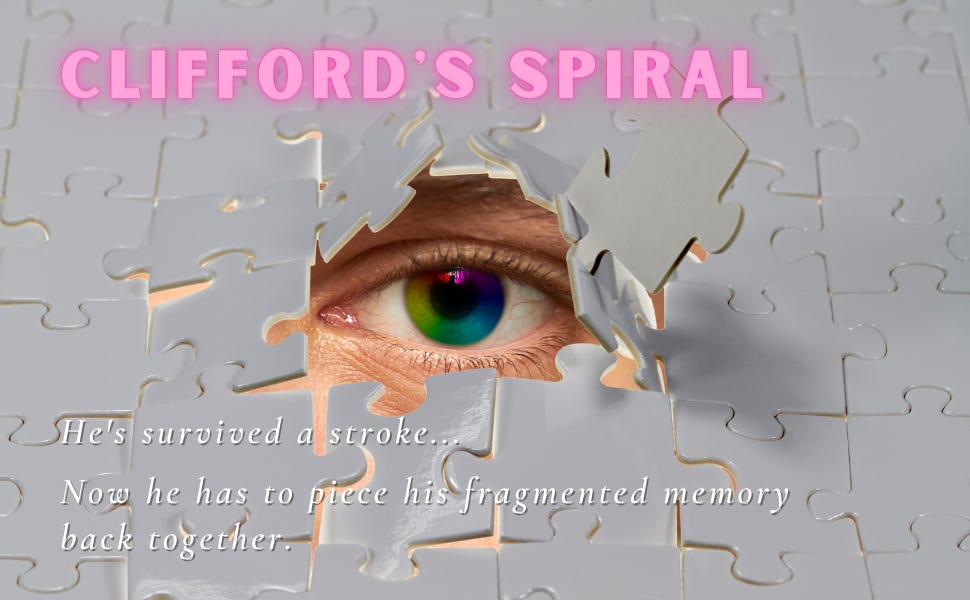
Chapter 10Stroke sufferer Clifford Klovis tries to piece together the colorful fragments of his memories. Is it possible in his situation to say life is good?
It was a warm, sunny morning after a weeklong spring thaw. The ground was freshly muddy and not yet green. The funky straw of last season’s Kentucky bluegrass would be mulch for the new sprouts. The air was ripe with rot that would feed the next generation of plants and animals. It was the smell of defrosted dog shit sinking into piles of damp, moldy leaves. It was the smell of death morphing into new life.
Clifford took a deep breath and smiled. Myra had wheeled him out on the veranda and turned his wheelchair to face the glaring sun. Mind you, he didn’t need a wheelchair. He was still ambulatory. He could still cross a room on his own, although unsteadily. But, to prevent injuries from falling, mandatory policy in the place was to wheel patients around when the destination was anywhere outside of their rooms.
It was glorious. The staff had only a vague notion of his quality of life. It probably came down to something like survival with the absence of pain. They used drugs in various forms — injections, drips, and pills — to deal with both. Well, he had survived, and he had no pain to speak of (that is, if he could or would speak of anything). He’d attained the next layer on a human’s hierarchy of needs — namely, a comfort zone. He had shelter and warmth, a bed that was clean and dry (most of the time), recurring hot meals, and — thanks to Myra’s diligence today — the sun on his face. There are exquisitely spoiled family dogs who don’t get as much. Those dutiful animals no doubt fret about their jobs — or their perceived lack of a job: “Am I supposed to guard the baby or the back door? Do I alert the household of all strangers in uniform? What about those shiftless people on the sidewalk who smell bad? Is this some kind of trial period or a long-term gig? If you leave, will you return? Will I eat tonight? Tomorrow?”
As she set the brake on his wheelchair, Myra sat down stiffly in the lawn chair opposite him and leaned in very close. She spoke in a low tone, even though no one else was near enough to hear: “Clifford, I’m going to tell you something, and I want you to give me an eye blink to let me know you know I’m telling you something.”
June 1, 2025
Clifford's Spiral: Chapter 9
In Clifford's Spiral, the stroke survivor’s past is blurry, and his memories are in pieces. He asks himself:
Who was Clifford Olmstead Klovis?

Chapter 9Stroke sufferer Clifford Klovis tries to piece together the colorful fragments of his memories. Lost in the clouds?
It was after Ruth and before Tessa. Clifford was dating Chloe, who worked as an administrative assistant for one of the big consulting engineering firms. Chloe’s work pal was Pam, who was in a committed relationship with Larry, a Vietnam vet who was ten years her senior. Larry was news traffic manager at a local TV station, a tedious job with a graveyard shift. He had a way of making his work sound like high adventure to his barroom buddies.
Larry claimed to have had flying experience in Nam, but he was no fighter pilot. More likely he’d flown a desk, as the jet jockeys say, coordinating Air Force logistics. His job in news traffic demanded much the same skills as he dispatched and tracked helicopter crews to cover highway accidents, car chases, and big thunderstorms. Larry was proud to hold a single-engine private-aircraft license, which was how Clifford came to meet him. Their brief acquaintance added another memorable experience to Clifford’s mental album — and his fear of flying.
May 28, 2025
Clifford's Spiral: Chapter 8
In Clifford's Spiral, the stroke survivor’s past is blurry, and his memories are in pieces. He asks himself:
Who was Clifford Olmstead Klovis?
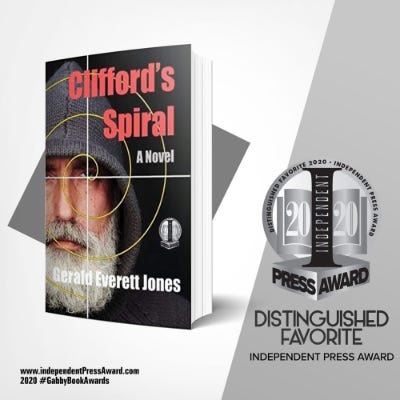
Chapter 8Stroke sufferer Clifford Klovis tries to piece together the colorful fragments of his memories. Why is he seeing spirals everywhere?
Clifford often had difficulty sleeping. He could fall asleep readily enough, as he did without effort when he’d had little more to say to Hypatia and René. He’d wake, too soon, from active REM sleep after just a few hours. He wished his dreams were more imaginative. There were frequent bathroom themes, locker rooms, and stinky stalls, and he guessed these were merely the mind’s tricks to keep him sleeping when his bladder was full and he’d otherwise want to get up to go relieve himself. He wasn’t surprised. In his waking life, too, bathroom urges had become more frequent and their satisfaction more logistically complicated.
Now, in the early morning, he’d been asleep for hours. The Epiphany of the Yo-Yo had taken place in the late afternoon, just as visitors, including the Gatsky kid and his mother, had overstayed their welcome. Hypatia and Descartes had arrived just after dinner, and then Clifford had dozed off. So here he was, wide awake, and it would be four or five hours before the sky would begin to brighten and the sun would rise again.
This gray area between sleeping and waking was a magical space. He’d see faces of people he’d never met. At least, he thought he didn’t know them. He’d have inklings of ghostly figures standing by his bed. They weren’t threatening, but their presence was hardly warm. They were just there. Perhaps they were Insiders — or sent by Insiders.
And memories would bubble up. Tonight it was a flood of recollections about Sissy Sidley, one of his teenage sweethearts.
May 25, 2025
Clifford's Spiral: Chapter 7
In Clifford's Spiral, the stroke survivor’s past is blurry, and his memories are in pieces. He asks himself:
Who was Clifford Olmstead Klovis?
Chapter 7Stroke sufferer Clifford Klovis tries to piece together the colorful fragments of his memories. Why is he seeing spirals everywhere?
The Gatsky grandkid was playing in the middle of the freeway. This wasn’t necessarily dangerous. Although their drivers might be near-blind or almost deaf or both, the electric wheelchairs moved slowly. The boy would be agile enough to dodge them. The pace of the few ambulatory dodderers wobbling their way on walkers was glacial and likewise posed no threat except to themselves should the little brat miscalculate in his trajectory. If he progressed as far as the nurse’s station, which the residents referred to as downtown, the situation would become more perilous. There the freeway merged and widened into a busy, lushly carpeted interchange, patterned improbably with palm fronds and royal crests. Past that nexus, the carpet extended over the enclosed pedestrian overpass to the Mauna Loa Room, where the nightly buffet had a Hawaiian theme on Fridays, presumably in anticipation of the weekend, which staff saw as no vacation at all since hordes of loved ones and their brats would be descending on the apprehensive residents. That’s when the traffic would be loud and confusing, even to the residents who navigated the route to their food with regularity.
Mauna Loa was where the residents dined who were not either housed in Clifford’s assisted-living wing or residing in the hotel-like environment of the “ambulatory apartments.”
The electric wheelchairs were equipped with warning horns, which in such situations created a chorus of honks not unlike a gaggle of taxis at rush hour in Manhattan.
May 24, 2025
Three Writers Who Changed My Life
Posted from my presentation to the Passion Purpose and & Peace Summit 2024 Reserve your spot for the next conference, starting Septempber 20, 2025. www.PassionPurposeAndPeaceSummit.com.
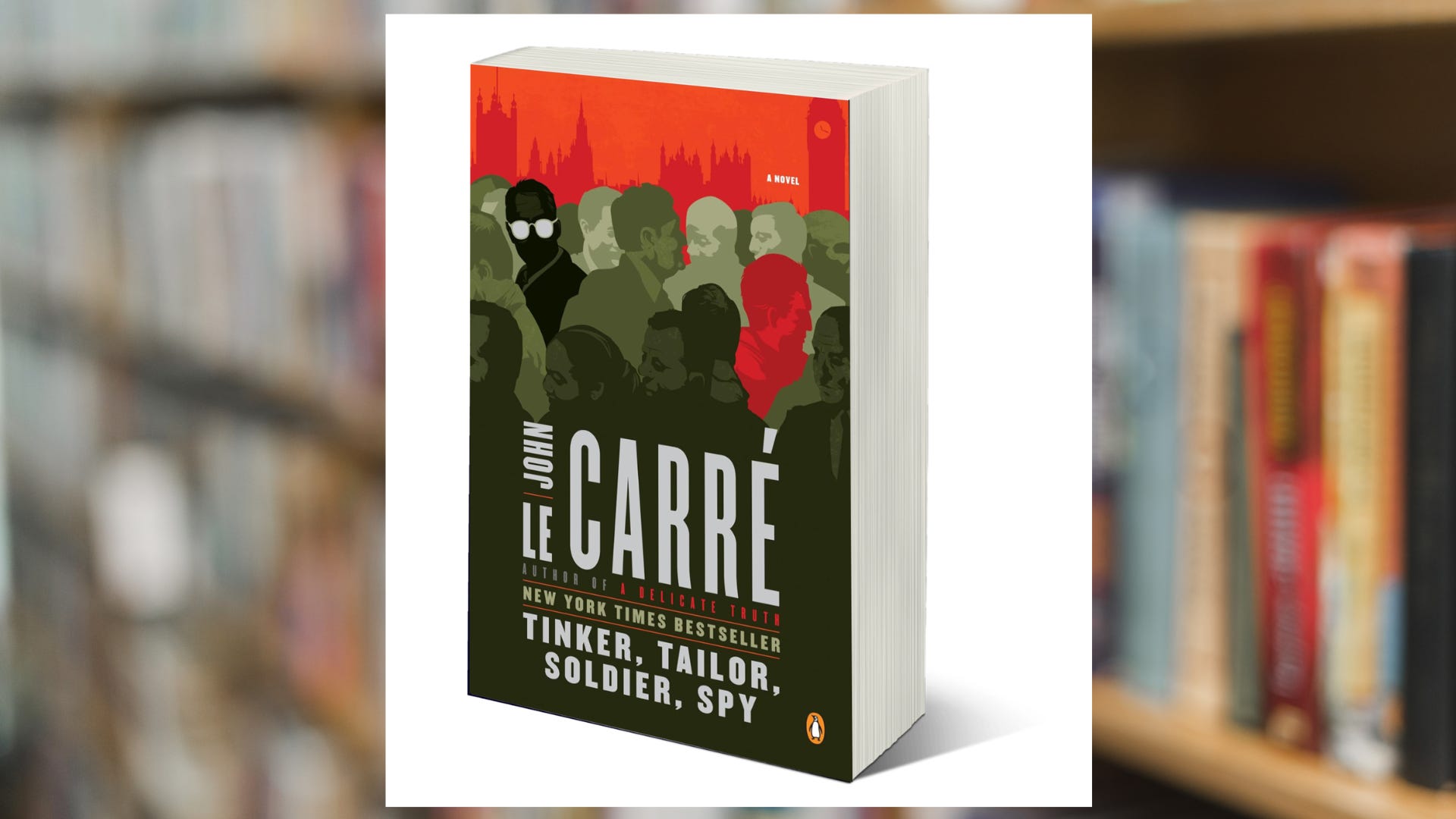

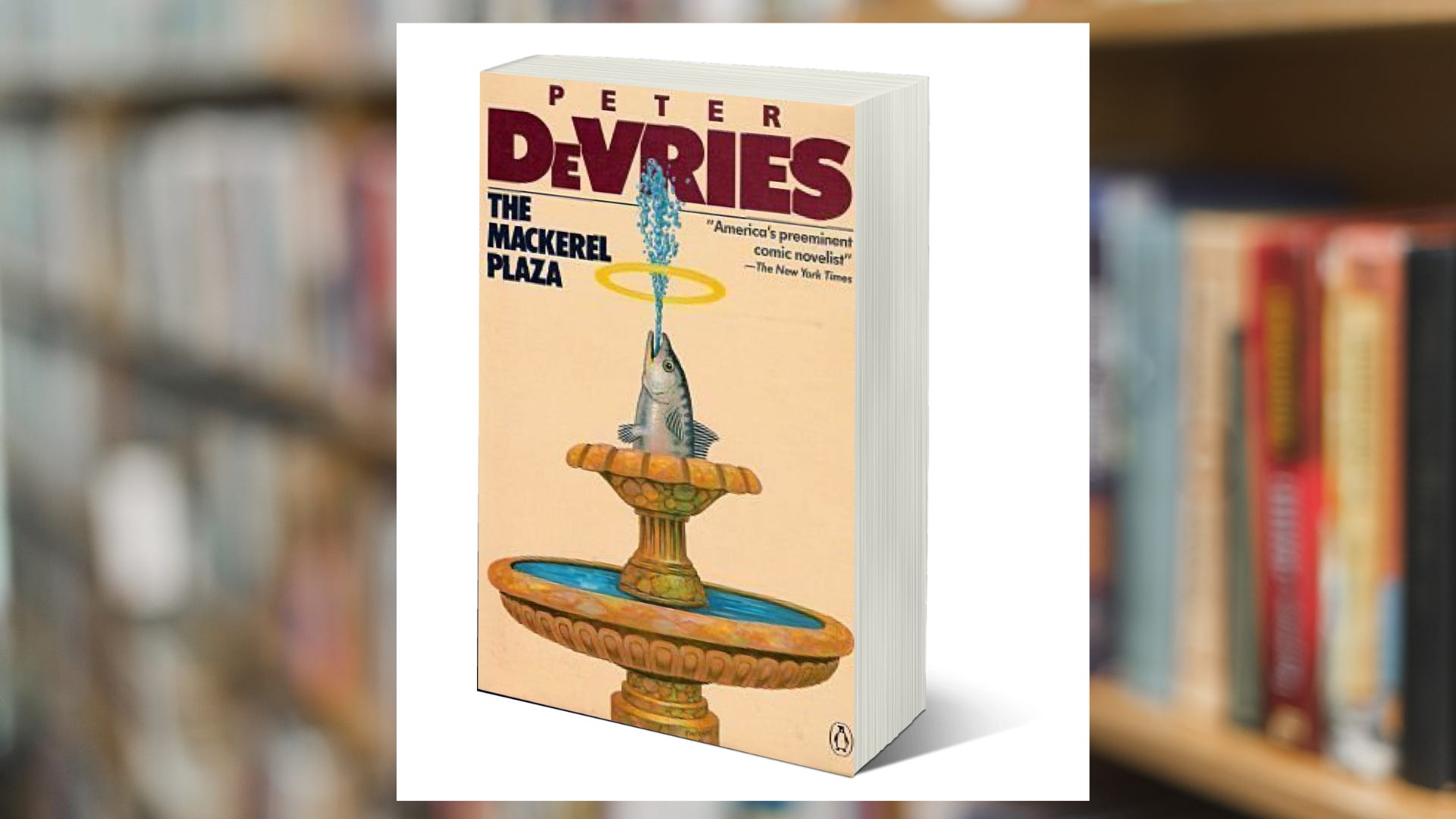
All about Close Observers, the Angel’s-Eye-View, and Religion + Sex = Comedy
Paid subscribers to Thinking About Thinking can follow audiobook episodes - always available on the Podcast tab.

Thinking About Thinking is a reader-supported publication. To receive new posts and support my work, consider becoming a free or paid subscriber. Paid subscribers get audiobooks and lots to think about.
Gerald Everett Jones - Author

- Gerald Everett Jones's profile
- 489 followers

