
Janice Hardy's Blog, page 95
September 25, 2018
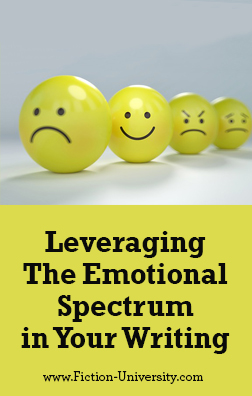
Leveraging The Emotional Spectrum in Your Writing
 By Bonnie Randall
 Part of the How They Do It Series (Monthly Contributor)
Every base emotion—love, sadness, anger, envy, happiness—resides upon a spectrum. Such spectrums range from pallid to intense, and an emotional response will be variant depending on the precipitating event, the personality of the individual experiencing it, and that person’s history. Consider the following chart:
Low Spectrum → Base Emotion → High Spectrum → Off-Chart/Dysfunction
Content → HAPPY → Euphoria → Mania
Melancholy → SAD → Despair → Suicide/Homicide
Indignant → ANGER → Rage → Wrath/Destruction
Snarky → JEALOUS → Obsessive → Sabotage
Restless → NERVOUS → Paranoia → Psychotic Break
Satisfaction → PROUD → Arrogance → Tyranny
Uneasy → FEAR → Panic→ Hysteria
Continue ReadingWritten by Janice Hardy. Fiction-University.com


September 24, 2018
Writers Take Heart: First Drafts Don't Always Suck
 By Janice Hardy, @Janice_Hardy
 Just because it's a first draft doesn't mean it has to be a terrible manuscript.
There's a common term in the writing world: the s%#@y first draft. Despite the harshness of the words, it's actually meant as encouragement. Most first drafts are rough and not very good, and that's the point. They're not supposed to be, because they're a brain dump to get an idea down and see how it all works.
But many writers--especially new writers--think a novel pops perfectly from the author's head. When that doesn't happen, they get frustrated and discouraged. Some may even given up entirely, which is a shame.
Continue ReadingWritten by Janice Hardy. Fiction-University.com

September 23, 2018
Writing Prompt: The Free Write: The Blues
 By Janice Hardy, @Janice_Hardy
This week’s prompt is a free write, so take the seed below and run with it. It doesn’t have to turn into anything (unless you want it to, of course), just let the words flow and see where they go.
Write down this opening sentence and follow it wherever it goes:
There was entirely too much blue.
Write as much or as little as you’d like. Written by Janice Hardy. Fiction-University.com

September 22, 2018
Real Life Diagnostics: Would This Query Letter Make You Ask for More?
 Critique By Janice Hardy, @Janice_Hardy
Real Life Diagnostics is a weekly column that studies a snippet of a work in progress for specific issues. Readers are encouraged to send in work with questions, and we diagnose it on the site. It’s part critique, part example, and designed to help the submitter as well as anyone else having a similar problem.
If you're interested in submitting to Real Life Diagnostics, please check out these guidelines.
Submissions currently in the queue: Three
Please Note: As of today, RLD slots are booked through October 13.
This week’s question:
Would this query letter make you ask for more?
Market/Genre: Young adult fantasy
On to the diagnosis…
Continue ReadingWritten by Janice Hardy. Fiction-University.com

September 21, 2018
5 Things Re-Editing Your Older Work Can Teach You
 By Joanna Campbell Slan, @joannaslan
Part of the Writer's Life Series
JH: As the saying goes, "No writing is ever wasted." That's especially true when we learn from our past work and improve with every book. Please help me welcome Joanna Campbell Slan to the lecture hall today, with reasons how re-editing our older work can benefit us.
Joanna Campbell Slan is the national and Amazon bestselling author of nearly 40 books. She’s been shortlisted for the Agatha Award and won the Daphne du Maurier Award of Excellence. Joanna has taught writing on the college level and to corporate executives. Learn more about her work at
Website | Goodreads | Facebook | Twitter | Pinterest
Take it away Joanna...
Continue ReadingWritten by Janice Hardy. Fiction-University.com

September 20, 2018
Author Advertising: Stacking Ads to Maximize Promotional Dollars
 By John G. Hartness, @johnhartness
 Part of the Indie Author Series
This is kind of a complex topic, and if you haven’t read Marcy Kennedy’s articles on ads here on Fiction University, I suggest you at least familiarize yourself with them now. Her excellent article on the basics of advertising will give you a basis for understanding what I’m talking about here.
There are a million book promo sites, and they range from the very inexpensive to the downright wallet-busting, and range in efficacy from negligible to chart-topping. Today we’ll talk about how to maximize the bang for your buck(s) and stack promos to make sure your book hits as many eyeballs as possible and hopefully insure you see a positive return on your investment. As always, here’s a caveat – your mileage may vary, and no results are guaranteed.
Written by Janice Hardy. Fiction-University.com

Why Writing for Younger Readers is the Best. Job. Ever.
 By Janice Hardy, @Janice_Hardy
 Part of The Writer’s Life Series
Writing for teens and tweens has benefits no other market can offer.
Although my writing career has expanded to other genres and markets since I published my first novel (a middle grade fantasy), writing for teens and tweens is where my heart lies. I love writing nonfiction and stories for adults as well, but connecting with young readers is rewarding on a different level.
I’ve known a lot of writers who have considered writing for teens and tweens, and if you’re thinking about it now, I encourage you to do so. Writing for a younger audience takes the job (and fun) to a whole new level.
And maybe I’m biased, but kidlit authors have the best fans (grin). We also get the best fan letters.
Written by Janice Hardy. Fiction-University.com

September 19, 2018
4 Ways to Keep Your Sentences From All Sounding the Same
 By Janice Hardy, @Janice_Hardy
 A varied sentence structure can help keep your writing from sounding stale and flat.
After eight years of diagnosing pages here, and a few decades of critique experience, I’m quite familiar with issues writers face—from those just starting to write, to those on the brink of selling their novels, and even those with multiple published novels. Some aspects of writing are difficult for almost everyone, and each stage of the author’s journey has its own set of challenges.
One of those challenges is writing sentences that don’t all sound the same.
Written by Janice Hardy. Fiction-University.com

September 18, 2018
Tips for Managing Writing and Chronic Illness
 By Alyssa Hollingsworth, @alyssa__holly
Part of the How They Do It Series
JH: Being a writer can be tough under the best of circumstances, but it's even more difficult when you're dealing with an illness you can't simply ignore. Please help me welcome Alyssa Hollingsworth to the lecture hall today, to share tips and advice on writing while managing a chronic illness.
Alyssa was born in small-town Milton, Florida, but life as a roving military kid soon mellowed her (unintelligibly strong) Southern accent. Wanderlust is in her blood, and she's always waiting for the wind to change. Stories remain her constant.
She got her BA in English with an emphasis in Creative Writing from Berry College and my MA with honors in Writing for Young People at Bath Spa University. She’ll happily talk your ear off about either of these programs — they both rocked!
The Eleventh Trade is her debut novel with Roaring Brook/Macmillan (U.S.) and Piccadilly Press (U.K.), as well as a handful of other foreign publishers. This will be followed by a separate book in Fall 2019.
Website | Goodreads | Twitter | Pinterest | Instagram
Take it away Alyssa...
Written by Janice Hardy. Fiction-University.com

September 17, 2018
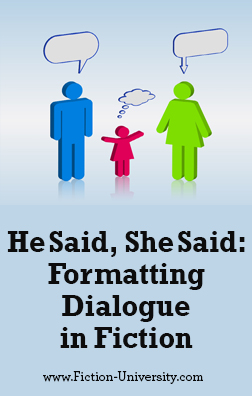
Formatting Dialogue in Fiction: He Said, She Said
 By Janice Hardy, @Janice_Hardy
 Dialogue is more than just writing down what your characters says--it's also using the correct punctuation and structure so readers understand who's speaking and how.
I once had a debate with someone over the proper structure of a dialogue tag. She felt that you should always write "said Bob," because you wouldn't say "Ran Bob up a hill." I felt it could go either way. "Get thee to a nunnery" sound fine, right?
So, which is Correct: "Bob said," or "said Bob?"
I checked with my linguist expert, and she says there's nothing grammatically wrong with "Bob said." It just depends on which verb-noun pairs you use that determines how odd it sounds to you.
Written by Janice Hardy. Fiction-University.com


