
Janice Hardy's Blog, page 94
October 5, 2018
Three Types of Irony in Lois Lowry's The Giver
 By Natalie Odisho
Let’s Get Lit: Spotlight on Allegory
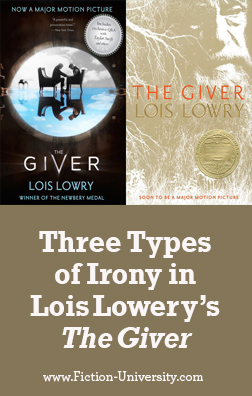
In The Giver, Jonas is scolded for using imprecise language of “starving”. He is assured by the community that he will never be starving in his life. Isn’t it ironic?
"It’s ironic, a little too ironic don’t you think?" Aside from Alanis Morisette’s literary lyrics, irony is a common rhetorical device used to add drama and mystery.
Lois Lowry uses irony to create complicated layers of ethics, emotion and morality in The Giver. The Giver is the groundbreaking 1994 Newbery award winner in which a young boy, Jonas, is sorted into a painfully real career receiving memories from a tired Giver in a seemingly perfect community.
(Warning! Spoiler alert for The Giver. Read at your own caution.)
Continue ReadingWritten by Janice Hardy. Fiction-University.com


October 4, 2018
The Indie Publisher’s Toolbox – Part 2
 By Ray Flynt
(Part of the Indie Author Series)
Last month, in Part 1 of the Indie Publisher’s Toolbox, we examined an author’s website, including domain name and registration, options for hosting, and a brief look at content.
Now we want to look at two vehicles for direct communication between authors and readers. Specifically, more “long form” communication as opposed to what might be found in brief social media posts (Stay tuned: Social Media will be the subject of a future “Indie Publisher’s Toolbox).
Two months ago, in my first post here about writers as entrepreneurs, a reader posted the following comment, which I consider a cautionary tale as we consider today’s tools.
Continue ReadingWritten by Janice Hardy. Fiction-University.com

October 3, 2018
Writing Transitions: How to Move Smoothly Through Your Novel
 By Janice Hardy, @Janice_Hardy
 Just a heads up that I'm at Romance University this week, talking about plotting a novel when you don't yet know all the details of the story. Come on over and say hello!
As writers, we spend a lot of time on our scenes, but we don't always pay enough attention to how we move from scene to scene. But how we move our readers from line to line, paragraph to paragraph, scene to scene, and chapter to chapter all lead the reader though our story. If we don't do a good enough job, they won't get very far in the novel. Jarring jumps, awkward shifts, missing information, can all knock a reader right out of the tale.
And we don't want rough transitions that make readers give up on the book.
Continue ReadingWritten by Janice Hardy. Fiction-University.com

October 2, 2018
Writing About Slavery in Historical Fiction
 By E.R. Ramzipoor, @ER_Ramzipoor
 Part of the How They Do It Series
JH: With some topics, it's tough to strike a balance between approaching the subject authentically but not romantically, and being honest about it without normalizing it. Today, E.R. Ramzipoor visits the lecture hall to share some tips on how to write about slavery in historical fiction.
E.R. is a writer and freelance editor represented by Kristin Nelson of NLA. She is based in Berkeley, CA, where she’s working on a novel about a World War II newspaper heist and writing about tech for Sift Science.
Website | Twitter | Tumblr
Take it away E.R...
Continue ReadingWritten by Janice Hardy. Fiction-University.com

October 1, 2018
Free E-Book: Plotting Your Novel
By Janice Hardy, @Janice_Hardy
 It's October, which means writers all over the world are starting to think about National Novel Writing Month (me included).
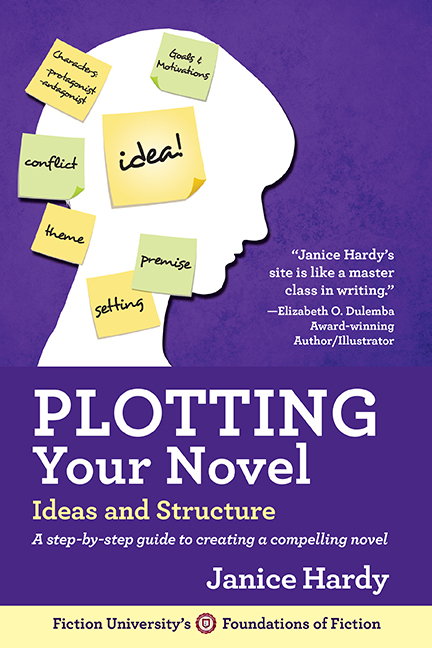
To help you make the most of NaNo, for the next two weeks, you can get my Plotting Your Novel: Ideas and Structure ebook for free.
Throughout my career, I have received tremendous support from the writing community and I can't think of a better way to "pass it on" than helping this year's NaNo crowd hit their goals. Writers helping writers is what it's all about.
For those who've always wanted to write a novel and weren't sure where to start, I hope this guide gets you onto the right track.
Get Your Free Ebook and Subscribe Now* indicates requiredEmail Address *
First Name
Last Name
Marketing Permissions
Please select all the ways you would like to hear from Fiction University:
Email Direct Mail Customized Online Advertising You can unsubscribe at any time by clicking the link in the footer of our emails. For information about our privacy practices, please visit our website.We use Mailchimp as our marketing platform. By clicking below to subscribe, you acknowledge that your information will be transferred to Mailchimp for processing. Learn more about Mailchimp's privacy practices here.
Written by Janice Hardy. Fiction-University.com
 It's October, which means writers all over the world are starting to think about National Novel Writing Month (me included).
To help you make the most of NaNo, for the next two weeks, you can get my Plotting Your Novel: Ideas and Structure ebook for free.
Throughout my career, I have received tremendous support from the writing community and I can't think of a better way to "pass it on" than helping this year's NaNo crowd hit their goals. Writers helping writers is what it's all about.
For those who've always wanted to write a novel and weren't sure where to start, I hope this guide gets you onto the right track.
Get Your Free Ebook and Subscribe Now* indicates requiredEmail Address *
First Name
Last Name
Marketing Permissions
Please select all the ways you would like to hear from Fiction University:
Email Direct Mail Customized Online Advertising You can unsubscribe at any time by clicking the link in the footer of our emails. For information about our privacy practices, please visit our website.We use Mailchimp as our marketing platform. By clicking below to subscribe, you acknowledge that your information will be transferred to Mailchimp for processing. Learn more about Mailchimp's privacy practices here.
Written by Janice Hardy. Fiction-University.com
September 30, 2018
Writing Prompt: The Skill Builder: Fixing Your Narrative Flow
 By Janice Hardy, @Janice_Hardy
This week’s prompt focuses on an exercise designed to work on a particular skill or technique, such as a POV exercise or character builder.
Today’s prompt is a bit more revision focused, with a task aimed at editing your current project and experimenting with it.
I’ve been discussing sentence flow and structure a lot the last few weeks, so let’s put some of that into practice. Today’s skill:
Sentence flow
Pick a scene and copy it into a new file so you’re free to much with it without losing anything.
Next, review it specifically for sentence structure and narrative flow. Look for paragraphs that use mostly the same style of sentence. Look for clunky or awkward dialogue tags. Look for repetition of words, ideas, or structure. Look for faulty parallelisms.
Move some dialogue tags around and see where they best fit in the scene. Break up a few longer sentences. Combine short sentences so they flow better as one longer, complex sentence. Even move some paragraphs around and see if changing when the information is revealed changes the flow or feel of the scene. Written by Janice Hardy. Fiction-University.com

September 29, 2018
Real Life Diagnostics: How Do You Feel About This Character?
 Critique By Maria D'Marco
 Real Life Diagnostics is a weekly column that studies a snippet of a work in progress for specific issues. Readers are encouraged to send in work with questions, and we diagnose it on the site. It’s part critique, part example, and designed to help the submitter as well as anyone else having a similar problem.
If you're interested in submitting to Real Life Diagnostics, please check out these guidelines.
Submissions currently in the queue: Three
Please Note: As of today, RLD slots are booked through October 20.
This week’s questions:
How does Synthea comes across? What will readers think of her, and her relationship with/feelings for Zafira?
Market/Genre: Science Fction
On to the diagnosis…
Continue ReadingWritten by Janice Hardy. Fiction-University.com

September 28, 2018
Five Edits to Strengthen Your Writing, Right Now
 By Janice Hardy, @Janice_Hardy
 Dipping into one of my favorites for this week's Refresher Friday, with an updated look at easy ways to improve your writing. Enjoy!
Back when I was first learning how to write and trying to figure it all out, one of my favorite things to discover was a great writing tip. The tips that I could immediately apply to my work and see actual improvement were the best. I got especially excited over lists of words or specific examples, because I could do a search and find the weak areas right away. Which is probably why I like to do a lot of lists and examples now in my own articles.
While there's nothing inherently wrong with a "weak word," they do tend to hang around trouble areas--just like those red flag words with show, don't tell. They're good places to start looking when something feels off in your work or you're getting negative feedback. If you're just looking for the next step to improve your craft, these are good words to search for to find possible places to revise.
Let's a take a peek at a few of those "weak area words" that often pull readers out of a story.
Continue ReadingWritten by Janice Hardy. Fiction-University.com

September 27, 2018
Create Your Perfect Writing Space
 By Janice Hardy, @Janice_Hardy
 Part of The Writer’s Life Series
When I first started writing, it was at my desk, usually in class, while ignoring my teachers. Over the years my writing space evolved to a real desk in my room, then it migrated to the dining room table after I got my own apartment, and eventually a home office. I’ve written on the living room sofa, in a coffee shop, and even airports and hotel rooms.
This past year my husband and I have been remodeling the house, and part of that includes building out the upstairs bonus room to be my office and writing space. After a decade as “an author,” I finally get to design that dream office I always wanted.
Having a dedicated writing space is important, because it triggers our brain that it’s time to write” whenever we go there. It helps us build solid writing habits and routines, and those habits will get us through the days when the writing is hard and the ideas aren’t coming.
Continue ReadingWritten by Janice Hardy. Fiction-University.com

September 26, 2018
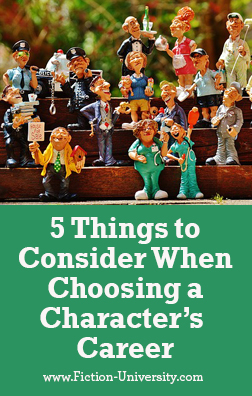
5 Things to Consider When Choosing a Character’s Career
 By Janice Hardy, @Janice_Hardy
 A character’s job is a useful tool when developing a novel.
I’ve been working hard on a new book this week, and since it’s a bit outside my normal genre (this one’s a science fiction detective novel), I’ve had to do a few things differently. There are elements to this genre I haven’t had to worry about in previous books.
Most notably, has been how my protagonist’s job affects the rest of the plot. As a private investigator, his job is the plot, and that career choice affects pretty much everything else in the novel.
In one way, this makes developing this novel easier. I have very clear parameters to work in, and a specific character type to flesh out.
In another way, it adds a layer of difficulty. The most obvious and easiest path is also the most overused or even cliched. I don’t want that, even if I might want to play with the tropes and cliches a little (I can never resist this—it’s too much fun).
Continue ReadingWritten by Janice Hardy. Fiction-University.com


