
Janice Hardy's Blog, page 69
July 29, 2019
How to Write Description Without Going Overboard
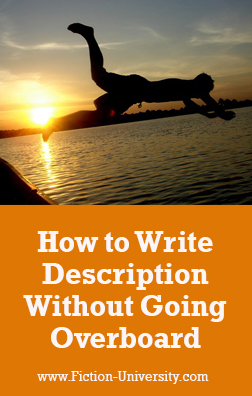 By Janice Hardy, @Janice_Hardy
 Description helps brings a novel to life, but too much of it can choke the life right out of the story. Finding the right balance between description and dialogue can be tricky.
One wonderful and yet annoying aspect of writing, is that there’s no set formula for how much description is necessary. Description levels vary by genre and authors, and even readers have their preferences. Fans of poetically written literary novels typically enjoy richer descriptions than fans of fast-paced thrillers, for example.
How we choose to write the description also plays a role. That thriller can have just as many details in a scene as the literary novel, but how they’re woven into the story will be completely different. The author’s style and voice, as well as the genre’s style, influence the description.
Continue ReadingWritten by Janice Hardy. Fiction-University.com


July 28, 2019
Sunday Writing Tip: Make Sure Your Protagonist Isn’t a Perfect Mary Sue/Gary Stu Character
 By Janice Hardy, @Janice_Hardy
 Each week, I’ll offer a tip you can take and apply to your WIP to help improve it. They’ll be easy to do and shouldn’t take long, so they’ll be tips you can do without taking up your Sunday. Though I do reserve the right to offer a good tip now and then that will take longer—but only because it would apply to the entire manuscript.
This week, make sure your protagonist isn’t too perfect.
The Mary Sue/Gary Stu character is the one who always knows exactly what to do in any situation, has no flaws, no bad habits, and rarely runs into any real trouble—and when they do, events align just as they need them to to get out of it.
Too-perfect characters are boring to read about, because there is no struggle and no real conflict. Readers know very early on that whatever problem Mary or Gary face, they’ll overcome it with little to no effort. Most of the time, other characters go out of their way to help them, even if they have reason to.
Take some time today and make sure that things aren’t too easy for your protagonist, and that they do have flaws and issues that cause them to struggle to achieve their goals.
Continue ReadingWritten by Janice Hardy. Fiction-University.com
July 27, 2019
Real Life Diagnostics: Would You Continue Reading This YA Fantasy?
 Critique By Maria D'Marco
 Real Life Diagnostics is a weekly column that studies a snippet of a work in progress for specific issues. Readers are encouraged to send in work with questions, and we diagnose it on the site. It’s part critique, part example, and designed to help the submitter as well as anyone else having a similar problem.
If you're interested in submitting to Real Life Diagnostics, please check out these guidelines.
Submissions currently in the queue: One
Please Note: As of today, RLD slots are booked through August 3.
This week’s questions:
1. Would you continue reading?
2. Do you like the sentences?
3. Start of story good?
Market/Genre: Young Adult Fantasy
On to the diagnosis…
Continue ReadingWritten by Janice Hardy. Fiction-University.com
July 26, 2019
Going All the Way: Should You Write the Whole Trilogy Before You Query?
 By Janice Hardy, @Janice_Hardy
 This week's Refresher Friday dips back to an updated look at writing trilogies.
There are two views on writing trilogies. Write only the first book and see if it sells, and write the whole thing before you start querying.
I hadn't intended to write a trilogy when I started The Shifter , but as I wrote closer to the ending, I realized the story could continue for a few more books. There was a bigger world with bigger problems to explore, if I wanted to follow along.
Which I did. So I pitched the novel as a stand-alone that could continue as a trilogy, and that's how we sold it. The two editors who'd wanted it--one wanted the trilogy, the other the stand alone book. This is a good example of how this could have gone either way.
Continue ReadingWritten by Janice Hardy. Fiction-University.com
July 25, 2019
So Many Books, So Little Heart: Thoughts on Writers’ Reading Habits
 By Dario Ciriello
 Part of The Writer’s Life Series
JH: Getting readers to care about our characters is something every reader should strive for—but do they? Dario Ciriello is back again this month, with thoughts on writing, reading, and why we care.
A new client said something yesterday that got me thinking about the reading habits of writers, and how they change over time. She mentioned having brought two of my books prior to hiring me to edit her work, and that she’d read my book on writing but only the beginning of the other, a memoir. Of course, it flashed through my mind that she may not have cared for the other work; as a picky reader myself, I understand how different each reader is, and don’t feel in the slightest offended if someone isn’t enamored of one of my books.
“You see,” she went on, “I daren’t allow myself to read a book while I’m writing.”
Continue ReadingWritten by Janice Hardy. Fiction-University.com
July 24, 2019
Are You Asking--and Answering--the Right Story Questions?
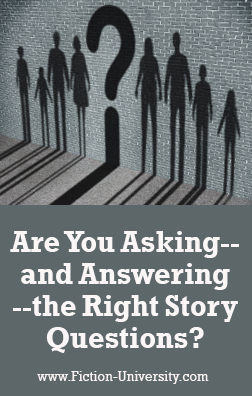 By Janice Hardy, @Janice_Hardy
Leaving the right trail for readers to follow is a big part of writing a novel. The right story questions make that a whole lot easier.
I always set aside time to update my outline and prepare for a manuscript revision. Not only is it a good way to remember what I wrote, it helps me ensure I have everything figured out so the revision is easier.
Years ago, I was working on a novel with a lot of layers and mysteries, and I added something new to this process:
Identify the story questions in each act.
Why I hadn't done this before I have no idea, as it sounds so obvious, right? It's likely something you assume you already do (I know I did before I started doing this). But while I knew the main story question of every act, there were a lot more questions readers might ask about, and some of them I didn't do much with in the novel. These little questions were all missed opportunities to deepen my story and keep that all-important tension high.
Continue ReadingWritten by Janice Hardy. Fiction-University.com
July 23, 2019
The Hardest Craft of All: Writing with a Block
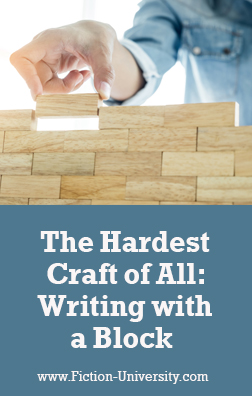 By Spencer Ellsworth, @spencimus
Part of The Writer’s Life Series
JH: There’s a myriad of reasons why someone suddenly can’t write, but they all result in the same thing—frustration. Spencer Ellsworth visits the lecture hall today to share tips on writing when you have a lot going on in your life.
Spencer Ellsworth has been writing since he learned how. His short fiction has previously appeared in Lightspeed Magazine, Fantasy & Science Fiction, and at Tor.com. Over the years, he's worked as a wilderness survival instructor, paraeducator in a special education classroom, and in publishing; he currently lives in the Pacific Northwest with his wife and three children and works at a small tribal college on a Native American reservation. His novel A Red Peace is the first book of his Starfire Trilogy from Tor.
Website | Twitter | Goodreads
Take it away Spencer…
Continue ReadingWritten by Janice Hardy. Fiction-University.com
July 22, 2019
A Common Reason Novels Fail
 By Janice Hardy, @Janice_Hardy
Discovering your novel doesn’t work is heartbreaking, but there are things you can do to fix it.
Story ideas are wonderful things, because they hold so much potential. Every spark of inspiration has the ability to become the next Great Novel and make a writer’s whole career. Or at least lead to a solid book readers might want to buy.
Not all ideas lead to good books, though.
Sometimes it’s the idea itself that’s the problem, but frequently, it’s the execution—but not in a “badly written” kind of way. The reason the idea (and the novel) falls flat is this:
It doesn’t tell a story, it explains a situation.
The “situation novel” isn’t about characters trying to solve problems, but scene after scene that tells readers how a situation occurs, offers a flat, play-by-play of how something came to be, or even examples of why this idea is so cool.
Continue ReadingWritten by Janice Hardy. Fiction-University.com
July 21, 2019
Sunday Writing Tip: Reveal Something New in Every Scene
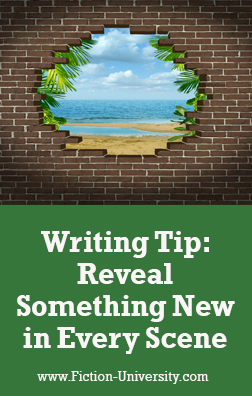 By Janice Hardy, @Janice_Hardy
 Each week, I’ll offer a tip you can take and apply to your WIP to help improve it. They’ll be easy to do and shouldn’t take long, so they’ll be tips you can do without taking up your Sunday. Though I do reserve the right to offer a good tip now and then that will take longer—but only because it would apply to the entire manuscript.
This week, check every scene and make sure readers are learning something new about the story, world, or characters.
One way to keep hooking readers in a novel is to reveal something new about the story. Maybe it’s a bit of character history or a not-yet-seen aspect of their personalities, perhaps it’s something about the world, or even how the story mechanics work if it’s science fiction or fantasy. It could even be the revelation of a secret—either the answer to one or that one exists.
It doesn’t have to me a major book-shattering reveal, as long as something is learned that lets readers further immerse themselves in your story and world.
Continue ReadingWritten by Janice Hardy. Fiction-University.com
July 20, 2019
Real Life Diagnostics: Is Inserting a Flashback a Good or Bad Idea?
 Critique By Janice Hardy, @Janice_Hardy
Real Life Diagnostics is a weekly column that studies a snippet of a work in progress for specific issues. Readers are encouraged to send in work with questions, and we diagnose it on the site. It’s part critique, part example, and designed to help the submitter as well as anyone else having a similar problem.
If you're interested in submitting to Real Life Diagnostics, please check out these guidelines.
Submissions currently in the queue: Two
Please Note: As of today, RLD slots are booked through August 3.
This week’s questions:
1. What are your feelings about this character? Could you bond with her?
2. Is there enough tension to keep you reading?
3. What are your expectations from these opening lines?
4. In your view, what is the opening promise?
5. Is inserting the flashback a good or bad idea?
Market/Genre: Literary Fiction
On to the diagnosis…
Continue ReadingWritten by Janice Hardy. Fiction-University.com


