
Janice Hardy's Blog, page 108
April 30, 2018
What a Concept! Plotting Your Novel Conceptually
 By Janice Hardy, @Janice_Hardy
 With two birthdays this week, major clean up after my home remodel, and prepping for a slew of people visiting in a few days, I'm dipping into the archives today. Enjoy this updated look at plotting a novel conceptually.
I'm always looking for better ways to plot my novels. Every time I attend a great workshop on story structure, or see a phenomenal blog post, or read a fantastic book, I incorporate those tips into my process and update my basic plotting template. One of my pre-novel planning techniques is to start conceptually and narrow the plot down to specifics.
Thinking about a story conceptually allows us to brainstorm what we want to have happen without worrying about the details. Such as, you know you want a major reveal and surprise at the mid-point, or you want X to happen in the climax. Maybe it's whatever the protagonist does at the climax of act one that will come back to bite her in the all-is-lost-moment at the end of act two. You can shape the flow of the story even though you don't know exactly how it will go. Conceptually, you know how you want it to turn out.
For examples, let's check in with Bob and the gang.
Read more »Written by Janice Hardy. Fiction-University.com


April 27, 2018
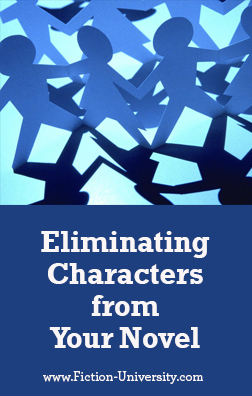
Sorry, Your Services are no Longer Required: Eliminating Characters from Your Novel
 By Janice Hardy, @Janice_Hardy
 This week's Refresher Friday takes another look at things to do when you have to cut a character from your novel.
It's not uncommon for the number of characters in a novel to grow as we write that novel. We discover scenes that need extra hands, or a walk-on role turns out to be a fantastic secondary character and gets more page time. Or we're writing a series, and after a few books, we realize the cast list has become unmanageable.
I ran into this while writing the third book in my fantasy trilogy, Darkfall . I had the main characters, the major supporting characters, old characters from book one, added characters from book two, and then all the new characters for book three. Suddenly, the scenes were all way too crowded.
I needed to do a little character pruning, but who got to stay and who had to go?
Read more »Written by Janice Hardy. Fiction-University.com

April 26, 2018
Tricks & Tips for Catching All Those Little Typos in Your Own Work
 Jodie Renner, editor and award-winning author @JodieRennerEd
 Part of the Indie Authors Series
Pulling from the archives today, with some editing tips from Jodie Renner.
Whether you’re writing a novel, a nonfiction book, a blog post, a magazine article, a short story, or an assignment, it’s important to go over your work several times before submitting, to make sure it’s error-free and flows well. No matter what your you’re writing, you’re your credibility will be eroded if readers find mispelled misspelled words, misused words, missing or extra words, or other typos.
Over the years, I’ve presented workshops and written several articles on tips for approaching the whole editing and revising process, starting with macro issues like logistics, characterization, plot, and pacing, and working your way through awkward phrasing and wordiness down to micro errors like spelling and punctuation. And of course Janice has done a stellar job of guiding writers through the process, to result in a polished story before querying or publishing.
Read more »Written by Janice Hardy. Fiction-University.com

April 25, 2018
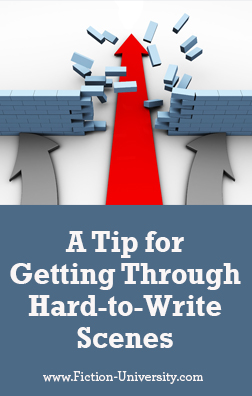
A Tip for Getting Through Hard-to-Write Scenes
 By Janice Hardy, @Janice_Hardy
 Even when a draft is going well, there’s bound to be at least one scene in a novel that gives us trouble. Maybe we’re not sure how it unfolds, or we’re missing a key emotional component, or it might even be that we’re not ready to write it or just don’t want to deal with whatever the scene covers right now.
When this happens, we usually get stuck. It might feel like writer’s block, but it’s not—it’s just a hard-to-write scene.
This happened to me recently, though it was more like four chapters (and entire story-structure turning point) than a single scene. These chapters cover the Dark Moment and launch act three, and there’s a lot of heavy, emotional stuff going on. The problem, is that I have a lot of stuff going on in my own life, so I flat out didn’t feel up to plunging myself into all that heartbreak and soul searching to do these chapters justice.
So I didn’t. Instead, I blitzed past it.
Read more »Written by Janice Hardy. Fiction-University.com

April 24, 2018
Putting the Ink in Imagination
 By Patricia Caliskan, @Caliskaniverse_
 Part of the How They Do It Series
JH: "Where do you get your ideas?" is the number-one questions authors get, and the answers vary widely. Please help me welcome Patricia Caliskan to the podium today to share some idea-generating thoughts.
Patricia Caliskan began her writing career as an entertainment journalist, before joining Trinity Mirror Newsgroup. She likes a nice, flouncy scarf, a good pair of boots, and laughter. Lots of laughter. Otherwise life feels far too grown-up for her liking.
Twitter | Goodreads | Amazon |
Take it away Patricia...
Read more »Written by Janice Hardy. Fiction-University.com

April 23, 2018
Where Does Your Novel's Conflict Come From?
 By Janice Hardy, @Janice_Hardy
 I’ve read a lot of manuscripts since I started this site, and one of the more common reasons I see in stories that aren’t working is the lack of a strong conflict.
Without conflict there is no story. No matter what the story is, you can boil it down to “protagonist wants something and someone or something is standing in the way of that.” The novel is about getting past that person or thing to resolve the conflict and earn the protagonist their goal.
As simple as that sounds, it’s not always so clear when you’re looking at your story idea or even your first (or later) draft. Ideas are often more concept than plot, a great premise without a solid story yet, and the conflict at the core of that idea is fuzzy. Your instinct tells you it’s there, but critique partners or even agents just aren’t seeing it.
In most cases, the conflict isn’t strong enough yet, or it’s not clear what the actual conflict (and problem) is.
Read more »Written by Janice Hardy. Fiction-University.com

April 22, 2018
Writing Prompt: The Re-Write: A Love Story Opening That Needs a Lot of Love
 By Janice Hardy, @Janice_Hardy
This week’s prompt is designed to help you practice your revision skills without the risk of messing up your manuscript. Edit the bad writing, strengthen and clarify the goals, conflict, and stakes, develop the setting, establish the character, etc. You know the drill.
You have to keep the bones of the piece, but how you get those ideas across is up to you. Add whatever details strike you, as long as you can still identify this scene as the scene I started—so no completely rewriting it from scratch. The goal is to make this monstrosity better.
Edit this opening page into something worth reading:
I knew it would end like this. I knew it would stop and cease and drag me to a terrible, awful end that would look exactly like the scene playing out before me. Which sucked.For fun, let’s try to keep this as a one-page opener, so try not to go over 300 words. Written by Janice Hardy. Fiction-University.com
“Why are you doing this to me,” I asked tearfully, my eyes stinging from the waterfall of tears pouring from them.
The man who had been my everything looked back and said, “I told you I was going to leave you if you didn’t quit your job as an ER nurse and stopped working the graveyard shift.”
I gasped and pressed perfectly manicured nails against matching red lips. “But Maurice, you know how much I need to be needed. Saving lives in the ER fulfills my very soul. I can’t quit.”
“Not even for me?” Maurice asked.
That was the question, wasn’t it? I thought to myself. When he had first walked into my life I thought he’d been the perfect man. So tall, so strong, and his clothes had reflected that sense of style. But he had been the most confident man I had ever met, and sometimes it felt like he didn’t need me, not the way the patients who came into the ER on the worst days of their lives did.
Who did I want? I wondered. My patients or the man I thought I loved?

Writing Prompt: The Re-Write: An Love Story Opening That Needs a Lot of Love
By Janice Hardy, @Janice_HardyThis week’s prompt is designed to help you practice your revision skills without the risk of messing up your manuscript. Edit the bad writing, strengthen and clarify the goals, conflict, and stakes, develop the setting, establish the character, etc. You know the drill.
You have to keep the bones of the piece, but how you get those ideas across is up to you. Add whatever details strike you, as long as you can still identify this scene as the scene I started—so no completely rewriting it from scratch. The goal is to make this monstrosity better.
Edit this opening page into something worth reading:
I knew it would end like this. I knew it would stop and cease and drag me to a terrible, awful end that would look exactly like the scene playing out before me. Which sucked.For fun, let’s try to keep this as a one-page opener, so try not to go over 300 words. Written by Janice Hardy. Fiction-University.com
“Why are you doing this to me,” I asked tearfully, my eyes stinging from the waterfall of tears pouring from them.
The man who had been my everything looked back and said, “I told you I was going to leave you if you didn’t quit your job as an ER nurse and stopped working the graveyard shift.”
I gasped and pressed perfectly manicured nails against matching red lips. “But Maurice, you know how much I need to be needed. Saving lives in the ER fulfills my very soul. I can’t quit.”
“Not even for me?” Maurice asked.
That was the question, wasn’t it? I thought to myself. When he had first walked into my life I thought he’d been the perfect man. So tall, so strong, and his clothes had reflected that sense of style. But he had been the most confident man I had ever met, and sometimes it felt like he didn’t need me, not the way the patients who came into the ER on the worst days of their lives did.
Who did I want? I wondered. My patients or the man I thought I loved?
April 21, 2018
Real Life Diagnostics: Does This Scene Show a Strong Bond Between the Couple?
 Critique By Maria D'Marco
 Real Life Diagnostics is a weekly column that studies a snippet of a work in progress for specific issues. Readers are encouraged to send in work with questions, and we diagnose it on the site. It’s part critique, part example, and designed to help the submitter as well as anyone else having a similar problem.
If you're interested in submitting to Real Life Diagnostics, please check out these guidelines.
Submissions currently in the queue: One
Please Note: As of today, RLD slots are booked through April 28.
This week’s questions:
1. Does this scene successfully convey a playful, sexual connection without actually describing the act?
2. Does this scene show a strong bond between the couple?
3. The beach is a strong theme throughout the novel. Is it used effectively here?
4. Would you read on?
Market/Genre: Adult fiction (Please note: This snippet contains a non-graphic sex scene)
On to the diagnosis…
Read more »Written by Janice Hardy. Fiction-University.com

April 20, 2018
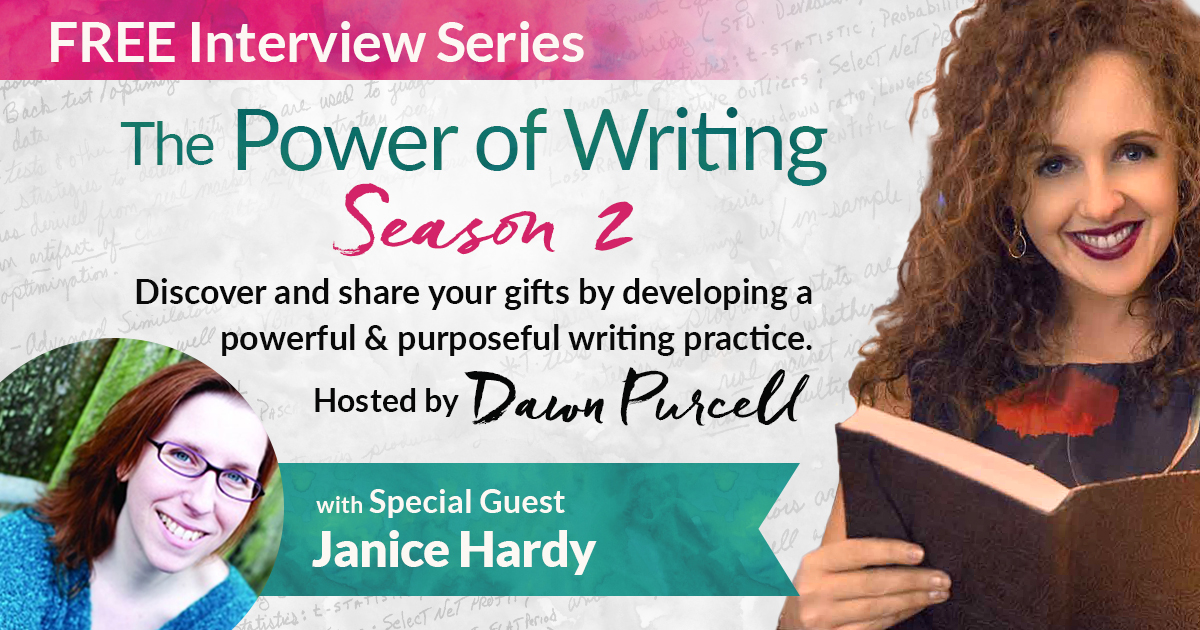
Join Me for the Power of Writing Interview Series 2
By Janice Hardy, @Janice_Hardy
Becoming a writer isn’t an easy path! There are many challenges that new writers face on their quest to say "I am a writer" --challenges which, like those on any other quest, have to be overcome if we wish to find the treasure at the end.
Some of these common challenges include: Wondering what you should be writing about; finding the time and the inspiration to write; overcoming the fear of not being good enough, of what might come up; not writing consistently; procrastinating; getting easily distracted; struggling with keep a writer’s journal that inspires and guide your writing life (because you know you should be doing that but you just…don’t!)
Read more »Written by Janice Hardy. Fiction-University.com


