Angela Slatter's Blog, page 42
May 8, 2017
Over at Patreon …
… the May reward is up for my Monkshood supporters. The newsletter will go out to all my lovely patrons in the next day or so. Meanwhile, here’s a snippet, Monkshooders.
Got a few spare shekels? Consider throwing them my way! My Patreon reward levels are here.


May 4, 2017
eBookery
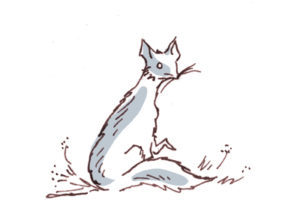
White fox by Kathleen Jennings
Have I mentioned lately that I’ve got some ebooks over at Amazon?
Samplers so you can see what I do if you don’t want to commit to an anthology or a collection or a novel …
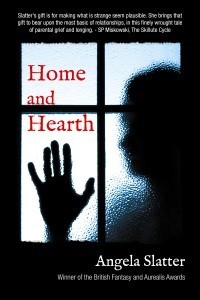
“Home and Hearth”, eBook, on Amazon.
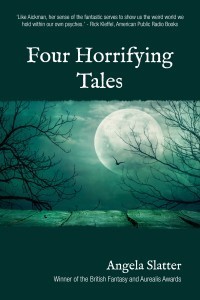
“Four Horrifying Tales”, mini-collection eBook on Amazon.
“Four Dark Tales”, mini-collection eBook on Amazon.
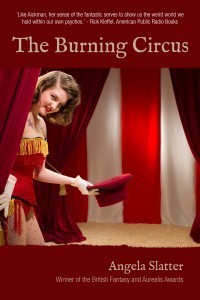
“The Burning Circus”, eBook on Amazon.

Aurora Australis
 For the latest Australian spec-fic news, head over to Tor.com for Alexandra Pierce’s Aurora Australis column.
Awards! Films! Anthologies! Stuff!
May 2, 2017
Shadows & Tall Trees 7: Manish Melwani
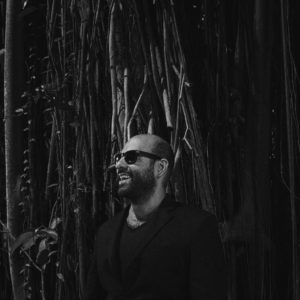 Manish Melwani is a Singaporean writer of science fiction, fantasy and horror. He attended the Clarion Writers’ Workshop in 2014, and currently lives in New York City, where he’s completing a masters thesis in creative writing, history and literature. His research focuses on the intersection of science fiction and postcolonial studies.
His story “The Tigers of Bengal” can be read in Lontar: The Journal of Southeast Asian Speculative Fiction #7. That tale, and “The Water Kings”, which will be published in Shadows and Tall Trees #7, are part of a forthcoming collection of Singapore ghost stories. You’ll find him where the waters are darkest, or online at www.manishmelwani.com.
1. What inspired your story in Shadows & Tall Trees 7?
This story was awful to write. It was inspired by a death in the family, and the writing (or grieving) process was essentially a waking nightmare filled with bizarre, occult coincidences.
It started late one night, when I saw an apparition in a neighbouring apartment: someone holding a giant green umbrella close to their head, so they looked like a crocodile-headed monstrosity. When I looked again, the person was gone. This became the opening image of the story, and was soon followed by a title: The Water Kings.
I’m not the sort of writer who starts with a title, so this was unusual. It didn’t make the story any easier to write, though.
Much of its grist comes from the politics and drama of multigenerational family businesses (a common occurrence in the Sindhi diaspora, to which I belong). There’s also a forgotten atrocity from WW2 that I learned about while researching my Singapore ghost story collection. I won’t give away any more, but I’m planning to publish an essay about these influences on my website after Shadows comes out.
2. Can you recall the first story you ever read that made you think “I want to be a writer!”?
Not specifically, but my Dad kept a huge collection of sci-fi paperbacks from his childhood, so I had the fortune of encountering books like The Hobbit, Foundation and Dune really early on.
My earliest writerly memory dates from Primary 2 (2nd grade). I was sitting at the back of the class, drawing a map of a fantasy kingdom in my exercise book. Our teacher told everyone to come sit on the floor at the front of the classroom, and I didn’t go, because I was so engrossed in my world-building. She confiscated the book and gave me detention. Traumatic for sure, but a clear sign that I was destined to write SFF.
3. What scares you?
When I’m up late at night, I fear that the visible world will turn out to be nothing but a facade, that it’ll be ripped away to reveal a nightmare universe; that demons or monsters might pry through reality’s fabric at any moment.
As a result, I really enjoy cosmic horror—the more coherent the cosmology, the scarier. Laird Barron’s Old Leech mythos and John Langan’s The Fisherman are recent favourites.
4. You can take five books to a desert island: which ones do you choose?
Oh god. I would bring “The Big Book of Five Books Brought To Desert Islands: An Anthology of Every Answer to This Question Ever”.
In all seriousness, though, I would bring books that are really long and/or re-readable, so they’d keep me busy for years.
Ann and Jeff Vandermeer’s massive short story anthologies The Weird and The Big Book of Science Fiction clock in at a total of 1.5 million words, which would keep me busy for at least the first three months. Gene Wolfe’s Book of the New Sun tetralogy: I suspect it’s got enough hidden secrets that I could re-read it a couple more times. Ulysses, so I can force myself to finally finish it.
Lastly, I want to get fluent in Hindi, so I would like the most comprehensive Hindi primer ever written. Preferably with an appendix of short stories.
5. What’s next for you? 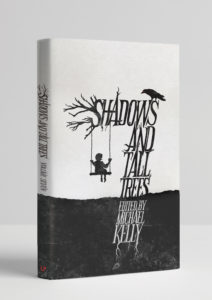
Finishing this collection of Singapore ghost stories in which The Water Kings will sit.
There’ll be ten stories total, taking place at various points in Singapore’s history between 1300 and 2300. They span a range of genre styles: magical realism, supernatural horror, spooky adventure story, science-fiction-but-with-ghost, etc.
After that, I’ve got a space opera novella, and another (completely unrelated) space opera novel in the works. So I’m slowly learning how to write stories that are longer and longer.
May 1, 2017
Review of Vigil
 A lovely podcasty review of Vigil by Madeleine D’Este!
Merci mille fois, Madeleine – perfectly timed in the lead-up to Corpselight’s release.
April 28, 2017
Boonah Writers Festival: Short Stories
White fox by Kathleen Jennings
As promised to my classes this morning, here’s the list of short stories that have remained with me over many years and still give me nightmares on occasion – so, highly recommended!
It’s by no means definitive and entirely personal!
“The Monkey’s Paw” by W. W. Jacobs
“The Tell-tale Heart” by Edgar Allan Poe
“Wendigo’s Child” by Tom Monteleone
“The Chosen Vessel” by Barbara Bayton
“La Dame” by Tanith Lee
“The Tower” by Marghanita Laski
“Snow, Glass, Apples” by Neil Gaiman
Good solid classics and great learning tools.
April 27, 2017
Boonah Writers Festival
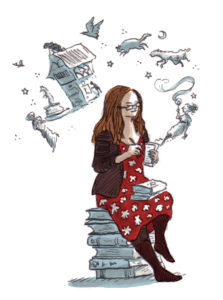
Art by Kathleen Jennings
Okay, this is where I’ll be this week: the Boonah Writers Festival, along with the likes of Nick Earls and Mary-Rose MacColl.
From 9.45am – 10.45am I’ll be talking about the psychology of horror writing and how to scare the pants off your readers. And if you miss that session, I’ll be repeating myself at 11.15!
Now, I’d best go and think up something smart to say …
April 25, 2017
Lotus Blue: Cat Sparks
 Cat Sparks is a multi-award-winning Australian author, editor and artist whose former employment has included: media monitor, political and archaeological photographer, graphic designer, Fiction Editor of Cosmos Magazine and Manager of Agog! Press. She’s currently finishing a PhD in sci fi and cli fi. Her short story collection The Bride Price was published in 2013. Her debut novel, Lotus Blue, will be published by Skyhorse in March, 2017.
1. What do readers need to know about Cat Sparks?
That I am an enormous Sci fi nerd, always was and probably always will be. Which isn’t to say that I don’t dig other genres and non-fiction, only that for me, inevitably, all roads lead back to the future.
2. Which story of yours would you recommend to a new reader?
‘Hot Rods’, published in John Joseph Adams’s anthology Loosed Upon the World and free to read up at Lightspeed Magazine: www.lightspeedmagazine.com/fiction/hot-rods/
I consider this my most skillful and accomplished piece of fiction to date. It’s a cli fi story set about 20 years from now which features one of my favourite concepts: weaponized weather, and is positioned very early on in the timeline and backstory to Lotus Blue.
3. Who are your literary heroes/influences?
I so admire the brute, alchemical power of accomplished writing. The kind of skill it takes most practitioners years to develop and hone. Writers such as David Mitchell and Margaret Atwood manage to blend the gosh wow engagement of storytelling with the cadence and fluidity of poetry. Pretty damned impressive stuff.
4. You get to take five books and five movies when you are exiled to a desert island. Which ones do you choose?
Books: David Mitchell’s The Bone Clocks, The Complete Adventures of Tintin (shut up, a boxed set totally counts as one title…), What Snake is That and Can I Eat It – a comprehensive idiot’s guide to desert island survival, Pride and Prejudice and Connie Willis’s Blackout and All Clear, which also totally counts as one title.
Movies: North by Northwest, Raiders of the Lost Ark, Star Wars (the original), Five Million Years to Earth & Team America.
5. What was the inspiration for Lotus Blue? 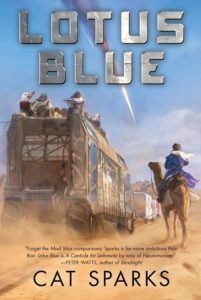
I’ve been attracted to post-apocalypse narratives since I was a kid so it was probably inevitable that I’d eventually try my hand at writing one.
In the 90s I volunteered as a photographer on a series of archaeological digs in Jordan. The villages near the dig house where we lived hadn’t changed much in a thousand years. Dig work was hard and rough, the landscape primitive and surreal, especially to a city gal like me not accustomed to getting her hands dirty. The mix of the old and the new world caught my attention: Bedouin living in tents with colour televisions and other mod cons. Oftentimes the landscape had a post-apocalyptic feel to it. The team was excavating Bronze Age sites, but I wouldn’t have been surprised had something utterly alien and inexplicable been unearthed.
These experiences, coupled with the imagery of Frank Herbert’s Dune, a book I adored as a teenager, and half-remembered classroom tales of European explorers starving to death in the Australian outback surrounded by food sources they couldn’t recognise, led me to Lotus Blue and its dead red heart.
6. Can you pinpoint a place in your career timeline when you had a writing epiphany that helped you move forward?
There have been a few small, yet impactful moments. Here’s one: I recall a few years back walking into my study and noticing for the first time just how many entirely filled, hand scrawled legal pads were teetering in towers, how many dog-eared books, how many scribbled-on scraps of paper scattered across the floor like autumn leaves. Me standing in the doorway comprehending that this was the end point. I wasn’t working towards a goal, I was standing in it.
7. Can you remember what story/novel made you think “I want to be a writer”?
There was never a particular story, it was more a state of mind. Reaching the point of engagement with the spec fic genre where being a consumer was no longer enough. I felt the burning urge to be a maker, to become a part of the fabric of the conversation.
8. Short fiction or long fiction?
As a reader, long, on account of the immersion factor.
9. How does Lotus Blue differ from your previous work? 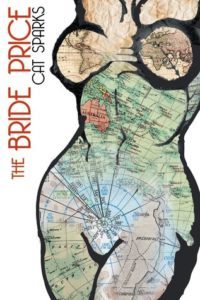
The novel took me somewhere around ten years to hammer into acceptable form, largely because I didn’t know what I was doing, having written short fiction for so long and not fully comprehending the vast technical differences between the two disparate forms.Lotus Blue started life as a secondary world fantasy under a different title. I binned at least 300,000 words across the decade. There is more of my own sweat, blood and gristle in Lotus Blue than in anything else I’ve ever written*.
* I reserve the right to amend this statement after I’ve handed in my PhD.
10. What’s next for Cat Sparks?
First up, I need to finish said PhD, which is running approximately a year and a half behind, unless I want to be a bit more honest with myself and admit that we’re probably talking two. Secondly, I need to learn to drive and get a freaking license. Last year my partner & I moved to a lovely wooden house on a hill in Canberra where public transport is as rare as rocking horse poop. Then finally, I would like to start work on a sci fi thriller set in the present day. I’ve got the idea sketched out already, just haven’t had the time to get stuck into it.
April 20, 2017
And for those of you playing at home …
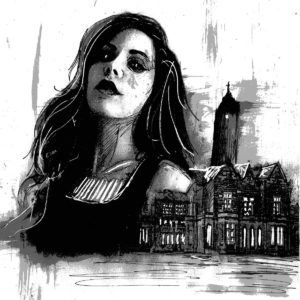
Luke Spooner
Part Three of “The Night Stair” is up at Gamut!
Here’s a snippet from the opening of the tale:
The Steward is a tall man, entirely bald, gaunt in the face, yet rotund in the belly. His legs in their loose fawn linen trews, look like a scarecrow’s, sticking out under the awning of his gut – perpetually in shade perhaps they don’t get enough light to grow. His tunic of padded green silk, his sable wool coat with its thick fur collar, are too warm even for the end of summer, but as marks of his office, must be seen, just like the yellow crystal hanging about his neck. Called the “Steward’s Gaze”, it’s the size of the top joint of a man’s thumb, and has passed from incumbent to incumbent for as long as anyone has the will to recall. He puts it in his mouth and sucks hard when he thinks no one is watching. It’s worth a king’s ransom, and I’ll warrant the gold chatelaine belt around his waist could buy the city’s food for half a year.
His finery makes me aware of the state of my black dress – not that it’s poor or made shiny by age, but it belonged to others before me. Both my sisters – my only full-blood siblings – wore it to their own choosing. I am certain I can smell them, their scents imprinted into the warp and weft of the fabric despite washing. The colour makes my skin paler, my eyes bluer, provides the perfect background for the tresses, which pour down my back like gold fresh from the smelter. I was careful, so careful with my toilette: brushing my hair, one hundred strokes; rubbing the cream that was my mother’s (comfrey and rose to soften and plump, a little lemon balm for lightening) into my skin; drops of eyebright to ensure my gaze is clear. I refrained from pinching my cheeks – pale is best – but I did nip gently at my lips, to carmine them a little, so it seems as if all life is concentrated there. I will not be found wanting.
I stand in line with seven other girls who have been presented this day. We are of an age, none more than sixteen springs, and there is only one of them, perhaps two, who might outdo me. To my right is Essa, with her milky skin and eyes like the sky reflected in ice, hair bright platinum; even her nails seem to have a silvery sheen. She watches me from the corner of her eye, just as I watch her.
To my left is Dimity, whose eyes are bright green, her cheeks with the tiniest hint of pink. She keeps her regard firmly fixed upon her own feet. Our Lady best likes girls who resemble herself; that is not Dimity for all her snow-washed whiteness – the eyes are all wrong and the eyes count.
So, Essa. Essa is the one to beat – the Steward will surely select between the two of us.
April 19, 2017
Supersonic Magazine
 The latest Supersonic Magazine has a lot of great fiction, reviews and articles – as do all of the issues! But this one is especially awesome for me as my version of Little Red Riding Hood, “Red Skein”, has been translated into Spanish!
Also, a most excellent cover, and look at those other contributors!