
Lari Don's Blog, page 8
March 5, 2012
Original Questions From School Visits
I'm in the middle of lots of school visits around World Book Day, which you'd think would only last a 'Day' but seems to last at least a fortnight!
One of the best things about lots of school visits is lots of great questions from pupils. I answer questions at the end of every session, so I probably answer dozens of questions a week, possibly even hundreds a week at this time of year.
What amazes me is I'm still being asked new, original and surprising questions. There are questions which come up pretty much every time (when did you become a writer, how many books have you written, what's your favourite book?) but I'm impressed that kids are still asking questions which I've not heard before, questions which make me think hard about my writing process.
The best question I got on World Book Day was from a pupil at Stockbridge Primary in Edinburgh, who asked: "What's more important for a writer, imagination or knowledge?" I thought that was fascinating, because creative writing teaching often concentrates entirely on imagination, but a story won't be convincing if it's full of errors. On the other hand, if you have lots of facts, but no flash of inspiration bouncing off the facts, then you haven't got a story. I came to the conclusion that both imagination and knowledge are vital, but that I start with imagination then fill the gaps with research. New writers are often told to "write what you know" but if I only wrote what I know, then I'd write boring books about making packed lunches. Instead I allow myself to imagine stories about injured centaurs or living rocking horses, then I research the time or place or biology and write about the NEW stuff I know.
Another question I was asked recently at Westercommon Primary in Glasgow was: "How do you know when a story is finished?" That's a brilliant question, because we spend a lot of time thinking about good ways to start stories, and we may not think hard enough about how to finish them. I explained that my stories are finished when my characters have solved the main problem. Because it isn't a story without a problem: a mystery, a quest, a baddie to be defeated. You spend the story trying to solve the problem, and once it's solved, the story is over. Boom. The End.
A pupil at St Mary's in Glasgow asked: "When you reach a certain age, will you want someone else to continue your work?" That made me laugh, because I never want to reach a certain age… But the serious point we discussed was whether someone else could carry on my work, indeed any writers' work, or whether it's individual to us. If a person's life work is campaigning for animal rights, or planting a forest, or running a jam factory, someone else probably could continue it, but no-one else could write my stories. Not exactly the way I write them. Because my stories come out of my thought processes, my experiences, my way of research, and my own individual (hard to explain and impossible to replicate) flashes of imagination. That's the magical thing about writing: we all write differently. So no, if I ever reach a certain age and stop writing, that will be it. No more Lari Don books. I'd better get a move on and write another one while I still can!
I've been asked other fascinating questions in the last few weeks, but my author events are noisy and fast moving, so I don't often remember the exact questions afterwards. If you asked an original question which I've not mentioned – sorry!
And if you can come up with a question which you think no-one has ever asked me before, please do ask it! You don't have to wait until next World Book Day or until I visit your school, just post a comment here or email me on: info@laridon.co.uk
And if any other writers want to share the best or most original questions they've been asked, I'd love to read them!


February 16, 2012
Drawing A Veil – Writing Right Outside Your Comfort Zone
My new novella, Drawing a Veil, is about a girl who decides to wear a headscarf to school, and her friends' and classmates' reaction to that decision.
I'm fascinated by the idea of choice, and how we deal with the awkward fact that if we support people's right to make free choices, then we also have to support them when they make a choice we may not agree with.
Writing this book did make me feel uncomfortable at times, and I know it made a few of my feminist friends uncomfortable too.
So is it a good idea to write about something which makes you feel uncomfortable or challenges the comfy assumptions you don't question often enough?
If I only wrote about decisions which I agreed with, if I only wrote stories which I felt happy and warm and cosy writing, then I probably wouldn't write anything worth reading. (A lot of Helen's risk-taking in the First Aid series, for example, makes me VERY nervous as a mum!)
So, even though I'm an atheist, who would never cover any bit of me up to please a god I don't believe in, I realised that if I want the right NOT to wear a headscarf, then I also have to stand up for other people's right to wear headscarves if that's what they want. (And of course, any girl's, or any woman's, right not to cover up if she doesn't want to.)
Also I think there's an assumption that all girls in veils or scarves are shy, unsure of themselves, hiding themselves. But when I talk to kids in schools about imagination and creativity, I see absolutely no difference in their levels of confidence or self esteem, whatever the girls are wearing on their heads. So I really wanted to write about a girl in a headscarf who stands up for herself, who takes part in an argument, a fight and a chase (because action is what I enjoy writing!)
This isn't the first time I've written about subjects which make me uncomfortable or make me question my own assumptions. In both Wolf Notes and Rocking Horse War, I've written about hunting and hunters, even though I've been a strict vegetarian since I was 14. So writing about wolves hunting deer, or girls tracking deer (poor deer are victims in a few of my books!) made me question my own reasons for being vegetarian. When I was researching wolves and how hunting led to their social networks and their intelligence, I seriously considered becoming an omnivore again, because that's what humans evolved to be. But after reflection, I decided my reasons for being vegetarian were more than just a long lasting fit of teenage pique, so I am still a proud veggie.
But the point is that I write about characters who believe very different things from me, and I allow those characters and their stories to make me examine my own beliefs. I think that's a very good thing. For the characters, for the stories and for me.
And how did spending time with Amina in Drawing a Veil change my comfy assumptions? Writing about this confident girl and her decisions made me realise that a freely taken decision to wear a headscarf can be a positive assertion of identity, rather than a passive adherence to family or religious pressure.
So – what beliefs or assumptions of yours could do with being taken out and examined by stories, characters and tough questions?
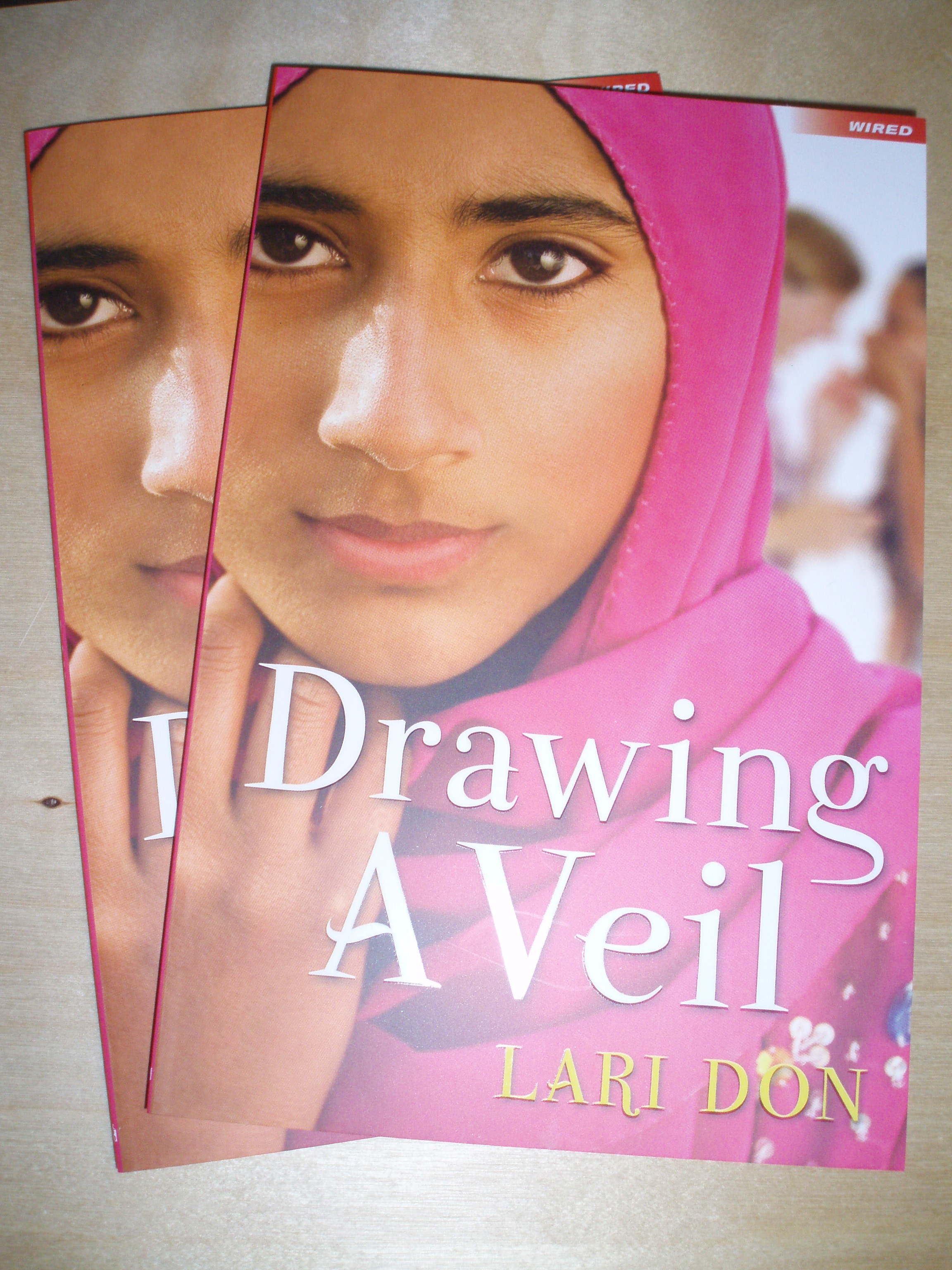
Drawing a Veil cover
February 2, 2012
Naming Your Newborn Book
I've chosen names for two children, and both times it was a lot easier than naming my next novel!
Titles are sometimes very easy to find. Some of my books have arrived in my head with titles almost fully formed. I had the idea, I thought 'oh, that could be a book!' and by the time I'd reached for a notebook to start scribbling the idea down, I already knew what title to put on the cover.
For example, Rocking Horse War and How to Make a Heron Happy were always the titles of those books. I never considered anything else.
And the title First Aid For Fairies And Other Fabled Beasts arrived very fast too. Though to be fair, I always expected someone (my mum, my agent, the publisher) to say, 'don't be daft, please come up with something shorter!' But no-one did; everyone seemed to like it. And it does describe the story pretty well!
However, it did leave me with a bit of a problem, which is that the title of every subsequent book in the series has to have the structure:
Something Something and other Something Somethings. Whew.
This has posed problems for every book. Wolf Notes as a title didn't appear until I was about 2/3 of the way through the book. I knew I wanted 'wolf' or 'fangs' in the title, but didn't know what else, until my husband found the phrase 'wolf notes', which I loved because it fitted the feel of the book. Though I have to admit that I went back through the story and changed a few bits of the plot to make the title fit perfectly.
Which poses an interesting question: do you write a different story if you already know the title? Do you write the story to FIT the title? Is it better to wait until the end of the plot-building to come up with a title, so you aren't pinned down by the title, or is it better to know the title at the start so you can keep the story focussed? I'm not sure – I've done both, and both ways have worked for me with different books. And of course, sometimes a writer will think they know the title of a book, but the editor will disagree, so the title changes at the last minute! (In which case, can the title ever really fit the book?)
Storm Singing was a title I liked right from the start of the writing process, and I agreed it with the editor early on – we even had the tricky second part (And Other Tangled Tasks) sorted too. So writing the book and that title went hand in hand, which meant the idea of Storm Singing was a vital part of the plot from the start.
But now I'm working on the fourth First Aid book. And this time I wrote the whole plotline with no idea what the title was going to be. I had a few ideas, but none fitted perfectly, and the ones I liked best my editor didn't like at all. So I finished the story, and started to edit it, still with no idea what the title was going to be. This felt very weird, because I had little signposts in the book to various potential titles, and I didn't know which were going to stay in and which were going to come out.
Then only two weeks ago, I came across a phrase which was PERFECT! It fitted the story, it even added another layer which I hadn't anticipated, and it sounded great! And not only that, my editor likes it too.
So… I can now announce that the title of the fourth and final First Aid for Fairies book is:
Maze Running And Other Magical Missions!
What do you think? Please let me know…
January 23, 2012
Happy Year of the Dragon!
The start of the Year of the Dragon has made me think about dragons. Though I don't really need to be encouraged to think about dragons – the book I'm deep in the middle of editing has seven speaking dragon parts, and any number of minor spear-carrying dragons. But this seems like a good time to celebrate other people's dragons too!
My favourite dragon books include:
The wonderful heartrending dragon in CS Lewis's The Voyage of the Dawn Treader, which is my earliest dragon memory.
The amazing How to Train Your Dragon series by Cressida Cowell, the funniest, cleverest, most exciting series of dragon books ever. Though I'm not sure I'd want Toothless under my helmet.
Philip Reeves' No Such Thing As Dragons, which is dark, spiky, tantalisingly short, and a fabulous novel for slightly older readers.
And the very similarly titled, but for much smaller people: There's No Such Thing As A Dragon by Jack Kent.
I also love the splendidly distant dragons in Vivien French's Flight of Dragons.
I have mixed feelings about Eragon and its sequels, partly because they are almost too big to hold, but also because I thought I'd been really original, creating a friendly female dragon, making her blue and calling her Sapphire. Then shortly after First Aid for Fairies was published, I read Eragon, and met his friendly blue female dragon, called Saphira. I'm very relieved about that final vowel.
I have a couple of favourite dragon reference books too (I'm not sure if you can call them non-fiction!)
My first dragon collection was A Book of Dragons, edited by Roger Lancelyn Green (though I see it has my wee brother's name on the first page, in pencil. Perhaps I could rub that out, because he's not getting it back now!)
And more recently, I've loved the wonderful tactile Dragonology books by Dr Ernest Drake (which aren't mine either – they belong to my kids.)
And finally, my favourite dragon myths.
I've enjoyed telling dragon myths for years, partly because they come with inbuilt excitement (a dragon! fire! teeth!), partly because they come from all over the world, and partly because it feels right to share dragon stories when I'm doing author sessions about the novels with Sapphire in them.
My favourite dragon stories to share include:
A seven-headed Chinese dragon
A Greek dragon who kept a shepherd boy company on the hills
A Viking dragon defeated by a sheepskin
A Polish dragon, also defeated by a sheepskin (some dragons are easily fooled)
A Persian dragon who teased a horse
A Georgian dragon who was sung to sleep
And an Irish dragon who lost his tongue
(If you want to find out more about these dragons, you'll have to ask me to come and tell you the stories!)
Dragons are universal, appearing as the monster of choice in many cultures and countries, so I'm fascinated by theories about where our dragon stories come from. Do we need monsters for our heroes to prove themselves against? Did our ancestors need explanations for those big fossilised bones and teeth? Or maybe, just maybe, these stories are about real dragons, and they're still out there, somewhere…
What are your favourite dragon books and stories? Please let me know!
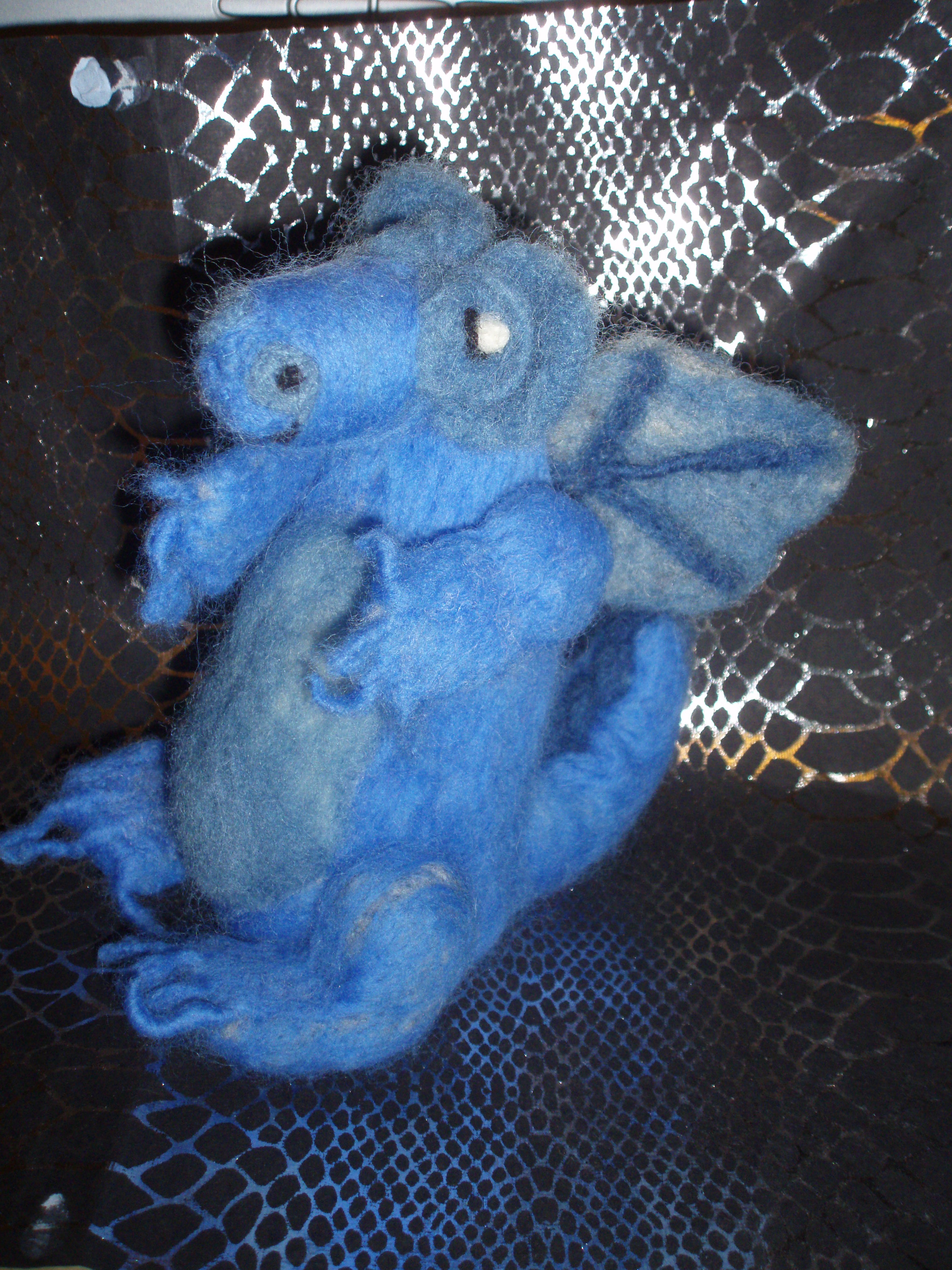
(And here is the dragon who sits beside my computer – hand made for me by a Sapphire fan!)
January 11, 2012
What if…? The birth of an idea, and how it felt
Today, I had an idea for a book. I thought "What if…?" and sudddenly there was the idea.
And because I scribbled down what happened at the time, I thought I would share it with you, because one of the questions I get asked most often is 'where do you get your ideas from?'
I was meant to be doing boring businessy stuff (it's the tax return deadline at the end of the month) so I thought I'd take a break from adding up numbers and make a list of the books I'd like to write next. Not the next book (that's First Aid 4) and not the one after that (I've started researching it) but what will I write after that. I started making a list of the ideas I'd had, to see which one seemed most fun. And as I typed an idea I'd got from one line of a previous novel, and always meant to follow up…
…it suddenly happened.
I found myself typing a line which started "what if they all…" and then a whole sentence and a question mark.
And I felt it. I actually FELT it. An idea.
My pulse got faster. My hands went a little bit cold. I sat up straighter.
I felt physically quite strange. Like I'd been running too fast, or just started a fever, or almost fallen over an edge but just caught myself in time.
My body actually reacted to this idea.
Then the idea took off. I stopped writing a list and started writing a book.
I started thinking of characters (and here is one answer to where do ideas come from – one of the characters seems to have leapt directly out of a nonfiction book I got for Christmas, so if I'd been reading a different book this week, this idea would have been different.)
Once I started thinking of characters, I started hearing their voices. I heard them talk to each other, insult each other, ask each other questions. They were meeting for the first time, and they didn't really like each other.
Then I thought about names, because I can't get to know characters until they have names. But names are tough. Every name has to mean something. And all the names I wanted for these characters were great for them, but didn't work in a cast of characters. My first attempt all had Ss in them. Every name started with S, ended with S or had S in the middle. Reading the book out loud would have sounded like snakes telling stories. Then my next attempt had all the names ending in A. That wasn't any better. So I got distracted by looking up lists of names on the internet
Then I had to stop, to be a mum, and take my daughter up to her sports club. So I got a fresh notebook and a pen, and I scribbled all the way up the road and through the park.
By this time, I was seeing the characters, not just hearing them. Maybe getting out into the fresh air helped. I could see a boy with long damp hair, a woman with a shivering animal in her arms. Wooden desks, and a large creature with a stony face in the corner…
So now I have a first scene, I have a problem to be solved, I have characters I already feel a connection to. I don't have time to WRITE it yet, but never mind. It's there. I'm excited about it, and I'll write it soon!
So THAT is how I get ideas. When I should be doing something else. From the magic words 'What if…' From passing thoughts I had when I was editing other books. And from whatever is around me or rattling round my head at the time.
The fact that I had such a strong reaction to this idea, and got so involved with the characters and the story, gives me confidence that it's a strong idea. I have ideas every day, I scribble dozens down when I'm listening to the radio, or chatting, or reading, or cooking. But very few of them become books. But I think this one will. I do hope so…
December 31, 2011
Hugging ebooks, cuddling Kindles
My new year's resolution for 2012 isn't to run more often, or spend less time at the computer and more time with real people (though I should do both of those too) it's to learn to love ebooks.
That's not going to be easy for me, for several reasons.
Firstly, I love books. Real actual paper books. I love sharing them with small kids on my knee. I love putting them in coat pockets, or carting rucksacks full of them about. I love piling them up, putting them on shelves, lending them to friends. I love opening a new book. I love READING BOOKS. Books, real books, are where I've spent many of my happiest hours, for most of my life. I love books. And I love that what I write becomes real books.
I love bookshops too. Real bookshops. Staffed by real booksellers, with a real understanding of books and bookbuyers. Shops where you can find a book you didn't even know you wanted to read. And I love that my books sit on shelves in those shops, and get browsed, recommended and bought, in those bookshops.
Also I'm not a fan of new technology. I'm never at the cutting edge of anything digital. I have the oldest phone in my family (even my kids have fancier ones). I like to see a new thing work in the hands of other people for a while before I accept that it might be a good thing. I'm not actually a technophobe. Once someone can persuade me it's useful and not going to bite me, I get to grips with it eventually. I have a netbook which I love, and an ipod which I couldn't live without. But I don't have an ereader. I thought about asking Santa for one, and then changed my mind and gave Santa a list of books about mazes, dragons, hares, and Scottish history instead. I love my new pile of books. I'm not jealous of all the people who got Kindles. I can read my books in the bath.
I worry about the effect ebooks will have on real books, and real booksellers. And I don't trust new technology anyway, not until it becomes slightly older technology.
But…
BUT…
BUT…
People read ebooks. Kids, lots of kids, got ebook readers for Christmas.
So if I want people to meet and care about my characters, to join in the adventures I've imagined, to be excited by the dangers and challenges I've created, if I want people to read my STORIES, then I have to share those stories in the way readers want to read them.
If you want ebooks, then that's how my characters will have to come and find you.
So this coming year, I will try to understand ebooks. I will accept them. I will even learn to love them. Next time I see someone reading a Kindle, I will ask them if I can give it a cuddle. Because I need to learn to embrace ebooks. Not for me, I think I'll probably stick with my teetering piles of books, but for my stories, my characters, my readers.
Because however you want to get your stories, that's how writers should to give you your stories.
So, please let me know what you think of ebooks: Did you get an ereader for Christmas? Do you think children's books should be on screen or on paper? Do you enjoy books as much on a screen? And can real books survive?
But in the meantime, here's my New Year's resolution for 2012: cuddling ebooks.
And in honour of this, I can now announce that all my novels are available in ebook form. And First Aid for Fairies and Other Fabled Beasts, the first in the series, is on Amazon's 12 Days of Kindle until 6th Jan at only 99p.
See, I'm promoting ebooks already. Getting off to a great start. Now, I need to find an ebook reader to cuddle. You've been warned…
December 27, 2011
Reaching the End
(This is a replacement post for one which went missing when my website crashed on Boxing Day – something very similar to this, but not exactly the same, was originally posted mid December)
I've finished First Aid Four!
Which sounds very impressive, but really, though I've typed the words "The End", this is just the beginning.
I've reached the end of the STORY, I know what happens in the end, and how it happens, but now I have to go all the way back to Chapter 1 and make it work properly. I always end up discovering new things about the characters and the plot on the way to the end, which means I have to go back and tweak things at the start and in the middle.
Also this draft is far too long, very repetitive and not very well written. Nope. It's not very well written. Which is fine. I never worry about the words when I'm writing a first draft, I just try to follow the story and hear the characters. So now I need to take out the clichés and the long-winded sentences, and make the language sharper and stronger. I really enjoy cutting and tidying a story. The first draft is my way of discovering the story, and the editing brings it to .
So having rattled through writing the novel I will now spend several happy months editing it.
However, I wasn't always happy when I was writing it (quite aside from nagging feelings of guilt about all those dreadful injuries and terrible dangers). In the last week of writing, when I was working out how to defeat the baddie and trying to find a happy ending for anyone left standing, I was starting to feel quite strange. Nervous. Sad. And I couldn't work out why. Until I realised that this is the last book in the series. There were only ever meant to be four First Aid for Fairies books. And this is the last one.
So this is the last book I will write with Helen, Yann, Lavender, all their friends and all their enemies. And I'm going to miss them.
I know I'm going to spend the next few months editing this book. And probably the rest of my life reading bits of all the books in the series out loud in school halls. But last week when I was able to see the end of the story, it was like I was reaching the end of a journey with these characters. Editing is really just writing the postcards and tidying the photos. We've already done the exciting bit. So I feel like I'm already saying good bye to them.
Normally when I'm finishing a book, I find it fairly easy to say bye to the characters because I'm already making scribbly notes about a possible sequel. But this time, I haven't been doing that, and even though it was my decision to make this a series of four, because I have other books I want to write, I do feel very sad that I'm not going to spend more time with Helen and the fabled beasts. I feel like I'm walking away from them!
So this time, the end really is the end. But I still have all that editing to do, so I'd better get back to it…
November 28, 2011
Defeating the baddie with a well-sharpened rereading
I've now defeated baddies in four different novels. But that adds up to a lot more than four baddies.
I'm counting right now, and if you include minions, packs of slightly untrustworthy wolves, and creatures up to no good making the lives of my goodies more difficult, I think I've come up with ways of destroying, defeating, evading or embarrassing at least 13 different baddies or groups of baddies.
But when I started writing each book I didn't know how I was how going to defeat any of them. I almost think that would be cheating, to have a baddie that I already knew how I was going to deal with.
Because the goodies don't know. They don't have any idea what they are going to do, and I like it like that. They are scared and nervous and confused and often don't know what the baddie's agenda is, or even all their powers. Usually, as the writer, I do at least have that information before them.
I can build the baddie to be as nasty or strong or clever or tricky as I like. But I certainly DON'T deliberately build in any weaknesses. I don't have some kind of washing machine style built-in obsolescence.
Because I want a real baddie not a cardboard pushover.
When I'm writing, there comes a point about two thirds or three quarters of the way through the book when I start to see how the final battle or confrontation is going to happen. I call it the endgame, and when it slowly starts to form in my mind, that's usually when I begin to see how to defeat the baddie.
In the book I'm writing now, the fourth First Aid for Fairies book, I knew who had to defeat the baddie (you'll see who and I'm sure you'll understand why when you read the book), I was starting to see where it had to happen, and once Helen made a very daft mistake, I even knew why it had to happen. But I didn't know how. No idea. I have this great big clever powerful highly-armed baddie. And no idea how to defeat him.
This is ok. This has always happened to me. I'm starting to assume that it always will and that it's just part of how I write.
But this time it was getting a bit worrying. I am now on chapter 26 of the book. There will only be about 30 chapters. I'm very nearly at the endgame. And last week, I had no idea how it was going to end. Not an inkling, not a tiny little clue. I've never taken so long to see how to defeat the baddie before… I was starting to wonder if this particular monster was too much for me.
But then I went back and reread the rest of the manuscript. I read the first trap, the four quests, the dragon riddles. I was actually rereading it to check I hadn't left any silly loose ends. But while I was rereading, I suddenly realised how to defeat the baddie! It was there all along. It was in what I had already written. Everything I needed was already there!
This is why I have complete faith in the writing process, because whenever I have a big problem to solve, the answer is usually there in the small details of what I've already written.
A Scottish writer called Janet Paisley said pretty much the same thing at a workshop I went to years ago at the Edinburgh Book Festival: if you have a plot problem the answer is probably in what you've already written.
I'm pretty sure that doesn't hold true for plot problems in the first two paragraphs, but if you've got thousands of words and a good knowledge of your characters, then you probably already have all the tools and weapons you need to defeat that baddie!
So, now I know what we're going to do. Fabled beasts, let's go get him!
November 23, 2011
The joy of picture books
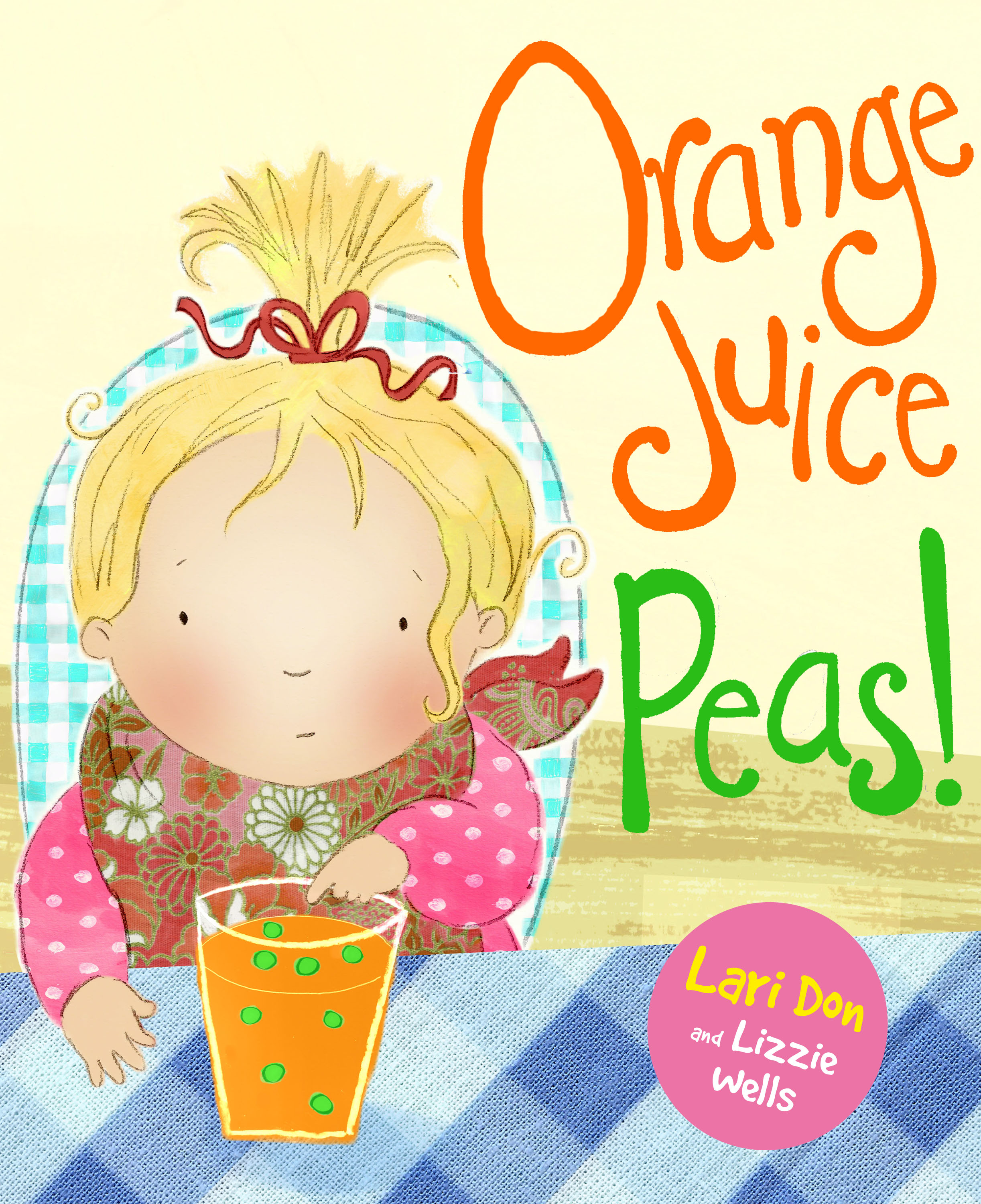
Cute is pretty much a swearword in our house these days, both my children having grown out of thinking "well, aren't you cute!" is a compliment. But there are now two really cute kids around again, because I've seen all the finished pictures for my next picture book: Orange Juice Peas. And the Floris 2012 catalogue is out, so I can show it to you, or the cover, at least.
The two kids in Orange Juice Peas, Jessie and Ben, are SO CUTE. And that's not an insult, it's just a fact!
It was a joy watching both of them come to life in sketches, roughs and final pictures by the wonderful illustrator Lizzie Wells. That's the best thing about picture books. I have the idea, I write the words and I create the story, but the illustrator brings the characters to life. It's nerve-wracking meeting my creations for the first time in a picture, just in case they look somehow wrong. There are lots of ways for a character to look right, not just one way, but there are just as many ways for them to look wrong.
But this time it's fine, lots more than fine, because Lizzie has brought Jessie and Ben (and their cat, their babysitter, and their dad's hairy legs) to life wonderfully.
So picture books really are teamwork. Novels are teamwork too, with the editor an essential part towards the end of the process. But picture books are more obviously teamwork. And if you get a great illustrator, who tells the story in expressions and movement, then the writer can back off a bit and take some words out again.
I sometimes get asked 'Do you have your own illustrator?' No, I don't. I don't keep an artist in the cupboard, or the fridge, or under the desk. But I think the question means: are all my books illustrated by the same person? And no, they're not.
Sometimes I think it would be nice to have a recognisable style to all my picture books, so that people could say, 'oh, that's the new Lari Don and x book.' But it's also good to have exactly the right artist for each book, because they are all different stories, with different characters, in different realities.
Gabby Grant's funny cheeky polite pictures were perfect for The Big Bottom Hunt, Nicola O'Byrne's simple panoramic style was ideal for How to Make a Heron Happy and now that I've seen them, I know that Lizzie Wells' colour, energy and CUTE faces are wonderful for Orange Juice Peas.
I wonder who will illustrate my next story? No idea. But for now, I'll just smile at the cover of Orange Juice Peas:
November 16, 2011
The weirdest photo call I've ever done
The winner of the Set the Scene competition, to suggest a location for the fourth and final First Aid for Fairies book, is:
EMILY WRIGHT!
She suggested the gorgeous Traquair House and (this is what won it for her) Traquair House Maze….
Today I met Emily at the maze to present her prize, with various photographers and journalists there taking pictures and interviewing her.
Emily was fabulous. Really calm, patient and great at answering questions.
But it was one of the weirdest photo calls I've ever done…
Because we were presenting the prize in the maze. So a nice man showed my publisher the quick way to the middle, then he went off and left us.
But all the journalists and photographers turned up at different times, and once we'd taken the first journalist into the middle, all the press who arrived later got lost on their way in! We were in the middle getting our photo taken (which is my least favourite bit of being an author) and we kept hearing footsteps wandering around a few hedges away, so we'd have to shout: "Are you here for the photocall? Are you lost? Do you need us to come and find you?" The lady from Borders TV managed to fit herself and her camera through a little hole in the hedge, which was very impressive.
So it was quite spooky and very dramatic doing an interview in the middle of these high hedges, with lost people all around, and with my publisher shouting instructions like "left, no the next left, oh you've gone too far, go back…"
Then everyone else went away, leaving me and Emily in the middle of the maze on our own, so they could get a nice picture from high up on the terrace of Traquair House. They left us. In the maze. On our own.
And I wasn't the one who'd been shown the way in or out!
So, has it taken me til this evening to escape?
No, it's ok – they came to get us out eventually, but the feeling of being stuck in there was pretty good practice for imagining Helen and Yann trapped in there… which I should probably go off and write now!
So well done Emily, and well done the brilliant runners up, from Inverkip, Tain, Ullapool and Falkirk. And well done too to the other 250 kids who entered. It was very hard to choose a winner, because all the ideas were fabulous. I wish I could write a book about every single one of them. But I can't, or not this year anyway! But you all have great imaginations and you all know your suggested locations really well, so why you don't set an adventure there yourself and let me see what you come up with!
Here are some photos of me and Emily at the maze!
And please notice, I managed this whole blog without using the word "amazing" at any point. I wonder if the local press will be as be restrained.
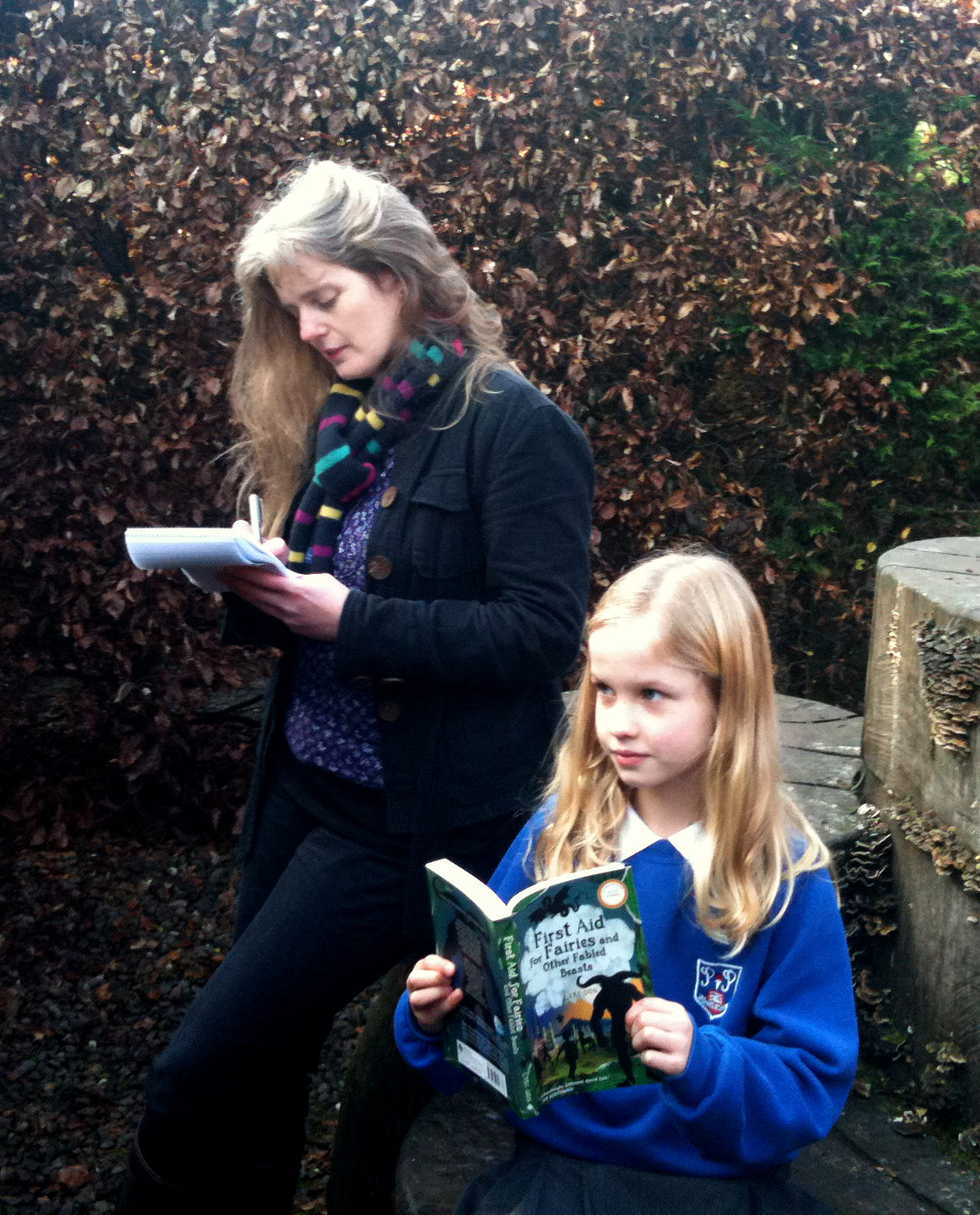
Lari and Emily posing completely naturally
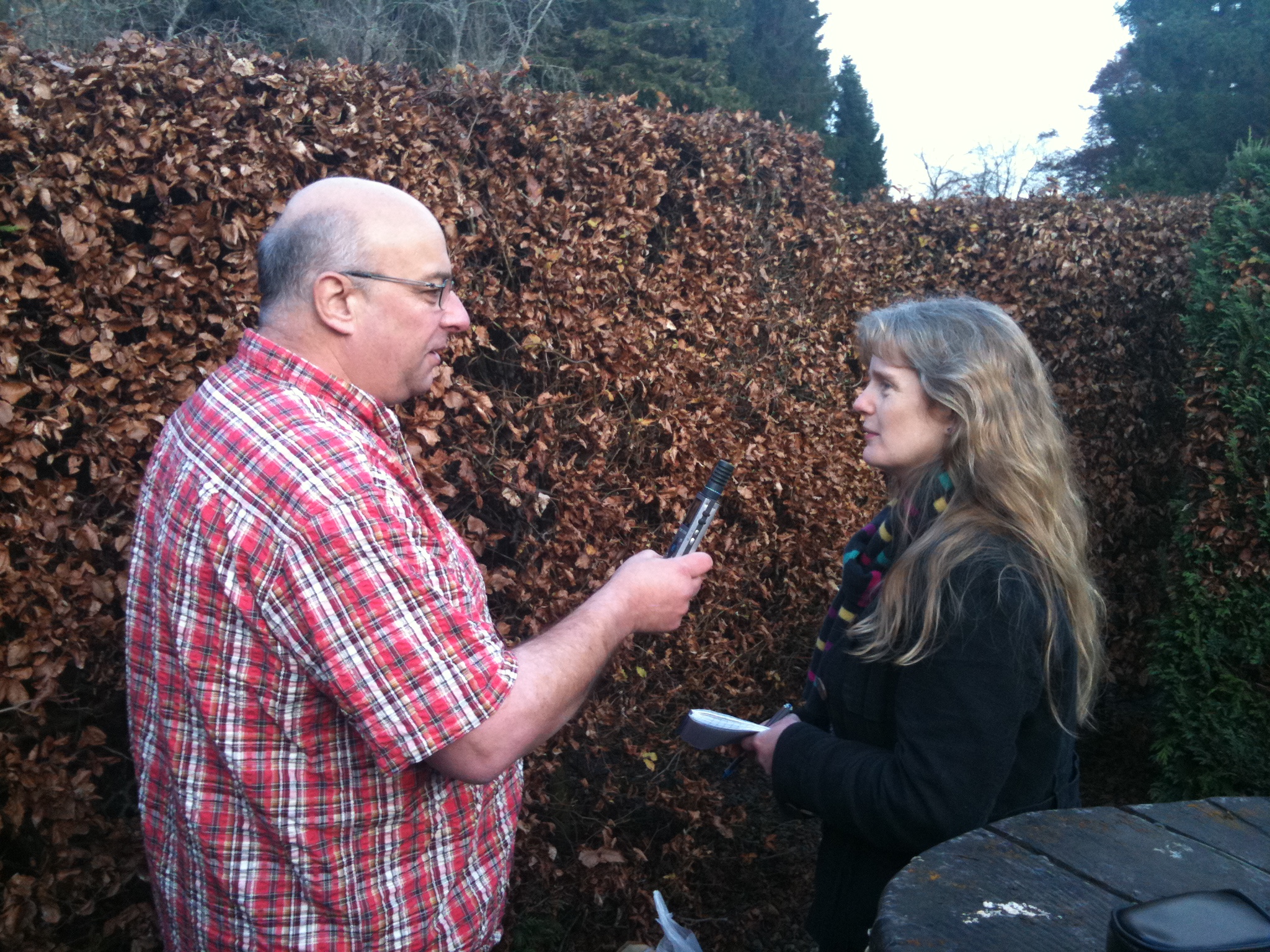
Lari being interviewed by an intrepid BBC reporter who found his way in
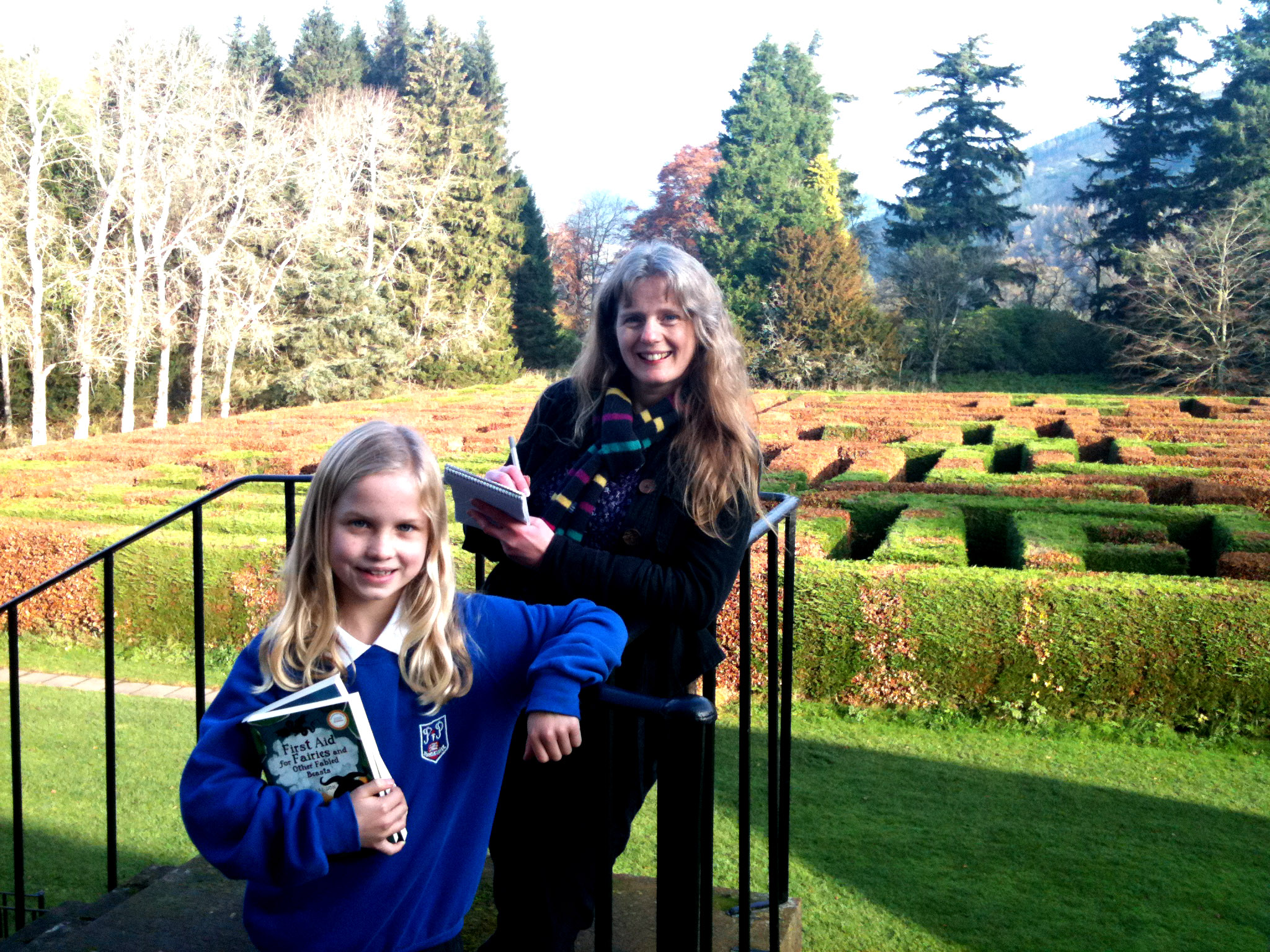
We escaped! And doesn't the maze look wonderful?


