Ian Plenderleith's Blog, page 3
January 8, 2015
Over-rated, Overpaid and Over There - Gerrard and Lampard in MLS
When European players come to Major League Soccer on European wages, we fondly remember the North American Soccer League and the dash for green-backed cash that followed Pele's 1975 signing for the New York Cosmos. Suddenly, every club wanted its own superstar, and the strain which this trend put on owners' finances was one of the chief reasons that many clubs went under, dragging the league down with them.
 Paul Gardner: "You know that
the English over-rate their players."
MLS initially eschewed such profligate policies, just as it rejected everything else in the NASL's boom-bust methodology. Then in response to pressure from the LA Galaxy, who were being whispered to by the David Beckham Industry, it relaxed its rules in 2006 to allow clubs the option of signing a handful of big name players on fat wages. It seemed a timely move, but opened up the league to the morose old criticism that America would again attract ageing stars on the hunt for a lucrative final payoff. True, Beckham would ensure that MLS became internationally known overnight. But if he played well, that just proved how poor the league was. And if he failed, that just proved that he was over the hill.
It might unkindly be suggested that Steven Gerrard's move to MLS finally means he won't be the most over-rated player in his chosen league. Reading the eulogies in the UK press these past few days, you'd be forgiven for thinking that the Galaxy has signed a meta-star with the combined skills of Messi, Maradona and Mohammed Ali, rather than an above average club player who is sporadically inspired to the spectacular, but has never lifted a League trophy or a World Cup.
It's no coincidence that the other player in the transatlantic soccer news this week has been Gerrard's former England team-mate Frank Lampard, for reneging on his commitment to debut for New York City FC at the start of its first MLS season. Again, another solid club player. Yet he and Gerrard, touted as the supposedly shining nuggets of England's golden generation, were a repeated disappointment on the international stage. After several mediocre tournaments, Gerrard was England's best player at Euro 2012, but his team-mates didn't offer much competition, and they went out on penalties after playing dire football in the 0-0 quarter-final against Italy. The England team has been tellingly revitalised since the pair retired from the international game.
Their two big-name predecessors in MLS, Beckham and Thierry Henry, did enough to justify selection for their respective teams, LA and New York, but were they were worth their extravagant wages? It's impossible to quantify, though the league's marketing arm will argue they lead to the exposure that has lured the New York Yankees and petro-dollar backed Manchester City to invest in Lampard's New York team.
On the other hand, it takes a leap of the imagination to see the millions reportedly being spent on the wages of Gerrard and Lampard as anything other then the enrichment of two already very wealthy Englishmen. It may be facile to say those millions could be better spent on inner-city turf fields and a fund to support talented but impoverished young American players. And indeed, if it wasn't being spent on England's decreasingly pacey ex-central midfielders, it would probably be staying in the owners' pockets. Nonetheless, I'm calling these signings out for what they are - a waste of money in the name of jacking up the league's profile.
"Those guys, the theory is, just show up and the crowds come flocking in," says sceptical journalist Paul Gardner in chapter three of Rock n Roll Soccer. Gardner, who has covered the US game for 50 years, was drawing a parallel between the NASL's marquee signings, and the arrival of Beckham in MLS 30 years later. "You know that the English over-rate their players anyway, and if they [Americans] don’t know that by now then there’s not much hope. The reason the Brits of course were imported [to the NASL] and became popular was simply the language. You want to sell the sport, you want to have players with personality who can go on TV and mix with the local populace, you’ve got to have them speak the language. There was a logic involved to the whole thing, but it was unfortunate because it meant bringing in a certain brand of soccer and that meant certain attitudes that came along with it. Just take a look at British soccer… the sad thing was [that even in 1975] they were playing dull, out-dated soccer."
Gardner wasn't referring to the players who came to the nascent NASL in the late 60s and early 70s looking to make a little extra summer cash. Many of those players ended up falling in love with North America and stayed around to coach and run soccer schools. Gerrard and Lampard, in contrast, are not in the US to 'grow the game', to use that Beckham-flogged cliché. They are here in a mutual pact with their clubs to exploit their reputations in upping the hype. Check out Gerrard's press-released, wooden words this week on his reasons for coming to LA:
"I'm very excited to begin the next chapter of my career in the United States. The Galaxy are the most successful club in MLS history and I'm looking forward to competing for more championships in the years to come. I want to add some medals and trophies to my collection."
Finally, a League winner's medal for Steven. That's the script which he, his club, the league, and the more invested sections of the media will be reading off until it eventually happens. There's no doubt that Gerrard and Lampard will perform well in MLS. In the long term, however, they will give the US game as much as they gave England's midfield - publicity-inspired expectations, but nothing of much substance.
 Paul Gardner: "You know that
the English over-rate their players."
MLS initially eschewed such profligate policies, just as it rejected everything else in the NASL's boom-bust methodology. Then in response to pressure from the LA Galaxy, who were being whispered to by the David Beckham Industry, it relaxed its rules in 2006 to allow clubs the option of signing a handful of big name players on fat wages. It seemed a timely move, but opened up the league to the morose old criticism that America would again attract ageing stars on the hunt for a lucrative final payoff. True, Beckham would ensure that MLS became internationally known overnight. But if he played well, that just proved how poor the league was. And if he failed, that just proved that he was over the hill.
It might unkindly be suggested that Steven Gerrard's move to MLS finally means he won't be the most over-rated player in his chosen league. Reading the eulogies in the UK press these past few days, you'd be forgiven for thinking that the Galaxy has signed a meta-star with the combined skills of Messi, Maradona and Mohammed Ali, rather than an above average club player who is sporadically inspired to the spectacular, but has never lifted a League trophy or a World Cup.
It's no coincidence that the other player in the transatlantic soccer news this week has been Gerrard's former England team-mate Frank Lampard, for reneging on his commitment to debut for New York City FC at the start of its first MLS season. Again, another solid club player. Yet he and Gerrard, touted as the supposedly shining nuggets of England's golden generation, were a repeated disappointment on the international stage. After several mediocre tournaments, Gerrard was England's best player at Euro 2012, but his team-mates didn't offer much competition, and they went out on penalties after playing dire football in the 0-0 quarter-final against Italy. The England team has been tellingly revitalised since the pair retired from the international game.
Their two big-name predecessors in MLS, Beckham and Thierry Henry, did enough to justify selection for their respective teams, LA and New York, but were they were worth their extravagant wages? It's impossible to quantify, though the league's marketing arm will argue they lead to the exposure that has lured the New York Yankees and petro-dollar backed Manchester City to invest in Lampard's New York team.
On the other hand, it takes a leap of the imagination to see the millions reportedly being spent on the wages of Gerrard and Lampard as anything other then the enrichment of two already very wealthy Englishmen. It may be facile to say those millions could be better spent on inner-city turf fields and a fund to support talented but impoverished young American players. And indeed, if it wasn't being spent on England's decreasingly pacey ex-central midfielders, it would probably be staying in the owners' pockets. Nonetheless, I'm calling these signings out for what they are - a waste of money in the name of jacking up the league's profile.
"Those guys, the theory is, just show up and the crowds come flocking in," says sceptical journalist Paul Gardner in chapter three of Rock n Roll Soccer. Gardner, who has covered the US game for 50 years, was drawing a parallel between the NASL's marquee signings, and the arrival of Beckham in MLS 30 years later. "You know that the English over-rate their players anyway, and if they [Americans] don’t know that by now then there’s not much hope. The reason the Brits of course were imported [to the NASL] and became popular was simply the language. You want to sell the sport, you want to have players with personality who can go on TV and mix with the local populace, you’ve got to have them speak the language. There was a logic involved to the whole thing, but it was unfortunate because it meant bringing in a certain brand of soccer and that meant certain attitudes that came along with it. Just take a look at British soccer… the sad thing was [that even in 1975] they were playing dull, out-dated soccer."
Gardner wasn't referring to the players who came to the nascent NASL in the late 60s and early 70s looking to make a little extra summer cash. Many of those players ended up falling in love with North America and stayed around to coach and run soccer schools. Gerrard and Lampard, in contrast, are not in the US to 'grow the game', to use that Beckham-flogged cliché. They are here in a mutual pact with their clubs to exploit their reputations in upping the hype. Check out Gerrard's press-released, wooden words this week on his reasons for coming to LA:
"I'm very excited to begin the next chapter of my career in the United States. The Galaxy are the most successful club in MLS history and I'm looking forward to competing for more championships in the years to come. I want to add some medals and trophies to my collection."
Finally, a League winner's medal for Steven. That's the script which he, his club, the league, and the more invested sections of the media will be reading off until it eventually happens. There's no doubt that Gerrard and Lampard will perform well in MLS. In the long term, however, they will give the US game as much as they gave England's midfield - publicity-inspired expectations, but nothing of much substance.


October 28, 2014
"Obviously one of the best football books for years..."
The good folks at Got, Not Got - the pictorial-centric book series for those of us who gorge on football nostalgia rather than moan about and mourn over the absurd hype of the modern game - have written up a stunningly positive review of
Rock 'n' Roll Soccer
here:
 Got, Not Got - they get it."As the definitive story of the genius concept/trainwreck of the North American Soccer League, Ian Plenderleith’s Rock ‘n' Roll Soccer is obsessively detailed, hilarious and subtly mindblowing – a revolutionary revision of history based entirely on original research and interviews with a litany of movers, shakers and ex-players.
"This is obviously one of the best football books for years, moving way beyond the standard jokey cliches of the NASL – the fat old pros in cowboy-fringed shirts, the rule-tampering, the cheerleaders – to reveal the nascent American league of the 70s and 80s as nothing less than a blueprint for our own ‘modern’ game.
"That’s right: everything we sniggered about back then is now pushed into our cheery upturned faces week on week, rebranded as the ‘Premier’ League. Ha ha ha ha: three points for a win, names on jerseys, squad numbers, an avalanche of stats, multi subs, no backpasses, female-friendliness and bullshit marketing by the agency-load. The difference is, the NASL was experimental, innovative and creative.
"Don’t worry, this is far more than merely enlightening and entertaining; there are plenty of anorak rock ‘n’ roll parallels and arsey jokes, too."
 Got, Not Got - they get it."As the definitive story of the genius concept/trainwreck of the North American Soccer League, Ian Plenderleith’s Rock ‘n' Roll Soccer is obsessively detailed, hilarious and subtly mindblowing – a revolutionary revision of history based entirely on original research and interviews with a litany of movers, shakers and ex-players.
"This is obviously one of the best football books for years, moving way beyond the standard jokey cliches of the NASL – the fat old pros in cowboy-fringed shirts, the rule-tampering, the cheerleaders – to reveal the nascent American league of the 70s and 80s as nothing less than a blueprint for our own ‘modern’ game.
"That’s right: everything we sniggered about back then is now pushed into our cheery upturned faces week on week, rebranded as the ‘Premier’ League. Ha ha ha ha: three points for a win, names on jerseys, squad numbers, an avalanche of stats, multi subs, no backpasses, female-friendliness and bullshit marketing by the agency-load. The difference is, the NASL was experimental, innovative and creative.
"Don’t worry, this is far more than merely enlightening and entertaining; there are plenty of anorak rock ‘n’ roll parallels and arsey jokes, too."
October 9, 2014
"Well worth your hard-earned buck"
 Pink rocksMany thanks to the print and digital magazine The Football Pink for its generous appraisal of Rock n Roll Soccer. So many nice quotes to choose from. In addition to the headline above, let's go with:
"Plenderleith’s superbly researched, fact-packed book sets out not only to recap the excesses we know about [the NASL], but also to remind us and celebrate that, with so many of its innovations it was ahead of its time. There was so much more to the NASL than cheerleaders, fireworks and razzmattaz – but in the good old US of A, there’s no reason you can’t throw them in for good measure!
"[....] As you might expect, some of the more well-worn topics are covered in great detail in Rock n Roll Soccer – financial ruin, gimmickry, rule changes, the import of ageing foreigners like Pelé, Beckenbauer, Best, Marsh and Cruyff, the English influence, the girls and the parties…
"But you’ll also find out a lot of stuff from the periphery and the far-flung outposts of the NASL that you may never have known without reading this book. The league wasn’t just about the New York Cosmos, you know!
"Plenderleith also pokes around the murky world of the moneymen and politicians of the NASL and how, eventually, those in charge really didn’t have the first idea how to run a soccer club or a league (the Jimmy Hill chapter was an eye opener for me).
"As well as being an engrossing eulogy to the madness and magic of [the] NASL, there’s a healthy smattering of entertaining facts and stats intertwined between chapters. This book is highly recommended whether or not you’re an aficionado of NASL or MLS. This cautionary tale is part of our game’s weird and wonderful history and one that is too often shrugged off with snobbish disdain by European observers as a mere far-away, inconsequential circus. Once you read this book, you’re likely to have changed your mind. The NASL’s legacy may be more visible than you think."
October 6, 2014
TLS Review of "raffish" Rock n Roll Soccer
 "Raffish? Me? I say!"Well, I feel all grown up now that the Times Literary Supplement has reviewed
Rock n Roll Soccer
. As though I haven't just written a book about football, but I have written actual literature. The TLS doesn't have anything as vulgar as a Sports section, but it does, apparently, review books about sport on occasion, and in its edition of September 26, 2014, nicely summarized the contents of my book and, without giving me anything like a 'Read this NOW!' quote for publicity purposes, seemed to like it. In fact the reviewer tweeted that he "loved it", but what goes out on Twitter obviously would not be fit for the carefully honed print pages of the TLS. Here's an extract:
"Raffish? Me? I say!"Well, I feel all grown up now that the Times Literary Supplement has reviewed
Rock n Roll Soccer
. As though I haven't just written a book about football, but I have written actual literature. The TLS doesn't have anything as vulgar as a Sports section, but it does, apparently, review books about sport on occasion, and in its edition of September 26, 2014, nicely summarized the contents of my book and, without giving me anything like a 'Read this NOW!' quote for publicity purposes, seemed to like it. In fact the reviewer tweeted that he "loved it", but what goes out on Twitter obviously would not be fit for the carefully honed print pages of the TLS. Here's an extract:"Written with a raffish exuberance worthy of its subject, Rock n Roll Soccer offers a more generous take [than the common perception] on the ill-fated NASL. Yes, it was foolishly short-sighted to try to establish clubs in places like Las Vegas and Hawaii, but there was plenty to admire about the audacity and enterprise of a project that brought together footballers like Pelé, Eusebio, George Best and Franz Beckenbauer. In forcing Association Football onto the radar of US popular consciousness, it ultimately paved the way for the more sustainable, low-key success of Major League Soccer. If the enthusiasm of the American public during the recent World Cup is anything to go by, it hasn't all been in vain.
"Rock n Roll Soccer challenges the parochial assumptions that have skewed the NASL narrative in England - in particular, the idea of English football as a paragon of sporting authenticity. The English football culture of the 1970s was far from perfect: on the pitch, tactics were increasingly defensive and negative; off the pitch, as Ian Plenderleith correctly observes, the hooligan violence that blighted the decade 'no more reflected a passion for soccer than cheering teams of choreographed dancing girls and cheap hot dog promotions'.
"Plenderleith maintains that the NASL was actually ahead of its time, its showbiz trappings, a harbinger of the brazen commercialism that would come to dominate the English game from the 1990s onwards, with the advent of Sky TV and the English Premier League...."
September 28, 2014
"An excellent work of sports journalism"
 Transgress points the wayOne of my favourite reviews of
Rock n Roll Soccer
so far was published this weekend by Transgress Magazine, and not just because of the above quote. The reviewer really 'got' the book and what it's attempting to say. In his words:
Transgress points the wayOne of my favourite reviews of
Rock n Roll Soccer
so far was published this weekend by Transgress Magazine, and not just because of the above quote. The reviewer really 'got' the book and what it's attempting to say. In his words:"Plenderleith documents the folly, effrontery and ultimate failure of the NASL—an impressively thorough tome that benefits from solid research and a witty outsider’s perspective (though now living in America, Plenderleith is British and brings a European’s passion and insight to football writing).
"One of Plenderleith’s great accomplishments in this book is his ability to zoom in and out of the action while keeping the reader engaged. This is not an easy task. At times, he’ll be recounting the exaggerated drug- and drink-fueled antics of over-the-hill international stars and young Americans performing in a flamboyant, fly-by-night federation that defied, in equal measure, rules, tradition and, ahem, sound business practice.
"Then Plenderleith will step back and establish the international and cultural context within which the NASL was operating. At first, the international audience mocked the upstart Americans, and FIFA pushed back against the young league that was tinkering with tradition.
"But as the NASL achieved early success, the world took notice. While it didn’t reinvent the sport, the outlaw league reinvigorated it by making it a fan-friendly experience and drove rule changes that increased substitutions and decreased back passes.
"The model, though exciting, was as unsustainable as that alcohol-fueled borderline relationship you had in college. The peaks were unforgettable, but the valleys unbearable. Sure enough, the NASL folded following the 1984 season.
"It was an experiment and experience that was thoroughly American, and though the league didn’t last, it left a lasting impression on the game and paved the way for MLS success.
"Rock ‘n’ Roll Soccer is an excellent work of sports journalism and, regardless of whether you follow football or futbol (or both), it is worthy of any fan’s bookshelf."
September 22, 2014
Independent on Sunday: 'Book of the Week'
 IoS: clearly a paper of
taste and distinctionNot much more to add to that. The Independent on Sunday sports section on September 21 named Rock n Roll Soccer as its Book of the Week, and praised it as a "compendious but vividly entertaining history of the League". They are so right.
September 9, 2014
Sunday Mirror review: three errors in 47 words
The Sunday Mirror did me the immense favour of reviewing Rock n Roll Soccer this past weekend. It was an astonishing achievement. Not to sound ungrateful or anything, but in the space of just 47 words, the review not only failed to even remotely convey what the book is about, but also managed to make three gross factual errors (or five, if you take into account that one of the errors is tripartite). It also made a grammatical error and a terminology error. That’s an impressive rate of around one mistake every seven words.
Here’s the review in full:
“A nostalgic trip through the early years of the North American Soccer League, the harbinger for what we now know as the lucrative MLS. Its struggle to stay afloat and be accepted by FIFA is fascinatingly explained, with cameos from legends Pele, George Best and Bobby Moore.”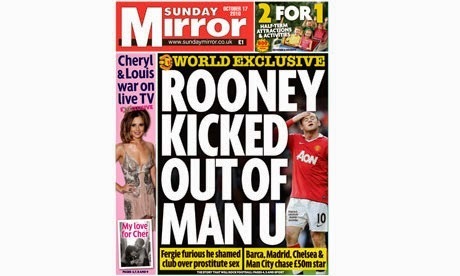 Mirror, Mirror, on the ball...
Error one : it’s not a trip through “the early years” of the NASL. In fact “the early years” only make up about one tenth of the book. It’s an account of all 17 years of the NASL.
Error two (discounting the following grammatical error - you can only be “a harbinger of” something, not “a harbinger for”; and Major League Soccer is known as “MLS”, not “the MLS”): MLS is not “lucrative”, it is a league that prides itself on its attempts to be financially stable, having learned from the mistakes of the NASL. It has been lucrative for David Beckham, and it may well one day become lucrative for its current owners, but that’s all a long way off – many of its teams have only just started making modest profits, many others still run at a loss.
Error three (and errors four and five): Pele, George Best and Bobby Moore played “cameos” in the NASL? You mean, they showed up, played one game and then left again? Or does the writer (and his sub-editor, and his editor) not actually have a flying clue what a cameo is? Best played for seven seasons in the NASL, Pele for three (bringing it instant world coverage and prompting hundreds more players to follow), and Bobby Moore for two.
Apart from that, the review’s spot on. Indeed, I am absolutely convinced that the reviewer read the book from cover to cover. Thank you, Sunday Mirror – your review is a journalistic triumph. I have no doubt at all that the rest of the paper is as scrupulously accurate as this towering two-sentence book review.
Here’s the review in full:
“A nostalgic trip through the early years of the North American Soccer League, the harbinger for what we now know as the lucrative MLS. Its struggle to stay afloat and be accepted by FIFA is fascinatingly explained, with cameos from legends Pele, George Best and Bobby Moore.”
 Mirror, Mirror, on the ball...
Error one : it’s not a trip through “the early years” of the NASL. In fact “the early years” only make up about one tenth of the book. It’s an account of all 17 years of the NASL.
Error two (discounting the following grammatical error - you can only be “a harbinger of” something, not “a harbinger for”; and Major League Soccer is known as “MLS”, not “the MLS”): MLS is not “lucrative”, it is a league that prides itself on its attempts to be financially stable, having learned from the mistakes of the NASL. It has been lucrative for David Beckham, and it may well one day become lucrative for its current owners, but that’s all a long way off – many of its teams have only just started making modest profits, many others still run at a loss.
Error three (and errors four and five): Pele, George Best and Bobby Moore played “cameos” in the NASL? You mean, they showed up, played one game and then left again? Or does the writer (and his sub-editor, and his editor) not actually have a flying clue what a cameo is? Best played for seven seasons in the NASL, Pele for three (bringing it instant world coverage and prompting hundreds more players to follow), and Bobby Moore for two.
Apart from that, the review’s spot on. Indeed, I am absolutely convinced that the reviewer read the book from cover to cover. Thank you, Sunday Mirror – your review is a journalistic triumph. I have no doubt at all that the rest of the paper is as scrupulously accurate as this towering two-sentence book review.
September 5, 2014
Interview at This Is Cosmos Country
Cesar Diaz at This Is Cosmos Country interviewed me this week about the book, and here are the resultant words. I must say that I like the idea of him reading the book while sitting in an actual stadium.
Here are a couple of sample answers:
What was more enjoyable, the research or the interviews?
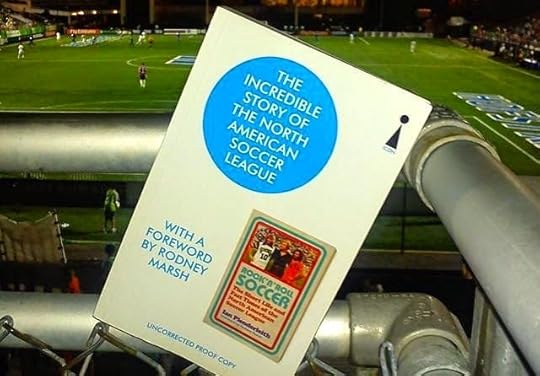 My book, watching the game (pic: Cesar Diaz)Both. I loved the research aspect – leafing through countless old soccer magazines and books that had been in my cupboards for years, and finally being able to say to my wife, “See! I told you they’d be useful some day.” I spent a lot of time in the magnificent Library of Congress in Washington DC, and if they’d only had beds there and an all-night bar I would probably have moved in.
The interviews were great fun, too – almost everyone I contacted was happy to talk about a period that we all felt had been neglected by soccer history. Some of the former players would still be talking now if I hadn’t called time on them – just wonderful blokes who were willing to give up their time to a hack they didn’t know from Adam.
What was it like to interact with Rodney Marsh?
Rodney was one of the first people to agree to an interview, because he understood straight away what the book was about, and why it needed to be written. He’s not only funny, but a very astute analyst, so he gave me lots of material, and then later agreed to write the foreword.
Needless to say, he was one of those players that I idolised as a boy growing up in England in the 1970s – full of character and flair, and always smiling. It’s amazing what a difference that makes to kids watching the game, a smile. I really wish we could see more of that in the game – from players, coaches and fans alike.
Here are a couple of sample answers:
What was more enjoyable, the research or the interviews?
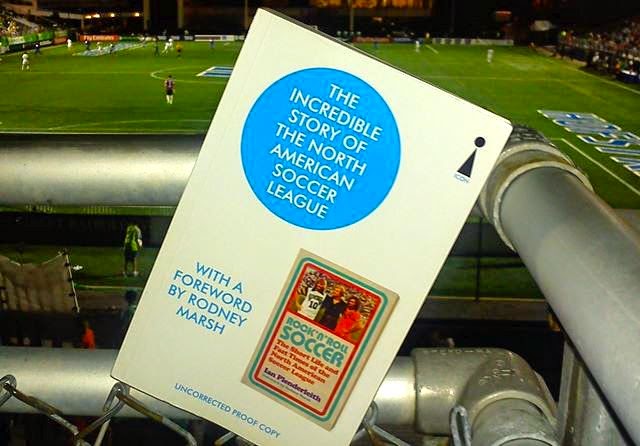 My book, watching the game (pic: Cesar Diaz)Both. I loved the research aspect – leafing through countless old soccer magazines and books that had been in my cupboards for years, and finally being able to say to my wife, “See! I told you they’d be useful some day.” I spent a lot of time in the magnificent Library of Congress in Washington DC, and if they’d only had beds there and an all-night bar I would probably have moved in.
The interviews were great fun, too – almost everyone I contacted was happy to talk about a period that we all felt had been neglected by soccer history. Some of the former players would still be talking now if I hadn’t called time on them – just wonderful blokes who were willing to give up their time to a hack they didn’t know from Adam.
What was it like to interact with Rodney Marsh?
Rodney was one of the first people to agree to an interview, because he understood straight away what the book was about, and why it needed to be written. He’s not only funny, but a very astute analyst, so he gave me lots of material, and then later agreed to write the foreword.
Needless to say, he was one of those players that I idolised as a boy growing up in England in the 1970s – full of character and flair, and always smiling. It’s amazing what a difference that makes to kids watching the game, a smile. I really wish we could see more of that in the game – from players, coaches and fans alike.