Ian Plenderleith's Blog, page 2
September 26, 2015
Miles, Blondie, ELO, Defunkt - all part of Rock n Roll Soccer
Here's a round-up of some more reviews of Rock n Roll Soccer, and an interview at the US Soccer Players website. This contained my favourite question of all: "If you were going to make a playlist to go along with the book, what would be on it?" In the book, I already came up with an NASL soundtrack. But a playlist is different, right? So I had the excuse to rummage through old CDs and records and re-think the musical accompaniment to the North American Soccer League. Here's a sample:
Miles Davis – Bitches Brew (1972). From the album of the same name because it was, like the NASL, a one-off, revolutionary fusion of styles that drew from the past and the present, and pointed to the future.
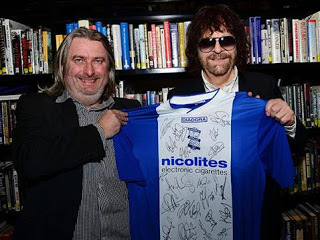 Jeff Lynne, singing for the Blues (pic: bcfc.com)Electric Light Orchestra – Livin’ Thing (1976). The peak years of the NASL coincided with the peak years of stadium rock, and the fan cultures of both shared a lot of features – the game/concert as a big event, the spectacle of mass entertainment, the easy availability of recreational drugs. I’m no fan of stadium rock, but ELO was an exception, and this fine, typically upbeat track from the wonderful and aptly titled A New World Record is a good example of Jeff Lynne’s ease at being cheerfully influenced by US AOR. He’s a Birmingham City fan too.
The International Soccer Network wrote that Rock n Roll Soccer "is the definitive history on the original NASL. Nothing out there rivals the detail and variety provided by this book. It is easily one of the best soccer titles of 2015, if not the best. Plenderleith, one of the best top journalists anywhere [Steady on! IP], is a magician with words and history, making the entertaining NASL even more exciting. That is quite a task indeed. You can’t go wrong with this one. This is an absolute must for any soccer fan, regardless of where your allegiances lie. It has the honor of being one of our favorite soccer books of all-time. It’s that good!"
The NY-focused Empire of Soccer looked in particular at chapter seven 'The NASL v s FIFA and the World', which has scarcely been mentioned in other reviews. "One thing," writes Jake Nutting, "is abundantly clear from Plenderleith’s engaging staging of all the many grievances the NASL embroiled itself in – neither incarnation of the NASL has ever been about going with the flow. Owners were openly hostile toward what they deemed intrusive oversight from the overlords at FIFA. Ironically, the league’s focus in the modern era has shifted to aligning American soccer more with the rest of the world, but the bickering within our own shores has remained robust."
"This is a far more substantive book than you’d expect from its title," writes the blog Message In A Bottle at Island Books, an independent outlet in Washington State, "but then the NASL was a far more substantive operation than history has acknowledged. When it’s remembered these days, it’s usually for garish disco-era uniforms, gimmicky promotions, and overpaid, over-the-hill stars from overseas. All of that is at best only partly true, as Plenderleith shows. [He] excels in showing what the teams and players were really like and establishes a historical context for the league, definitively answering the interesting question of how North American soccer compared to the kind played everywhere else on the globe.
"Today MLS trails only the National Football League and Major League Baseball in average game attendance, thanks mostly to the spectacular support of Northwest fans who insisted that their MLS franchises carry the names of their lost NASL forebears. Rock 'n’ Roll Soccer speaks to everyone with football fever, but to us most of all."
Miles Davis – Bitches Brew (1972). From the album of the same name because it was, like the NASL, a one-off, revolutionary fusion of styles that drew from the past and the present, and pointed to the future.
 Jeff Lynne, singing for the Blues (pic: bcfc.com)Electric Light Orchestra – Livin’ Thing (1976). The peak years of the NASL coincided with the peak years of stadium rock, and the fan cultures of both shared a lot of features – the game/concert as a big event, the spectacle of mass entertainment, the easy availability of recreational drugs. I’m no fan of stadium rock, but ELO was an exception, and this fine, typically upbeat track from the wonderful and aptly titled A New World Record is a good example of Jeff Lynne’s ease at being cheerfully influenced by US AOR. He’s a Birmingham City fan too.
The International Soccer Network wrote that Rock n Roll Soccer "is the definitive history on the original NASL. Nothing out there rivals the detail and variety provided by this book. It is easily one of the best soccer titles of 2015, if not the best. Plenderleith, one of the best top journalists anywhere [Steady on! IP], is a magician with words and history, making the entertaining NASL even more exciting. That is quite a task indeed. You can’t go wrong with this one. This is an absolute must for any soccer fan, regardless of where your allegiances lie. It has the honor of being one of our favorite soccer books of all-time. It’s that good!"
The NY-focused Empire of Soccer looked in particular at chapter seven 'The NASL v s FIFA and the World', which has scarcely been mentioned in other reviews. "One thing," writes Jake Nutting, "is abundantly clear from Plenderleith’s engaging staging of all the many grievances the NASL embroiled itself in – neither incarnation of the NASL has ever been about going with the flow. Owners were openly hostile toward what they deemed intrusive oversight from the overlords at FIFA. Ironically, the league’s focus in the modern era has shifted to aligning American soccer more with the rest of the world, but the bickering within our own shores has remained robust."
"This is a far more substantive book than you’d expect from its title," writes the blog Message In A Bottle at Island Books, an independent outlet in Washington State, "but then the NASL was a far more substantive operation than history has acknowledged. When it’s remembered these days, it’s usually for garish disco-era uniforms, gimmicky promotions, and overpaid, over-the-hill stars from overseas. All of that is at best only partly true, as Plenderleith shows. [He] excels in showing what the teams and players were really like and establishes a historical context for the league, definitively answering the interesting question of how North American soccer compared to the kind played everywhere else on the globe.
"Today MLS trails only the National Football League and Major League Baseball in average game attendance, thanks mostly to the spectacular support of Northwest fans who insisted that their MLS franchises carry the names of their lost NASL forebears. Rock 'n’ Roll Soccer speaks to everyone with football fever, but to us most of all."


September 22, 2015
The Day I Silenced Radio 5 Live
Here's the link to my interview late last night on World Soccer Talk Radio with Nate Abaurrea, which was thoroughly enjoyable thanks to his having closely read the book we were talking about -
Rock n Roll Soccer
(published today in the United States and Canada by St. Martin's Press/Thomas Dunne Books). That's not necessarily always the case, as I discovered when I was in the UK in 2001, attempting to promote my first book
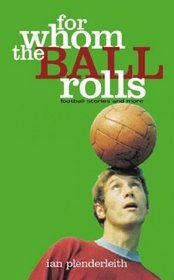
For Whom The Ball Rolls
, a selection of adult-oriented, football-based short fiction (clearly not a category that anyone had a clue how to market, given its sales figures).
 Live and silent...thanks to meI was booked in to appear on the Fi Glover Show on BBC Radio 5 Live, along with various other luminaries of broadsheet sporting journalism - Sue Mott of The Daily Telegraph and Jim White, at that time of The Guardian. We chatted in the booth beforehand. I was terrified. They were both very posh and confident. Jim told a funny story about something that had happened to him at a game at the weekend, and we all chuckled. They asked me about my book, pretended that they were really interested, and both promised to write something about it. Neither ever did, but hey, they're busy people, and a promise in the media world is worth as much as the sodden beer mat it's written on (a few years later my Dad bought me Jim White's book You'll Win Nothing With Kids, but eight years on I still haven't opened it. So there).
To the studio. Fi Glover wasn't there, and some bloke whose name I can't remember was standing in. He briefed us - we'd start by talking about my book, and then move on to a general chat about the sporting events of the weekend. Fine. The countdown - then the host introduced all of us. I was still terrified. He turned to me and announced my book to the world. "I haven't read the book," he said glibly, then added something like, "but presumably these are stories very much rooted in actual experience."
That was my cue. Was that an actual question? Was I supposed to agree with it? Say something like "Yes, they are" and see what he said next? Of course, looking back, it was a chance for me to promote myself by banging on about my vast experience of the football world, and how that had inspired me to write football-based fiction. At that second, though, my mind was a complete blank. National BBC Radio 5 Live experienced a five-second silence. It felt like five minutes, and I can still see the host's increasingly desperate face, waiting for me not to screw up his show in the very first minute. And here I was, the nervous debutant appearing in front of a huge and expectant crowd, and I'd clumsily conceded a penalty just 30 seconds in.
 What's this about? "Er,
I don't really know."Eventually I stuttered out something about the stories being more of a product of my imagination. That wasn't the right answer at all, and no one followed it up. We moved rapidly on to the sporting events of the weekend. Jim White told the same anecdote he'd told in the booth beforehand, and everyone except me laughed, like they were hearing it for the first time. Play the game, Ian. Maybe that's why he never wrote anything about my book, because I didn't laugh twice at his story.
Now I was no longer being introduced as Ian Plenderleith, author of fantastic new book For Whom The Ball Rolls, but as Ian Plenderleith of When Saturday Comes magazine. Fine, if that's the way you want it. My nerves subsided and I started to talk. A lot. My friend Tim Bradford, who was at home making a tape of the broadcast, said that my normally accent-neutral voice gradually started sounding more northern, as though defiantly countering the well-honed tones of my southern counterparts. By the end of the show I sounded like I was from darkest Leeds, wilfully and bolshily contradicting everything that Sue and Jim said (okay, so that's why they never wrote anything about my bloody book). I can't remember much what we were talking about, but I do remembering slagging off Rangers and Celtic and the Scottish FA, and making a joke about Princess Anne being an actual horse.
The BBC never asked me back (though like Jim and Sue, they promised that they would). Tim gave me the tape, but I've never listened to it, and I don't even know where it is. Even if I wanted to hear me get into my stroppy stride taking on these titans of the established fourth estate, I could never face hearing again that five-second silence at the start of the show. And wishing that I had interrupted the sentence, "I haven't read the book..." with a full-on northern roar of, "Well then you're not doing your fookin' job very well, are you lad?" That's how you generate publicity.
 Live and silent...thanks to meI was booked in to appear on the Fi Glover Show on BBC Radio 5 Live, along with various other luminaries of broadsheet sporting journalism - Sue Mott of The Daily Telegraph and Jim White, at that time of The Guardian. We chatted in the booth beforehand. I was terrified. They were both very posh and confident. Jim told a funny story about something that had happened to him at a game at the weekend, and we all chuckled. They asked me about my book, pretended that they were really interested, and both promised to write something about it. Neither ever did, but hey, they're busy people, and a promise in the media world is worth as much as the sodden beer mat it's written on (a few years later my Dad bought me Jim White's book You'll Win Nothing With Kids, but eight years on I still haven't opened it. So there).
To the studio. Fi Glover wasn't there, and some bloke whose name I can't remember was standing in. He briefed us - we'd start by talking about my book, and then move on to a general chat about the sporting events of the weekend. Fine. The countdown - then the host introduced all of us. I was still terrified. He turned to me and announced my book to the world. "I haven't read the book," he said glibly, then added something like, "but presumably these are stories very much rooted in actual experience."
That was my cue. Was that an actual question? Was I supposed to agree with it? Say something like "Yes, they are" and see what he said next? Of course, looking back, it was a chance for me to promote myself by banging on about my vast experience of the football world, and how that had inspired me to write football-based fiction. At that second, though, my mind was a complete blank. National BBC Radio 5 Live experienced a five-second silence. It felt like five minutes, and I can still see the host's increasingly desperate face, waiting for me not to screw up his show in the very first minute. And here I was, the nervous debutant appearing in front of a huge and expectant crowd, and I'd clumsily conceded a penalty just 30 seconds in.
 What's this about? "Er,
I don't really know."Eventually I stuttered out something about the stories being more of a product of my imagination. That wasn't the right answer at all, and no one followed it up. We moved rapidly on to the sporting events of the weekend. Jim White told the same anecdote he'd told in the booth beforehand, and everyone except me laughed, like they were hearing it for the first time. Play the game, Ian. Maybe that's why he never wrote anything about my book, because I didn't laugh twice at his story.
Now I was no longer being introduced as Ian Plenderleith, author of fantastic new book For Whom The Ball Rolls, but as Ian Plenderleith of When Saturday Comes magazine. Fine, if that's the way you want it. My nerves subsided and I started to talk. A lot. My friend Tim Bradford, who was at home making a tape of the broadcast, said that my normally accent-neutral voice gradually started sounding more northern, as though defiantly countering the well-honed tones of my southern counterparts. By the end of the show I sounded like I was from darkest Leeds, wilfully and bolshily contradicting everything that Sue and Jim said (okay, so that's why they never wrote anything about my bloody book). I can't remember much what we were talking about, but I do remembering slagging off Rangers and Celtic and the Scottish FA, and making a joke about Princess Anne being an actual horse.
The BBC never asked me back (though like Jim and Sue, they promised that they would). Tim gave me the tape, but I've never listened to it, and I don't even know where it is. Even if I wanted to hear me get into my stroppy stride taking on these titans of the established fourth estate, I could never face hearing again that five-second silence at the start of the show. And wishing that I had interrupted the sentence, "I haven't read the book..." with a full-on northern roar of, "Well then you're not doing your fookin' job very well, are you lad?" That's how you generate publicity.
September 4, 2015
Kicks against the Cosmos
 The Kicks: simply AceThe Minnesota Kicks once beat the Cosmos 9-2 in a playoff game, in one of the North American Soccer League's more bizarre results. But that's not the only reason why I think they embodied the League's spirit of rock n roll soccer more than their New York rivals. There was the spontaneous, organic nature of the Kicks' rapid rise from nothing to crowds of 46,000 within weeks of playing their first ever game. There was the free-scoring, attacking nature of their play. And there were the proto-Rave tailgates where - outside the Kicks' stadium before the game - thousands of young people enjoyed the summer weather, the drink, the drugs, and each other. Read more here in my piece at The History Reader, a spin-off site run by the US publisher of
Rock n Roll Soccer
, St. Martin's Press.
The Kicks: simply AceThe Minnesota Kicks once beat the Cosmos 9-2 in a playoff game, in one of the North American Soccer League's more bizarre results. But that's not the only reason why I think they embodied the League's spirit of rock n roll soccer more than their New York rivals. There was the spontaneous, organic nature of the Kicks' rapid rise from nothing to crowds of 46,000 within weeks of playing their first ever game. There was the free-scoring, attacking nature of their play. And there were the proto-Rave tailgates where - outside the Kicks' stadium before the game - thousands of young people enjoyed the summer weather, the drink, the drugs, and each other. Read more here in my piece at The History Reader, a spin-off site run by the US publisher of
Rock n Roll Soccer
, St. Martin's Press.
August 26, 2015
Booklist: "A gift to fans of America's soccer history"
A review of the US edition of Rock n Roll Soccer from today's Booklist, a trade publication for the book industry:
 Rock 'n' Roll Soccer: The Short Life and Fast Times of the North American Soccer League.
Plenderleith, Ian. Sep 2015. 368 p. St. Martin's/Thomas Dunne, hardcover, $27.99. (9781250072382).
Breaking from the common view that the original North American Soccer League (NASL) was a gaudy, failed experiment, soccer journalist Plenderleith posits that, although it may have been a product of the “brash, loud, and shameless ’70s,” its focus on entertainment and innovation made it “the league of the future.” Over 17 tumultuous seasons (1968–84), with investors ranging from potato-chip scions and used-car dealers to rock stars, and players mostly borrowed or bargain-hunted from English and other European leagues, the NASL provided lots to talk about - massive tailgate parties, goofy promotional stunts - if not much consistency.
Some teams lasted only a season, while others changed towns along with their names. But Plenderleith makes a compelling case. Scrupulously researched and sourced, with first-person accounts knitted together in an enthusiastic, irreverent narrative, this is a gift to fans of America’s richer-than-expected soccer history. Major League Soccer is growing deep roots (and the new New York Cosmos are playing in the new NASL), but today’s younger fans may read this and wish they were there when the seeds were planted.
— Keir Graff
 Rock 'n' Roll Soccer: The Short Life and Fast Times of the North American Soccer League.
 Plenderleith, Ian. Sep 2015. 368 p. St. Martin's/Thomas Dunne, hardcover, $27.99. (9781250072382).
Breaking from the common view that the original North American Soccer League (NASL) was a gaudy, failed experiment, soccer journalist Plenderleith posits that, although it may have been a product of the “brash, loud, and shameless ’70s,” its focus on entertainment and innovation made it “the league of the future.” Over 17 tumultuous seasons (1968–84), with investors ranging from potato-chip scions and used-car dealers to rock stars, and players mostly borrowed or bargain-hunted from English and other European leagues, the NASL provided lots to talk about - massive tailgate parties, goofy promotional stunts - if not much consistency.
Some teams lasted only a season, while others changed towns along with their names. But Plenderleith makes a compelling case. Scrupulously researched and sourced, with first-person accounts knitted together in an enthusiastic, irreverent narrative, this is a gift to fans of America’s richer-than-expected soccer history. Major League Soccer is growing deep roots (and the new New York Cosmos are playing in the new NASL), but today’s younger fans may read this and wish they were there when the seeds were planted.
— Keir Graff
August 17, 2015
How Gerd Müller Came to the Strikers
 Müller: unwanted in Deutschland,
 a superstar in the NASLToday's edition of the German bi-weekly Kicker tells the bitter story of how West Germany's World Cup-winning striker Gerd Müller was forced out of Bayern Munich in the late 1970s and went to finish his career at the NASL's Fort Lauderdale Strikers.
The article begins by talking about how players who have recently left the club, such as Bastian Schweinsteiger and Mario Mandzukic, were fully praised by coach Pep Guardiola even as they were being eased out of the door. Müller was no less of a club legend than Schweinsteiger, yet the man who scored 398 league goals for the club in only 453 games was, in his own words, "systematically destroyed" by his Bavarian bosses.
His former team-mate Frank Roth confirms that "Gerd was properly squeezed out. That's not how you do things, it was not fair. It was not a pleasant departure." At the time, the team's commercial director Walter Fembeck said, "He [Müller] has to understand that he's no longer the best." Club President Wilhelm Neudecker was no more tactful: "We need Gerd as a striker, not as a monument."
Müller was the Bundesliga's leading scorer in seven seasons spanning the period 1967-1978. He won the German title four times, likewise the German FA Cup, not to mention the European Champions' Cup three times. Yet Bayern's Hungarian coach was ruthless in his analysis of the striker after substituting 'The Bomber' in February 1979 for the first time in his career during a 2-0 loss at Eintracht Frankfurt:
"Only achievement counts - and Gerd Müller has not achieved anything for some games now. He's lacking in fitness and mobility. If his former coaches turned a blind eye, that was up to them. That's not how I operate."
On February 14, Müller sent the club his resignation letter by taxi and left for the Strikers "without flowers and without warm words for the man to whom Bayern owed so much", as Kicker puts it. After his career finished, Müller turned to the bottle, and only when his alcoholism became public in the early 1990s did Bayern remember its former star. Franz Beckenbauer and Uli Hoeness intervened to help him give up booze and found him a job at the club.
The move to America was almost certainly the right one for Müller, even if the manner of his departure from Germany still beggars belief. He and Peruvian forward Teofilo Cubillas formed a prolific partnership up front for Fort Lauderdale in 1979, and took the team into the playoffs. "Neither spoke each other’s language," said David Chadwick, who was an assistant coach at the Florida team, in an interview for Rock N Roll Soccer in 2013. "I couldn’t speak either language, but I noticed in training with players like that, they all understand - they want to be challenged, they want to work, they do have an appetite for the game, that’s what made them great players. It was their eyes that made such a difference, you could just sense they knew exactly what was going on."
Chadwick said that he "learnt as a coach so much from being around Gerd Müller and seeing how he turned players in the box. When I grew up you did the Matthews, you dropped the shoulder and exploded past someone. I was good at that, but I learnt so much more from these other players in the NASL."
In 1980, Cubillas and Müller were on even better form, and the pair's goals lead the Strikers to the 1980 Soccer Bowl, which they lost 3-0 to the Cosmos. In 1981, Müller's goals finally dried up and he sensed that was the moment to retire. A venture with a steakhouse didn't work out, but following his rehabilitation he later became the long term assistant coach of Bayern's reserve team.
June 7, 2015
Beckenbauer v Matthäus in New York
 Good apple, bad apple, in the Big AppleThe careers of two of the greatest players in German football were inextricably linked through their country's victory at the 1990 World Cup in Italy. The coach was Franz Beckenbauer, his captain was Lothar Matthäus. Beckenbauer himself had lifted the same trophy in 1974. Influential playmakers and versatile team-leaders, they were both champions time and again with Bayern Munich, and boasted multiple team and individual awards. And towards the end of their careers, both players joined clubs in New York.
That's where the parallel lives start to drift apart. Here at the website In Bed With Maradona, as part of their extensive feature on soccer in the Five Boroughs, is my feature on how the Kaiser was a huge hit with the New York Cosmos in the late 1970s, while two decades later Matthäus came to the Big Apple and ended up scoring no goals, and making just as many friends.
May 12, 2015
Being Mistaken For Rodney Marsh
There are at least two reviews out on the internet whose authors are under the impression that
'Rock n Roll Soccer'
was written by Rodney Marsh. Marsh, of course, wrote the foreword, and his name appears on the cover beneath my own. I don't have a problem with this. If people read the book and enjoyed it and thought it was written by one of the most prominent and colourful English footballers of the 1970s, who am I to complain?
When I first received proof copies of 'RnRS' a year ago, my father-in-law happened to be visiting and was keen to read the book. As the foreword was not attributed to Marsh on the first page, at first he thought it was written by me. "It seemed a bit strange that you were making out you'd played in the NASL," he said, "and I was somewhat worried about your mental state." For the final print edition, we made it clear from the first page that the foreword consisted of Marsh's account of playing in the league, and not some flight of my imagination.
And God knows, I've spent enough time in my life imagining myself as a paid footballer. From around my fifth birthday onwards, to varying degrees, until my tender hamstrings forced me into retirement last year at the age of 49.
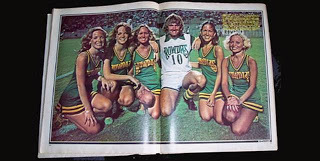 Me with some cheerleaders during the 1970s.I once wrote a piece for the now defunct Major League Soccer magazine about players who'd only made a single appearance in MLS. While most of those players probably regarded themselves as failures, it's obvious from re-reading my introduction to the piece that all I felt towards them was a profound existential envy:
"If dreams, as Shakespeare wrote, are nothing but 'the children of an idle brain, begot of nothing but vain fantasy', then I plead guilty. In sleep, I've often scored great goals in front of huge crowds. In waking hours, I've longed to play in a professional game, even for five minutes. Just to see what it's like. Just to say I've been there."
Around a decade ago, when MLS started up its reserve league, I dreamt that I got called up to play for DC United's second string due to an injury crisis. I told my dream to Doug Hicks, who was the team's head of media relations at the time. "That's not gonna happen," he responded drily, as though just by telling him the dream, I'd been hinting that maybe it would, or at least that it could. Which of course was exactly why I'd told him. He was on to me.
Hicks and his colleagues are, however, very switched on to the needs of writers and journalists in this respect. They know we're only carping from the press box because we're either too fat, slow, useless or old (or all four) to be out there ourselves. So during MLS Cup and the MLS All-Star Game they indulge us by taking the trouble to organise media games or tournaments. I've still got my lovely trophy from being on the winning team at the 2011 All-Star Media Challenge in New York. I played against Greg Lalas, who once played half a dozen games in MLS (albeit over a decade earlier). He didn't seem to be noticeably better or worse than the rest of us. See, man, I coulda been a contender.
But that passage in Rock n Roll Soccer that goes: "In one game he [Pele] went ballistic at me for what he thought was showboating. In another game he scythed me down and provoked a 15-man brawl. Most painful of all, after I nutmegged him once he came up to me and ruffled my hair - a sporting gesture by the revered icon. Except that no one could see that he'd gouged my ear with his fingernail and opened up a bleeding wound..." - that was not written by me. I did not nutmeg Pele. That was Rodney Marsh. But if you want to confuse the two, be my guest.
When I first received proof copies of 'RnRS' a year ago, my father-in-law happened to be visiting and was keen to read the book. As the foreword was not attributed to Marsh on the first page, at first he thought it was written by me. "It seemed a bit strange that you were making out you'd played in the NASL," he said, "and I was somewhat worried about your mental state." For the final print edition, we made it clear from the first page that the foreword consisted of Marsh's account of playing in the league, and not some flight of my imagination.
And God knows, I've spent enough time in my life imagining myself as a paid footballer. From around my fifth birthday onwards, to varying degrees, until my tender hamstrings forced me into retirement last year at the age of 49.
 Me with some cheerleaders during the 1970s.I once wrote a piece for the now defunct Major League Soccer magazine about players who'd only made a single appearance in MLS. While most of those players probably regarded themselves as failures, it's obvious from re-reading my introduction to the piece that all I felt towards them was a profound existential envy:
"If dreams, as Shakespeare wrote, are nothing but 'the children of an idle brain, begot of nothing but vain fantasy', then I plead guilty. In sleep, I've often scored great goals in front of huge crowds. In waking hours, I've longed to play in a professional game, even for five minutes. Just to see what it's like. Just to say I've been there."
Around a decade ago, when MLS started up its reserve league, I dreamt that I got called up to play for DC United's second string due to an injury crisis. I told my dream to Doug Hicks, who was the team's head of media relations at the time. "That's not gonna happen," he responded drily, as though just by telling him the dream, I'd been hinting that maybe it would, or at least that it could. Which of course was exactly why I'd told him. He was on to me.
Hicks and his colleagues are, however, very switched on to the needs of writers and journalists in this respect. They know we're only carping from the press box because we're either too fat, slow, useless or old (or all four) to be out there ourselves. So during MLS Cup and the MLS All-Star Game they indulge us by taking the trouble to organise media games or tournaments. I've still got my lovely trophy from being on the winning team at the 2011 All-Star Media Challenge in New York. I played against Greg Lalas, who once played half a dozen games in MLS (albeit over a decade earlier). He didn't seem to be noticeably better or worse than the rest of us. See, man, I coulda been a contender.
But that passage in Rock n Roll Soccer that goes: "In one game he [Pele] went ballistic at me for what he thought was showboating. In another game he scythed me down and provoked a 15-man brawl. Most painful of all, after I nutmegged him once he came up to me and ruffled my hair - a sporting gesture by the revered icon. Except that no one could see that he'd gouged my ear with his fingernail and opened up a bleeding wound..." - that was not written by me. I did not nutmeg Pele. That was Rodney Marsh. But if you want to confuse the two, be my guest.
May 11, 2015
Interview at World Soccer Talk
 World Soccer Talk
published an interview with me this weekend, conducted by Drew Farmer. Below is a sample, and here's a link to the whole interview.
World Soccer Talk
published an interview with me this weekend, conducted by Drew Farmer. Below is a sample, and here's a link to the whole interview.Drew Farmer: Near the end of the book, Rodney Marsh had a few quotes about the new NASL and Tampa Bay Rowdies. Ian, what are your thoughts on the revived league and can it return to something similar to the original league? Do you share Marsh’s thoughts on the league?
"No, I don’t agree with Rodney on that one, though I can see why he denigrated it – he’s someone who’s used to top class football. That’s what he played, and that’s what he wants to see. For me, the more teams and leagues there are, the better. Personally, I’d watch anything (and I do) – I grew up watching Lincoln, Scunthorpe and Grimsby, after all.
"I had a bit of a testy email exchange with the current [New York] Cosmos, though, because they objected to me referring to the new league as “semi-pro” in the book. That wasn’t intended as a putdown. In many respects, the old NASL, especially in its early years, was semi-pro too, at least according to my definition. That is, players played and were paid for less than half a year, at least until they started the winter indoor league(s). To me, semi-pro is when you have players on contracts that mean they have to work other jobs, because the break between seasons is several months long, or because the players are also coaching or working other jobs to make a living. There’s no shame in that for a brand new league in a country like the US. In that respect, many MLS players could have been classified as semi-pro until they re-negotiated the minimum wage in the latest round of pay negotiations. It’s not an insult, it’s just a reflection of a league’s status at this point in time.
"Can it grow to the size of the old NASL? Again, I think that question doesn’t really apply. I think eventually it would be best if the leagues merge and we end up with two or three divisions with at least some form of relegation and promotion when that’s sustainable. The US is, after all, the ultimate meritocracy, or at least in theory. It can also be more protectionist than a Soviet planned economy. Right now, though, MLS and NASL seem to be in an unspoken competition, and from what I can gather at this distance, they’re not on especially good speaking terms."
February 5, 2015
"US soccer has been a fascinating work in progress ever since 1967"
Not content with praising Rock N Roll Soccer to the rafters, the estimable football literature web site
Of Pitch & Page
has published an interview with the author, allowing me to pontificate at great length.
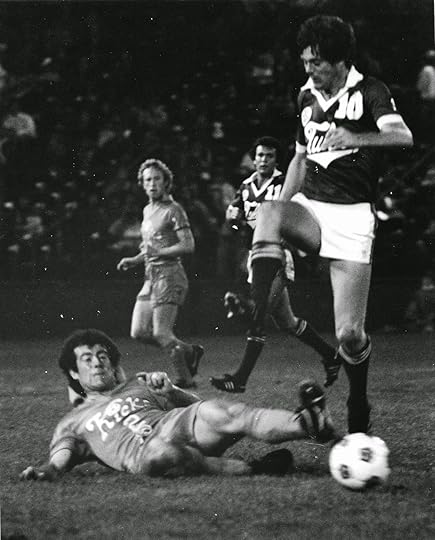 Tulsa roughneck takes aim at my NASL
softspot: the Minnesota Kicks (pic: Alan
Merrick private archive).Authors of course love to talk about their books, but we tend to drone on and become tedious very quickly. That's why I like doing email interviews - you have time to consider both the questions and your own answers. And on a web site, they usually print everything you write because they have the space.
Along with the quote above, here's a teaser to lure you into reading more...
Do you have a favourite NASL team? You do a good job of seeming impartial!
I ended up with a particular soft spot for the Minnesota Kicks – partly because of their incredible rise-and-fall story that I wrote about in Chapter Five, and partly because many of their ex-players were so helpful. When you’re a writer working on a miserly budget you become really grateful towards people who get what you’re doing, and who go out of their way to assist you for no return.
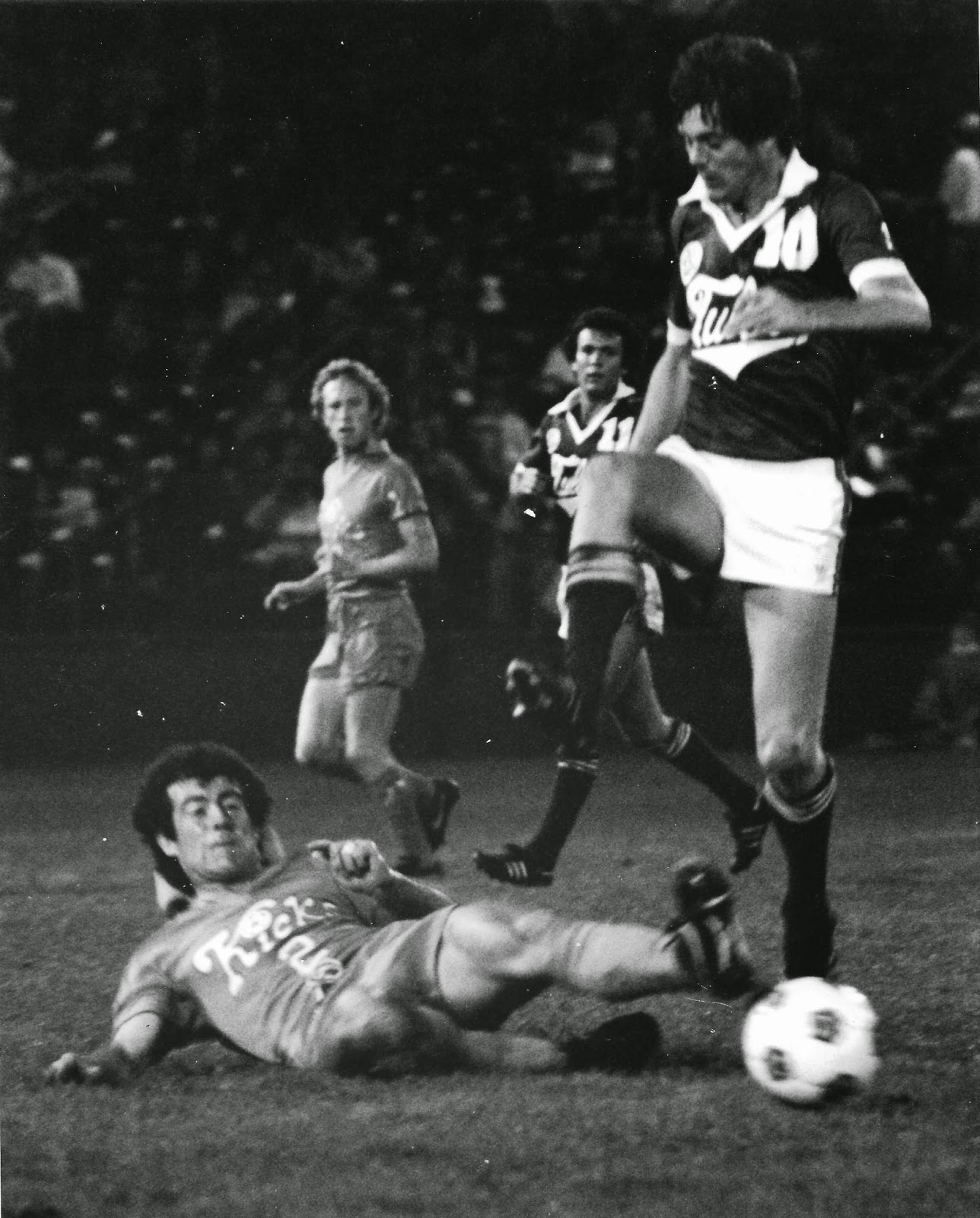 Tulsa roughneck takes aim at my NASL
softspot: the Minnesota Kicks (pic: Alan
Merrick private archive).Authors of course love to talk about their books, but we tend to drone on and become tedious very quickly. That's why I like doing email interviews - you have time to consider both the questions and your own answers. And on a web site, they usually print everything you write because they have the space.
Along with the quote above, here's a teaser to lure you into reading more...
Do you have a favourite NASL team? You do a good job of seeming impartial!
I ended up with a particular soft spot for the Minnesota Kicks – partly because of their incredible rise-and-fall story that I wrote about in Chapter Five, and partly because many of their ex-players were so helpful. When you’re a writer working on a miserly budget you become really grateful towards people who get what you’re doing, and who go out of their way to assist you for no return.
January 28, 2015
Bringing the NASL to life "in all its spectacular glory and failure"
A big thank you to the football literature web site Of Pitch & Page for a pertinent summary of Rock n Roll Soccer, and for the enthusiastic recommendation. It's nice to get a review a few months after the book has come out to remind everyone that it's still most definitely available. "Rock n Roll Soccer," they state, "takes a relatively unknown area of ‘soccer’ history and brings it to life in all its spectacular glory and failure."

This was the first review to mention (and appreciate) some of the book's less conventional sections. In the site's words: "Plenderleith’s tone and structure is a great fit with the subject matter. Rock n Roll Soccer is full of amusing asides and dry wit, from the chapter [sub] titles – ‘Debit does Dallas’, ‘Learning from your alcoholic dad’ – right through to the ‘Fun Facts’ sections for each season. But best of all is the ‘Half-time’ lists section in the middle of the book, which features ’20 odd names in the NASL’ plus the ‘NASL Soundtrack’."
As a former sub editor who took particular pride in his sub-titles (which rarely get any notice, or credit), I paid a lot of attention to breaking up the text in long chapters in an attempt to keep the reader interested. It's true that you'd have to be both a Smiths fan and a keen observer of the North American Soccer league to appreciate the sub-heading 'Toye With The Thorn In His Side', but every sub takes some satisfaction that his or her dreary job at the fag end of journalism can be livened up with some possibly clever reference that may be lost on the majority of people.
I was also very pleased to see some love for the Half-Time section, hitherto unmentioned in most reviews. I wondered about the wisdom of including this part of the book, which was immensely fun to write, but which I thought might not fit. Perhaps it was the sort of thing that belonged exclusively online, being basically just a series of lists. One editor at Icon was no fan of the NASL Soundtrack mentioned by Of Pitch & Page, and recommended cutting it. I could definitely see why, but in the end I was just too pleased with myself for claiming that Blondie's Detroit 442 was about "Debbie Harry's barely coded tactical advice to Detroit Express coach Ken Furphy to play four in midfield and two men up front. Harry's musically articulated guidance took the Express to the playoffs..." And so on.

This was the first review to mention (and appreciate) some of the book's less conventional sections. In the site's words: "Plenderleith’s tone and structure is a great fit with the subject matter. Rock n Roll Soccer is full of amusing asides and dry wit, from the chapter [sub] titles – ‘Debit does Dallas’, ‘Learning from your alcoholic dad’ – right through to the ‘Fun Facts’ sections for each season. But best of all is the ‘Half-time’ lists section in the middle of the book, which features ’20 odd names in the NASL’ plus the ‘NASL Soundtrack’."
As a former sub editor who took particular pride in his sub-titles (which rarely get any notice, or credit), I paid a lot of attention to breaking up the text in long chapters in an attempt to keep the reader interested. It's true that you'd have to be both a Smiths fan and a keen observer of the North American Soccer league to appreciate the sub-heading 'Toye With The Thorn In His Side', but every sub takes some satisfaction that his or her dreary job at the fag end of journalism can be livened up with some possibly clever reference that may be lost on the majority of people.
I was also very pleased to see some love for the Half-Time section, hitherto unmentioned in most reviews. I wondered about the wisdom of including this part of the book, which was immensely fun to write, but which I thought might not fit. Perhaps it was the sort of thing that belonged exclusively online, being basically just a series of lists. One editor at Icon was no fan of the NASL Soundtrack mentioned by Of Pitch & Page, and recommended cutting it. I could definitely see why, but in the end I was just too pleased with myself for claiming that Blondie's Detroit 442 was about "Debbie Harry's barely coded tactical advice to Detroit Express coach Ken Furphy to play four in midfield and two men up front. Harry's musically articulated guidance took the Express to the playoffs..." And so on.