Brian Yansky's Blog, page 8
January 1, 2022
How Can You Show More and Tell Less In Your Fiction?
You always hear show don't tell. There are times to tell, sure, but a lot of writers, especially inexperienced writers, struggle with being able to see when they are telling too much. So what's wrong with telling? One word—boring. Most telling slides into listing information or navel gazing or telling emotions, which can be deadly for a story. You want the reader to connect to your characters and what they're feeling when something is happening in a scene. If the reader isn't feeling the experience with the character, it creates a filter between them and the story and they disconnect. Avoid this at all costs. The other problem, also big, is telling too much leads to mistakes, like overwriting or making the wrong choices about where to go in a scene.
So how do you avoid this problem, particularly if you're inexperienced and find it hard to know if you're telling too much?
Obviously practice is the main way you get a feel for show v tell. But one way to work on this is to consider POV. Doesn't matter if you use first person or third person POV; if you can narrate from your character you will be more likely to keep showing rather than telling. So see the scene and what is happening through your character's eyes and show how they feel by actions and reactions and through dialogue
This is the first paragraph from my work-in-progress:
Sheriff July Jackson opened his eyes. The room was dark, but bright light slipped in the space between the blinds and the window frame. He turned away from it, forcing himself to sit up, expecting a headache and other symptoms of a one-too-many night. Velcro, 130 pounds without clothes, leaped from the floor onto the bed. His tongue moved up July’s cheek. It was like the scratchy side of a wet sponge.
That's showing. I'm trying to show the reader the beginning of this scene and let the reader experience it rather than telling the reader what is going on or how the POV main character feels.
Here's the same scene with too much telling:
Sheriff July Jackson opened his eyes. The room was dark but bright light from the window hurt his eyes. He turned away from it, sat up. He thought his head would hurt because he'd been out drinking the night before but he felt pretty good. Then his dog, Velcro, 130 pounds without clothes, jumped onto the bed and bounced July so that he almost lost his balance and ended up on the floor. The dogs tongue drenched his cheek. He hated that. He loved the dog but he hated that sticky tongue. He'd definitely need a shower to get that off.
The example is just one paragraph but imagine if you had ten or twenty pages, how the show writing would start to distance itself from the tell writing.
The other befit of keeping yourself and narrator out and letting the POV character narrate is, of course, you'll learn about the character. What she sees and the way she describes it will help illuminate who she is.


December 21, 2021
Visualize The Scene
You know it's hard sometimes to get into writing and, for me anyway, it's hard sometimes to stop writing. When it's hard to get into writing, it's usually (occasionally I just don't feel like it or I feel crappy or I'm distracted but these aren't all that often) because I don't know where I'm going or I'm not excited about writing the scene I'm going to write.
This is bad on many levels: both quality and quantity of words.
One thing you need to do is be excited about writing the scene that you're writing. If you aren't, go on to another scene. But maybe you aren't because you just haven't thought it through, haven't dug deeper into it for the cool parts. Do this before you start writing. Try to visualize the scene the night before when you're lying in bed or that morning while you're showering or doing your morning exercise or taking the dog out or whatever...Visualize. For me, writing a scene is often using the camera of the mind, the camera being words since I'm a fiction writer. So visualizing that scene, no matter how sketchy the visualization is, helps me get excited about it.
Give it a try.
Also, have a wonderful holiday. Hope you get to do what you love during these Covid holiday times.
By the by, gentle reader, I'm discounting my books (the self published ones; the publishers won't let me touch pricing the ones that are trad published) to 0.99 and 0.00 for the first Poe Detective Novel. Also, the Poe Detective boxed set is free in KU, so if you want to have them all in one package you can read them there.
Thanks for reading.
Brian
December 17, 2021
The difference between Mystery and Suspense (according to Alfred Hitchcock)
Hitchcock said he seldom made mysteries—maybe just once. He made movies that relied on suspense. I remember Elmore Leonard, in an interview, saying something similar. Everyone called him a writer of mysteries. He said he'd never written a mystery. He wrote suspense. Of course both Hitchcock and Leonard were artists, great stylists, but they both used suspense to keep their audiences (watchers and readers) engaged.
A mystery is a puzzle, an intellectual experience. The reader is given given clues and puts the clues together and solves the puzzle. The key is that the characters, at least some of them, know more than the watcher or the reader. If you have a detective, the reader or watcher, solves the mystery with the detective. Suspense is more of an emotional ride. In suspense the watcher or the reader knows more than the characters. If you're writing multiple POV's this is easier to pull off. I notice Leonard often uses multiple POVs. You give the reader more information and then you create suspense by putting characters in situations. For example, Sal is going to murder his wife because she's cheating on him. We know he's going to do it in the bedroom when she's asleep. The reader has to watch her stay up late watching a movie, has to watch her take a sleeping pill etc...We're unsure Sal will go through with it...You get the idea. You could make all kinds of things happen to cause more suspense etc...but the main idea is this simple: you use the information you give the reader to create suspense.
Hitchcock explains why having a bomb go off under a table, surprising the audience, is the wrong move. To create emotional suspense, to get the audience working for you, you need to let the audience know there's a bomb about to go off under the table. Then have five people sit there and have a conversation about what they did last night. That's suspense. I'd add, the audience will care because people are empathetic (with a few exceptions) even if they don't know the characters. Check out the video below to hear this idea in Hitchcock's own words.
December 9, 2021
Characters Need Motivations—make them real
My characters get very cranky when I try to make them do things because of plot. Worse than rebellious teens. They will mess things up just to get back at me. They will lead me in all the wrong directions. Solution: you need to give characters real motivations for what they do, say, think.
Too many formulas tell you to have your characters do things at specific places in the novel in order to follow a certain plot strategy. It just doesn’t work in my opinion.
You tell a character she has to act a certain way on page 33 because 3 is a lucky number, and if you have two 3’s well, double the luck, and you’ll for sure write a bestseller.
Your character says “I wouldn’t act that way.”
You say, “I need you to because I’ve been told you need to on page 33.”
So after some argument she does. Then she falls into an identity crisis. Then she acts out or shuts down. This has a domino effect on your other characters and story. Things go wrong. Very wrong.
Your characters aren’t going to seem real because they’re doing the wrong things at the wrong time and your story is going to seem forced because it goes in the wrong direction at several turns and pretty soon you’re lost in the swamp.
You know where I’m going with this.
It’s not a pretty ending.
Quicksand.
Work on plot, always. Story is important. But be true to your characters. Give them clear motivations. Readers will read even if they’re reading about terrible characters doing terrible things if the readers feel like they’re doing them out of real motivations.
December 2, 2021
We Need Silence As Writers—from a glass half-empty optimist
Be The Dog https://www.amazon.com/dp/B09MVB9LZ2/ref=sr_1_1?keywords=Be+the+Dog+yansky&qid=1638409356&sr=8-1
has over a hundred and thirty mini-lessons on the art and craft of novel writing
(along with bits of inspiration because writing is tough and we all need a little encouragement).
I’ve got a lot of ideas about how to write novels and how to help beginning writers and even more seasoned ones write them. I’d like to help you along your writer road if I can.
Another sample mini-lesson below.

We Need Silence As Writers.
I’m not talking about the silence of a room to work in or a space to work at though that’s certainly nice. Some people do need that, too. I’m not one of them. I can work anywhere: in an airport or coffee house or restaurant or hotel room. I prefer the relative silence of my house, but I don’t need it.
But I still need silence.
I need to find that place of calm within me. I have to silence all the voices. And there are a lot of them. Sometimes it’s voices telling me that I need to do this or that. I have so much to do and I shouldn’t be trying to squeeze in writing. Sometimes it’s a problem I’m worrying over. It could have to do with work or with a relationship or one of the animals or…you get the idea. A worry. Sometimes it’s critical voices saying I can’t write about this or a voice saying that no one will want to read my manuscript. Someone told me that 85% of what we worry about won’t ever be a problem. My answer to that was, “That worries me. What about the other 15 percent?” I’m a glass half-empty optimist.
But back to my point—there are voices that will interfere with your writing. Voices of doubt, voices of criticism, voices of everyday problems. You have to find a way to silence them before you can get to the place you need to go as a writer to write. It’s a place of silence within you where the voices of your stories can be heard and written.
November 30, 2021
My Mantra for First Drafts: Low Expectations
(From my book on writing: Be The Dog), which will be out by this weekend.)

My process is a bit discovery and a bit outlining. I use both.
The first draft still gets messy, of course. It’s just the way it goes with first drafts. It’s like a construction site. Messy. Messy. I have a mantra. Say it with me. LOW EXPECTATIONS, LOW EXPECTATIONS, LOW EXPECTATIONS.
Extra: Don’t let the mess stop you! You have to keep going. You neat-freaks, bothered by disorder, will struggle most with this. Just keep reminding yourself that revision is just a draft away. You will have many chances to bring order to your unruly creation.
That’s how I begin a novel.
Extra: A lot of writers begin with gusto. They write that first chapter like a racehorse exploding out of a gate. They go to the next. But they hit some headwind. All of a sudden it’s a hurricane strength headwind. They’re running in place. They reread their first pages. Maybe they even go back and rework them. They tell everyone they know how great their idea is and how good their first chapter is. But the problem is that on page 15 or 20 or whatever, they are suddenly stuck in place. They won’t finish. They won’t even get close.
You need more than one idea. You need many. You’re going to need to be able to flesh them out. You’ll need characters and a story. You need to be projecting where your story will go. One or two scenes is short-sighted.
But if you find yourself in this place, try some of the outline ideas in #6 of this section. It’s OK to outline as you move along. Sometimes it can help you quiet the headwind enough to take a step forward.
November 26, 2021
Creating Character: Use the yearning and the fear

A Characters Heart
More from my book on writing, Be The Dog, available in the first week of December.
The way to a character’s heart (and isn’t that where we, as writers, are trying to get?) is through the things he or she wants/needs/desires and the things he or she fears or the things that get in the way of what he/she wants. The things that the character does in order to get what he or she wants and the things he or she avoids to be successful in getting what they want are at the heart of many stories.
Extra: Look at fear. The character wants something. What he/she wants comes with a fear that he/she won’t get it. Say the character, male or female, wants to protect his/her family. That’s the driving force of the character. But there is a powerful enemy and by trying to save his/her town she/he is putting his/her family at risk. His/her greatest fear is he/she won’t be strong enough to protect her/his family and town. This gives you, as an author, a lot of possibilities. Maybe the enemy captures the child of our MC. They have to make a choice: save the town or save his/her child. That’s just one way this could go. You can spin out a lot of possibilities from a powerful fear.
November 19, 2021
My dog, full grown. More from the my book on writing ...
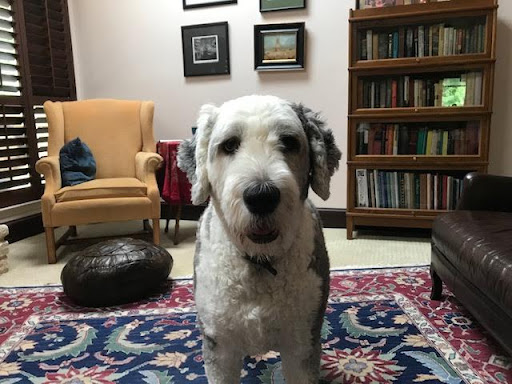
My dog, full grown. More from the my book on writing coming out in the first week of December. Extra: One bit of starting advice: Don’t let that voice of doubt stop you from writing. It will try. You aren’t smart enough. Who do you think you are, trying to write a novel? You don’t have a story to tell and you don’t have any art in telling a story. You aren’t special. You will never be a writer. Almost every writer hears this crap from themselves. I know I have. You have to quiet this voice and in the quiet that follows you begin. 2.
Write In The Moment: Be The DogLet me elaborate on writing in the moment a little more. One thing that was important for me to learn is that writing fiction is juggling many things at once and not thinking about any of them while you’re in the act of writing. There are just so many areas of concern: voice, character, plot, setting, language, and on and on. If we think about them while we’re writing, there’s a good chance we’ll freeze up or go into a kind of stiff, forced writing, or maybe make the wrong choices. And the wrong choices can be deadly in a novel. The wrong choices can lead you to other wrong choices and then you’re halfway through the novel and you’re thinking, HOW THE F**K DID I GET HERE? WHAT AM I DOING HERE? THIS ISN’T MY BEAUTIFUL NOVEL. THESE AREN’T MY BEAUTIFUL CHARACTERS (and before you know it you’re in a Talking Heads song—sorry, off topic). So--you can't think—not consciously--about writing while you're writing. You can think all around it, of course. When you're driving your car (this does raise safety concerns but we all must make sacrifices for our art), taking a shower, walking the dog (one of my favorites). I'm constantly turning over aspects of what I'm working on when I'm not actually working. However, when writing be in the moment.
November 13, 2021
I will have a new book on writin...
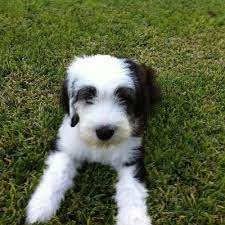
I will have a new book on writing out in a few weeks, December 1. It will be on all the major online retailers. The book covers the topics I cover on this blog but in a more organized way. Some of the content even comes from this blog, revised and edited. But there's whole lot of new material and a lot of content from the class in Creative Writing I taught for many years. Below is the book's introduction. That's my pup in the picture when he was just a pup. He's 125 pounds now.
BE THE DOG
HOW TO START AND (MORE IMPORTANTLY) FINISH YOUR NOVEL
Welcome Reader,
Dogs live in the moment. It’s one of the great things about dogs. They are Zen without knowing what Zen is. You have to Be The Dog when you’re writing the scenes of your novel; you have to live in the moment of your scene. Like a martial artist or musician or painter, you can’t be thinking about all the art and craft you’ve learned when you’re doing what you do, but it all has to be there when you create. Anonymous once said, “There are three secrets to writing a novel. Unfortunately no one knows what they are.” Fortunately, I know hundreds of secrets for you to learn and practice all so you can forget them in the moment of writing itself. In this guide, I’ll let you in on as many as I’m able. You already know number one: Be The Dog.
***
The sections in this writer’s guide have titles like Story, Language, Characters, that sound convincingly practical, and they are in the sense that there is plenty of nuts and bolts craft talk and also some attempts at discussing the more airy aspects of artistic endeavor, but the information and advice are offered in bite-size segments rather than point-by-point instruction.
Additionally, there are Extra entries that offer commentary on my commentary, sort of a spoonful of meta.
Admittedly, this is not your typical writing manual. It is more like the disreputable cousin who sneaks his way into the family reunion uninvited.
A little about me: I’ve written over a dozen novels. Five of them were published traditionally and two won awards from the Texas Institute of Letters. I’ve independently published three urban fantasy novels. I’ve had over a dozen stories published in magazines like Glimmer Train and Literal Latte. I also taught a college level creative writing class, off and on, for over a decade.
I’ve written a lot of words and I plan on writing a lot more because I love to write and I love to have written. It took me a long time to get published. I hope I can shorten your road to whatever your goals are as a writer by using my mistakes and my experiences writing and rewriting novels to help you along your journey. To do something you love (sometimes even be paid pretty well for doing it) is a gift. I’m lucky to have found it. I hope I communicate my absolute and unconditional joy for the art and craft of writing. Maybe you will be lucky, too, and discover you have a similar passion. Good writing.
Thanks for reading.
Brian
October 30, 2021
How do you get to those two words every novelist loves to write, THE END? I'll tell you...
 Are you sitting down? You have to be sitting down to write a novel so that's step 1. Step 2—the blank page is waiting. Start filling it up. HOWEVER, if you think, "OMG, I've got to write hundreds of pages and how will I ever, ever do that when I've got nothing but...almost nothing...maybe a tiny idea, maybe a vague character? This is impossible." If you think this or something like this, it might be impossible. Think smaller steps... Whether you begin with an outline or you just start writing, don't focus on writing a novel. Don't even focus on writing a chapter because what a chapter is, that's vague. What you want is a step that you can easily climb up. What you need is a clear goal. THINK scene. Think of a scene you want to write. My advice is even if you're not an outliner, you write a little one paragraph note to yourself about what happens in this scene you're going to write and what you want the reader to feel or maybe think and what happens and something about the people involved in the scene. Then write that one scene as best you can. Then go on to the next scene. Often a scene will be a chapter but not always. That doesn't matter. Just keep moving from scene to scene. My advice is that you keep trying to give yourself a foot up in the scene by writing a quick paragraph about each scene before you write it. Then write the scene. Then move on to the next.
Step by step, scene by scene, you'll reach where you want to go which is that final page with that final sentence and the words THE END.