Malcolm Blair-Robinson's Blog, page 171
May 6, 2015
Book Of The Day: Downfall In Downing Street
Set in the mid nineteen nineties, this fast moving  thriller lifts the curtain on sex, sleaze and corruption in high places as the long reign of the government totters to an end, following the ousting of the iconic Margaret Thatcher. The novel catches the mood of those times with a host of fictional characters who engage in political intrigue, sex, money laundering and murder, pursued by an Irish investigative journalist and his girlfriend, the daughter of a cabinet minister found dead in a hotel room after bondage sex.


Dynamic QE: What Is It?
An idea to stimulate economic growth without further government  borrowing. Written in plain English and very easy to follow, this is the only really fresh approach out there to the intractable problems of the UK economy, and it is just beginning to be noticed in important places. Buy! Download only .99p Paperback £2.99
Election 2015: The Works are Edinburgh But The Spanner is UKIP.
Unless the polls are wrong and as they mostly agree this is unlikely, we are headed for a hung parliament with the Tories just ahead on seats. Labour will be close behind and together with the anti-austerity pro-EU parties, will have enough sympathisers to block any Tory led Queen’s speech which looks the least bit Tory and includes heavy duty cuts. How this will resolve itself into stable government is beyond prediction at this stage.
Beneath that expectation there is a bigger story. If this election were to be decided on the predicted swing from Tory to Labour, this would not only make Milliband leader of the largest party, but it might also give him a majority. But the epicentre of this election is not London but Edinburgh, for if the polls are right (if again) Labour stands to lose most if not all its Scottish seats. This is equivalent to a Tory massacre in the Shires. It means that whatever gains Labour makes in England will be offset or partly offset by its losses in Scotland. However there is very little difference in the political philosophy of the two parties. The SNP are a bit more left and on a par with the left wing of the Labour party. In effect the SNP has replaced the Labour party in Scotland.
The new reality is that although Scotland is still in the Union it is now speaking with its own voice and just as in other European countries with federal systems, local state parties of right or left come together to form a national majority coalition. This is what should happen if things turn out as expected on Friday morning, but such is the bad blood between Labour and the SNP it may not. Moreover such has been the venomous anti-SNP rhetoric (widely seen as anti-Scotland by Scots themselves) of the Tory campaign, that any Cameron led government would not be seen as legitimate by many north of the border, putting further strains on the Union. This is why many commentators who have been engaged on the ground reporting the election in Scotland itself, are beginning to have doubts about whether the Union can, in fact, endure.
That could turn out to be the big story of this election. The election which saw the Union begin to crack. Had we taken the trouble to organize constitutional arrangements at the time of devolution which recognized the need for some form of federal structure of governance, the Union would now be secure. As it is the ambiguous status of both the House of Commons and the voting rights of those who sit in it, may well be the point of fracture.
Meanwhile it seems in order to throw up some warnings about the economic recovery. Growth is still there but slowing, consumer debt has risen to 2008 levels, exports are down, manufacturing has fallen and no rebalancing of the economy has actually happened. At the currency level something awkward is brewing. The pound has risen against the euro and fallen against the dollar. This means exports to our main market which are priced in euros at point of sale, are becoming expensive, so demand is falling. But imports of energy and raw materials are becoming more expensive to us because they are mostly priced in dollars. The twist is that this may also be the moment when having an independent currency becomes a problem we did not see coming.
So whoever forms the government only one thing is certain. The experience will be no bed of roses. Finally there is the impact of UKIP. If tactical voting is used comprehensively it could well be that UKIP could fail to win a single seat, yet cause a political upset so unexpected as to make much that I have written above little more than hot air.
May 3, 2015

Election 2015: Where Are We Headed?
Sunday’s polls show no break in the neck and neck deadlock, although the hints that the Tories were gaining a small lead seem to have receded, but they have not been replaced with a distinctive Labour advantage.
This is not a prediction, but the poll averages appear to indicate a possible outcome where the Tories are the largest party, leaving Cameron trying to form some kind of new government, but the anti-austerity parties led by Labour having a collective majority against it. This majority grouping may or may not operate as a single force, depending very much on Labour’s post election relations with the SNP.
As for details, the Tories will gain some seats but lose more, Labour will gain but not enough and will lose almost all in Scotland, the Lib Dems will lose about half their seats to both Labour and the Tories, and UKIP will lose Rochester but maybe gain Thanet South and Thurrock. The big story will be the scale of the Scot Nat win. If it is less than forty seats for the SNP that will be a story too, but different.
All this ignores tactical voting. If that occurs in a big way almost anything can happen, but to whom and with what outcome it is impossible to say. Put another way it could produce an upset, but of what nobody knows. Another caveat is the any swings may not be uniform. Constituency polling reveals variations going against the overall trends.
It will not be long before we know how the election has turned out, but it may be a good deal longer before we know who is going to govern us.
May 2, 2015
Election 2015: Economic Truth
It is important to pause a moment in the election campaign and look at something which this blog finds rather shocking. All politicians exaggerate their own and their party’s performance and denigrate their opponents, especially their predecessors (you don’t want them back!), but I do not recall a previous case of calculated dishonesty designed to mislead voters. Yet this is what the endless mantra about Labour have left a disastrous deficit which the Tories are having to clear up.
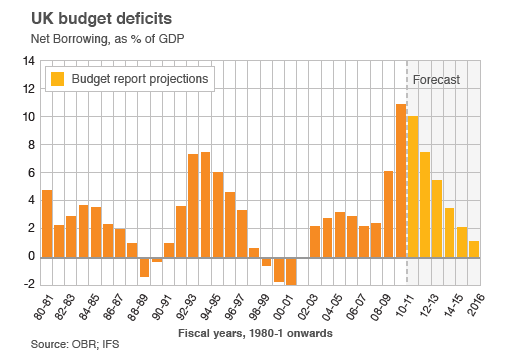
The history of deficits in recent times is very different to the Tory version. There were big deficits in the Thatcher era which grew then reduced and became a small surplus in the early nineties. After the 1992 election came Black Wednesday and deficits went up and up before beginning to come down until the 1997 massacre of the Tories by Tony Blair. After Labour came to power it then went into surplus until after Blair’s 2001 victory, when Labour began a programme of infrastructure renewal. This pushed the gap upwards but it did not reach Thatcher/Major levels until the crash came in 2008. It then rose sharply because it had to, or the financial system would have imploded. It continued to rise sharply because of the twin effects of rising benefits through unemployment and falling tax receipts through the consequent economic slowdown, added to which was the huge cost of saving the banking system.
The crash was not the fault of Labour, nor could any government which allowed markets to run free have stopped it as the worldwide nature of the disaster demonstrates. There is no more enthusiastic political party in the world for a free market economy than the Thatcherite Tory party, the rump of which still drives the Conservatives today. The crash was caused by an uncontrolled housing bubble principally in the US, UK and Ireland providing a new investment derivative called bundled securitized mortgages and loans, which were traded at ludicrous valuations in volumes which defied imagination inflating balance sheets of banks worldwide until they became bigger than the economies of which there were a part. Eventually a liquidity crisis arose for which the solution was the sale of the valuable assets accumulated in trillions, not only in themselves but as bets on their future performance. At that point this mega asset pile was found to be worthless. The banks were bust.
The only part that Alistair Darling and Gordon Brown played was to react very fast when given one hundred and twenty minutes warning that the Royal Bank of Scotland Group, which includes the Nat West and Coutts among many others, was about to collapse. Had they not done so, it would have closed its doors and all the other banks would have gone down the next day. Then there really would have been no money for anybody for anything anywhere. To present an exceedingly complex chain of folly in which many hands worldwide were engaged, mostly active Tories and their allies, as all down to a simple Labour overspend is ludicrous. It is worse than that. It displays a degree of intellectual and factual dishonesty which seeks to take advantage of the lack of understanding by ordinary people of sophisticated financial structures. It is either economically illiterate or deliberately fraudulent and either way it should debar those who pedal it from power.
The historical graph below tells the story.
May 1, 2015
Election 2015: Red Lines
The performance of all three leaders last night was robust in the face of pretty hostile questioning which at times was really nasty. Cameron perhaps had the easier ride because his platform of we are fixing the economy let us finish the job is the easiest brief. Milliband coped well and ended closer behind Cameron on a snap poll than anyone would have thought possible not long ago. Clegg came last, not I think because of his performance, but because (save for the biggest upset in British democratic history) he is not in the running for prime minister.
All the commentators seemed to be agreed that the star was the audience and all were surprised by the venomous mistrust of the political class it revealed. This is going to become a serious issue which will undermine the authority of government generally, especially because of the complete unsuitability of our democratic structure for the challenge which is about to confront it. Whatever government emerges after the poll there is every prospect that it will have been voted for by no one.
Cameron has said he will not join up with any party which does not back his referendum plan. Clegg refuses to join any party that wants a referendum without a further hand over of sovereignty to the EU, which is not even on the agenda in Brussels. So that cuts out a Tory/Lib Dem deal and leaves only UKIP for Cameron. But on current polling the two together will not have a majority. So we look to Labour. But Milliband has ruled out a deal with the Scot Nats, who on current polling will have all or nearly all of Labour’s Scottish seats, so he would not be able to go to the Palace either.
So maybe Cameron, who is prime minister until he resigns (or the Queen fires him, which constitutional convention not the constitution itself, prevents) so he may have a go as a minority administration and put forward a Queen’s Speech. This will then be voted down by the anti-heavy austerity parties, which is actually all of them except the Tories. So Milliband has a go, but he cannot get a confidence vote without the Scot Nats. So say he does and gets his Queen’s Speech through. Unless he has already overturned the Tory’s natural majority in England, in which case he could probably do it alone or with the Lib Dems but no polls are predicting that outcome, he will have to cosy up to Alex Salmond. But the new government will not have a majority in England so devolved issues will be subject to a Tory veto as far as they affect England.
In the worst case scenario it will be neither clear who is governing nor whom they govern. One dare not think of the fright this will give the markets. It will be made worse by the fact that with so many parties standing for every seat and no fair voting system in place, few MPs will sit in the Commons with a majority of the votes in their constituencies. This will give an assembly of honourable members, whom we now know voters regard as liars and cheats, which most people have voted against.
It may not happen but on the present state of the opinions polls it is the most likely outcome.
April 30, 2015
Dynamic QE : What Is It?
An idea to stimulate economic growth without further government borrowing. Written in plain English and very easy to follow, this is the only really fresh approach out there to the intractable problems of the UK economy, and it is just beginning to be noticed in important places. Buy! Download only .99p Paperback £2.99
The Three Leaders
Tonight there is another broadcasting set piece; an edition of BBC Question Time featuring the three main party leaders of the old parliament. Cameron, Clegg and Milliband. How they perform will be the subject of much analysis and polling, but how many votes will move from one to another is hard to tell.
What we do know is that Cameron looks a lot less secure than he did at the start of the campaign and Milliband and Clegg look stronger, especially Milliband. Aside from Nicola Sturgeon, the mega star, Ed is the big surprise to friend and foe alike in the way he and his ratings have grown as the campaign has unfolded. Lynton Crosby, the Tory guru hired from Australia is in part responsible through orchestrating a number of crass attacks on the Labour leader which backfired badly. But the Labour campaign has been better run, as has the much more limited Lib Dem effort, and Milliband has emerged as a measured and sympathetic leader with some kind of inner strength or conviction that people had not noticed before. This could be important, but as with everything in this unprecedented election, it remains impossible to say for sure.