Malcolm Blair-Robinson's Blog, page 138
January 21, 2016
Quantitative Easing? How It Works: Download or Paperback
QE in various forms is now very much part of the economic conversation, especially in connection with recent market turmoil. Dynamic Quantitative Easing remains under government, not bank, control and targets specific investment projects without borrowing, interest or repayments. It can reboot the economy, boost manufacturing and exports and enable sustained growth of real national wealth shared by all, rather than just asset inflation which is the downside of ordinary QE. If you want to find out more you can enjoy a lucid explanation of the original idea from the link below.


China: How bad Is It?
The answer is that if you keep calm, China has problems but they are manageable. Because of the unusual model of state controlled capitalism where the government, not the markets, is in ultimate control, it is hard for analysts of all types to read what will happen. Therefore a slowdown from exotic growth to significant growth causes near panic across the world. Yet China is financially very strong. Its external debt is just under a trillion dollars but its currency reserves are over three trillion. Too much has been lent to Chinese citizens by its banks to buy shares and property which has inflated both above either’s true value and this is bringing about a painful correction which will slow its economy further. But in the end the second largest economy in the world controls its own currency and has the resources to ride out its own storms. Its record thus far suggests it will find a safe course to sail.
The problem is that too much of the rest of the world has taken Chinese mega growth as a bedrock certainty, leading to overproduction, especially of oil and commodities, and to over borrowing. It is not clear whether some emerging market economies can cope with the consequences and whether international banks are as secure as was hoped should an Eastern credit crunch develop. This is an economic situation which has dangers, but also opportunities, and it can be managed by cool heads and steady hands, neither of which are in evidence in a bear market if one develops.
Remedies require political decisions, because as always in economics, it is a case of organising competing tensions into an acceptable model, and opinions vary as to what that should be. The greatest risk out there is that far too much of the menu of economic management has been ceded to Central Bankers whose caution, because of their discomfort in the political undertow of their remit, usually drives them to do too little too late. Right now that could be quite a problem.
January 20, 2016
UK Economy: Dark Clouds Gathering
As this Blog has pointed out time and again, no serious attempt has been made to re-balance the UK economy away from shopping and house price inflation driven by borrowed money. Thus it is that, as things in the global economy turn sour, as now they are, apart from some tinkering to make our banks more resilient (but far from shockproof) we are about where we were as the economic weather took a nasty turn 2007. Then it was the credit crunch which gave the signal. Now it is the collapse in oil prices, the slowdown in China and the realisation that there is another credit crunch rumbling beneath the surface; this time in the East rather than the West. Stock markets in London and across the world are crashing, as is the value of the pound against the dollar and to a lesser degree against the Euro. Yet coupled with the ultra low oil prices this could be good news.
The cost of motor fuel and energy should fall, putting more money into people’s pockets and exports should be more competitive and therefore grow. Unfortunately the market for exports has shrunk and though lower, the pound remains competitively overvalued. Imports will remain cheap, too cheap to offer enough incentive for a real revival of home production of consumer merchandise. So it is not all bad news but the very bad news is that we have done nothing to put the economy into a position to take full advantage of what good news there is.
Meanwhile the Bank of England Governor makes yet another speech to explain how he got it wrong in the last one and announces that yet again interest rates cannot be increased without risk to the faltering growth that is still just alive. So the Bank has now sat on its hands for close on nine years and its various committees do no more than waffle. The reason is plain. Economies cannot be managed by committees of wise men and women, because too many decisions about interest rates, liquidity, investment, economic modelling, employment and expansion are political. So HMS Great Britain approaches the storm with nobody at the helm.
Except Osborne. Whose forecasts of a few weeks back already look dodgy. He must be getting worried. So must Cameron. Behind them both a tousled figure with haystack hair looms. You know his name. He knows that within the coming headwinds there is a route to a better economy through mobilising the twin benefits of lower energy costs and a lower pound. It would mean abandoning austerity and going for growth. For Osborne and Cameron this would represent a humiliating U turn, from which they would never recover. For a new leader with haystack hair it would be a fresh direction in which to lead the country to better times.
January 15, 2016
Anglican Church: Truly Shocking
The decision by the Anglican Church to sanction its US Branch for practicing same sex marriage is truly shocking. Religion without spirituality is both dangerous and harmful. There are too many in the Anglican (and other) churches who are very religious but spiritually barren. They have no instinctive feel for truth or for the meaning of life, they have no sense of compassion and human understanding, they are unable to think for themselves. Instead they study ancient texts, written by men long before much was understood about the science of nature, the universe or even the fact that the earth was round. They interpret what they read literally to reinforce their own prejudice and impose on others unhappiness and distress to make themselves feel good. They declare they speak for God, yet all of it flies in the face of what compassionate Christianity is all about.
People cannot help the way they are born. To place them at practical or emotional or spiritual disadvantage because of their sexual orientation, so that the Anglican Church treats them as second class is not only wrong. It is wicked. There is no other word for it. It is also not Christian.
January 14, 2016
QE in various forms is now very much part of the economic...
QE in various forms is now very much part of the economic conversation, especially in connection with a fresh approach to financial issues by the new leadership of the Labour party. Dynamic Quantitative Easing remains under government, not bank, control and targets specific investment projects without borrowing, interest or repayments. It can reboot the economy, boost manufacturing and exports and enable sustained growth of real national wealth shared by all, rather than just asset inflation which is the downside of ordinary QE. If you want to find out more you can enjoy a lucid explanation of the original idea from the link below.
Hague Warns
In his first face to face TV interview, a scoop for Robert Peston in his new role as political editor for ITN, the former Tory leader and foreign secretary warned that were Britain to vote to leave, this would seriously destabilize the EU to nobody’s advantage, least of all our own, and if that were not enough, lead to the potential break up of the UK as the Scots who want to remain in the EU, up stumps and declare time on the Union.
That has been this blog’s view for many months and it is reassuring that one of the Tory big guns, some still feel the biggest, reports that though in many aspects a Eurosceptic before, he has come to the view that in the world of today, with all its pressures and problems, in is better than out. Quite right.
UK Politics: Splits And Fissures
At times of stress the public at large, whether they vote or not, look to politicians for leadership. Especially from the government. The opposition is often split because the party out of power can indulge itself, the more so now that the possibility of being caught by a snap election is made remote, with the move to five year parliaments. Governments are not supposed to split, but if they do, prime ministers are in turn expected to rid the cabinet of rebels.
But now things are different. The Tory party has been split over Europe since the prime of Thatcher. It crashed out under Major the split was so bad, and it has never healed. Cameron thought up the idea of an official referendum (of which the renegotiations are window dressing) in the belief it would unite the party for the general election. The ruse worked but in a peculiar fashion. It was a unity which was glued by the knowledge that it could split again later. Later is now.
Most commentators and historians agree that the vote to remain or leave is of historic importance. It is therefore unfortunate that the only way which the Tory party, which is in majority government, can hold together is to campaign for both yes and no. That is like a civil war in which one army under one commander fights on both sides. When the fight is over the wounds will run deep. Meanwhile the voting public looking for leadership, will find none and will have to choose between the prejudice of one side over the hopes of another. The opposition shows more unity on the issue of Europe, which it supports, than on most other issues, but even here there are some who want to leave.
Unfortunately that is not all. Corbyn struggles to lead a parliamentary party which did not want him, yet he is backed by the largest membership of any political party in the UK, who do. Over the holiday period and just after, Labour made the news with a blizzard of resignations of shadow ministers of whom nobody outside Westminster had ever heard, none of whom a few days later, after the light of publicity is switched off, can be recalled to mind.
So when the referendum is over, assuming that the country does not lose its mind and vote to leave, action to restore order will be called for. Far from welcoming back those ministers who campaigned for no, the prime minister should fire them all. At the same time Corbyn should not only fire New Labour die-hards from his shadow cabinet, but he should also withdraw the whip from them. Whatever may be the froth and fury of the hour, both leaders will have a firm base from which to build, Farage will have some useful scraps to harvest and Osborne will have some potential recruits from the old Thatcherite wing of the busted flush still calling itself New Labour.
Of course if the country votes to leave it is chaos for everybody.
January 13, 2016
NHS: Time To Get Real
The junior doctors’ strike is over for the moment as the row with the government runs on in the form of talks which may or may not get somewhere. Wherever they do get, even if it solves the dispute, is essentially the wrong place. This blog has said over and over, you cannot have an infinite service on a finite budget. The NHS is chronically underfunded at a time when demand and costs are rising. It has run by an overlapping structure of supervisory quangos, breathing down the necks of confused managers, trying to run a fragmented bureaucracy spinning out of control, through a command system with so many fingers in the pie or on the button that while it does not crash, neither does it deliver a timely healthcare programme. In an emergency it works, but for routines stuff, some of it life threatening, people are kept waiting weeks in a cruel system organised round the principle of waiting and delay.
To set the show back on the road envisaged by its founders requires 24/7 working 365 days per year. This would involve three 8 hour shifts for everybody, never more, operations at night and the elimination of waiting lists. It will also require a funding system that recognises the true cost has to be paid and that taxes will have to go up to meet it. If the public will not accept that, then the whole thing should be cut back to work within a finite budget and people who can afford it will have to pay for their treatment. The problem for politicians is that the public will not pay the higher taxes, but demand the the universal free service. At least some savings could be made by abolishing the quangos, commissioning boards, foundation trusts et al and by returning to a rational management structure that derives its form from common sense, not Alice in Wonderland.
January 8, 2016
Downfall In Downing Street: Get It Now!
Set in the mid nineteen nineties, this fast moving 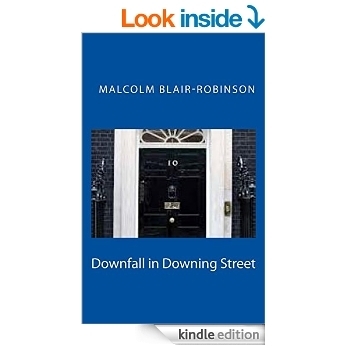 thriller lifts the curtain on sex, sleaze and corruption in high places as the long reign of the government totters to an end, following the ousting of the iconic Margaret Thatcher. The novel catches the mood of those times with a host of fictional characters who engage in political intrigue, sex, money laundering and murder, pursued by an Irish investigative journalist and his girlfriend, the daughter of a cabinet minister found dead in a hotel room after bondage sex.