Malcolm Blair-Robinson's Blog, page 120
July 7, 2016
Falling Pound : An Opportunity Needing Management
The one ingredient indispensable to re-balancing the economy to achieve sustained growth for the benefit of everybody, a falling pound, is in place. But the things to make it work in our favour are not.
This Blog believes that sustained growth in which imports fall, home industry prospers and exports expand, require a pound sterling trading between a low of $.95 and a high of $1.20. It also believes that central banks now have too big a remit which takes them into the arena of political decisions where they have no place to be, and from which they shrink. Restoring the role of government in both economic and currency management is essential. Government should introduce QE into the real economy to create new wealth through critical investment in social housing, transport, education, health, science, power generation and so on. This will divert investment from banking and debt, which is far too large and which funds asset inflation, into the creation of new wealth, which is far too small.
If managed in the traditional manner by government, business, industry and unions, personal incomes grow as the increased money supply expands the economy, through new activity both in the public and private sectors, which allows for an increase in the prices of imported goods and food to be offset by falling housing costs and less borrowing. It also creates much better opportunities for home manufacture of consumer goods and an expansion of exports through competitive pricing. This is all the more critical to the country’s future following Brexit. The critical bit is careful control and management of a volatile process.
If that is absent at the political level, which it now is, there is a risk that export opportunities will be limited and the weight of increased costs of imports in a country which imports almost everything, will act as a dead weight on the economy and slow it down. We are headed this way now.
We need a Prime Minister and a Chancellor long before September.


July 6, 2016
Tory Members Must Stand Aside
This blog has always proposed that in the event that a governing party changes its leader and therefore the country’s prime minister, only MPs should vote, so as to ensure a quick resolution to the crisis. With the pound now at $1.29 and no plan of action to take advantage of this silver lining, it will become instead a dead weight on the real economy, which is clearly slowing down.
There are stresses beginning to develop in commercial property as what used to be called property bonds close their funds to withdrawals. Attempts to balance the budget have been abandoned not from choice, but because they cannot be achieved. Inward investment is severely curtailed as is business investment. This is no time to be without both an operational prime minister and chancellor and to continue like this would be to exhibit a degree of national irresponsibility without clear historical parallel. When Chamberlain had to go Churchill replaced him within the hour.
The Conservative Party must accept that its 140,000 members must forgo the luxury of hustings and a ballot. If they do act in the national interest, we can have a new government before the weekend. We certainly need one.
July 5, 2016
Labour in Crisis: A Must Read
Turn Left To Power is an explosive dissertation in book form offering a fundamental redirection for Labour’s return to power, with bold ideas for a new economic and social settlement, including economic and taxation reform, restoration of responsibility in government and a renewal of democracy. Full of detailed information, hard facts and the results of thorough research and deep thinking, the narrative will grip you like a thriller and open your eyes to a brighter, fairer future in a mere 25000 words. The ideas are relevant whether Brexit goes In or Out. Frank and at a times brutal, Turn Left To Power offers a collection of fundamental reforms which amount to a political revolution which can propel Labour back to government in 2020.
Check it out now. Paperback £4.99 Kindle £1.99 AMAZON UK
Carney’s Latest: Some Sympathy
This Blog has some sympathy for central bankers generally. They are non-political yet they have to carry out political orders and deal with financial consequences of political mistakes and miscalculations. Most of them know that the current structure of free market globalization is failing ordinary people and is therefore in decline. In the UK, in spite of promises by Osborne to re-balance the economy and declarations by Cameron who does not have much grasp of economics that he has, Osborne has not in fact succeeded. This is because the ever forecasting Chancellor has taken the soft option and rebuilt the shattered Brown model economic settlement with its reliance on house price inflation, cheap imports and high personal borrowing almost exactly as it was before, although with rather stronger, but not invulnerable, banks.
After Brexit we are still in the throes of a political crisis without a functioning government except for emergencies and an opposition which has gone mad. Financial mayhem, tasted in the first few hours, has been averted by the timely interventions of Mark Carney; apparently the Bank of England was the only government institution to consider the prospect of Brexit and get together a plan. Even the Brexiteers have not bothered, let alone the Remain core of the government. His warnings that there is a slowdown coming, which there is little that he and his colleagues can do about, is timely. He also warned that personal and household debt is dangerously high. It demonstrates the perverse idiocy of the current economic model, that the only thing he can do to help is to making bank lending easier.
The good news is that the pound is now down to near $1.31. Every point it falls, it makes the way through this mess easier, and every point it rises it makes that way more difficult. But either way you need to have a plan.
Labour On The Brink
Jeremy Corbyn has the overwhelming backing of Labour Party members and is winning back the millions of votes lost to Labour since it abandoned the working classes and re-invented itself as a Social Democratic party of the centre left. When the Tories were undetectable it gained power and held onto it, but when the Tories recovered their equilibrium, they lost it and will not get it back. Because to get power back the Tories had to move to the left and the two parties now occupy the same space.
The Labour Party is the political arm of the Labour movement, The other arm is the Trade Unions. The purpose of the whole idea is to protect and advance the standards of living and future prospects of all those who work for the benefit of the economy in industry, commerce, services, education, health and whose earnings can never make them rich but upon whom the functions of a civilised state depend. The Labour Movement and Labour party members are engaged in this notion of brotherhood and purpose for the common good of all. They are a political movement rooted in the country at large.
The Parliamentary Labour Party has become a party detached from the country and rooted in Westminster. It smokes a daily dose from the pipe of power and lusts after it for its own sake. It spouts the nostrum, to justify its addiction, that without power you cannot help people. You can take this as a self evident truth, or, as the Blog prefers, dismiss it at cynical drivel. Because power for power’s sake is like a journey without a compass or a destination. The party membership in the country know where they want to go, there are more of them than all the other parties put together, and they chose by an overwhelming mandate from a wide choice of options just the person to take them there.
If the PLP successfully engineers a means to dump him, it will be the last big thing it ever does.
Print For The People, Not The Banks
QE in various forms is now very much part of the economic conversation, especially in connection with recent market turmoil. Dynamic Quantitative Easing (also called Peoples Quantitative Easing) remains under government, not bank, control and targets specific investment projects without borrowing, interest or repayments. It can reboot the economy, boost manufacturing and exports and enable sustained growth of real national wealth shared by all, rather than just asset inflation which is the downside of ordinary QE. If you want to find out more you can enjoy a lucid explanation of the original idea from the link below.
July 4, 2016
Ways Forward 1: Globilization
WAYS FORWARD will be a new Series which examines ideas to bring the UK through the self imposed hazard of leaving the EU and will focus on the very real changes demanded by the magnitude of that decision. It will not explore the reasons for, or wisdom of, the decision itself, which this Blog opposed, but accept it and move forward to find a path which could offer a new deal for everybody. Before we set off we must examine the character of the key component of where we are. Globalization.
Globalization is now a word used by almost every commentator to explain almost everything, as if it is a new phenomenon. There is nothing new about globalization. When the first primitive human stood upright and walked to the next valley, it began. It has been going on for hundreds of thousands of years. But it takes many different forms and has many different drivers. It is the drivers which determine the model of the age. We have had models driven by migration, trade, empire, famine, tyranny, industrialisation and so on. Each model is different and tends to have different aims and beneficiaries. Some are so restrictive in structure that they are thought of as closed rather than open. Each depends on communication and travel, so early models were tiny, covering a known world which today we would regard as no more than a neighbourhood. That meant that countless models operated simultaneously without contact with, or even awareness of, the others.
To succeed these various structure must bring benefit to the people they are inaugurated to serve. The model which was ushered in by the industrial revolution eventually split into two competing halves; capitalism and communism. Capitalism prevailed in the West, was led finally after two world wars by the United States and brought unprecedented improvements in living standards for all who lived within its boundaries. Communism prevailed in the East, was led by the Soviet Union and while it provided security and a basic standard for all its people, it did not raise their standard of living by anything approaching the margin of the rival capitalist model and therefore it eventually collapsed.
This coincided with the end of the Cold War, the reunification of Europe, in particular Germany, and the morphing of China into a one party autocratic state calling itself communist, but which embraced capitalism as its economic model. Added to these political influences came the belief that markets should be given freedom to lead. Meanwhile huge advances in technology, communications, the internet connected to the palm of any hand or carried in any briefcase, and strides in aircraft design and supporting infrastructures, allowed this emerging model of globalization to become truly global for the very first time in human history. And this time it was not controlled, but allowed to find its level. It was driven by free markets.
To begin with the idea was liberating and successful but the model is failing and in its final act. Markets follow patterns not unlike a flood. They advance where there is least resistance. Thus the current globalization model has created huge imbalances between trade surpluses and deficits, Forex reserves and government debt. Put loosely most of the money is in the East and most of the debt is in the West. But that could perhaps be resolved were it not for one fatal flaw. The rich are getting ever richer and the middle and working classes are seeing their standards of living fall. The young have a much tougher prospect than their parents who are the authors of this failure, did when they were young. This is not about an unequal advance, it is about a divergence of direction, making this unfettered capitalist model exhibit the same flaw as the controlled Soviet Communist one. Ordinary people are not benefiting. How and why this is, we will explore in future posts.
Enough to conclude by saying that the next model will still be capitalist, but it will be driven not by markets, but by people, whose advancement capital will this time more fairly serve.
Labour Can Win: Turn Left To Power
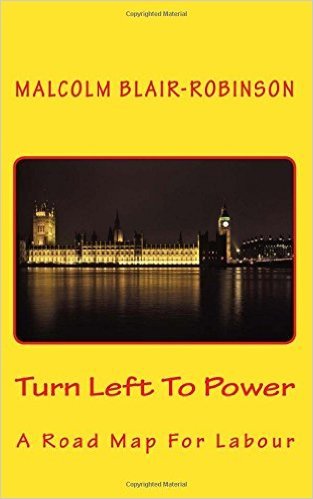
Turn Left To Power is an explosive dissertation in book form offering a fundamental redirection for Labour’s return to power, with bold ideas for a new economic and social settlement, including economic and taxation reform, restoration of responsibility in government and a renewal of democracy. Full of detailed information, hard facts and the results of thorough research and deep thinking, the narrative will grip you like a thriller and open your eyes to a brighter, fairer future in a mere 25000 words. The ideas are relevant whether Brexit goes In or Out.
Malcolm Blair-Robinson, writer and blogger, has been a keen political observer for more than sixty years. Born a Tory, he became a founder member of the SDP, before gradually migrating left. In 2014 he published his idea of Dynamic Quantitative Easing which aroused interest in high places and this forms a core element of this powerful and compact analysis of Labour’s opportunity to regain power. Frank and at a times brutal, Turn Left To Power offers a collection of fundamental reforms which amount to a political revolution. He is dismayed by the unfairness of the current economic model and is driven by the hope of a better future for the rising generation.
Get your copy now. Paperback £4.99 Kindle £1.99 AMAZON UK
Farage Goes. Corbyn Stays. And The Tories?
The political theatre continues in full swing. Keen audiences, mostly the Westminster village, find it thrilling. Meanwhile there is a sense of drift in a county without either a functioning government or opposition. Perhaps Chilcot will liven things up on Wednesday. It may not be a good day for Blair.
Meanwhile Farage, having achieved his lifelong ambition to get Britain out of the EU, has decided to pack it in. He never managed to get elected to parliament, but my goodness it danced to his tune. Without Farage there would have been no referendum and no Brexit. Meanwhile the coup against Corbyn has clearly collapsed and the PLP, having blundered about and made a fool of itself, will now have to get a grip. The only reputation in Labour which has not been dented by this gross misjudgement by those who should know better is Corbyn’s. His as risen, among party members especially, but also in the country at large. As a rule people do not like to see a decent person vilified and bullied by lesser people keen to grab his star and they admire someone willing to tough it out.
That leaves the Tory party. Dear me. There is a lot of blood letting here for sure. And several candidates. It is good to see two are women. This blog thinks either would be fine. The boys have screwed up quite enough. We need another handbag.
July 2, 2016
A Way Ahead For Labour.
Turn Left To Power is an explosive dissertation in book form offering a fundamental redirection for Labour’s return to power, with bold ideas for a new economic and social settlement, including economic and taxation reform, restoration of responsibility in government and a renewal of democracy. Full of detailed information, hard facts and the results of thorough research and deep thinking, the narrative will grip you like a thriller and open your eyes to a brighter, fairer future in a mere 25000 words. The ideas are relevant whether Brexit goes In or Out. Frank and at a times brutal, Turn Left To Power offers a collection of fundamental reforms which amount to a political revolution which can propel Labour back to government in 2020.
Check it out now. Paperback £4.99 Kindle £1.99 AMAZON UK