
Karl Shuker's Blog, page 58
December 13, 2012
THE MEGALOPEDUS, THE SUKOTYRO, AND A VERY CRYPTIC CABINET OF CURIOSITIES
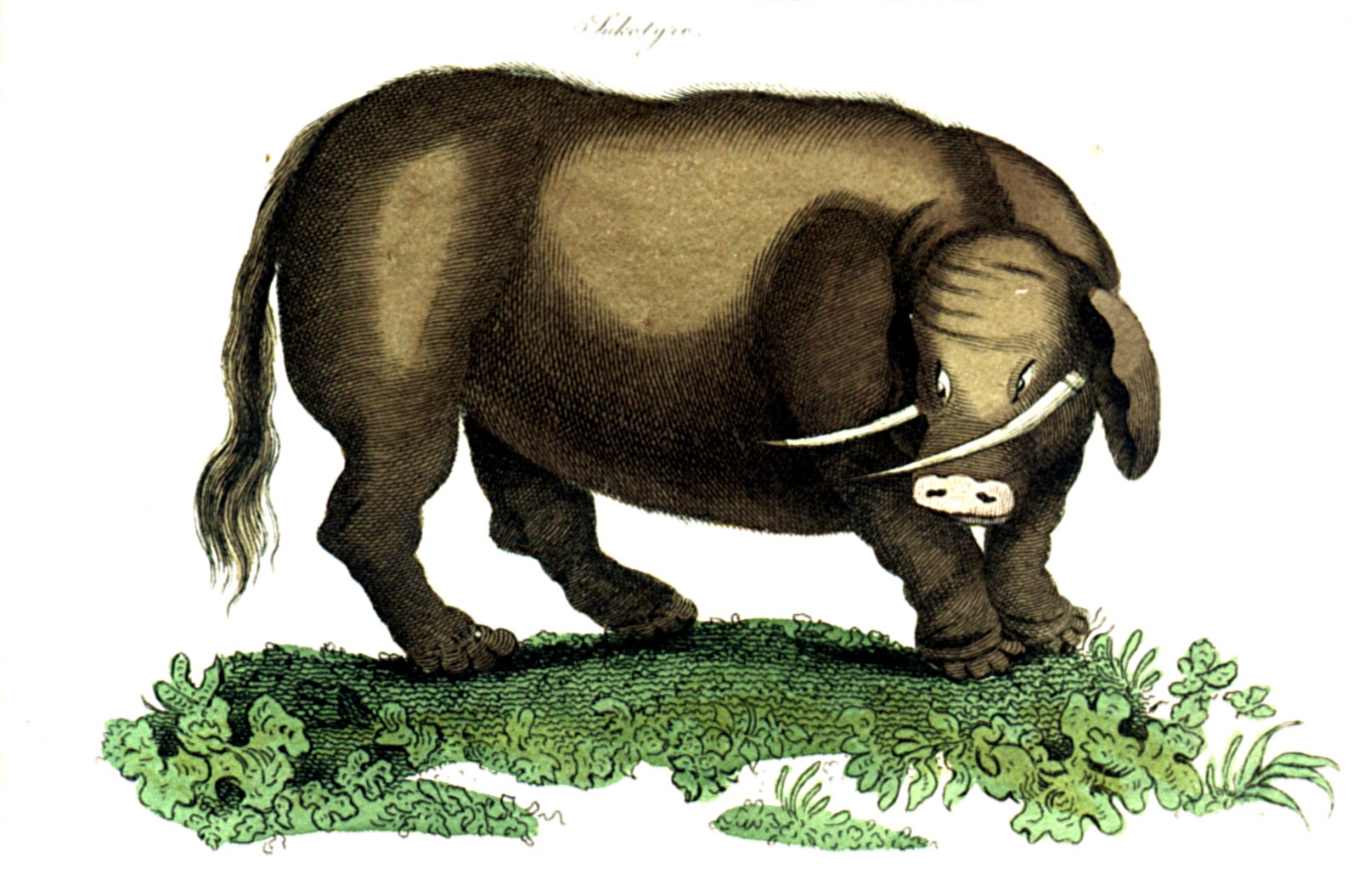 The sukotyro, as depicted in a colour engraving from 1812 (Dr Karl Shuker)
In cryptozoology, it is always a delight to unearth accounts of hitherto-obscure mystery beasts from the archives of antiquity. Lately two such creatures, hailing from widely disparate geographical regions but of oddly similar appearance, have occupied my attention simultaneously, though with very different outcomes, as will be seen!
THE TUSKED MEGALOPEDUS
It was American cryptozoological contact Marc Gaglione who first brought the tusked megalopedus to my attention, asking me in early 2011 if I’d ever heard of this enigmatic beast:
"What are some animals, small or large, that are known only from a single specimen, skin, or skull? Is there something called a Tusked Megalopedus? I read the name somewhere."
However, I certainly hadn’t, because I would have definitely remembered a name as distinctive as ‘tusked megalopedus’, and, indeed, would have actively investigated it - if only because of the tantalising cryptozoological coincidence that ‘megalopedus’ translates as ‘bigfoot’! But a bigfoot with tusks? Moreover, judging from the context of Marc’s message, it appeared that this creature was known only from a single specimen, making it even more curious.
Mirroring that situation, internet searches for information concerning the tusked megalopedus yielded only a single but highly informative source. It stated that this mysterious creature had been described by no less an authority than Pliny the Elder (23-79 AD), the famous Roman naturalist-scholar and author of the encyclopaedic work Historia Naturalis. It also claimed that the only known specimen of the megalopedus was ensconced in a quite extraordinary cabinet of curiosities, and it included a description of this remarkable collection as witnessed by a visiting journalist that contains a brief account of that unique specimen:
"...a strange stuffed animal greeted his eye: a large, tapirlike mammal with a huge muzzle, powerful forelegs, bulbous head, and curving tusks. It was like nothing he had ever seen before; a freak. He bent down to make out the dim label: Only known specimen of the Tusked Megalopedus, described by Pliny, thought to be fantastical until this specimen was shot in the Belgian Congo by the English explorer Col. Sir Henry F. Moreton, in 1869...[But] could it be true? A large mammal, completely unknown to science?"
So where can this peerless repository of the world’s only tusked megalopedus, and untold other scientific treasures besides, be found? Yes, you’ve guessed it – in the pages of a novel! Published in 2002 and entitled (what else?) The Cabinet of Curiosities, it was written by Douglas Preston and Lincoln Child, and is the source of the above statements and quote.

Once I’d discovered that, I contacted Marc, who confirmed that this was indeed the book where he had read about the megalopedus, but he had wondered whether, although the story was fiction, the animal itself may have been genuine. Certainly, Pliny documented many bizarre creatures in his encyclopaedia, some of which were later unmasked as legendary beasts or even wholly fictitious monsters with no basis either in fact or in folklore, so such a situation would not be unprecedented.
 Reconstruction of the tusked megalopedus's appearance as described in The Cabinet of Curiosities (Tim Morris)
As far as I am aware, however, there is no mention of the tusked megalopedus in any of Pliny’s works. Another reason for doubting even an erstwhile existence for this ultra-cryptic creature supposedly hailing from the Belgian Congo is that the name of its discoverer, Col. Sir Henry F. Moreton, is clearly inspired by that of a real explorer, Sir Henry Morton Stanley, who did indeed contribute to a major zoological discovery in the Belgian Congo – the okapi, in 1901.
Nevertheless, I would be delighted to be proven wrong, and receive verifiable evidence that Pliny genuinely documented the mystifying megalopedus, or even something comparable upon which the megalopedus may have been based. Consequently, if anyone out there can do so, please send in details!
Having said that, there is one final, but extremely significant twist in the tale (if not the tail!) of the tusked megalopedus. Even though this is assuredly a make-believe mammal, its description is strangely reminiscent of a seemingly genuine yet wholly obscure, long-forgotten mystery beast that I serendipitously uncovered during my megalopedus investigations. And the name of this overlooked oddity? The sukotyro of Java.
THE SUKOTYRO
While seeking possible images of the megalopedus before discovering its true nature, I spotted a very unusual antiquarian print for sale online. It depicted two animals. One was Australia’s familiar duck-billed platypus. The other was an entirely unfamiliar hoofed mammal labelled as the sukotyro. This print was a colour plate taken from Ebenezer Sibly’s A Universal System of Natural History (1794). I collect antiquarian natural history prints as a hobby, but I was reluctant to purchase this one as I considered its asking price to be unjustifiably high. Happily, however, further internet perusal soon yielded several other plates depicting this same creature, all dating from the early 1800s.
Despite emanating from different sources, these plates' depictions were all clearly based upon the same, earlier, original illustration (see later here). And as they were reasonably priced, I duly purchased no less than three large, excellent plates (two in colour, one b/w) that included the instantly-recognisable sukotyro image (together with various well-known beasts). At a later date I also succeeded in purchasing a reasonably-priced 1804-dated version of Sibly's plate.
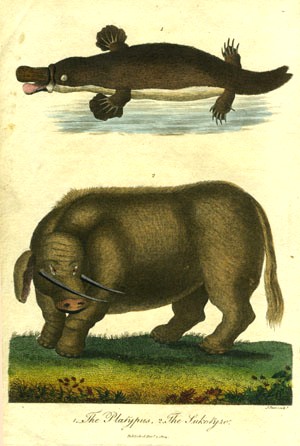 The platypus (top) and the sukotyro (bottom), depicted in a colour plate from 1804 (Dr Karl Shuker)
As the images reproduced here from some of these plates reveal, the sukotyro does not readily resemble any known mammal. Its large, burly body (variously portrayed as elephantine grey or deep-brown in coloured depictions) is somewhat rhinoceros-like in general shape but its smooth skin lacks these creatures’ characteristic armour, and its long, bushy-tipped tail differs from their shorter versions. Equally distinct is the short upright narrow mane that runs down the entire length of its back.
Furthermore, each of its feet appears to possess four hooves (thereby allying it with the pigs, hippos, camels, ruminants, and other even-toed ungulates or artiodactyls, whereas the rhinos are odd-toed ungulates or perissodactyls, which also include the horses and tapirs). Its head is also totally unlike that of any rhinoceros, sporting a sturdy but elongate, hornless muzzle ending in a pair of decidedly porcine nostrils, a pair of long, pendant ears, and, most distinctive of all, a pair of truly extraordinary tusks.
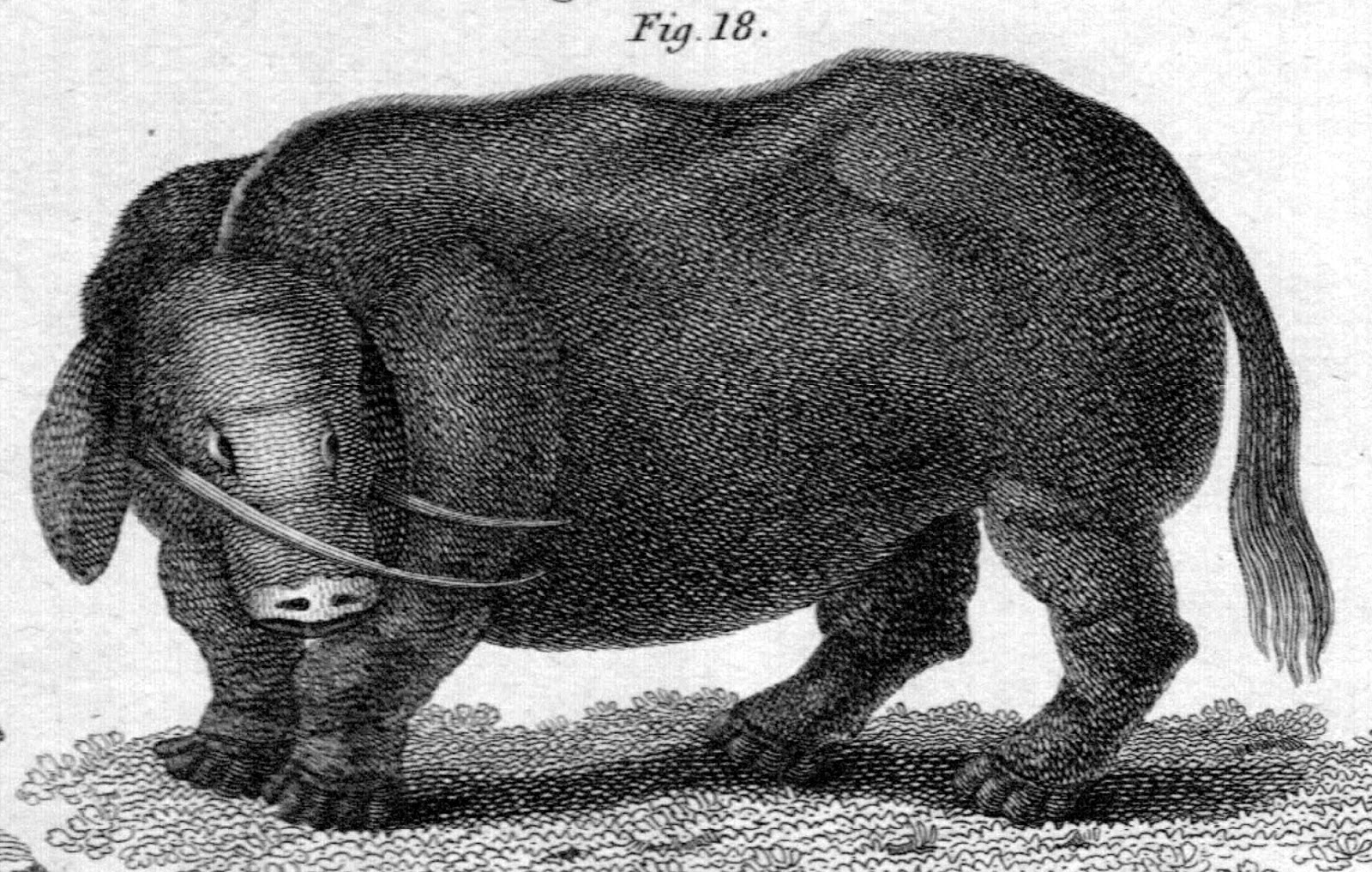 A b/w undated plate depicting the sukotyro (Dr Karl Shuker)
Bizarrely, all of the sukotyro illustrations that I have seen depict these tusks emerging from a point located directly beneath and behind the eyes rather than from any anterior region of the jaws. In addition, they are held above the level of the snout, and (rather like those of elephants) are almost entirely horizontal in orientation with only their tips exhibiting a slight upward curve. I can only assume, therefore, that these depictions are meant to signify (albeit with poor artistry) that the sukotyro’s tusks emerge from some site at the back of the (upper?) jaws.
Tusks aside, in overall appearance the sukotyro resembles a big wild pig, but where does (or did) it come from? What, if indeed anything, is known about this strange creature?
 Niewhoff's 17th-Century illustration of the sukotyro, alongside an elephant, a jackal, and other animals (Dr Karl Shuker)
The earliest known description of the sukotyro is that of Johan Niewhoff (aka Niuhoff and Neuhoff) in his account of his travels to the East Indies, entitled Die Gesantschaft der Ost-Indischen Gesellschaft in den Vereinigten Niederländern, and published in 1669. He also included an illustration of it (as reproduced directly above this paragraph), upon which all subsequent ones appear to have been directly based. His description, kindly translated from Dutch into English for me by longstanding Dutch cryptozoological correspondent Gerard Van Leusden, reads as follows:
"The animal Sukotyro as it is called by the Chinese has a wonderful and strange shape. It is about as big as an ox, has a snout like a pig, two long rough ears and a long hairy tail and two eyes that stand high, completely different from those in other animals, alongside the head.
"At each side of the head, along the ears, are two long horns or tusks that are darker than the teeth of the elephant. The animal lives from vegetables and is seldom captured."
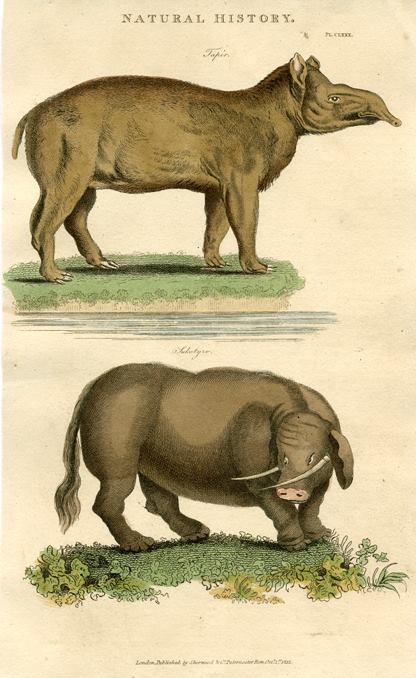 Tapir (top) and sukotyro (bottom) in a colour plate from A New Cabinet Cyclopedia, published in 1819 (Dr Karl Shuker)
My continuing searches revealed that the sukotyro received its most authoritative scientific coverage in 1799, by British Museum zoologist Dr George Shaw in Vol 1 of his exhaustive 16-volume General Zoology: Or Systematic Natural History.
 The sukotyro as depicted in a copper engraving within Shaw's treatise (Dr Karl Shuker)
Inserting it directly but somewhat hesitantly after the elephant in this volume’s main text (and neglecting to mention, incidentally, that in 1792 its species had been formally christened Sukotyro indicus by fellow zoologist Robert Kerr), Shaw paraphrased Niewhoff's description and concisely documented this enigmatic mammal as follows:
"That we may not seem to neglect so remarkable an animal, though hitherto so very imperfectly known, we shall here introduce the Sukotyro. This, according to Niewhoff, its only describer, and who has figured it in his travels to the East Indies [Die Gesantschaft der Ost-Indischen Gesellschaft in den Vereinigten Niederländern, 1669, containing the original illustration reproduced above], is a quadruped of a very singular shape. Its size is that of a large ox: the snout like that of a hog: the ears long and rough; and the tail thick and bushy. The eyes are placed upright in the head, quite differently from those of other quadrupeds. On each side the head, next to the eyes, stand the horns, or rather teeth, not quite so thick as those of an Elephant. This animal feeds upon herbage, and is but seldom taken. It is a native of Java, and is called by the Chinese Sukotyro. This is all the description given by Niewhoff. The figure is repeated in Churchill’s Collection of Voyages and Travels, vol. 2. p. 360. Niewhoff was a Dutch traveller, who visited the East Indies about the middle of the last century, viz. about the year 1563 [sic – should be 1653], and continued his peregrinations for several years. It must be confessed that some of the figures introduced into his works are not remarkable for their accuracy."
This would presumably explain, therefore, the anatomically aberrant positioning of the sukotyro’s tusks, and also, probably, the upright positioning of its eyes. Of course, if the latter are portrayed correctly, it could be suggested that the sukotyro spends time submerged in water, with only its eyes showing above the surface, as with hippopotamuses, whose eyes are also placed high on their skull. However, so too are the hippos’ nostrils and ears, whereas those of the sukotyro are not, thereby reducing the likelihood that it does spend any length of time largely submerged.
 The sukotyro (top) and Asian elephant (bottom) in a colour plate from 1806 (Dr Karl Shuker)
As for the sukotyro’s tusks: ignoring their potentially-inaccurate horizontal orientation, they remind me both in shape and in size of those bizarre versions sported by the babirusas of Indonesia (formerly a single species, but recently split into several separate ones). These grotesque-looking wild pigs are famous for the huge vertical tusks sported by the males, in which not only the lower tusks but also the much larger upper ones project vertically upwards, with the upper ones growing directly through the top of the snout!
 Babirusa (Hirscheber/Wikipedia)
Babirusas are native to Celebes (Sulawesi) and various much smaller islands close by, but zoologists believe that they may have been deliberately introduced onto at least some of these latter isles by human activity rather than by natural migration. If so, might they also have been transported elsewhere in Indonesia, perhaps as far west as Java, in fact?
Following Shaw’s cautious coverage of the sukotyro, other zoologists adopted an even more sceptical view of it. This deepened still further following the revelation that a pair of alleged sukotyro tusks acquired by British Museum founder Sir Hans Sloane during the 1700s were actually the horns of an Indian water buffalo. These had been presented as a gift to Sloane by a Mr Doyle after he had discovered them in a partially worm-eaten state inside the cellar of a shop in Wapping, London, and were formally documented in 1727 within the Memoirs of the Academy of Sciences. Eventually, with no further specimens or data regarding it coming to light, the scientific world dismissed the sukotyro as a hoax, after which it quietly vanished from the natural history books. But was it really a hoax?
 Babirusa (top) and sukotyro (bottom) - comparable, or conspecific? (Hirscheber-Wikipedia/Dr Karl Shuker)
The more I look at the depictions of the sukotyro, the more they seem – at least to me - to resemble a distorted but still-identifiable portrait of a babirusa. There is no indication that any of these porcine species exist on Java today, but perhaps Niewoff’s mystifying sukotyro is evidence that one did exist there long ago. Alternatively, could this cryptid even have been an unknown relative of the babirusas, differing from them via its bulkier form and longer ears, but still recognisably akin?
Finally, an even more controversial, dramatic possibility is that the sukotyro was a bona fide prehistoric survivor. If we assume that its extraordinary tusks really were horizontal, and not an artefact of poor artistry, its overall form calls to mind a modest-sized stegodont, a cousin of today’s elephants, complete with proboscis (albeit rather short in the sukotyro images), floppy ears, and long hairy-tipped tail.
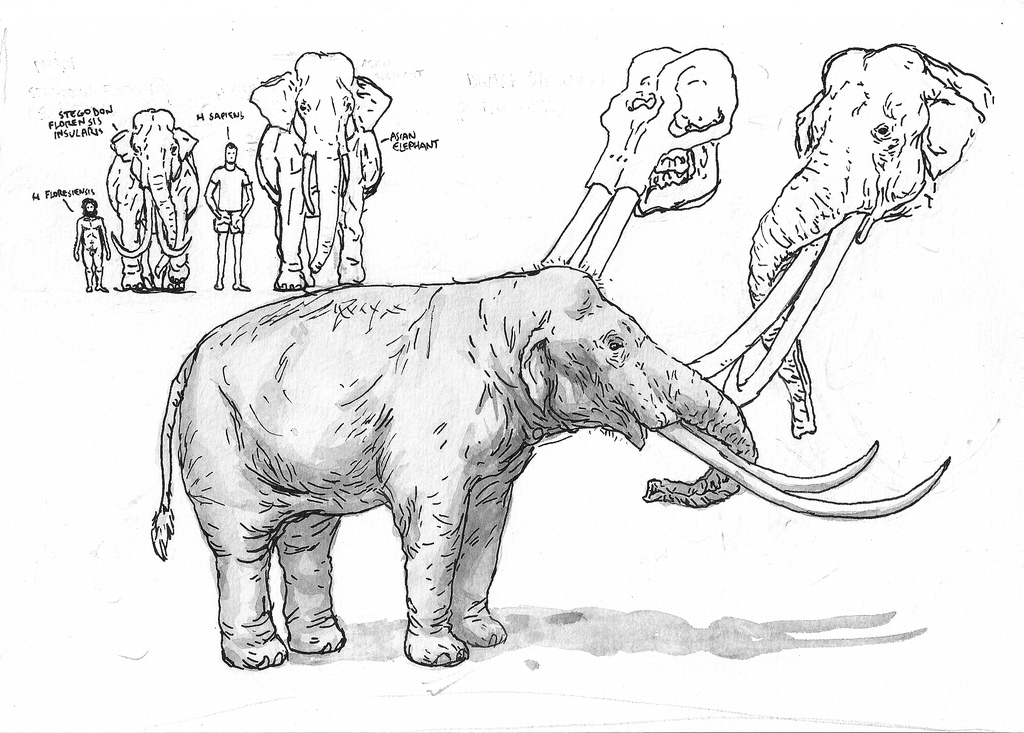 Stegodon florensis (Povorot/Flickr)
Moreover, a dwarf, buffalo-sized species of stegodont, Stegodon florensis, is known to have survived on the island of Flores, just east of Java, until as recently as 12,000 years ago – so could a comparable form have existed on Java too, and lingered even longer there, right into historical times?
Sadly, we will probably never know, for in a very real sense the lost, forgotten sukotyro is today just as intangible as its literary, fictional doppelgänger, the tusked megalopedus.
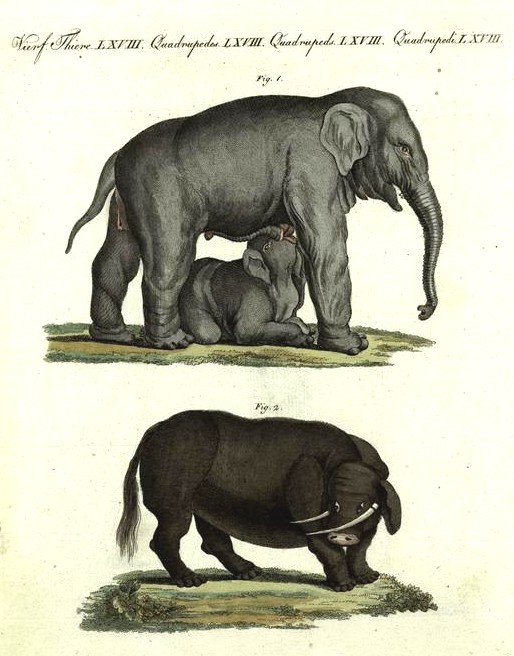 Undated colour plate (c.1770-1820) depicting a female Asian elephant with a suckling calf (top) and the sukotyro (bottom) (Dr Karl Shuker)
This ShukerNature post is exclusively excerpted from my next book, Mirabilis: A Carnival of Cryptozoology , to be published in 2013 by Anomalist Books.


December 11, 2012
THE SMILE ON THE FACE OF THE MANTICORE AND LEUCROCUTA
 Manticore, from Edward Topsell's The History of Four-Footed Beasts (1607)
“I know you,” whispered Strange again. “You are...You are...” He moved his hands through the empty air as if tracing magical symbols. “You are a Leucrocuta!”...
“You are the Wolf of the Evening! You prey upon men and women! Your father was a hyena and your mother a lioness! You have the body of a lion; your hooves are cloven. You cannot look behind you. You have one long tooth and no gums. Yet you can take human shape and lure men to you with a human voice!”
Susanna Clarke – Jonathan Strange & Mr Norrell
Medieval bestiaries contain many monsters, but few are stranger or more sinister than the following pair of feline fabulosi.
Combining the stature and body of a red lion, with the head and leering face of a bearded man (but sporting no less than three separate rows of shark-like teeth in each jaw), and the sting-tipped tail of a scorpion (which also bore a series of long spines that could be hurled from it with deadly accuracy at any would-be foe), the manticore was a rapacious beast originally from Persian mythology. However, it also entered European folklore after being documented in a now-lost book on India by Ctesias (a Greek physician and historian at the Persian court of King Artaxerxes II in the 4th Century BC), and later appeared in many medieval bestiaries. Not only did this ferocious monster attack and devour any human that it met, it even consumed their bones, clothes, and any belongings that they had with them, thus leaving behind not the slightest trace of its victim’s former existence.
 A manticore in Liber de Proprietatibus Animalium, a 16th-Century bestiary
Zoologists have attempted to identify the manticore with the tiger (or even as a shape-shifting were-tiger), but there is scant – if, indeed, any? – similarity between the two creatures. Its sting-tipped tail has been explained by the occasional prominent presence of a horny claw-like structure at the extremity of a tiger’s tail. However, such structures are regularly present at the tip of lions’ tails, as well as those of leopards and even domestic cats on occasion, so this is hardly a characteristic exclusive to tigers. Equally unsatisfactory are claims that the manticore’s triple row of teeth was merely a misunderstanding based upon the fact that each molar of a mammalian carnivore bears three cusps or lobes. And why, if the manticore were indeed based upon a tiger, did it lack that great cat’s most distinctive feature – its stripes? (Incidentally, fantasy artwork featuring the manticore often gifts it with a pair of large bat-like wings, but this is a modern invention, which does not appear in early sources.)
Somewhat akin to the manticore but less well known was another mythological Asian monster – the leucrocuta (also spelled ‘leucrocota’, ‘leucrocotta’, 'crocotta', and other variants). Sometimes confounded in bestiaries with the hyaena (whose spotted species has been given the zoological name Crocuta crocuta), and said to frequent Ethiopia or India, the true leucrocuta was believed to be the hybrid offspring of a male hyaena and a lioness, but exhibited various features not possessed by either of these creatures - such as its hoofed feet, and, instead of normal separate teeth, having only a single unbroken ridge of bone in each jaw, forming one long continuous tooth without any gum.
 A bestiary portrayal of the leucrocuta
Other characteristics included the head of a badger, the limbs of a stag, a lion’s neck, breast, and tail (as well as its bravery), a stature approaching that of a male ass coupled with the speed of a horse and the strength of a bull, plus an invulnerability to any weapon made of steel. Most bizarre of all, however, was its extraordinarily wide mouth, which allegedly stretched right back to its ears in a thoroughly unnerving grin!
Just like the manticore, the leucrocuta was a man-eater, but was much more cunning, luring its victims out of their houses at night by calling their names in a perfect imitation of a human voice. Indeed, and again like the manticore, the leucrocuta was often claimed to be a shape-shifter, able to adopt human form in order to increase the success of its voice’s ability to draw its victims within reach of its deadly jaws.
 The Cheshire Cat's evil doppelganger? A manticore as portrayed by celebrated fantasy artist-author Una Woodruff
Even in modern times some vestigial fear of these man-faced, horror-jawed, semi-feline were-beasts survives. As recorded in Peter Costello’s book The Magic Zoo: The Natural History of Fabulous Animals (1979), novelist David Garnett revealed that in 1930, while visiting Spain, one of his friends, a Mr Richard Strachey, was mobbed by sedentary gypsies living in the Andalusian village of Ugijar after his beard led to his being mistaken for a manticore.
More recently, in 1964, Garnett learnt that another friend, an English lady who had stayed one evening with a bearded male companion at a small inn near the Alhambra Palace in Granada, Andalusia, was approached the next morning by the inn’s greatly-perturbed hostess, who revealed that all of her staff (hired from the local peasant population) were leaving straight away, because they believed that the lady’s male companion was a manticore who would steal their babies at night, cut them up, and eat them! Despite doing her best to assure their hostess that he would do nothing of the sort, the lady was only able to convince the peasants that her companion was human when she publicly kissed and caressed him while they all watched, hidden from his view, at a safe distance!
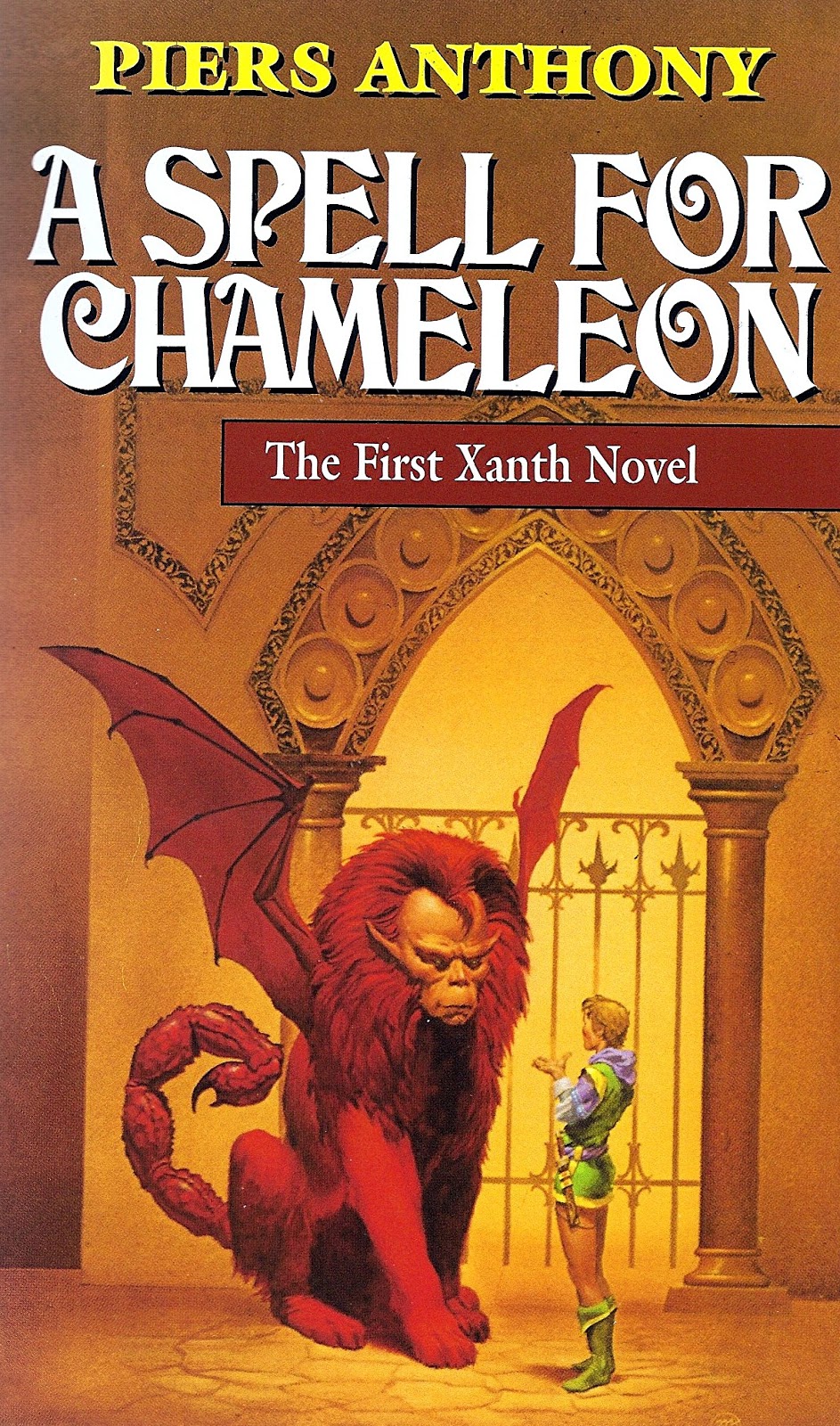 A winged manticore on the front cover of Piers Anthony's A Spell For Chameleon - one of my all-time favourite fantasy novels, and the first in Anthony's long-running Xanth series (Del Rey Books)
If such remarkable beliefs persist regarding the manticore, what about the leucrocuta? Perhaps it may be best, just in case, to view with extreme caution any stranger who calls your name and then greets you grinning, quite literally, from ear to ear!
This ShukerNature article is excerpted from my latest book, Cats of Magic, Mythology, and Mystery: A Feline Phantasmagoria (CFZ Press: Bideford, 2012), which is now available to pre-order at www.catsofmagicmythologyandmystery.com and is due to appear on Amazon within the next few days.


December 4, 2012
SRI LANKA’S DEVIL BIRD – INVESTIGATING A DEVIL OF A MYSTERY
 Highland nightjar - the secret identity of Sri Lanka's cryptic devil bird? (Shyamal/Wikipedia)
Back in the early 1980s, one of the most popular TV series was ‘Arthur C Clarke’s Mysterious World’. Opening one episode devoted to cryptozoology, the show’s eponymous star briefly mentioned two Sri Lankan mystery animals – the horned jackal and the devil bird. Not having heard of either of these before, and discovering that they were not mentioned further in the show itself, I carried out extensive researches into both of them, and took as my initial source and starting point the man himself, Arthur C. Clarke, who in response to my enquiries very kindly provided me with much information and further sources of reference. As I have documented elsewhere, the horned jackal turned out to be little more than a morphological fluke, but the devil bird is more intriguing. Also called the ulama, it takes its English name from its truly hideous cry, graphically described as resembling the sound that would be made by a boy being slowly strangled!
What makes this crypto-case especially unusual, moreover, is that although its eldritch cry has been heard on countless occasions by all manner of reliable ‘earwitnesses’, sightings of the bird responsible are virtually non-existent. As discussed fully in my books From Flying Toads To Snakes With Wings (1997) and Extraordinary Animals Revisited (2007), identities put forward include various owls, nightjars (notably Sri Lanka's highland nightjar Caprimulgus indicus kelaarti), raptors, and assorted reclusive water birds such as rails, herons, and crakes. One rare, decent sighting described a long tail and a nightjar-like shape, despite sceptics claiming that it is nothing more than Sri Lanka’s well known brown wood owl Strix leptogrammica ochrogenys or the larger, familiar Sri Lankan or spot-bellied eagle owl Bubo nipalensis blighi. (Yet if it is indeed a well known bird, surely its identity as the voice of the devil bird would have been firmly established long ago?)
 Spot-bellied eagle owl - NOT confirmed as the Sri Lankan devil bird
In July 2001, an abandoned immature Sri Lankan eagle owl was rescued from a flock of attacking crows in a forest by some villagers, and it was subsequently claimed for a time on some websites that this specimen perfectly matched native descriptions of the devil bird, and that the devil bird mystery had therefore been solved. Yet, as has been already noted here, the very crux of the devil bird dilemma is that detailed sightings of it are all but non-existent – it is its cry, not its appearance, that is well-documented. Consequently, I fail to see how that rescued eagle owl specimen could be confirmed to be a perfect match with an infamously elusive bird whose morphology is largely unknown, except, that is, for its long tail – which does not match that of the Sri Lankan eagle owl!
Could it be, therefore, that a still-unknown species of bird genuinely exists amid the dense forests of this tropical island? It is certainly a more rational explanation than one that seeks to shoehorn an ill-fitting known identity into the uniquely-shaped (and sounding!) crypto-box presently dubbed the Sri Lankan devil bird.
 Brown wood owl - a popular yet unproven identity for the devil bird (Tanaka Juuyoh/Wikipedia)
December 3, 2012
A TWO-TAILED ALPINE IMPOSSIBEAST - A SHUKERNATURE PICTURE OF THE DAY

Even among the exceedingly diverse, and decidedly different, fauna of cryptozoology, occasionally there comes along what can only be described as a truly impossible beast - or, as I like to call such exotica, an impossibeast. And here, as the latest ShukerNature Picture of the Day, is one such example. Appearing in an early 18th-Century tome about Switzerland, Itinera per Helvetiae, written by Austrian naturalist-historian Johann Jakob Scheuchzer, this engraving depicts an anomalous Alpine impossibeast that was categorised as a dragon, despite sporting an extravagantly furry pelage, an unquestionably mammalian face, and two long, slender, exceedingly hirsute tails so independently mobile that each seemed to have a life of its own! If anyone has any notion of what this extraordinary creature might have been inspired by, I'd be very happy to hear from you.

November 28, 2012
CATS OF MAGIC, MYTHOLOGY, AND MYSTERY - IT'S HERE! AVAILABLE TO PRE-ORDER AT LAST!

My latest book, Cats of Magic, Mythology, and Mystery: A Feline Phantasmagoria (CFZ Press: Bideford, 2012), 322 pages long, almost 300 illustrations, and in full colour throughout, is now available to pre-order!! Click here for full details and the pre-order button.
And click here for its full-page coverage on my website.
The wait is over!


November 26, 2012
MY VERY FIRST WHITE TIGER! - CAR BOOT SALES AND CRYPTOZOOLOGY #3
 The eyecatching front cover of Bristol Zoo's late-1960s guidebook (Bristol Zoo Gardens/Dr Karl Shuker)
One of the most delightful features of car boot sales, bric-a-brac fairs, and suchlike is the frequent opportunity presented by them to buy items that you once possessed, perhaps many years ago as a child, but subsequentlty broke, discarded, or lost, and have often wished that you still owned. Out there, somewhere, are a last few surviving representatives of those items, and such selling venues as these often provide a last chance of reconnecting with them, and rekindling precious memories that they embody. Over the years, I've bought several such items, including the example presented here.
The first time that I ever saw a white tiger was when my parents took me to Bristol Zoo in the late 1960s. Whenever we visited any zoo, moreover, they would always buy me its current guidebook, and I particularly remember the one from that first of many visits to Bristol Zoo because of the stunning full-colour photo of a white tiger on the front cover – so stunning, sadly, that it was soon snipped off and pasted into one of the many wildlife scrapbooks that I used to compile at that age.
In later years, however, I bitterly regretted mutilating that guidebook, and I yearned to obtain a complete, undamaged replacement somehow, but that particular edition had long been supplanted at the zoo by later editions with different covers and contents. A couple of years ago, however, while browsing through a box containing assorted guidebooks to stately homes as well as other printed ephemera at a bric-a-brac fair, I was stunned but delighted to find a near-pristine copy of that old late-1960s Bristol Zoo guidebook with its well-remembered white tiger cover.
Purchased for £1, it now takes pride of place among my collection of other guidebooks acquired during my numerous visits to zoos in the UK and overseas.
 Another photograph of Bristol Zoo's late 1960s white tigers from this same guidebook (Bristol Zoo Gardens/Dr Karl Shuker)
For an extensive account of the history and genetics of white tigers, see my latest book Cats of Magic, Mythology, and Mystery (CFZ Press: Bideford, 2012).


November 24, 2012
THE CURUPIRA - A SHUKERNATURE PICTURE OF THE DAY
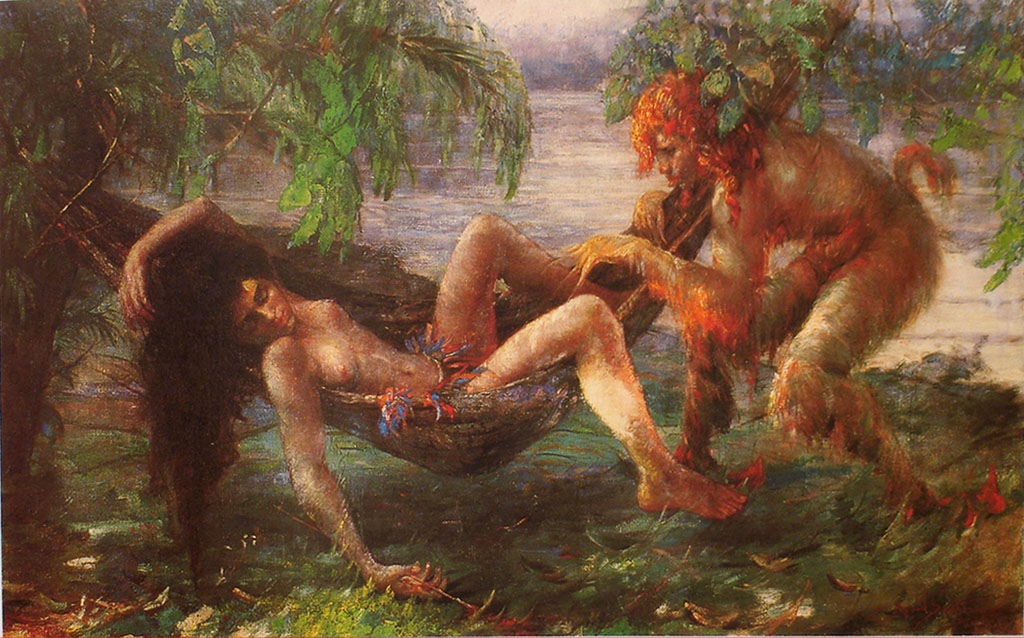 'The Curupira' (Manoel Santiago, 1926)
Here's something new for ShukerNature, which I plan to run as a regular series. Over the years, I have encountered all manner of unusual, noteworthy illustrations relevant to cryptozoology and/or animal mythology (and have even prepared a few myself) that may also be of interest to others. Consequently, I've decided to showcase an eclectic, annotated, ongoing selection of them here as ShukerNature Pictures of the Day.
And here is the first one - a very lush, colourful painting by Manoel Santiago from 1926, entitled 'The Curupira'. It depicts a sleeping maiden attracting the inquisitive attention of this eponymous hairy forest demon from traditional Brazilian folklore, which some cryptozoologists consider may be based upon a real, undiscovered form of small red-furred man-beast.

November 23, 2012
THE BLACK LION VERSUS TARZAN!
 Front cover of 'Tarzan' #218, 'The Trophy' (Joe Kubert/DC Comics)
In earlier ShukerNature posts of mine (click here and here ), I have revealed that although a number of unconfirmed reports can be found in the archives of cryptozoology, as yet there is no conclusive evidence for the reality of black lions (i.e. lions exhibiting melanism), and that four much-circulated online photographs purporting to be of genuine black lions are nothing more than Photoshopped fakes.
Nevertheless, the very concept of a black lion is so captivating and compelling that it has been utilised very effectively in fiction. Perhaps the most stunning example of this was recently brought to my attention by Facebook friend Sefton Disney, and features a mighty confrontation between a magnificent black lion and a very formidable rival for the crown of African jungle king - Tarzan!
As seen in the illustration that opens this ShukerNature blog post, issue #218 of 'Tarzan', published by DC Comics, contains a story entitled 'The Trophy', and appearing on this comic's spectacular front cover is Tarzan fending off a ferocious black lion. This superb artwork was created by the late, great artist Joe Kubert.
Moreover, this is not the first time that Tarzan has done battle with a cryptid - check out a previous ShukerNature post of mine for details of his encounter with the terrifying Nandi bear and a separate adventure pitting him against a spotted lion (click here ), plus his secret meeting with the reclusive mokele-mbembe (click here ). Who needs cryptozoological field work in search of Africa's most elusive mystery beasts when all we have to do is send out Tarzan!!
NB - A Buy It Now button for pre-ordering my latest book, Cats of Magic, Mythology, and Mystery (CFZ Press: Bideford, 2012), will be available here and on my website very soon - so please check back often!


November 22, 2012
THE PANTHER OF GIFFARD'S CROSS – AS SIMPLE AS ABC?
 Standing by Giffard's Cross (Dr Karl Shuker)
Excerpted from my impending book, Cats of Magic, Mythology, and Mystery (CFZ Press: Bideford, 2012):
Several centuries before any of the modern-day specimens had appeared on the scene, an exotic British mystery cat was big news not all that far away from where I live today. Indeed, its case may even be one of the earliest records of a so-called alien big cat (or ABC for short) in Britain that did not involve some unidentifiable feline creature heavily enshrouded in fable and fancy but rather featured a bona fide non-native big cat on the loose. Although certain details differ from one account to another, the basic facts of this historic case in British cryptozoology are as follows.
Just outside the village of Brewood, near Wolverhampton in the West Midlands, England, is an imposing Georgian mansion called Chillington Hall, set in beautiful parkland. Built during the mid-1780s, it is the home of the Giffard (aka Gifford) family, whose direct link with this site dates back over 800 years, and it is the third residence to have stood here. The previous one was a medieval manor house built during the early 1500s by Sir John Giffard, who was Standard Bearer to Henry VIII, and accompanied him at the Field of the Cloth of Gold in June 1520.
 Stained-glass window depicting the Giffard family crest, containing a full-faced panther head (photo source unknown to me)
It was several years earlier, however, in or just before 1513, when Sir John's deed of valour took place for which he was granted two family crests by the king, and which also inspired their emblems and motto. One day, a wild cat loosely described as a panther escaped from a menagerie of exotic beasts maintained at Chillington, and was pursued in earnest by the household. The great cat's attention was drawn to a woman carrying her baby through the park, and it began to stalk her. Approaching within range of its intended victim, the panther was just about to spring upon her and the child when Sir John himself appeared on the scene, having been riding with his son through the park in search of it. Armed with his crossbow, Sir John took careful aim, and just as he was about to shoot, his son exclaimed in French: "Prenez haleine, tirez fort!" ('Take breath, pull hard!'). Clearly Sir John followed his son's advice, for he skilfully dispatched the escapee big cat with a single well-aimed arrow through its head.
Later in 1513, the first of the two Giffard family crests granted to Sir John in recognition of his heroic action was prepared by the College of Arms, describing it as a "Panther’s head couped full-faced spotted various with flames issuing from his mouth". And in 1523, the second crest featured a "demi-archer bearded and couped at the knees from his middle, a short coat, paly argend and gule, at his middle a quiver of arrows, drawn to the head". As for the family motto, Sir John chose the fateful words uttered by his son as he took aim at the panther with his bow.
 Giffard's Cross, marking the spot where an escapee panther was allegedly shot during the early 1500s (Dr Karl Shuker)
A wooden cross – nowadays known as Giffard's Cross - was erected at the precise site of his victory, but during the 20th Century it was moved for safe keeping into the grounds of the house, and a replacement was erected in its stead, which is readily visible from the public road running just in front of it. Not living very far away, I visited it one sunny Sunday afternoon during summer 2011, and was pleased to have seen for myself this tangible link to that dramatic cryptozoologically-linked episode of long ago.
Like so many episodes of this nature, however, it wouldn't be cryptozoological without having some degree of mystery or controversy surrounding it – and in this particular case, the mystery concerns the precise identity of the escapee cat. Just what was it? It is only ever referred to in historical accounts as a panther, but whereas modern-day usage of this term, at least in the UK, tends to be confined almost exclusively to the melanistic morph of the leopard Panthera pardus, i.e. the black panther, in medieval times 'panther' was also used in relation to the leopard's normal spotted version. So was it a black panther, or was it a spotted leopard – or even, as at least one account read by me has claimed, a jaguar? (The panther appears as a white-faced cat in the Giffard family crest, but as heraldic beasts are often very different in appearance from their real-life namesakes, this does not provide a solution.) Most extreme of all, as also suggested by some researchers, is that the entire episode is an invention, nothing more than local folklore? If that were true, however, how can the panther head on the Giffard family crest be explained - just a coincidence? Rather like the Giffard panther itself, this is one crypto-mystery that seems destined to run and run!
 Just for fun, this delightful artwork portrays a very different kind of alien big cat!! (William Rebsamen) This ShukerNature article is excerpted from my latest book, Cats of Magic, Mythology, and Mystery (CFZ Press: Bideford, 2012). NB - A Buy It Now button for pre-ordering my book should be available here and on my website very soon, so please check back often!


November 21, 2012
NELSON MANDELA AND THE AFRICAN TIGER
 A striped mystery cat with an incongruous tail tuft from Saqqara, Egypt
Here is a third appetiser from my soon-to-be-published book, Cats of Magic, Mythology, and Mystery (CFZ Press: Bideford, 2012).
The most famous striped or brindled mystery cats on record from Africa are the Tanzanian nunda or mngwa (click here for a ShukerNature post devoted to this feline cryptid) and the so-called mountain tiger of the Central African Republic, which has been likened in outward appearance to Africa's prehistoric sabre-tooth Machairodus. However, these are not the only ones by any means, as demonstrated by the following selection of lesser-known striped crypto-cats reported from the Dark Continent.
 Nunda reconstruction (Randy Merrill)
The Ethiopian wobo is known chiefly from the baffling pelt formerly exhibited at the principal cathedral of Eifag. According to Ethiopia's Amhara and Tigré inhabitants, the wobo is larger than a lion and yellowish-brown or brownish-grey in colour with black stripes. Sceptics dismiss the Eifag skin as a tiger Panthera tigris pelt brought there from Asia by a traveller or merchant, but as the wobo is a familiar beast to many Ethiopians, this is not a satisfactory explanation - especially when an identical creature, dubbed the abu sotan, has been reported from the mountains near the River Rahad in neighbouring Sudan.
Speaking of tigerine beasts in Sudan: in 1951, eminent Sri Lankan zoologist Dr Paules E.P. Deraniyagala actually described a new subspecies of tiger, Panthera tigris sudanensis, the Sudan tiger, based upon a pelt that he had seen in a bazaar in Cairo, Egypt, and which the seller claimed had originated from a tiger shot in Sudan! Although he did not purchase the pelt, he did photograph it, and according to Czech mammalogist Dr Vratislav Mazák, who documented this curious affair in 1980, it clearly resembled that of a Caspian tiger P. t. virgata, and had probably been smuggled into Egypt from Turkey or Iran.
 Early colour postcard depicting a captive Caspian tiger
Back to bona fide striped mystery cats, and definitely in need of an explanation is an illustrated limestone relief from the tomb of Ti, a wealthy 5th-Dynasty Egyptian landowner and courtier (c. 2490-2300 BC), at Saqqara - for among the many animals portrayed is a striped tiger-like cat, but with a distinctly leonine tuft at the tip of its tail. Is it a freak lion whose juvenile spots have coalesced into stripes (such specimens are known - see later), or an imported tiger poorly represented? Or could this enigmatic image be a portrait of a species still unknown to science? Whatever the answer, it is significant that all of the other animals present in this relief, including a lion and a leopard, are accurately depicted and readily recognisable.
 Striped mystery cat on Ti's Saqqara tomb, with clearly recognisable lion and leopard depictions above-left of it
And why, as noted by Nelson Mandela no less in his 1994 autobiography Long Walk To Freedom, is there a word for ‘tiger’ in South Africa’s Xhosa language? Mandela revealed this fascinating little fact while arguing with various fellow prisoners on Robben Island who were insisting that they had seen tigers in Africa’s jungles. Here is his account of this intriguing claim:
"One subject we hearkened back to again and again was the question of whether there were tigers in Africa. Some argued that although it was popularly assumed that tigers lived in Africa, this was a myth and they were native to Asia and the Indian subcontinent. Africa had leopards in abundance, but no tigers. The other side argued that tigers were native to Africa and some still lived there. Some claimed to have seen with their own eyes this most powerful and beautiful of cats in the jungles of Africa. I maintained that while there were no tigers to be found in contemporary Africa, there was a Xhosa word for tiger, a word different from the one for leopard, and that if the word existed in our language, the creature must once have existed in Africa. Otherwise, why would there be a name for it?"
In 2005, British scientist Tim Davenport made zoological headlines with his co-discovery of the kipunji Rungwecebus kipunji - a new species, and genus, of mangabey monkey in Tanzania’s Rungwe (Rongwe) highlands that was well known to the local people (‘kibunji’ is its native name), but which had previously been dismissed by scientists as a wholly mythical spirit beast. Still dismissed today as such, conversely, is the so-called Rungwe tiger.
 The aardwolf, a striped member of the hyaena family (Dominik Käuferle/Wikipedia)
According to the locals, this is a large striped animal, a description not matching that of any known species from this area of Tanzania. Davenport concedes that it could be a striped hyaena Hyaena hyaena or aardwolf Proteles cristatus - albeit way out of its known range - but does not discount that it might be a still-unknown species. After all, he has only to look at the kibunji to know that such a prospect is far from unrealistic in this remote African locality.
Although Kenya's mysterious spotted lion or marozi, and its counterparts reported elsewhere in Africa (such as Rwanda's ikimizi, Uganda's ntarargo, and and Cameroon's bung bung), have been well documented (see my earlier book Mystery Cats of the World , 1989, for the most extensive coverage published), striped lions are another matter entirely. Interestingly, in 2003 a novel entitled The Striped Lion, written by Mike Sackett, was published, which featured a marauding big cat on the loose in Africa that resembled a bona fide striped lion but was in fact a tigon - a hybrid of tiger and lioness. Here is a brief plot synopsis for this book as quoted from Amazon:
"The Striped Lion is the story of a bold experiment in wildlife conservation gone horribly wrong. A world-renowned foundation dedicated to the preservation of big cats accidentally impregnates an African lioness with the semen of a man-eating Siberian tiger and releases her into Kenya's Masai Mara Game Preserve. Only one of her cubs, the Alpha Male, survives to maturity but hybrid vigor has endowed him with monstrous size and his father's genes have given him a taste for human flesh.
"Fatalities mount across the Masai Mara as the tourist season approaches, threatening the Game Preserve's survival. Soon a desperate race is joined by the foundation and the Kenyan government to find and destroy the elusive predator before he kills again. But the searchers discover the problem is far more serious than they had ever imagined: The huge crossbreed has been mating with the local lionesses, and his offspring are man-eaters too."

Sadly, however, this book's plot contains a fundamental zoological flaw. The feline villain of The Striped Lion is a tigon - a hybrid of tiger and lioness. Yet as revealed by real-life specimens, it is only the reciprocal crossbreed, the liger - a hybrid of lion and tigress - which is bigger than its two pure-bred progenitor species; the tigon, conversely, is generally smaller and much less impressive. Moreover, male big cat hybrids are normally sterile, not fertile (in contrast, some females have proved to be fertile, giving birth to second-generation hybrid or back-crossed cubs). Hybrid misconceptions notwithstanding, The Striped Lion sounds like an enjoyable, entertaining read for anyone like me who is fascinated by the more unusual and unexpected members of the animal kingdom, so I shall certainly be seeking out a copy.
As for real-life, non-hybrid striped lions: As noted by cat expert C.A.W. Guggisberg, in some lion cubs their juvenile spots are arranged in distinct vertical lines, and occasionally these merge to yield true stripes. Normally of course, the spots of juvenile lions disappear as they mature, and so too, therefore, would any stripes that resulted from the merging of such spots. However, Ivan Heran’s book Animal Coloration (1976) includes a photo of an adult maned lion with several clearly-visible vertical stripes decorating its flanks, as seen here.
 Striped lion (Ivan Heran)
This ShukerNature post is an adapted excerpt from my soon-to-be-published book Cats of Magic, Mythology, and Mystery (CFZ Press: Bideford, 2012).
NB - By the end of this week, a Buy It Now button for my book should be present here and on my website, so please check back again soon!


Karl Shuker's Blog

- Karl Shuker's profile
- 45 followers
Karl Shuker isn't a Goodreads Author
(yet),
but they
do have a blog,
so here are some recent posts imported from
their feed.

