Jeremy Puma's Blog, page 5
March 18, 2013
Help Strange Animal Meet Our Stretch Goals
Strange Animal Publications is going to be AWESOME, but we could still use a hand getting started.
Help us meet our stretch goals!
Anything over and above the goal can only benefit this venture further! Let’s move some goalposts and see if we can get enough support to help cover some of these additional anticipated costs:
We have enough for ten ISBNs at the $250 price point. But, we could also purchase 100 ISBNs for $575! Here’s a link to the pricing, in case you’re wondering where that number comes from: https://www.myidentifiers.com/isbn/main. 10 ISBNs would cover us for a year; 100 would cover us for a looooooooong time!
Adobe’s Creative Suite, which contains everything that I’d need to do some awesome layouts, costs a lot of money. But, as a UW staff member, I can purchase a discounted license for a mere $250. Wow!
IndieGoGo’s fee. It’s 4% of what I raise, so any little bit helps cover that fee.
Business training. I plan to take some classes and seminars, which will cost anywhere from $100-$500.
Professional memberships and conference fees. We’ll be joining as many small press/publishing organizations as possible, and covering fees, dues and conference registrations will of course cost, as well.
Author advances. Once we start publishing your work, we’ll need some funds for advances.
Goodies and treats. I’d like to make regular give-aways part of our publishing plan!
Yes, all of this is gravy, but the more seed funds we raise, the more we can do, and the more successful we’ll ultimately be. Any amount you can contribute will help us meet these goals!


March 15, 2013
Flash Fiction Friday: Gabble
Every Friday, Strange Animal Publications will be featuring a short-short story. Have a lit blog? You should participate, too: let’s do this thing!
Gabble
The Muttering Monks of Verbal IV, an order of anchorites who worship the local deity Loquacion, have become something of a tourist attraction of late. The Rule of this Holy Order, actually “The Congregated Solitary Order of Saint Prolix,” concludes that, although their brethren who choose to express their devotions with Vows of Silence are sound according to Doctrine, a more challenging vow– and one more worthy of their deity, whose purview includes conversation and the exchange of ideas– would be an Observation of Gabble.
“Anyone can stop talking,” St. Prolix had written in “On the Oration of God.” ”It is,” he continued, “the Natural State of the human to keep silent, as we can illustrate through the sleeper, who very rarely speaks; and when he does so emit a nocturnal converse, we find it meaningless, and an aberration.
“More significant and Holy, therefore,” he went on to conclude, “would be perpetual vocalization. For, this would require both the facility of the Mind, which formulates words, and the Divine Spirit of Loquacion, which animates the Mouth, and raises us up above the animals.”
Members of the Order are not allowed to cease talking at any time while awake, and it is said that certain Masters who have practiced this Holy Observation for years on-end can even continue their cant through the night, not in the fashion of the occasional sleep-talker, but continuously, and with meaning.
And so, in recent years, now that Intragalactic Travel has become so affordable, the Monastery of the Blessed Laryngopharynx receives thousands of visitors annually, second only to the nearby Sex Fields. Crowded against the walls, gawking, the sightseers point and gape, shouting and waving their arms, trying as a lark to say or do something that will cause one of the Holy Men to break into silence.
March 14, 2013
False Confessions, False Alarms now available in Paperback!
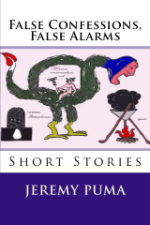 False Confessions, False Alarms: Short Stories is now available in paperback on Createspace.com and Amazon.com!
“I wish I had my camera.”
“No, if you had your camera, the shark would not have been here. Carrying a camera is one of the quickest and most solidly proven ways to avoid the unexpected. You think the Loch Ness Monster shows itself to people who bring cameras into its murky domain? Never. It would be a tragedy if it were to do so.” Bau thought to himself that events that seem to break the laws of space must also break the laws of time, as he believed that the two were inseparable. As cameras do nothing more than freeze time, it would be impossible to actually take a picture of anything out of the ordinary. For this reason Bau never carried a camera, he told her, “unless it is to be used for something mundane, like a drive to the country or a friend’s wedding or a trip to another town, where the universe is expected to behave a certain way. I can never remember such insignificant events, and such photographs are only necessary to help one to remember the unmemorable. Cameras tend to be villainous, malcontents, for every camera distorts what it sees, and every photograph is a lie.”
“Using that logic,” replied Ananda, “every work of art is a lie, too.”
“This is true, but some lies are more valid than others.”
From “November 17.”
March 11, 2013
Note Found on a Red Velvet Chair: A Short Story
(from False Confessions, False Alarms - available on Kindle for $0.99!)
———————–

This morning, upon waking, I noticed that someone had placed a new sculpture in the courtyard outside. I can see it through the window, the dirty window that reminds me of Her mascara covered cheeks, streaks of dull black carried down the smooth surface by tears, or rain. I’d like to go look at the pyramid, investigate how it got there, but there are simply too many things between my red velvet chair and the pyramid, like Zeno’s paradox. You know, in order to get from A to B, you first have to get halfway there, to point C, but to get to point C, you’ll first have to get halfway there, to point D, ad infinitum, so you can never reach B, such a chore, and I’m so comfortable here in my chair.
You see, in order for me to get to that pyramid, which seems to consist of marble blocks, white— and I can tell they’re white because through the blackened, streaked, window they’re grey, except for the places where they’re broken by a dull green, perhaps a serpent or an eel, molded from stained copper, that eternally climbs to the summit of the pyramid— in order for me to get to the pyramid, the first thing I have to do is to get halfway there. Based on my estimate, made via my meagre knowledge of geometry and triangles and shadows, the halfway point between my chair and the pyramid is roughly twelve feet.
Twelve feet away, someone has planted another sculpture, Rodin-like, or Muñoz, a woman of bronze, black and wrinkled, wilted, a sculpture of solidified tissue paper, shriveled, eternally screaming. The woman is covered in dust; I estimate that there are approximately seven million, seven hundred and thirty-four thousand, three hundred and sixteen specks of dust on the statue, enough to turn its color from a dull bronze to a dull iron-grey. That number, by the way, in case you need to see it as a number, is 7,743,316.
This dust consists of an entire civilisation built on filth, with mites as citizens and skin flecks as buildings, and dust its earth, and its art is excrement. Any society is based on what its members are able to produce, and excrement is all that mites can produce, so the basis for mite culture, for mite politics, for mite art, must be excrement. The sculpture— woman seems to scream vividly, and one can imagine the terror of her scream, but if she were real and were to scream, or to move at all, a great, vast, cloud-city of dust mites would launch into the air before her, doomed forever to wander the atmosphere of the courtyard, each breath taken by a visitor to the courtyard would invite the remnants of this mite society into his or her lungs, into his or her hair, into his or her clothing and eyes and skin.
Perhaps this is why she’s screaming: the horror of being covered in a society of crawling, excrement-producing mites, but anything she could do to remove the mites or even to move a foot to the left or right would launch the mites into the air where they would infest someone anew, and soon the mites would spread in clouds over the world, so the lady chose instead, halfway through her scream, to freeze into a sculpture, her final realization, to transubstantiate herself into a bronze sculpture in order to save us from the mites. She has become the Saviour of Man in this respect; her decision to freeze in passivity so as not to launch the mites into the air was the greatest and most terrible sacrifice she could have made, and she screams forever, silently, while the mites, helpless but perfect symbols of the sins of man, thrive on her eternally frozen form, producing sculptures of their own out of excrement.
This is, of course, all conjectural, because in order for me to truly investigate this sculpture, I’d have to move twelve feet, which means I’d first have to move halfway there, six feet, and make my way past the carven door, six feet away, as I mentioned. The door, while indifferent to my decision to open or close it, nonetheless remains heavier than any other door, as it contains the entire range of human potentiality; it depicts the entire range of human doors. Carved into its cedar surface, the branches and leaves which used to cover cave entries for camouflage on the darkest primitive nights strut jaggedly up and down the sides, while the deerskin flap of the hunter’s hut flows wave— like across the top panel. An intricate fiber curtain dances in wood over the flap, upon which rests, unobtrusive, a simple wooden plank, undoubtedly unhinged, surrounded by another wooden door, this one with hinges, itself surrounding a great bronze Romanesque door depicting Janus, the Roman God of Doorways between a myriad of multi-hued Corinthian columns.
In his left hand, Janus holds another wooden door, this one carved to represent the Medieval conception of the ascent of the soul to heaven, or its descent to hell, the figures thick and stocky, peasants perhaps, semi-realistic, crawling down tunnels of fire, lapped at by naked and horrific insectoid demon wasps with stingers of steel, and heaven sucks up other figures in beams of light and saints. In his other hand, Janus holds an airlock, round, blue, separating alien— suited men from what could be either water, speckled with fish, or the vastness of space, speckled with stars. The men rest contentedly in a tube of silver, praising the door in Latin, “Holy art thou, O Door, our protector, thou keepest us safe from that which is outside,” except for one man, helmeted, face visible through glass and on the other side of the door drifting through the vague sea towards the heaven depicted on the other door, carved eyes gazing up at the Throne of God, a bright yellow-white halo stained with golden shimmering angelic faces, and seated on the Throne, at the very top of the door, is a depiction of the Door to end all Doors, the Alpha door, open on creation, and the Omega door, closed at the end of time, both of which are carved to depict the door which sits six feet away from me, the door that prevents me from investigating the statue of the woman on which the dust mites have built a civilisation of their own, no doubt with their own doors made of excrement.
It’s a moot point, really; this collection of carven images remains completely inaccessible to me. Do you realize how far away it is, what lengths I must endure to get from the relative comfort of my red velvet chair to the multifaceted and intricately detailed face of the great door? It’s a full six feet away. In order to walk six feet from here, I’d first have to get three feet away from my chair, at which point I’d reach Her body.
I just noticed that there are people surrounding the pyramid in the courtyard. Five or six men, it seems, who all wear standard issue Union Army uniforms, blue, silver buttons like stars of glitter sparkling on their chests. They’re methodically combing the ground around the pyramid. The one who seems to be the leader of the men leans over, wipes a single finger over one of the bricks, opens a sack and sprinkles more dust over the sculpture, doing I don’t know what. The other men spread out among the courtyard, one sitting on the rim of the fountain to the left of the pyramid, another pausing for a moment to pluck an infinitely detailed mango from the tree to the right of it, scrutinizing the mango, not stopping, as he should, to count the spots on the mango’s skin, brushing off a wandering ant, and removing a knife from his pocket. He peels the mango tenderly, softly, as if he is peeling a woman’s breast, and the other men continue through their motions, their investigations, searching for something, again coming sometimes between the statue of the woman covered in dust and the pyramid.
I’d like to go and talk to them, ask them what they’re doing in my courtyard, but they’re so far away from me, I don’t think I could make it. I’d have to get to the great, carved door first, infinitely far away, and between me and the door, three feet away from the comfort of my red velvet chair, I’d have to somehow traverse the remnants of a human universe, the entire human experience, the thoughts, feelings, emotions of Her psyche, Her protests and Her agony. Her twisted form, between the mascara stained cheeks that look like my window, wears a smirk on its face that I assume can only mean that she lived Her life to the fullest satisfaction, that when I delivered the blade into the mail slot of Her ribs, she had prepared Herself for the moment, and, content, satisfied, mocks me in death, Her half— smile contrasting vividly with the frozen shriek on the bronze sculpture outside.
She is a universe. Contained in Her form are the myriad experiences of Her life, Her introduction to me at Antonio’s soirée, and our eventual courtship, Her acceptance of my engagement ring, which decorates Her finger like a miniature diamond tiara. Within Her form, there on the tiles between my chair and the door, another society thrives, produces, and I have released it into the world; it seeps out of the wound in Her abdomen and grows, expands, mingling with the dust, microcosmic cities, shadow plays of experience.
The men outside have somehow reached the statue of the screaming woman, and I’m not sure how they were able to cross such a vast and incomprehensible distance. To my chagrin, they are defeating the raison d’etre of the statue, dusting it with feathers, the clouds of dust shooting into the atmosphere like sparks from a blacksmith’s anvil, perhaps the anvil on which my knife was hammered, the archetypal anvil of God, the God of Doors, who crafts the metal frames of airlocks and the sparks thrown off become societies of mites who sculpt screaming women in excrement. The men in uniform destroy the Saviour of Man with each brush of the feather against bronze, defeat the woman’s original intention, and doom us all to a world in which cities of microscopic insects navigate the atmosphere, air the outside of their vehicles, a populated zeppelin in reverse.
Again I contemplate the great abyss of distance between myself and the door, each of Her fingers a galaxy of experiences, every touch recorded there in the flesh between the ridges of Her fingerprints, each caress living and breathing there on the tiles. I live there, too; or at least, my shadow lives there, my form, in Her caresses, as does Antonio’s. We both take up residence there, in that infinite space, which I did not realize was infinite until it was too late, until I had already reached into Her galaxy of experience and grabbed for as many stars as possible, thinking that if I pulled them out on the tip of my knife, Her universe would finally end, and I would be the new God of Doors, who dispenses justice to those who would betray others. But, in an infinite universe, you can take away as many stars as you wish without causing even the slightest difference. Instead, Her universe thrives there, captured on the floor, billions of years passing by each second, every letter in every book she’s read marching out of Her in intricate formation. How many times did she see the entire alphabet in Her life? Did the alphabet, each time she read it, make extra words for Her out of the words she read? Did she see new words in the sentences she read, the paragraphs, that instructed Her and shaped Her? When she read the word ‘shape,’ did Her mind take the ‘she’ out?
Upon further thought, I should be thankful for Her unfaithfulness. Had she not let Antonio into Her universe, I would not have finally had the clock— shaped blinders removed from my eyes; I would not have known what the plurality of the universe truly looks like. Had she not let Antonio into Her universe, I would have remained content, I would have been able still to cross the distances between myself and the pyramid, and I’d know exactly what the copper streak represents. I’d still be content to imagine the universe as limited, to imagine the universe unable to accept both Antonio and myself. But now, since I preserved Her universe, since I created a new universe from Her, on the floor between my chair and the cedar door, I know the truth, I know the actual size of the universe that I created, and I know that no one but a universe’s creator can ever take the time to know that universe, as I knew Her before she blossomed, before the cosmos blossomed on my tile floor.
A scritching and knocking at the door tells me that my friends from the courtyard have traversed another six feet, that they have reached the door. Their voices, multifaceted and jellied, somehow reach my ears across the aeons between us, and the door, the Omega door, swings open, and they stand, staring across the abyss, the doorway a scenic overlook onto Her universe, and they step off into the void, but it’s futile. And they yell to me, their voices tinny and small, mouse like, the screams of dust mites, by the time they reach my ears. The six men set adrift, floating, in a cosmos of unknowable length, traversing the universe between the door and Her body, trying to reach me, no doubt, to dispense their own justice. I can only smile; I am not afraid. They are three feet away. They’ll never reach me.
————————–
False Confessions, False Alarms: Short Stories is available on Amazon.com.
March 8, 2013
21 Days to Go in IndieGoGo Campaign!
Even though we’ve already released our first title, we aren’t done with the IndieGoGo Campaign! Any help we receive can only make this project more successful, so if you’re inclined, I hope you’ll find it in you to toss a few coins into the virtual hat!
As a reminder, here’s something from our latest update: anything over and above the goal can only benefit this venture further! Let’s move some goalposts and see if we can get enough support to help cover some of these additional anticipated costs:
We have enough for ten ISBNs at the $250 price point. But, we could also purchase 100 ISBNs for $575! Here’s a link to the pricing, in case you’re wondering where that number comes from: https://www.myidentifiers.com/isbn/main. 10 ISBNs would cover us for a year; 100 would cover us for a looooooooong time!
Adobe’s Creative Suite, which contains everything that I’d need to do some awesome layouts, costs a lot of money. But, as a UW staff member, I can purchase a discounted license for a mere $250. Wow!
IndieGoGo’s fee. It’s 4% of what I raise, so any little bit helps cover that fee.
Business training. I plan to take some classes and seminars, which will cost anywhere from $100-$500.
Professional memberships and conference fees. We’ll be joining as many small press/publishing organizations as possible, and covering fees, dues and conference registrations will of course cost, as well.
Author advances. Once we start publishing your work, we’ll need some funds for advances.
Goodies and treats. I’d like to make regular give-aways part of our publishing plan!
Yes, all of this is gravy, but the more seed funds we raise, the more we can do, and the more successful we’ll ultimately be. Any amount you can contribute will help us meet these goals!
March 5, 2013
Whither “False Confessions”? (or, How Fast Can You Kindle?)
I know, I hadn’t planned on publishing anything until April, so it was a surprise when Strange Animal released a story collection, False Confessions, False Alarms, this past Saturday. It was also a bit of a surprise to me. Thing is, I had a little time on my hands, so I thought I’d take some old material that hadn’t really seen the light of day, and see how quickly I could turn out a book that looked pretty okay.
Pretty quickly, as it turns out, as long as the material is already written and edited. I’ve had these works of short fiction sitting around collecting dust (and rejection slips), so why not parcel them into a document and get them out there? I basically pasted them into Word, auto-generated an active Table of Contents, formatted according to the directions for Kindle Documents on Amazon’s website, did a quick scan-through for typos etc., and saved.
I also some old ‘fake alchemy’ image files (another example below) from an ancient project, so I photo-shopped it into a fun-looking cover. Then, after uploading the files and making sure the preview files looked good, I hit ‘publish.’
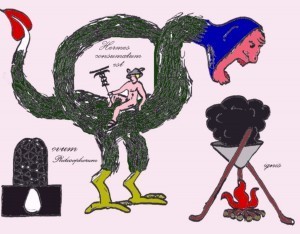
From start to finish, the whole design and editing process took about four hours (maybe). After hitting publish, it takes about 12 hours for Amazon to review the work, then about 12 hours for it to be published to Amazon’s site. This means, from the beginning of the design/formatting process to the moment of publication, we can put out a title for Kindle in approximately 30 hours.
That. Is. Awesome.
Now then: there are some sacrifices I made for the sake of speed. For instance, I’ve already noticed a few extra spaces in the body of the text, that I could have caught and fixed, but these are pretty minor in the scheme of things. Also, this turnaround time only applies to Amazon’s Kindle program, which means we don’t need an ISBN and it isn’t available on paper. If we were publishing using a different service, or publishing in print, it would be a much longer process. Still, anybody can read Kindle titles using the various Kindle apps available, so yeah, to compensate for any limitations of quality, I decided to price-point it at $0.99 (which means I see $0.35 in royalties from each purchase). But, it also means you get a selection of quality tales for a pittance!
Since it’s a $0.99 title, I decided not to include it in the perks for the IndieGoGo campaign; those perks will apply to more ‘official’ titles that will benefit from the whole
Thanks for indulging me in my little ‘speed publishing’ experiment; I hope you’ll head to Amazon and download a copy of False Confessions, False Alarms today!
March 2, 2013
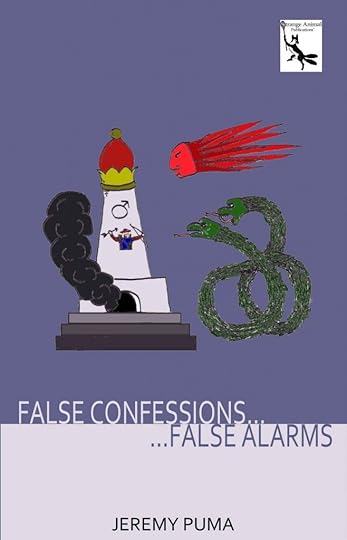
False Confessions, False Alarms: Strange Animal Publications’ First Release!
A young couple suffers from unwanted and extraordinary deliveries…. A candy heart’s mysterious message initiates an odd series of events…. A nondescript drug dealer spends his final hours with a bizarre menagerie of individuals…. A heist in a future world is pulled off without a hitch– until it’s time to get away….
If you enjoy the work of authors like Philip K Dick, Adolfo Bioy Casares and Julio Cortá�zar, you’re certain to enjoy this collection of seven short stories (and one one-act play). Part “Twilight Zone,” part Borgesian metafictions, these tales range from intellectually challenging, to dark and melancholy, to laugh-out-loud funny. Fill your liminal space with wonder and weird fiction!
Only $0.99 — available exclusively for Amazon Kindle. So cheap, what’s the harm?
(No Kindle? That’s okay, you can still read in one of Amazon’s FREE Kindle Apps on your Ipad or mobile device– click here to download!)
February 27, 2013
Thanks to our Supporters!
So far, we’ve managed to raise $1,030 from incredibly generous individuals who support independent publishing. One of the perks of contributing is having your name in lights, so I’ve added a “Supporters” page to the site. Profound thanks to anyone able to toss a few dimes into the hat.
Work on “Sunbathing in the World of Forms” continues apace, and an April 2013 release date is still looking likely!
If you’re interested in contributing, please drop by our IndieGoGo campaign and check out the fun perks we’re offering (like books! You get books!).
February 21, 2013
Work Beginning on First Strange Animal Title!

Fun news! I’ve started compiling and editing the first release from Strange Animal Publications. It’s tentatively titled, “Sunbathing in the World of Forms: Essays on a Gnostic Worldview.” It will consist of material from the “This Way” Website, collected and reformatted and edited into a mondo mega-essay, with some additional new material that hasn’t yet seen the light of day.
The ISBNs for this title will be acquired with your contributions, so, again, thank you!
I anticipate a release date in April, but will keep everyone apprised.
Still: Huzzah!
Meanwhile, there’s still time to contribute to our start-up funds if you’re so inclined.
Watch this space for more news!
February 19, 2013
The Most Beautiful Book Design
This is a pretty neat how-to, which I may take into consideration for the next work. Well worth reading the whole thing!
The perfect book. This is how designer-genius Jan Tschichold described this system. Not the ok book, nor the pretty good book, but the perfectbook.
This method existed long before the computer, the printing press and even a defined measuring unit. No picas or points, no inches or millimeters. It can be used with nothing more than a straight edge, a piece of paper and a pencil.
And you can still use it. This is a system which is still as valid, beautiful and elegant with ultra-modern design as it ever was for the work of the scribes, Gutenberg and Tschichold.
The Secret Canon & Page HarmonyBooks were once a luxury only the richest could afford and would take months of work to be brought to fruition.
And they were harmoniously beautiful.
The bookmakers knew the secret to the perfect book. They shared among themselves a system—a canon—by which their blocks of text and the pages they were printed on would “agree with one another and become a harmonious unit.”
So elegant is this method of producing harmony that a few designers saw to rediscover it. Even though it was considered a trade-secret, they all came to the same conclusion, hundreds of years apart, independent of one another, but each supported by the other.
They found the way to design a harmonious page. A perfect page.