Steven Harper's Blog, page 53
September 1, 2019
Germany: More School and Heidelberg
Monday was another school day. KL and I let the students have at while we bummed around downtown Esslingen. I could do this every day, thanks.
The next day the students and teachers took a trip to Heidelberg. We bustled down to the train station and hopped aboard an ICE train for a three-hour ride which I still enjoyed, thank you.
Heidelberg is an old, old city that was largely untouched by World War II. It’s a medium-sized town at the bottom of a valley on the banks of the Neckar River (which also flows through Esslingen). It’s the quintessential German city, with narrow, cobblestone streets, unexpected churches, little markets, and a world-class university. Looming over the whole place is The Ruin. The Ruin is a ruined castle that was built and inhabited only a short time before a war blasted it into semi-rubble. It’s been partly restored, but largely left as a ruin and something about it looks incredibly romantic and poetic, which is why it hasn’t been fully rebuilt. It’s a stunning site. Heidelberg is probably my favorite place in Germany, and if I won the lottery, I would give serious consideration to living there.
The students were given time to explore. Me, I had my own agenda.
See, Darwin has been doing genealogy for decades and, like most genealogists, he has a few stopping points—ancestors he can’t get past. One ancestor is Graf (Count) Johann (Johannes/John) Damon (Dammon/Daymon/Daman). Darwin can’t find his parents, a necessary step for going farther back on his tree.
However, family legend says he studied at the University of Heidelberg in the early 1800s, when the Napoleanic Wars pulled him out of school. Eventually he made his way to the United States. I was going to find out more about him.
My main goal was to find out if it would be worth searching more for him in Heidelberg. See, I only had about an hour, and I was fairly sure that if the records existed, they would be scanned from hand-written pages and saved as photos or PDFs. Early 19th century hand-written German is a bitch to read. You have to know, for example, if what looks an f is actually an f, an s, or even ss. Capital letters are florid and difficult to distinguish from one another. V and W look much the same. So I was fairly sure that finding Daman in any existing records would be a difficult and careful hunt, which I couldn’t do in just an hour. I wanted to learn if it would be worth it for Darwin and me to return later.
I located the university library with my iPhone and discovered it was only a short walk from the meeting point for the students. Yay! I hiked through Heidelberg’s horrifyingly delightful streets to the massive stone library, which is conveniently located across the street from an equally massive church built of pink sandstone. I had settled on the library as a more likely place to store old records than, say, the registrar’s office.
Inside, I found an information desk, where a Very Helpful Lady sat me down and asked me what I needed. I told her. She settled her glasses on her nose and started clicking keys. I was a little worried that my request would be greeted with a semi-huffy, “I can only help you a little,” but not at all. I had just handed a librarian a research puzzle, you see, and most of them live for this kind of thing, including the Very Helpful Lady.
A second monitor that faced me mirrored what she was doing, which was very useful. She called up a number of records sites, and it turned out I had been right—the early 1800s records were PDFs of old books. Printed or typed records didn’t start until the 1830s, long after Daman would have been a student. They definitely had the records, and the VHL perused a few of them to see if Daman’s name cropped up. In the meantime, she fired questions at me (but very nicely). Did he earn his doctorate? (No, he didn’t even graduate.) Do you know what he studied? (No.) Do you know what religion he was? (Protestant.)
I also called poor Darwin, who was dead asleep at 4 AM back home, to get more clarification on some points. (Hey, this was the only chance to do this search with on-site help. Sacrifices must be made.) He scared up a little more information and answers to the questions, but not a whole lot. Most of it was, as I said, family legend, and wasn’t official knowledge.
Rather than become frustrated by the skimpy information, the VHL became more interested. Could we find him? She suggested that, since he was born a count, that we check the city records at Kassel, where he was born. Records of nobility were more carefully preserved. We should also check at churches for birth, baptism, and marriage records, since we know his religion. And she showed me a bunch of places where such records were already digitized and available on-line. (Although Darwin is adept at searching web archives, American search engines often ignore European archive sites, and without a URL, he didn’t know where to look.)
In the end, I came away with a whole bunch of leads, including the tantalizing idea that his original (pre-Amercan) name may have been Jacques, since there was a Jacque Daman from Belgium who served under Napoleon, was injured at Waterloo, and attended university at Heidelberg. Darwin doesn’t think he’s the right person, but it’s worth following up on. And we have the other archives to search now.
I thanked the VHL effusively for her time, and she seemed pleased. So it was a good day for all!
 comments


August 25, 2019
Tropes! We Got Tropes!
A big part of much of this fiction (especially YA fiction) is the Coming Out Moment. I'm not opposed to having a Coming Out Moment. But I'm opposed to the stupid tropes about it. Specifically:
TROPE #1: The LGBT person comes out to a friend or family member and expects a bad reaction. The friend/family member explodes in anger. "How could you? Why would you do this to me? How dare you?" and the reader is supposed to think, "Oh geez--the poor main character. Now we'll see if s/he has the strength to deal with this." But then, in an amazing plot twist, the friend/family member says, "I'm angry because you didn't tell me sooner! Didn't you trust me?" And it turns out the friend/family member is actually supportive after all.
I despise this trope. First, it isn't in the slightest bit realistic. Second, it's been used over and over and over and over and over. And over. It's like watching a movie with a time bomb in it. There's no suspense whatsoever because we know the bomb will be defused. There's no shock or suspense in this trope because we know what the friend/family member will end up saying. Third, it's damaging. NO ONE has the right to decide when someone else comes out. NO ONE is allowed to decide for someone else that another person is trustworthy with this kind of information. How dare =you= be angry when I've lived my entire life trying second- and third-guess everyone around me about this issue? Fuck you. It's bad writing, it's boring, and it's damaging. It's not suspenseful or amusing or cute.
TROPE #2: The LGBT person comes out to a parent, who immediately shouts for joy. "Oh, I'm so happy for you!" the parent gushes. "Yay! You're gay! You know, Myra has a son who's gay. Maybe you two could date! I want to throw a coming out party for you. Let's pick out some outfits." This one is meant to be a reversal on the more expected response of disappointment, fear, or even hatred. The problem is, like the one above, it's been done and done and done and done. It also makes the parent (usually a mom) look like a complete ditz. Finally, the parent is dismissing the entire event by making light of it. The teen has just done something very person and very powerful, and the parents reacts like a five-year-old being told they're going to Disneyland, which diminishes and infantilizes the news. The author again means to be different and cool, but it's cliche and stupid, and it makes me throw the book across the room.
We have the obligatory plug. If you want to see a much better handling of the coming out, read THE IMPORTANCE OF BEING KEVIN.
 comments
August 23, 2019
Pasta Restored!
I made a couple of pasta dishes with CarbaNada noodles, and not only did they taste the same, they didn't spike Darwin's sugar. Total win! Darwin can eat pasta again! One of Darwin's favorite recipes is Sweetie's Macaroni and Cheese (https://www.justapinch.com/…/p…/sweetie-pies-mac-cheese.html), but it's on his strictly forbidden list. I made it with the Carba-Nada noodles. He tried it and we watched his sugar levels carefully afterward. Not a peep. Darwin was overjoyed! This is why he has declared Tammy a food goddess.
 comments
August 17, 2019
What I'm Doing Wrong
--I shouldn't use my debit card at a gas station, grocery store, restaurant, hotel, ATM that isn't at my bank, or to buy anything on-line.
--I'm pooping wrong.
--I get upset too easily about social issues.
--I don't get upset enough about social issues.
--I'm feeding my cat the wrong food.
--I'm watering my plants wrong.
--I'm making cookies totally the wrong way.
--I shouldn't give my phone number out to anyone, especially to a web site.
--I should be using two-factor login verification by giving my phone number to the web site.
--I shouldn't drink sugared soda, diet soda, juice, coffee, hot cocoa, black tea, herbal tea, bottled water, or tap water.
--I shouldn't eat carbohydrates, proteins, or fat.
--I need to eat more vegetables.
--I shouldn't eat kale, spinach, romaine lettuce, peppers, celery, or root vegetables.
--I should be binge-watching all the incredible television and playing all these fantastic video games while thumbing through these 10 amazing apps that will change my life.
--I spend too much time in front of a screen.
--I should clean my house out of everything I own except a thumb drive of documents and personal photos.
--I should relax and not worry if my house is filled with stuff.
--I should exercise more.
--I'm at risk of injury if I exercise.
--I'm still pooping wrong.
Anything else . . . ?
 comments
August 15, 2019
Germany--Well, Actually It's Switzerland
Before I came over to Germany, JK asked me if I would rather visit Paris or Switzerland during one of the family weekends, when no field trips were scheduled with students. I said Switzerland on the grounds that I’ve never really been a Francophile. So on Sunday we hit up Switzerland.
It’s always strange to American me that in Germany you can reach a whole lot of different countries with an easy drive. To a German, visiting another country is much like a Detroiter popping up to Traverse City or down to Cedar Point. It was a two-hour drive to Switzerland, and we barely slowed down when we crossed the border—no passport check. (See, Brexit people?)
Brief aside. I’ve visited the Appalachian Mountains any number of times in Pennsylvania and West Virginia and don’t like them much. I always feel hemmed in and limited and even a little claustrophobic. And heaven help you if you miss your turn somewhere because it’s three miles before you can turn around.
And then there are the Alps.
The Appalachians are much older than the Alps and they've been ground down over a few zillion years, which is why they’re relatively stubby little things. The Alps are young and TALL and I loved them immediately. We came around a bend in the road and were suddenly on the shore of Lake Lucern, a calm azure lake between mountains with a town around the shore. The mountains near the lake sweep up to the sky, and behind them are even BIGGER mountains capped with clouds. I would be immensely happy if I could live there.
To get to the top of Mount Rigi, our target mountain, we boarded a rack railway, which looks like a regular street train, except a gear track runs up the center of the track. A gear in the middle of the train turns and hauls the train up, or prevents it from rushing down. It takes a long, long time to reach the top, but you don’t mind because the view is magnificent. The villages fall away, getting smaller and smaller. You pass tidy Swiss houses built into the side of the mountain, and they look crooked because of the angle you’re on.
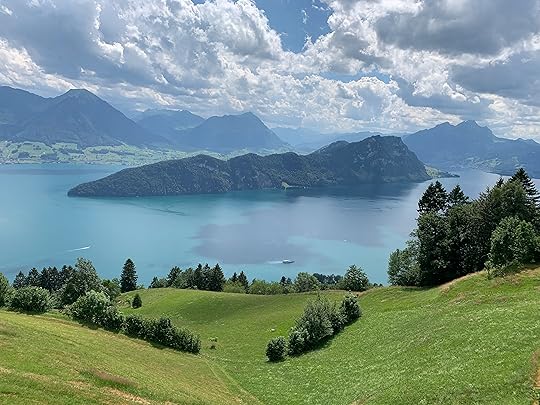
At the top is a small hotel and a whole lot of open mountain covered in grass and flowers and grazing cows. The cow bells mingle with church bells, while below the ground falls away, down sheer cliffs to the far-away houses. It occurs to you as you peer down the insanely steep, grassy face that if you went over the edge, you would die, and the mountain wouldn’t even notice. Far distant, the even bigger blue Alps go about their business like giants with their heads in the clouds.
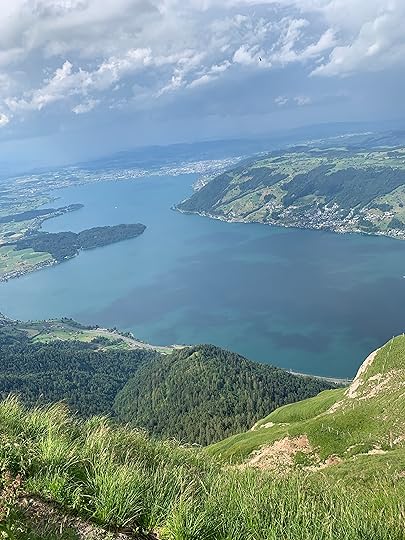
We spent considerable time hiking around and exploring and enjoying the powerful view. Down below, we’d been sweating in shorts and polo shirts, but up here the air carried a bite of chill and we donned hats and jackets. I took three or four thousand pictures and made short videos.
Mount Rigi is 6,000 feet up, higher than Denver. I visited Denver several years ago and spent the weekend unable to run more than a few yards without gasping in the thin air. I wondered how bad it would be on Rigi, but I suffered no ill effects whatever. I had no trouble hiking up and down the trails and slopes. The Alps seem to have a Narnia-like quality to them, granting strength to everyone who visits.
At last it was time to head back down. The train ride down was just as resplendent as the trip up. The Swiss ticket-taker lady who rode the train and checked people in as they boarded was polite and funny with everyone, too. At the bottom, we collected the car and realized a small problem—it was early evening and we couldn’t get chocolate.
In Switzerland, stores used to be closed pretty much all weekend, but in recent years, the regulations have relaxed to encourage more tourism. However, even the new regs have their limits, and by the time we emerged from the parking garage, everything was closed. How could I buy Swiss chocolate when the stores were shut?
“Don’t worry,” said JK. “We’ll stop at a gas station.”
This we did, and here I feel compelled to point out that gas station chocolate in Switzerland is better than gourmet store chocolate in the USA. I loaded up on quite a bit of it.
That evening, we arrived late in Stuttgart, too late to consider cooking for supper, so we drove around until we found a Doener place that was still open. Doener are to Germans what Chinese food is to Americans. Much like Chinese restaurants serve “Asian” food invented in America, Doener restaurants in Germany serve Turkish food that was created in Germany. A Doener is made of shaved lamb meat served in pita bread with a variety of vegetable toppings and flavoring sauces, and they’re insanely popular. We picked up a bagful of them and trooped back home for a tasty supper.
All this made for an intensely long weekend for JK after a long week of teaching, with another school week beginning Monday, and I let him know how much I appreciated the delightful outings.
 comments
August 10, 2019
Germany: Family Weekend
The first weekend, no field trips were planned. This a Familienwochenende, or family weekend, in which the individual families do what they want. We later learned various families went horseback riding, took trips to France, toured Stuttgart, and more.
As for me, JK and AK took me to the Burg Hohen-Zollern.
The Burg Hohen-Zollern ( https://www.burg-hohenzollern.com/) is a working castle. The prince and his family still live there, and a flag flies at the highest tower to indicate if he’s at home. The place is ingeniously built around a spiral ramp. To get inside, you have to haul yourself up the mountain to the castle itself (thank heavens for shuttle buses), then start up a sort-of driveway that curves around and around in a spiral around the castle and then finally into it. Naturally, if you’re part of an attacking army, there are plenty of places for defenders to throw dreadful things like arrows, hot pitch, and boulders down on you. The modern version is more welcoming, and is festooned with statues of Kaisers and other luminaries of Prussian history.
I love castles, and spend my time in them in a kind of happy haze. I adore trying to figure out which parts are original and which were added or changed. I live for trying to figure out who did what to whom and where and imagining what the place was like after it was first built. I got to indulge myself fully here.
Only limited areas of the castle are open to the public (it’s a private home, after all), but I explored everything I could, including the interesting cellars. Many levels wind themselves deep under the castle, connected with stone spiral staircases and low stone passageways lit only by dim electric lights. The original kitchen was down there, and is still used today to store the family china. I followed one passage and found an old guard room, and then another tunnel, and then a door, and suddenly I was outside the castle at the bottom! I couldn’t get back in, so I had to wind my way around the spiral back up to the top to find JK waiting for me. (He grew up in the area and knows the castle well, so he mostly let me explore.)
Afterward, we had lunch in an interesting indoor-outdoor German/Italian restaurant/musical performance/petting zoo place at the bottom of the mountain. The place is popular for weddings, and during our time there, three sets of wedding parties came through! I had an embarrassing moment in which I insisted on paying for lunch, only to have both my cards turned down. (AK paid, and I later hit a cash machine to pay him back. I called the bank to complain, and they said they didn’t even have a record of an attempt at payment from the restaurant, so it must have been their credit card system at fault.)
On the drive home, we stopped at JK’s parents’ place for a moment, and I met his father. We bonded over our mutual dislike of Donald Trump.
I have never met a European who likes Donald Trump. Like, =ever=. I was once in a taxi in Ireland and after I mentioned my effusive hatred of the baboon, said driver replied that he had never met an American who supported Trump. I thought about that and wondered aloud if it’s that baboon supporters don’t often travel outside the USA. The driver thought that might be the case, too.
 comments
August 8, 2019
School Day
The first day after the party (Friday) was a school day, and the students followed their partners through their schedules. We learned that students went swimming in gym class, to the park for a biology lesson, and watched a judo demonstration. As always, they were impressed by the food in the cafeteria, which is prepared and served by parent volunteers and is more like a home-cooked supper than what Americans think of as a school lunch.
KL and I usually pop out to Esslingen proper for coffee and to plan upcoming events or solve problems. I always love coming to European cities, myself. The architecture, the narrow streets, the cobblestones, the wide variety of shops, the food, the street markets—every bit of it is wonderful.
In the afternoon, we met with the students, where they reported what they had done that day, with a certain amount of excitement and interest.
That evening, I was wiped!
 comments
August 6, 2019
Arriving in Esslingen
We rode the train to Esslingen. This was a six-hour deal, but I like traveling by train. Way more room and less stress than flying, more comfortable than by bus. The only problem we had was how to stash the luggage. German mass-transit is wonderful about a lot of things (cleanliness, ease, speed), but they can’t seem to figure out how to design a train car with adequate luggage space for travelers. We had 26 people, all with two bags. There was literally no room for all the suitcases in the luggage racks, and we were forbidden from using the open area between the cars. In the end, we stashed bags behind seats and piled them in an extra seat that we’d bought for someone who ended up canceling. This also meant figuring out some serious logistics—the trains stop for three minutes at each stop, and if you and your luggage haven’t de-trained by then, you’re off for the next city.
We ended up doing a fire brigade. When the train stopped, a bunch of students debarked and the remaining students literally threw the suitcases onto the platform to them. We barely made it!
At Esslingen, a handful of students met us with SM, one of the teachers I knew. Joyful reunion! Then we gathered up our stuff and hoofed it about half a mile through hot, sticky sunlight to the school, where the rest of the families awaited us. More joyful reunions! (Remember, the students all knew each other from the American end of the exchange.) The parents had brought a potluck supper and we had a little welcome party in the school’s cafeteria.
Here, I met JK for the first time in person. JK (I use initials because many Germans are more leery of social media) and I had been corresponding for several months by email. He was supposed to come to the American exchange to stay with Darwin and me, but he got injured and couldn’t fly at the last minute. (This is how we met and befriended CE, his substitute.)
Anyway, Jan and I got to meet and it was a fine thing. We got on quite well.
The party ended early—everyone was tired and wanted to get home. I saw the students off and hopped into JK’s car. In JK's apartment in Stuttgart (a short but winding drive away), I got the chance to settle in. JK is a biology teacher and a comic book geek (yay!), so the apartment is filled with exotic plants, fish tanks, and other interesting animals (including poisonous frogs, geckos, and a variety of insects). The apartment building overlooks the valley where Stuttgart lies, and the view of the mountains is striking in every way. On the balcony in the morning, we eat a breakfast of bread, cheese, and tea and listen to the church bells in the distance. You don’t get more German than this!
 comments
August 4, 2019
Rushing About Berlin
KL is of the opinion that the students need to be tired out every day so they don’t have the energy to get into trouble in the evening. To that end, she requires everyone to walk everywhere, and quietly fails to let them know it would be possible to take the bus or train. The trouble is, I have very bad feet, and even the most powerful arch supports only take me so far.
By the end of one day, we had walked so many kilometers, my FitBit was jumping for joy. At the Reichstag Building, our final stop for the day, I was limping badly and wasn’t able to walk up the spiral ramp to the top of the famous glass dome that tops it. That was when I learned KL intended to have us walk back to the hotel—a 45 minute perambulation. I had to put my foot down, physically and metaphorically, so I drew KL aside.
“This is me telling you that I physically can’t walk back to the hotel,” I said quietly. “I know my body, and I’ll get at most a third of the way there before I won’t be able to take another step. So we have a couple choices. I can take the bus back alone and you can usher the students back to the hotel. Or we can split into two groups: bus riders and walkers. Or we call all take the bus.”
She offered up a fourth choice: let the students decide. “I’ll bet most of them want to walk,” she said.
Well . . .
When we put the choice to the students, every one of them voted for the bus. :)
 comments
August 3, 2019
Concentration Camp
While in Berlin, we visited the concentration camp at Sachsenhausen: https://en.wikipedia.org/wiki/Sachsenhausen_concentration_camp It was one of the bigger camps, though unlike many other camps, the main point wasn’t extermination (though over 10,000 people were murdered there). No, the point of this camp was work people to death.
Inmates were used for slave labor, especially in the brick factory, where conditions were the harshest. They were used as subjects in medical experiments, and more experiments were performed on their corpses. They were injected with cocaine and forced to run mile after mile after mile to test army boots. They were told to stand still to be measured for uniforms, then shot in the back of the neck. And more horrifying atrocities were visited on them.
The camp was also a major end point for gay men. This fact grabbed my attention more than anything else.
The camp is a thousand-acre triangle, with some of the original buildings still standing and other buildings shown as outlines on the ground. It’s like walking through a park, except you keep finding reminders that thousands of people were tortured to death there.
I found on one wall set of photographs and stories about the gay men who were murdered there. One was a famous dancer. Another liked to dress in drag. Yet another had just met a boyfriend and was arrested moments later. It made me teary and angry and deeply mournful all at once. These were my brothers, and they had been tortured to death. More of them went to the brick factory than any other group.
The students had brought roses to place on one of the memorials by the ruins of the crematorium. I pulled from my backpack some chocolate—the most valuable substance in a concentration camp. Scattered about the lawn were huge ash trees, ones clearly far older than the camp itself. They must have witnessed everything. I put pieces of chocolate among the roots of one tree as an offering to my dead brothers and cried over them.
 comments