Denise Domning's Blog, page 22
June 20, 2016
Pioneer Woman
Oh yeah! That’s me. I once again proved this to myself this morning as I turned my little ram lamb into a wether. For those folks who don’t know, a wether is a castrated ram just as a steer is a castrated bull. Since I can’t let Toby breed with his sister, Tiny, I had no choice but to do the deed…and quickly! It’s totally possible that Tiny is ready to come into heat this month and I caught Toby trying to mount her the other day. She’s way too young to get pregnant.
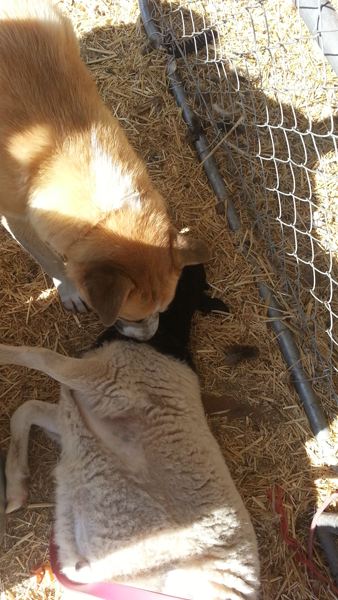 Moosie “comforting” Toby
Doing the deed required catching Toby, which I needed to do anyway. I bought them both collars last month and needed to get them on. I cornered the little sneaks near one of the turkey coops. They’re fascinated with the turkey food–not at all interested in eating it, only sniffling in it. I put Tiny’s collar on first, then, armed with dog leashes, I got Toby onto his back. It took me about fifteen minutes to do the deed, but that’s because it was the first time I’d ever done it. The next time it won’t take but five minutes. How did I know what to do? Well, my friend Doug Morgan described the process to me then I watched a YouTube video. This is the first farm chore I haven’t learned how to do from a book. I swear, you can learn anything from a book, even how to be a farmer. Then again, I’m a writer, of course I’d say that. Read more books! Yada yada.
Today, my trash company came to retrieve the dumpster they brought last week. That’s right. Over this last week, I’ve been doing the BIG BARN CLEANUP. It needs capitals. It was that sort of job.
This was something that should have been done 6 years ago when we first moved in. When Sam’s heirs sold this house they sold it “as is”, complete with the promise that they would take NOTHING from the house or barn. And they didn’t. There were even clothes and shoes in the closets. The barn was full of stacks of empty tractor oil buckets, bins of plumbing supplies (from 1″ to 4″ pieces!), broken chain saws, a wall full of less-than-useful circa 1985 garden tools, workbenches that I swear were built in the 40s, and packrats. The cats came and the packrats departed. That left plenty of mice, which Spots keep down to a dull roar now that she’s my only true barn cat. Fuzzy and Adventure Boy, her brothers, do what most male cats do, sleep and eat cat food. As for her sister Socks, well, Socks has found herself a new home, judging by her plump silhouette the last time she dropped by to say “hi”. Socks visits about once a month. I think she’s trying to convince Spots to join her at this new and obviously less demanding residence.
But besides packrats, nothing else departed from that barn when we moved in. One person’s clutter is another’s treasure trove. Thus, we added to the clutter as he crammed his shop into what space was left, and stored rows of unopened moving boxes wherever there space. Shelves were added, metal cabinets were forced into corners. And where were the gardening/farming tools? In the darkest corner of the barn, of course.
It’s almost been a year since I sent the ex packing, which he decidedly didn’t do (pack, that is). I waited a few months, in case he intended to collect those things he’d left behind. When he didn’t return for anything, the purging began. I started in the basement of the house, then moving to the exterior junk collection area under the porch. Before long, the house was clean but just looking at the barn and all that clutter made me shudder. I started with the moving boxes. By March, they were gone as were the items in them, mostly to thrift stores. I kept looking at my tools, trapped in that dark, cobweb-strewn corner, and sighing.
Then about a week ago the nephew of a friend’s contractor showed up and asked if he could store a CNC (Computer Numeric Control) machine here. He’s in the process of moving his machine shop out of Phoenix and needs a temporary space, once big enough for the machine. This is no little hobby machine, but a big brute, one that makes real parts for real industrial uses. It’s so big that it will take up the whole center of the barn.
It was a clear message from the Universe. “Stop dragging your heels and clean the barn!” So I ordered the dumpster and out things went, Focus-carload by Focus-carload. Scrap wood, degraded particle board, boxes, old work benches, bent or twisted bits of pipe, broken PVC pipe (saved “just in case”), empty paint cans (really?!), that one spare tile, that broken latch that could be fixed if it were needed–or rather if it could be found once it was needed. You can’t imagine the duplicates of things I discovered, no doubt bought because someone couldn’t remember where the first one went.
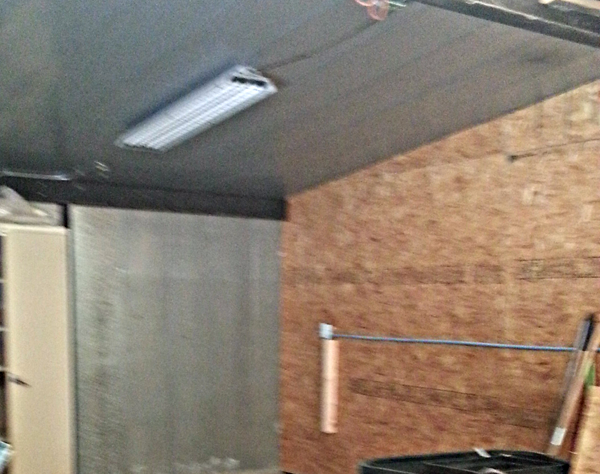 A well-lit corner for my tools!
Days and at least a ton of dirt later, I couldn’t be happier, although my back is still quibbling a bit. I had to move 2500 pounds of turkey food twice, a fifty pound bag at a time. Still, I grin each time I walk into the barn. I should have done this last summer. At last, my tools–the ones I use every day to do the work that is slowly turning this place into a farm–will be in the best-lit spot in the barn, right where they should be.
Oh, and speaking of tools, I bought a battery-powered hedge trimmer this week. Now, I don’t have a hedge on the place, unless you include the out-of-control blackberries. However, the trimmer cuts reedy Quack Grass stems like they were, well grass! I am Woman, hear me roar–because my trimmer doesn’t! Ha!


June 13, 2016
New and Improved Bear
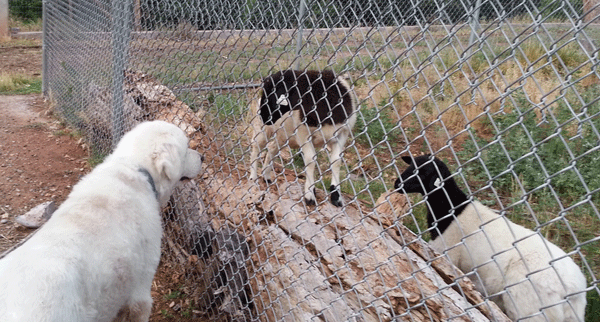 Wow! Having sheep has changed Bear. He’s become Mr. Protective. Well, when he’s not being his usual sweet doofus. This includes a big step up in his barking. As I mentioned, those first few nights after the lambs arrived were so bad I had to put on his bark collar. Now, mind you, the collar wasn’t turned on, but he didn’t know that. The action of putting on the collar is enough to let him know to tone it down. Over the last weeks, as having sheep has become more routine, his barking has receded to his normal half-hearted commentary, usually delivered from the corner of the porch closest to my open window.
Then last night around midnight, Bear went crazy. His barking was frantic and punctuated with high-pitched huffs. My eyes flew open. As I always do when the big dog barks, I listen for the little guy. When Moosie barks, there’s something to worry about. Sure enough, Moosie took up the chorus.
That’s when I heard the coyote. Judging from its voice, this was a big critter–close to, if not Moosie-sized. It was yipping from the front fence right where the *&%@ pyracantha that the previous owner planted probably three decades ago had torn a good-sized hole in the chain link.
Warning: diatribe follows.
I hate pyracantha. It’s common name, Fire Thorn, says it all. A tiny prick from one of those inch-long nasties burns for hours. Okay, so the birds love it, especially after the berries have fermented a little. Nothing so cute as a LLB (little brown bird) smiling and nodding as it stumbles around the pyracantha in a drunken stupor. And, it can be an attractive plant, if well cared for. That is not the case for the dozens of bushes that had been planted every few feet outside my fence line. These plants had been left untended and unwatered for years. Branches had twisted through the chain link while small, then grown until the metal fencing and wooden limb melded permanently, never to be removed…ever. If you drive down Page Springs Road, you’ll recognize my fence–it’s the one with the interesting wooden fence art. I’ve removed all the dead bushes and have started on those that not only didn’t die from neglect, but actually thrived. After six years, I’m about a third of the way to success. As you can imagine, the plants left gaping holes as they departed as well as tearing the base of the chain link loose. I’ve blocked and staked these gaps as best I can. I don’t want to replace this fence with more chain link, I want block, mostly because that will prevent any further car intrusion from the road. But Yavapai County will only approve said replacement if I close the lane closest to my property and hire a flagman to stop/redirect traffic. That’s a $30K bite, so I’m still waiting.
Okay, diatribe over. Back to the yipping coyote standing about ten feet away from my house, trying to use one of those gaps to get to my dogs, cats, sheep and birds.
That yipping sound brought me straight up to sitting. It was so loud I thought the coyote was already inside the fence. That’s certainly possible, and they don’t have to come through the fence to do it. As long as they’re willing to swim, they can enter through the Mason Ditch at either end of the property. I worry about that a lot. Moosie wouldn’t be able to stop himself. He’d throw himself at the pack, entering the fray and fighting to the death.
As I was wrestling myself out of the sheets and fumbling on the nightstand looking for my glasses, the big coyote howled and that’s when I heard the rest of the pack. OMG! They all sounded like they were climbing the fence or already inside it! By the time I had my robe on and was headed for the door, the big coyote made that aggressive challenging sound that all canines make when they’re ready to attack.
My dogs! And me without my trusty Rogue Hoe! (Would I swing an 8 pound hoe–blade sharpened to a nice edge to better cut through sun-hardened clay–at a coyote with the intent to kill or break bones? You bet I would.)
Just as I threw open the door I heard something I’ve never before heard. Bear snarled. The sounds that came out of his throat would have been enough to make my blood run cold if I didn’t know what a marshmallow he is. Or, that I thought he was. It was Gandalf challenging the demon: “You shall not pass!”
All of a sudden, the coyote was crying and retreating. From the sound of it, blood had been shed. Both dogs met me a moment later. It wasn’t their blood. I breathed in relief and hugged the Bear. Apparently, lambs bring out the best in him.
Good dog!
June 6, 2016
Razzle-berries!
I can’t help myself. I’m old enough to remember the Mr. Magoo version of “A Christmas Carol”. So every time I go out to pick raspberries, out of the back of my mind comes the phrase “and razzleberry dressing!” Which, when I think about it, doesn’t sound good at all. Now, cranberry dressing…well, that’s a different story.
I have to say that this year’s raspberries are definitely razzle-dazzle, especially considering I’ve done nothing to them. The plants doing the best are under the walnut bush. I’m sure it started as a tree, but as time and neglect went on it either died or fell. Then, when I started watering the hillside, it re-sprouted from what remained of the trunk. Since then, I’ve been working on turning into something more like a tree than a bush. The point of all that is NOTHING should be under the walnut tree. It’s a walnut, and walnuts, as well as sunflowers, are allelopathic. That’s a plant that adds a bit of a toxin to the soil to guarantee it has no competition for nutrients. Life being life, certain other plants have found a way to build an immunity to that toxin. Apparently, raspberries are among this group. I know that the hackberry is, so maybe it’s a berry thing.
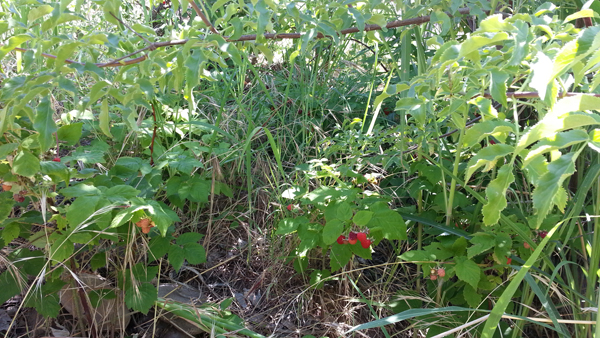 Right now the raspberry hillside looks like a wreck, but there’s something to be said for the sheer abundance of it all. The quack grass is coming on strong and the rains have caused some dirt slides, making it hard to walk on the edge to the wall. (I used to be afraid of heights, then I came here and everything is on a hillside; I’ve gotten used to being a mountain goat.) The peach trees are bending, there’s so much fruit on them, and I haven’t yet had time to thin them. The Egyptian walking onions have spread themselves beneath the quack grass so that when I’m not careful about where I step the smell of crushed onion greens fills the air. Of the four Mexican Elderberry I planted two years ago, one had become a tree while the other three are moving rapidly in that direction. The only thing I don’t yet see are the Blue Lake Pole Beans that I seeded in about 3 years ago and have come back without fail. Now that’s a tasty dried bean!
I’ve lost my tiny little olive trees because I didn’t winterize last winter, but that’s okay. I think I’d rather have figs instead. I planted two figs next to the cement wall that holds up the raspberry hillside, and they’ve done beautifully, albeit without producing a single fruit yet. Then again, I don’t know what variety they are and they seem very healthy, so I’m content to leave them be and see what happens. However, my new figs will be Kadotas. Now those are tasty!
As for the raspberri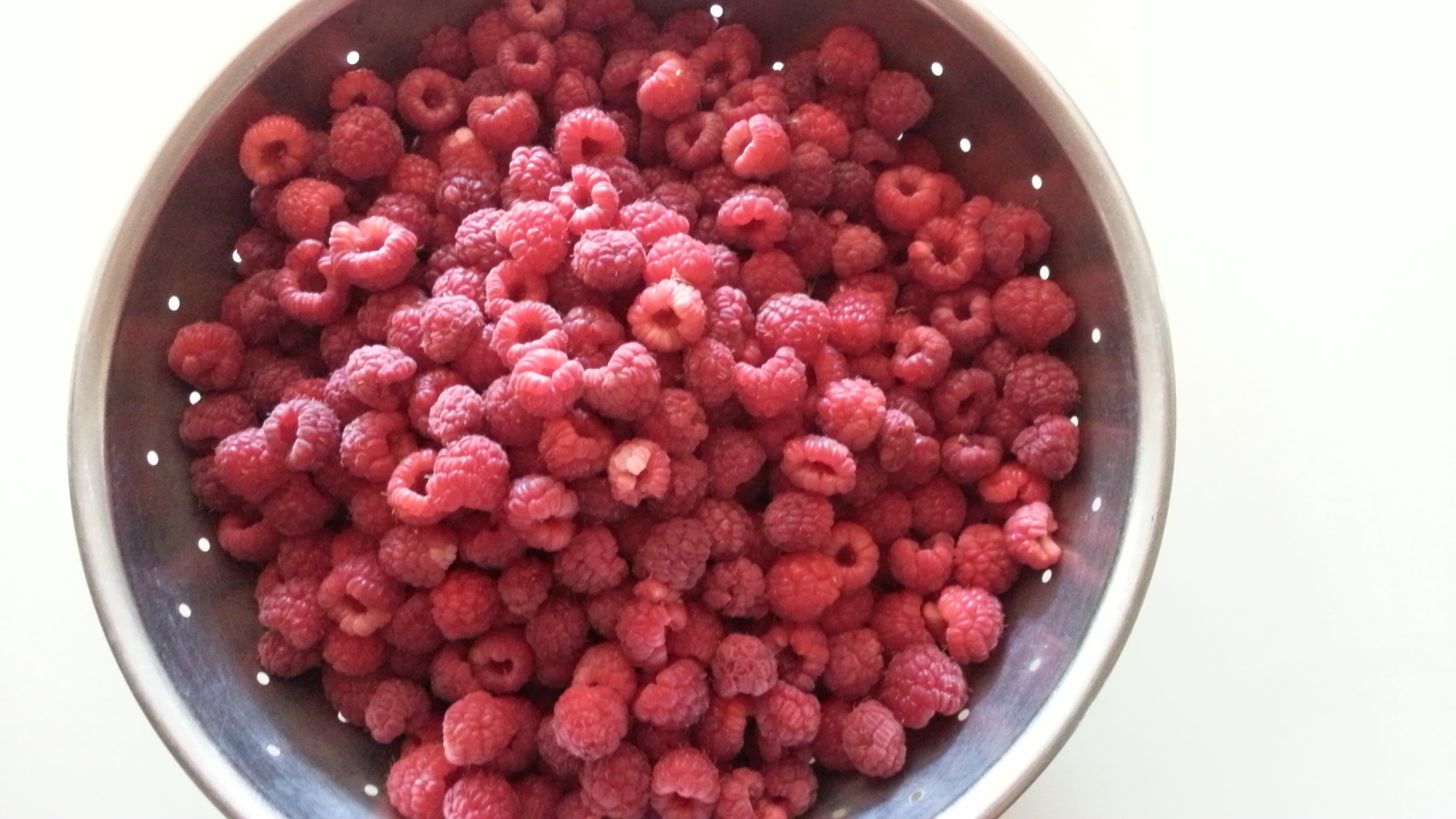 es, they’re an ever-bearing variety, so I’ll be harvesting all summer. I got about a fourth of the hillside harvested yesterday morning, and this is what I came in with (about 2 pounds). I see Raspberry Shrub/Vinegar in my future! That, and I bought this great Rousanne from Page Springs Cellars as part of celebrating finishing the book. I think around 7 PM tonight, after it’s cooled down a little, I’ll throw a handful of razzle into my wine glass and top it with some dazzle. Porch wine time!
May 31, 2016
Farm Flowers
Okay, the title makes it sound like this is a girly post and maybe it is, but walking the property over the weekend made me realize just how many plants are blooming right now. Like my stuffy nose couldn’t tell me that pollen is saturating the air I breathe? I blame my itchy eyes on the local Mesquite trees. There are still far too many of those scrubby little things all over this property. Nasty trees with horrid poison-tipped thorns that invariably manage to poke through whatever protective gear I might be wearing. At any rate, I’ve given up using any over-the-counter hay fever remedy for an essential oil–Frankincense, actually. Yep, the same stuff that one of the Wise Men brought to Bethlehem (can’t remember which one). I rub the oil on the back of my neck and for whatever reason, it stops my sneezing and most of my sniffling. And, it smells piney and clean, which is much better than the scent of chicken and turkey poop. So there you go. Between that and homeopathic eye drops, I’m surviving my allergies so far.
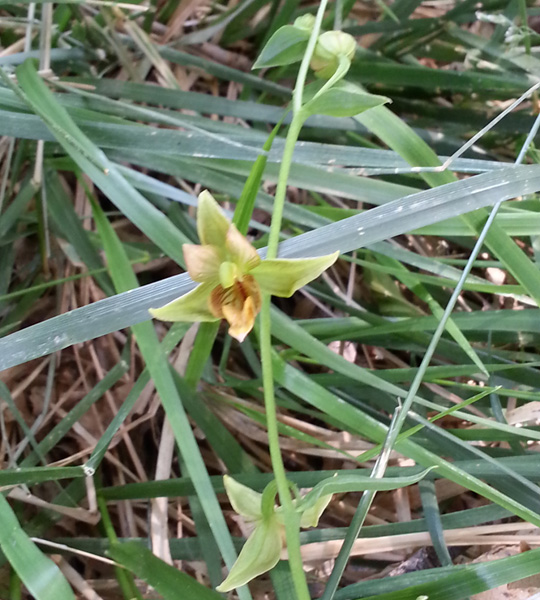 As far as the big bloomers right now, some of them are natives while others have gone native after I started throwing out seeds five years ago. But of all the flowers I’ve got on the place, I have one that I just can’t believe I found on my property in Arizona. Although I didn’t know its name until today, I knew it was an orchid the minute I found it. And it is: Epipactis Gigantea, a wild stream orchid. I first saw it on the ditch bank three years ago and it’s now spread along a three foot area. Who knew we had orchids in Arizona?
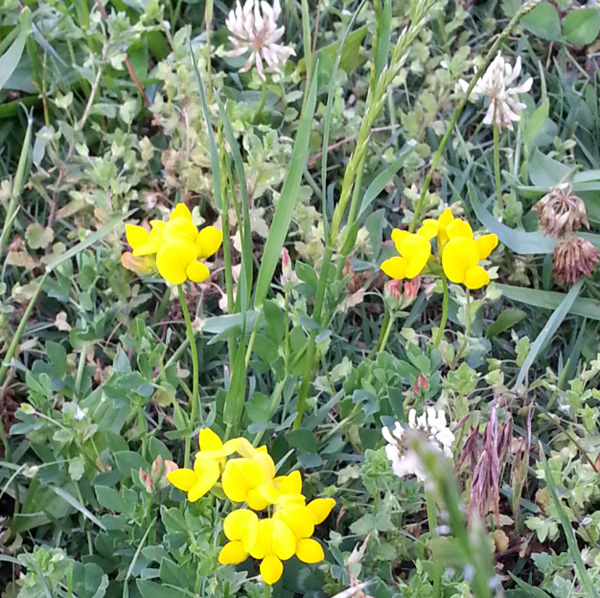 Now this next one I’m sure is also an orchid, but I can’t figure out what it is. It looks to me like the “Lady Slipper” orchid I’ve seen in the Midwest except those are pink while this is a beautiful bright yellow. It’s scattered all over my pastures, poking up from the sea of white and red clover that’s attracting bees like crazy–so much so that I don’t dare walk in it without closed shoes on. These little yellow flowers have that orchid face with a pouty lower lip.
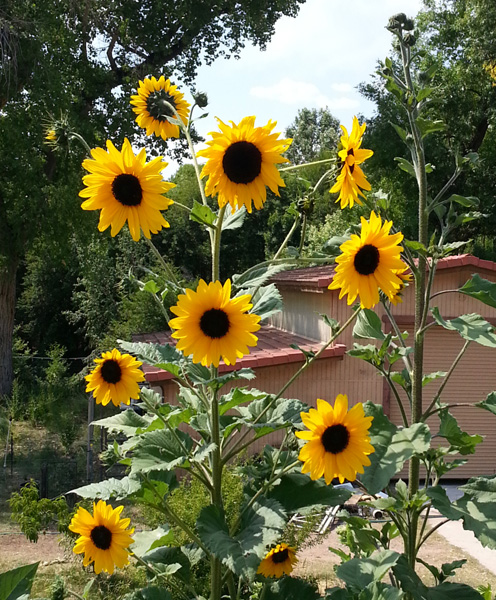 Sunflowers
I don’t think I could live anywhere where my favorite summer flower couldn’t grow. I don’t just love sunflowers because they’re beautiful, but because they’re so helpful to a gardener. They’re a trap crop for aphids and they attract Lesser Goldfinches, ladybugs and praying mantis. The Lesser Goldfinch is a sweet social little bird with a dark back and yellowish belly. They come as a flock, peeping and talking to each other, as they dart through the garden eating bugs, then retreating into the sunflowers to dine on aphids and cut round patches from the leaves to line their nests. They very quickly get to know me and don’t mind it when I’m working right next to them. As for the sunflowers presently growing on my property, every one is a volunteer from previous years, spread by the birds. Some have lost any of their parents’ hybrid drama while others still retain a bit of grandma’s pizazz.
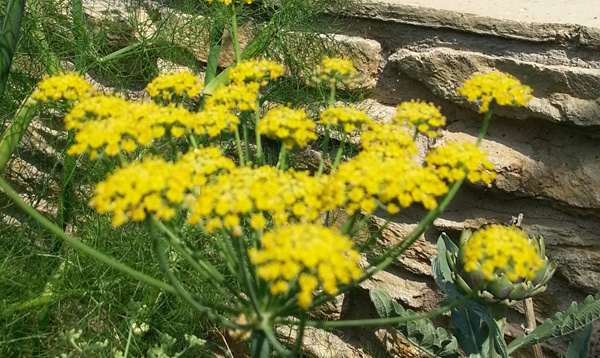 Fennel
I have tons of fennel growing in the front gardens. Their smell reminds me of the California’s beaches where Anise runs rampant. Okay, not exactly the same scent but close. I keep them going because fennel has a long tap root that brings nutrients up to soil level, but even if they weren’t good for the dirt, I’d keep them. The ferny fronds and clusters of yellow flowers are great in a posy. Of course when it comes to fragrance, there’s nothing like a Magnolia’s massive white, waxy blossoms. The tree is just beyond the western edge of my porch and the strong scent of citrus wafts from it every time the breeze blows. That the tree exists at all where it is is a miracle in my book and of course I can’t reach the blooms to cut one, so I’m content to just breathe it in.
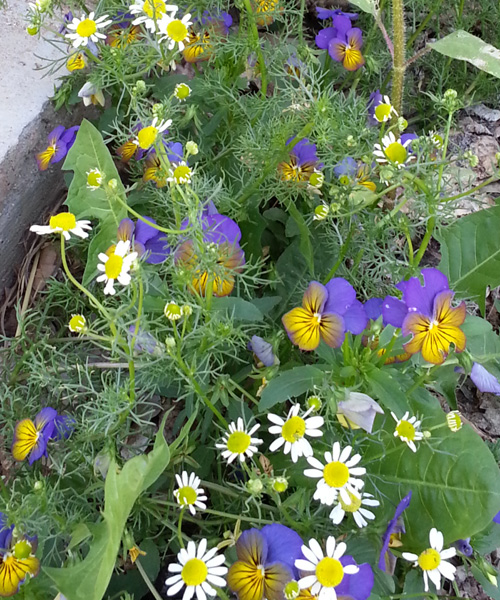 Chamomile and Violas
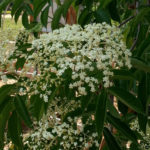
A few years back I planted an Elderberry hedge, and since then its blossoms have become a favorite for my impromptu bouquets. White, wide and lacy it’s perfect in a mason jar with a couple of roses. So is Chamomile, which I’m hoping takes off this year. I started it last year near the commercial kitchen door and let it go to seed. Much to my pleasure, dozens of plants reappeared this year. I’m hoping to collect seed this year and spread it throughout my gardens. Because it’s such a pretty little daisy-like flower, I love adding it to gardens for its look, but drying the flowers for tea is also high on my list of uses for it.
Okay, so this was a bit of a girly post, but you know what? I LOVE being a girl, even if I can’t remember the last time I was actually girly. And if I have to endure a runny nose and itchy eyes so I can keep growing all these little beauties, so be it. Although I might have to finally give up and buy tissues that don’t come on a roll as the season progresses. Sigh.





May 23, 2016
Always something new
First, I apologize for never managing to write a post last week, but, at least for me, finishing a book is like running a marathon. Everything but breathing and typing are optional. If it weren’t for the turkeys, I wouldn’t have been outside at all. And, of course, once the book was done all I wanted was to crawl into bed for a week. But farming doesn’t allow for that kind of indulgence. So instead, I settled for crawling out to the barns, opening the doors, then crawling back to the house and pretending to sleep for a few hours while the (supposed) house cats held me down. That lasted for a day. By ten on the second day, I gave up and indulged in a third pot of tea. That’s when I remembered that although the WORDS of the book had gone to the editors, I’d forgotten a few things. Like filing for my copyright, formatting for the print version, creating the cover for both the digital and print versions. Ah, the life of an independent author. For all of you out there who would like to be published by a New York house, it’s not what it’s cracked up to be. Take it from me. I’d much rather do my own covers, PR, marketing, technical stuff and earn $2.99 per book, then go back to earning 40 cents per book while having absolutely NO say on what happens to my work.
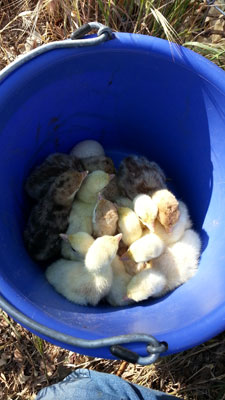
As for the farm, what can I say? There’s always something new and different going on here. The surprises started happening after that third pot of tea. That’s when I discovered one of my black Australorpes had laid a dozen eggs in a tub and was happily sitting on them. What a quandary! I killed my last rooster two weeks ago because I caught him trying to batter one of the hens to death, just like his father and brother had done before him. That simply doesn’t wash with me and he breathed his last. So, had that hen laid those eggs before or after the rooster went the way of the dodo? The answer came on Friday when she began to hatch out the cutest little black and yellow chicks. Pop, pop, pop, suddenly there were 8 with 4 more eggs to go. I couldn’t leave them in the tub, not when the babies could slide through the layers of plastic chicken wire and die. So I grabbed my trusty blue bucket, gathered up the babies and took the little family into the turkey barn. Mama settled in happily and by this morning she had two more chicks and had left the last two eggs to show her shiny new babies a shiny new world. I quickly carried those eggs into the brooder barn and tucked them under the poor pathetic turkey hen who has lost every chick or poult she’s hatched to some other marauding mother, whether chicken or turkey.
 Then on Saturday evening I went to check on Gabby Gray. After abandoning the eggs I’d transported from the blackberries into the brooder barn, she’d returned to the blackberries to lay a second batch. At least she chose a better spot this time, so close to the fence the dogs could press their noses against any predator that tried to go after her. But, because I’d stolen her from her last spot, she’d dug into the thorns even more deeply. Worse, every time I tried to leave her a little can of water, she shoved them to where I could reach them without losing skin. So, the best I could do was throw the occasional handful of black oil sunflower seeds at her. That’s where I was Saturday night, getting ready to launch seeds over the fence at her, when three little heads popped out from underneath her! I returned Sunday morning with yet another can of water and a pile of food. There were a dozen little guys under her by that point with two eggs yet to hatch. By that time I was biting my nails worrying, about what might happen overnight. I really need those babies! I was sleeping with half an ear tuned to the outside when, sure enough, at about 2 AM I heard the coyotes. So out the dogs and I went to patrol the fence for an hour or so. By 7 AM this morning, she and her brood were in the brooder barn with those two unhatched eggs shoved under that pitiful broody girl. (Do turkeys suffer from postpartum depression? You bet they do!)
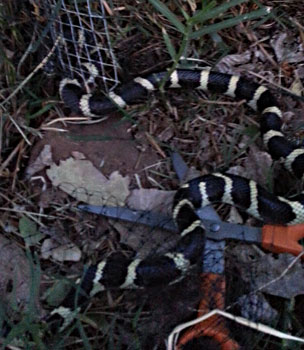 Meanwhile, last night as I was walking back from closing up the chicken coop, Moosie stopped to investigate something. My first thought was that it was a poult left behind by its mama. It wasn’t. It was a king snake that had somehow managed to shove itself through the layers of bird netting and hardware cloth I’d wrapped around the trunk of my ditch-side peach tree. Beaver protection. Now, I haven’t seen a beaver since the creek changed course, sending most of the water around the opposite side of the island. I armored that trunk after that beaver took 1 nectarine and 2 peaches and forgotten it. Since I love King Snakes–not only are they beautiful but also hard workers–I wasn’t about to let it die, I got my gloves, scissors and wire snips and went to work. It took almost a half an hour to free the poor thing. He/she wrapped him/herself into a knot as I carried it into the fenced garden where Moosie couldn’t play with it. It was gone this morning, so I’m choosing to assume it went under its own power.
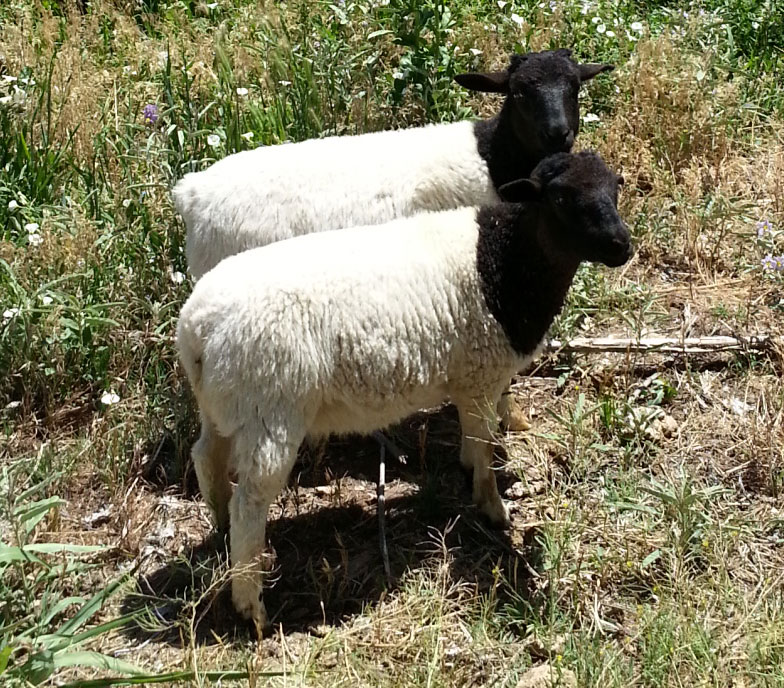 Then this morning, the urge couldn’t be resisted a moment longer. I got into the car and drove to Mayer where I bought myself three Dorper sheep. Tobey and Tiny are both 3 months old, born in February. At 20 pounds each, they came home in the back of my little Focus in a dog crate, baaing the whole way. Tobey definitely has a boy voice while Tiny’s voice is all sweet little girl. Little Cinco (born on Cinco de Mayo), the ram who will hopefully make more sheep via Tiny, will stay with his mom until July when he’s weaned. This time the surprise was on the dogs. They aren’t quite sure what those little creatures locked in the orchard garden are. Just in case Moosie gets any ideas (he’s creeping over to the orchard fence as I type this to have yet another look at them), I spent an hour telling him that these creatures are MINE! I’m hoping he’ll do with them what he did with the calves, figure they’re some sort of odd-looking dog, then adopt them as his own. It’s nice to see the little guys finally moving around the overgrown orchard and taste a bit of this and that.
I’m hoping that’s the last of the surprises for the week. It wouldn’t do to discover that the twins are able to eat a small apricot tree overnight It’s time to start stringing that electric fencing again. Yep, it’s always something.
May 9, 2016
Shooting Blanks
Oh no! I can’t believe it’s happened. Hundreds of turkey eggs and only 8 hatchlings to date. Oh, Tom! Five years old and no longer the virile young man that he was four years ago. Well, more like three and half years ago. It took him a year and a half to figure out how to effectively fertilize eggs.
If you’ve never seen turkeys mating, it’s a complicated dance, and I do mean dance. The tom inflates his breast (there’s a membrane between his muscles and his skin that he fills with air), then stomps his feet, tapping his toes twice on the ground on each side, shifting from side to side as his wide-spread tail moves back and forth. I’ve been to Powwows in the past. Well, the first time I saw Tom dancing, I recognized the connection right away.
As for the actual act, if the hen’s receptive, she’ll walk around and around the tom, brushing herself against his breast, then crouch so he can climb on her back. After that, it’s all a balancing act. Yep, the tom has to keep his balance on that slippery slope as he shifts his tail to the side and makes a 3 second dip that should guarantee new turkeys. Let me say that the first time a young tom tries it is pretty hilarious. Tom’s first attempt had him slipping, sliding and finally toppling over the front of his poor girl. She was definitely wondering if she’d made a big mistake choosing him.
My replacement tom, Tommy II, isn’t quite old enough to do the job, although I’ve seen him trying. He’s still in the slip-n-slide mode. Worse, the girls aren’t really interested in him, not when Tom is such a suave and handsome devil. But Tommy II will be ready to take over once Tom is no longer in charge.
The two Toms are good together, which is pretty unusual since toms are supposed to fight for dominance. But these two act like father and son, or at least partners. They’re rarely more than a few yards apart. And they’ve become “The Protectors of the Flock”. This is akin to being “Guardians of the Galaxy”. That’s because there is no creature more alien looking on earth than a tom turkey.
Last week, a pair of ravens swooped in, looking to steal eggs and/or poults. I watched as the two toms arranged themselves in battle mode, breasts inflated and tails spread. The ravens were using a “divert and conquer” strategy, which had one bird swooping down in the hopes of distracting both toms giving the second bird a chance to go for the kill. Tom and Tommy II were onto them. They shifted until they stood tail-to-tail in front of the coop, each one watching his area. Again and again, the ravens tried to get past them, only to be charged by one or the other of the two larger, albeit ground-bound, birds. The ravens finally gave up and beat a retreat. They haven’t come back to try it again…yet.
So now what do I do? Separating Tom from his flock just isn’t an option, not when it’s clear he serves other purposes than just making new turkeys. Even Tommy II still wants him as part of the family. I wonder if it’s feasible to separate the hens, giving each tom his own harem?
Dang it, there’s always something. I just didn’t consider the problem of infertility. Death by mountain lion, coyote, dog, old age, yes, but not E.D.
I suppose there’s really nothing else for me to do but wait for Tom to pass away from old age. I love that bird. And the rotting eggs don’t go to waste. Once the hens recognize they’ve got a “stinker” under them, they roll it out of the nest, sharing that stink with the rest of the world. This attracts dogs and my dogs LOVE them, eating them like candy. Yuck. But there will never be another Tom. That means when Tommy II reaches this point, I’ll have no trouble turning him into a meal.
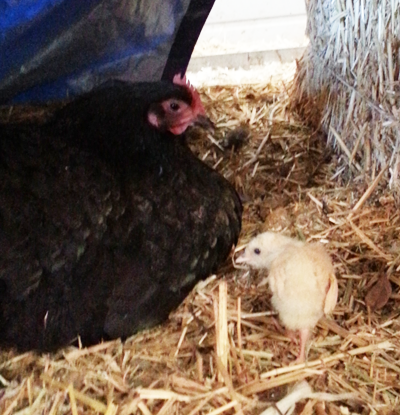 And now a post script from the nesting coop. Last year, one of my Australorpe hens decided to sit on turkey eggs along with two turkey hens. The three were steadfast brooders, one of the three going off at a time to eat and drink. It was funny to watch that chicken hen–a bird half the size of the turkeys–do her best to spread her smaller body over the thirty eggs in that batch. When the eggs hatched, the chicken treated the turkey poults as if they were hers. Never mind that she was black and those babies were a bright gold.
Well, she’s done it again this year, this time kicking the turkey hen off the eight turkey eggs she claimed for herself. One egg hatched, and as far as this chicken is concerned, she got her baby. I’m not sure what she’s going to think when it outgrows her in a few weeks!
May 2, 2016
One Crone Amilking
On the first day of May a rancher called to me…please come out and help me milk Cissy.
So if you’re creative with “The 12 Days of Christmas” that line works pretty darn well. Yes, this Crone is milking a cow again, a cow that used to live here but now lives down around the corner at Tres Hermanas Ranch. Cissy, or Sissy as they now spell her name, spends her time there grazing with 80 or so head of 100% grass-fed Angus. Cissy was a dairy reject from Glendale. I got her as an 18 month old heifer just after her first fresh (her first calf). The dairy was willing to sell her because she kept kicking off her teat cups. That resulted in dedicating an employee to stand behind her and hold the teat cups in place as he dodged her hooves. I’m sure they were happy to get rid of a problem cow when they sold her to me.
As for me, I didn’t know what I was in for, taking on a cow who’d been born on a factory farm. First, she was unaccustomed to being touched by humans. At the big dairies there are just too many animals for them to be treated as anything other than “cogs in a wheel”. Moreover, twisting a cow’s tail is how you “encourage” a cow to behave. As you can imagine, she was very shy that first day. But I had the advantage of being female. Only men worked at the dairy. By day two, she’d discovered pats and scratches were really nice. Also, because she missed her big herd, she stayed close to Brighty. That meant I had no trouble getting her to come up to the trough when it was time for milking. And once it was her turn, she had no trouble with standing in front of it to eat the hay she was given. But milking? Not with that vacuum milker! To Cissy, the miracle of escaping the dairy meant never having a teat cup on her again.
With a sigh, I gave way. I put my hands on her teats, expecting to battle for every drop. It was Cissy’s turn to sigh. Hand milking was just fine with her. That had me grumbling. I’d just bought that vacuum milker so I wouldn’t have to hand milk any more. I promised myself I’d hand milk her until she got accustomed to the farm.
It took her three days to learn how to graze. Seriously. Until she got here, she’d never seen grass growing from the ground. She had no idea what to do with the stuff. Then on that third day, I caught her biting tiny mouthfuls, moving the blades around her mouth with her tongue as if testing the texture, then chewing. Once she figured out how to make that work, she was dancing across the pasture, tasting this leaf, trying that blade.
Equally astonishing to her was the Mason Ditch. Obviously, she’d never before seen a stream. Her water came in a trough. I was working in my garden when she first tiptoed her way down the bank and stuck her nose into the water. Her head came up with a start as she snorted water out of her nostrils. In her head went, out it came, dripping. She did it again, then again, playing with the water. I looked away for a moment. When I looked back she was in the ditch, kicking with one front leg, then the next, like a kid in a bathtub. Laughing, I went back to working on the row I was planting. The next time I looked back, all I could see were four hooves in the air, flailing. Although there was nothing I could do to help right a cow ten times my weight, I took off for her at a run. By the time I was halfway there, she’d come back upright and was shaking the water off as she climbed out. Apparently, no harm was done, because she was back in the ditch a few minutes later, splashing and playing.
After that, she became a 1000 pound puppy, following me around the farm, calling for me if she couldn’t see me and trying to follow me up the porch stairs so she could come inside with me. Hoo-boy. Cute, but not exactly what I had in mind, cow-wise. And she kept refusing to take that vacuum milker when I had a book to finish. Back then, before I had researched everything I could find about keeping a family cow, I was milking twice a day. That’s a good chunk of time when you’re trying to finish a book, which I am once again doing. Nine thousand words to go!
That’s when I sold her to Ernesto at Tres Hermanas Ranch. They already had cows for beef, but he and his wife wanted milk as well. They had a ranch hand at the time who liked to hand milk. As for me, I knew she’d be going to a place where she could dance in streams and graze all the grass she wanted. And, they were just down the way from me, so if I wanted to visit my pet, I could.
Well, the guy doing the milking left and their Sissy dried up. She was with calf by then, so that was fine. When she dropped her calf, somehow the milking never started up again. Another pregnancy occurred (that happens when you keep bulls) and this time Ernesto was determined to keep the milk. By then, as happens when dairy cows aren’t regularly milked, her udder had lost its regular shape and her quarters were inconsistent about the amount of milk they produced. Then again, she really wasn’t there to be milked. She’d become their pet, and the producer of “wedding gift” calves.
With the next calf, Ernesto called again. They were milking her with a little hand pump and it was taking too long for his ranch hand to do the job. Plus, it seemed she had a bit of mastitis. Could I help? I could, but only if she agreed to take the vacuum milker.
Let’s just say Miss Ciss wasn’t a fan, but the ranch has a squeeze shoot. Try as she might, once she was in that shoot she couldn’t kick off those cups. I’d like to think she remembered me. If she didn’t, she got to know me again over the next few months. Once she was in the shoot, I’d talk to her as I brushed her and fed her Chaffhaye, which is her most favorite thing in the whole world. Then, it was time to dry her up again, mainly because we were all tired of milking her. So off she went to cavort with the bull, graze as she wanted and keep her eye on the flowing water.
Last week, Cissy again dropped a little bull calf. By this time, I’d sold Ernesto the milker for Cissy. Well, her little guy struggled for those first few days, a little lethargic and weak, and unable to latch on the way he should have. That left Cissy with mastitis again. Ernesto put the milker together, but couldn’t get vacuum. When I arrived, I found the rip in the tubing, reassembled the pulser with the base turned the right direction (in Ernesto’s defense, these are both hard flaws to spot when you first start assembling milkers) and we went to put it on Cissy.
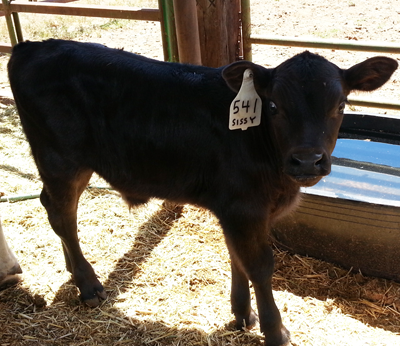 Again, I’d like to think she remembered me. Maybe she did, because we tied her to the fence and revved up the vacuum pump. She didn’t so much as move a hoof. I put the milker on her. She kicked once at the right rear teat cup, telling me which quarter was hurting, then stood perfectly still as the milker emptied her. I stayed on my knees next to her, talking and patting, as I watched the milk to see if any of her other quarters were affected. About halfway through, the little guy, who had by then had found his bounces, made his escape, climbing through the pole fencing to visit the horses. Calm dairy cow became worried mama cow, and that was the end of that. I left yesterday, promising to come at noon every day from now on to milk her out.
Today, we put Cissy into the hospital headlock. I don’t think she needed it. Once I got the milker on her, her shoulders relaxed. To my surprise, it wasn’t just the right rear quarter that was hurting. It took forever to milk out that back left quarter. When I removed that last teat cup, she was visibly relieved and ready to leave the headlock. Only I couldn’t figure it out. I pressed this lever, moved that handle. The doors wouldn’t open. As I bent over in front of her to try yet another lever, she pressed her nose to my hair and gave me a quick lick. I stood up and scratched her nose. I guess she’s still my 1000 pound pup.
April 26, 2016
First Poult of the Year
I have the first surviving poult of the year. She (okay, I don’t really know if the little thing is male or female, but she feels female to me) is thriving and lively despite the strangeness of her first hours. Those hours are strange because (1) I have no idea what nest produced her and (2) I wasn’t the first farm denizen to find her. All of that makes her continued survival fairly miraculous, and maybe a good omen.
She appeared at about 5:30 PM yesterday evening. I was prepping the coop in my usual evening ritual–changing the waterers, filling the food bowls, tossing sunflower seeds to the sitting hens–when I looked over and saw a hen out in the pasture poking at something. It wasn’t a serious poke, the sort they use when they’re picking up food. It was more of a curious poke, as in “what are you?” Then, all of a sudden, the hen turned and walked away.
Moosie, who’d been watching along with me although from the vantage of the chicken coop, was over there in a flash. He picked up something from that clump of horehound. I caught a brief glimpse from where I stood. It looked a bit like a piece of bread, which it could have been right there. That’s the general area where I dump the contents of the veggie trash bins from my kitchen renters. They sometimes put stale bread in the pails.
But there was something guilty about the little glance Moosie sent me as he started back toward the house. It set off my radar. “Moosie?” I called out.
Instantly, his shoulders dropped and his ears lowered. He slowed to almost creeping. The alarms were going off like crazy now, with plenty of flashing red lights to boot.
“Drop it!” I called, just in case.
Sure enough, he put his head down and gently spat out whatever it was he was carrying. Then he moved off by about a dozen yards and sat down, his whole body radiating guilt. He stared apologetically at me as I went to see what it was he’d dropped.
There she was, not a scratch on her, staring up at me as if to say, “What in the world just happened?”
I scooped up her and took her into the main turkey coop (the expensive side) and tucked her under the hen who’s presently sitting on some 40 eggs which should start opening tomorrow or the 28th. The hen welcomed the little one with that sweet peeping the mothers make, the one that sounds an awfully lot like the noises we human mothers make to our infants.
I returned this morning to find the baby chipper and interested in my finger. So, food and water has been left within reach. As of this picture-taking, mother and baby are doing very well. Now, to keep Moosie out of that coop!
April 25, 2016
Bird by Bird
Thanks to Anne Lamott for this title. But, unlike her book, this post is actually about birds. That’s because this morning at around 7:00 AM I had another National Geographic moment. (That’s it. I’ll try to restrain myself and avoid any other literary mentions in this post.)
I haven’t seen Osprey here, although I know they’re in the area. So I was startled when the Osprey flew out of my Cottonwood and across my field this morning as I watched from my desk near the windows. Actually, I was so startled that I ran for my Sibley Guide to Birds, just to be sure. Definitely an Osprey. And like many of the birds of prey I see around here, this one had a tail. As in four LBBs (Little Brown Birds) diving and swooping at a creature four times their size. Size of a Finch, heart of an Eagle, especially in nesting season. I love it when the starlings take on the ravens. Nasty ravens! They steal my eggs.
I’ve had other NatGeo moments. My favorite happened two summers ago while I was down by the creek. I happened to glance to the west. Coming in fast and low straight at me was a Bald Eagle. It was clear that he had his eye on the water, otherwise he would have noticed the Black-hawk hanging out on the dead branch over my head. Just as the eagle thrust his talons in the water and snatched a good sized trout, the hawk above me let out its usual “wheet-wheet-wheet” of complaint and swooped down at the eagle’s back. But Black-hawks are slow and the eagle, fish caught tight, feinted toward me, coming within a wing’s length. As the Black-hawk missed, a Red-tail exploded out of the trees across the creek. (She nests over there.) As she dove at the bigger bird, she gave that piercing, haunting “scree!” you always hear when you’re watching a Western. The eagle gave a few lazy flaps of its wings. That’s all it took to escape the Red-tail, although she continued to give chase until the eagle disappeared around the tip of the island.
Yep. I live in a birder’s paradise.
Once again this year, the Cottonwood near my front barn has become a giant economy sized bird house. The starlings live in a hole in one of the dead branches. The doves nest all over the branches. For the fourth year Western Tanagers have rented a condo on the south side of the massive tree. I really like these birds. Not only are they beautiful, with a red head, black wings and yellow body, but their call sounds like a demented squeaky toy. Even better, the Cardinals that nest in the Magnolia near the back of my house hate them. There’s nothing better than sitting on the back porch on a humid July evening and watching the ruby-red Cardinal chase the jewel-bright Tanager back onto its side of the field. You know those multi-colored birds with their weird calls. Who needs them in the neighborhood!
Also in the cottonwood are the tiny little woodpeckers. I see some with a patch of red on their heads and some without. According to Sibley’s this means I could be seeing a Downy Woodpecker (which may or may not have the red patch) or a Hairy Woodpecker. Or both. But I think I hear the “kikikiki” call of the Downy. There are Flickers in there too. Big birds, obnoxious noise. And just last month I saw the bright yellow flash of a true Goldfinch among the spring green leaves. The Goldfinches were here last year, too. I also have their smaller cousins, the Lesser Goldfinches, but they nest along the ditch bank. I grow sunflowers just for them because I love the sweet way they talk to each other as they move around my garden, eating sunflower seeds, taking chunks of sunflower leaves for their nests and generally devouring my aphids.
Right now my mulberry is fruiting. This not only feeds the birds living in Cottonwood Condos but brings in other birds I don’t usually see. I especially like the Phainopepla. It looks like a black Cardinal with a white stripe across its wings.
I had a cute little wren stuck in the fenced-in area under my porch the other day. Probably a House Wren. Definitely not the Canyon Wren that I see out in my raspberry patch. I figure it got a little too brash about the cats. I’ve watched as this wren has made itself at home on the porch, pecking at dog food on the floor, eating the cat food out of the feeder on the table, harvesting bugs and more from the rafters of the porch ceiling. Being a wren, it probably threw one challenge too many at a cat and got chased for its efforts, only to end up confused by the hardware cloth screening that encloses that area. I opened the gate for it. It went through the gaps between the boards instead. Tiny bird!
Other daring harvesters of porch bugs are the flycatchers that seem to stay here all year-round. I have two types. One is blackish, the other brown-and -goldish. I haven’t been able to figure out what they are, or if they’re the same species but just male and female. Whatever they are I love them, especially during gnat season. They are prodigious eaters of bugs. And great Cat TV.
Another potential cat toy is the persistent pair of House Finches that so want to nest on the I-Beam that supports the porch roof. When I first moved here, they’d already made that beam their home. It’s actually a good place for a nest, since the rafters create a separate little room that’s inaccessible to felines, no matter how hard they try. More than one cat has levered herself up onto the beam and tried to slither around that rafter only to end up hanging by her claws. Each year the little pair, she dressed all in brown, he wearing a bright red shirt and cap, check out their former home. They’ll even start building, getting a few straws in place. But after a few days, the pressure of being watched by cats 24/7 is more than they can take, and they think the better of it.
There are birds in this area that I haven’t seen since my childhood, like Robins and Nuthatches. Then there are the Disney birds, like the Western Bluebird and the tiny little Vireo–both of them have colored backs and differently colored bellies, and that pudgy shape that we all find so cute. Never mind that these creatures are the descendants of dinosaurs, and that they’re omnivores, if not flat-out carnivores. Bugs are protein. For that matter, I consider my chickens to be Tyrannosaurus Plebs (as compared to Tyrannosaurus Rex). They’ll eat anything, including dead animals and each others’ eggs. Now, turkeys are definitely Diplodicus, but then I’m fond of turkeys as you might have guessed.
I’ve seen Hebert’s Towhees–smooth brown back with a muted but pretty pink belly and a sweet bell-like call, and Peregrines, Prairie Falcons and that gorgeous Turquoise-backed Kingfisher. One of last year’s hatchlings accidentally landed on the porch rail during his maiden flight, startling us both. Speaking of bird-watching from the porch, the eagle has more than once flown past me while I’m out there, not the least bit concerned that I could touch him if I just stretched out my arm.
But that’s me. Just living my life, bird by bird.
April 18, 2016
Be-bop-a-re-bop…
RHUBARB PIE!
Okay, I admit to listening to Garrison Keillor and A Prairie Home Companion from time to time. He first caught my attention was when I read an essay he’d written that included the statement that all Scandinavian food is “carrier” food. It’s meant to carry butter, sugar or salt to the gullet.
That had me bent over in laughter. Why? Because I’m of Norwegian ancestry. How Norwegian? Well, my Grandmother Skistad was born in northern Wisconsin (Ladysmith, I believe) but spoke only Norwegian until she left school (in the eighth grade because her father didn’t believe in educating girls) to become a housemaid for a doctor in Eau Claire. Her “yelly yiggled” pretty well. Suffice it to say, I’m Norwegian enough to know I don’t like Lutefisk, but I do love pickled herring, Fattigmans, Spritz Cookies and Lefse. And that Hot Dish is required at Lutheran Church potluck dinners.
Figuring high on the list of all the foods my grandmother taught me to love is Rhubarb. Yes, I’ve even crunched on the raw stalk. It’s not unlike biting into a lemon. But the best thing about rhubarb is the amount of sugar it takes to turn it into the things I love, like rhubarb pie, rhubarb pudding, strawberry rhubarb crisp and, of course, rhubarb yelly and yam. (See above about carrier food–I mean this is one vegetable that lives up to the requirements of Scandinavian cooking.)
So, being such a huge fan of rhubarb you can bet I scanned the local planting guide to see if I could grow it up here when I first moved in. Check! So I bought me a root from a local nursery and planted it along the ditch bank, which has nice, compost-y soil. I put it close but not too close to the water hoping the moist air would mimic that awful humidity they have in Wisconsin, and maybe cut the intensity of our midsummer heat. That plant straggled through the first year and didn’t return. I dug up the root. Oops. It was a soppy mess. I didn’t realize the water saturated the ground so far from the main flow of the ditch. No wonder the grass is always green there, a whole lot greener than over the septic tank, by the way.
The next year I tried again, this time in my upper garden, the one in which my roses are presently going crazy and putting on quite the show for passersby on Page Spring Road. The ground was dryer and I’d amended it well the previous year. Plus there’s partial shade cast by the massive willow tree I’ve pretty much fallen out of love with. What a mess! It’s been poorly trimmed over the years so it lacks shape and is full of dying branches infested with mistletoe. This time, the rhubarb managed to grow big enough the first year to give me 3 stalks. Like I can do anything with 3 stalks of rhubarb. But that was more than I’d gotten from the first plant, so I crossed my fingers and offered up the farmer’s prayer (next year for sure!). Well, next year it gave me nothing but a few stunted leaves that barely made it out of the ground. It’s nothing but a memory this year.
Still, the call of that yelly wouldn’t be denied. Two winters ago, I was perusing a catalog from a huge northern nursery looking for elderberry bushes, which they had for a really decent price. Then I found the Pakistani mulberries–the white ones that have a faint cinnamon taste to them. They were listed in “bush form”. Huh. Bush form. In the Twelfth Century “bush form” is referred to as “coppiced”. That’s when you cut off the developed tree and it grows back all branchy instead of in one trunk. Be that as it may, bush form is the perfect size for the hillside I was filling, the one between the Mason Ditch and my house.
Then I flipped the digital page and there they were. A full page of rhubarb varieties, enough to make my mouth water. I couldn’t help myself. I bought three different varieties. Since everything else was going in the Mason Ditch hillside near the house, that’s where these three roots went, in with the elderberries, French sorrel, fennel and chicory that are presently doing a great job crowding out the original quack grass, thank you very much. I figured the rhubarb would die right away. After all, nothing about that soil or the micro-climate on that hillside fits what that local garden how-to lists for growing rhubarb in this area.
Much to my surprise, my three little plants did far better than I expected last summer, although not well enough to harvest anything. Then again, I guess you’re supposed to wait a few years for the roots to establish before harvesting. That might be why Plant #2 didn’t do that well. I took those 3 stalks.
Then winter came, fast and hard. That first surprise frost took the tops of all my bush mulberries. The elderberries browned, then dropped their leaves and the sorrel disappeared. So did any trace of the rhubarb. With little hope they’d return, I put them out of my mind. When things first started to bud out this spring, I crawled over the awful concrete walls that enclose the ditch side near my house (and make me feel like a queen in her castle–disconnected from the land I rule) and walked the narrow paths I’ve carved into that steep slope over the past five years.
The mulberries lost the tops of their branches, but have grown back strong from their lower halves, even setting on plenty of berries. It turns out that elderberries laugh at the cold. They’ve tripled in size since budding out and will set berries like crazy this year, a year sooner than I expected. Then I remembered the rhubarb. I climbed to the area I’d chosen, pushed aside the grass and the sorrel (it’s another weed like arugula) and there they were, all three of them.
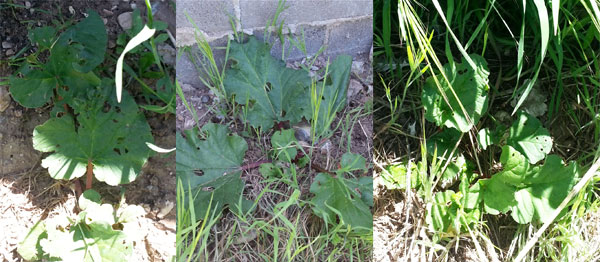 The middle one is twice the size of the others. Victoria, I think
I no longer know what two of them are. Something–snails, gophers, cats, turkeys, who knows–ate the stakes I put in next to those plants. The one doing the best still has its tag: Victoria. It’s already twice the size it achieved last year, sporting three nice long stalks with well-developed leaves and plenty of new leaves. The stalks are a beautiful red hue. Oh be still my heart! Yelly might just be possible this year!
Apricot Rhubarb Yam (makes about 5 pints)
20 oz stewed rhubarb, about 7-8 stalks chopped
4 cups pureed apricots
1/4 cup lemon juice
7 1/2 cups sugar
1 package liquid pectin
Slightly drain stewed rhubarb to make 20 ounces. Combine with apricot and lemon juice in a pot. Stir in sugar and bring to a roiling boil, stirring constantly. Boil hard one minute. Immediately stir in pectin. Fill pint or cup jars and process in a water bath for 10 minutes (cup jars) or 15 minutes (pint jars)