Denise Domning's Blog, page 19
January 23, 2017
Soil
Before the Earth, a Tiny update.
Tiny the Ewe remains pregnant and, boy oh boy, does she look miserable. Her udder isn’t big, but it’s as round as a ball and so full nothing jiggles as she slowly makes her way back and forth across the fields. She’s not one for pats and scratches, but today she let me massage her back just above her tail. Yep, that girl is way ready to dump those little lambikins. Cinco has no sympathy for her and dashes off in whatever direction sparks his fancy without a backward look. Since she can’t bear to be apart from him, she’s left to waddle slowly after. Because Tiny is so far along, I’ve been walking out a few times a day to check on her.
Nope, not walking–slogging. I have standing water in the area between my front barn and the orchard as well as in the first of my three pastures. My back barn has become a castle moated by quick-mud. Even the turkeys have taken to walking the long way around to avoid the gooey stuff. But there are places where I don’t have puddles and oh how that pleases me!
 The old (and huge) Cottonwood
When I first arrived here almost seven years ago now, the whole front of the property–the area that lacks much tree coverage–was carpeted with half-dead bermuda grass. Without shade and proper irrigation plus improper grazing, the ground had become so compacted that when the tractor’s roto-tiller attachment was first put to it, the tines bounced off the ground. The back pasture, the one behind the far barn that’s shaded by the massive Cottonwood, was sparsely covered with silver nightshade, horehound and nasty little Mesquite trees. The soil there was a fine, bright red clay. That it was still nothing but clay was surprising given the amount of leaf litter that huge tree drops.
I started with a soil test that recommended soil amendments, which I applied by hand (probably should have worn gloves for some of them, but oh well–I’m old). Plenty of flood irrigation followed along with a few bags of clover and daikon radish seeds followed by a dry land dairy mix of clovers, grasses and vetch. Then I added cows. They came with their big hooves and copious cow pies. Hmm, fresh cow pie. Now, that’s a “squelch” that you never forget. Following after them came my chickens and turkeys–my non-gasoline powered roto-tillers–who scratched all that manure around while looking for grain and maggots. Good turkeys and chickens!
I started to see a difference within a year. In the front pastures the grass was greener and the water soaked in more quickly with every month that passed. I left the back pasture to its own devices as no matter how much I or others graded, we couldn’t get water to the whole area.
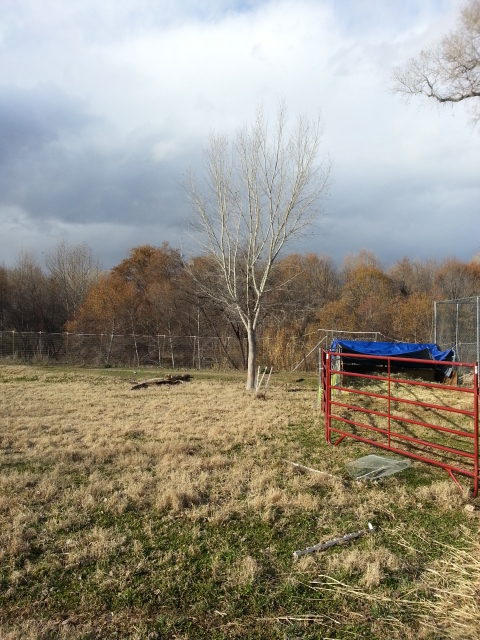 new and not so big Cottonwood
Three years ago, I added four tiny, thigh-high Cottonwood trees to the middle two pastures. The nurseryman who sold them to me assured me they’d grow fast, especially since the water table in my pastures is at about 50 feet. That was, if their roots could break through the rock hard soil. It took a backhoe and more than a day to dig those four holes!
Boy howdy, have those trees exceeded my expectations. They’re over 20 feet tall now and I can see the difference their shade is making in the front pasture. Last year, when I decided to plant some Pecan twigs…I mean trees…near those Cottonwoods all it took was a slim trenching shovel. (You know the old saying: “The time to plant trees was ten years ago, dang it!”)
But I think I know why only that middle pasture is standing-water-free. Two years ago, back when I still had a working tractor, I experimented on that pasture because I could. I decided to turn it (using the big, non-feathered roto-tiller), tilling in the various grasses and clovers as a green manure. My goal was to barely scratch the surface, so I did my best to keep the tiller at a depth of 2 inches. It was worth the two days it took to complete the job and the next year I was sorry I hadn’t done the rest of the property before the tractor did its swan song. Since I turned it, that pasture has become a sponge, soaking up every drop of water that hits it. Where my piggy-girls have turned the soil, it’s a gorgeous brown-black. Very nice!
The other two front pastures remain much more compacted, especially the area between my orchard and my front barn. But then, I’ve pretty much ignored that area because of the difficult fence situation and the septic tank. I’m hoping to change that this coming year. Hugelkulture coming soon to a pasture near you!
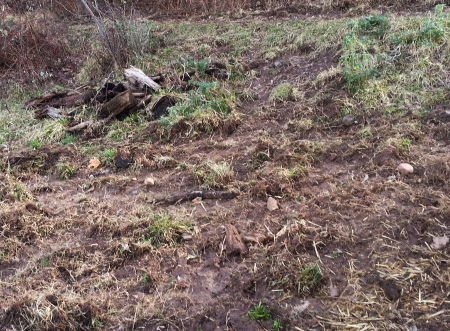 Pig-turned earth
There’s one other area that’s water free–that back pasture. Two years ago, I finally got the flood figured out and seeded it in with a vetch/grass/clover mix that the birds immediately devoured, much to my chagrin. Unwilling to feed them such expensive scratch, I instead started depositing the dirty straw from the chicken coops and turkey barn on that area. Week after week, I’d dump the straw and, week after week, the birds would rush after me, eager to check each pile for whatever treasures it might hold. I went from one end to the other twice, my winged roto-tillers following. This past summer, that area was filled with mullein, native sunflower, not-so-native sunflowers, a few corn stalks, lots of barley and some of the native grasses, the foliage so thick the birds had to shove their way through it. But there was no silver nightshade and minimal horehound (both plants signal nutritional deficiencies). Definitely a miracle!
Right now, that pasture is once again bare, and that means I can see that the soil is no longer red clay. Instead, it’s dark brown rich earth just waiting for me to put some sort of seed into it. If only. The problem with those little feathered roto-tillers is that I can’t turn them off and they never run out of gas. Dang it!


January 17, 2017
Successes and Failures
Well, Boinker is no more. She didn’t leave the way I planned and that’s on me. The one certain rule in life is that if you want it done your way you must do it yourself. And so I will the next time.
All that aside, it turned out she was over 300 pounds. Wow, she looked so small next to Oinker. I guess this means Oinker is pushing 400. Double wow. It’s been constant work since Friday night breaking down her carcass and preserving her meat. I’m so glad I bought the bone saw. That thing made it almost easy. And I finally got my knives as sharp as I wanted them. This, unfortunately, caused a problem for Derek, my renter. Derek is a chef and he offered to help me cut her up. As he grabbed up a knife, I warned him it probably wasn’t sharp enough for him (thinking that professionals keep things “really really” sharp). He dove into the meat and the knife went right through to slice into his finger on the first stroke. Four stitches later… So sorry!
At this point my new freezer, which I bought just for this pig and am now glad I did it, is stuffed to the gills and I’m still not done. The ham I kept goes into brine today. There’s about 20 pounds of potential bacon that needs to start curing. And, I’ve got another 40 pounds of scrap to be reduced into ground pork and potential sausage, as well as dog food of course. Lastly, there’s the lard. Hour after hour her copious fat is melting into beautiful lard.
Oinker definitely misses her buddy, but she’s agreed that it’ll be okay as long as I offer lots of pats and scratches. She’s even considering bonding with the sheep. Now, this is surprising because Cinco, my ram, has developed a pretty unfortunate trick of head-butting everyone and everything from behind. Mind you, he doesn’t do it so hard that it does damage, but it’s definitely startling. On Sunday, he tried it out on Oinker. He hit her hard enough to make her “yarp” –it’s the first time I’ve heard her make that sound–and do one of those mid-air 180s (very impressive at her size). As she hit the ground, she was already moving, coming at the much smaller ram at good speed. Her mouth was open. It was clear she was going to have herself some lamb. Cinco very carefully backed away, head lowered and ready, just in case Oinker really meant it. Then yesterday he apologized to her. Head drooping, he walked slowly up to her, stopped and waited. She tentatively reached out the tip of her snout and he very gently placed his forehead against her nose and held it there for a moment.
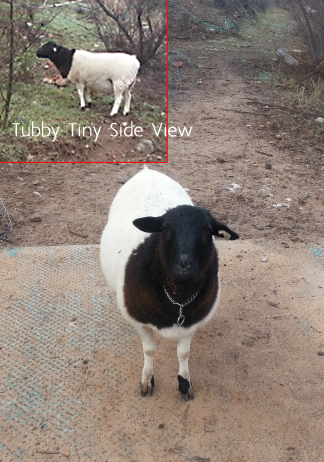 I hope this means all is truly forgiven, because Oinker loves sleeping in the sheep pen during the day and from all appearances I’m about 2 weeks away from Tiny’s lambs making their appearance. I’m pretty sure there are two–it’s how she’s carrying the weight. The last thing I need is for a giant gilt getting even with the lambs’ daddy by eating one.
I wonder how Oinker will react to something else’s baby, now that I’m even more convinced that she’s pregnant. Oinker was never one to offer me her belly to rub, that was Boinker’s thing. Then yesterday while she was laying on her side as I gave ear scratches, she shifted to present her belly. Her nipples have changed shape. Either way, I’ll know on the 26th. If she cycles, we do it again. If not, there’ll be piglets in late April.
As for the other critters, I pretty sure what will happen when the ovine newborns make their appearance. The chickens won’t notice. They don’t care what happens to anyone else. That’s just chickens. Now,Tom will invite the lambs into the flock. That’s what Tom does. To him everyone’s a turkey. Except Bear; Tom deems Bear very ill-behaved and rude because my big dog likes nothing better than to run through the unsuspecting flock just to watch them scatter. This isn’t something Bear would do to the lambs. Somewhere in his obstinate pea brain he knows that protecting sheep is his job. Just as he did when Toby and Tiny first arrived, he’ll migrate down to the pasture to keep an eye on the babies.
It’s Moosie’s reaction I’m waiting to see. Will he do with the lambs what he did with the calves, turn them into his best friends and teach them how to dig for gophers? Now that would be a real coup for him. I hear that the tent flaps of the Barnum and Bailey Circus will soon be shutting forever. Just imagine. I could create my own circus, a three-ring affair. There’d be the turkeys in one, the dancing pig and butting ram in another, and dog and lambs digging for gophers in the third one.
Yep, it’s the circus life for me!
January 8, 2017
Piglets? I think so!
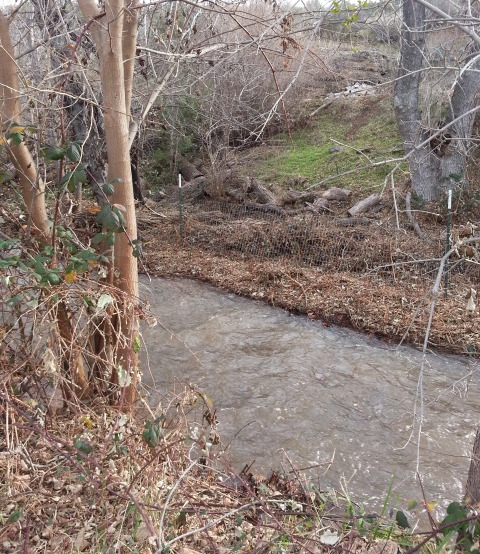 No blackberries!
Before I launch into the description of Pigs in Heat Part 3, I have to take a moment to celebrate. After two years of watching the wild blackberries engulf the steep ditch bank across from the turkey barn, after watching at least a dozen turkey poults float away because Mama nested in said blackberries then flew across the ditch and called her wingless, newly hatched babies to follow, (drum roll please…) the blackberries are gone! About a month ago the folks in charge of the Mason Ditch began working on their waterway. With the water off I was able to stand in the stream bed and hack down the tangled six-foot-tall thicket that had previously thwarted every attempt to penetrate it. Swinging my handy-dandy electric hedge trimmer from side to side, I hacked pathways through the brambles followed by my trusty sheep and pigs who couldn’t think of anything more tasty to eat on a cold winter’s day than blackberry leaves. Today, I climbed the four-foot-diameter remains of a downed Cottonwood tree and went for the last thorny bastion. Another epic battle, another victory.
I wonder where those turkey hens will try to nest next? The only thing I’m certain of is that I probably won’t like it.
Onto the piglets that I predict here and now will be born on April 29th.
Just as I suggested in my last post, Oinker went into heat on Wednesday. And just like her last heat, she was a stealth pig…no squealing or pacing, just Oinker being her usual calm self. While Oinker was working her way toward “standing heat”, I called the place that supplies pre-piglet needs. Tim was very helpful, and suggested two doses instead of three, given Oinker’s age and schedule. The only problem was they were out of Berkshire semen. When I mentioned I was in Arizona and didn’t want white pigs due to sunburn, he suggested a Hampshire boar. Hampshires are the black pigs with the white band around the middle. I think Oinker may already be half Hampshire, what with the big black spot on her ear, so I’m guessing there will be plenty of melatonin to go around. When all was tallied up, I had two doses of the semen, a tube of lubricant, the special spiral applicator on plastic tubing and what turned out to be a life-saving, piglet-creating spray bottle of boar pheromone.
 Important stuff
Thursday morning, I double-checked my kitchen–it was holding steady at the required 60 to 65 degrees–then made the trip to the UPS hub in Camp Verde to pick up my package. Diana showed up shortly after I returned. I was ready for her with two buckets full of raisins along with the instruments of impregnation. However, I didn’t notice that the pheromones hadn’t made it out of the box.
Down we went to the orchard, me in my boots and her in those great flower-print rubber shoes that you can get at Tractor Supply. After locking Boinker outside the orchard with her bucket of raisins, we set Oinker’s bucket in the corner of the fence so she was hemmed in by the wall of shelters I built out of pallets. At Diana’s instruction, I leaned heavily across Oinker’s back. She tolerated it for about a nanosecond, then backed up and looked at me as if to say, “What the heck are you doing? I’m eating here.”
Diana asked if I was sure Oinker was in standing heat. We pressed on her back. Sure enough, my pig went stock still and her ears shifted back. As she again settled into raisin heaven, I once more draped myself across her back. Diana was poised with the applicator. It was coitus interruptus with Oinker now irritated by all this fussing. As she she backed out of the corner and started eying the orchard gate, Diana, who was still holding the applicator, said, “I wish I’d remembered to bring the pheromones.”
“Wait! I have them,” I replied, already dashing toward the far gate. “I bought some just in case you couldn’t find yours.”
As I returned, I gave the small spray bottle to Diana and assumed the position–once more draping myself over Oinker’s lower back. As I did, Diana reached around me and pushed the plunger on the sprayer five or six times. “Wow,” I said with a cough, my eyes stinging, “that stuff stinks!”
Diana laughed at that. “I kind of like the smell,” she said.
Huh. Guess boars aren’t my thing.
Just then, Oinker got a good whiff and the light bulb went on over her head. Virgin gilt that she was, she played coy a bit but swiftly softened under my inadequate weight and accepted the contents of the squeeze bottle. It was a good thing she did because at that point Boinker was squealing, having smelled the same thing Oinker was enjoying and wanting to get in on whatever fun was being had.
It was only as I opened the orchard gate for her that I realized Oinker wasn’t the only one wearing the contents of that spray bottle. Boinker nuzzled the hem of my jacket and the dance was on, me backing away as she circled, her snout in my coat. Oh yeah, my life would have definitely been poorer–and cleaner–without that experience. Well, the coat needed to be washed anyway.
Once Diana and I were safely out of the orchard, we agreed to repeat the experience the next morning at 7:30. This time it took us less than five minutes. I sprayed the pheromone directly on Oinker’s snout (holding my sleeve out of the way) as Diana prepared the applicator. I draped, Oinker presented, Diana inserted and squeezed, and it was done. So much for romance.
Although Diana went away worried that Oinker might not have taken, I’m almost positive she’s pregnant. Just after Diana left, Boinker tried one of her usual domination maneuvers and for the very first time Oinker not only resisted but fought back until Boinker backed off. And it’s still happening. Tonight, Boinker tried to help herself to some of OInker’s dinner. Oinker refused to move and Boinker went back to her own pan.
Other things have changed as well. Oinker has become unusually friendly with me, doing things she hasn’t done before, like rubbing against my legs and tapping me with her snout to demand pats. Is Oinker pregnant or just taking on the role of dominant pig? Or did draping myself across her back confuse her into thinking I’m more than I am?
More likely I didn’t get all that pheromone off my coat. And if I can’t get it out of the coat? Well, I’ll guess I’ll have to start singing to Oinker, “Gilt, you are a woman now, but I’m just not your kind…..”
January 2, 2017
P.I.H., Episode Two
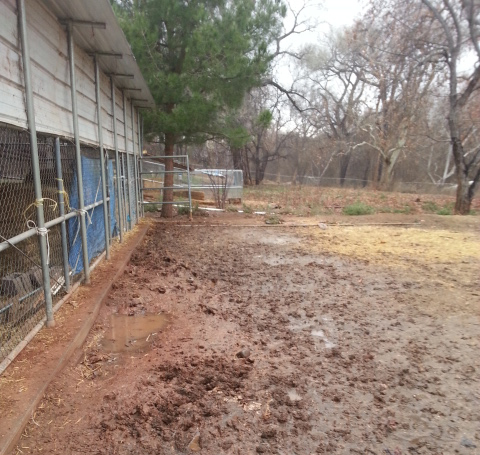 quick-mud–yuck.
First, before I launch into the tale of “Pigs in Heat, Episode 2”, I don’t know about anyone else up here but I’m swimming in a sea of mud. Even the animals are sick of the muck. Bear carefully made his way around the large lake in front of the orchard gate so as not to dirty his paws. The sheep are using the narrow edge of the barn’s concrete foundation to avoid what is an almost quick-mud puddle in front of their pen. That stuff’s particularly sticky. I almost lost a boot to it. Even the pigs have had it with the cold, wet, gooey stuff. And, what about that creek? No more gentle trickle, at least not at the moment. Although it’s nowhere near flooding, until this last week I hadn’t heard the noise of rushing water since last year’s flood, which rerouted most of the flow to the other side of the island. I keep waiting for the other shoe to drop: rain followed by a freeze that will leave me slip-and-sliding down the ramp to the barn early some morning.
Now, to PIGS IN HE-E-EAT!
Twenty-one days. That’s the length of a gilt/sow’s cycle. So, December 31st was exactly 21 days since Boinker went into heat for the first time. (I can hardly believe how quickly the days whizzed by!) The first day of my year was filled with those blood-curdling squeals of hers. She spent all of yesterday locked in the orchard because this time I was ready for her, although sort of by accident.
I love having an insurance agent who is also a farmer. Kelly Cathcart knows practically every farmer in the area, and what they do. So when I mentioned to her that I wanted to breed one of my gilts for piglets without a boar, Kelly knew just who to contact. After juggling our schedules, Diana arrived at the farm on the 30th to take a look at my girls. She took one look at Boinker and said what I already suspected–that my pig was just about to go into heat. Unfortunately for her, Boinker’s timing is off.
You see, in order to do the deed sans male, I need to order semen for overnight delivery on the day before the girl reaches what is referred to in pig-lingo is a “standing heat.” That means if I press on the middle of my girl’s back, she stops everything she’s doing, stands perfectly still and puts her ears back in anticipation of the “great event.” Sort of like dirty dancing without moving.
Yep, just as Diana indicated and I suspected, Boinker hit that moment late on New Year’s Eve while the place that supplies pig semen was closed for the holiday. That’s unfortunate for her but fortunate for Oinker, who will entering her heat on Wednesday. (This is the upside of blogging. I just checked the date of that post and counted to 21.)
Still, I thought I should double-check and asked Diana which pig she’d breed. She immediately pointed to Oinker. What’s not to like about that statuesque gilt with her shapely hams, broad back and well-spaced teats. Diana believes Oinker is at least part Berkshire (good meat!), and breeding her with a full Berkshire boar should make for really pretty black and white piglets. OOOH! No more sunburn!
With that, I was grateful that Carl the Butcher had to cancel our appointment. Earlier in December, I have finally decided I needed a professional to kill and gut my first pig. Between this one and the next one, I need to learn how to shoot. Even before Diana’s comments, I’d been regretting my choice of which girl was to be the mama and which the sausages. Although Oinker is bigger (meatier), she’s sweet-natured and much calmer while Boinker is more aggressive, albeit in a friendly way, as well as skittish. The day I waded out wearing the army surplus poncho a friend gave me poor Boinker practically had a heart attack. She ran forward as if to greet me only to do one of those cartoon leaps–all four feet off the ground while turning a full 180 before returning to earth. Hard to imagine a 130 pound pig doing that, but I’ve learned that pigs are unbelievably agile despite their short legs and big bulk. As Boinker hit the ground, she shouted out “YARP!” Then she repeated the whole maneuver, certain it was me for an instant, then reacting as if it was hooded Death coming for her. And maybe it was.
The more I think about this, the more I like my choice. Boinker was clearly a runty piglet. Will her offspring be small as well? Or worse, will she die because her offspring are too big? Either one is not a good risk. Moreover, Boinker’s heat–the agitation, the pacing, the inability to eat–makes me look at her behavior with a new eye. The calmer the girl, the better the mom, I think. For the record, I’m not using a farrowing cage. If pigs needed those to continue their species, they’d have evolved bars around their hips and shoulders. But then I’m not out to profit from my one pig. I just want a few pig-erators for next year’s pasture turning.
So there it is. Carl will come for Boinker while I’ll be perusing the catalog of boars on Wednesday for delivery on Thursday. Three doses, I’m told, to be stored in my commercial kitchen which I can keep at 60 degrees. There’ll be no romance for poor Oinker, just three doses delivered 12 hours apart. Diana thinks we’ll have no trouble doing what needs doing. I assured her that raisins will keep Oinker happy while one of us (I’m assuming me) straddles her and the other pushes the pipette where it needs to go. That’ll give me the piglets I want three months, three weeks and three days later. (There is something really weird about saying it that way when it’s just 114 days.)
Oh yeah, this is one more thing that was never on my bucket list and now I can’t imagine why it wasn’t. Can you think of anything more fun than splashing around in a sea of mud atop a pig as she’s made pregnant?
Before she left Diana added one very scary note, even more scary than trying to find the right non-spermicidal lubricant. It seems piglets are dangerous. Diana is certain that I’ll instantly fall in love with them because they’re so-o-o CUTE!
Oh bother, Piglets!
December 27, 2016
Dogs and Cats
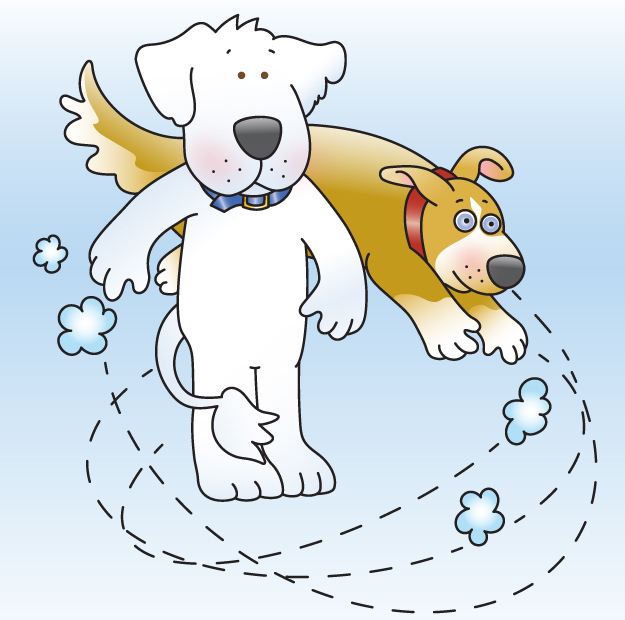 Moosie and Bear
My dogs are about to be famous. Okay, probably not famous-famous, but more famous than they are now. In the next few days their first book will be published. That’s right. The illustrator is finished and my seventeenth book is on its way to publication.
Seventeen books! Hard to believe. It’s even harder to believe that I actually wrote a children’s book. Unlike many authors who have always wanted to write for children, I never have. Now I’ve not only done it once, I’m considering doing it again. Me! I never expected to depart from my usual swords, rats, fleas, blood, gore and plagues, and certainly not for talking dogs and pigs that want to use “P” words because they’re “p-p-p-pigs”.
Then Moosie and Bear happened.
That I fell in love with a couple of dogs is even more astonishing to me than writing a children’s book. I was convinced I was a cat person. Most writers are. Dogs bark while cats are quiet. Dogs always want attention while cats sleep twenty-two hours a day. No need to walk the cat, not when they use a litter box. And cats don’t take up much room on a mattress. (Except for Fat Girl. She’s not allowed to sleep with me since she pushed me out of bed.) Five cats would take up the space that Moosie needs were I to ever allow him to sleep with me. For Bear, I’d need a new bed. Even without me in it, mine’s too small for him.
Maybe it just these particular dogs. They are so bonded to each other that they don’t ask much of me except steady meals and a nightly cookie or two. Moosie rarely barks, only making noise when there’s really something scary out there. Lately, that means Javelina. He hasn’t forgotten the damage that one of those nasty critters did to him. Bear does bark, but not because he expects any reaction out of me. He’s just doing his job, ma’am.
They don’t even ask me to play with them. No sticks or balls or frisbees required for these two. Instead, they stalk each other across the pastures, Moosie waiting until Bear’s almost on him before he explodes into motion, racing away faster than Bear can move; Bear crouching behind a tree waiting to pounce and Moosie pretending he doesn’t see the white bulk sticking out from either side of the trunk. I’ve seen Moosie run up to the pasture berms at full speed (which is impressive–he’s really fast), then launch himself into the air, his feet tucked under him and his eyes shut as he soars for the briefest instant. Bear loves the icy grass and rolls onto his back, all four feet in the air as he rubs his spine into the cold earth. He’s in his winter glory right now, choosing to sleep out in the frosty air instead of joining Moosie in their well-insulated and cozy dog room, which is attached to my kitchen.
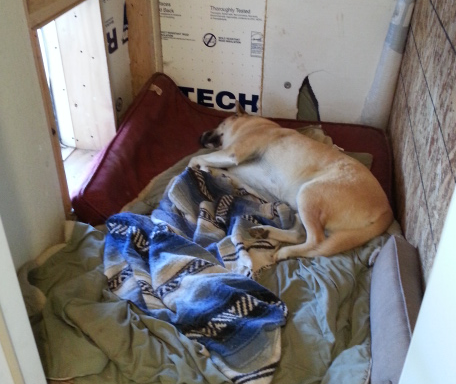 Moosie in the dog house
Perhaps I’ve mistaken them. Maybe they’re cats in disguise. Very large disguises. When Moosie was a pup he followed the cats as they walked the narrow line of the walls that prevent you from tumbling down the hillside into the Mason Ditch. He never considered that walking a wall top was a “cat thing”. When Bear came, Moosie taught his buddy to do the same thing. Now they prefer the wall as their passageway to the far end of the property.
Not that they’ve fully mastered “cat-ness”. Despite his careful study and great effort, Moosie cannot climb trees. And believe me, he has tried. Those pesky squirrels taunt him from the treetops. He scratches, gouges, leaps and clutches as he tries to turn toenails into claws. Bear, being bigger and lazier, or maybe smarter, at least about this, knows better than to even try.
So, I guess I’m going to have to accept that I’m now “Bi”. I can no longer imagine a life that doesn’t have both cats and dogs in it.
At least, these dogs. And maybe not all cats, especially the ones that kick me out of my own bed.
December 20, 2016
The Remains of the Gate
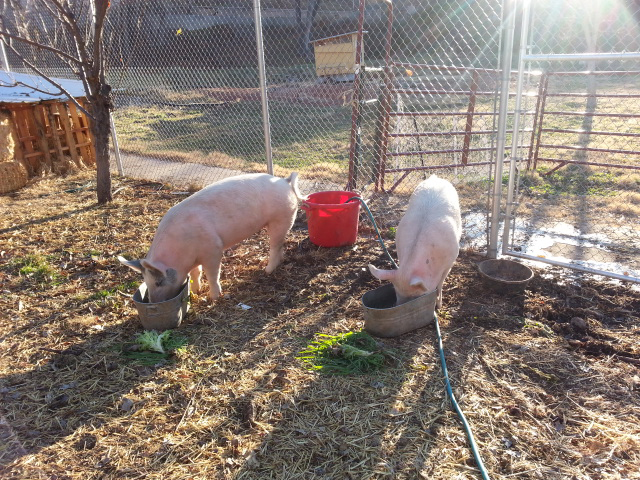 Pigs in the Pokey
So many titles fit this post. Like Pigs in the Pen or Pigs in the Pokey or even Pigs in HE-E-Eat. (Anyone out there remember the Muppets and ‘Pigs in SPA-A-ACE‘?) But, instead of rolling in the muck of what really happened, I went with a more literary bend.
Just as I expected, Oinker followed Boinker into heat last Thursday. And, just as I expected, she did it in her usual understated way. Why make a bunch of noise calling for the non-existent boar when all you really need to do is break down the gate and go on walkabout?
Thank heavens she waited to do the deed until I returned home from a chore run to Sedona. Even fifteen minutes earlier and I wouldn’t have been here to receive my neighbor Kevin’s call.
“Hi Kevin,” I said as I picked up the phone, “what’s up?”
“Your pigs are here,” he replied calmly. Very calmly considering he’s a guy who’s had no experience whatsoever with livestock and isn’t exactly certain he wants to have any experience with critters of size.
“WHAT?!” I shouted in true panic. I have no trailer and nothing that passes for a hog chute or other such hog guidance devices. “I’ll be right there!”
Dropping the phone, I raced to the barn and filled a bucket with my mix of goodies–cracked corn, wheat seeds, barley seeds, oat seeds, peas, black oil sunflower seeds and milo. Although it’s meant for the birds, the piggies love that stuff. Rather than drive the short distance, I jogged through the pastures to the fence that separates our properties. The gate that lets us pass back and forth is about 10 feet wide and made of cheap chain link panels bolted to a far sturdier line of cattle panel fence held in place with t-posts. Back when there was a working tractor on the property, this gate let us drive the tractor onto Kevin’s property when the need arose. The gate had been knocked from its hinges. The only thing holding it in place was the dead electric tape that runs across the top of the fence.
I guess I had been lulled into a false sense of security. The pigs had ignored this gate since I moved them back here to my wild third pasture in September. It probably didn’t help that this cheapo gate had succeeded in keeping my larger, more powerful cows in place. Then again, cows don’t have powerful snouts that easily lift and bend everything but…dare I say it…pig iron. (Sorry.)
Up the hill I jogged. You know, for an old woman I’m in pretty good shape; I wasn’t even panting. Chasing animals is really good exercise.
As I rounded Kevin’s house I found my girls standing in front of a nearly completed shed. They were at their sweetest, making eyes at the contractors and workers surrounding them, one of whom was feeding them what looked like packaged peanut butter crackers. I nearly dropped my now useless bucket of goodies as my girls politely grunted for more. They were never coming home again.
“I need raisins,” I told Kevin when he joined me, “I’ll be right back.”
My girls think that raisins are the bomb. Or they had thought that. Now that they had discovered crackers, all bets were off.
This time I took the high way and walked Page Springs Road to my front gate. I spent the next few minutes filling my bucket with raisins and trying to find what I needed to put together a makeshift hog chute that might get the girls into the back of the pickup. Yeah, right. That’d take a miracle. Then again, bringing this load of junk with me on this trip would save time if I wasn’t able to lure them back onto my property with my newly revised bait and switch gambit.
I returned to Kevin’s place, very grateful that I now own a truck. At their present size, one of my hogs would have needed to drive the Focus home while the other rode in the back. By the time I reached that shed, it was clear that the crackers were gone. The girls had moved on to Kevin’s vineyard. Thank heavens my pigs weren’t interested in eating the things that supply them with raisins!
Only then did I notice there’s nothing between Kevin’s property and the ranch next door except a pretty white plank fence. Oh no! The bottom plank of that fence was high enough that the pigs could easily duck under it. On the other side was almost an acre of carefully mowed lush green grass. A true pig magnet! If they made it under that fence, they’d be gone for, well, forever. I know the cows eventually come home (around twilight), but I have no clue if pigs do the same.
As I hurried up and down the lines of vines, Kevin gamely walked ahead of the pigs, doing his best to deter the girls from the fence line. I reached Oinker first and stuck the bucket of raisins under her nose. Her eyes lit up. She grunted her ‘thank you’–I mean, seriously, how much better could the day get? First crackers, now raisins!–and stuck her snout into the sweet, sticky clumps of fruit. I pulled the bucket out from under her nose and walked backward a few steps. She eyed me for moment, then sighed as if to say ‘Have it your way’ and turned back to the much more interesting fence behind Kevin.
I went for Boinker. She didn’t even bother looking at the raisins. All she wanted was that beautiful green grass. Yep, she had a snout and she was going do a little sod bustin’.
Crap! This called for the nuclear solution.
Just as I’d done four years ago when Brighty, my sweet Jersey girl, had made herself at home in this very same vineyard, I grabbed a nice thin branch from the ground and took after my girls. Much to my surprise, they both reacted positively to the switch, i.e. they turned toward home. God be praised!
Holding tight to my bucket of raisins, I drove them swat by swat out of the vineyard, down the hill, across the bridge over the Mason ditch and through the unused pasture on Kevin’s side of the fence. Kevin followed, shifting back and forth to deter either girl from turning around. By now my forty-remaining turkeys had come down to see what was going on. The sheep followed, watching the commotion from a safe distance.
Oinker recognized home and immediately went through the broken gate. Boinker was a little more resistant but, once again, greed won out. I showed her the raisins then went inside and gave them to Oinker. Boinker was inside in an instant.
It wasn’t until I turned around to close the gate behind them that I realized there was no way to do that. This thing needed some serious repairs. Double crap!
Leaving Kevin to hold the gate shut, I dashed to the turkey barn for–you guessed it–baling twine to sew the bits and pieces back together as quickly and best as I could. Patches in place, I raced back to the house for help. Another heaven-sent thank you is due here, because Derek just happened to be at home for the morning, entertaining his almost two-year-old son.
As Derek and little Jasper, now riding high on his daddy’s back, went to collect the needed tools, I grabbed the t-post driver and made my way back to the gate. The gate was where I’d left it, but the remaining whole panel now hung crookedly in a new opening. Meanwhile, the girls were making their way back towards those crackers.
Out came that switch. Back the pigs went onto my property. Tom greeted them, huffing and gobbling as he scolded them for leaving the safety of his watch.
While I was herding pigs, Derek had taken an old t-post from the turkey barn and driven it into the ground next to the bent frame to hold it in place. I gathered more baling twine and lashed the other panel back to vertical. As I sewed, he went for more fence clamps. And where were the girls? Why, laying next to me on the ground, watching as I locked them out of the new world they had so enjoyed. Every so often the tip of a snout would dip to touch my fingers and a sad grunt would follow.
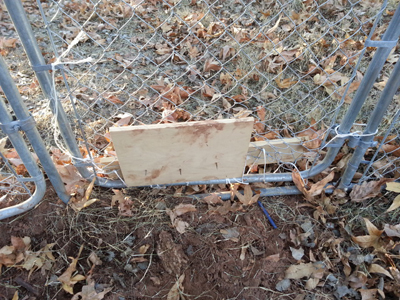 Tear that up! Just try it!
Derek returned with clamps and a bunch of scrap wood and screws. As he’d done in the pigs’ smaller pen, he sandwiched the chain link between the wood and screwed it so the pointy ends of the screws faced the destructive forces determined to remove them. Each time the drill ran the pigs would snort and little Jasper would giggle. Oh yeah, it was almost starting to be funny.
By then, it was time for Derek to go to work. As he and Jasper departed, I was now praying this fix would last long enough for me to rustle up more t-posts and proper fencing wire from the front barn. So, after bungee’ing the gate shut, I told the girls to “stay” and rushed back across the almost two acres of the pastures.
Sure enough, by the time I returned with everything I needed, the girls had once more done their work. The bent panel was in place, but now the whole one hung horizontally from its clamps. Luckily, Kevin and Mike, the Mason ditch boss, had already identified the escape artists and were driving my pigs back toward the gate. One more time, my critters were returned home against their will and, one more time, I embarked on repairs.
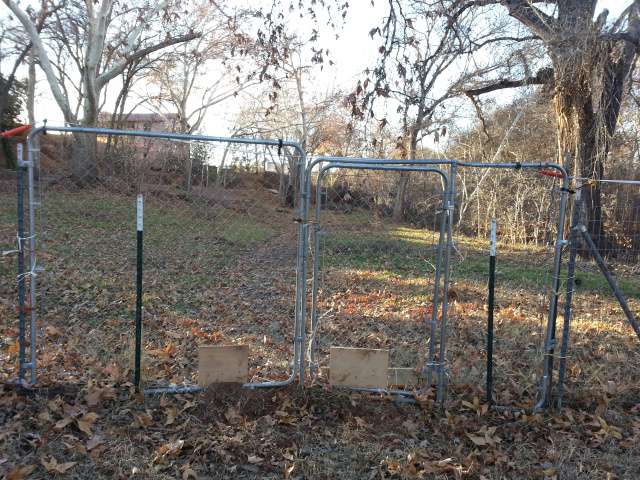 So far, so good…of course the pigs aren’t free ranging any more
But this time I had them. Driving t-posts into the ground on either side of both gate panels, I wired the chain link to the sturdy steel posts. Two sets of chains now hold the gate closed and baling twine keeps the properly set hinges melded in place. New fence clamps have been installed to pin the cheap chain link panels tight to the far stronger cow panels on either side.
Then, because despite all I’d done I wasn’t certain they still couldn’t take it all down, I locked the girls into the orchard. That fence is built of “real” chain link, the expensive stuff, and the posts are set in concrete.
Give it your best shot, girls! While you’re at it, turn the rest of the dirt in there so when spring comes I’ll be ready to plant. By then, I’ll be building all new fences and gates so I’ll be ready for the next episode of “Pigs in HE-E-Eat!”
December 13, 2016
Beef-and-Cheese Foldover
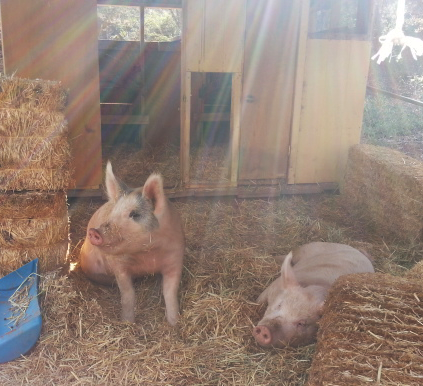 She’s normal again, or as normal as she gets
So before I throw myself into another recipe, I need to make a porcine update. The day when I have one piggy instead of two is drawing rapidly closer, but I really thought I was going be short a pig two days ago. That morning I was drawn to the door by a strange squeaking sound. When I looked out, I discovered that Boinker, the smaller, bolder of my two girls and the one I’ve agreed to breed rather than eat, was squealing like I was gutting her alive. From the porch I watched as she paced back and forth across the pasture. Meanwhile Oinker was dozing in the sun in what seemed complete unconcern for her sister-sow. Boinker tried to lay down with OInker, but almost immediately hopped up and started pacing again, squealing all the while.
Worried that she was hurt, I rushed down to look her over. It was a long walk because by then she’d paced to the far end of the property. Much to my surprise, when I joined her she looked up at me with the same “Oh, there you are! I was just wondering where you were” look she always gives me. There was no sign of physical injury. I gave her a good scratch, then the moment I turned to leave, she started squalling again.
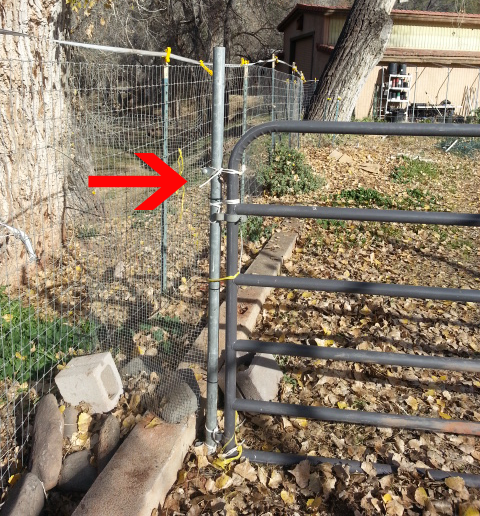 Baling twine to the rescue again!
That left me wondering if she’d eaten something she shouldn’t have, like poison ivy root. Or perhaps she’d swallowed something that had splintered or otherwise got caught in her gut. I made a panicked call to a friend with more hog experience. He showed up later in the day. By then, the still-squealing Boinker had broken through three gates. We found her eating my precious spinach up by the pump house. She looked at us, no sign of distress in her eyes, swallowed her mouthful of spinach, then began that high-pitched squealing again. That’s when the dogs solved the mystery by doing something really gross that doesn’t bear describing.
“Oh,” says I, “I think she’s in heat.” At which point my friend replied, “I didn’t even know pigs went into heat.” Apparently at least one of them does. And just as I expected, Boinker is once again her usual quiet but piss-and-vinegar self. Holy Toledo, is she going to be doing this next month? If so, then I need new gates. No, I need a boar, now! Please Santa, get her pregnant and save my farm!
Now, onto the recipe portion of our program.
Back when I was a teenager (oh so many decades ago), my grandmother made me a present of a cookbook that had been put together by the elderly women of her church’s congregation. If I remember rightly, the congregation of that particular church was pretty much nothing but elderly women, most of them of Scandinavian extraction. (I totally get Lake Woe-be-gone.)
I immediately fell in love with the Highlands Lutheran Church Fifteenth Anniversary Cookbook. There were recipes in that spiral-bound tome I could never have dreamed up (or would have wanted to dream up) as well as recipes that made me giggle, because even at 17 I recognized what was missing. Take the first recipe for yeast bread in the “Breads” section, which includes these instructions:
“In mixing bowl, dissolve yeast in water; add shortening, salt, sugar and half flour. Beat well about 2 min. Put in the rest of the flour, then put dough on a greased pan, 9 x 5 x 3. Bake at 350 degrees for 40 min. and at 375 degrees for 5 min. more. This makes very good buns and rolls too.”
If you didn’t notice the missing steps, I’ve laid them out for you. Right after “Put in the rest of the flour” add “Knead dough until smooth and elastic. Round and place in greased bowl. Let rise until double, punch down; form into a loaf, let rise again”. Whoops. I still smile thinking about what that bread might look like if someone followed the directions exactly.
During the holiday season I return to the pages of this cookbook for the few items I can’t live without, like my Grandmother Leona’s recipes for Jule Kage and Fattigman Bakels. But the one recipe that made this cookbook a keeper is the ever-so-easy recipe for rolls which the author, one Selma Eaton (Mrs. Paul), calls Speedy Rolls. Need to add homemade rolls to your holiday table? This is the recipe for you:
1 pkg yeast (1 tbsp dry active yeast)
1 cup lukewarm water
3 tbsp sugar
1 tsp salt
6 tbsp olive oil
3 cups of flour
Sprinkle yeast over water and let soften for a few minutes; add sugar, oil and salt. Mix well. Stir in flour 1 cup at a time until dough forms. Turn onto floured board and knead 1 minute. Place in a buttered bowl, cover and let rise until double (about 2 hours). Punch down, roll to 1/2″ thick, cut out your rolls. Space rolls evenly on a greased or parchment paper-lined baking sheet. Cover and let rise to double again (about 45 minutes). Bake at 400 degrees for 12- 15 minutes.
Over the years I’ve altered this recipe in all sorts of ways–adding scaled milk instead of water, melted butter instead of oil and skipping the sugar completely. (Never skip the salt in bread–yuck.) But Beef and Cheese Foldover is the best thing I’ve ever used this recipe for, or so my kids claimed. I mean, what’s not to love about fresh, warm bread baked around a filling of barbecue-flavored ground beef topped with cheese?
Beef and Cheese Foldover
1 pd ground beef or turkey or tofu (yes, I’ve made this with crumbled tofu)
2 cloves garlic
1/2 large onion, chopped
1 red bell pepper, chopped
1/2 to 1 cup prepared Barbecue sauce
salt and pepper to taste
enough arugula leaves to cover the meat when spread on the dough (optional)
4 to 6 ounces block cheese (Cheddar, Monterey jack or Gouda), sliced thin
1 recipe of Speedy Rolls, raised twice, then rolled 1/2″ thick and laid out on a greased or parchment paper-covered cookie sheet. The dough should be as long as the cookie sheet while overlapping the sides a bit.
Heat over to 350 degrees. Brown meat, garlic, onion and peppers in a large saute pan. When cooked through add barbecue sauce, salt and pepper to taste. Spread the meat mixture down the center of the dough. Leave enough dough open on either side so it will cover the filling completely. Layer the arugula on the meat mixture, then top with the cheese. Fold the dough over the filling, long sides first, then the ends. Using wet fingers, soften the edges of the dough so the seams are “glued” shut (flour and water is paste, you know). Bake 20 minutes. Remove from oven and slide carefully off the sheet onto a board or dish towel-covered counter top to cool. You can serve this warm or cold or even reheat it. That makes this an easy dish to take to potlucks, especially if that potluck is in Phoenix.
And that potluck is why this post is being written on Tuesday instead of Monday.
December 6, 2016
Butchery
Butcher n. 1 a person who slaughters or dresses meat 2 a person who mangles, ruins or bungles something…
Toby, my Dorper sheep (technically a wether, or castrated male) went the way of the Thanksgiving turkeys unexpectedly this Saturday. Unexpectedly, not because slaughtering him hadn’t been on my to-do list, but because I guess I hadn’t truly convinced myself that I was really going to do the dirty deed.
I may not have convinced myself, but I had apparently set the intention. You don’t fool with intentions. Nor do you forget that speaking an intention is as powerful as setting one. That’s what I did when when I began to ask around after someone willing to teach me how to slaughter Toby.
Funny how many local small farmers and homesteader-types I’ve met since I moved up here to farm six years ago. Or maybe not. Those who have the same passion I do about nurturing life from the soil, whether through produce or livestock, are hungry to connect to others inflicted with the same insanity. What we’re most hungry for, though, is the knowledge we don’t have and needed to know YESTERDAY.
Although a number of the folks in my new tribe suggested a local butcher, that wasn’t really what I wanted. I’m not sure how it happened but I’m haunted by a strange sense of responsibility for the animals I raise. I feel that if I intend to eat them, then I need to be the one who takes their lives. It’s not a path for everyone, nor do I expect it to be, but it is my path.
That said, I wasn’t as committed to butchering the animal after the fact. It was a case of knowing exactly what I didn’t know. I’ve cut up two-legged critters for forty years because it’s cheaper to buy a whole chicken and cut it into pieces. But, until yesterday, I knew exactly nothing about cutting up four-legged critters.
Despite my uncertainty, I almost instantly made the right connection (thereby forcing the issue–see above about setting intentions). Of course, it turned out I already knew the person recommended to me. I’d met Deidre a few years ago when I was still milking. Come to find out, she not only keeps goats but slaughters when necessary.
Still, I didn’t make the call right away. Like the turkeys, a sheep carcass needs to hang before being turned into meat, up to five days it turns out. Hanging the meat wasn’t the issue. Sam Frey, the guy who used to own this house, had installed a hoist in the barn, no doubt to remove car engines. What I needed was for my barn to become a giant refrigerator and that requires the one thing that wasn’t happening: cold weather. Seriously?! How could it still be over 60 degrees on Thanksgiving?
The day the temperature didn’t go above 45 was the day I made the call. Deidre and I played phone tag (a result of my refusal to carry my cell phone with me at all times) for a while, then connected last Saturday, which, of course, was a balmy 60 degrees. Certain the “heat wave” would break by mid-week, we set the date for this coming Thursday and hung up.
About 10 minutes later, Deidre called back. “What about today? I’m off and have the time. The weather’s a little warm, but it will cold enough tonight for the carcass.”
I drew a quick breath in trepidation. Here it was–push come to shove. Was I really committed to this? Could I really kill something that I’d named and whose chin I’d scratched? Well, I sure couldn’t just keep him as a pet.
“Okay,” I said before I could change my mind.
Since she lives just down the road, she was here in a few minutes. We lured Toby into the orchard with “the bucket”. It doesn’t matter if the bucket is empty–once seen, it’s a magnet that draws every animal on the farm. From there, we used the dog leashes to bring him into the barn.
Warning: graphic description follows. If you’re someone who believes your meat grows from seeds placed on styrofoam platters in the back of the supermarket butcher shop, skip this part.
Butcher n. 1 a person who slaughters or dresses meat.
Oddly enough, neither of us were comfortable with the idea of shooting him. Deidre said that the last few goats she and her husband had tried to shoot hadn’t died as expected and the result had been spiritually taxing. As for me, despite my recent success with the .22, I have no confidence that I can actually hit anything even at point blank range. That left us with no option but the one we were both most comfortable with–the biblical way; Deidre slit his throat.
Death is a taboo in our culture and that’s a terrible shame. After all, death is the one thing that every one of us is guaranteed to experience and turning away from it doesn’t change that fact.
Once Toby was gone, we raised him on the hoist using Deidre’s gambrel. I was surprised at how little time it took to remove his pelt. Okay, not as fast as my plucker, but no longer than 10 minutes. I wasn’t quite as surprised as Deidre by the amount of fat we removed from him. That’s because last week I discovered that the sheep had been tag teaming my piggies–two to distract while one dodged in to grab bites of pig food, I think they were getting more pig food than the pigs. I’m still rendering fat today. Lamb fat makes really great fried potatoes, by the way.
Then it was time to remove his innards. Again, I was surprised by how easy it was. Yes, turkeys are smaller, but in this case bigger is easier. After cutting him open, we gently guided his insides into a big metal garbage can, saving his heart for the dogs, his lungs for the pigs and the liver for me. His kidneys were lost in the fat; I found them later.
That was pretty much it. I thanked Deidre, who didn’t want to be paid but will get Toby’s neck as it’s her husband’s favorite piece. Toby’s head, pelt and innards are presently buried under a deep layer of rotting wood and compost that will play host to new fruit trees next year. Meanwhile, I wrapped his carcass in cheesecloth and left it hanging in the barn, which (thank you God!) maintained a temperature of about 42 degrees…
Butcher n. 2 a person who mangles, ruins or bungles something.
…until I noticed the weather report Monday morning. WHAT?!! No way could it actually reach 65 degrees on the afternoon of December 5th! So much for my cool barn.
That left me no choice. Ready or not, I was going to have to make meat out of that carcass immediately. A while back a friend gave me a book about slaughtering and butchering livestock and game. Armed with that, I brought the carcass up to the commercial kitchen. Deidre’s husband had suggested a sawsall for cutting through bones, so I added that to my knife selection. With my eyes on the illustrations in the book, I started cutting while my renter Derek ran to the store to buy what I called butcher’s paper and is actually called “freezer” paper (sorry, Derek) as well as vacuum seal bags. I ended up opting for the vacuum bags.
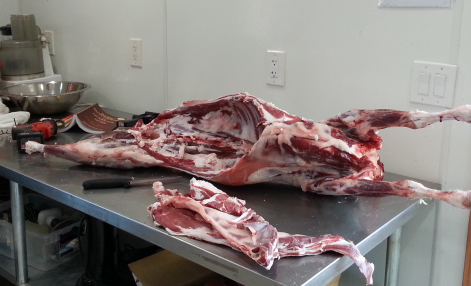 Oh, I so wasn’t ready. First, although I’ve eaten lamb over the years, the only parts I’ve chosen have been shoulder chops, lamb chops and de-boned leg of lamb. I knew where those where, but what the heck is the rest of this stuff and what do I do with it? I so needed someone who could name the parts, touch the carcass exactly where I needed to cut and tell me what to do with it after I’d cut it off.
No, what I really needed was a butcher’s saw. The sawsall just didn’t cut it (sorry, couldn’t resist), most likely because of operator failure.
About an hour into the chore, I gave up on the book and went to Youtube. What I found was a Brit butcher who took apart a whole lamb carcass in 30 minutes. Yeah, right. It took me almost 8 hours to accomplish the same thing. Along the way I think I mangled as much as I cut. I took heart from the Brit, who assured me that I could use the mashed bits for curries and lamb stew or even grind it for Shepherd’s Pie. For the record, Shepherd’s Pie is made with lamb while Cottage Pie is made with ground beef.
Around 3:30, just before it was time to put critters to bed, I had finished everything except for a chunk of almost meatless rib bones still attached to the spine. I looked at the sawsall and knew I couldn’t wrap my now-aching hand around it one more time. That left one option: Bone Broth!
With no time to fuss, I threw the whole thing into the crockpot at high to brown the bones a little, then added a half gallon of water and the half an onion I’d left on the cutting board from lunch. No salt, no pepper, no greens, just half an onion and water. Two hours later, the critters were locked away, the commercial kitchen was clean and I was starving. By then, the smell of cooking lamb had filled the house. Curious, I opened the crockpot and cut off a bit of the thin, fatty meat that clung to a bone.
OH MY GOSH! I swear, it was the most amazing thing I’ve ever eaten! For the next ten minutes I stood over the crockpot scavenging every last morsel from those bones. That made all my work, however poorly done, worth it. My goal had been that no scrap of Toby would be wasted, whether as compost, dog food and bones, meaty fat for the pigs or something I would eat.
Before too long, I’m going to have to do it all again when the time comes to take one of my porcine girls. I’ll be ready by then. I’m already studying the Brit’s video in which he does half a hog in twenty minutes. Hmm, I should be able to handle it in about 6 hours for sure.
But before I do that, I’m buying a butcher’s saw.
November 28, 2016
Another Soup Day
I was hoping for snow last night, but that didn’t happen. Probably just as well since the turkeys really dislike snow. They walk through it like one of those fancy show horses, lifting one foot high, pausing then lowering the slightly warmer foot to raise the cold one. A few years back we had that 3 inches or so of snow that stayed on the ground for almost a week. By day three the turkeys had simply given up and retreated to their barn to wait it out.
But snow or not, today is definitely a soup day. Which one, which one?
The nice part is that I now have quarts and quarts of turkey broth to use for the base. I did thirty birds the week before Thanksgiving. Why thirty? Because it turns out that thirty is the number of birds my commercial refrigerator will hold, and since the birds must rest for 3 days before they’re edible, thirty was the number I did. That leaves me with another twenty-seven to do to bring the flock down to ten hens and my two toms. I’m hoping next year TommyTwo is able to step up to the plate, as it were, and take over for Tom. But if he doesn’t or Tom won’t let him, then I don’t want to have twenty hens eating up my expensive organic feed and not giving me babies in return.
All this is a thought for later, since those turkey girls won’t even be considering nests and eggs until next April…which brings me back to my looming dinner menu and the soup of the day. Black Bean Soup is what I want. With freshly baked sourdough rolls, which I will have by five o’clock, and a bit of goat yogurt my dinner will be grand, indeed.
I’ve fallen in love with black beans and their rich smoky taste. I don’t even bother adding broth. If I want something really healthy, I add onions, peppers, including one cayenne pepper for sparkle, and arugula. If you don’t remember, I have encouraged arugula to grow wherever it wants on my property, hence it shows up often in my recipes. It’s a great green with a wonderful nutty, peppery flavor and an ANDI (Aggregate Nutrient Density Index) score of 604, right under spinach. Like spinach, arugula contains high levels of oxalic acid and some folks suggest it’s better eaten cooked than raw. Me, I’m more concerned about making sure I don’t accidentally bring in a few cottonwood leaves in my arugula bunches. Ultimately, it doesn’t matter–even cooked arugula it holds onto its great taste.
But what about the embarrassing side effect of eating beans, you might ask? Well, interestingly enough there are some easy home remedies to address that issue. First and foremost, make your bean soup from scratch, starting with dried beans instead of canned. The long soaking period helps to break down some of the good-for-you fiber that causes the issue in the first place. After that, consider adding a teaspoon of ground coriander or fennel to your bean dish. Both will help prevent flatulence. The fennel will add a hint of licorice while the flavor of coriander, being cilantro seed, melds well with the beans. If you don’t have the seeds, try peppermint tea or even chamomile. Or just go the ignorance route and act as outraged as everyone else when the issue issues.
When it comes to soaking and cooking beans, I say there’s no easier way to do it than in a crock pot, although others might argue for a pressure cooker. I have never used a pressure cooker, so I can’t speak to that. Those of you who have, please feel free to leave your comments and suggestions.
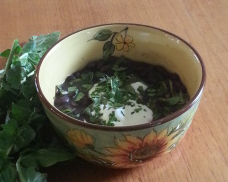 Black Bean Soup with Arugula
Measure out a pound of beans and sort them. As much as I hate this step, I always do it. There was one tiny stone in the pound I soaked last night, but, you know, if I’d missed it, I would have surely broken a tooth on it. Put the picked-over beans into the crock pot, add 6 cups of water and 2 teaspoons of Celtic Sea Salt (or other unrefined, mineral dense salt) and let soak overnight. The next morning drain off the water, rinse the beans then return them to the crock pot with 6 cups of fresh water and a teaspoon of salt, turn the pot on low and cook until the beans are soft. Black beans happen to cook very quickly–about 1.5 hours at the crock pot’s low setting. Back in the day, before I worked for myself and from home, I had my crock pot plugged into a timer. This made sure everything was finished by the time I got home and nothing was ever overcooked. So easy!
So, here is the Soup of the Day: Denise’s Super Simple Black Bean Soup
1 pound black beans, soaked overnight, drained and returned to the crock pot
6 cups water
1 tsp salt
1/2 large onion roughly chopped
Soak/drain/rinse beans as described above. Add the onion. Cook for an hour and a half. Eat as is. Seriously. I love them this way, but this isn’t always how I make them. So here’s the fussier, better-for-you recipe.
Black Bean Soup with Arugula
1 pound black beans, soaked overnight, drained and returned to the crock pot
6 cups water
1 tsp salt (or more to taste)
1/2 large onion roughly chopped
1 red Bell pepper, roughly chopped
2 cloves garlic, whole
1 dried cayenne pepper (optional–I grew them this year, now I have to use them)
2 oz arugula, roughly chopped (This is how much a good-sized handful weighs; it’s basically half a bunch of arugula.)
1 tsp ground coriander
dollop of goat yogurt, if desired
cilantro to make it pretty (because, like the cayenne, it’s in the garden and I have to use it)
Soak/drain/rinse the beans as described above. Add the water, salt, onion, peppers, garlic plus the ground coriander if you wish. Cook until the beans are tender, about an hour and a half. Add the chopped arugula, Continue cooking until that huge pile of arugula disappears into the beans, about 15 minutes with the crock pot set at high. Ladle into bowls and top with a dollop of goat yogurt sprinkled with chopped cilantro.
By the way, if you’re wondering why I use goat yogurt, there are two reasons. First, I always have goat yogurt in the house as the my porcine girls each get a pint of yogurt a day for their gut health. Second, raw goat milk makes a wonderful, tangy, probiotic-filled yogurt that, hands down, outshines any commercially made sour cream on the market. Moreover, it tends not to curdle when stirred into hot ingredients. Trust me. Try it on a baked potato once and you’ll never go back.
November 23, 2016
Happy Thanksgiving
‘Twas the eve before Thanksgiving and all across the farm
the last turkeys roosted, certain they were safe from all harm.
The chimney was clean, swept out with all care
now that the farmer was certain winter soon would be here;
The pigs were both nestled all snug in their sty
while the farmer cherished thoughts of lots of bacon to fry;
Then out on the bridge there arose such a clatter,
that the farmer leapt up to see what was the matter.
Away to the window she flew like a flash,
Tossed back the curtains and threw open the sash.
But what to her tired eyes did she spy? (Although what was there gave her no reason to wonder.)
All three sheep, escaped to a garden to find lettuce to plunder.
More rapid than eagles these hooligans they came, so she whistled, and shouted, and called her dogs by their names:
“Now, Moosie, please stop them. Come, Bear. You can move faster,
or did you forget once again I am your master?”
From the porch to the wall the dogs they did bolt,
to chase those sheep to the field but not to their fold.
So down from the house the farmer she came,
To the barn, for the bucket and the lure of some grain.
She entered the barn in one easy bound,
dressed in old jeans, her tall boots making a clip-clopping sound.
Her clothes were all tarnished with turkey…never mind…
and she shivered because not even a sweater could she find.
“Where is my coat this time?” she cried as she drew up a scoop.
“What an idiot, a dolt. No just an old poop!”
Then she laughed, and her eyes—how they twinkled!
Her cheeks were like roses despite they were wrinkled.
Singing again, she went straight to her work,
filled the bucket with grain then turned with a jerk,
to trip over the hose that she’d left out in the rain
and pinch her hand on that stupid latch once again.
With her dogs at her heels, she locked up the sheep,
then one more time checked her birds and her pigs, now asleep.
Then giving a nod, back to her house and her fire she did fly,
crying “I’m done for the night,” even though this was a lie.
“I do love my life,” she said to fire. “I give thanks every day, that really is true.
But what I most grateful for is..” All of you!
To all my readers, Happy Thanksgiving from The Farm on Oak Creek