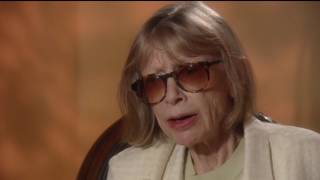
Joan Didion
Born
in Sacramento, California, The United States
December 05, 1934
Died
December 23, 2021
Website
Genre
Influences
Ernest Hemingway, George Eliot, Henry James
|
The Year of Magical Thinking
—
published
2005
—
176 editions
|
|
|
Play It As It Lays
—
published
1970
—
4 editions
|
|
|
Slouching Towards Bethlehem
—
published
1968
—
87 editions
|
|
|
The White Album
—
published
1979
—
14 editions
|
|
|
Blue Nights
—
published
2011
—
8 editions
|
|
|
Let Me Tell You What I Mean
—
published
2021
—
32 editions
|
|
|
South and West: From a Notebook
by
—
published
2017
—
12 editions
|
|
|
A Book of Common Prayer
—
published
1977
—
78 editions
|
|
|
Where I Was From
—
published
2003
—
6 editions
|
|
|
Run River
—
published
1963
—
13 editions
|
|
Related News
Need another excuse to treat yourself to a new book this week? We've got you covered with the buzziest new releases of the day, according to early...
53 likes · 0 comments
Need another excuse to treat yourself to a new book this week? We've got you covered with the buzziest new releases of the day, according to early...
57 likes · 0 comments
Good news, bookworms! Our annual Big Books of Spring collection returns for 2025 with a particularly good lineup of incoming titles....
284 likes · 89 comments
“I think we are well advised to keep on nodding terms with the people we used to be, whether we find them attractive company or not. Otherwise they turn up unannounced and surprise us, come hammering on the mind's door at 4 a.m. of a bad night and demand to know who deserted them, who betrayed them, who is going to make amends.”
― Slouching Towards Bethlehem
Polls
Which non-fiction book should we read for 4Q22?
The Comfort Book
Matt Haig
“It is a strange paradox, that many of the clearest, most comforting life lessons are learnt while we are at our lowest. But then we never think about food more than when we are hungry and we never think about life rafts more than when we are thrown overboard.”
The Comfort Book is Haig’s life raft: it’s a collection of notes, lists, and stories written over a span of several years that originally served as gentle reminders to Haig’s future self that things are not always as dark as they may seem. Incorporating a diverse array of sources from across the world, history, science, and his own experiences, Haig offers warmth and reassurance, reminding us to slow down and appreciate the beauty and unpredictability of existence.
Matt Haig
“It is a strange paradox, that many of the clearest, most comforting life lessons are learnt while we are at our lowest. But then we never think about food more than when we are hungry and we never think about life rafts more than when we are thrown overboard.”
The Comfort Book is Haig’s life raft: it’s a collection of notes, lists, and stories written over a span of several years that originally served as gentle reminders to Haig’s future self that things are not always as dark as they may seem. Incorporating a diverse array of sources from across the world, history, science, and his own experiences, Haig offers warmth and reassurance, reminding us to slow down and appreciate the beauty and unpredictability of existence.
Blue Nights
Joan Didion
From one of our most powerful writers, a work of stunning frankness about losing a daughter. Richly textured with bits of her own childhood and married life with her husband, John Gregory Dunne, and daughter, Quintana Roo, this book by Joan Didion examines her thoughts, fears, and doubts regarding having children, illness, and growing old.
Blue Nights opens on July 26, 2010, as Didion thinks back to Quintana’s wedding in New York seven years before. Today would be her wedding anniversary. This fact triggers vivid snapshots of Quintana’s childhood—in Malibu, in Brentwood, at school in Holmby Hills. Reflecting on her daughter but also on her role as a parent, Didion asks the candid questions any parent might about how she feels she failed either because cues were not taken or perhaps displaced. “How could I have missed what was clearly there to be seen?” Finally, perhaps we all remain unknown to each other. Seamlessly woven in are incidents Didion sees as underscoring her own age, something she finds hard to acknowledge, much less accept.
Blue Nights—the long, light evening hours that signal the summer solstice, “the opposite of the dying of the brightness, but also its warning”—like The Year of Magical Thinking before it, is an iconic book of incisive and electric honesty, haunting and profoundly moving.
Joan Didion
From one of our most powerful writers, a work of stunning frankness about losing a daughter. Richly textured with bits of her own childhood and married life with her husband, John Gregory Dunne, and daughter, Quintana Roo, this book by Joan Didion examines her thoughts, fears, and doubts regarding having children, illness, and growing old.
Blue Nights opens on July 26, 2010, as Didion thinks back to Quintana’s wedding in New York seven years before. Today would be her wedding anniversary. This fact triggers vivid snapshots of Quintana’s childhood—in Malibu, in Brentwood, at school in Holmby Hills. Reflecting on her daughter but also on her role as a parent, Didion asks the candid questions any parent might about how she feels she failed either because cues were not taken or perhaps displaced. “How could I have missed what was clearly there to be seen?” Finally, perhaps we all remain unknown to each other. Seamlessly woven in are incidents Didion sees as underscoring her own age, something she finds hard to acknowledge, much less accept.
Blue Nights—the long, light evening hours that signal the summer solstice, “the opposite of the dying of the brightness, but also its warning”—like The Year of Magical Thinking before it, is an iconic book of incisive and electric honesty, haunting and profoundly moving.
The Desperate Hours: One Hospital's Fight to Save a City on the Pandemic's Front Lines
Marie Brenner
A remarkable depiction of a city in crisis – based on new, behind-the-scenes reporting – that captures the resilience, peril, and compassion of the early days of the Covid pandemic
In the spring of 2020, COVID-19 arrived in New York City.
Before long, America’s largest metropolis was at war against a virus that mercilessly swept through its five boroughs. It became apparent that if Covid wasn’t somehow halted, the death count in New York alone would be in the hundreds of thousands. And if New York’s hospitals failed, what chance did the rest of the country have?
In The Desperate Hours, award-winning journalist Marie Brenner, having been granted unprecedented 18-month access to the entire New York-Presbyterian hospital system, tells the story of the doctors, nurses, residents, researchers, and suppliers who tried to save lives across Manhattan, Queens, and Brooklyn and the northern periphery of the city. Drawing on more than 200 interviews, Brenner takes us inside secure ICU units, sealed operating rooms, locked executive suites, unknown basement workshops, and makeshift clinics to provide extraordinary witness to the war as it was waged on the front line. But The Desperate Hours is more than a thrilling account of medicine under extreme pressure. It is an intimate portrait of courageous men and women coming together in their devotion to duty, their families, each other, and the city they loved more than any other.
Marie Brenner
A remarkable depiction of a city in crisis – based on new, behind-the-scenes reporting – that captures the resilience, peril, and compassion of the early days of the Covid pandemic
In the spring of 2020, COVID-19 arrived in New York City.
Before long, America’s largest metropolis was at war against a virus that mercilessly swept through its five boroughs. It became apparent that if Covid wasn’t somehow halted, the death count in New York alone would be in the hundreds of thousands. And if New York’s hospitals failed, what chance did the rest of the country have?
In The Desperate Hours, award-winning journalist Marie Brenner, having been granted unprecedented 18-month access to the entire New York-Presbyterian hospital system, tells the story of the doctors, nurses, residents, researchers, and suppliers who tried to save lives across Manhattan, Queens, and Brooklyn and the northern periphery of the city. Drawing on more than 200 interviews, Brenner takes us inside secure ICU units, sealed operating rooms, locked executive suites, unknown basement workshops, and makeshift clinics to provide extraordinary witness to the war as it was waged on the front line. But The Desperate Hours is more than a thrilling account of medicine under extreme pressure. It is an intimate portrait of courageous men and women coming together in their devotion to duty, their families, each other, and the city they loved more than any other.
48 total votes
Topics Mentioning This Author
| topics | posts | views | last activity | |
|---|---|---|---|---|
| Challenge: 50 Books: Melanie's List. | 7 | 229 | Feb 11, 2008 06:19PM | |
| The Seasonal Read...: By Blood or Marriage (25.2) | 41 | 412 | Aug 24, 2009 02:23PM | |
| Challenge: 50 Books: Barb's 50 books for 2009 | 80 | 813 | Dec 31, 2009 06:37AM | |
The Seasonal Read...:
WINTER CHALLENGE 2009-2010 COMPLETED TASKS
|
3143 | 3264 | Feb 28, 2010 09:02PM | |
The Seasonal Read...:
30.5 (PJ Reads' Task - As Suggested By Tanja - Six Degrees of Separation)
|
347 | 422 | May 26, 2010 07:44AM | |
The Seasonal Read...:
Fall Challenge 2010 Completed Tasks (do NOT delete any posts in this thread)
|
2785 | 1208 | Nov 30, 2010 09:03PM |