
Christine Valters Paintner's Blog, page 58
February 13, 2021
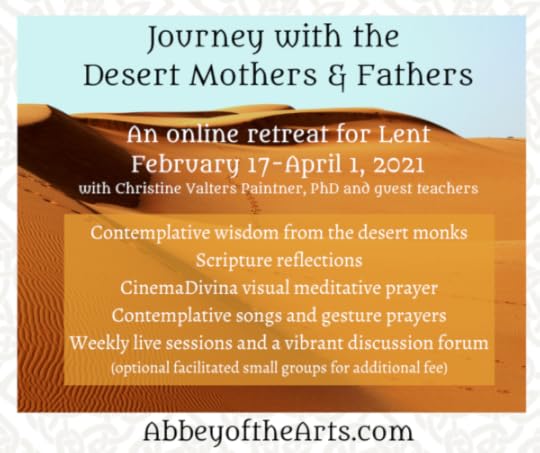
Join us on a Desert Journey for Lent ~ A Love Note from Your Online Abbess
 Dearest monks and artists,
We begin a desert journey on Wednesday through the sacred days of Lent this week on Ash Wednesday. We will be drawing wisdom from the desert mothers and fathers and creating a sacred space for contemplation and reflection. As we collectively move through a desert time in this pandemic, the desert elders have much to offer us. This is an excerpt from the introduction to my book about them:
The wisdom the ammas and abbas offer is so pertinent to our times because it is about the fundamental struggle to live a meaningful and authentic life. They offer a challenge to the values of our contemporary culture which include productivity, achievement, “power over” rather than shared power, self-interest over the common good, and self-preservation at all costs.
In many ways the ethos of our times are similar to that which prompted the ancient monks to flee out into the desert. Many of us are similarly seeking ways to live with integrity and congruence between our inner convictions and actions in the world. It takes courage and insight to live in active resistance to the destructive forces in the culture around us. Desert wisdom helps us to see ourselves more clearly and remember that our relationship to God is at the center of our lives’ meaning.
In The Solace of Fierce Landscapes, his book on desert and mountain spirituality, theologian Belden Lane writes, “Certain truths can be learned, it seems, only as one is sufficiently emptied, frightened, or confused.” The desire to go out into the desert is a desire to be stripped bare of all pretension so that we might see what is real. He goes on to write:
"My fear is that much of what we call ‘spirituality’ today is overly sanitized and sterile, far removed from the anguish of pain, the anchoredness of place. Without the tough-minded discipline of desert-mountain experience, spirituality loses its bite, its capacity to speak prophetically to its culture, its demand for justice. Avoiding pain and confrontation, it makes no demands, assumes no risks. . . It resists every form of desert perversity, dissolving at last into a spirituality that protects its readers from the vulnerability it was meant to provoke. The desert, in the end, will have none of it."
Desert spirituality is about allowing ourselves to be broken open and to meet our attachments with a fierce willingness to surrender. The desert demands that we be vulnerable and broken open. This is no comforting path assuring us tritely that “everything happens for a reason.” The God of the desert elders shatters the boxes to which we try to confine the sacred.
We do not have to journey to the literal desert to encounter its power. Each of us has desert experiences – seasons that strip away all of our comforts and assurances and leave us to face ourselves directly. When illness, death, or loss of any significant kind visits us, we meet the desert in one of its guises. Each of us can benefit from the wisdom of the desert mothers and fathers who speak to us across time about the meaning and grace possible there. The symbolic, and very human, dimension of life in the desert is common to all of us.
In the desert, the only option is to stand clear-eyed before every aspect of yourself, to your temptations, to your addictions, to your ways of falling asleep to life. The way of the desert calls us to confront our hearts and its deepest desires without any place to hide or turn away. There is no room for lying or deception there. It is the struggle of a lifetime.
The desert is a place of deep encounter, not of superficial escape. The ultimate paradox of the desert is that to find oneself, we have to relinquish everything we think we know about ourselves.
Ultimately, and in contrast to “sanitized and sterile” spirituality of today which Belden Lane warns against, these desert monastics are fiercely uncompromising in their advice for fellow pilgrims traveling the interior geography of the human heart. This fierceness is refreshing, it takes our woundedness seriously, but always points back to our beauty as creatures of God. Their wisdom is in the service of healing and love rather than theological systematization of ideas or doctrine.
Scholar of religion, Andrew Harvey once wrote, “The things that ignore us save us in the end. Their presence awakens silence in us; they refresh our courage with the purity of their detachment.” One of the goals of the spiritual life in desert tradition was detachment from our own desires and agendas. Being in the desert landscape reminds us of what that means on a visceral level. The harshness of that world helps to clarify the mind and reorder priorities. To be in surroundings which are not conditioned by our own meek presence, which do not exist for us, can also set us free. For a moment in time the world is not there to serve us, we fade into the background. We can release our frantic quest for self-fulfillment and return to what is deeply true and meaningful, to the essence of the spiritual life.
Please join us for this pilgrimage through the desert with kindred souls.
With great and growing love,
ChristineChristine Valters Paintner, PhD


February 9, 2021
Hildy Tales 5: Níl aon tinteán mar do thinteán féin ~ by John Valters Paintner
Hello, gentle readers! This series of 12 essays were composed during John & Christine’s Jubilee Year (which began pre-pandemic, but some of which was written during varying degrees of lockdown). They were dictated to John by the Abbey’s mascot, Hildy the Monk-ey. Hildy is a bit of a free spirit who likes to entertain and doesn’t normally feel constrained by conventional story structure . . . or grammar, in general. She lives by the motto that “all stories are true; some actually happened.” We wanted to share them with you, our wider Abbey community, to give you a small monkey-sized window into life on the wild edges of Ireland. They will take the place of our Monk in the World guest posts until May when those will return.
 Níl aon tinteán mar do thinteán féin.
Greetings, fellow monks and pilgrims! It’s me again, Hildy – your friendly online abbey mascot.
Today’s Irish phrase translates to “There’s no fireplace like your own fireplace.” It’s our version of “There’s no place like home” . . . but with a fireplace. Not that we have a fireplace here in Christine and John’s apartment. But I had one growing up and most places in Ireland do. Fireplaces are very traditional in Ireland. Even pubs with central heating usually have one, at least for show. And so I am not at all upset that my current abode doesn’t have one . . . even on cool Autumn nights or cold Winter evenings.
(Sorry, John. I’ll stop about the lack of a fireplace.)
Anyway, It’s home . . . even if it doesn’t have a fireplace (that was a slip, I swear; I’ll do better from here on out.) . . . that I want to talk about today.
As some of you may know, my adopted home town of Galway City was named European Capital of Culture for 2020. Exciting, I know! And just recently, Lonely Planet ranked Galway as the fourth best city IN THE WORLD to visit in 2020. Everybody, except maybe Dubliners, loves us . . . and even the Dubs come here for a fun weekend now and again. So while it’s against my humble Irish monkey nature to brag . . . I can’t help it.
The competition for European Capital of Culture was fierce. We were up against the actual capital of Dublin, the large and vibrant city of Limerick, and several smaller and charming towns from the south east that banded together in what they called The Three Sisters. There were also four cities in Croatia that were competing for their own Capital of Culture competition, as there are two each time, from different countries. But that’s someone else’s story to tell.
Halfway through the competition, which included writing up this HUGE bid book with all the great cultural stuff going on in town and how winning would be helpful to us in the future, the judges were supposed to eliminate two cities and only two Irish cities would be in the finals . . . so to speak. But when the judges, after visiting all four (That was nerve racking, was it not, John?), they only eliminated Dublin. Odd, to be sure. But it was right after ‘The Big Smoke’ had decided on an almost all male-authored retrospective at the national theatre and . . . there was backlash. (#WakingTheFeminist, am I right, John? John knows what I’m talking about.)
But, that put Galway in a strange position, so it did. Galway’s kind of a small town, but the Sister Cities are smaller. So if the judges wanted to award the prize to a small community that would get a boost from it, we were too big. But Galway’s also a city with a lot of great stuff going on already. So if the judges wanted to award the prize to a larger community that already had the infrastructure to support the programme, we were too small. But luckily, the judges must have been Goldilocks, because Galway won!
Once the celebrating was over – and since this is Galway and we’re really good at celebrating, that took a while – the real “fun” began. A non-Irish person who had experience running another European city’s Capital of Culture was hired to run things here in Galway. But in the end it wasn’t a good fit. It’s unclear whether locals were upset that he didn’t seem to be very good at the job or he wasn’t good at the job because locals were upset that he got the job. But he left and someone else took over and still people weren’t happy. I hate to air Galway’s dirty laundry in a worldwide public forum, but it’s no secret that funding goals weren’t reached and people in town felt excluded and . . . Well, the only thing everyone seems to agree on is that nobody is completely happy . . . Which sadly, everyone is secretly happy about.
But we’re back on track and the programme was launched at a really amazing ceremony in Eyre Square with local and European artists and it’s all good. There are still people who aren’t happy, but that may just be more them than anything else. ‘Tis a matter of finding happiness in your own skin . . . even if you haven’t got a fireplace at home. (Sorry. I forgot my promise there for a moment.)
Being European Capital of Culture isn’t the only thing we can brag about here in Galway. Like I said earlier, Lonely Planet is after naming us the fourth best city in the world to visit in 2020! It doesn’t matter what the other cities are; I can only brag about one city at a time. I’m sure your cities have plenty to brag about, too . . . but back to Galway for the moment.
Everybody in town was over the moon that wee Galway, barely a city at all with under 100 thousand inhabitants, would even be considered for such international recognition. Many a city council member was seen to be posting about it all over their various social media accounts. Only, the Lonely Planet article about why Galway was chosen started off by mentioning the thriving busking scene in Galway. Busking is street performance – mainly musicians and street theatre. However . . . prepare for more dirty Galway laundry . . . wasn’t the city council just after voting in new, highly restrictive, anti-Busking bylaws that go into effect in 2020? Some of the very same politicians who voted to all but ban most busking in town are now basically bragging about said busking. I wasn’t going to mention that, because it makes Galway look bad and might dissuade some people from visiting. But some of the bylaws might be unconstitutional and so a law suit to throw them out might stop them before they start. And besides, it’s just not the Busking that brings people to Galway . . . although it doesn’t improve an already wonderful experience.
At the end of the day though . . . pride of place/home isn’t about outside recognition . . . or even a fireplace. (Sorry. I couldn’t help myself.) It’s about finding joy in what’s already around you, about what’s on the inside that counts. And one thing that Galway had long before any Capital of Culture or Lonely Planet nonsense was Macnas. The word macnas, or de Bhaldraithe in Irish, means “joyful abandonment.” It’s the perfect name for a local street theatre group that has been putting on parades in Galway, and around the world, for decades. They build giant, two-story, puppets. They walk on stilts. They juggle. They dance. They dress in magnificent handmade costumes. They interact with the crowds along the route. They create magnificent and magical mischief!
As a small monkey, I’m a bit too small to participate as a performer or assistant. But as a small monkey, I can get the most amazing vantage spot positions along the parade route as it twists and turns its way through the city centre. Before meeting Christine and John, my monkey friends and I would love jumping from building to building and along the tops of the heads of the crowds to follow the parade. But now . . . the parade goes by our flat on the Westend of Galway. I can sit on our patio with a hot chocolate . . . maybe a hot toddy . . . and wait for the parade to come to me. I don’t need a fireplace to make me warm or happy. (I’m not sorry about that mention of our non-fireplace.) It’s a warm and happy home because of who lives here.
February 6, 2021
Sacred Time (new book coming from Christine) ~ A Love Note from Your Online Abbess
 Dearest monks and artists,
I am really thrilled to announce that I have another book coming out on February 19th! Sacred Time: Embracing an Intentional Way of Life is being published by Ave Maria Press (see the end of this love note for a special discount code for those of you in the U.S.) and has been in the process of writing for some time now. Some of you may even have read early versions of it many years ago in a couple of online retreats about the seasons of the soul.
The book begins with the moment of each breath and slowly widens out to consider the Hours of the day, Sabbath rhythms each week, lunar cycles, seasonal rhythms, seasons of a lifetime, ancestral time, and cosmic time. It invites the reader into a more intentional way of being in the world that makes space for touching eternity.
This is an excerpt from the Introduction:
We live in a breathless world.
Everything around us seems to move at faster and faster speeds, summoning us to keep up. We multitask, we organize, we simplify, we do all we can to keep on top of the many demands on our time. We yearn for a day with more hours in it so we can complete all we long to do.
We often talk about wasted time, or time spent like money, or time fleeting. This rushed and frenzied existence is not sacred time.
Sacred time is time governed by the rhythms of creation, rhythms that incorporate times of rest as essential to our own unfolding. Sacred time is being present to the moments of eternity available to us at any time we choose to pause and breathe.
In sacred time, we step out of the madness of our lives and choose to reflect, to linger, to savor, to slow down. We gain new perspective here. We have all had those moments of time outside of time, when we felt like we were touching eternity, bathed in a different kind of rhythm. Touching eternity brings a cohesion to our lives and reminds us of the goodness and surplus of living because it honors the rhythms of the soul.
The clock with its forced march is not the only marker of time. Our calendars with their five and ten year strategic plans rob us of our future as we desperately try to cram things in. Each slow mindful breath, the rising and setting of the sun, the expansion and contraction of the moon, the ripening and releasing of the seasons, these all mark a different quality of time and invite us into a deepened and renewed way of being.
Psychologist Mihaly Csikszentmihalyi has written extensively about our “flow state,” that experience of moving beyond consciousness of time’s ticking and into a place of timelessness. Wisdom traditions tell us that reaching these states of spaciousness and ease takes time, but that is the one thing that feels most scarce, and so we seek quick and easy fixes to our time anxiety. Often this includes rushing more, sleeping less, and being distracted by multiple demands on our attention.
Gary Eberle, in his book Sacred Time and the Search for Meaning writes:
"Sacred time is what we experience when we step outside the quick flow of life and luxuriate, as it were, in a realm where there is enough of everything, where we are not trying to fill a void in ourselves or the world, where we exist for a moment at both the deepest and the loftiest levels of our existence and participate in the eternal life of all that is. In simpler, or perhaps just slower, times, people seemed to enter this realm more regularly, or perhaps even to live with one foot inside it. Prayer, meditation, religious rituals, and holy days provided gateways into eternity that allowed us to return to the world of daily time refreshed and renewed, with an understanding that beneath the busyness of daily life there was an underpinning of calm, peace, and sufficiency."
Our clocks and calendars were created as tools to serve us, but the roles have reversed and now we serve them in their perpetual drive forward. They measure time horizontally, in a linear way, always ticking off the missed moments. For some, the calculations are literal with productivity expectations rising, and the need to produce more and more widgets in the same amount of time. Our schedules are so packed full of appointments and commitments that there is no time to lose ourselves in dreaming, wandering, playing, or in the eternal now.
It is only when we move more slowly and with intention that we can touch the vertical modes of experiencing time. In this book I suggest that the slow witness of the natural world and rhythms offer us a portal into another experience of time and offer ways to begin practicing this alternate way of being.
When we look at the world around us, of nature and creation, we find exquisite examples of sacred timing: I’ve experienced the monarch butterflies resting in Cape May, NJ in the midst of their migration, cherry trees blossoming each April in Seattle around the building where I lived, the salmon festival in the Pacific Northwest celebrating their return each autumn, and now living in Ireland, welcoming them home to Lough Corrib after crossing the Atlantic to return to the place of their origins to spawn and die. I’ve been in the arctic circle in Norway just before their two months of polar darkness begin, and what I found most surprising and refreshing was how the restaurants and cafes didn’t have bright lights trying to dispel the darkness. Instead everything was lit with candles, there was a sense of welcoming in winter’s gifts.
Seasons like winter call for hibernation, rest, moving into darkness and mystery. Instead we are bombarded with an ubiquitous call to shop endlessly, to socialize as much as possible, lights are strung everywhere to stave off the night. This now begins as early as late summer, and at least by Halloween. I suggest that we look at time as a spiral, through the lens of each breath’s rise and fall, the rhythms of the sun and moon, and the longer cycles of a lifetime, generations, and the Universe itself.
(If you’d love to read through this book in community, we will be hosting an 8-week online retreat starting April 5th.)
Ave Maria Press is offering a special 25% discount on all the books I have published with them including Sacred Time. Use the code TIME at checkout for the discount. Expires June 1, 2021. Only valid in the contiguous U.S. (sorry my beloved global community outside the U.S.)
With great and growing love,
ChristineChristine Valters Paintner, PhD, REACE
February 2, 2021
Hildy Tale 4: An té a luíonn le madaí, eiroidh sé le dearnaid ~ by John Valters Paintner
Hello, gentle readers! This series of 12 essays were composed during John & Christine’s Jubilee Year (which began pre-pandemic, but some of which was written during varying degrees of lockdown). They were dictated to John by the Abbey’s mascot, Hildy the Monk-ey. Hildy is a bit of a free spirit who likes to entertain and doesn’t normally feel constrained by conventional story structure . . . or grammar, in general. She lives by the motto that “all stories are true; some actually happened.” We wanted to share them with you, our wider Abbey community, to give you a small monkey-sized window into life on the wild edges of Ireland. They will take the place of our Monk in the World guest posts until May when those will return.
 An té a luíonn le madaí, eiroidh sé le dearnaid.
Greetings, my fellow pilgrims! ‘Tis I, Hildy – your friendly online mascot for the Abbey of the Arts.
This month’s Irish phrase roughly translates to, “he who lies down with dogs, gets up with fleas.” It’s usually used in the context of warning people about the type of company they keep. But I think it gives dogs a bad rep and my favourite dog, Sourney, certainly has no fleas on her (literal or figurative). And so today’s story is as much about her as it is about me.
You see (and I hope John is ready for this revelation), sometimes . . . I get on Sourney’s back and we go for a run up the canal and around the river!
(I’ll give John a moment to process.)
Yep. If Christine (who I think also just found out about this when John repeat-yelled it in disbelief) and John coordinate afternoon naps, then I will put Sourney’s harness on her and the two of us will go for a furry gallop along our favourite waterway. There. The truth is out in the open.
I feel so much better now. (John looks a little pale, but that’s kind of his natural color, so . . . )
John doesn’t believe I can ride Sourney like a person rides a horse. But I’ll have ye know, that in my youth, my siblings and I did a fair bit of mutton-busting. My parents, among other things, kept a small herd of sheep in the fields behind our house. And so warm, lazy summer days, my siblings and I would jump on the back of some sheep and race each other around the fields.
In hindsight, I realize that my parents were right to yell at us . . . as we were “worrying the sheep” and more than one of us got thrown off and broke a limb. (Not me, of course; I was the best and always won.)
But I am a good rider and Sourney is a . . . fairly good-ish . . . stead. Okay, to be completely honest: she’s a bit sporadic. She goes from wanting to bolt ahead at great speed to stopping on a dime to sniff something in great detail. I was going to say she’s unpredictable, but . . . It’s guaranteed that she’s going to want to bolt and then want to stop for a long time to sniff, every time. (Every. Single. Time.) She’s a dog; the nose must be obeyed. (What are ya gonna do, am I right?) But that’s not to say we don’t always have a blast and I enjoy the challenge of holding on as we navigate the trail.
The most difficult part of the whole thing is getting the harness on Sourney. She’s very sweet and tries to help, but she gets excited and jumps around a bit too much. I also have tiny hands and the buckle is kind of large for me. But I’ve got a prehensile tail and we always manage. Once we’re out of the building it’s a quick dash across the street and the first stop at the auld gate-keepers house. It’s a law office now, but originally was the home and office of the man (John Keogh) who was responsible for collecting fees for barges taking goods along the canal that connected the Claddagh Basin in Galway City and County Mayo, by way of Lough Corrib.
(John helped with some research and even I learned a bit of history about the place we live. Like . . . ) The Eglinton Canal was a publics work programme that was constructed between 1848 and 1852. The idea was to create a better economic routine between Galway and Mayo. But by the time it was done the roads were also greatly improved and once the automobile was introduced, the canal fell into disuse. But it did employ a lot of people in the area towards the end of the Potato Famine (and that was good).
Anyway, back to our run. A quick sniff and piddle at the corner (“checking her messages” as Christine likes to say) and we’re off again, past a wall that always has some lovely commissioned graffiti on it. It’s too bad Sourney is colour blind, as she can’t fully appreciate it.
Next we race past what was one of the last locks on the canal. The old wooden gates lasted until just a couple of years ago when the rotting timbers were finally replaced by cement brinks. It’s a lovely little waterfall in the middle of the city and there’s a wee grassy area on the other side of a small foot bridge over the lock that’s a nice place to stop and . . . But Sourney is not one for stopping for too long and so . . . Past the remaining wall of an auld saw mill and on we go!
Another, what Americans call, “block” and the path opens up a bit as we saunter by some lovely two story houses with front lawns and trees along the canal. Another stop or two by Sourney, perhaps a quick chat with one of her dog friends and we’re opposite Nun’s Island. It’s named after the convent of cloistered Poor Clare nuns that have lived there for ages! Like, they were there way before they tore down the old Goal (jail) and build the Cathedral, reusing the same stones.
The canal goes for another “block” past the university (NUIG or the National University in Galway) and the rowing clubs and ends at a marina. But we turn right over a bridge and head into Millennium Park. ‘Tis a lovely wee park with a modern playground for kids and a rundown skate park, with the cloistered nuns just over the wall from it. Sourney and I will stop here sometimes and make up stories about novices sneaking over the back wall of the convent at night to skateboard. (It could happen!)
But eventually we exit the park via another footbridge next to the Cathedral and we run down an older canal that separates the church from the convent and scare a bunch of sleeping ducks. I swear Sourney thinks she’s eventually going to catch one someday and . . . do what with it, I’m not sure. But I whoop and shout to give them a heads up to get out of Sourney’s way. (Sourney just thinks I’m getting into the fun of the chase, so let’s not tell her.)
The next bit of our usual routine is the second trickiest bit. We cross over the river here at the Salmon Weir Bridge. There’s a lot of traffic, most times of the day, and a VERY narrow footpath for pedestrians. The city council have plans to build a second, wider footpath only bridge here, but . . . neither Sourney nor I are holding our breath for that to happen any time soon. I mean, do NOT get us started on humans and their politics.
Let’s talk about the River Walk, instead!
The stroll along the canal (with the gentle water so close you could reach out and touch it) and the walk along the river (with its raging torrents of water several meters below) are two very different experiences. The Corrib River may be the shortest in all of Europe, but it makes up for that in speed and volume of water. There’s quite a drop in elevation from Lake Corrib that feeds the river and the Galway Bay where the river ends, so . . . it’s not a river to mess with.
Although . . . when the tide is very low (and the Corrib is tidal, being so close to the Bay and the Atlantic) the occasional angler can be seen wading in to do a bit of fishing! But also, kayakers like to play in the rapids created by not-quite high tide. The river is never the same and so always a delight.
Along the river, we often see grey herons and swans and cormorants. But Sourney is more interested in the ducks that sit between the two canals along the east side of the river. The one nearest the river is called the Middle River and the other one is rarely mentioned by name. It’s called Blood River, because the primary school it runs past used to be a slaughter house. (Sure, a bit gory. But the St. Pat’s students are cute and just recently co-ed and so more than make up for the gruesome history.)
Any-hoo, this is where Sourney and I usually have a bit of a . . . shall we say . . . discussion on whether to go one more “block” to the Wolfe Tonne Bridge or turn at O’Brien’s Bridge to head for home. The decision depends if we want to go pick up some croissants at the bakery or have some tea at the café.
Sometimes we do both.
January 30, 2021
Blessed Feast of St. Brigid – Join us for the Spiral Way! ~ A Love Note from Your Online Abbess
 Dearest monks and artists,
I am really excited to be offering a brand new online retreat starting tomorrow through the Rowe Center in Massachusetts. The Spiral Way: Celtic Spirituality and the Creative Imagination will be an exploration of Celtic stories and practices which help to cultivate and nourish our creative imaginations. The program will be delivered through four 90-minute live weekly sessions with me and will include meditation, teaching, writing exercises, song, and poetry.
I am especially delighted to begin this journey on the Celtic feast of Imbolc which is also the feast of St. Brigid, one of the wondrous Irish saints known for her hospitality and generosity.
This is an excerpt from our Sacred Seasons online retreat about some of St. Brigid’s gifts for us. Join me on her feast day tomorrow by embarking on the spiral way.
February 1st-2nd marks a confluence of several feasts and occasions including: the Celtic feast of Imbolc, St. Brigid’s Day, Candlemas, Feast of the Presentation, and Groundhog Day!
Imbolc is a Celtic feast that is cross-quarter day, meaning it is the midway point between the winter solstice and spring equinox. The sun marks the four Quarter Days of the year (the Solstices and Equinoxes) and the midpoints are the cross-quarter days. In some cultures February 2nd is the official beginning of spring.
As the days slowly lengthen in the northern hemisphere and the sun makes her way higher in the sky, the ground beneath our feet begins to thaw. The earth softens and the seeds deep below stir in the darkness. The word “imbolc” means “in the belly.” The earth’s belly is beginning to awaken, new life is stirring, seeds are sprouting forth. This mini-retreat draws its invitation from this image.
In many places the ground is still frozen or covered with snow, but the call now is tend to those very first signs of movement beneath the fertile ground. What happens when you listen ever so closely in the stillness? What do you hear beginning to emerge?
St. Brigid
In Ireland, Brigid (c. 451-525) is one of the three main Saints of the land alongside Patrick and Columba. We don’t know many details of her life, and there is great evidence that she is part of a much older lineage extending back to the Irish triple goddess Brigid of pre-Christian times who was the goddess of poets, smithwork, and healing.
Most of what we know about St. Brigid comes from the Life of Brigid written by the monk Cogitosis in the second half of the 7th century. The Life emphasizes her healing, her kinship with animals, her profound sense of hospitality and generosity, and concern for those oppressed. These stories of the Saints are not meant to be literal or historical, but spiritual, mythical, archetypal, and psychological, resonating with the deepest parts of our souls.
Her feast day is February 1st which in the Celtic calendar is also the feast of Imbolc and the very beginning of springtime. It is the time when the ewes begin to give birth and give forth their milk, and heralds the coming of longer and warmer days. She is the first sign of life after the long dark nights of winter. She breathes into the landscape so that it begins to awaken. Snowdrops, the first flowers of spring are one of her symbols.
On the eve of January 31st it is traditional to leave a piece of cloth or ribbon outside the house. It was believed that St Brigid’s spirit traveled across the land and left her curative powers in the brat Bride (Brigid’s Mantle or cloth). It was then used throughout the year as a healing from sickness and protection from harm.
In Ireland Brigid is even called Mary of the Gaels and was said to be present as a midwife to Mary at the birth of Jesus. She crosses thresholds of time and space and these stories often break the boundaries of linearity. It is said that she was born as her mother crossed the threshold of a doorway. Women giving birth often stand on the threshold of a doorway and call out her name.
Brigid was a powerful leader and one of the founders of monasticism in Ireland. She was an abbess, healer, soul friend, prophet, and more. Many miracles are connected to her, especially related to milk. She had a white cow who could give as much milk as needed. A small amount of her butter miraculously feeds many guests. There is a sense of lavish hospitality and generosity connected to the spirit of Brigid. Many of the stories connected to her, reflect the dignity of the ordinary tasks, especially in the home. No more divisions between what is worthy of grace and beyond the scope.
Brigid is especially connected to the elements of water and fire. Many holy wells across Ireland are dedicated to her and wells are places of healing, where those suffering with illness come to be transformed. In Kildare is the perpetual flame of Brigid. When she was consecrated as a nun (and legend says she was inadvertently also ordained bishop) a flame extended from her head up to the heavens. She is invoked for protection in travel, in prayers at night, and in the work of the day. Brigid would also have been immersed in herbal traditions of her time.
Often in Ireland, I have heard Brigid described as a bridge between the pre-Christian and Christian traditions, between the other world and this one. She bridges the natural and human world. Brigid sees the face of Christ in all persons and creatures, and overcomes the division between rich and poor. Our practice of inner hospitality as monks in the world is essentially about healing all of places we feel fragmented, scattered, and shamed. One of her symbols is her cloak which becomes a symbol of unity. All can dwell under her mantle.
I have come to embrace and love Brigid more and more the longer I live in this sacred landscape. From visiting her holy wells, to participating in the festivals for her feast day which continue to celebrate her gifts for the world, to her kinship with creatures, I discover in Brigid a powerful source of wisdom for how to be with the places within me which often feel divided. I find myself calling on her name in times of illness or other places where the gap between my heart’s longing and how I am living feels too very large.
With great and growing love,
ChristineImage credit: © Marcy Hall at Rabbit Room Arts
January 28, 2021
Lift Every Voice: Contemplative Writers of Color – February Video Discussion and Book Group Resources Now Available
Join Abbey of the Arts for a monthly conversation on how increasing our diversity of perspectives on contemplative practice can enrich our understanding and experience of the Christian mystical tradition.
Christine Valters Paintner is joined by author Claudia Love Mair for a series of video conversations. Each month they take up a new book by or about a voice of color. The community is invited to purchase and read the books in advance and participate actively in this journey of deepening, discovery, and transformation.
Click here to view this month's video discussion along with questions for reflection.
Join our Lift Every Voice Facebook Group for more engagement and discussion.
Featured Book for February 2021! – God Alone is Enough: A Spirited Journey with Teresa of AvilaNo one can teach a Christian to pray, like Teresa can. This lively little book introduces postmodern readers to one of Christianity's most endearing prayer warriors, and guides them through her most radical teachings. Here, Teresa of Avila is not a lofty, inaccessible saint; she's a companion, taking readers on a rollicking journey through their own interior castles. The secrets of Teresa's intimate devotional life are revealed, and readers learn practical ways to abandon complicated contemplative prayer techniques, and simply "enjoy" God. This journey through the life and writings of Teresa of Avila will engage Christians who would have never before considered encountering a post-Reformation Catholic nun. Mair Burney makes Teresa accessible-and essential-for understanding what it means to come to know God, and how it's possible.
"This is the kind of book that a serious Christian has to thank God for. It only illuminates and opens St. Teresa of Avila in a profound and intimate way. I cannot recommend this book too highly or, I suspect, even adequately. Read it and you will see what I mean." -Phyllis Tickle, author of The Divine Hours
January 23, 2021
Celtic Spirituality and the Spiral Way ~ A Love Note from Your Online Abbess
 Dearest monks and artists,
On my first trip to Ireland in 2007 with my husband John, I read Thomas Cahill’s now-classic book How the Irish Saved Civilization, in which he describes the essential role of the Irish monks and their work on illuminating manuscripts during the Dark Ages. I was captivated especially by the idea that Ireland was outside the Roman Empire and a form of Christianity developed early on that was more indigenous and localized.
Because Christianity was introduced into Ireland without violence, it also preserved older traditions and practices of the pagan culture and the Druids. Eventually, Irish Christians found themselves in conflict with the Roman church around such issues as the date of Easter and how to wear the tonsure (monks’ haircut). By the later middle ages, Rome had brought conformity to these practices, but there was a rich period from about the 5th until the 11th centuries when Christianity flourished in a way that seemed to be more earth-honoring and connected to the landscape. We call this period Celtic Christianity.
In 2012, John and I felt called to move to Europe. It was the unfolding of a whole confluence of events that led us first to Vienna, Austria, an ancestral place for me, and ultimately to Galway, Ireland where we have lived for the last eight years.
People often ask us how we ended up in Galway City, and largely it was an intuitive choice. We knew we didn’t want to be in Dublin, but we still wanted the convenience of a city. I loved the idea of living by the Atlantic, on the western edge of Ireland, on the western fringe of Europe. The image of the wild edges called to me. We also knew it had a reputation for being a center for the arts. Both of these factors sparked our imaginations, so that was enough to draw us.
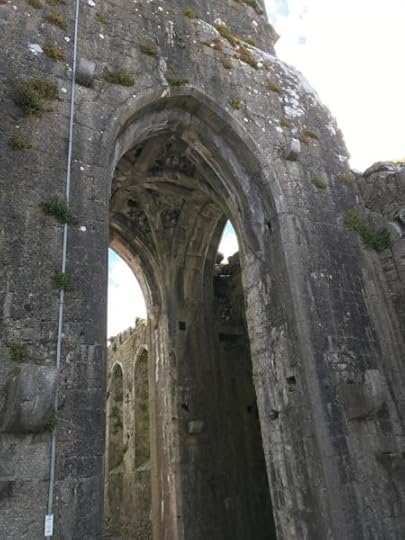
When we moved to Galway I knew that Ireland had been a thriving community of monks for centuries, but I had no idea just how saturated the landscape was with the ruins of these ancient monasteries. Within an hour’s drive of us are dozens of sacred sites. Despite the buildings being “ruins”, we were entranced by these places. The roofs were gone from many of them, opening them up to the sky and the elements of creation. Holy wells were still places people came to seek healing. The stillness found at these locations opened us up to a beautiful sense of sacred presence where we could feel all those who had prayed in these places for hundreds of years prior.
Place is a vital concept in the Celtic imagination. Certain places can be called “thin” where we experience the nearness of heaven and earth to one another. In the Celtic worldview, there is a veil between this world and the Otherworld, and when the veil is thin, we sense the presence of the ancestors and the angels more closely. We are able to encounter the divine in all things.
Physical matter pointed toward the sacred, incarnation was a living and breathing concept felt most keenly in creation among trees and mountains, oceans and rivers. Ninth century Irish theologian John Scotus Eriugena taught that there are indeed two books of revelation – the book of the scriptures and the book of creation. The first is physically small, the second is vast. Both are required to know the fullness of the divine presence. Just as the divine can speak through the words of the scriptures, so can we hear the voice of the sacred presence in the elements, the creatures, and the land.
Therefore the landscape can become a theophany, or place of divine manifestation. The shoreline is a living threshold, the mountain lifts us toward the heavens. The monks sought out places in the wilderness to receive this gift of revelation. The hermitage was a new Eden, a place where the promise of paradise could be tasted in this world.
The Celtic monks saw that all of creation is continually offering praise to God, as Psalm 104 describes. The great and powerful sea, the wide sky, the creatures, the sacred trees, the force of wind and rain, are all seen as participating in a liturgy of praise, which our own worship joins.
When we awaken to the holy shimmering in each flower, tree, and bird, we suddenly discover that we are woven into a vast community. We find ourselves nourished and supported in ways we didn’t see before. We are called to hold this deepening awareness and trust that we are sustained and called forth by the choirs of creation into our own creative journeys of expression.
The Celtic imagination moves in circles and spirals; values dreams and visions; sees animals as wise guides; and gives reverence to Earth, her seasons, and land as wisdom guides. Living in Ireland has broken open my own creativity in new ways and has affirmed my own inner sense that the creative process is best nourished by letting go of our goals and opening our hearts to what wants to arrive each moment.
Join me for The Spiral Way: Celtic Spirituality and the Creative Imagination – a 4-session program hosted by the Rowe Center February 1-22, 2021. We will dive into the Celtic imagination through story, poetry, writing exploration, music, conversation, and teaching.
With great and growing love,
ChristineChristine Valters Paintner, PhD, REACE
Photo © Christine Valters Paintner taken at Ross Errilly Friary
January 19, 2021
Hildy Tales 3: Ní heolas go haontíos ~ by John Valters Paintner
Hello, gentle readers! This series of 12 essays were composed during John & Christine’s Jubilee Year (which began pre-pandemic, but some of which was written during varying degrees of lockdown). They were dictated to John by the Abbey’s mascot, Hildy the Monk-ey. Hildy is a bit of a free spirit who likes to entertain and doesn’t normally feel constrained by conventional story structure . . . or grammar, in general. She lives by the motto that “all stories are true; some actually happened.” We wanted to share them with you, our wider Abbey community, to give you a small monkey-sized window into life on the wild edges of Ireland. They will take the place of our Monk in the World guest posts until May when those will return.
 Ní heolas go haontíos.
Hello again! It’s your friendly (if mysterious) abbey mascot, Hildy.
This weeks' Irish phrase means “you must live with a person to know that person.” I only bring it up because . . . well . . . John’s making me tell more of my own personal story. I don’t normally like talking about myself. I was raised to keep family business quiet and not offer information that wasn’t requested and even then . . .
You see, the two great sins of Irish culture are “Notions” and “Telling.” Notions, or more precisely “having notions” is about not thinking too highly of one’s self. It’s fine to emigrate and make one’s fortune, but being successful here at home . . . it can bring out the jealous side of the Irish. But I don’t suppose that’s a uniquely Irish trait. And we are getting better about self-promotion and self-care and supporting one another here on the Emerald Island. But “telling” . . . Now that’s a sin with some dark history to it. We were an occupied country for hundreds of years and collaborating with the oppressor was strongly discouraged. And so, to this day, talking too much about oneself or one’s family . . . it’s not how I was raised. We’re a private family, so I’ll stick to talking about myself, if you don’t mind.
Some of you already know the basics. I was born (don’t you worry about when; a lady doesn’t reveal her age) in Monks Town in County Roscommon. But my parents (who asked that I not mention them or my siblings by name, because of their fears over identity theft) are both from County Galway. They even told me that I was conceived in Galway, but told me not to ever tell my siblings, so they won’t get jealous. Personally, I think Ma and Dad told all of us kids that and we’re too afraid to talk about and find out part of our origin story is a lie . . . even if it’s based on my parents being proud Tribesmen. (County Galway is known as the county of the Tribesmen on account of the . . . OK, John. I’ll stop stalling and get back to me.)
After school, I travelled around the continent for a few years. (That’s mainland Europe for those of you who are Yanks . . . and yes, John’s informed me that “Yanks” doesn’t originally, technically apply to all Americans . . . but you know who I’m talking about.) I hitchhiked and worked odd jobs (a bit of busking, sweeping up a hair salon, a day labourer for a week or two on a sheep farm during calving season, personal assistant to a midwife for half a day . . . all under the table, so I can’t go into too much detail there). Mainly, I met a lot of cool people and a ton of craic (the fun stories kind, not the illegal drug kind). I’d like to say I learned a lot about myself and life during my travels, but I was young and foolish.
In fact, I only came home because I was on the run from the French police. I was squatting in Paris for about a month, with maybe a dozen different people (mainly from Ireland and Eastern Europe). We got into the habit of daring each other to do silly stuff, for the craic. But that’s not why I did what I did. It was my idea and I can’t blame my friends who risked their own freedom to help me get away. (No, John! I’m not stalling. I’m building dramatic tension. Just keep typing and let me tell it the way I want to tell it.)
Look. I admit that wine was drunk that day. But to be fair, we also had cheese and fresh bread. It was a very civilized, Parisian picnic in the Parc du Champ de Mars in the shadow of the Eiffel Tower. But then . . . I joked about being King Kong and climbing the tower to swat down bi-planes and . . . and then I was climbing the Eiffel Tower. I wouldn’t recommend any of you try it . . . even if you are an agile monkey with a prehensile tail . . . but I did it. I don’t mean to brag, but getting to the top was fairly easy. I didn’t even really think about it. But people had noticed even little old me as I climbed up the outside of the structure. So by the time I got to the observation deck, security was waiting for me.
I panicked and starting climbing down to get away. Now THAT was scary and difficult and the actual police were waiting when I got to the bottom. Thankfully my friends caused a distraction and I made my escape. I’m not proud of it and I have sent a formal, if anonymous letter to the French apologizing. But let’s face it, the French don’t have a sense of humour about this sort of thing.
Long-story-short: I pulled a von Trapp and snuck over the Swiss border and smuggled myself back to Ireland on a small cargo plane. You know . . . a typical European vacation, right?
But as crazy as all that sounds, it led to me meeting John and Christine. I started going by my middle name, Hildegard (to make it more difficult for InterPol to find me), and got a job at a charity shop in Galway City. They happened to have walked past the shop on my birthday, the seventeenth of September (the Feast of St. Hildegard of Bingen). They saw me putting up a window display. They stopped to watch me work. I waved. They waved. I waved them in. They came in and we got to chatting. It turned out that I was ready for a change and they were looking for a helper. (I should have told them about the whole “the French authorities might be looking for me” thing . . . but who hasn’t fibbed a little in a job interview? Best paw forward, my Dad would always say.)
Unfortunately, my lie-of-omission led to more trouble down the line when I went AWOL. Christine and John took me on a trip to the States. While there, one of the lovely Dancing Monks (the lovely and talented Cindy Read) offered to make me a bespoke habit. I was thrilled! John didn’t want to leave me behind for the fittings, but Christine agreed and so he was outvoted. First, Cindy made me a simple white habit. I was concerned about keeping it clean, but it turned out to just be a test run to get John and Christine’s approval before the more formal (and might I add regal) green habit I wear today. ‘Tis a lovely colour and a sturdy material that’s easy to keep clean (I like to climb; I get dirty; this is good).
But then a problem arose. Cindy wasn’t taking me back home to Ireland. I was to be sent to Kayce Stevens Hughlett in Seattle and travel back to Ireland via Paris, France!
It wasn’t Cindy or Kayce’s fault. How were they to know that I couldn’t go back to France? I hadn’t even told the Paintners, yet. But if only I had come clean then and told everybody the truth.
Instead, I panicked. I “got lost” on the way to Seattle and “accidentally” missed my flight with Kayce to France. (My loss, believe me.) Needless to say, I had everybody worried. But I finally resurfaced in time to travel back with Sharon Richards.
The official story (for a while, at least), was that UPS lost me and was going to write me off as a loss . . . until Cindy called in some favours with some UPS friends (everybody knows Cindy; she’s class) and got me delivered to Seattle. But . . . that was just more of my embarrassment.
Turns out, I worried everyone for nothing. Christine and John were very understanding about my . . . youthful indiscretion. While reckless and disrespectful, they did see the humour in my Le King Kong impression on the Eiffel Tower. And if I had just been honest from the start, they would have arranged other, non-French transportation back from the States. (We’re pretty sure the French government wants to “talk to me” . . . but that’s a story for another day . . . a long time from now, hopefully.)
I realize that I haven’t divulged a whole lot of details about my past (a girl likes to keep a bit of mystery about herself), but I think this story gives a really good insight into who I am. I’ll always be a bit mischievous, but I’ve also matured and drown as a person. If I’m not careful, I just might become an adult.
January 16, 2021
Humility + Join us today for live prayer! ~ A Love Note from Your Online Abbess
The Way of the Hermit with Kayleen Asbo from Abbey of the Arts on Vimeo.
Dearest monks and artists,
* * * * *
Please see the note below about joining us today for our live prayer service (we love gathering together in real time). The video above is from Dr. Kayleen Asbo who is offering a retreat on The Way of the Hermit next weekend.
* * * * *
This year of pandemic, political instability, and continued climate crisis has shaken most of us. We feel unsteady, overwhelmed, perhaps struggling to find hope in the midst of continual difficult news, especially about numbers of infections and those dying around the world. For those in the U.S. the added civil unrest and violent uprising a the Capitol is further destabilizing. There is so much grief to carry.
When the pandemic first hit in full force in March 2020 and many places went into lockdown, John and I were still on our sabbatical but we felt compelled to do something, to gather our community so we could pray together and offer one another some stability so we offered our Novena in Times of Unraveling. It was as much a gift for us as for others to feel connected in such unprecedented times. I felt a shift within me, an even deeper sense of how we are community for one another here at Abbey of the Arts. We followed with an online retreat on The Soul of a Pilgrim, again to support us all in moving through uncertainty.
The Christian tradition is filled with stories of how it is when we are broken open, when we are most in need, when we cry out in vulnerability, when we lament and wail How long O God, when we must ask others for support, when we feel a profound sense of not knowing, that divine grace enters in and reveals something much bigger than we can imagine ourselves. We so often try to rely on our own wills and visions, when we are reminded the divine source is so vast and is revealing new things in each moment.
Admitting what I don’t know and where I still have places to grow has always been an important part of my spiritual practice. I love the practice of conversion as framed in St. Benedict’s Rule. I often describe it as a commitment to being always surprised by the sacred. When I grow cynical and think nothing new can happen, I am turning away from conversion. When I recognize that I can grow and stretch every day until the end of my life and never reach completion, that is conversion and also a much more exciting adventure.
I taught a poetry writing seminar recently where I said that when I start writing a poem, I don’t know how it will end, because it is the process of writing that takes me there. It is in the journey that the discoveries happen.
This is true of life as well. If I am honest, I don’t know how things will unfold. I am a planner at heart, always oriented toward the future. So my spiritual practice helps me to stay present and to keep the plans spacious enough to allow Spirit to blow through them.
When last September approached I received an email from our city university with a listing of their diploma programs. I have long been drawn to their German studies program because it is impossible to find any courses beyond beginner in the local language schools and the university program you can enter in at the second year which is intermediate and more my level. But I have never registered before because we are so often leading groups and traveling for work so I can’t make a weekly commitment. This year with the pandemic and everything online, I took the plunge and signed up even though I knew I didn’t really have the time. But the truth is I never have the time, so this year I would make the time.
It is incredibly humbling to do language studies at age 50 (even though it is a language I am familiar with and have some foundation in). And it is a great gift to step into something that both stretches me and makes me feel so uncomfortable at times and also brings me alive because it touches something ancestral in me I can’t even name, it connects me to my father and his motherline in ways I can’t explain.
As the year begins, I’ve said yes to another project that will stretch me in new ways. With growing awareness around issues of racism that affect not only the U.S. but are a global poison, I reflected on how Abbey of the Arts could be a voice for transformation of unconscious patterns and help our community to stretch and grow. There are lots of great anti-racism resources and places to learn. What we can do is to work actively to lift up voices of color in the Christian contemplative and mystical traditions to bring a rich diversity to the conversation. I mentioned last week that I will be partnering with long-time dancing monk Claudia Mair Burney in 2021 to host a series of video conversations around 11 books that we have selected from voices of color to ask the question, what new insights and awarenesses do these experiences bring to the conversation? It is called Lift Every Voice: Contemplative Voices of Color – Monthly Conversations on the Christian Mystical Tradition. In many ways I feel completely unequipped to have these conversations, other than my willingness and desire to be changed by them. Humility and conversion lead me into these spaces.
It became clear to me that humility was the word seeking me as I found myself longing for these commitments to stretch myself beyond my ordinary comfortable places. Entering into humility means to honor my gifts as a human being but also to honor my limitations. While I am seeking new ways to learn, I am also seeking deeper ways to rest as well. I want my life to continue to be a witness to a slower and more spacious way of being in the world.
We have been experimenting with small groups for our current Midwinter God retreat and we offered contemplative prayer services for Advent, all new adventures to be of service to you, our beloved community, but also to see where the Spirit might lead when we surrender into possibility. I am certain there will be many more invitations to step further into humility and open my heart to ongoing surprise and change in the year to come.
Join us today for a live prayer service!
We are celebrating the completion of our Earth Monastery Prayer Cycle video and audio podcasts. Join Simon, Betsey, Richard, and me TODAY at 8 pm Ireland/UK time (12 noon Pacific / 3 pm Eastern). More details and Zoom link here>>
With great and growing love,
ChristineChristine Valters Paintner, PhD, REACE
January 12, 2021
Hildy Tales 2: Tús maith leath na hoibre – by John Valters Paintner
Hello, gentle readers! This series of 12 essays were composed during John & Christine’s Jubilee Year (which began pre-pandemic, but some of which was written during varying degrees of lockdown). They were dictated to John by the Abbey’s mascot, Hildy the Monk-ey. Hildy is a bit of a free spirit who likes to entertain and doesn’t normally feel constrained by conventional story structure . . . or grammar, in general. She lives by the motto that “all stories are true; some actually happened.” We wanted to share them with you, our wider Abbey community, to give you a small monkey-sized window into life on the wild edges of Ireland. They will take the place of our Monk in the World guest posts until May when those will return.
 Tús maith leath na hoibre.
Hello everyone! It’s me, Hildy the Abbey of the Arts mascot. (I’m a monk-ey . . . Get it? You get it. John’s right; it’s not funny if I have to explain it.)
The Irish phrase above is one of my favourites. It translates into English as “A good start is half the work.” So, since we’re still just starting with these stories of mine, I thought I’d share this one with you. I just hope I haven’t literarily (or should that be metaphorically?) painted myself into a corner by setting up a precedent to start each one of these with a bit of Irish. Like most Irish, I’m a bit self-conscious about my less-than-fluent Irish skills. But I’m also proud of my Irish heritage and since Galway is a designated bi-lingual city . . .
Anyway, I’m back with another story about my adopted town – The City of Galway. And one of the best places to start telling you about Galway is at the founding of the formal walled city by the Normans. And one of the first (and perhaps most significant) buildings in Galway is St. Nicholas Church. It’s the oldest church (among many – I’ve lost count myself) in the city centre and has quite an interesting history.
The original church was built around 1320 or something (I’m not sure; I wasn’t there). But it’s been added to a couple of times since then, expanded and what not. There’s even a lovely wee bell tower now. Oh, the clock tower only has clock faces on three of the four sides. One explanation is that the people from the neighbourhood that can’t see a clock face didn’t donate enough towards the new clock tower and so didn’t get a clock face. But back then, there weren’t really a whole lot of people living between he church and the river, just the cloistered Catholic nuns across the river. And that’s the other explanation, that the Protestants didn’t want to give the Catholics the time of day. (I swear it’s a funnier joke in person here in Galway.) Anyway, it’s a small clock tower and a big auld clock mechanism and there’s just no room for a fourth clock and as I said, fewer people live on that side of the city centre. (And the nuns had their own clock and church bells.)
But that’s enough time spent on the clock tower. (Okay, that was the last clock joke; I promise). Getting back to the church . . . it’s named after Saint Nicholas of Myra (that’s in Turkey; sorry for all the geography). You might know him as “Santa Claus,” but he’s also the patron saint of sailors, so there are churches named after him all up and down the west coast of Europe. There’s even another one right . . . (Sorry. I’m getting ahead of myself here. Monkey Mind!)
(Where was I? Sailors?) Oh, speaking of sailors (trust me, it relates!) . . . Christopher Columbus went to Mass here in 1477. Local legend has it that a local couple meet him and took a liking to him and so gave yer man Chris a copy of St. Brendan the Navigator’s map . . . and that’s why Columbus was able to make it to the “New World” as he was following the saint’s famous journey. (Christine can tell you more about that; I just really like the bit about the Easter whale, but anyway . . .)
Another infamous visitor to St. Nicholas Church was Cromwell (that is Oliver Cromwell’s army; he couldn’t be bothered to travel here himself; he just sent some really mean army guys like Edmund Ludlow who went to the beautiful Burren region just south of Galway and complained about it not having enough water to drown someone or trees to hang anyone or soil to bury anybody . . . Don’t get me started.) Where was I . . . oh, yeah! The Cromwellian soldiers desecrated St. Nicholas and turned it into a stable for their horses for a while. (Best stable they ever had, that’s for sure.) Eventually it was converted back into a church, but (plot twist!) a non-Catholic one this time.
Now as a cradle-Catholic, I could let that last bit get to me . . . but what’s the point? That was ages ago and the new congregation is very generous in sharing the sacred space with visitors and holding all sorts of great musical concerts there (some for free, which I really like) AND two Orthodox churches in Galway also share the worship space. They even have a female vicar, which is cool and long overdue! (Again, don’t get me started.)
So, let’s ignore the past negativity and focus on some of the more beautiful aspects of the church itself. It has a gorgeous stone baptismal font and stain glass windows that don’t get nearly enough credit. (Seriously, come see them for yourself.) The pulpit and choir stalls are beautiful. (I’m a huge fan of carpenters and carpentry.) And I really like the Orthodox icons in the side chapel. But my favourite bit is the columns . . . or more precisely, the “Apprentice’s Column.” You see, all the columns in the church are the same, except for one. It’s not very different, so one would be excused for not noticing it the first time (or the first several times, like I did . . . There’s just so many wonderful details, like the gargoyles and . . .) Right. Sorry, the “Apprentice’s Column.” It’s like the final project for an apprentice stone mason before they can be called a full-fledged craftsman. So, it’s different and it stands out, but in a beautiful way. I love it!
Now something else I like is that there’s another St. Nicholas Church in Galway City. Technically, its full name is Our Lady Assumed into Heaven and St. Nicholas . . . but, for obvious reasons, we locals just call it The Cathedral. (I’m not sure if most people even know the full name.) It’s across the river from the courthouse and is on the location of the old jail. In fact, when it was decided to move the Cathedral to Galway, not only did they pick the spot of the old jail, but they also repurposed the old jail’s stones in the construction. So, along with an older traditional style, the weathered stones make most visitors think the Cathedral is hundreds of years old.
But in reality (are you sitting down for this one?), it just celebrated its 50th year! (You read that correctly – fifty!) This means that JFK was assassinated shortly after his visit to Ireland and Galway when construction was finishing. So, like most typical Irish homes, there’s an icon (of sorts) of JFK in a side chapel. The ceiling and stained glass windows, particularly the large rose-style ones, are breath-taking. But don’t forget to look down when you visit the Cathedral. The floor is Connemara marble, which is mainly green with white and black veins, but also some of it is red with white and black veins. You don’t see large slabs of Connemara marble like this used in construction anymore; it’s only mined in one quarry outside the city and they’re worried about running out soon, so it’s mainly just used in jewellery nowadays.
I could keep going and tell you about the pope’s door/balcony that was put in for his visit (not the most recent one, but the one a couple of decades ago) or the statue across the street of the woman emerging from the stone . . . but I’ll end with my favourite bit of the Cathedral (since I did that with the original St. Nicholas Church in Galway). Despite them being very intentional about using an old, cruciform style of church architecture, the altar is in-the-round. So, even though the Irish Church might be a bit stuck in the past, at least this church building is very Vatican II . . . and I really like that.


