
Christine Valters Paintner's Blog, page 161
September 11, 2013
"Lovingly Fitted" (a love note from your online Abbess)
To receive this love note straight to your in-box, subscribe here (and also receive a free gift!)
King Solomon made himself an enclosed litter
of wood from Lebanon.
He made its columns of silver,
its roof of gold,
Its seat of purple cloth,
its interior lovingly fitted.
—Song of Songs 3:9-10
Dearest monks and artists,
I have mentioned before that my husband and I practice lectio divina together and we have slowly been working our way through the Song of Songs together, praying with just a couple of verses at a time in a practice of lectio continua.
Several weeks ago we were praying with the passage above and the words "lovingly fitted" shimmered forth for me from the text.
The theme for me this summer, as I have had a sabbatical from teaching, has been sustainability. How do I continue to nourish this work I am doing and flourish in the process? What are the things to say "no" to, so that I might have more space for the fullness of blossoming? What are the essential practices which cultivate joyfulness in this work?
When I read the words "lovingly fitted" I had to take pause. In the passage it is referring to King Solomon's litter, which is a kind of seat or throne. But as I prayed with the words and let them stir my imagination, I found myself invited to ponder the ways God wants my life "lovingly fitted" for me. What I think this means, in part, is not living someone else's life or another person's expectations of what I think I "should" be doing.
"Lovingly fitted" speaks to me of taking great time and care to craft something that fits a person just so. How might I craft my days with such joy, attentiveness, reverence, and love for my own abundant gifts? What if each day were a throne, a royal seat, a holy tabernacle?
And it is not just me doing the fitting. I do it by listening to the Source of all wisdom within. I listen for the thrumming beat of love and what makes my heart pound more loudly.
How do I "lovingly fit" my days? How do I craft my book of days so that generosity can be poured forth?
There is such depth to this image for me right now, especially as I listen for the call to sustainability, for how not to bottleneck my gifts by getting stuck in the burden of administrative details or things which don't truly nourish me or further my deep longings arising from the deep heart of God within.
Hand in hand with these questions, begs the question of all the ways we sabotage our own best efforts, when we take on things to please others, or not disappoint them, or we continue doing what has brought us joy in the past without realizing that things have gently shifted, and our souls are ready and hungry for new nourishment and challenges.
In my own life I am listening to the many new invitations – the Wisdom Council, the Earth Monastery Project, the Holy Disorder of Dancing Monks, and the great hunger for pilgrimage and meaningful journeys to sacred places. This past year has been such a powerful threshold to newness which has brought me to the western edge of Ireland and here I listen for new invitations. I hear the call to shed my previous expectations.
As I write these words I am preparing to travel to the land of St. Hildegard of Bingen to help steward a pilgrimage with my beloved teaching partner Betsey Beckman. By the time you read this 30 pilgrims will be gathering together with a shared longing – to listen to Hildegard's wisdom shimmering across time and in the process to listen to their own hearts more deeply.
For Hildegard, a fundamental principle of discernment was viriditas – or the greening power of God. We are to seek out what most deeply nourishes us in both body and soul. What contributes to our flourishing is holy. What depletes us is not, so we can stop worshipping at the altar of busyness for the sake of appearing important or productive.
We can pause and ask ourselves, what would it mean to live as if my life were "lovingly fitted" for me? To believe that God does not demand us to contort our spirits into other people's versions of us, but to recognize our life task as living what is uniquely given to us.
My own heart is so eager and excited to return to the verdant landscape of the Rhineland. I know my heart will also be broken open in new ways on this journey. I will discover new ways God is calling me to reverence who I am.
I ask for your prayers during this time of pilgrimage, for myself and my co-leaders, and for the beautiful pilgrims making this journey.
May we encounter the greening of our souls in profound new ways, so as to bring that kind of vitality back to the world. May you find an abundance of greening moments revealed each day.
With great and growing love,
Christine


September 9, 2013
Monk in the World guest post: Tara Owens
This summer I invited the 12 members of the Wisdom Council to each write a reflection on being a monk in the world. They were so well-received by the Abbey community, I decided to continue the series this fall by asking some fellow authors and bloggers I know to also write about living contemplatively in daily life.
I am delighted to have such a lovely line up for you, beginning with Tara Owens, who I got to know initially through Spiritual Directors International and have grown to love her spirit and perspective on things. So I bring you some of her wisdom:
To Be A Monk Is To Laugh
by Tara M. Owens
A few weeks ago, I had the opportunity to visit the Monastery of the Holy Spirit in Conyers, GA. A contemplative order of monks, the Cistercians dedicate themselves to the Rule of St. Benedict, living, as they say, “a monastic way of life in solitude and silence, in assiduous prayer and joyful penitence… rending to the divine majesty a service that is at once humble and noble.”
My heart always thrills and settles to be among brothers and sisters, and this, my first visit to the Monastery, was no exception. We arrived in the morning, and spent some time exploring their stunning exhibit on the history of monasticism—a rich history layered down a blue hallway thick with silence and almost-but-not-quiet audible holy laughter.
So many things caught my eye or my heart, spoke an affirming “yes” or a “this will come to you, daughter, just rest” as I read and was reminded of this history and practices of monasticism. I myself have been living as a monk in the world, an artist of the Divine, for only a handful of years (I pause and count, realizing that this is the year of seven for me, a year of completion, and I smile at God’s synchronicities), and these monks have dedicated their whole lives to the way. I am humbled by how much I still have to learn, happy to be reminded once again that there are so many others dancing on the path ahead of me, calling me deeper into the movement of the Spirit.
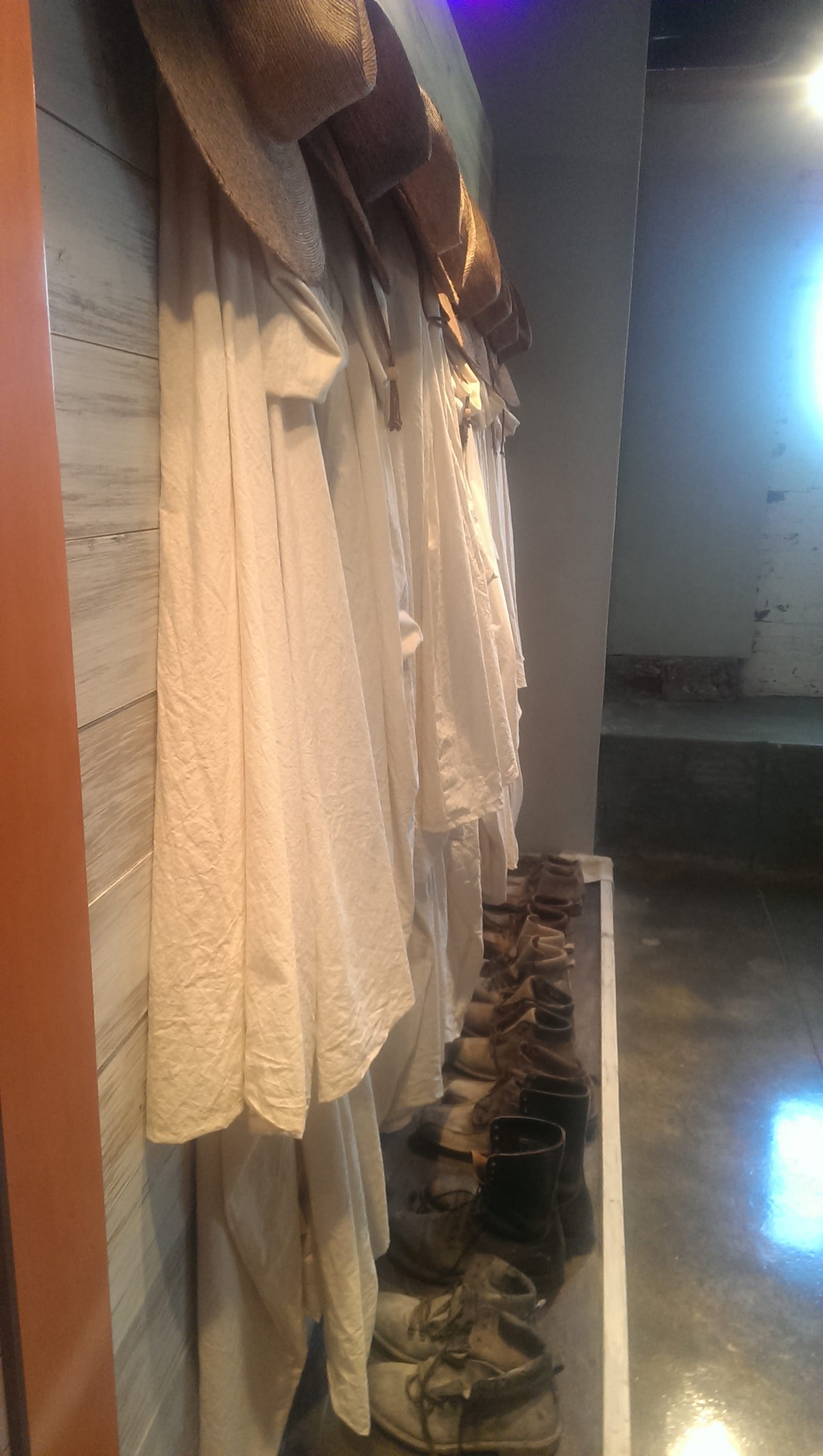
The Monastery of the Holy Spirit is a daughter house to Gethsemani Abbey in Kentucky, which was home to Father Thomas Merton, and the monks called here to Georgia came as they lived—in holy silence that was broken only by the calling of their names in service to this new house. For a time, the 20 monks lived in a barn in the sweltering Southern heat. A panel offers one monk’s cheeky and wholly disruptive response to this hardship: “If it was good enough for our Lord, it was good enough for us.”
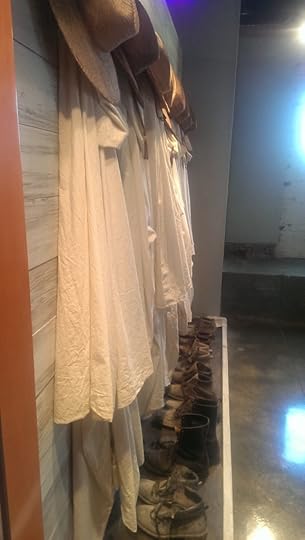
This is the lesson, the reminder, the whisper of God for me in this visit and in this season of my life as a monk in the world—to live in the disruptive, holy laughter of God.
I move on in the exhibit, and the monks talk through the walls of this barn about rising for morning prayer. The obedience, stability and conversion in the process of getting up at 4 am to be together in the dark morning, praying Lauds. The voices speak of the difficulty, the humor of those tired hours, how it doesn’t get easier, and they quote Benedict with wry tones on why it is good to rise together, “let them gently encourage one another on account of the excuses of the drowsy.”
What catches my companion on this visit to the Order is the history of the chapel itself. Cistercians, also called Trappists, are called to simplicity, and their places of worship are unadorned, almost stark, usually with clear glass windows. At the Monastery of the Holy Spirit, the chapel is made of the simplest of substances: concrete. What is holy about this ordinary material is that the monks built the soaring arches without machinery. Each load of cement mixed by hand, each taken in a wheelbarrow and poured in prayer into the flying columns that surround and support their daily prayers today.
This is the lesson of radical presence that my past years as a monk in the world have been about—I have learned through the practices, through the falling down and the getting up again, the grace and the awareness of the Holy in every day life, to be exactly where I am, as I am. I don’t claim perfection in this path, but it is something that I know about myself, something that I see pouring out of me when I am in partnership with God in my practice of spiritual direction. I am present where I am, as each monk at the Monastery of the Holy Spirit was present to his wheelbarrow of cement, to the heat of the Georgia summers, to the gift of living simply in a barn together.
I walk through the world that insists that I be elsewhere—distracted by technology, consumed by the list of things to be done (the wheelbarrows of cement yet to be poured), the responsibilities to be heavily worn. In this world, I insist that I am here—sitting in front of this computer screen in the early morning light in Colorado Springs, listening to the green leaves of the tree before my desk whisper that they are already in the process of turning yellow, well before I can see it with my physical eyes. I am here, hopeful that these words will reach out to someone who needs them, touching the keyboard tenderly, and I would your hand, if we were sitting together across a cup of tea.
These are the things that I know, that I live into the world in my own monkish ways. But the lesson of the Monastery for me, the one that God is giggling in my ears even now, is to be a monk who laughs, who delights in the foolishness of God, the surprising joy of the Holy in the world.
This, this is hard for me. I take things so seriously. I am still on the path. I am only a novitiate. I begin again, as Benedict says.
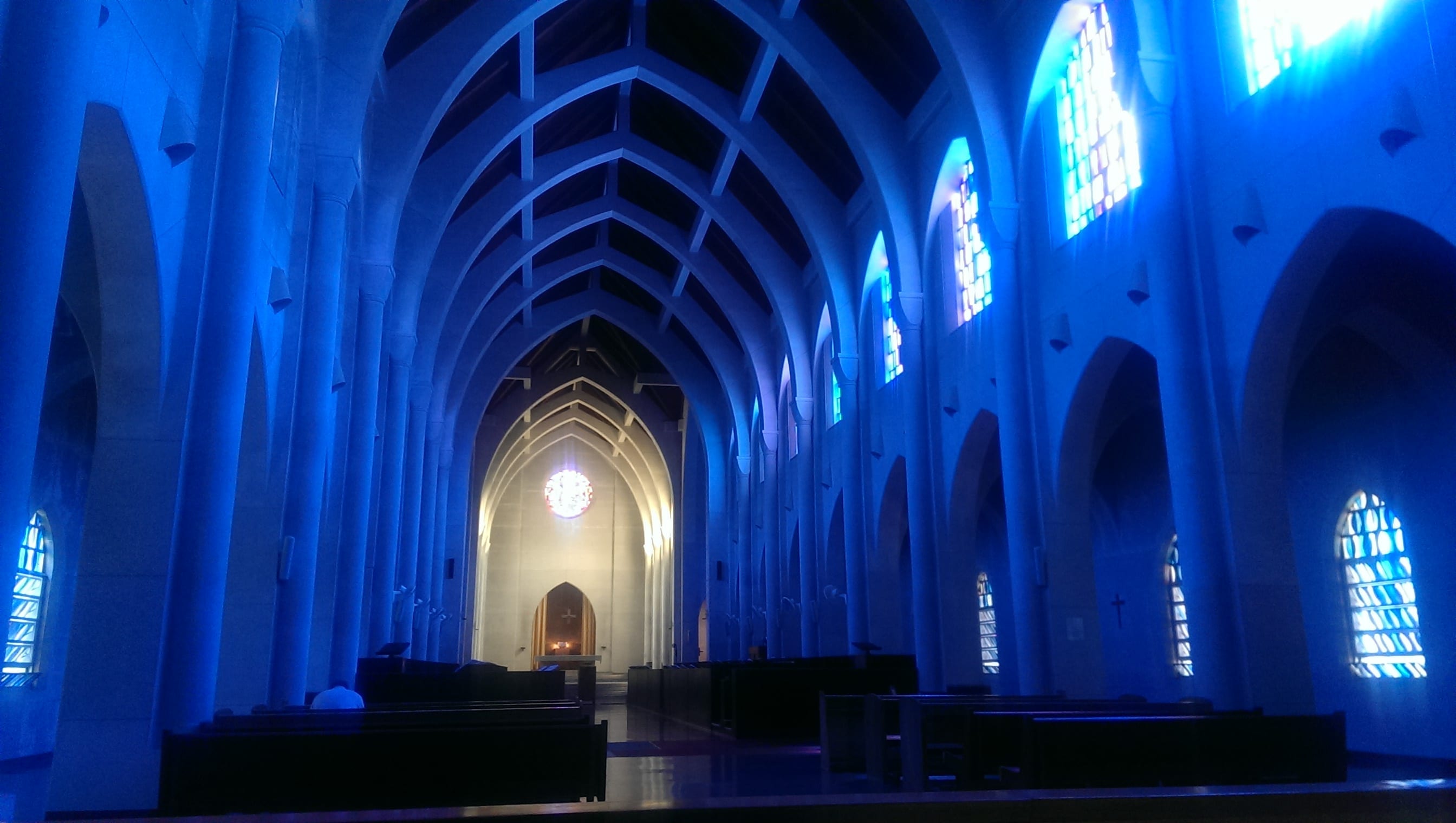
I walk silently alongside my friend to the chapel for midday prayer. Knowing the history of this place, being reminded of the journey that I have already walked so far, I am present to the midday sun, the sound of our footsteps, the awe I feel in the presence of a building so large yet built by hands so small. I read in the history of this place that a small concession was made to the Trappist insistence on simplicity: because of the cement and the intensity of the summer heat, the windows of the chapel were permitted to be colored, just this once, in order to make the interior hospitable. The patterns were to be simple, and only one color so as not to disturb the stark white-grey of the walls.
I enter this house of prayer, and the laughter that I heard but didn’t hear in the hallways erupts within my soul. I struggle not to laugh out loud and disrupt my fellow worshippers. This vaulted, holy place is filled with light, the midday sun pouring in. Bubbles of joy tickle my throat and I smile. The whole chapel, this place of presence and prayer, is washed in color (my very favorite color): blue.
I kneel, giggling inside. I am a monk in the world, and my God is leading me in the way of laughter.

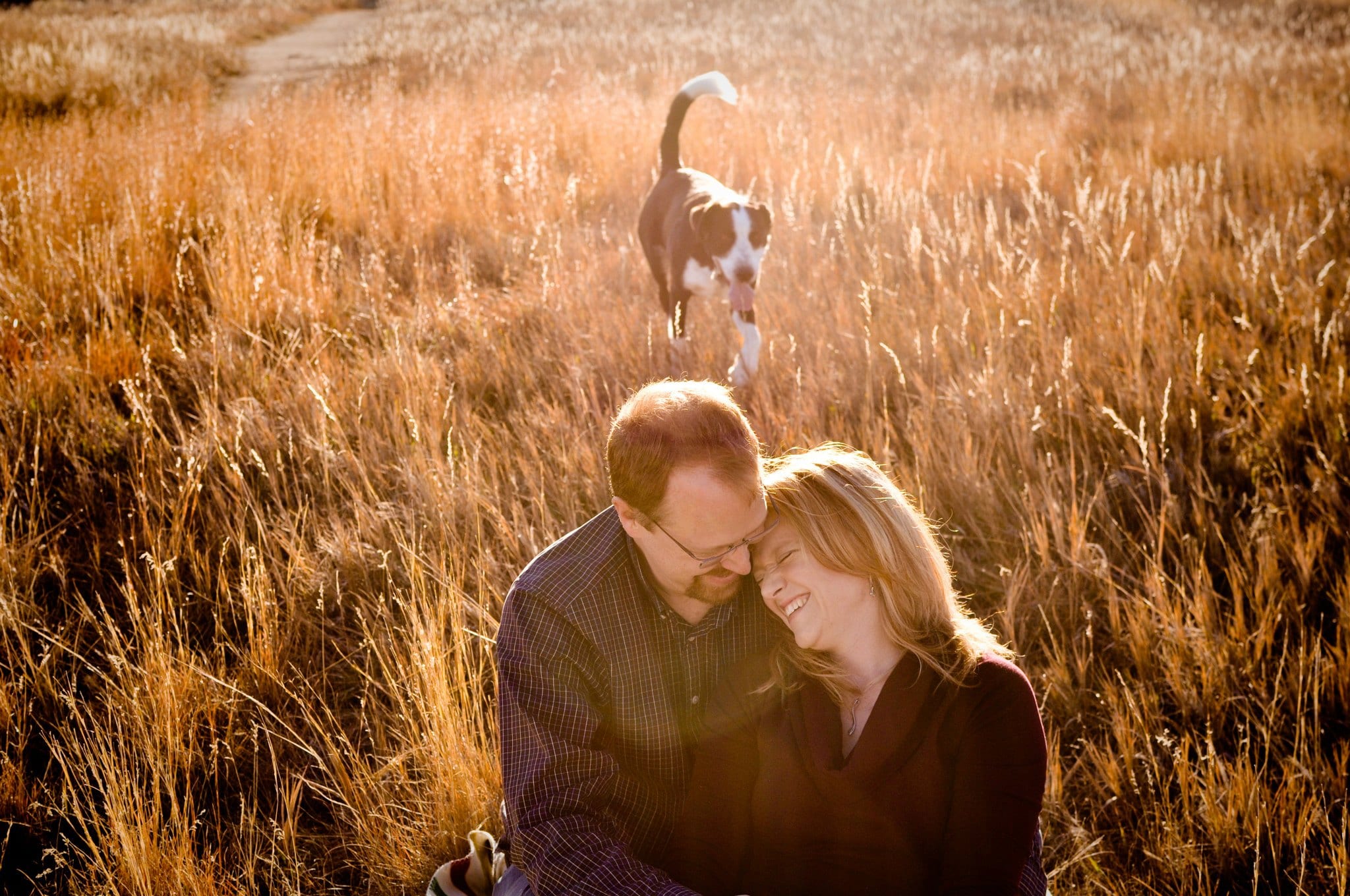 Tara M. Owens, CSD is a monk in the world and an artist of the Divine. She is a spiritual director and supervisor with Anam Cara Ministries where she speaks, curates retreats and teaches. She is writing a book on spirituality and the body that will be published by InterVarsity Press in early 2014. She is also the Senior Editor of a spiritual formation publication called Conversations Journal. She lives in Colorado with her husband Bryan and their rescue dog, Hullabaloo.
If you’d like to receive news on her book, you can sign up here.
If you’re interested in supervision, spiritual direction or anything else, you can email her here.
You can join the Anam Cara Community on Facebook here.
September 8, 2013
Invitation to Photography: Call to Newness
Welcome to this month's Abbey Photo Party!
I select a theme and invite you to respond with images.
We began this month with a Community Lectio Divina practice (stop by to read the beautiful responses). As I prayed with the Isaiah text, this phrase kept shimmering for me:
See, the former things have come to pass, and new things I now declare; before they spring forth, I tell you of them.
I love this image of God seeing the newness of things to come before we do, God's imagination so much wider than we can see, and the possibilities just on the verge of being birthed that are hidden to us in this moment.
September can have the feel of a new year beginning, especially for those of us connected to school calendars. The ushering in of autumn, the return to classes, programs gearing up again after the slower pace of summer. Here at the Abbey we are celebrating many new things like the Wisdom Council, the Earth Monastery Project, the Holy Disorder of Dancing Monks, and the fall calendar of new invitations.
I invite you for this month's Photo Party to play with this idea as you go out in the world to receive images in response. As you walk hold this inspiration of newness and be ready to see what is revealed to you.
You can share images you already have which illuminate the theme, but I encourage you also to go for a walk with the theme in mind and see what you discover.
You are also welcome to post photos of any other art you create inspired by the theme. See what stirs your imagination!
How to participate:
You can post your photo either in the comment section below* (there is now an option to upload a file with your comment) or you can join our Holy Disorder of Dancing Monks Facebook group and post there. Feel free to share a few words about the process of receiving this image and how it speaks of the "Call to Newness" for you.
*Note: If this is your first time posting, or includes a link, your comment will need to be moderated before it appears. This is to prevent spam and should be approved within 24 hours.
September 6, 2013
Join us for Community Lectio Divina!
There are a couple more days left for our Community Lectio Divina practice this month with Isaiah 42:6-10. Reading your responses has been very powerful for me, to listen to the Spirit at work weaving through our shared prayers. Sunday we will post this month's Photo Party which will continue breaking open the themes explored in the passage.
Come to Ireland next spring. . . (new dates added!)
We have added a fourth and final set of dates for the Monk in the World: Pilgrimage to the Sacred Edge of Ireland in 2014. We love the poetry of now having one pilgrimage in each of the four Celtic seasons.
There are only a couple of spaces left for March 18-26, 2014, so please contact me to register (or to be added to the waiting list for the other dates or advance notice of 2015 dates).
Join your fellow pilgrims and monks in the world for an intimate and transformative journey to a sacred landscape. If Ireland calls to your heart we would love to share her with you.
Your 2014 registration includes a space in the Abbey online retreat – Birthing the Holy: A Celtic Spirituality Retreat for Advent (December 1-28, 2013) as part of your pilgrimage preparation.
You can find all the details here and a visual journey of what you will experience in this video:
September 2, 2013
Exile and Belonging (a love note from your online Abbess)
To receive this love note straight to your in-box, subscribe here (and also receive a free gift!)
Sometimes you can only understand yourself through exile, and feeling really far away from yourself and your world. If you look to the poetic tradition, all you’ve got to do is enunciate the exact nature of your exile and that will open up the door to your conversation. There’s no one else in the world who feels exiled as you do. There’s no one else who feels far away from things with exactly the same coloration and tonality that you do. Therefore you must have faith in whatever you’re confronted with.
Every human life is quite magnificent and dramatic and mythological because of the intensity of what’s at stake. Once you understand that, and turn your face back towards it — towards your ability to feel exiled, towards the necessary human qualities of losing and being lost — then suddenly you find a place to stand in it all. And you, strangely enough, find yourself emboldened by it… and more courageous.
—David Whyte, an excerpt from an interview with Sounds True
Dearest monks and artists,
This coming Tuesday represents two significant relationships in my life. September 3rd is my mother's birthday, she would have been 71 and it is also my 19th wedding anniversary with my beloved, and your online Prior, John.
My mother's death 10 years ago was unexpected and wrenching. I was blessed to be by her side at the moment of her last breath. Truly it was one of the holiest moments of my life and one of the most terrible, as this woman I loved so dearly was torn from me too soon. Her death plunged me into a depression for the next couple of years, although it took time to name it as such. I felt unwell so much of the time, I felt an aloneness and orphaned. I have come to know this time as a season of exile in my life, of feeling far away from "home."
John and I met when we were both 22 and at 24 we married. There are no words adequate to express my love for him and the gifts of our friendship in my life. I daily feel gratitude for all the things we have traversed together: deaths of three parents, serious illness, job loss, moving multiple times, and of course, our decision together to sell everything and travel across the sea to discover what lay awaiting us on the other shore. In my marriage is the place where I experience a profound sense of belonging. I know I am loved and cherished. I am at home.
I believe that we each have fundamental experiences of exile and belonging. We have each had losses that shattered us, or experiences which thrust us into a kind of deep aloneness we never knew existed.
And we have each had moments of profound kindness, tasted the sweetness of belonging, experienced a love that told us on the deepest level that we belong here, if only for a fleeting glimpse.
So much of my work is a tribute to my mother: her courage in all kinds of life challenges, the beautiful woman and powerful she matured into, her commitment to justice, and her love of art.
So much of my work is a tribute to my marriage, without which I am not sure I would have had the courage to do so many of the things I have risked. John's support while working through our struggles and feeling loved in the most unconditional way.
This path of becoming a monk in the world holds this tension of exile and belonging. The ancient desert monks taught us to not only welcome being the stranger, but to seek it out. They traveled to the harsh and barren landscape to feel their vulnerability in the keenest possible way.
They knew that seeking out the experience of exile demands that the heart becomes soft and tender and is precisely the place where God can enter in, when we let go of how we want God to work in our lives and welcome in God as presence beyond our imagining.
We live in a culture of competency, achievement, and goals. Even our spiritual language can have this sheen of achieving proficiency and the seduction of believing that if we only find the right practice and do it in the right way at the right intervals and for the right length of time, we will become immune to the need for further transformation. We will have arrived in the place of strength and certainty and deep trust.
But this is always a journey. We never arrive.
In the midst of our belonging, there are always reminders of exile. And in the exile, glimpses of home.
I know I will have my heart broken again in this life because I open myself to love. I know I will continue to taste the delight of feeling at home and truly belonging, whether in marriage, or friendship, or when gathering with you my beloved monks online and in person.
Perhaps that is why the archetype of pilgrim calls so much to my heart, this honoring of always being on the way, and the intentionality of moving out into strange landscapes and cultures as a way of meeting my own vulnerability again and again. Of welcoming in my own great losses as the places where I can be most crafted into the person I am to become. As the great poet Naomi Shihab Nye writes, "Before you know kindness as the deepest thing inside, you must know sorrow as the other deepest thing."
And we also need these experiences of belonging, we thirst and hunger for them. To always be in exile and strangeness is to forget what home feels like. We need to remember and cherish these moments when we feel loved, when trust arises like a fountain. Then we can offer that experience to another and contribute to radical hospitality in the world.
Where are your own great places of exile and belonging?
It seems especially poignant and serendipitous that as I have been pondering the theme of exile and belonging this past week that John finally received his letter of approval from the Irish immigration office and now has his residency card which is valid for the next five years. There is a sense of deepening into Ireland as home.
There is so much goodness at the Abbey right now, the fruit of summer's spaciousness and time for dreaming opened up many inspirations. The core word seems to be community and how best to nourish this gathering of dancing monks so we might witness to alternative ways of being in our own corners of the world.
Please join us for:
Holy Disorder of Dancing Monks – we have a new Facebook group for connection and conversation
Earth Monastery Project - applications are now being accepted
Communal Lectio Divina
Calendar of fall invitations
and the online self-study version of Eyes of the Heart is now available. If you register now you can join a cohort of kindred spirits to share your contemplative photography practice with in our online forum.
With great and growing love,
Christine
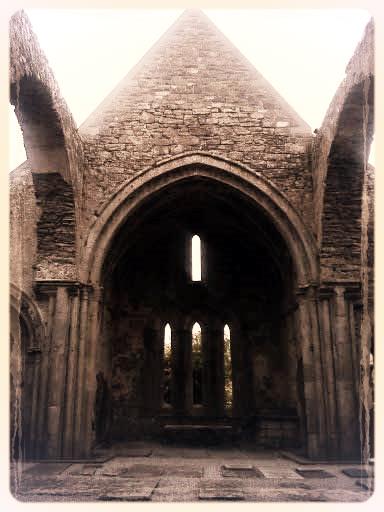
*Photo: Corcomroe Abbey in the Burren, Ireland
September 1, 2013
Community Lectio Divina: Isaiah 42:6-10
With autumn we return to a fuller rhythm here at the Abbey blog after the quieter time of summer. I know many of you will welcome the Poetry and Photo Parties back. In addition, we are adding in an invitation to practice lectio divina as a community and there will also be a Dance Party at the end of the month to nourish all my dancing monks.
You can see the fall calendar of invitations here>>
Join the Holy Disorder of Dancing Monks Facebook group here>>
How Community Lectio Divina works:
Each month there will be a passage selected from scripture or poetry (and at some point we will engage in some visio and audio divina as well with art and music).
For the year I am choosing an overarching theme of discernment. I feel like the Abbey is in the midst of some wonderful transition, movement, and expansion.
How amazing it would be to discern together the movements of the Spirit at work in the hearts of monks around the world.
I invite you to set aside some time this week to pray with the text below. I have included an audio guided meditation for those of you who prefer to be led through the experience of lectio. It is just below the scripture text.
If you prefer to pray on your own, here is a handout with a brief overview (feel free to reproduce this handout as long as you leave in the attribution at the bottom – thank you!)
Lean into silence, pray the text, listen to what shimmers, allow the images and memories to unfold, tend to the invitation, and then sit in stillness.
I am the Lord, I have called you in righteousness, I have taken you by the hand and kept you; I have given you as a covenant to the people, a light to the nations, to open the eyes that are blind, to bring out the prisoners from the dungeon, from the prison those who sit in darkness. I am the Lord, that is my name; my glory I give to no other, nor my praise to idols. See, the former things have come to pass, and new things I now declare; before they spring forth, I tell you of them. Sing to the Lord a new song, his praise from the end of the earth! Let the sea roar and all that fills it, the coastlands and their inhabitants.
—Isaiah 42:6-10 (NRSV)
Listen to a guided lectio divina:
(or you can download the file here to listen on an mp3 player)
After you have prayed with the text (and feel free to pray with it more than once - St. Ignatius wrote about the deep value of repetition in prayer, especially when something feels particularly rich) spend some time journaling what insights arise for you.
How is this text calling to your dancing monk heart in this moment of your life?
What wisdom emerged that may be just for you, but may also be for the wider community?
Creative Response to Prayer
I find lectio divina to be such a rich way to engage my heart and my imagination, and it can be a powerful way to lead into art-making, poem-writing, or movement. Feel free to go in any direction with this you feel led.
I will offer a suggestion each month. For this first month's practice, I suggest going on a photo pilgrimage following your lectio practice (in the hours or days following).
Begin by spending a few moments centering and breathing. Call your word or phrase that shimmered to mind and repeat it gently to yourself like a mantra. Then begin your walk with your camera. It can be just in your backyard or around the block.
Softening your gaze and holding this word, move out into the world without agenda, only simply noticing what arises, what shimmers in the world around you. Is there perhaps an image which offers you another way of experiencing the word from your prayer?
See if you can release your desire to do this a certain way or find a certain image. Allow yourself to receive what comes, even if that is just ten minutes of quiet, attentive walking.
Sharing Your Responses
Please share the fruits of your lectio divina practice and/or your creative response either in the comments below or at our Holy Disorder of Dancing Monks Facebook group which you can join here. Photos can be included in both places.
You might share the word or phrase that shimmered, the invitation that arose from your prayer, or a photo you received in response. There is something powerful about naming your experience in community and then seeing what threads are woven between all of our responses.
August 31, 2013
Join me in Chicago on October 19th!
 Eyes of the Heart: Conference in Chicago with Christine Valters Paintner
Saturday, October 19, 2013 at Mundelein Seminary
Join Benedictine Oblate, retreat leader, and widely
acclaimed author, Christine Valters Paintner, as she invites us to consider how viewing the world through the lens of a camera (even a humble cell phone camera!) can become a means of “seeing” the Sacred all around us in a fresh,
new way. Participants are encouraged to bring their cameras so that they, too, may capture the beauty of God in the world around us.
(register at this link and scroll down to October 19th).
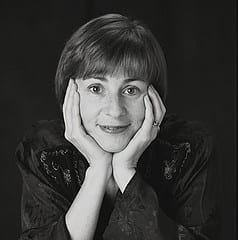
Wisdom Council: Guest Post from Betsey Beckman
This week brings us to our final guest post from Wisdom Council members! And a wonderful way to finish is with my dear friend and teaching partner Betsey Beckman. Betsey and I met soon after I moved to Seattle over ten years ago. We discovered we made a beautiful partnership in bringing the gifts of the arts to others and created Awakening the Creative Spirit: Experiential Education in the Expressive Arts together, our 5-day residential intensive for soul care practitioners which is now in its 8th year (and later wrote a book together as well)! Over the years we have partnered in many programs, both live and online, as well as deepened into the joys of friendship. Read on for Betsey's reflections about being a monk in the world:
Hello friends! I love reading all the reflections from my fellow Wisdom Council members on being a monk in the world. What does it mean to me?
When I was about 12 years old, my mom and dad drove my sister and me on a weekend trip down to Kentucky, which included a visit to the Trappist Monastery of Gethsemani, where Thomas Merton lived his community life. This was perhaps in 1969, which would have been a year or so after Thomas Merton died. By then, I had not yet read Seven Storey Mountain, but I had a sense of Merton’s profound influence on my mom and dad. The visit to Gethsemani was my first glimpse of monastic life, and I was struck by the quality of peace and stillness that graced the community there. I was quite accustomed to attending church for Mass, but I don’t think I had ever previously experienced the simplicity and song of the monastic liturgy of the hours. I clearly remember emerging from afternoon prayer, and commenting to my family that there would be so much less violence in the world if people could only experience the depth of peace that I had just been steeped in.
A few years before that, when I was perhaps six years old, I remember being asked what I wanted to be when I grew up. My answer was three-fold: a teacher, a nun and a dancer. I somehow realized that there were so many needs in the world, that I obviously needed to dedicate myself to praying for the world all day long! I don’t know how I was planning on blending these longings with my desire to be married and have children. And for that matter, my other longing to be on TV, like Buffy and Jody of Family Affair, or like Marta and Grete in The Sound of Music. But all these possibilities seemed to co-exist!
A few other memories pop up on this subject as well: the time my mom helped me to decorate a shoe-box to express my desire to become a dancer, and my strong feeling that the stock images of ballerinas that I had in front of me did not express the kind of artistry I felt called to. Or the time I emerged from a parish Mass and knew so clearly that the message of the Gospel needed to be proclaimed with so much more enthusiasm than the drone of the priest’s recitation!
It’s funny when I look back and see how nothing is wasted. All these longings and experiences have woven themselves into my unique call to artistry and ministry as a kind of “monk” in the world. Even my desire to be on TV has come true, now that producing DVD’s of storydance artistry is a significant part of The Dancing Word outreach.
As Dorothy of the Wizard of Oz learned, the journey to our hearts desire often requires traveling wide for new perspectives. A significant awakening happened for me during the decade or so where church-going was not part of my regular routine. I loved having the freedom to explore Native American practices, Gaia consciousness, dream-work, yoga, Goddess imagery, Sufi chanting and more. In my journeys, many of these gifts have ended up in my own spiritual backpack!
Even so, over time, I felt myself drawn back to my Christian roots with a longing to celebrate and explore the sacredness of the body and the feminine right there in my own tradition. One of my friends once called me “a missionary to the church.” I love being anointed with this calling! In recent years, Ignatian spirituality has given me a chance to break open scripture through imagination; re-envisioning the “He” and “She” of God has invited me to an embrace of wholeness; Mary as womb of the Divine has given me feminine power; Miriam dancing through the Sea of Reeds has become my rabble-rousing mentor; Mary Magdalene has got me dancing in cemeteries and called me to France to experience her presence as sacred icon; and Hildegard of Bingen, as “patron saint” of artists and monks, is calling me to Germany to steep myself in her creativity and mystical propheticism.
In a recent conversation with my 21-year-old son about the nature of the universe, he asked me – “What do you think exists?” My answer was, “Being evolving through love into consciousness.” His answer was even simpler than mine: “Creativity, which is consciousness.” I wonder how he came upon the notion of the foundational unity of creativity and consciousness? He contemplates these mysteries even more fervently than I!
I have wandered far from the Abbey of Gethsemani, and yet, by opening to this page in the book of my life, I now discover a quote from Thomas Merton that delights and affirms:
“They were in the world and not of it–not because they were saints, but in a different way: because they were artists. The integrity of an artist lifts a man above the level of the world without delivering him from it.” —Thomas Merton, The Seven Storey Mountain
As monks and artists, may we delight, express, transform and celebrate. And as we dance more deeply, may the world be lifted evermore into freedom, be embraced evermore by beauty, be drawn evermore to peace.
August 30, 2013
Community Contemplation & Creativity (Fall Schedule)
For several years now the Abbey has offered a regular Poetry Party and last year we added in the Photo Parties. These have been invitations into your own creative expression through a particular theme and then sharing it with your fellow monks. We took a break from them over the summer but are excited to be bringing them back now.
This autumn we are adding on two new features:
Community Lectio Divina: Each month I will be posting a scripture passage or poem (and eventually some art and music) which you will be invited to pray with using the ancient contemplative practice of lectio divina. Guidelines will be posted and an audio recording of Christine leading you in the prayer. Suggestions will also be offered for creative ways to respond to what arises in your prayer and you are invited to share the fruits of your discoveries with the wider community.
Invitation to Dance/Dance Party: I will also be posting a monthly invitation into a gentle movement practice so you can explore the body in prayer as sacred landscape and holy vessel and invite you to share what you discover.
Join the Conversation: You are invited to join the Holy Disorder of Dancing Monks Facebook page as a place to participate or in the comments below each blog post as they appear.
Below is a look ahead at the weekly themes. All are welcome to participate.
Our approach to the arts at the Abbey is one of exploration, discovery, and prayer. Our aim in art-making isn't to create a beautiful product and impress others, but to pay attention to the process of unfolding that leads to the creation of something that is an authentic expression of our experience in the moment. We welcome in the discomfort and resistance, as well as the ease and joy. When we create what is truly within us, rather than what we want others to see, we dance on the wild edges and expand our understanding of the Spirit's movement in our lives.
Art can be a journey of revelation and truth-telling. Creating from the heart (as opposed to the mind or ego) draws us closer to the Great Artist who is continuously at work in the world, and with whom we can collaborate on life's artistry.
Autumn 2013 Community Invitations
September 1: Community Lectio Divina
September 8: Invitation to Photography
September 15: Invitation to Poetry
September 22: Invitation to Dance
September 29: A chance to pause and savor
October 6: Community Lectio Divina
October 13: Invitation to Photography
October 20: Invitation to Poetry
October 27: Invitation to Dance
November 3: Community Lectio Divina
November 10: Invitation to Photography
November 17: Invitation to Poetry
November 24: Invitation to Dance
Upcoming Monk in the World Guest Posts:
Each of the Wisdom Council members shared a guest post this past summer about becoming a monk in the world and artist of everyday life. They were so well received, that we are continuing the series with some more wonderful writers and bloggers on the contemplative life.
September 9: Tara Owens of Anam Cara
September 16: Carl McColman, author of Answering the Contemplative Call: First Steps on the Mystical Path and The Big Book of Christian Mysticism: The Essential Guide to Contemplative Spirituality
September 23: Claudia Mair Burney, author of God Alone is Enough: A Spirited Journey with Teresa of Avila
September 30: Claire Bangasser of A Catholic Woman's Place
October 7: Lacy Ellman of A Sacred Journey
October 14: Kent Ira Groff, author of Honest to God Prayer: Spirituality as Awareness, Empowerment, Relinquishment, and Paradox and Writing Tides: Finding Grace and Growth through Writing
October 21: Tonja Reichley of Moon Dance Botanicals
October 28: Paula Huston, author of Simplifying the Soul: Lenten Practices to Renew Your Spirit and The Holy Way: Practices for a Simple Life
November 4: Ken Peterson, author of forthcoming Prayer as Night Falls: Experiencing Compline
November 11: Wil Hernandez of Center Quest and author of Henri Nouwen and Spiritual Polarities: A Life of Tension and Henri Nouwen and Soul Care: A Ministry of Integration
November 18: Christine Claire Reed of Girl on Fire
November 25: TBA
December 2: Mary Earle, author of Celtic Christian Spirituality and Marvelously Made: Gratefulness and the Body
*Please note: The book links above are Amazon Associates links which provides the Abbey a small percentage of your purchase price at no additional cost to you. These funds go to support the Earth Monastery Project and our scholarship fund.


