Christine Valters Paintner's Blog, page 143
November 17, 2014
Monks, Mystics, Archetypes and SoulCollage® (guest post from Kayce Stevens Hughlett)
For the last several months, we have been embarking on an exciting creative project and collaboration. It started with choosing 12 dancing monks to be a part of the original Dancing Monk Icon series painted by Marcy Hall. These icons were meant to depict some beloved monks and mystics in a joyful and colorful way, reminding us of our call to dance through this life.
We had the inspiration to feature a dancing monk for each week of our Advent/Christmas and Epiphany/New Year's online retreats. My wonderful teaching partner Kayce Hughlett, is a trained SoulCollage® facilitator and will be offering this gift as a part of our creative experience and shares below about what this process means for her.
If you would like to join us for these online retreats you can find the registration info here:
Birthing the Holy: Advent & Christmas Online Retreat with Monks, Mystics, and Archetypes
Illuminating the Way: Epiphany & New Year's Online Retreat with Monks, Mystics, and Archetypes
From Kayce: Opening into the threshold of this new day and season, I awaken for the second or possibly third time from a restless and jet-lagged sleep. In this moment, the sun is making lace-like patterns on the shades of my bedroom window. Aslan, my golden muse, is draped across my side, his feline paw gently touching my face. It is morning. Time to arise.
Today I’ve set aside time to write and be creative. I feel dry as a bone. I can’t even imagine writing this piece I’ve promised to Abbey of the Arts. Edging toward frustration, I close my eyes and listen to the sounds around me. A foghorn echoes in the distance. Aslan rolls off my lap. The clock clicks over to 8:00 a.m. Something inside me shifts as I sink into the images floating through my mind.
My memory turns to the rugged west coast of Ireland from where I’ve recently returned. Together with other pilgrims, I stood on sacred ground in the world of ancestors and saints. In my mind, I see our Inismor guide, Dara Malloy, speaking of saints and signs, dreams and symbols. He mentions Carl Jung and I smile as I recall the magic of SoulCollage®. I think about Advent and the upcoming journey with Hildegard, Brigid, Mary, and more. I am honored that I have the privilege of sharing this journey and the SoulCollage® creative process with seekers around the world.
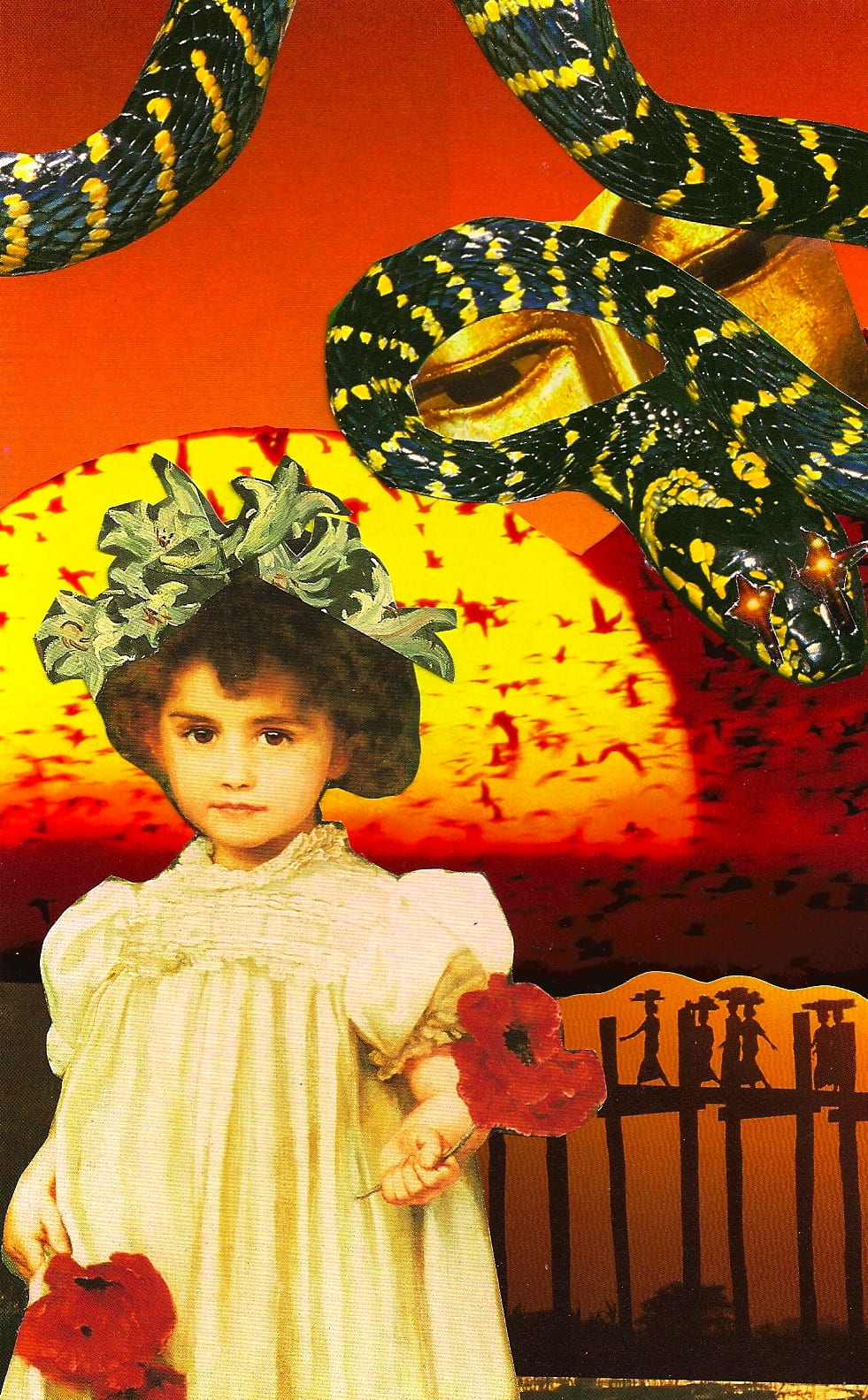
SoulCollage® is a process for accessing intuition and creating incredible cards with deep personal meaning that help the creators explore life's questions and transitions. Images speak to us in ways that words cannot. By dropping into image, we step through a portal in the mind. We find new ways of seeing and finding meaning for topics and areas of our life we may be pondering. In the Abbey’s upcoming online classes, we will be exploring Advent and the New Year through monks, mystics, and archetypes.
I didn’t grow up with monks, liturgical seasons, or even much creativity. My journey with the mystics and saints is being pieced together like images in a collage. Perhaps yours is too. This makes SoulCollage® a perfect companion for our journey. I’m looking forward to seeing what we create together.
During the Advent and Christmas retreat as well as the New Year journey, SoulCollage® will help us listen and learn in creative ways. The invitation will be for each of us to step intuitively into what we need to hear, see, and learn. There is no right or wrong way to create collaged cards, but following the simple guidelines I’ll provide will help give shape to your own intuitive process.
Each week I’ll provide a brief commentary on our featured monk, mystic, and archetype followed by an invitation to create your own SoulCollage® card. We will begin with basic guidelines and information on creating cards then move into ways of exploring more deeply what you’ve created. Finally, we can share and talk about our creations on the class forum. It’s going to be great!
If you haven’t already signed up for the retreat(s), I hope you will today. Start gathering magazines, catalogues, and photographs. Get your glue sticks and scissors ready. You’ll also want 5” x 8” cardboard bases for your collaged cards. Cut your own, have your local frame shop do it for you, or order pre-cut cards from www.soulcollage.com.
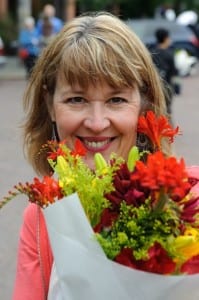 Kayce Stevens Hughlett, MA LMHC is a soulful and spirited woman. In her roles as ponderer extraordinaire, spiritual director, life muse, author, creative coach, and speaker, she invites us to playfully and fearlessly cross the thresholds toward authentic living. A strong proponent of compassionate care in the world, Kayce's live and online work focuses on the principle that we must live it to give it.


November 15, 2014
Invitation to Poetry: Honoring Saints & Ancestors
 Welcome to Poetry Party #81!
I select an image and suggest a theme/title and invite you to respond with your own poem. Scroll down and add it in the comments section below or join our Holy Disorder of Dancing Monks Facebook group and post there.
Feel free to take your poem in any direction and then post the image and invitation on your blog (if you have one), Facebook, or Twitter, and encourage others to come join the party! (If you repost the photo, please make sure to include the credit link and link back to this post inviting others to join us).
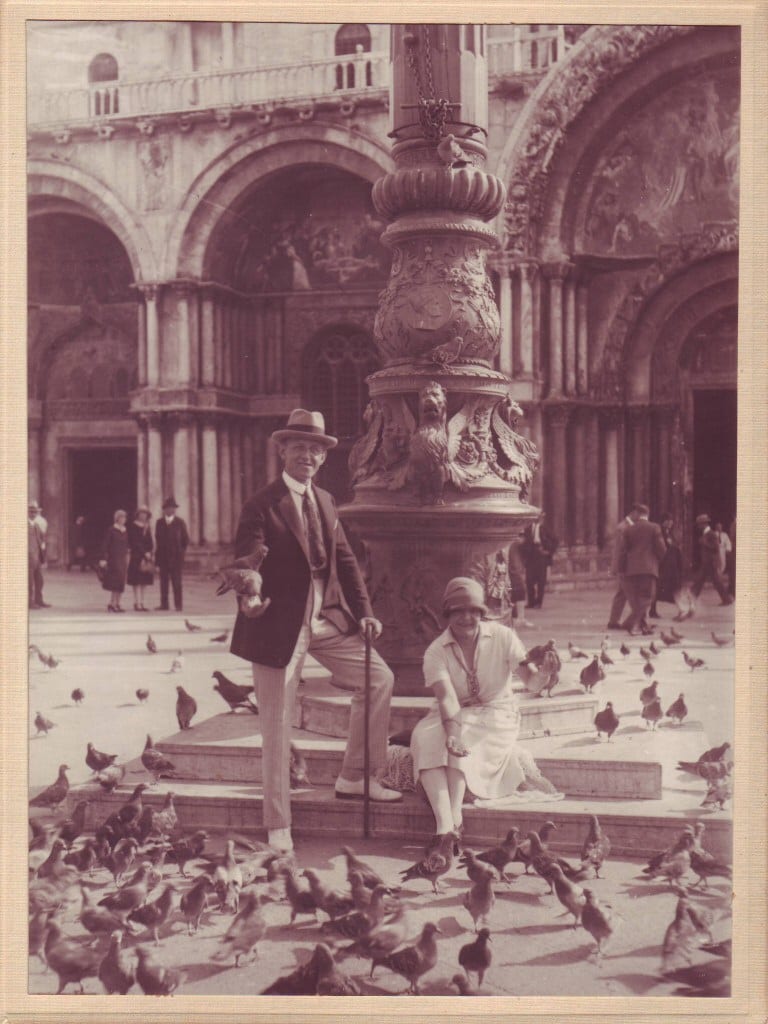
We began this month with a Community Lectio Divina practice with a story from the Letter to the Hebrews and followed up with our Photo Party on the theme of "Honoring Saints & Ancestors." (You are most welcome to still participate). We continue this theme in our Poetry Party this month. What are you continuing to discover about how your ancestors speak across the veil? (This photo is of Christine's great grandmother with her second husband.)
You can post your poem either in the comment section below*or you can join our Holy Disorder of Dancing Monks Facebook group (with more than 2400 members!) and post there.
*Note: If this is your first time posting, or includes a link, your comment will need to be moderated before it appears. This is to prevent spam and should be approved within 24 hours.
November 12, 2014
Monk in the World guest post: Angela Doll Carlson
Another wonderful submission for the Monk in the World guest post series from the community. Read on for Angela Doll Carlson's wisdom on living as a monk in the world:
11:11
A number of years ago I took a silent retreat at the Abbey at Gethsemane near Bowling Green, Kentucky. At that time of my life my four children were still very young. I was burned out and overwhelmed. The trip to the monastery was rest and nurturing. I remember the lush grounds and the quiet early morning chanting. I remember the feel of the sparse quarters, comforting, completely adequate. I was alone for the first time in quite a while and I drank that in. The monk who welcomed us gave us a quick lesson on the monastic life as a sort of orientation, telling us many things about the order to which he belonged and about the history of the place but it was the rule of prayer that stood out to me. It was probably that trip that awaked my own inner monastic and I took home some pieces with me that day. I tried them on like clothing whenever I would feel overwhelmed, the rule of prayer becoming a constant companion, a warm sweater on a cold day, a reminder of the monastery amid the fast moving world of parenting and urban life.
But there are some habits I had nurtured already before I visited the Abbey at Gethsemane, some practices I did without really thinking about them to help me navigate my growing list of responsibilities, anxieties and fears.
At 11:11, if I’m cognizant of it, I pray. I pray three things. I pray the first three things that come to mind. I feel the pressure of it, 11:11 only lasting one minute, maybe less if I catch it late. Whether a.m. or p.m., at 11:11, I pray the first three things that come to mind.
My husband.
My children.
My writing.
A minute later I think to pray for other things- world peace, starving children, government elections, equal rights, fair trade, my health…maybe my health.
It might be Fibromyalgia or it might be Iodine deficiency or Thyroid issues but there is this constant but dull pain, a sort of throbbing in my legs and neck and upper back. There is this fatigue that drapes over me, pressing down on my now stooping shoulders. There is this fog that creeps over my face, like a mask, clouding everything.
“Poet, heal thyself,” the voice inside of me whispers.
At 11:11, if I am awake and aware, I pray the first three things that come to me and though the fog and the pain and the fatigue are constant companions they never make it to the gate.
My parents.
My friends.
My book.
Poet, heal thyself.
All parents feel tired, I’m told. I have four children in four different schools. That must be why I feel so tired all the time. I’m getting older so, the aching is natural. On the backside of 40 and sliding headfirst into 50 means that my brain will, of course, be less sharp than it was. This is aging. This is parenting. This is the effect of stress on the body or gluten intolerance or chemicals in the plastics I use. I heated one too many meals in the microwave. I used shampoo with toxins. I ate non organic, fully GMO foods. There’s a reason.
Poet, heal thyself.
At 11:11, I pray three things and my health never makes it to the gate. My fatigue, my pain and my brain fog stand back from the line, pressing up against the wall and trying to remain unseen. “Take these first” they say as they shoo other needs, other people, other causes, to the front of the line. “Be ready,” they say to the others, “be ready for 11:11.”
I can’t remember how I started the practice of prayer at 11:11. It might have grown from the practice of wishing on the first star I saw at night but instead of wishing I’d pray. I was young, just a child, spotting that first star while I sat in my room waiting and watching. I’d scan the square of black night I could see outside my window. I’d press my cheek against the pane and let the cool glass register my breath. When the star appeared I’d pray; one wish, one hope, whatever came to me first. When I was young and just a child it was always about me, about being popular, being understood, being famous, being happy, being free.
And now at 11:11, I pray- part habit, part luck, part superstition. It feels wrong to pray for my health, as though it is some cross I’m meant to bear, an illness I’m meant to embrace and suffer, whatever the cause. I’m tempted to think that I’m living only to wait for 11:11, as if that is the only stop and breathe in the day and if I miss that stop and breathe then my body will simply lose that oxygen. I’m tempted to think that life is the water moving, the stream flowing, the constant motion and colder closer to the mountain, the source, the cloud cover. But if life is a stream moving and flowing, in perpetual motion then the stop and breathe times are by default rocks around which I will either flow or upon which I will stop and breathe. I’m tempted to think this is my only chance to notice all the good, all the clear, all the air ready to revisit my overworked mind and exhausted cells.
It’s a trap and I built it.
The reality is that life is the stream flowing and the rocks rising up and the dirt that holds the rocks in place. Life is the mountain above and the sea below. It’s all here, the sum of the parts, more than 11:11, more than stop and breathe moments because I cannot rely on the clock alone or my awareness of the time or the clouds or the cold of the water. Every moment is 11:11 no matter what the clock might say.
And the words of my inner monastic ring clear to me finally, the praying without ceasing, the life of the world, the stirring of the wind in the trees on the grounds of the Abbey at Gethsemane. But I am away from the monastery now. I am here in the world, moving in the stream, letting the water flow around me so I carry my inner monastic forward, cradling her in my arms as we go and it keeps me afloat somehow.
Poet, heal thyself.
 Angela Doll Carlson is a poet and essayist whose work has appeared in Burnside Writer’s Collective, Image Journal’s Good Letters, St Katherine Review, Rock & Sling Journal, Ruminate Magazine’s blog and Art House America. You can also find her writing online at Mrsmetaphor.com,NearlyOrthodox.com and DoxaSoma.com. Her book, "Nearly Orthodox: On being a modern woman in an ancient tradition" is now available.
Angela and her husband, David currently raise their four chaos makers in the wilds of Chicago with some measurable success.
Click here to read all the guest posts in the Monk in the World series>>
November 11, 2014
St. Brigid and the Fruit Tree (a love note from your online Abbess)
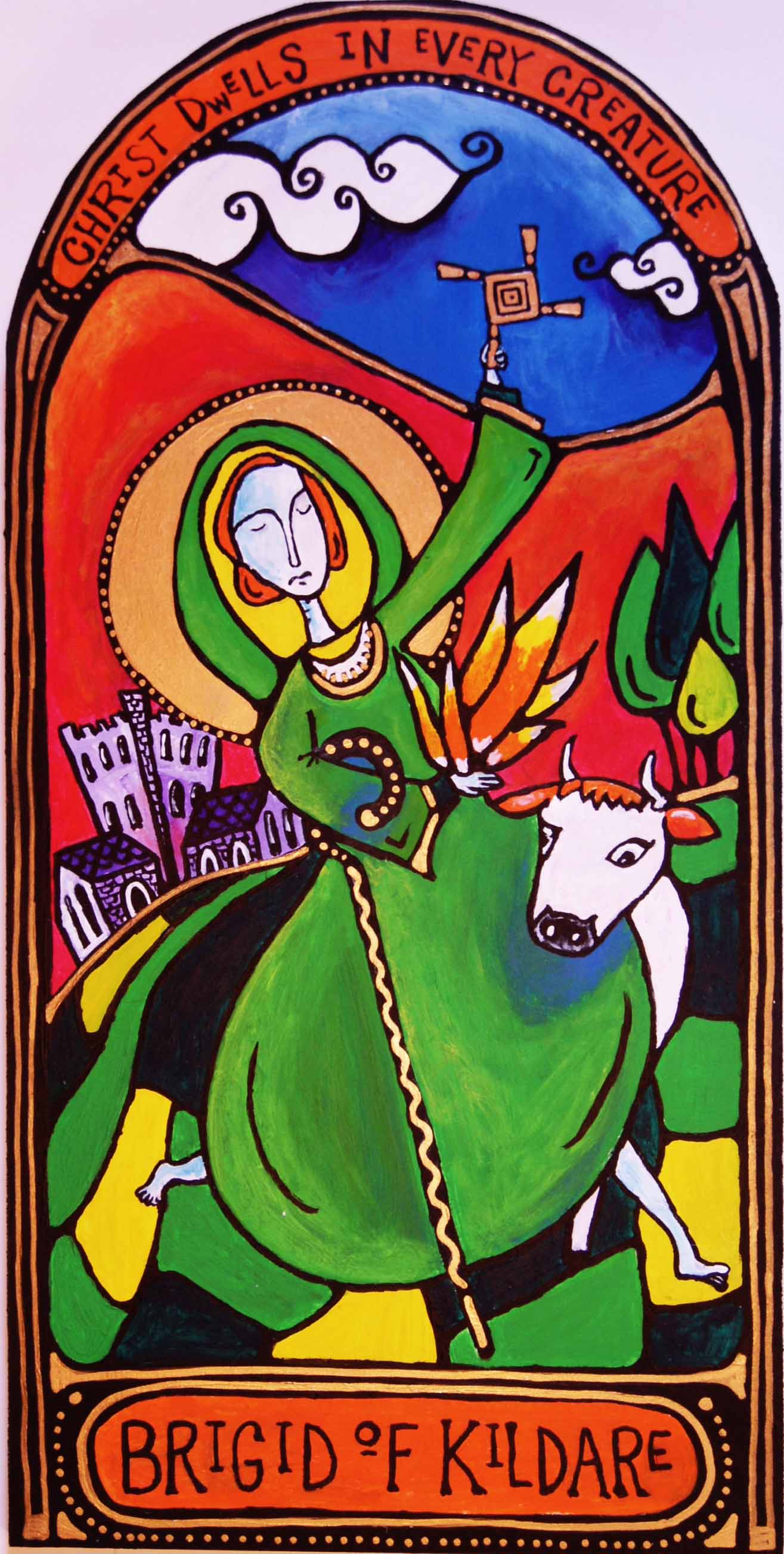
St. Brigid and the Fruit Tree
There was the moment
you could bear it no more.
Your eyes brimming with
great glistening drops
summoned by the hunger of
the world, the callous and
terrible things men and
women do to one another.
Your tears splashed onto
cold stony earth, ringing out
like bells calling monks to prayer,
like the river breaking open to
the wide expanse of sea.
From that salt-soaked ground
a fruit tree sprouts and rises.
I imagine pendulous pears,
tears transmuted to sweetness.
There will always be more grief
than we can bear.
There will always be ripe fruitflesh
making your fingers sticky from the juice.
Life is tidal, rising and receding,
its long loneliness, its lush loveliness,
no need to wish for low tide when
the banks are breaking.
The woman in labor straddles the doorway
screaming out your name.
You stand there on the threshold, weeping,
and pear trees still burst into blossom,
their branches hang so heavy, low,
you don’t even have to reach.
–Christine Valters Paintner
Dearest Monks and Artists,
This is a shorter love note this week as I am away teaching in the UK, but I wanted to send my latest poem in the dancing monk icon series. Brigid is a beloved Irish saint and I too have fallen more and more in love with her the longer I live in this sacred landscape. The stories and threads which tie her to ancient goddess tradition and Christian saint reveal a woman who is in love with life, who shows the most tremendous compassion for others who are struggling, and who offers us guidance and wisdom in our lives.
The monk is called to hold the tensions of life – to savor the grace and gift of it all while also welcoming in sorrow and grief. Our lives are like the rhythm of the sea, calling us to rise and fall, to feel the fullness of joy and the ache of loss.
If spending time with St. Hildegard, Brigid, Benedict, Brendan, and Mother Mary makes your heart flutter, please consider joining us for our Advent & Christmas online retreat where we will focus on a different mystic/saint each week and the archetype they invite us to embrace. Reflections, songs, poetry, SoulCollage, dance, and herbs will all be a part of this journey. We have an incredible group of artists and teachers offering their gifts to the community.
With great and growing love,
Christine
Christine Valters Paintner, PhD, REACE
www.AbbeyoftheArts.com
Photo top: Brigid dancing monk icon by Marcy Hall
November 9, 2014
Spiritual Formation with Music, St. Francis, and Frosty the Snowman (guest post from Richard Bruxvoort Colligan)
For the last several months, we have been embarking on an exciting creative project and collaboration. It started with choosing 12 dancing monks to be a part of the original Dancing Monk Icon series painted by Marcy Hall. These icons were meant to depict some beloved monks and mystics in a joyful and colorful way, reminding us of our call to dance through this life. I have been following with a series of poems I am slowly writing about each of these wondrous figures, choosing moments in their stories to illuminate.
Then we had the inspiration to feature a dancing monk for each week of our Advent/Christmas and Epiphany/New Year's online retreats. In conversation with my beloved teaching partner Betsey Beckman, we started to dream of having a song composed for each one as well, which Betsey would create gesture prayers and dances to accompany them.
So we enlisted the help of some musicians we love, including Richard Bruxvoort Colligan. One of the great joys of the Abbey is collaborating with other artists to create resources that support the life of this community.
I asked Richard if he might reflect on the process of creating the songs he was responsible for, as an insight into the creative process.
(You can read the first post in this series by musician David Ash here)
If you would like to join us for these online retreats you can find the registration info here:
Birthing the Holy: Advent & Christmas Online Retreat with Monks, Mystics, and Archetypes
Illuminating the Way: Epiphany & New Year's Online Retreat with Monks, Mystics, and Archetypes
Read on for Richard's reflection:
Have you heard? We’re making an Abbey album! A soundtrack for pilgrims and our adopted Dancing Saints. There’s nothing like it anywhere.
When Abbess Christine asked me to be one of the songwriters, I was tickled because making songs on behalf of a community is one of my favorite things to do. Plus, what could be better than spending time with Thomas Merton, Amma Syncletica, Rainer Maria Rilke, Benedict of Nursia and St. Francis of Assisi?
Can you imagine singing with these saints? Dancing together?
Music as a spiritual practice means we enter a song as a way to discover and stretch beyond and within.
Whether the music is contemplative or groovy, singing weaves the words and ideas into our consciousness using both brain hemispheres. What we upload in this way we test and often come to believe. What we believe, in turn, becomes part of our core.
John Bell of the Iona Community of Scotland says the songs we teach one another are about spiritual formation, that the songs we teach our children are preparing them for their death beds. Which is to say music gets life-giving stuff into our bones where we have access to them at any moment.
That’s been true for me, too. Family lore says whenever I was scared as a kid, I’d ask mom to sing the most happy song I knew: “Frosty the Snowman.” I still get teased about that, and I still insist Frosty is healing the world with his “thumpity thump thump.”
Imagine us singing together in a circle, looking at faces, feeling one another’s breath, listening carefully to the sound of humanity within and about us. The day after or the following week that song might pop into our heads in the shower, on the train to work or as our heads rest on the pillow after a long day. As that song carries that moment to us again, we will remember, resonate and integrate that experience of being together.
I’m excited about the Abbey’s adoption of these great dancing saints, the presence of whom are good company for our journey. Marcy Hall’s visual art for each saint is brilliant. We’re hoping these recordings will be another way to engage with them.
I want to tell you about one of songs and what happened to me in the process of making it.
St. Francis is one of my heroes because shows me what’s possible in a life. I love him and have been a student of his Tao since seminary ten years ago.
The phrase Christine has tagged on his icon is stunning and simple: “The world is my monastery.” Perfect for us monks in the world.
I decided to make a slow, walking song, and use these words and not much else.
At the same time, I felt the tug to risk adding something fresh. In the spirit of Francis who set aside the safety of his original home to discover the Christ, I wondered what it might be.
One of Francis’ gifts is a model of an integrated life deeply engaged with both one’s own unique spirit and with all of creation: “The world is my monastery.” An earth-wide church. A wide and wild field for prayer and service connected to a great cloud of witnesses.
I wondered how Francis might feel about adding, “The world is my home.” A place of anchoring and identity. A primary place of stretching and growth and pain and delight. A place to be open-hearted in order to discover our fullness.
What if our home planet is that sacred place of home?
And I wondered about adding the phrase, “The world is my heart.” The soul, the unique essence of the self, including some mysteries about how our thoughts, feelings, bodies and instincts even work.
What if planet earth is the heart of us?
We will sing with St. Francis:
The world is my home
The world is my heart
The world is my monastery
It’s harvest time in the Midwest where we live, and farmers are finishing in the fields. With the resonance of All Saints and a glimpse ahead to Thanksgiving and Winter solstice, it’s an intense season for many of us.
How great to be connected with one another as monks in the world in the monastery of the world.
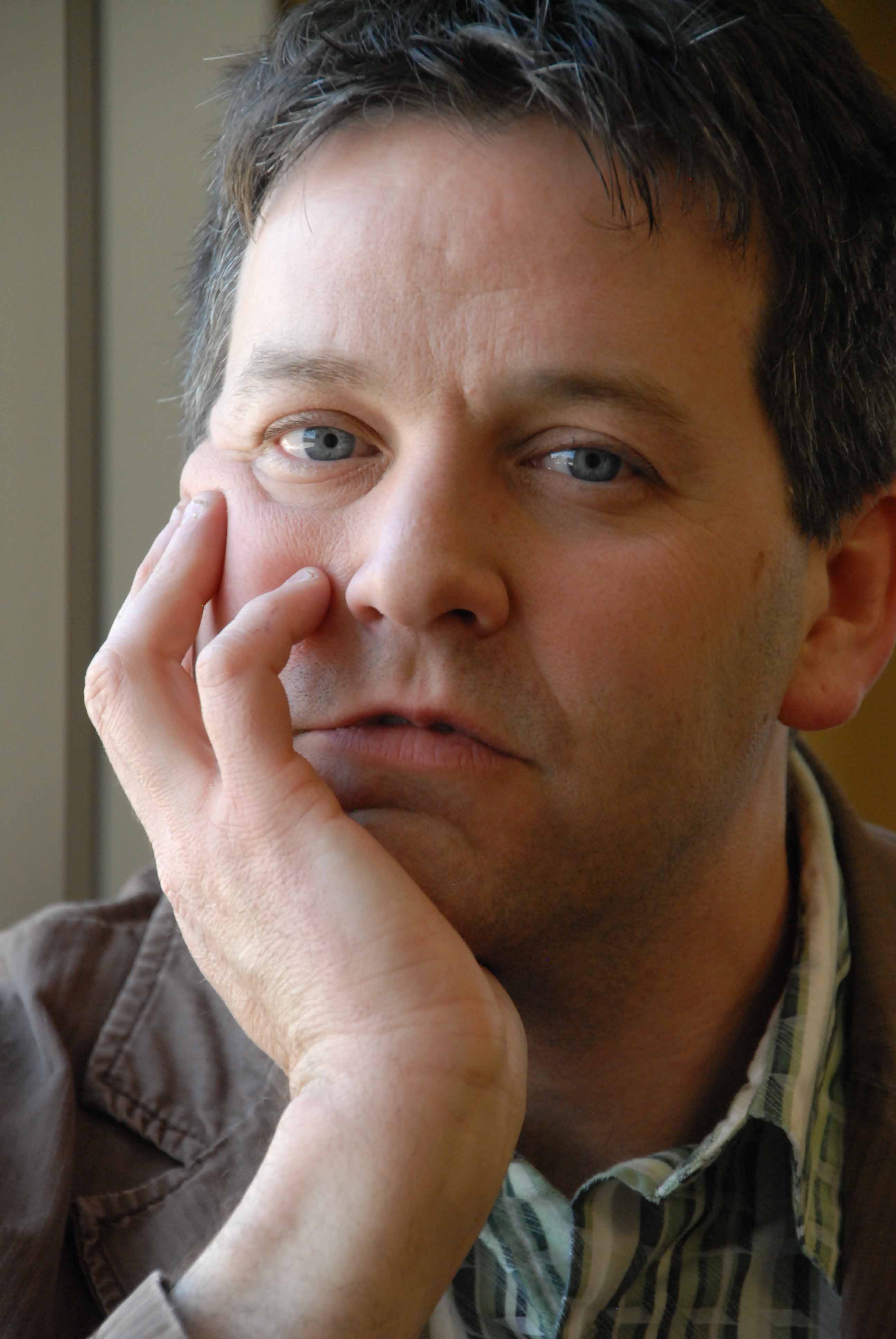 Richard Bruxvoort Colligan is a Psalmist, husband, dad, son and brother, and a contributor to the Abbey of the Arts. He’s just completed his fourth album of songs based on the Psalms, “Love Stands With.”
November 8, 2014
Invitation to Photography: Honoring Saints & Ancestors
Welcome to this month's Abbey Photo Party!
 I select a theme and invite you to respond with images.
We began this month with a Community Lectio Divina practice with our reflection on honoring saints and ancestors from the story in the Letter to the Hebrews.
I invite you for this month's Photo Party to hold these words in your heart as you go out in the world to receive images in response. As you walk be ready to see what is revealed to you as a visual expression of your prayer.
You can share images you already have which illuminate the theme, but I encourage you also to go for a walk with the theme in mind and see what you discover.
You are also welcome to post photos of any other art you create inspired by the theme. See what stirs your imagination!
How to participate:
You can post your photo either in the comment section below* (there is now an option to upload a file with your comment – your file size must be smaller than 1MB – you can re-size your image for free here – choose the "small size" option and a maximum width of 500).
You can also join our Holy Disorder of Dancing Monks Facebook group and post there. Feel free to share a few words about the process of receiving this image and how it speaks of the harvest for you.
*Note: If this is your first time posting, or includes a link, your comment will need to be moderated before it appears. This is to prevent spam and should be approved within 24 hours.
Becoming a Monk in the World: Monk Manifesto
We are delighted to announce that our Monk in the World online course is now in a full-color booklet format including the wonderful illustrations from Kristin Noelle and reflections by Christine. You can order your copies directly through Blurb for $20 each, in a 7×7 inch format they make great companions for times of retreat and great gifts to help nourish the inner monk of someone you love.
The $3.41 profit from the sale of each booklet goes directly to support our scholarship fund and Earth Monastery Project.
We also plan to make a booklet with the dancing monk icon series (along with poems and song lyrics) available in the New Year.
Becoming a Monk in the WorldbyChristine Valters Paintner | Make Your Own Book
November 6, 2014
Worlds Coming Together (a love note from your online Abbess)
Dearest monks and artists,
This has been an incredible couple of weeks with our renewal of vows for our 20th anniversary where American friends and Irish friends gathered with us together to celebrate. It felt like our worlds were coming together in a beautiful way.
Then, just before the pilgrimage began, a shipment of our things from Seattle which had been in storage for the last two and a half years, arrived. This included two pieces of furniture from my father's family in Austria, an oil painting of my grandmother, lots and lots of family photos, and some other mementos from my parents like the wool cape my mother sewed and the hiking stick my father used in the mountains of Austria. We were finally ready to make the commitment to be here in Ireland long-term and so had everything shipped over in late August. The unplanned timing of arrival to fall during the week of Samhain and All Saints/Souls was very poignant and sweet. It felt again like my worlds were coming together, to bring these things which connect me to my ancestors here to our new home in Galway.
I love the Irish monastic tradition of peregrinatio, of setting out on a pilgrimage without destination and following the currents to the place of resurrection. In many ways, our setting off from Seattle for Europe felt in deep kinship with this tradition and longing – to be guided to the soul's true home and landscape without knowing exactly where that would be. I have been falling more and more in love with Galway the longer we live here and it has become clear that this is our place to set down anchor for a long while.
I also love the Benedictine tradition of stability, of committing to a place and a community and not running away when things get difficult or challenging. We have been in a season of peregrinatio, but now are called to enter a new season of stability. We no longer need to wander and seek, and are deepening into the gifts and mysteries of this place we now call home. We celebrate the friendships formed here and our slowly growing local community.
Sometimes in life we are called to be pilgrims, and sometimes we are called to stand firmly in one place and say "here." It is only in listening to the wisdom and guidance of the Spirit that we can discern which one it is the season for. There have been many struggles along the way, times of doubt and resistance, of loneliness and restlessness, and yet now I feel like we have fully arrived and Ireland has an abundance of riches to keep offering to us. My joy overflows.
We have a pilgrimage group with us this past week, and it has been incredibly powerful to sit at this threshold of entering the dark half of the year, the time when the Celtic imagination believes the veil is especially thin between worlds. With the arrival of all these physical ties to my ancestors, I am feeling surrounded by a multitude all whispering: "you are home now."
This past Friday we went to Brigit's Gardens, always a favorite with our pilgrims. Jenny Beale, who is the founder and visionary behind this magical place led us in a Samhain ritual. "You can rest now" she said to the gardens, it is the season of incubation ahead, of dreaming and replenishing. "You can rest now" is the invitation to each of us living in the northern hemisphere.
Next week I travel to the UK with Betsey Beckman to teach our Awakening the Creative Spirit intensive with another amazing group gathering. It is an incredible gift to spend time with dancing monks. Then I return mid-November for four contemplative months at home working on my upcoming book Coming Home to Your Body and our series of online retreats from Advent through Lent. See more details below.
Consider joining us for our Advent & Christmas online retreat where we will focus on a different mystic/saint each week and the archetype they invite us to embrace. Reflections, songs, poetry, SoulCollage, dance, and herbs will all be a part of this journey. We have an incredible group of artists and teachers offering their gifts to the community.
If you will be shopping for the holidays with Amazon.com at all, we would be very grateful if you would use this link. When you shop through that link we receive a very small percentage of your purchase price and no extra cost to you. These funds help support our scholarships to those who can't afford to join our programs otherwise.
For those of you who might have missed it last week, see below for my gift to you as we enter this season of new beginnings and the remembrance of ancestors.
With great and growing love,
Christine
Christine Valters Paintner, PhD, REACE
www.AbbeyoftheArts.com
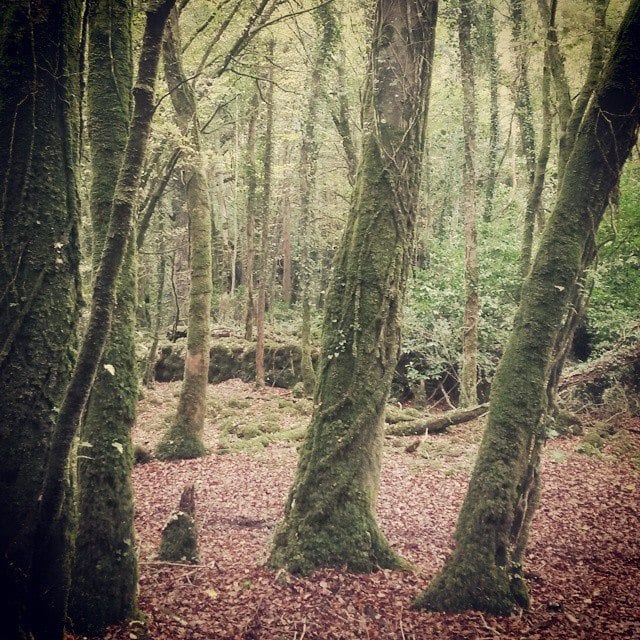
Photo: Forest at Cong Abbey
November 5, 2014
Monk in the World guest post: Lynn Domina
This week in our Monk in the World guest post series we have a reflection from fellow monk Lynn Domina. Read on for her wisdom on paying attention as a contemplative practice:
The Pleasure of Attention
Driving the route I ordinarily take from my home to the next town over, across a few hills and one mountain, around several curves always winding generally north, I pass thousands of trees. They all look alike, green in summer, red and orange in the fall, bare in winter. Many are conifers though, and so they do differ from the deciduous maple, oak, and ash. I called them all pine, even though I recognize the tree in the center of our backyard as a blue spruce and the tall narrow trees along our property line as some sort of cedar.
Then a while back, I noticed something peculiar. Along one stretch of the road, the long cones on most of the trees hung in clusters, like bunches of bananas. I enjoyed the paradox, the suggestion of tropical fruit as the days shortened and the temperature dropped in my northern climate. Then I noticed how the needles always drooped downward on these trees, like weary fingers. I learned that the name of this tree is Alaskan Weeping Cedar, and I enjoyed knowing that, for the only other weeping tree I knew was a willow. Now I see them more clearly. I see their distinctiveness, and so I also see the distinctiveness of the surrounding trees, the ones that are not Alaskan Weeping Cedars.
Some of them have branches that angle upward while the limbs of others slant downward. Their needles shade not only from light to dark but from the yellow edge of green to the blue edge. I enjoy noticing this, and so I begin to notice more. I promise myself to look at the trees as I pass by them each trip over the mountain. Some of the needles do look stiff and prickly, but others spread out from their branches, growing intricately like lace. I promise myself to see where I am rather than to hover inside the worries of the day, encased in my anxiety as fully as I am encased in my car.
While I am paying attention to the trees, I begin to notice other things also. Soon after the snow has melted, I see the short yellow flowers my friend had assured me would blossom at the edge of the field, colt’s foot. I notice that some of the wildflowers growing alongside my woodshed have petals that are actually a series of layered tinier petals, and I begin to leave the wildflowers be, growing among the perennials we’ve planted intentionally. I admit that some of them get a little too high, and some of their stems are a little bulky and their leaves are untidy, but their purple and white blossoms are so pleasant looking there among the green.
I begin to see more animals scuttling across the road too, not only squirrels and chipmunks, but a juvenile red fox and a baby woodchuck. Deer graze occasionally in cornfields, but they seem to prefer new mown hay. In early spring, they huddle together, a dozen or two nipping at the scant patches of grass, but by summer they spread themselves apart, eating leisurely. One day, a parade of geese paces off the circumference of a pond downhill from the deer, a mother and her young. The babies look like gray puffballs. They grow quickly but remain soft and downy for weeks. Then one day they’re adolescents, covered with feathers, half as large as their mother. I know that in a few more weeks, they’ll have flown off, somewhere south. When I drive by and look for them, they’ll be gone. I’ll feel a pang of loneliness. I feel that pang now, even as I remind myself that they’re still here, as am I.
This world—how abundant it is, how mystical. And I am part of it—the cedars, the spruce, the pine, the maple, the chipmunk, the geese, you, me. Giving the world attention requires active engagement, though it can seem so passive. Meditation, contemplation—they are experiences that urge me to enter creation rather than hold myself apart from it. Turning my attention outward, I receive reassurance, renew my confidence in the God who could imagine such variety into being.
Paying attention is a contemplative practice; it slows us down, requires us to move through our days at a more reverent pace. Paying attention helps us to incorporate a little bit of sabbath time into every day. Observing the trees, the wildflowers, the domesticated and undomesticated animals in all their variety reminds me of how much attention God has paid creation. In this pause, this interruption of time, I recognize myself as one held up by the gaze of God.
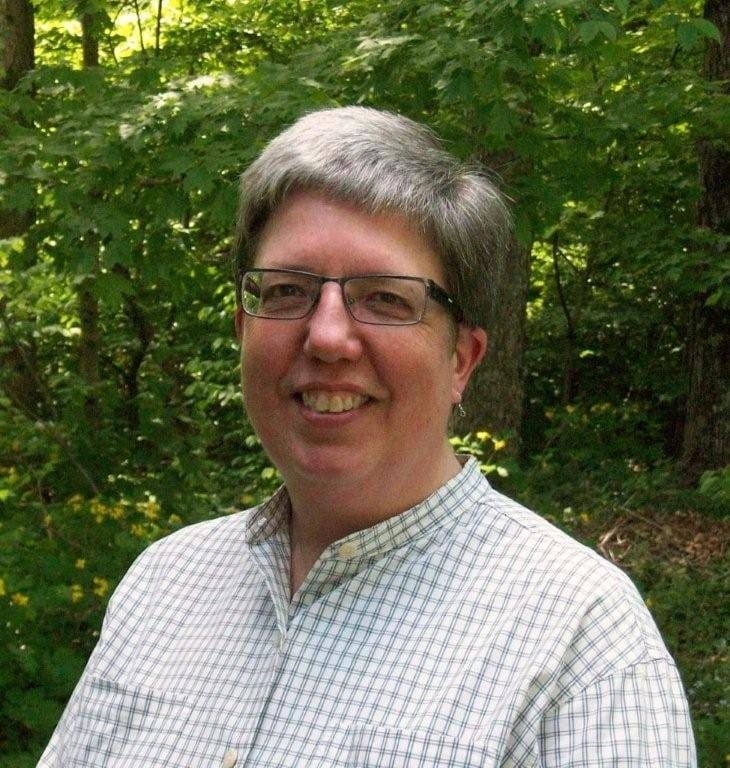 Lynn Domina is the author of two collections of poetry, Corporal Works and Framed in Silence, and the editor of Poets on the Psalms. She is a student at the Earlham School of Religion, where she takes courses in the Ministry of Writing and lives in the western Catskill region of New York.
Click here to read all the guest posts in the Monk in the World series>>
November 2, 2014
Sacred Rhythms Writing & Movement Retreat
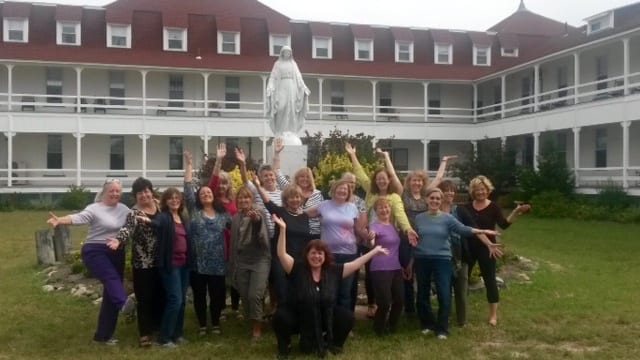
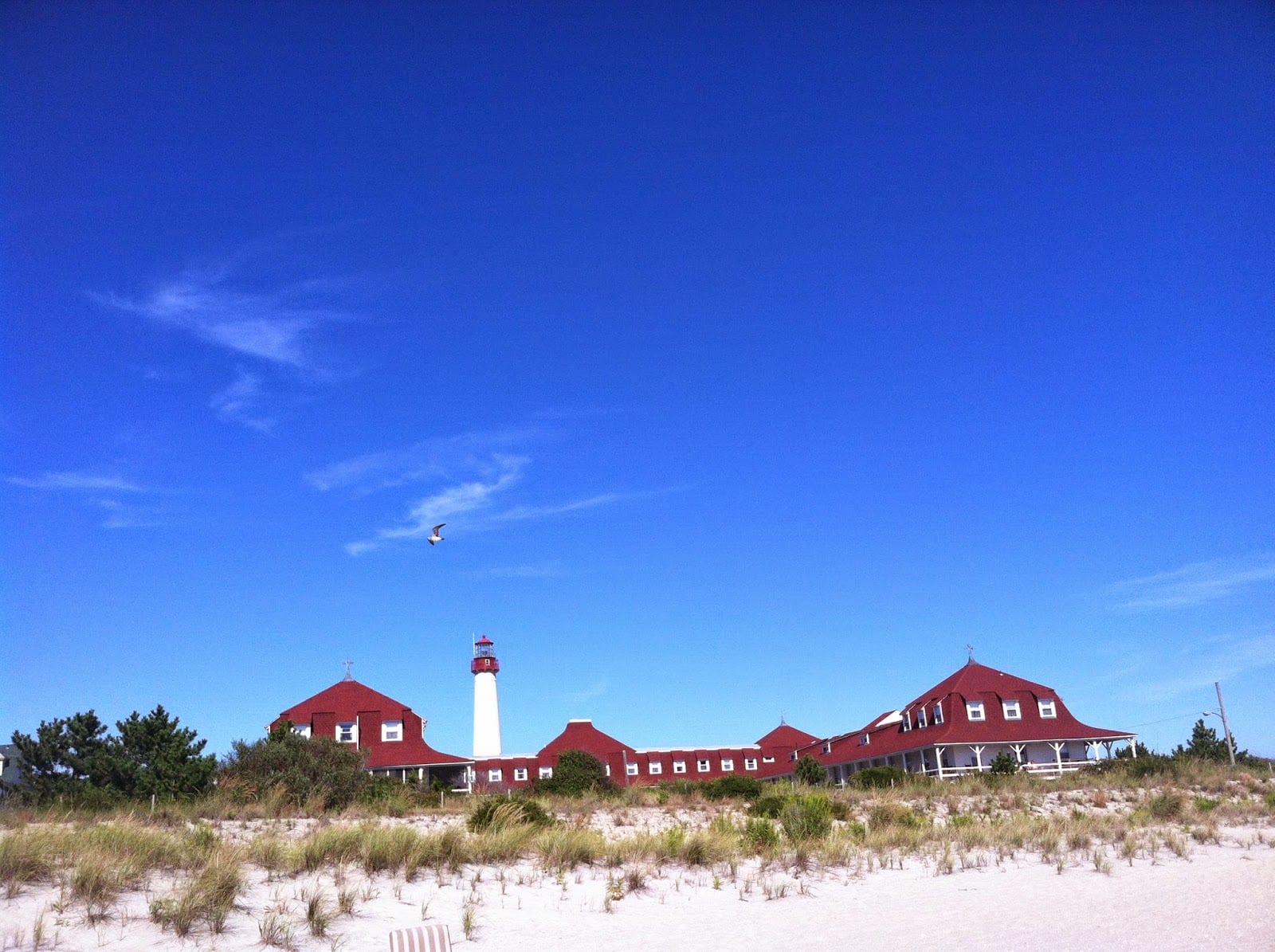
In September, I traveled to beautiful Cape May, NJ to lead one of my favorite retreats: Sacred Rhythms Writing and Movement Retreat (I need to work on scheduling another one soon, perhaps in Ireland!) An amazing group of 18 dancing monks gathered and we had a time full of joy, depth, and beauty together. We followed the monastic hours of the day with time for yoga, dance, and writing, so that we could explore what happens to our writing when we move into a more embodied place. What unfolds and flowers is always powerful!
Several dancing monks were willing to share their poems with our community and for this I am very grateful:
How to Be a Dancing Monk
Celebrate Everyday
Move Freely
Sit Silently
Offer Gentleness and Gratitude
Embody your Creativity
Connect with the Holy Spirit
Always Love, Share and Sigh often
—Jennifer Trently (poem and photo of St. Mary-by-the-Sea in Cape May, NJ above)
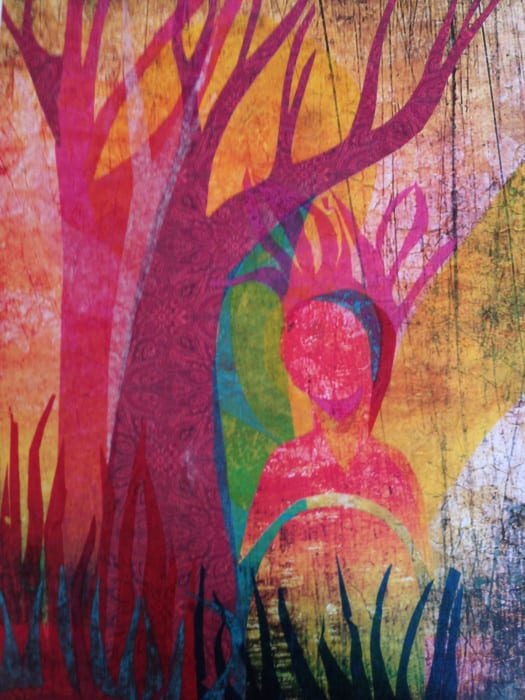
Dancing With Trees
The late summer heat
shimmers on my leaves,
my sap pulsing and throbbing
in my limbs,
Beckoning to you in the breeze,
come dance with me.
Set aside your trembling,
look deep in your heart.
I have been waiting
Standing strong for you
Feel my sacred life
in your bones.
Come dance.
—Mary Kerns, This Sacred Life (poem and image above)
Response to prompt: What is the boat that you are missing? (inspired by this poem)
What is the boat, what is the boat, oh my God, what is the boat? The boat is life as it unfolds, slowly, beautifully even as I rush about wanting experiences, wanting love, my dog sighs in his bed, loving the warmth of his own body heat reflected back and holding him in fuzzy flannel.
The boat is love blossoming everywhere in the obvious, in the unseen, hiding in crevices, in buzzing cicada songs, in flutters of wings and flow of willow branches, teasing in breezes and hints, in the color of pale blue climbing my split rail fence shouting glory, glory while I grab another bag to stuff full of things I might need on my journey. While I gather up supplies to ease anxiety or bring comfort, my husband’s eyes lovingly follow my movements in brown liquid wonder. While my heart aches for a sunset, a cup of hot chocolate, a cardinal, a sign that God is near….any damn sign will do in this hour of deep longing… I miss seeing how sunlight catches my friend’s hair and turns the white into strands of gold.
—Sharon Landis, Color My Soul (blog post excerpt)
What Do You Want to Remember from the Cape May Retreat?
The electric toothbrush, its absence mysterious
reappears next to the breakfast menu.
101 butterflies that flutter by–
monarchs framed by a single retangle of porch railing.
The lighthouse, white with a red top
that calls, here, here, here, from every direction.
The courtyand dance of chaos under Mary's watch.
A simple rocking along with the waves, just out of sight,
The flap flap flump of wild turkey, lands so close, intimate.
Two swans flare feathers, intruder bird flies.
The circle of women, writing together,
The sound of the bell. Time to stop.
—Johanna Rucker
A line from what each monk wants to remember
written down by Johanna
how my body felt during the 5 dance movements
the praying mantis that seemed lifeless–
what we thought dead, resurrected
the dolphins leap
three swans fly, necks stretched
the smell of salt air
the sea that caressed me all night
A bird teases me as I turn around
the escaped electric toothbrush reappears by the breakfast menu
the slamming doors raise the hair on even a dead nun's neck
lace curtains dance
the opening of sighs before dance
a great blue heron takes off, white swans lift away
the rush of autumn coming in
the clarity of the Milky Way, Sagittarius and Scorpio
the mirror dance of the lighthouse sweep
a healing from Mother Mary
Chicken Waldorf salad, two days running.
Photo by Johanna Rucker:

Group photo: