
Christine Valters Paintner's Blog, page 115
June 4, 2016
Join us for Way of the Monk, Path of the Artist
Dearest monks, artists, and pilgrims,
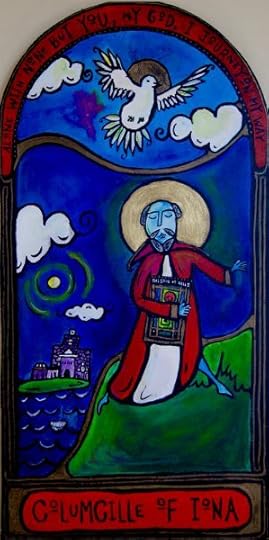
June 9th is the feast of St. Columcille, one of Ireland’s three patron saints, and the founder of the monastic community in Iona. Above is Marcy Hall’s wonderful dancing monk icon of him.
On June 13th we begin a summer online journey through my book The Artist’s Rule called Way of the Monk, Path of the Artist. Out of all my books, this one is still the best selling title, I think because it taps into this deep hunger for integrating contemplative practice with creative expression. When I started the Abbey 10 years ago I had no idea how far and wide the community of monks and artists extended in the world waiting for a place to call their own.
These words, inspired by a poetry writing exercise to write a poem of instruction, tumbled forth from me years ago as I discerned writing the book:
Be. Here. This Moment Now is all there is, don’t go seeking another. Discover the sacred in your artist’s tools, they are the vessels of the altar of your own unfolding. Look at this cup of holy water, washing clean the brushes. See the blank page, awaiting your blessing. Gaze on the colors before you, each one a name of God: Saffron, Cobalt, Azure, Ruby. Say each one slowly and taste its juice in your mouth. Let this be your prayer. Brush them across the page. First the small strokes, then the larger sweeps. Lose track of all time. This too is prayer. Listen for the words that rise up: Awaken. Envision. Sing. Alleluia. Place marks on the page saying I am here. Watch as word and image dance together. Luminous. Illuminated. This is your sacred text. This is where God’s words are spoken, sometimes in whispers, sometimes in shouts. Be there to catch them as they pass over those sacred lips, tumbling so generously into your open arms.
Most of the books I write are process-oriented, meaning that they are best savored slowly, working through the material week by week, rather than in one big gulp. Much like the way of the monk. They are also enriched by engaging in them in community, to enter into conversation around the ideas, to share one’s creations in a safe space, these all bring the work to life even more.
For this next offering of the 12-week online retreat I have a special added bonus of six teleconference calls where I will be sharing further on the ideas in The Artist’s Rule, from 5 years on after publication. If you can’t make the scheduled times these will be recorded for later listening.
Join us for Way of the Monk, Path of the Artist. There is always an amazing community of monks and artists that forms. You do need to purchase the book to accompany it as well.
With great and growing love,
Christine
Christine Valters Paintner, PhD, REACE
Photo © Columcille Dancing Monk icon by Marcy Hall at Rabbit Room Arts
The post Join us for Way of the Monk, Path of the Artist appeared first on Abbey of the Arts.


May 31, 2016
Monk in the World guest post: Tim Olivieri
I am delighted to share another beautiful submission for the Monk in the World guest post series from the community. Read on for Tim Olivieri's reflection on not overthinking compassion.
In my early 20’s I lived as a member of a Roman Catholic religious order. Once, while traveling to visit family, a woman in the Philadelphia airport began to make conversation with me. A the time, I was reading In The Spirit of Happiness by the Monks of New Skete. She told me how her employer had called her to Philadelphia only the night before. She arrived that morning, was unceremoniously fired, and put on the first flight home. She was putting on a brave face and trying to laugh about the inhumanity of it all. I could only imagine the pain, embarrassment, and uncertainty that she was feeling, and would likely feel more intensely later that night. As my flight was called, I gave her my book. She had a long wait, followed by a long flight and then an uncertain homecoming. She was a single mother who was very recently unemployed.
Years later, I am no longer, by all outward appearances, a monk. I am married. I am a father. I wear a tie to my secular job. I meditate daily. But, unlike my former life, I also worry about bills, work deadlines, the sorry state of my retirement account and if I will be able to pay for my daughter to receive the quality education I feel she deserves.
Silence, as a spiritual practice, has always come easily to me. From the time I first read Thomas Merton in high school I began finding peace and serenity once I retreated into silence. My walking meditation has likewise always been an enjoyable practice. Where I have always been lacking was in the area of compassion. Empathy? No problem. I find that I empathize with others readily. I recognize their suffering. I’m just very bad at doing anything about it.
I’m inclined toward introversion. My spiritual practice throughout my teens and 20’s was introspective. I empathized with the homeless and the suffering. But I never ventured outside of my comfort zone to learn how to connect with them. I never would have had the positive interaction with the woman in the airport had she not started the conversation. It was easier to simply bask in my silence. Retreating inward is easy. My challenge is the outside world.
Spiritual exercises are not unlike physical exercises. When they become too easy the benefit to us diminishes greatly. The resistance we experience enables us to grow. Without resistance, there is no growth.
Flash forward to my present life. An Ivy League university with a multi-billion dollar endowment is situated to my right. To my left, you can see the probation office, the drug treatment center and the subsidized housing. Right in the middle is the trendy little walking commons where the two worlds meet. The homeless beg for money and food while the wealthy browse in trendy shops. I have to walk through this space to get to my office every day. My walking meditation often makes me oblivious to those around me. I cannot count the number of times that, wholly wrapped up in my own introspection, I have walked past a particular corner with a daily changing homeless person. Even when I am aware of their presence, I find myself feeling awkward. I’m embarrassed to meet their gaze. I’m too ashamed to admit that I don’t know how to help. Too ashamed to admit that I wouldn’t know what to say.
One especially cold winter day, I was preparing to leave the office when I noticed three small oranges in the break room that were free for the taking. I love oranges. I put them into my coat pocket and headed out. It was snowing. The falling snow was brilliantly illuminated by the street lights. Students and locals walked about, ducking into expensive shops, upscale eateries and high end cafes. There, on that same corner, was a woman huddled beneath a comforter.
My meditative walk was uninterrupted. I walked over and pulled the oranges out of my pocket and offered them to her.
“Hi, I’m Tim. What’s your name?” I said without giving myself an opportunity to think before speaking.
“I’m Sarah. Thank you," she said as she took the fruit.
“Enjoy them, Sarah. Please stay warm.”
“I will, God Bless you,” she said.
As I walked toward my car I realized that my weakness was not in compassion. Rather, my weakness was overthinking compassion. On this occasion I acted without conscious thought. On any other day I selfishly worried about how I might “do” compassion wrong; how I may embarrass myself by saying the wrong thing. And so, I avoided saying anything. In doing so I missed the point of my meditative reflections and my efforts– to be a better person.
Is there a moral here? Perhaps. Don’t think about being a better person. Just be."
 Tim Olivieri is a former member of a Roman Catholic religious order. After leaving the religious life he converted to Judaism. He now lives in Ithaca, NY with his wife and daughter and maintains a daily spiritual practice.
The post Monk in the World guest post: Tim Olivieri appeared first on Abbey of the Arts.
May 28, 2016
St. Kevin and Holy Yielding ~ A love note from your online abbess
 St. Kevin and the Blackbird
(after Seamus Heaney)
Imagine being like Kevin,
your grasping fist softens,
fingers uncurl and
palms open, rest upward,
and the blackbird
weaves twigs and straw and bits of string
in the begging bowl of your hand,
you feel the delicate weight of
speckled blue orbs descend,
and her feathered warmth
settling in for a while.
How many days can you stay,
open,
waiting
for the shell
to fissure and crack,
awaiting the slow emergence
of tiny gaping mouths
and slick wings
that need time to strengthen?
Are you willing to wait and watch?
To not withdraw your
affections too soon?
Can you fall in love with the
exquisite ache in your arms
knowing the hatching it holds?
Can you stay not knowing
how broad those wings will
become, or how they will fly
awkwardly at first,
then soar above you
until you have become the sky
and all that remains is
your tiny shadow
swooping across the earth.
—Christine Valters Paintner
Dearest monks, artists, and pilgrims,
June 3rd is the feast day of St. Kevin. The story of Kevin and the Blackbird is perhaps one of my favorites of all the Celtic saints. He would pray every day in a small hut with arms outstretched. The hut was so small though that one arm reached out the window. One day, a blackbird landed in his palm, and slowly built a nest there. Kevin realized what was happening and knew that he could not pull his hand back with this new life being hatched there. So he spent however many days or weeks it took for the eggs to be laid, and the tiny birds to hatch, and for them to ready themselves to fly away.
I love this story because it is such an image of yielding, of surrendering to something that was not in the “plans,” but instead, receiving it as gift. Instead of sitting there in agony trying to figure out how to move the bird, he enters into this moment with great love and hospitality.
How many times in our lives do we reach out our hands for a particular purpose, and something else arrives? Something that may cause discomfort, something we may want to pull away from, but in our wiser moments we know that this is a holy gift we are invited to receive.
Join us in Ireland on pilgrimage where St. Kevin is one of our wisdom guides for the journey!
With great and growing love,
Christine
Christine Valters Paintner, PhD, REACE
Photo © St. Kevin Dancing Monk Icon by Marcy Hall at Rabbit Room Arts.
The post St. Kevin and Holy Yielding ~ A love note from your online abbess appeared first on Abbey of the Arts.
May 24, 2016
Monk in the World guest post: Susan O’Connell
I am delighted to share another beautiful submission for the Monk in the World guest post series from the community. Read on for Susan O’Connell's reflection listening and contemplation:
Listening to the silence is truly one of the great spiritual practices, in which we tune into a deeper level of being and of experience. Silence in nature can facilitate that deeper connection to ourselves through allowing us to listen more deeply to our hearts and bodies. Nature or wilderness can provide a holding environment so that we can relax the ways we chronically constrict ourselves. (Hutton, 2003, p. 250)
Having an affinity for communication and service, it came as a surprise to me how much my soul yearned for quiet. In response, I began to dedicate time to contemplative practices such as yoga, meditation, creative expression and nature walks. These slow and quieting practices enabled me to reach deep into the well of silence. They assisted me to listen to, and trust, subtle ways of knowing beyond thought. Contemplative practices created space to explore the Divine mystery, to become aware of my soul’s longing, and to be fully present to others, often recognizing an unspoken meaning. I began to have glimmers of understanding about Longaker’s (2003) words regarding the “spaciousness,” and “unbounded gratitude” found through meditative practices (p.8).
The contemplative practices holding the deepest meaning for me take place in nature. As long as I remember, I have felt a connection with the natural world. At the time of my upbringing, children were encouraged to be outdoors a good part of the day and into the evening. I was allowed the experience of being alone in a sensual natural world. My child’s heart and body felt connected to earth when I was surrounded by the beautiful, singing, and creative world. My imagination came alive when I witnessed the crashing waves, the trees dancing in the wind, and the pelicans in flight. Further, I was drawn into the mystery of life, recognizing both a sense of self and the Sacred. It was in nature that I most easily experienced well-being, wonder and joy. Today, I am aware how deeply nature has informed me throughout life.
To return to dedicated nature engagements in adult life is a blessing. My favorite contemplative practice involves walking in nature. Being in nature assists me to empty my busy mind which creates a spacious opening for image, soul and the Sacred. When I stay faithful to my daily walks, I feel my senses opening in alignment with the natural world and all beings. I notice an inner sense similar to a burst of color, texture, and joy, as when coming out of a dark, dense forest and being surprised to see a green meadow carpeted in wildflowers and interwoven vines. As I bear witness to, and absorb, the diversity found in nature, I am called to offer back care for earth and those beings that live in the wild. These experiences serve to awaken me from sensory slumber and I sense a re-kindling of life love. These sparks of light grow to flames that nourish me. I understand that for me the natural world offers a portal to the Sacred. This is all very quiet, yet powerful.
There seems to be an invitation from the sacred regardless of the contemplative practice chosen. Within months of returning to contemplative practices, I noticed a resurgence of creative energy. It became clear that nature inspires my creative expression. This occurs organically through listening, which offers space for the unknown, and through walks in nature, which provide image, rhythm, and diversity. My imagination is enlivened through a cross pollination of practices.
One way I explored the healing aspects of nature and creative expression was in addressing the grief that accompanied my father’s death. The image that spoke to my sense of sorrow was that of a bleak, snow-laden landscape with no growth as far as the eye could see. The sky above was steely gray and unmoving. The sound was muted, and the air was icy cold. I pictured myself lying on the cold snow facing the gray sky while snow softly fell from the sky. I was exposed to the harsh elements even as the world turned around me. Visualizing and then painting this image offered comfort as I fully received and digested one of nature’s cycles.
The gifts of contemplative practices and listening are varied and subtle; offering an avenue for inner and outer growth and expression, as well as experiential recognition of the Sacred. Thomas Merton writes beautifully;
'When I am liberated by silence, when I am no longer involved in the measurement of life, but in the living of it, I can discover a form of prayer in which there is effectively, no distraction. My whole life becomes a prayer. My whole silence is full of prayer. The world of silence in which I am immersed contributes to my prayer.'
(In Dear, 2001, p. 29)
As my openness and receptivity expands so too does my calm center merge into my everyday life until I experience a sense of belonging and unification with all of life. I feel released from many self-imposed and learned constrictions. All this invites me to offer myself to the world in a new way, and I am grateful.
Today, I continue to follow the call to engage the many ways of listening through contemplation practices knowing this as a lifelong learning process. I notice how contemplative practices influence the way I navigate within the context of communication. As I stumble along this learning path, my language broadens even as it decreases, and I have come to appreciate open, non-valuing queries and comments. These changes enable me to be more compassionately present to others, regardless of where they find themselves in life. I notice this benefits both the speaker and the listener when deep listening encourages reciprocity and rapport, which enables communication to flow trustingly from one heart to another. I begin to understand Ausburger’s beautiful meaning; “Being listened to is so close to being loved that most people don’t know the difference (In Brady, 2009, p. 15).”
References
Abram, D. (1996). The spell of the sensuous. New York: Random House. Cameron, J. (1998). On the path to creativity. Shambala Sun 6(5), 36-41.
Dear, J. (2001). Living Peace: A Spirituality of Contemplative and Action. Doubleday Religious Publishing
Hutton, M. (2003). Listening to the land. In M. Brady (Ed.), The wisdom of listening (pp.243-260). Somerville, MA: Wisdom Publications.
Lawrence, Brother. (Ed.) (2003). The practice of the presence of God. Boston: New Seeds Books.
Longaker, C. (2003). Listening with presence, awareness, and love. In M. Brady (Ed.), The wisdom of listening (pp. 7-22). Somerville, MA: Wisdom Publications.
Muller, W. (1999). Sabbath. New York: Bantam Books.
 Susan O’Connell, MTP serves as the Creative Expression Certificate (CEC) Director at Sofia University where she also teaches Creative Expression and Ecopsychology. Susan serves as Co-Chair for IEATA where she was awarded the professional credential of Registered Expressive Arts Consultant/Educator (REACE). She also serves through a multi-cultural ministry.
The post Monk in the World guest post: Susan O’Connell appeared first on Abbey of the Arts.
May 21, 2016
Pilgrimage + Join us for the free Illuminating the Way monthly calls ~ A love note from your online abbess
Dearest monks, artists, and pilgrims,
 It is hard for me to believe that ten years ago this month I first started writing the blog that became Abbey of the Arts and a global community. It is also hard for me to believe that four years ago my husband John and I were wrapping up the details of our life in Seattle, to go on a midlife adventure and pilgrimage to Europe and see where we would land. It is impossibly delightful that we have rooted ourselves here in Galway and now offer pilgrimages to others.
I offer you this reprise of a reflection I posted during that spring season of shifting in May 2012:
My husband and I put up the For Sale sign on our life as we know it. Our home has already sold, now we move through the process of closing. Something Holy is calling us East. It is an ancestral call, it is the call of the land itself, it is the call of our own unfolding longings. This time of preparation has many challenges and much grief and yet it is an essential part of the journey. This northwest landscape enlivens our souls, our friends are dear and beautiful, our neighborhood is thriving. This is a life we love, we are not running away from anything, but toward something invisible, yet shimmering with possibility. A new way of being, a simpler life, a slower life, a life with deep roots in ancestral stories, a life of more risk and adventure. A life full of things we can't even yet imagine.
We are feeling the call to move toward "an invisible goal, expending great energy with the possibility of failure; to live on migratory pathways into the future. . . an ancient summons. . . against the reasonable and safe." (Marianne Worcester) The natural world offers us so many symbols that speak to our inner life, creation is a map to the spiritual life. Everything outward is symbolic of an inner reality.
What is it that calls the great beating hearts of wild geese and king salmon, humpback whales and monarch butterflies to the very long, and often arduous, journey from one place to another? They do not doubt this call. They do not spend time and energy telling themselves stories why they can't follow the patterns of thousands of generation before them. They obey the longing, and in witnessing to that kind of obedience, we as witnesses are taught something about being a monk in the world.
My husband and I are carried on this journey ahead by the ancient wisdom of monks:
Our obedience to a call, an invisible thread drawing us forward; our commitment to conversion and always being surprised by God, even the monastic call to stability – which usually refers to staying in one place for a lifetime – in our case means staying with our experience and all of its doubts, uncertainties, questions, and judgments, and not running away from the inner challenges of being alive.
We must embrace a radical kind of inner hospitality as we welcome in all of the strangeness that we feel in moving to a foreign culture. Navigating new worlds, learning new customs, deepening into a foreign language, are all ways of extending welcome to the stranger within ourselves.
A profound kind of humility is also being demanded of us, as we recognize that we do not know – we do not know what exactly will happen, we do not know how long we will be there, we do not know how we will be changed by this experience. We will surely stumble and fall. We will certainly act foolishly at times. We do not know the magnitude of this path.
Simplicity is also calling to us. We are selling things and home and car and will be moving into a much smaller apartment in Vienna where we will rely on walking and excellent public transit. My husband has let go of his secure income and so we will have to live simply to make our finances stretch further. And in this letting go I feel the lifting of many burdens.
What will ground us is a commitment to return to the center. To make space for silence and solitude so that we can integrate all that is happening and unfolding. So that we might listen. The monk in the world knows that these holy pauses are essential for discovering the meaning of our experiences. There is no map, only the dropping deep into our hearts to hear the next step.
To return for a moment to the metaphor of migration and nature as wise teacher, I am exploring what it means to live a wild life. A wild life is one that is not domesticated or tamed or confined into boxes of safety, convention, or expectation. It is a risky way of being, because in the wild there is always an encounter with fierce forces. But the alternative is to slowly suffocate on dreams that dissolve by never allowing the opening. Monks are not concern with maintaining the status quo. The first monks went out into the fierce desert, knowing that life on the edges was fertile and rich. Living from the wild heart means remembering that God, the source and sustainer of everything, can see horizons much wider than we ever can.
What is the invisible thread you are being called to follow?
What would living from the wild heart mean for you in this season?
Stop by Monasteries of the Heart to read my guest post there.
Make sure to join us tomorrow for the first of our free monthly teleconference calls about my newest book Illuminating the Way: Embracing the Wisdom of Monks and Mystics.
If you missed our free Pilgrimage Preview Call, you can download it here. Listen to Christine read some poems, guide you in lectio divina, and hear John and Christine talk about what they love about pilgrimage as a sacred practice.
With great and growing love,
Christine
Christine Valters Paintner, PhD, REACE
Photo © Christine Valters Paintner leaving behind the U.S. in 2012 for our life pilgrimage
The post Pilgrimage + Join us for the free Illuminating the Way monthly calls ~ A love note from your online abbess appeared first on Abbey of the Arts.
One space just opened in our September 20-28, 2016 Ireland Pilgrimage!
 We just had one space come available for the September 20-28, 2016 dates of our Soul's Slow Ripening itinerary out of Galway where we explore Celtic wisdom for discernment. Imagine 8 nights on the wild west coast of Ireland exploring monastic ruins with kindred souls.
Please get in touch with me if you are interested in joining us or have any questions. Full payment for the program will be due at the time of registration.
The post One space just opened in our September 20-28, 2016 Ireland Pilgrimage! appeared first on Abbey of the Arts.
May 17, 2016
Monk in the World guest post: Mary Thomason-Smith
I am delighted to share another beautiful submission for the Monk in the World guest post series from the community. Read on for Mary Thomason-Smith's reflection on the homily of birdsong.
All nature sings, and round me rings the music of the spheres—Maltbie D. Babcock
Stepping on my deck for a deep, belly breath full of fresh air, the tranquility of an Indiana summer morning invites me to stillness, to receive the peaceful offerings of dawn. Green morning glory vines noodle their way through the wooden rails and posts that frame my space for prayer. A rabbit nibbles on clover just beyond the deck. The breeze stirs, ringing my neighbor’s wind chimes. The proud cardinal in the white pine summons me to morning prayer with his pure, cheer cheer. Aromas of dampened soil and grass rise like incense from the earth, while the warmth of golden light on my face is a morning discourse of the gospel: I am the light of the world. My soul settles in this space of serenity, my body softens to nature’s gentle, awakening presence, while sounds and scents vibrate with her hospitality of belonging: the earth is the Lord’s and everything in it, the world and all who live in it.
Creation sings to me God’s love song. Free of pretense, distortion or deception, it is a clear song given by our Divine Creator; a song pure of heart, utterly honest, trustworthy. I am not a stranger to song, having spent my life pursuing excellence of musical expression as a classical pianist, an organist, and presently directing a choir. Though graduate studies, I taught aural training and sightsinging to musicians, a course of study to develop a musician’s ear to identify musical patterns and relationships, to discern characteristics of harmony (major or minor chords, for example), to measure the distance between two pitches (intervals), and to transcribe (write in musical notation) rhythms, melodies and harmonic progressions. In addition, musicians practice singing musical intervals, melodies and rhythms at first sight. As a musician develops her ear, the greater her capacity to process, analyze and perform music. A culmination of my training, practice and teaching, I now realize, was my ear’s expanded ability to listen intently to the songs of creation, and to God, and my capacity to respond, in turn, with my own voice.
Following my transition from academia into the role of a practitioner musician, while embarking on my larger life’s purpose as a mother, birding became my hobby. Learning to identify birds by their songs, chirps, warbles, trills and repetitive calls was a delightful exercise combining my love of nature with an altogether unique challenge for my aural recognition skills. I shared this learning experience with my two preschool-aged children, Noah and Melody, comingling curiosity and growth with one another. From the library we borrowed materials to learn mnemonic devices for easier bird identification: cheeva-cheeva we learned was the call of the tufted titmouse, while we were charmed by the delightful little fellow who calls his own name, chick-a-dee-dee-dee.
As my children grew, we continued to savor occasional birding together, but their interests took different turns, so I kept my birding hobby alive for myself on my daily walks. In solitude, I discovered opportunity for a spiritual discipline of attentiveness to birdsong. As a result, rare and precious transcendent moments emerged for me through contemplation with birdsong. Prompted by my companion musicians, the birds, I experienced exquisite glimpses of closeness to God. Relaxing in a posture of openness to the beauty of their music, their songs brought grace into spaces of need in my soul. Like a cantor singing a psalm, their expressions led me into worship. And I willingly welcomed their lead. Their distinctively pure and effortless song fascinated me.
My present daily practice, very simply, is to appreciate the beauty of birds’ musical expression, and to embrace their musical invitation into worship, reverence, stillness, and ultimately, to release my voice as they do theirs. While I may be able to identify the bird by its call (or more often, not) I savor what their songs now signify to me: spontaneous praise, liberation of the voice, unprompted expression, freedom to sing the truth. It is a mystery to me, how God uses the beauty of creation to stir and soothe our spirits. As I listen with my heart’s appreciation turned to God’s beautiful gift of birdsong, I am warmed. Some mornings, it’s the eastern wood-pewee at whom I chuckle and am reminded, as he calls pee-a-wee, that laughter heals. Other days, it’s the white-throated sparrow’s lyric and plaintive, oh-sweet-Canada-Canada that calms my worries. This spiritual discipline is my delight. My practice is to listen, to pursue the hidden homily in their song, to experience their music as a means of grace. In birdsong, I find messages of joy and jubilance, fear and alarm, melancholy and sadness—songs, I too, must liberate myself to sing. And I offer God gratitude for these trustworthy friends who unfailingly coax me into song. "
 Mary Thomason–Smith is a musical artist seeking harmonious living through artistic expression in all roles and relationships in her life. Her interests include liberating the voice through the arts, through nature and through song. Nature that surrounds her home in Indiana provides inspiration and delight for her, her husband and two children.
The post Monk in the World guest post: Mary Thomason-Smith appeared first on Abbey of the Arts.
May 14, 2016
Celebrate Pentecost and the Feast of St. Brendan (Free Preview Call) ~ A love note from your online abbess
Dearest monks, artists, and pilgrims,
 Today is Pentecost and tomorrow is the Feast of St. Brendan, one of my favorite of the Irish saints. Here is another excerpt from my newest book Illuminating the Way:
Help me to journey beyond the familiar
and into the unknown.
Give me the faith to leave old ways
and break fresh ground with You.
Christ of the mysteries, I trust You
to be stronger than each storm within me.
I will trust in the darkness and know
that my times, even now, are in Your hand.
Tune my spirit to the music of heaven,
and somehow, make my obedience count for You.
—The Prayer of St. Brendan (attributed to Brendan)
I was not that familiar with Brendan the Navigator until I moved to Ireland. Officially, he would be known as Brendan of Clonfert, and there is a Cathedral in Clonfert, Ireland bearing his name and a site said to be his grave where I have visited.
The “Navigator” or “Voyager” is his more commonly known title because his life was defined by his seven year long journey across the sea to find the Island Promised to the Saints. He would have visited the island of Inismor off the coast of County Galway to receive a blessing from St. Enda before embarking on his journey, so I relish knowing I have walked and sailed on some of the same landscape as he.
He hears the call to search for this mythical island and it is revealed in a dream, an angel says he will be with him and guide him there. He brings along a group of fellow monks for community, and searches for seven years sailing in circles, visiting many of the islands again and again. Each year he celebrates Easter Mass on the back of a whale. Each year he visits the island of the birds, where white-feathered creatures sing the Psalms with his monks. Only when his eyes are opened, does he see that this paradise he seeks is right with him.
There is, of course, the actual narrative of a physical voyage. Tim Severin, a modern sailor in the 1970’s, re-created the voyage Brendan took, rebuilding the same boat, and landed in places like Iceland and Greenland. There have been suggestions that Brendan was perhaps the first to land in North America. This is the outward geography of the journey.
There is also a deeper, archetypal layer to this journey, which resonates with our own inner pilgrim – the part of ourselves drawn to make long voyages in search of something for which we long. This is the inward geography of the journey, and one where we may physically only travel a few feet or miles but the soul moves in astronomical measure.
The Navigatio, as the text of Brendan’s voyage is known in Latin, is a story of a soul rooted deeply in a monastic tradition and culture, as well as the liturgical cycles and rhythms, in early medieval Ireland. Each of the various parts of their journey take place in 40 and 50 day increments to reflect the liturgical seasons and the rhythms of fasting. They arrive to landfall to celebrate the major feasts and always accompanied by the singing of the Divine Office and chanting of the psalms. Time is not linear on this journey. Brendan and his monks move in circles, spiraling again and again to familiar places from new perspectives.
This journey is an allegory of spiritual transformation and the soul’s seeking to live and respond to the world from an experience of inner transfiguration with themes of Brendan’s waiting, anticipation, striving, searching, and seeing from a deeper perspective. The heart of the voyage asks us, what needs to change for the Land Promised to the Saints to be recognized? What is the way required through both illuminated and shadowy interior landscapes? Are we able to stay present through moments of solace, ease, and joy, as well as the anxiety, fear, and sometimes terror that comes when we let go of all that is familiar to follow our heart’s calling? Can we see the difficult journey as a passage of initiation?
There is a great deal of waiting in this journey, so much unknowing. There are whole seasons when they feel impatient and confused about why they can’t find the place they are seeking so diligently. Yet it is the very journey through the shadows that is required to make the desired discovery. Brendan doesn’t arrive to the promised land he seeks until he has made the arduous journey within.
I also have a reflection for Pentecost on the Call to Holy Surprise at Patheos, the last in my 8-part series on practicing resurrection. Click here to read >>
With great and growing love,
Christine
Christine Valters Paintner, PhD, REACE
Photo © St Brendan dancing monk icon by Marcy Hall at Rabbit Room Arts
The post Celebrate Pentecost and the Feast of St. Brendan (Free Preview Call) ~ A love note from your online abbess appeared first on Abbey of the Arts.
May 10, 2016
Monk in the World guest post: Adam Brooks Webber
I am delighted to share another beautiful submission for the Monk in the World guest post series from the community. Read on for Adam Brooks Webber's reflection on dancing with the sunrise.
I gather my weapons. No one else in the house is awake yet, save only the cat, and he’s too concerned now with the contents of his dish to pay any further attention to me. I ease the back door open and slip outside. The dew on the back steps chills my bare feet. The neighboring cottages are quiet, and there’s no one in sight. Good. I’d just as soon not be seen. With silent steps I make my way down the path, past the parking lot, past the old hotel, and onto the empty beach. I place my weapons carefully on the sand. I kneel, preparing myself.
Preparing myself, but not for violence. I have never used a weapon in earnest against another creature. I am a student of a traditional martial art—Karatedo Doshinkan—and my weapons this morning are simple wooden ones: the bo (a six-foot staff) and the tonfa (a pair of short sticks with handles). Each morning, when I can, I come to this beach on Lake Michigan to train, sometimes with weapons and sometimes without them. Each morning I begin with an opening ceremony of kiotsuke (gathering ki, life-energy) and rei (showing respect), preparing for my daily training in the way I first began to study more than twenty years ago. And each morning, as part of this ceremony, I kneel and pray.
Hanshi Isao Ichikawa, the founder of my style of Karatedo, opened each training with this traditional ceremony, which includes a time of kneeling silence. I never heard him give any instruction on what to do with this silence; it wasn’t his way to tell when he could show. I don’t think he thought of it as a time of prayer, but that’s what it is for me. In fact, my whole morning training is often a time of prayer—a time of heightened awareness of God’s presence.
The training itself involves the practice of many kata, traditional training dances. To learn a kata, a student watches a teacher carefully and attempts to imitate the movements. Kata are ancient teachings, kinetic traditions passed on through generations. They bear wisdom from out of the past, and they reward close study. Hanshi taught these movements carefully, but also used to emphasize that technique isn’t everything. In one rare moment of explanation he suggested that we try to perform kata as a mother sings lullabies to her child. When singing a lullaby it doesn’t hurt to have the vocal technique of a professional singer, but that isn’t the most important thing. What really makes a lullaby beautiful, with or without perfect technique, is the mother’s feeling for her child. And I find that when I am properly mindful a kata can be an intensely prayerful dance with God.
This morning, I start with my time of kneeling silence. The lake, which was noisy with waves all night, is at rest now, and the sun is not yet up. I kneel in the cold damp sand, eyes closed. I reflect with gratitude on my shivering body: I am a 53-year-old man, no great athlete, no paragon of strength or beauty, yet all my limbs seem to be working this morning, and we are all, as scripture says, fearfully and wonderfully made. I think about my teachers—the late Hanshi, Shihan Dean, Shihan June, Shihan Leone, Hanshi Nobuo Ichikawa. I picture them in my mind and pray my thanks for them. I offer my training to God, and ask that God watch and receive my practice. I wait and listen in the silence. And when it’s time, I open my eyes, and rise, and begin.
I begin, of course, with physical warm-ups. Some of them look pretty silly. I must confess, this is the part I’d rather not have anyone see. I’m vain enough to hope that, if anyone does pass by this early in the morning, they’ll at least wait until I’m doing something more impressive than swiveling my hips and swinging my arms. And now I do hear an approaching noise. It’s a rushing, murmuring sound. I look around, but no, it’s overhead: swans! In a V-formation they pass above me, heading up the shoreline. Up where they’re flying, the rising sun already touches them, and they shine a brilliant white in the grey dawn. They don’t seem to have taken any notice of me and my ridiculous wind-milling.
Warm-ups completed, I move into a time of practicing kata. I begin with the seven Kyoku kata—the sunrise kata—and I pray them repeatedly to God with my body, wordlessly. In this time of prayer I do not communicate verbal concepts to God: no praise, no request, no thanks, no complaint. We show more than tell, and dance more than show. This is an essentially kinetic prayer, a dance to God and with God, an expression of what it means to be alive and incarnate, performed with full feeling.
The sun rises to touch me. The hour wears away. There is no room for fear or self-consciousness. My fearfully-and-wonderfully-made body becomes hot and tired and stuck all over with sand. And as I train, I become more aware of God, and I feel God’s eyes on me. And a slow elation rises."
 Rev. Adam Brooks Webber Ph.D. holds a fifth degree black belt. He is the pastor of the Clare Congregational UCC in Clare, Michigan. He is also a husband and father, computer scientist, writer, composer, and entertainer. He blogs at adambrookswebber.com.
The post Monk in the World guest post: Adam Brooks Webber appeared first on Abbey of the Arts.
May 7, 2016
Writing as a Spiritual Practice ~ A love note from your online abbess
Dearest monks, artists, and pilgrims,
 I am away on the wild edges of Ireland this week and John and I are leading a writing retreat with a wonderful group of writers and pilgrims. So I leave you with this reflection I wrote last year on “Writing as a Spiritual Practice.”
I am deeply inspired by monastic tradition, one of the great contemplative and mystical strands of Christian heritage, and also present in other religions. Monks were the keepers of wisdom through their commitment to spiritual practice and to the art of writing. Manuscripts were illuminated, bringing word and image together, to shine a light on the poetry, stories, and other wise words that shape our western cultural imagination. I have been a writer for as long as I can remember. At age 8 I penned short stories about 008, the woman spy who had to step in where James Bond failed, marking my simultaneous early journey into feminism as well.
As an adult, I write mostly non-fiction and poetry. My journal is an intimate companion to my days. Writing is often a doorway of discovery to what I didn’t know before. When I write with openness to the unfolding journey, surprises await me on the page. When I fell in love with monasticism in graduate school fifteen years ago, I discovered a set of practices that resonated with the part of me that loves spaciousness and slowness. I slowly came to realize that the contemplative way can also be a gift for our creativity as well, nurturing it in powerful ways.
Silence and Slowness
In our busy lives we miss so much of the texture, nuance, and depth of the world around us. At heart, the contemplative life is about being willing to slow down enough to really see the wonders of life at work all around us. We embrace times of silence to allow a different voice to speak, a wiser and more centered voice than the anxious narrative many of us have running continually through our minds. What might happen if we allowed a few minutes each day to descend into the well of stillness?
Sacred Tools and Rituals
The Benedictine tradition encourages us to consider all things, people, and time as sacred. Benedict’s Rule states that the tools of the kitchen are to be treated with as much reverence as the sacred vessels of the altar. What if we treated the tools of our writing practice as sacred tools as well?
Blessing is an act of gratitude that honors the capacity for something to offer more than we expect in return. What if we began our writing time with a blessing for our creative work, blessing our hands as vessels, blessing the pen and paper (or laptop) as the implements of our expression?
Sacred Encounters and Hospitality
Benedict also wrote that every stranger who comes to the door is to be treated as the face of the divine. Creativity has a way of stirring up a multitude of inner voices, whether the perfectionist, the critic, or the judge. When we resist those voices we often end up feeling stuck or blocked. Writing as a contemplative practice calls us to make room for whatever shows up in a given moment and to treat it with respect, even as it may cause us some fear and trembling.
When the strangers that arrive into our lives, whether circumstances that make us uncomfortable, or parts of ourselves longing for integration, what would happen if we treated these guests as doorways to the divine presence? All of life has the potential to become a meeting place for the sacred. This can become the foundation for our writing.
Sacred Rhythms and Time
In the monastery, the unfolding of time is honored as sacred. The monks would pause about every three hours to gather together for prayer. This was a way of remembering throughout the day their source and mission. In addition, these Hours of the day were considered each unique in their invitation. Benedictine monk David Steindl-Rast writes in his book Music of Silence that each Hour has its own quality and question for us. The dawn calls us to awaken to a new day and new possibilities. Noon reminds us of the fullness of time and our own fruitfulness. Dusk invites us to remember our limits and that everything comes to an end. Midnight reminds us of the grace of incubation and offers us space for reflection and renewal. When we honor the rhythms integral to nature, we allow our own creativity to flourish. Nature can’t sustain a perpetual spring and summer, so why do we expect the same from our creative life? What if blocks were simply times the soul was lying fallow in preparation for a future harvest? What if stepping away from our work and allowing some time for silence was necessary to keep the inspiration flowing? Sometimes we try to fit our creativity into a pre-designed mold rather than listening to our own creative rhythms and how they want to unfold.
Writing as Pilgrimage
In the Celtic monastic tradition, one of the unique and key features was peregrinatio, a practice of stepping into a coracle without an oar or a rudder and letting the winds and the currents carry them to the “place of their resurrection.” At heart this was a practice of pilgrimage which signaled a profound surrender to the heart of mystery and where it might lead them. Our writing practice might garner some wisdom from this ancient way of wandering. What if we tried to direct things less and yield more to the flow of the current of creativity at work in our lives? What if we became less concerned with product and more so with process?
You are the Veil
One of the best-known Irish monks, Brendan, is described as embarking on a great voyage to find the island promised to the Saints. His journey can be seen as a metaphor for the creative process. He sets his sights on a goal and gathers a community with him for support. They end up sailing in circles for seven years, while Brendan hopes to finally “arrive” at his desired goal. Along the way he encounters many magical places like the island of the birds, where the avian chorus joins him and his monks in their singing of the psalms, and the whale upon which they land and celebrate Easter mass. His journey is a reminder of the grace and wonder available to us along the way and the fruits of our practice.
As he travels onward though, he becomes impatient with the circles he seems to be making and wants to know how much longer it will be. How many times do we hold off on our own creative expression, waiting for the perfect moment when our schedules suddenly clear away (a moment which sadly never arrives)? Finally Brendan has a profound realization. He discovers that he is the veil that hides the paradise he seeks. He is getting in his own way through all of his reaching and striving. As soon as he lets go, the island he has been seeking is revealed to him. Much like Dorothy in the story of the Wizard of Oz, home and paradise are right there with him all along, he just needs to see differently.
How might we release the goal we hold too tightly to and become aware of how we get in our own way? What are the ways we can weave time for our creative practice into daily life rather than waiting for some distant perfection of circumstances?
Sacredness of Work
In the yogic tradition is the concept of tapas, which is the fire or heat we need to bring to our practice to stay committed. Benedict also writes about the good zeal a monk needs to have. Even with this invitation to yield, to allow the process to unfold, to make room for all that is ripening in our creative hearts, there is also an invitation to do the hard work necessary of showing up each day to our practice. The root of the word discipline is disciple. What would it mean to become a disciple of our creativity? This is the paradox at the heart of all creative expression. We need the limits of the riverbank and the discipline of showing up to the page. And we also need the free flowing river, removing all that impedes its direction.
Always a Beginner
Buddhism counsels “beginner’s mind” and Benedict advises that always we begin again. Essential to the creative process is the humility to recognize our own humanness. When we fall away from our practice, instead of endlessly berating ourselves, the invitation is to ever so gently return. When writing becomes a spiritual practice, it opens us up to the possibility of discovery, of gentleness with ourselves, and of following rhythms which are renewing rather than exhausting. Our writing then can help us to break open the ordinary wonders of daily life.
Please consider joining us for Writing on the Wild Edges in 2017.
Stop by Patheos for my next reflection in the 8-week series on Practicing Resurrection.
With great and growing love,
Christine
Christine Valters Paintner, PhD, REACE
Photo © Christine Valters Paintner
The post Writing as a Spiritual Practice ~ A love note from your online abbess appeared first on Abbey of the Arts.


