
Martha Conway's Blog, page 3
September 2, 2016
Sugarland – Jazz, Speakeasies, and Mayhem
Sugarland, my latest novel, was named for the corn sugar that bootleggers used to make hooch. One of the fun things about writing about the 1920s is all the great slang I could use, like hooch. My daughter has recently expressed a wish that saying “the bees’ knees” would come back into style. I agree!

The novel is an historical mystery, and I started thinking about it one evening years ago when I was listening to the song “Si Tu Vois Ma Mere” (If You See My Mother) with the great Sidney Bechet on saxophone. I realized that in the back of my mind I was envisioning a scene: a woman was walking along a cold winter street, looking for someone or something. That’s all I knew at the time; the rest came slowly. But to this day I can still see that woman: her back is to me, and she’s wearing a hat like one that my grandmother used to wear.
You can check out the Kirkus Review here. . .
In 1921, talented young jazz pianist Eve Riser is caught in a drive-by shooting that kills the bootlegger standing next to her. Rescued by Lena Hardy, the bootlegger’s sister, Eve recovers only to find that her pregnant sister Chickie has vanished. Navigating the back alleys, jazz clubs, and speakeasies of 1920s Chicago, Eve and Lena must fight racial barriers in order to save Chickie and learn the truth behind the murder.



May 31, 2016
Sugarland Q & A
Recently I answered a few questions for Gef Fox’s Den for Dark Fiction about the impetus for writing my latest novel, Sugarland; writers who inspire me; and my least favorite writing advice. I thought I’d post an excerpt here.
What was the spark that made you sit down to write Sugarland?
I was listening to an early piece of jazz—“Si Tu Vois Ma Mere” played by the great Sidney Bechet, and I realized I was imagining a story in the back of my mind. A woman was walking down a cold, winter road looking for something or someone. That’s all I knew.
How long have you been toiling away at your craft, and how have you found your progression as a writer thus far?
I’ve been writing since I was about five years old, only back then it was with crayon on wallpaper. Since then I’ve graduated to paper and even sometimes computer.
My first published book, 12 Bliss Street, was a mystery, which I think is absolutely the best genre for a new writer to cut her teeth on, since writing a mystery really teaches you how to build up a plot, and prepare (and exploit) reader expectations. In mysteries, every plot point is a development of something that has happened previously. There’s no wandering (even if it seems, at times, like there’s no clear direction). That’s good practice for any kind of writer.
As I move into historical fiction I find that, whether my novels include crime-solving or not, I want the plot to move fast and have a lot of twists. But every twist has to have its own logic within the story. You have to make a case for it. Sometimes I think that writing is a lot like being a lawyer.
Who do you count among your writing influences?
Dickens, definitely, for his sense of fun and his amazing characters.
What’s the worst piece of writing advice you ever received? Or what piece of writing advice do you wish would just go away?
I studied with a teacher who used to say, “Never go into a character’s head or heart.” This lends distance to the story, in my opinion, and makes it much harder for readers to care about or engage with the character.
I also dislike this advice to new writers: “If you can do anything else, do it.” Sure, writing is hard and can be frustrating and you may not succeed with your project. But I think if you want to write (even if you can do something else—William Carlos Williams sold insurance) you should try! Why not? We’re not all of us going to be Toni Morrison, that’s true, but being creative is an activity that is rewarding in and of itself. At least, I think so.
What kind of guilty pleasures do you have when it comes to books or movies or whatnot?
I love Patrick O’Brian, all his sea-faring tales. Reading read him and Jane Austen is like eating comfort food.
What projects are you cooking up that folks can expect in the near future?
My next book will be coming out in 2017; it’s called THE FLOATING THEATRE, and takes place on a riverboat theatre on the Ohio River before the Civil War. A socially awkward costume designer gets caught up in the Underground Railroad— that’s all I’ll say.

May 23, 2016
164 5-star reviews!
Today’s Featured Kindle Book on FKBT: Thieving Forest by Martha Conway
4.4 out of 5 stars!
April 26, 2016
What are the Best Rules for Writing?
“Good stories have a quality of authorlessness. The better they are, the more authorless they seem. . . They give a sense of being out there, like facts.” (Janet Malcolm)
I have this quotation in front of me on my writing desk, and every once in a while I read it and ponder once again how I can apply it to my work. Clearly it is meaningful to me (why else would I give it such a place of prominence), but like every writing rule, it’s not going to be helpful to every writer. I cannot imagine Zadie Smith or Lauren Groff, both talented writers, being moved by this rule. Their zingy sentences show imaginations hard at work, whereas the novels of Michael Chabon, another writer I admire, display a kind of genius for creating multi-dimensional characters and plot without so much sentence zing.
There are so many ways of writing a good piece of fiction, and just as many ways of failing to do so. This must be why writers collect rules. At times I’m astounded at some of the rules my colleagues put forth — “Never use parentheses (or semi-colons, or dashes) in fiction” or “Never go into a character’s head or heart” or “Always remind the reader of your character’s physical presence” just to name a few.
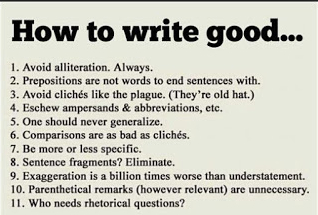 New writers are particularly susceptible to rules, and I always like to warn students away from trying to follow too many. At the same time, rules are there to keep writers alert to possible pitfalls, usually ones that many others have fallen into before them. Rules also serve to keep us attentive. The same teacher who told me never to go into a character’s head or heart (advice I ignore), also taught me to look at each sentence carefully. Really carefully. Like it was under a microscope. Even if you’re writing a 1,000 page epic, every sentence counts.
My rule (or one of them) is to look at writers you admire, writers who write fiction that more or less falls within your wheelhouse, and study how they do what they do. When I was writing short stories, I once took a short story by Rick Bass and re-wrote the first paragraph using my character and my situation and my setting but his sentence structure, just to see how he moved a story along. When he wrote about the weather, I wrote about the weather; when he wrote a facial description, I wrote a facial description. It was illuminating. Of course, I couldn’t use that exercise as my story’s opening (much as I wanted to), but it taught me some interesting techniques. (A revelation: you don’t always need to use connecting sentences to go from one image or action to another. Just make the leap.)
Here’s another note card I have propped up before me: “Character is action. Action is plot.” Paraphrased from David Mamet, who paraphrased from Aristotle.
Virginia Woolf would not abide by that rule.
The answer—my answer—to what are the best rules for writing is this: you must compile your own particular set of rules, and follow them. Study writers you admire, think about craft, pay attention when reading to what you enjoy and what you don’t. Think about your reader. Think about writing. And when you write, follow your rules.
As it turns out, following your own rules is basically called style.
What rules do you follow? Which do you ignore?
December 6, 2015
Featured Title and Giveaway
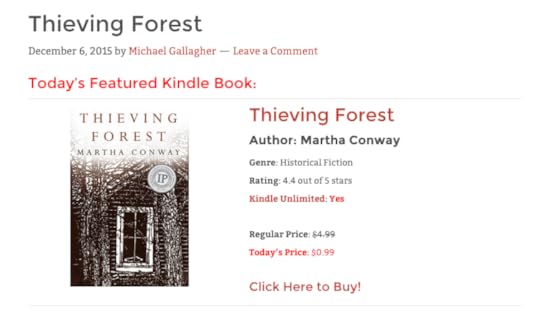
I’m also hosting a year-end giveaway. I’ll pick five winners for either a paperback or audiobook version of Thieving Forest on December 15th.
[contact-form-7]
Martha Conway’s new novel, Thieving Forest, won the North American Book Award in Historical Fiction and a Silver Medal in Historical Fiction in the Independent Publishers Awards, and her first novel was nominated for an Edgar Award. Her short stories have appeared in The Iowa Review, The Massachusetts Review, The Carolina Quarterly, Folio, and other journals. She teaches creative writing at Stanford University’s Online Writer’s Studio and UC Berkeley Extension.
November 22, 2015
Audiobook Prize Raffle
An avid reader until high school, he all but stopped reading because he “couldn’t find any books he liked.” Sound familiar?
Maybe he read so much for his classes that his reading capacity was tapped out, or maybe it was a developmental issue. However — although I didn’t say this aloud (much) — I found it hard to believe that with the thousands of books published every year, he couldn’t find anything good.
That is, until he tried listened to an audiobook. Now he’s listened to three books in the space of a month, and if he finds a part “boring” he just puts the narration on 1.5 speed until the next chapter begins! I’m thrilled.
Will this last? Who knows. But I believe it’s a good thing for however long it continues. Studies show that reading fiction helps to develop empathy and increases your attention span.
And this comes at an especially significant time for me, since Audible just released the audiobook version of Thieving Forest. Thieving Forest been given an 800 Lexile Score, which means that it’s appropriate for readers in the 8th grade and up. I’ve decided to set up a raffle to give away five free audiobooks.
To win a chance at a free listen, just fill out your name and email address below. I’ll pick five winners on December 15th. Good luck, and happy listening!
-Martha

Yes! I want to win a free audiobook of Thieving Forest. Sign me up!
[contact-form-7]
September 27, 2015
Daydreaming Your Novel
A PARENT IN MY child’s school recently forwarded me an 11-minute video about skills we’ll need for the 21st century. What really stuck with me was the bit about creativity:
“Most creative thoughts happen when your mind is left to wander: daydreaming; doing the dishes; exercising.”
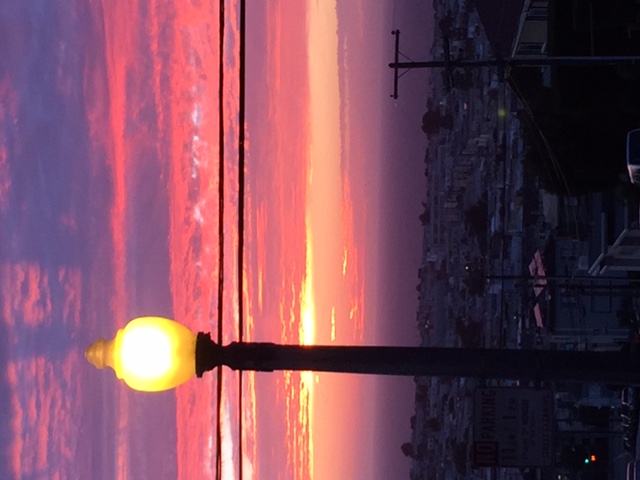
Sunset in the city. You can see the ocean where all the houses end; I like how it looks like part of the sunset.
This rang true for me. My last novel, Thieving Forest, had a lot of plot components that needed careful coordination, and in many ways these were cerebral exercises: how long would it take someone to walk through the Great Black Swamp, south to north? How long would it take someone to canoe up the Maumee River? How could these two characters from these two places meet up, and where?
I made a lot of lists, and I did a lot of calculations. When I wondered how a Potawatomi would greet someone, I looked it up on the internet. When a character reminisced about her childhood in 1790, what might she say? All in all I spent a lot of time reading and writing things down.
But when I got stuck, I went to the beach.
Whenever I walk along the beach looking at the sand dunes and the ocean waves and the little tiny black specks of surfers braving the cold Northern California waters, and I think about my current work-in-progress, my imagination begins to sort of hop from scenario to scenario. I picture characters doing this or that, saying this or that. It feels a bit like playing. There are times when nothing stands out, but most often I have an “Ah-ha” moment. I imagine something happening, or a character saying something, and I think, That’s It.
I can’t think my way into this place, I just have to sort of imagine it.
Daydreaming is an activity that doesn’t seem to get a lot of buzz lately. Ever since the Puritans came up with their eponymous work ethic, we’re all trying to get a lot more done in a lot less time. I’ve heard podcasts targeted for writers trying to speed up the process of getting a novel finish so that they (we) can write a lot more books. There’s a definite business model for writers that is based on producing as many books as quickly as you can.
However, taking a softer approach is also a worthwhile model. Time away from the keyboard is not necessarily time wasted. Daydreaming, wool gathering, trying out various scenarios in your mind while you walk the dog or do the dishes—all these can make for a much more complex, interesting story.
Don’t get me wrong, you still need to put words on paper or screen, and that requires discipline. But taking some time to not write can be very productive.
How do you dream your stories?
August 15, 2015
Thieving Forest Anniversary Giveaway
TODAY IS THE ONE-YEAR anniversary of the book launch for my novel, Thieving Forest. Although I can’t remember when I began, exactly, to think about this novel — when I started outlining the plot, or even before that, when several ideas suddenly converged into something that might, one day, resemble a plot — I think it was about seven years in the making.

In front of the Maumee River in Ohio.
But only four of those seven years were spent on research and writing: it took me three years to find an agent; work with her on revisions; send the manuscript out to editors; get precariously close to an offer (twice); research the self-publishing business; hire professionals to edit and format the manuscript and design its cover; and, finally, publish the novel.
What I like to say about this process is: I’m now both a writer and a small business owner.
It has been an interesting and fulfilling journey. Thieving Forest has sold over six times as many books as my first, traditionally published mystery sold. It’s made me question some business practices I took for granted, and find new ones I had never considered. I feel as though I’m an expert now in this slice of the publishing business — until I remember that it changes day by day! But it’s exciting to be part of an industry in flux.
To mark this one-year anniversary, I’m giving away three signed copies (either paperback or hardcover — winner’s choice) of Thieving Forest. Thanks to everyone who has made this year so successful!
To sign up for the giveaway, please enter your name below. Winners will be notified September 1st. Good luck!
[contact-form-7]
August 14, 2015
Love Among Rivals
My rating: 5 of 5 stars
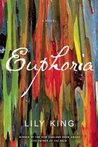
I’m including this review I wrote for Goodreads here because really this is one of the best books I’ve read all year. In some ways reminiscent of Ann Patchett’s State of Wonder, Euphoria goes beyond that book in scope, cultural detail, character development, and sheer breadth of story. On one level it tells the story of a love triangle among three cultural anthropologists in 1931, in New Guinea. On another level it explores how we see other people (and cultures), and what that says about us (and our own culture).
Nell and her husband Fen are looking for a new tribe to study when their rival anthropologist Andrew Bankson runs into them. Lonely and on the verge of suicide, Bankson sets them down at a village a few hours from where he’s living, determined to visit often. He does, with devastating results.

A huge amount of research clearly went into this book but the story never sagged from too much detail. The three main characters are unusual and yet believable, and their rivalry (especially the rivalry between husband and wife) is both dramatic and understandable.
I highly recommend this book.
July 25, 2015
Goodreads Giveaway this Weekend!
In celebration of the upcoming one-year anniversary of THIEVING FOREST, I’m giving away three copies on Goodreads. Hope you win!
Goodreads Book Giveaway

Thieving Forest
by Martha Conway
Giveaway ends July 28, 2015.
See the giveaway details
at Goodreads.


