
Martha Conway's Blog, page 2
June 3, 2017
A Victorian Partridge Family
ALL I KNEW AT FIRST was that I wanted my next novel to have something to do with theatre — early American theatre, since I’m currently on a nineteenth-century kick.
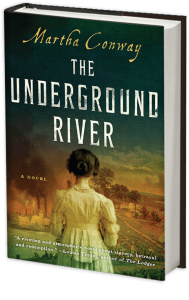
I got lucky. On the very first day of doing research, as I paged through a crushingly large volume called Theater in America, I came upon a reference to an Englishman named William Chapman. Chapman was a professional actor who had been trained at the Covent Garden Theatre in London. In 1831, Chapman came to America with his family, found the theatre scene there wanting, and built himself his own “floating theatre” — a flatboat with a stage and benches nailed to the deck.
The boat was a just a long, flat barge (no sail, no steam engine), but Chapman poled it down the Ohio River, landing in the little towns on either side of the water and performing shows every night but Sunday. Most fortunately, Chapman had a wife and eight children with him, all of whom acted, played musical instruments, and sang.
Basically, the Chapmans were a Victorian Partridge Family. Only on a flatbed boat instead of a school bus.
I haven’t spent a lot of time on boats, except for elementary school field trips on “The Good Time II” in Cleveland, where I grew up. That was on the Cuyohoga River, the one that caught on fire. (The Ohio River has not, to my knowledge, ever caught on fire.) So it’s not surprising that I came across a lot of boat terms I didn’t know.
Broadhorns, sweeps, and gougers—these are all kinds of poles or oars.
And there were a lot of names for ill-placed trees:
Snags — dead trees in the water (floating or otherwise)
Deadfall — a tree blown down by the wind
And some fun slang:
Arkansas toothpick — a large, pointed dagger used by river men
Grease hunger — to be hungry for meat
Holler calf rope — to surrender (I still don’t understand that)
Sadly, I couldn’t use all the slang I found for fear the text would begin to sound like the Song of the South ride in Disneyland. But the variety of boats—the keelboats, the passenger steamers, the packet steamers (think UPS trucks on the water), the sailboats and canoes, the rafts and barges—suddenly I had the sense of a crowded, watery highway.
And, of course, one riverboat theatre on a flatbed boat. That was where my character, May Bedloe, ended up.
If you were the Victorian version of The Partridge Family, you might have some fun, crazy antics (instigated by a boy named Danny) that almost but didn’t quite ruin your next show. In 1838, though, on the Ohio River, things were a bit more serious. To the north of the river lay Ohio and Indiana and Illinois; to the south was Virginia and Kentucky. Free states and slave states, with only one watery highway between them.
I decided that in this novel I needed to explore that conflict, too.
Next up: Runaway slaves and steamboats
ORDER: Amazon | B&N | IndieBound | BAM | Powell’s
Save
Save
Save
Save


May 7, 2017
The Cold Open – Get Scary!
YOU DON’T HAVE TO BE Stephen King to start your narrative with something scary. You don’t even have to be writing a horror story. Maybe you just want to grab your reader’s attention right away. Starting with a scar y scene or description not only grabs a reader’s emotion—which is a wonderful way to keep them on the page—but also creates a compelling visual image in the reader’s mind. An alley where the dumpsters are overflowing with garbage. Footsteps. A sudden cold breeze.
This technique works well with certain genres, such as mysteries, thrillers, and, of course, horror stories. But it can and has been used with literary novels and contemporary up-market stories as well. Maybe the scene you write is a misdirect — at the start it seems as though a boy is about to get killed by a stranger, and then the stranger turns out to be the boy’s mother. But guess what? In that first page you’ve already done some of the heavy lifting of writing: establishing the characters and time and place in an interesting way.
Even if you don’t want to start with a fright, you can get the same effect in other ways. Because what I’m really talking about is setting a specific, compelling atmosphere. Setting up a specific atmosphere—whether it’s scary, eerie, bucolic, festive, exotic, or other-worldly—is a great way to captivate your reader. It also gives you almost instant style.
“The primary thing you must do is encourage your reader to think about your situation in such detail that she can’t help but keep thinking about it. This what compelling, picturesque, and vivid details are for.”
(Jane Smiley)
You can evoke the Christmas spirit by beginning your novel on the day before Christmas, or the Halloween spirit by beginning (where else) on Halloween. You can set your novel in a foggy swamp (evoking mystery, possibly danger) or an eighteenth-century cove (innocence, romance, or maybe danger if it’s a pirate’s cove). The immediate sense of place does much more to anchor a story than almost anything else.
 The setting also draws readers in. As we read we like to paint pictures in our minds, and the more specific the picture, the better. This coupled with a strong emotional pull may not guarantee that every reader will stay with you, but it puts the odds up quite a bit.
So get scary (or romantic or bizarre or exciting). Play with your readers’ emotions. Be manipulative. Start fast and then slow down. This is not the only way to begin, but it’s a tried and true technique.
And after that first scene, you can draw a breath and begin to spin out your story more slowly. You’ll have your readers’ attention now, and that’s exactly what you want.
Get Scary!
YOU DON’T HAVE TO BE Stephen King to start your narrative with something scary. You don’t even have to be writing a horror story. Maybe you just want to grab your reader’s attention right away. Starting with a scary scene or description not only grabs a reader’s emotion—which is a wonderful way to keep them on the page—but also creates a compelling visual image in the reader’s mind. An alley where the dumpsters are overflowing with garbage. Footsteps. A sudden cold breeze.
This technique works well with certain genres, such as mysteries, thrillers, and, of course, horror stories. But it can and has been used with literary novels and contemporary up-market stories as well. Maybe the scene you write is a misdirect — at the start it seems as though a boy is about to get killed by a stranger, and then the stranger turns out to be the boy’s mother. But guess what? In that first page you’ve already done some of the heavy lifting of writing: establishing the characters and time and place in an interesting way.
Even if you don’t want to start with a fright, you can get the same effect in other ways. Because what I’m really talking about is setting a specific, compelling atmosphere. Setting up a specific atmosphere—whether it’s scary, eerie, bucolic, festive, exotic, or other-worldly—is a great way to captivate your reader. It also gives you almost instant style.
“The primary thing you must do is encourage your reader to think about your situation in such detail that she can’t help but keep thinking about it. This what compelling, picturesque, and vivid details are for.”
(Jane Smiley)
You can evoke the Christmas spirit by beginning your novel on the day before Christmas, or the Halloween spirit by beginning (where else) on Halloween. You can set your novel in a foggy swamp (evoking mystery, possibly danger) or an eighteenth-century cove (innocence, romance, or maybe danger if it’s a pirate’s cove). The immediate sense of place does much more to anchor a story than almost anything else.
The setting also draws readers in. As we read we like to paint pictures in our minds, and the more specific the picture, the better. This coupled with a strong emotional pull may not guarantee that every reader will stay with you, but it puts the odds up quite a bit.
So get scary (or romantic or bizarre or exciting). Play with your readers’ emotions. Be manipulative. Start fast and then slow down. This is not the only way to begin, but it’s a tried and true technique.
And after that first scene, you can draw a breath and begin to spin out your story more slowly. You’ll have your readers’ attention now, and that’s exactly what you want.

April 1, 2017
The Cold Open – Begin with a question

WHEN YOU BEGIN your novel using certain techniques—such as “In media res” (in the middle of the thing) or “At the last possible moment”—you are deliberately planting a question in your readers mind. In the first instance, the question is “What is going on?” and in the second, “What will happen now?” These are great ways to trigger a reader’s curiosity. But you can also pull that trigger by, literally, asking a question.
Such as the question that begins perhaps the most famous work of fiction:
“Who’s there?”
(Hamlet, William Shakespeare)
Or how about this:
“What about a teakettle? What if the spout opened and closed when the steam came out, so it would become a mouth, and it could whistle pretty melodies, or do Shakespeare, or just crack up with me?”
(Extremely Loud and Incredibly Close, Jonathan Safran Foer)
This technique immediately engages the reader. It calls on the reader to be, almost, part of the narrative itself. The story is not being told as much as it is being explored together, reader and writer.
And—bonus!—asking a question has the added attraction of “breaking the fourth wall,” as they say in theatre. Since you’re addressing the reader, he or she is instantly (we hope) engaged. There is an intimacy created on the spot. If we do it well, that reader will be more involved than usual.
But here’s a warning: If you start with a question, you must then consider how much you want to engage the reader as you go along. Too much involvement is intrusive; too little feels as though the use of your initial involvement was merely a trick. And of course it is a trick—although you don’t want the reader to feel as though it is!
Naturally this trick works better with some forms of fiction—such as literary fiction—than others. But there are work-arounds. Let’s say you’re writing science fiction. Maybe a computer asks the question. Or—for a romance—a young man asks the pretty heroine if he can share her cab. These aren’t questions to the reader, of course, but in the heady confusion of beginning a new story, a reader might well feel at first as though she’s being addressed. And voila, she feels connected.
Even if it doesn’t work with your beginning scene, asking a question at the start of a chapter or section adds energy to your story. Just as an exercise, try using this writing prompt to start a scene. . .
“What do you want from me?”
. . .and see where it gets you. What have you got to lose?
February 21, 2017
Just received my ARC!
 A big box of Advance Review copies came in the mail last week. I’m totally thrilled!
It’s 1838, and May Bedloe works as a seamstress for her cousin, the famous actress Comfort Vertue—until their steamboat sinks on the Ohio River. Though they both survive, both must find new employment. Comfort is hired to give lectures by noted abolitionist, Flora Howard, and May finds work on a small flatboat, Hugo and Helena’s Floating Theatre, as it cruises the border between the northern states and the southern slave-holding states.
May becomes indispensable to Hugo and his troupe, and all goes well until she sees her cousin again. Comfort and Mrs. Howard are also traveling down the Ohio River, speaking out against slavery at the many riverside towns. May owes Mrs. Howard a debt she cannot repay, and Mrs. Howard uses the opportunity to enlist May in her network of shadowy characters who ferry babies given up by their slave mothers across the river to freedom. Lying has never come easy to May, but now she is compelled to break the law, deceive all her new-found friends, and deflect the rising suspicions of Dr. Early who captures runaways and sells them back to their southern masters.
As May’s secrets become more tangled and harder to keep, the Floating Theatre readies for its biggest performance yet. May’s predicament could mean doom for all her friends on board, including her beloved Hugo, unless she can figure out a way to trap those who know her best.
The Underground River is now available for pre-order!
Save
October 23, 2016
The Cold Open – Start at the Last Possible Moment
 THERE IS A MOMENT WHEN, in your story world, everything has changed. The stranger has come to town, the father has died, the mother has left, the best friend has announced that she’s moving to Pakistan. And that moment is a great place to start your novel. Forget backstory, forget building up to it—just lay out the stakes right away.
Like In Media Res, in which you begin in the middle of the action, this technique relies on triggering a reader’s curiosity. The world has suddenly changed. What will happen now? That’s the question you want in the back of your readers’ minds at all times, but especially at the beginning.
Some examples: In The Lovely Bones, it is the moment when Susie, a teenage girl, gets lured into a neighbor’s secret bunker. In The Hobbit, it is the moment when the wizard Gandalf appears and talks to Bilbo, then leaves a mysterious mark on Bilbo’s front door. In The Light Between Oceans, this is when the childless couple manning a lighthouse finds a baby in a lifeboat.
This technique answers the question of why a reader should care by creating drama immediately that will result in—what? We want to know what. If you start big, you can afford to fall back a bit afterwards, a least for a bit. Layer in some characteristics; maybe even give a bit of back story. You have won the first battle: getting the reader’s attention.
Starting at the last moment possible allows for a dramatic chapter one, which is great, but it raises the stakes. Your reader will probably want more of the same. Of course, it would be difficult for the writer and tiring for the reader to have constant, building drama. There is an ebb and flow to everything, even our attention. Down time is important—but not too much. The writer needs to create enough sparks in chapters two, three, and so on to prepare for the next dramatic moment without losing readers.
And a dramatic moment doesn’t have to be a natural disaster or a gunfight; it can be as small as one character’s timely decision. Drama in the Greek means “Action.” Think of how many kinds of action there are in life! So don’t worry if your novel begins not with a death, but with a simple decision to write an anonymous letter. That’s an action. That’s drama. That’s starting at the last possible moment.
Other posts in “The Cold Open” series:
Save
Save
Save
Start at the Last Possible Moment
 THIS IS THE MOMENT WHEN, in your story world, everything has changed. The stranger has come to town, the father has died, the mother has left, the best friend has announced that she’s moving to Pakistan.
Like In Media Res, in which you begin in the middle of the action, this technique relies on triggering a reader’s curiosity. The world has suddenly changed. What will happen now? That’s the question you want in the back of your readers’ minds at all times, but especially at the beginning.
Some examples: In The Lovely Bones, it is the moment when Susie, a teenage girl, gets lured into a neighbor’s secret bunker. In The Hobbit, it is the moment when the wizard Gandalf appears and talks to Bilbo, then leaves a mysterious mark on Bilbo’s front door. In The Light Between Oceans, this is when the childless couple manning a lighthouse finds a baby in a lifeboat.
This technique answers the question of why a reader should care by creating drama immediately that will result in—what? We want to know what. If you start big, you can afford to fall back a bit afterwards, a least for a bit. Layer in some characteristics; maybe even give a bit of back story. You have won the first battle: getting the reader’s attention.
Starting at the last moment possible allows for a dramatic chapter one, which is great, but it raises the stakes. Your reader will probably want more of the same. Of course, it would be difficult for the writer and tiring for the reader to have constant, building drama. There is an ebb and flow to everything, even our attention. Down time is important—but not too much. The writer needs to create enough sparks in chapters two, three, and so on to prepare for the next dramatic moment without losing readers.
And a dramatic moment doesn’t have to be a natural disaster or a gunfight; it can be as small as one character’s timely decision. Drama in the Greek means “Action.” Think of how many kinds of action there are in life! So don’t worry if your novel begins not with a death, but with a simple decision to write an anonymous letter. That’s an action. That’s drama. That’s starting at the last possible moment.
Previous posts in “The Cold Open” series:
October 8, 2016
The Cold Open – In Media Res
STARTING A NOVEL, writing that very first sentence, is as exhilarating and intimidating as riding a bicycle for the first time without training wheels. Many writers think they need to explain a good deal more than they need to explain. They think that the first chapter is about laying a foundation so that the story — the real story— can begin in chapter two.
They could not be more wrong.
In this and in the coming weeks, I’ll be writing a blog series about those hooks—different techniques writers have successfully to capture their reader’s attention.
In media res, or “in the middle of things,” drops your reader into the middle of the action with no warning. In other words, the action of the story began off stage, before the very first sentence, and the reader must play catch up. A great example of this is from “A Room with a View” by E.M. Forster. Here are the very first lines from Chapter One:
“The Signora had no business to do it,” said Miss Bartlett, “no business at all. She promised us south rooms with a view close together, instead of which here are north rooms, looking into a courtyard, and a long way apart. Oh, Lucy!”
“And a Cockney, besides!” said Lucy. . . “It might be London.”
Yes, the reader will be confused at first, and in fact that’s what you want. Whenever you put a question in a reader’s mind, the reader is more likely to keep reading so she can find out the answer. Of course, too much confusion results in a book thrown across the room in disgust, but usually this doesn’t happen on the very first page. When you open using the “In Media Res” technique, there is an implicit promise that w hatever you are throwing your reader into will be explained. But not quite yet.
This logic also addresses the worry that readers won’t know (and care) enough about the characters to be sufficiently interested. Readers are generally patient for a few paragraphs or a page or maybe even a whole chapter, if you’re lucky. We want the writer to make us interested; that’s why we opened the book!
I’ll talk about another technique in the next blog post, which can be used in conjunction with “In Media Res”: starting at the last possible moment. And don’t worry, it’s not a pitch for procrastination (most writers don’t need that pitch, anyway).
Save
Save
Save
The Cold Open – in media res
STARTING A NOVEL, writing that very first sentence, is as exhilarating and intimidating as riding a bicycle for the first time without training wheels.
Many new writers think they need to explain a good deal more than they need to explain. They think that the first chapter is about laying a foundation so that the story — the real story— can begin in chapter two.
They could not be more wrong.
In this and in the coming weeks, I’ll be writing a blog series about those hooks—different techniques writers have successfully to capture their reader’s attention.
In media res, or “in the middle of things,” drops your reader into the middle of the action with no warning. In other words, the action of the story began off stage, before the very first sentence, and the reader must play catch up. A great example of this is from “A Room with a View” by E.M. Forster. Here are the very first lines from Chapter One:
“The Signora had no business to do it,” said Miss Bartlett, “no business at all. She promised us south rooms with a view close together, instead of which here are north rooms, looking into a courtyard, and a long way apart. Oh, Lucy!”
“And a Cockney, besides!” said Lucy. . . “It might be London.”
Yes, the reader will be confused at first, and in fact that’s what you want. Whenever you put a question in a reader’s mind, the reader is more likely to keep reading so she can find out the answer. Of course, too much confusion results in a book thrown across the room in disgust, but usually this doesn’t happen on the very first page. When you open using the “In Media Res” technique, there is an implicit promise that whatever you are throwing your reader into will be explained. But not quite yet.
This logic also addresses the worry that readers won’t know (and care) enough about the characters to be sufficiently interested. Readers are generally patient for a few paragraphs or a page or maybe even a whole chapter, if you’re lucky. We want the writer to make us interested; that’s why we opened the book!
I’ll talk about another technique in the next blog post, which can be used in conjunction with “In Media Res”: starting at the last possible moment. And don’t worry, it’s not a pitch for procrastination (most writers don’t need that pitch, anyway).
Martha Conway’s novel Thieving Forest won the North American Book Award in Historical Fiction, and her first novel was nominated for an Edgar Award. Her short stories have appeared in The Iowa Review, The Massachusetts Review, The Carolina Quarterly, Folio, and other journals. A recipient of a California Arts Council Fellowship, she teaches creative writing at Stanford University’s Online Writer’s Studio and UC Berkeley Extension.
Her new novel, Sugarland, is available now.

Save
September 7, 2016
What? I thought I was done!
IT’S BEEN SIX MONTHS or more since I looked at my last novel, the one that was “done.” That novel is gearing up to go into production now, and I have a few notes from my editors, stuff to change. As I read through the manuscript for places to cut back or to develop a character more, I am getting re-acquainted with my protagonist and her dilemmas. She hasn’t changed. The problem is, I have.
I’m six months older; some things in my life are different, some aren’t, but it all goes into what I want to write about—what I think is important.
The good news is, there are a few problematic scenes that, six months later, I don’t feel as tied to as I used to. Great—get rid of them. And I have a better sense of how other people are reading the novel, not just me. I still have my own secret story of what the novel is about, but once you put a book out to the public, it becomes something else, as well. One reader might think The Great Gatsby, for instance, is all about social change; another reader might lean more toward the personal relationships depicted therein. No doubt Fitzgerald had his own views (that should go without saying!), but after a while, weirdly, his work is no longer just his.
So as I go through and cut or expand, I’m thinking about what other people have said about my story, and how I felt about it when it started, and how I feel about it now. It’s a bit overwhelming. Here are a couple of things I’ve been telling myself:
To quote Shakespeare: “The play’s the thing.” The best guide for how to change your novel is the novel itself. Sure, I didn’t start out thinking I would write about slavery and the underground railroad, but that’s what it’s turned out to be about. Go with it. Every story has its own logic, and the best stories are the ones that stay truest to that.
Not everyone will agree with the changes, but I have to agree with them. I can always tell when, on re-reading my work (even six months later), I’ve written something just because someone else told me I should. Whatever you add has to fit the scene, the character, the tone. If it doesn’t, find someplace else to add whatever it is that agent/editor/beta reader wants. And if you can’t find a place, don’t add it.
Take more breaks. Re-reading with an eye to re-writing is basically all about making decisions. Is this okay as is? Is this? Is this? Decision after decision after decision. That’s hard on a psyche. Time to order in and watch a twenty-minute sit-com, get on the elliptical, or take the dog out for a walk. Decision-making muscles (I swear those exist) have to take rests, too, in order to work well.
A wise teacher once told me, “The hardest thing is keeping everything else out.” Like probably every other writer, I have a lot to say, and I’ll just never say it all in this novel—nor should I. When you start writing, the experience of feeling idea after idea come along is exhilarating. But unless you’re Thomas Pynchon, not all of those ideas will work themselves into your plot. And that’s a blessing for your readers, who probably just want a good read.


