Heidi Greco's Blog, page 20
August 30, 2021
Up in the air
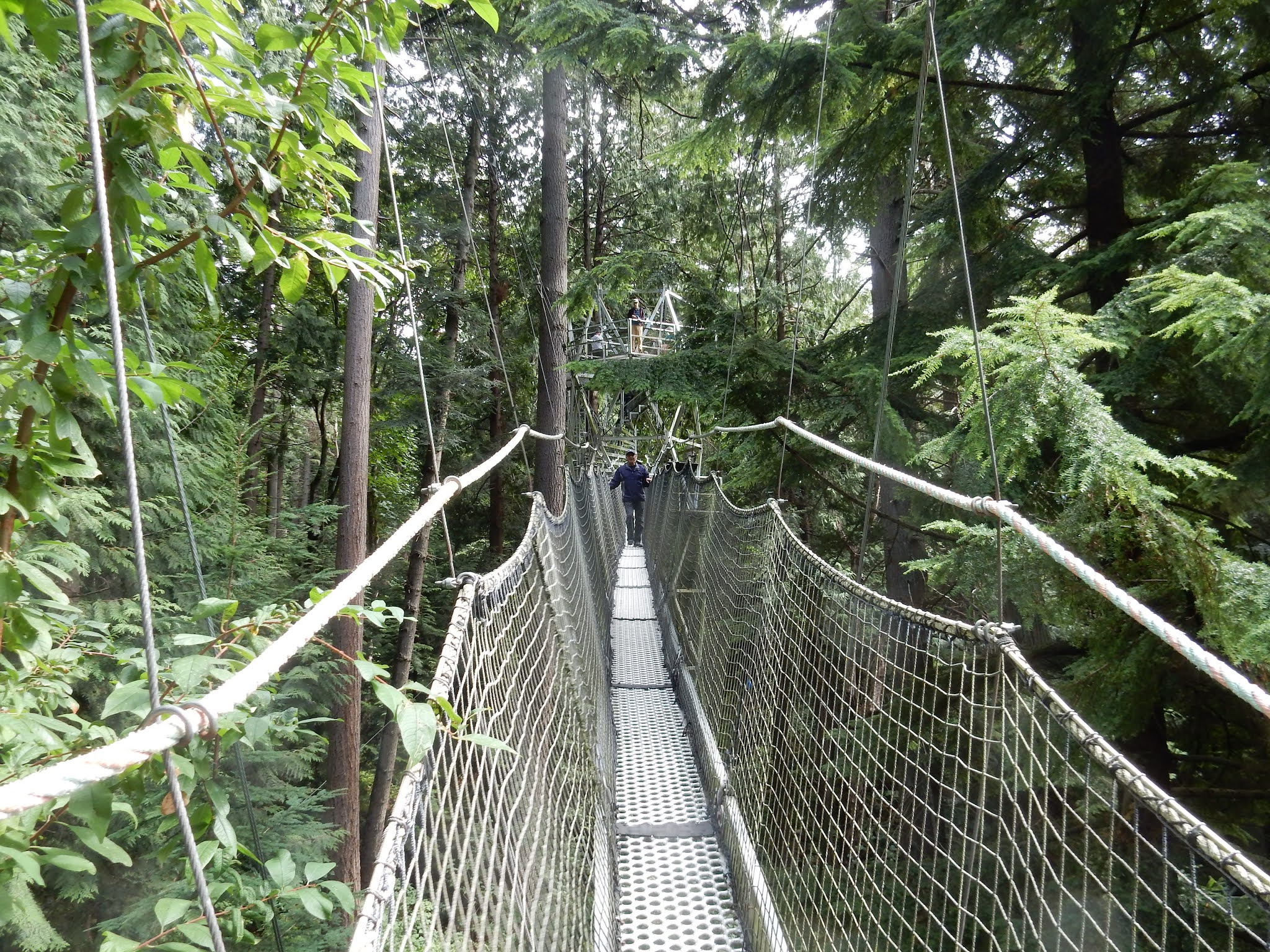 That's where we were the other, walking through the tree canopy at UBC's Greenheart TreeWalk. Even though we were high up (several storeys at many points along the route), it mostly felt a bit 'swingy' though the rope handles on either side were reassuring enough for even a chicken like me.
 Something I thought about while I was making the walk was the Wallenda family, who made tightrope walking a multi-generational career. I kept trying to keep my feet walking a line that followed the centre of the walkway. This only convinced me I could never have learned to walk on a rope, especially not one that didn't have a catch-net below. Yikes!
The other thing the walkway reminded me of was Robert Louis Stevenson's poem, "The Swing" with its rocking rhythms, so evocative of actually being on a swing. I tried finding a video of a film based on this poem, but none of the ones on YouTube were the one I'd been looking for. A former student of mine made it some years ago. While I was lucky enough to see it once, as she visited and shared it, but sadly, I can't find it anymore.
Nonetheless, I still like the poem, and I hope maybe you will too. Here's a link to the print version of it. Imagine yourself on a swing as you read it; you might even feel like 'pumping' your legs! And if you feel like taking a vicarious walk on the one out at UBC, click here for a video experience.


August 22, 2021
Standard shift
 Even though the peaches aren't quite ripe enough to pick, today no longer feels like summer. It's not even a matter of temperature, it's something about this afternoon's light. Maybe it's the angle of the sunlight dappling the boards of the deck -- whatever the cause, it makes me realize that autumn's on its way.
 The blackberries are thick on the vines, and we're still getting a few raspberries for our desserts. The plums down at Lee Street, where we're always encouraged to pick, are just about ready too. Another year with a bounteous supply of fruits.
I suppose this overabundance may well mean a harsher than usual winter. We'll wait and see about that.
For now, I'm heading back to the kitchen. Jars are sterilized and shiny, ready for me to make another batch of jam.
August 16, 2021
Is there snow on Mars?
 And no, I wasn't on Mars, though the light filtering through the smoky skies was eerie enough to feel like I was on the red planet.
 Even though we're far from the many forest fires currently burning in our province, the smoke made its way here, as if reminding us of our interconnectedness and vulnerability.
 The last time I remember this kind of dusting of ash was when Mount St Helens blew her top in 1980. Yes, that ash was thicker, but this had that same quality to it -- as if it were gritty snow.
 I'm washing the vegies and fruits as we pick them from the garden, not something I generally need to do.
Nonetheless, considering the horrors going on across the world in Afghanistan, where people are not only losing their rights, but their lives as they try to escape, I can only be grateful for smallish annoyances as the ones I've been given.
August 7, 2021
Coulda, shoulda
 Once upon a time the City of Surrey had the opportunity to make a park. As you can see from the photo, it looks as though they already had one.
 In actuality, it was the site of a nine-hole golf course. But more importantly, the site had several ponds which served as a home to nesting ducks and other migratory birds who stopped by along their flightpaths.
There was also a salmon-bearing stream, now lost.
Somehow the City Council decided it made more sense to turn it into a parking lot. Maybe they misunderstood Joni Mitchell's song, and thought that a parking lot meant paradise.The photo is from autumn of 2004, and those rolling green hills are long gone and paved, part of a shopping complex with a Walmart at its heart. If they'd moved that centre a mere one block to the east, and declared the site as parkland, the thousands of people who now live in the many nearby townhouses built since then, those families would have had a greenspace park. But no, instead they have a place for buying imported goods. No doubt useful in some respects, but hardly the place for a picnic.
Surrey is once again planning to pave another environmentally sensitive area. And surprise, surprise, despite the fact that the 'public' meeting (which ran until after 2 a.m.) heard from many speakers who presented science-based reasons for opposing the proposed development, Surrey's Mayor McCallum and his four sidekicks on Council voted instead for construction of an industrial park there. And yes, that term has to be one of the most contradictory oxymorons of our time.
The area where this construction is proposed contains a river where endangered salmon species still live, and is above an aquifer which feeds the wells of many residences. As one of the presenters put it: "Building a series of warehouses above an aquifer -- whose idea was that?!"
The Zoom meeting for public input began in the afternoon and then ran for just over 12 hours. Because I am a person who cares, I was present for the duration. Yet, as has been apparent at other such presentations in the past, it became clear that the elected officials had their minds made up in advance.
When the five minutes allotted me for my presentation came up (at 10:30 p.m.), I had the unsettling experience of being interrupted by the mayor -- who basically told me to shut up -- an occurrence that rattled me, I admit. I can't help but think that's partly the reason I've had such a hard time getting around to writing this particular post.
All that I -- and many others -- had hoped for was that the proposal as currently described would be rejected so that it could be revised in a way that would protect the sensitive areas from having warehouses built on them. Warehouses which are being touted as places for employment opportunities for the people of Surrey, despite the fact that more and more warehouse work is being performed by robots, and not people at all.
So yes, I think this is yet another error in the making by our municipal government, one that will prove to be regretted in the not-so-distant future. All we can hope is that some higher level of government will pronounce the plan as folly and stop it from going forward -- and, with luck, will determine that it's an area worthy enough of protection to be declared as parkland.
July 26, 2021
40 days (and 40 nights)
 That's how long it's been since we've had rain.
 The rain barrels have both been empty for weeks. The lawns are parched, too many trees look droopy. Even the ever-fresh daisies are looking tired.
Water restrictions are in place, though luckily still only at Phase One locally.
Naturally, we're not supposed to waste water by washing cars (hardly an essential demand). Fortunately, we are still permitted to hand-water our vegie gardens.
Tomorrow will be Day 41, the day we'll tie the longest dry spell experienced here. As for the rest of the province, the forecast -- especially with raging wildfires -- is not looking good.
Biblical? Nearly.
Crossing fingers on behalf of the plants, especially the trees, that they'll soon be able to get un-parched.
July 19, 2021
So much for social responsibility
 This is the way a house in my neighbourhood came down -- all of a piece, in one gigantic mess.
 Even though some days back, when we realized the house would be a tear-down (in itself an irresponsible decision, as the home was likely built in the 1980s), neighbours asked to buy some of the doors and windows. Sadly, their requests were refused.
So, a bunch of us happened along this morning and watched (some with masks, as the dust was hideous) while a machine methodically knocked it over and over and over.
Rather than recycling those beautiful French doors and oversize windows, a mass of wood and glass and metal, along with heaps of pink insulation, made its way to the landfill.
Only in Surrey? Could well be the case. So much for Surrey's slogan, The Future Lives Here. We can only hope not.
July 13, 2021
Nostalgia on a summer breeze
 At last, the season for reading outdoors has truly arrived. Oh sure, I used to read in the snow fort I’d built in the backyard, but that was a long time ago, a time I’m not all that nostalgic for. Still, such thoughts are somewhat apt, as the book I read yesterday afternoon, Diane Tucker’s
Nostalgia for Moving Parts
, opens with memories of childhood.
At last, the season for reading outdoors has truly arrived. Oh sure, I used to read in the snow fort I’d built in the backyard, but that was a long time ago, a time I’m not all that nostalgic for. Still, such thoughts are somewhat apt, as the book I read yesterday afternoon, Diane Tucker’s
Nostalgia for Moving Parts
, opens with memories of childhood. Whether she’s recalling the feel of bare feet on cool floors or sliding on them “in sock feet” or lying down, staring into the heat vents which she describes perfectly as looking like “little venetian blinds” she’s certainly succeeded in transporting me there. Even in her stories of being a very young girl, we see her developing what she understands being a woman to mean, whether that’s disliking a dress your mother wants you to wear, flirting with a cute boy in grade two, or coming to the realization that there’d come a day when “You threw the dice of yourself and hoped you’d win.”
Her poems and the experiences they recount—including the deaths of both of her parents—have taken me to some of the places I realize I still need to pay more attention to. Even my massage therapist tells me that my pains are from holding back grief. As the poet Edward Hirsch reminds us in 100 Poems to Break Your Heart, “The poet is one who…is determined to leave a trace in words, to transform oceanic depths of feeling into the faithful nuances of art.”
And that seems to be exactly what Tucker has done with her poems, which deal with everything from the joys of backyard games:
we smashed the badminton birdie
over the fading net arc after arc
until evening ate the small white thing
to observations about the qualities of evening wine:
White wine is not white but golden,
bright lantern to light your aging limbs,
slow lover bathing your solitary throat.
And from those words I read on yesterday’s summery afternoon (“This afternoon could scour the cool / out of anything…”), I have to say that I am grateful that she has given me words I can use to write about her book, a book that helps me understand why she is nostalgic for certain lost things—and how it is that she has come to write about them. For lack of a better way to express this, I offer a stanza from her poem, ‘The woods are full of poets’:
As cedar boughs grow down and then
grow up (a double wish, a desire for both
at once), blank paper does two things:
it blocks the light and it lets light through.
It’s a stanza that in itself evokes a small reminder of (and nostalgia for) Leonard Cohen, and his lessons about light.
July 9, 2021
For the birds?
 July is supposed to be the happiest of months. Or maybe somehow I just have that stuck in my mind. Maybe because it's the first month of no school. Or maybe because I often go to Kansas for the Amelia Earhart Festival (cancelled again this year) and its exciting display of fireworks.
 It's traditionally been the month when I get back down to plenty of leisure reading. Something about warm weather that makes me want to sit outside with a book -- a great excuse for not doing anything more energetic.
When I used to work in schools, July felt like the time when I was finally free of responsibilities of classroom teaching (marking, ugh) or library work (inventory, double-ugh). So the idea of free reading is one I still associate with this month.
Again going back to work days, my brain never seemed ready to tackle 'big' books. I'd start off by reading a few of Tintin's adventures, and then gradually go forward to books like David and the Phoenix or The Secret Garden. Before the month would be out, my brain would be back in gear and ready to tackle some grown-up books.
Even though I no longer have those mega-duties anymore, I still find myself doing 'warm-up' reading with what might these days be called YA materials. This year, it was GG-winner, The King of Jam Sandwiches, followed by the old-fashioned pleasures of a Green Knowe book from Lucy M. Boston.
Already I've managed to roar through Thomas King's latest, the very timely, Sufferance, much of it actually set on the site of a residential school. Among the residents of this very fine book is a passel of crows, one of whom stopped by on one of our skylights. Not sure if he thought he could get inside or what. Must have been a nice buffet of dead bugs up there. Or maybe he was just looking down onto my current stack of library books, hoping to find something good to read.

July 1, 2021
O, Kanata
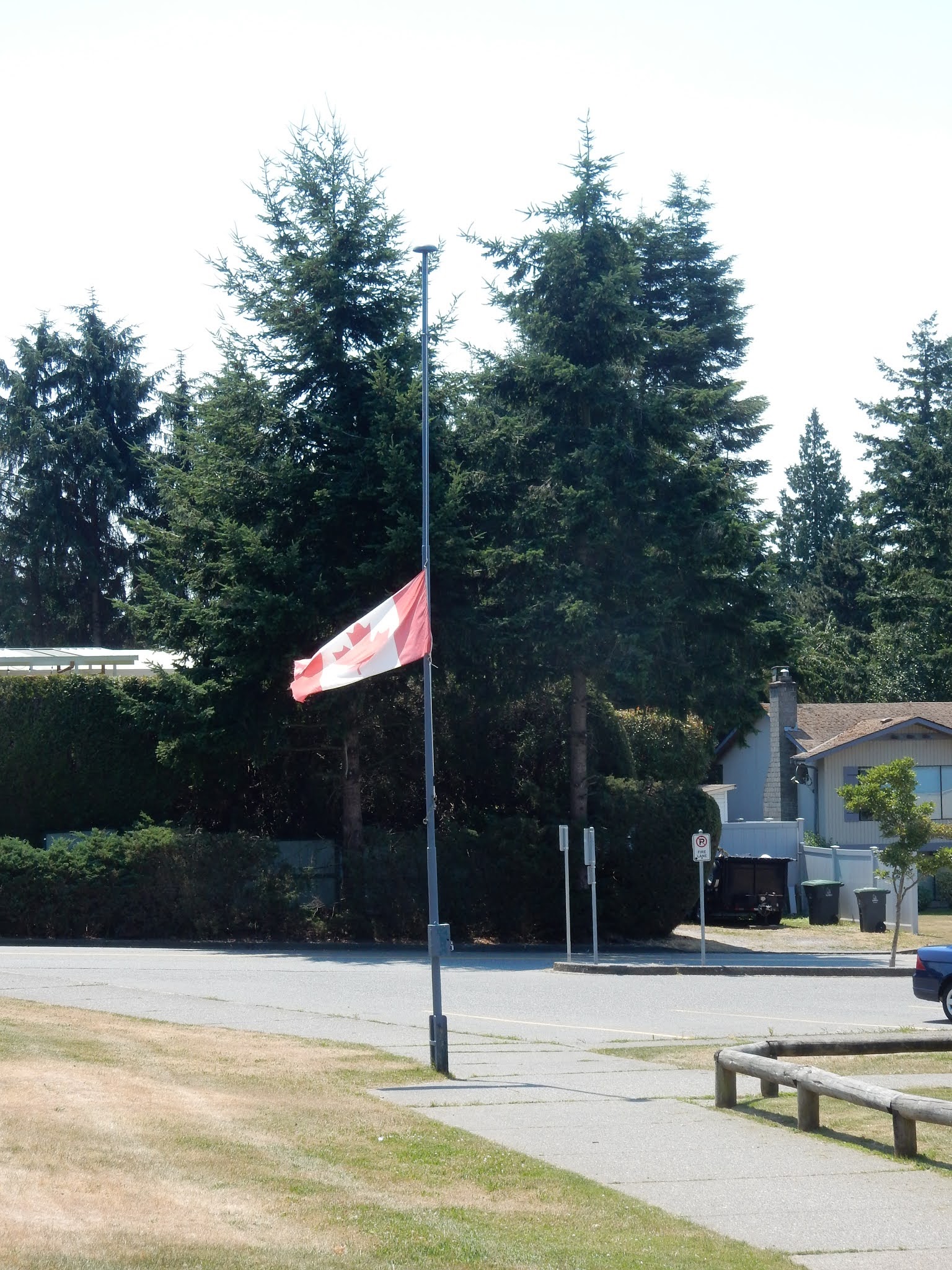 This year's July 1st has come to mean quite different thoughts than the proudly patriotic ones of the past. The reason, of course, is the sadness that descended on our country over the recent confirmation of the many deaths -- mostly of children -- that occurred at Canada's residential schools.
 For weeks now, nearly all flags have flying at half-mast in recognition of these lost souls.
Many of us are wearing orange shirts today, a sign that we choose to remember the children who were taken from their homes and who had their culture, their families, and their language taken from them.
The wearing of orange shirts has its origins in the story of Phyllis Jack, who had an orange shirt she loved when she was only six years old. Excited about her first day of school, she wore the bright orange shirt, a gift she'd received from her grandmother. But upon her arrival, the nuns took away her shirt and never gave it back. Recent years have seen the tradition of wearing orange shirts, many of which bear the reminder that Every Child Matters.
As for the 'Kanata' reference at the top of this post, it's part of Canada's origin story. Sadly, it's yet another example of how colonizing settlers took from the people they met here. We took a word from a language that wasn't our own -- a word that meant 'village' -- and applied it to the whole country. Stolen words, stolen lands.
Much to learn, and much to heal from. A time for listening.
June 29, 2021
Dog days of June
 In truth, it seems a bit unfair to dogs to designate some of the most miserable days of the year as 'dog' days. At least, looking into the history of the name, it turns out to relate to that time later in summer when Sirius, the dog star, passes overhead. And yes, this period of time generally comes must later, calendar-wise, toward the end of July and into August. (Oh, if you click on this last link, you may find yourself as enchanted as I was when you see the fanciful illustration.)
The temperatures we've been experiencing here in BC's Lower Mainland are unprecedented -- even for later in the season. Our little thermometer, which is never in direct sunlight, but on the inside of a post in our gazebo, has never before gone over 40 Celsius, and has certainly never before gone over 100 Fahrenheit. But that's exactly what it did, both yesterday and the day before.
As might be expected, the news is full of items about climate change. The Vancouver Sun's front page headline story chronicled just that. But really, unless you've been living under some moss-covered rock, this is hardly surprising.
I'm just hoping that the disquiet, discomfort -- and now, as we've learned, even deaths -- resulting from this latest distress call from the Earth, will help bring our politicians to action beyond their mumblings about reading reports and considering what to do. How convenient though for them (both provincial and federal) to have taken off for the summer recess and no doubt, to their lakeside cottages where soft breezes blow any such thoughts of responsibility and duty away to some other day.