
Heather Cox Richardson's Blog, page 5
November 9, 2025
November 9, 2025
In order to pressure the Democrats to cave to Trump’s demands that they sign on to the House Republicans’ continuing resolution to fund the government, the administration has been refusing to fund the Supplemental Nutrition Assistance Program (SNAP) benefits that 42 million Americans depend on to eat.
On September 19, House Republicans passed a continuing resolution to fund the government. House speaker Mike Johnson (R-LA) has kept the House from doing any work since then, sending members home in an attempt to force the Senate to pass the House measure. The Democrats don’t want to: they have refused to agree to the resolution unless the Republicans agree to extend the premium tax credits that support the Affordable Care Act healthcare insurance markets. The end of those credits at the end of this year means millions of Americans will lose their healthcare insurance and the premiums for others will skyrocket. It will be a blow to the Affordable Care Act, which Republicans want to get rid of.
SNAP needs about $8 billion for the month of November. There are two reserve accounts set up by Congress, one with about $6 billion in it that can be used to fund SNAP during emergencies and the other with about $23 billion to be used for nutrition programs. In past shutdowns, administrations—including the first Trump administration—tapped reserves to fund SNAP.
But in October, the administration said it would not use the emergency funds, essentially starving Americans to get Democrats to do as Republicans want and dramatically weaken the Affordable Care Act. Multiple groups sued.
Last week, U.S. District Court Judge John McConnell of the District of Rhode Island ordered the administration to use the emergency reserves to fund SNAP at least partially and to consider using the nutrition money to fund it fully. The administration said it would use the reserve for partial funding but that disbursing a fraction of benefits would create an administrative problem that would take weeks or even months to sort out, delaying payments.
Last Thursday, Judge McConnell found that the Trump administration had ignored his order to pay at least partial SNAP benefits last week and ordered the Trump administration to distribute the full amount of SNAP benefits for November to the states for distribution by the end of Friday.
As Steve Vladeck explained in One First, the administration appealed McConnell’s order to the First Circuit and also asked the First Circuit to pause the order while the court of appeals decided. When the First Circuit hadn’t ruled by late Friday afternoon, the administration filed an emergency application to the Supreme Court to ask it to stay McConnell’s order.
The emergency action fell to Justice Ketanji Brown Jackson. Shortly after 9:00 p.m. EST, she issued the administrative stay the administration wanted, apparently getting ahead of the chance that the full court would overrule her if she declined to issue it. As Vladeck notes, she used her ruling to give the First Circuit a deadline to decide if it would permit the SNAP funding to go forward.
Vladeck writes that Jackson was “stuck between a rock and a hard place,” and he reiterates the obvious point that the Trump administration doesn’t need a court order to pay out SNAP benefits. It could simply do it, as previous administrations have during a shutdown.
In the back-and-forth on Friday, the administration appears to have opened up state payments for SNAP, and several states received their full payments, while others did not. States that received full payments worked to get that funding through to beneficiaries’ Electronic Benefit Transfer (EBT) cards immediately.
Saturday, Patrick Penn, the deputy undersecretary for food, nutrition, and consumer services in the U.S. Department of Agriculture (USDA), which oversees SNAP, sent a memo to the states saying that “[t]o the extent States sent full SNAP payment files for November 2025, this was unauthorized. Accordingly, States must immediately undo any steps taken to issue full SNAP benefits for November 2025…. [F]ailure to comply with this memorandum may result in USDA taking various actions, including cancellation of the Federal share of State administrative costs and holding States liable for any overissuances that result from the noncompliance.”
“Yikes,” economic editor at The Bulwark Catherine Rampell wrote. “Astonishing how hard this administration is working to keep people hungry. It’s clear they are trying [to] maximize public suffering, in hopes of getting people to blame Dem[ocrat]s for that suffering. But it’s transparently the White House working overtime to keep the suffering going!”
Rampell asked Georgetown law professor David Super what it means for the states to claw back benefits they already sent out. He answered that “[t]his seems to be USDA howling into the void after its terrible communications led many states to think that they were free to do what USDA should have told them to do all along…. I do not see how USDA can do anything to the states,” he wrote, since the error was not a systems error or mistaken issuance. He speculated that the memo was an attempt “to intimidate states that are considering issuing full November benefits.”
Wisconsin governor Tony Evers, a Democrat, simply posted on social media: “No.”
The administration also ratcheted up pain on the American people by warning that the ongoing crisis of unpaid air traffic controllers would cause more and more disruption to U.S. travel. The Federal Aviation Administration (FAA) has cut thousands of flights from the nation’s busiest airports, and today, when Jake Tapper of CNN asked Transportation Secretary Sean Duffy “how many Americans will not be able to be with their families for [Thanksgiving] because of this,” Duffy answered: “I think the number is going to be substantial.”
Amid the fight over SNAP during the longest government shutdown in history, President Donald J. Trump spent the weekend at Mar-a-Lago, where he hosted another extravagant dinner party complete with scallops, beef filet, and ice sculptures. Today, as part of his defense of his tariffs, Trump promised on social media that “[a] dividend of at least $2000 a person (not including high income people!) will be paid to everyone.” Treasury Secretary Scott Bessent appeared to know nothing about the promise but told ABC host George Stephanopoulos that “[t]he $2,000 dividend could come in lots of forms and lots of ways,” including in the form of the tax cuts Trump and the Republicans have extended—the ones that primarily benefit the wealthy and corporations.
Tonight Trump attended an NFL football game between the Washington Commanders and the Detroit Lions after ESPN reported that he wants the Commanders to name their new stadium after him. Attendees soundly booed him.
Today, former U.S. district judge Mark L. Wolf, who was appointed to the U.S. District Court for the District of Massachusetts by President Ronald Reagan, explained that he resigned on Friday because he wanted the freedom to do “everything in my power to combat today’s existential threat to democracy and the rule of law.” Wolf called out Trump’s use of the Department of Justice to hurt his political opponents, his firing of inspectors general, the administration’s pay-to-play policies in which wealthy donors get government favors, the corruption of cryptocurrency, unconstitutional executive orders, and the threats against judges as Trump attacks the rule of law.
“I resigned in order to speak out, support litigation, and work with other individuals and organizations dedicated to protecting the rule of law and American democracy,” Wolf wrote. “I also intend to advocate for the judges who cannot speak publicly for themselves.” Because Wolf took senior status in 2013 and his successor was appointed then, his resignation will not create a vacancy for Trump to fill.
Tonight, the news is swirling about Democratic senators agreeing to a deal to end the government shutdown, but so far, the contours of such an agreement are not clear.
—
Notes:
https://www.documentcloud.org/documents/26220980-25a539/
 One First190. SNAP WTF?Welcome back to “One First,” a (more-than) weekly newsletter that aims to make the U.S. Supreme Court more accessible to lawyers and non-lawyers alike. I’m grateful to all of you for your continued support, and I hope that you’ll consider sharing some of what we’re doing with your networks…Read more6 days ago · 1491 likes · 197 comments · Steve Vladeck
 The Freedom Academy with Asha RangappaFriday Round Up! 11/7/25A few quick notes up front: First, next Saturday is my birthday! So, I will be taking a break from the Round Up to spend the weekend with my kids. (I might send a pic, though!) Second, I have some exciting announcements coming up soon after that about some fun changes to the Substack for the New Year, so stay tuned…Read more6 days ago · 68 likes · 16 comments · Asha Rangappa
https://www.politico.com/news/2025/11/09/trump-tariff-dividends-bessent-00643768
https://www.theatlantic.com/ideas/2025/11/federal-judge-resignation-trump/684845/
Bluesky:
crampell.bsky.social/post/3m57ihacn2s2r
govevers.wisconsin.gov/post/3m57lqbohzs2g
atrupar.com/post/3m57dvrrbxj2h
rpsagainsttrump.bsky.social/post/3m57hlugvek25
ronfilipkowski.bsky.social/post/3m5ach7xk5s2r


Tonight's letter might be delayed...
Hey folks: A heads up that we’re dealing with high winds here. It’s entirely likely that we’ll lose power, and we haven’t checked the generator this year so I might be out of luck. I’m writing tonight’s letter now but if it doesn’t appear as usual, don’t worry. I have it up as soon as I can.
October 18, 2025
October 18, 2025
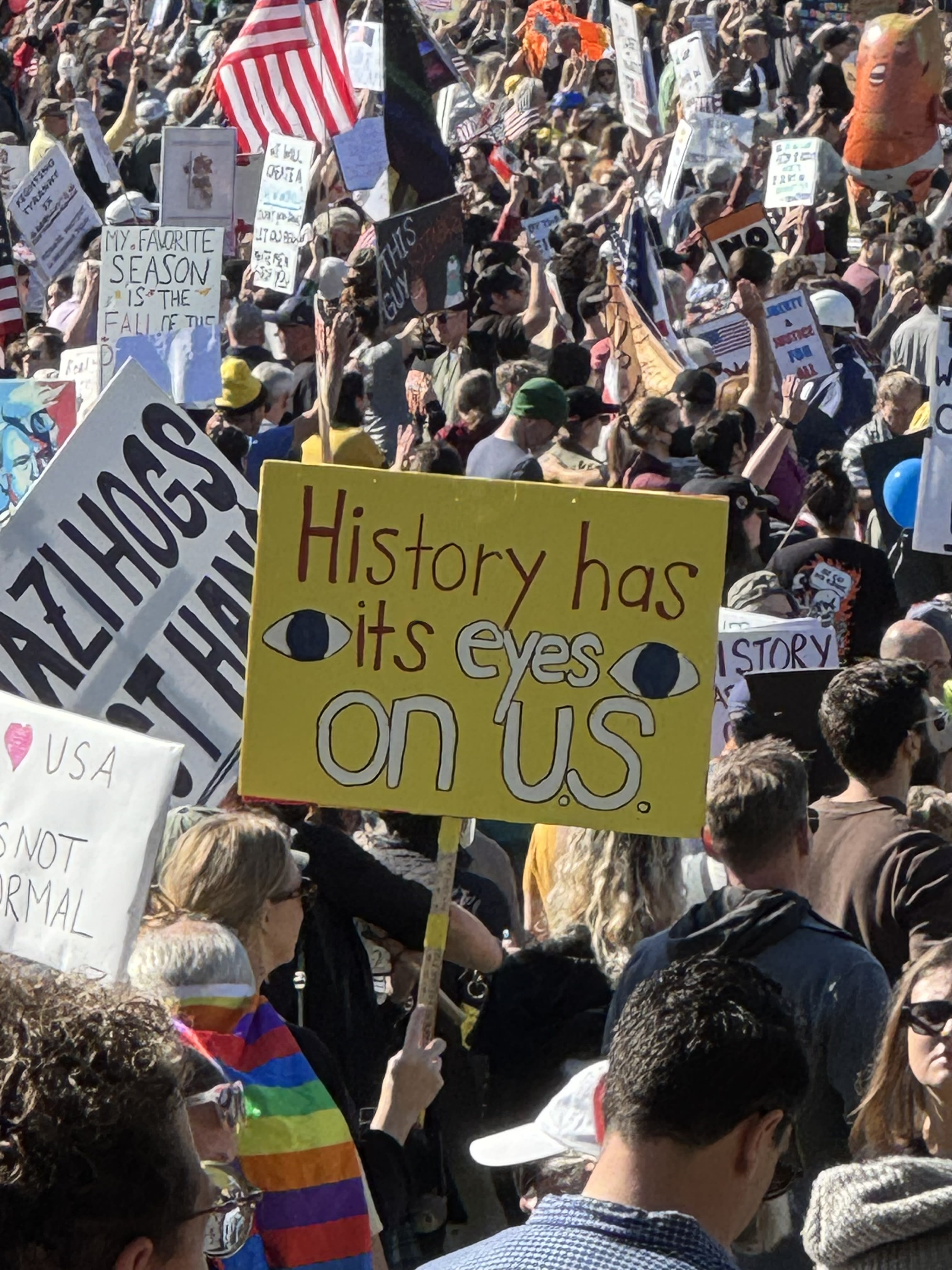
Today, millions of Americans and their allies turned out across the United States and around the globe to demonstrate their commitment to American democracy and their opposition to a president and an administration apparently bent on replacing that democracy with a dictatorship.
Administration loyalists tried to claim the No Kings protests would be “hate America” rallies of “the pro-Hamas wing and Antifa people.” Texas governor Greg Abbott deployed the Texas National Guard ahead of the No Kings Day protests, warning that “[v]iolence and destruction will never be tolerated in Texas.”
In fact, protesters turned out waving American flags and wearing frog and unicorn and banana costumes and carrying homemade signs that demanded the release of the Epstein files and defended Lady Liberty. They laughed and danced and took selfies and sang. City police departments, including those of New York City, San Diego, and Washington, D.C., said they had made no protest-related arrests.
In Oakland, California, Mother Jones senior editor Michael Mechanic interviewed a man named Justin, asking him if, as a Black man, he had particular concerns about the actions of the Trump administration.
Justin answered: “You know…a lot of times I have a hopeless feeling, but…being out here today just reminds me about the beauty of America and American protests. And, you know, the fact that they tried to…stomp on this, step on this, you know, say it’s non-American, because that’s what I’ve been reading a lot about. No, this is the point of America right here: to be able to have this opportunity to protest…. [This] does not look like Antifa, Hamas, none of this stuff that they’re talking about…. [Y]ou know, this is the beauty of America.”
The No Kings demonstrations ran the gamut from hundreds of thousands of protesters in large, blue cities, to smaller crowds in small towns in Republican-dominated states. Together, they demonstrate that the administration’s claims to popularity are a lie. Such a high turnout means businesses and institutions that thought they must cater to the administration to appeal to a majority of Americans will be forced to recalculate.
And the protests showed that Americans care fervently about democracy.
Today, millions of Americans and their allies turned out across the United States and around the globe to demonstrate their commitment to American democracy and their opposition to a president and an administration apparently bent on replacing democracy with a dictatorship.
[Photo, “History has its eyes on U.S.” anonymous photographer, Boston, Massachusetts, October 18, 2025]
—
Notes:
 The BulwarkTrump’s Very Own Basket of DeplorablesTech CEOs are another breed, exhibit 42,205…Read more2 days ago · 720 likes · 347 comments · William Kristol, Andrew Egger, and Jim Swift
Bluesky:
https://gtconway.bsky.social/post/3m3iybuxn2s2l
michaelmechanic.bsky.social/post/3m3im427ims24
victinibcn.bsky.social/post/3m3ixvmr6sk26
uncannykyle.bsky.social/post/3m3ir7m4n2226
moebius13.bsky.social/post/3m3imoqfsdk27
motherjones.com/post/3m3ivbvp3gu2k
dutchiegirlie.bsky.social/post/3m3j4cf444k2t
lavegannative.bsky.social/post/3m3iv6sdjgk2s
taradublinrocks.bsky.social/post/3m3j6frihrc2d
dc2daylight.bsky.social/post/3m3ixxnc4wk2u
October 17, 2025
October 17, 2025 (Friday)
On the morning of October 18, 1775, a small fleet of Royal Navy vessels opened fire on the seaport town that is now known as Portland, Maine. Under the direction of Captain Henry Mowat, the ships fired incendiary shot into the trading port’s wooden buildings, which caught fire. A landing party followed to complete the destruction of 400 buildings in the town. By the time the sun went down, almost all of the town was smouldering ruins.
The burning of the town then known as Falmouth, Massachusetts—not the same town as today’s Falmouth, Maine, or Falmouth, Massachusetts, on Cape Cod—was retaliation for raids local mariners had made against British ships along the coast of New England. Since 1765, with the arrival of news of the Stamp Act to raise revenue to pay for the French and Indian War, residents of Falmouth had joined other colonists in protesting British policies.
In spring 1775, the colonies agreed to boycott British goods in order to pressure Parliament into addressing their grievances. In March a shipload of sails, rope, and rigging arrived in Falmouth for a loyalist shipbuilder. Patriots demanded the ship carrying the supplies leave port, but they agreed to let it undergo repairs before heading back across the Atlantic Ocean. While shipbuilders worked on the vessel, the British man-of-war Canceaux arrived from Boston under the command of Captain Henry Mowat. Under the Canceaux’s protection, the loyalist unloaded the ship’s cargo.
While the Canceaux lay at anchor, news arrived of the Battles of Lexington and Concord, where British regulars had opened fire on the colony’s militiamen. When they heard of the battles, militia from Brunswick, about 25 miles (40 kilometers) north of Falmouth, decided to capture the Canceaux. Led by tavern owner Samuel Thompson, they traveled to Falmouth in small boats in May and captured Mowat while he was on shore. The sailors on the Canceaux threatened to shell the town if the militia didn’t release Mowat. Eventually, the militiamen released him but refused to turn Thompson over for punishment, and locals forced the Canceaux to leave the harbor.
In June, when news of the Brunswick militia’s escapade reached militiamen in Machias, near the Canadian border, they decided to capture the Margaretta, a British armed schooner that was protecting two merchant ships carrying supplies to the troops hunkered down in Boston after the Battles of Lexington and Concord.
Heartened by these successes, during the summer of 1775, American privateers raided British ships. Coming after the Battles of Lexington and Concord, their harassment helped to convince the king’s Cabinet that they must use military and naval force to put down the rebellion in the colonies.
On October 6, 1775, Vice-Admiral Samuel Graves, who commanded the British North Atlantic fleet, decided he would regain control of the coastal townspeople by terrorizing them. He ordered Captain Mowat to retaliate against the colonists, directing him to take four ships and “lay waste burn and destroy such Seaport Towns as are accessible to his Majesty’s Ships.” “My Design is to chastize Marblehead, Salem, Newbury Port, Cape Anne Harbour, Portsmouth, Ipswich, Saco, Falmouth in Casco Bay, and particularly Mechias where the Margueritta was taken,” Graves wrote. “You are to go to all or to as many of the above named Places as you can, and make the most vigorous Efforts to burn the Towns, and destroy the Shipping in the Harbours.”
Mowat decided against attacking the towns near Boston, recognizing that they were close enough together to mount a spirited defense. Instead, he headed for Falmouth, dropping anchor there on October 16. The next day, Mowat accused the townspeople of “the most unpardonable Rebellion” and informed them that he had “orders to execute a just Punishment on the Town of Falmouth.” He warned them “to remove without delay the Human Species out of the said town” and gave them two hours to clear out.
The townspeople were shocked. An eyewitness recalled that a committee of three men asked Mowat what was going on, and he answered “that his Orders were to set fire on all the Sea Port Towns between Boston and Halifax & that he expected New York was then Burnt to Ashes.” The committee negotiated to put off the attack for the night, but they would not agree to Mowat’s promise to spare the town if they would relinquish all their weapons and hand over “Four Gentlemen of the Town as Hostages.”
Throughout the night, the townspeople hurried to save their possessions and move out of danger.
The next morning was clear and calm, and at 9:40 the Canceaux and the other ships opened fire. “In a few minutes the whole town was involved in smoak [sic] and combustion,” an eyewitness recalled. “The crackling of the flames, the falling of the houses, the bursting of the shells, the heavy thunder of the cannon, threw the elements into frightful noise and commotion, and occasioned the very foundations of surrounding nature to quake and tremble.” When a lack of wind kept the fires contained, Mowat sent sailors ashore to spread them.
Although Admiral Graves was pleased with Mowat’s assault on Falmouth, the attack backfired spectacularly.
Rather than terrorizing the colonists into submission, the burning of Falmouth steeled their resolve. From his position at the head of the brand new Continental Army in Cambridge, Massachusetts, George Washington wrote to revolutionary leader John Hancock that the burning of Falmouth was “an Outrage exceeding in Barbarity & Cruelty every hostile Act practised among civilized Nations.”
Washington noted that Mowat had warned that he would make similar attacks on port towns all along the coastline, prompting the Continental Congress on November 25 to authorize American ships to capture British armed vessels, transports, and supply ships. Meanwhile, the people in the coastal towns fortified their defenses and prepared to fire back at any attacking British ships.
Colonists saw the burning of Falmouth as proof that their government had turned against them, and began to suggest they must declare independence. About a month after Falmouth burned, William Whipple, a prominent resident of Portsmouth, New Hampshire, wrote to a friend that the destruction and threat to visit such ruin on other towns caused “everyone to risque his all in Support of his Liberties & privileges…the unheard of cruelties of the enemy have so effectually unified us that I believe there are not four persons now in Portsmouth who do not [oppose] the Tyranny of Great Britain.”
—
Notes:
Donald A. Yerxa, “The Burning of Falmouth, 1775: A Case Study in British Imperial Pacification,” Maine History 14, 3 (1975): 119–161, available at: https://digitalcommons.library.umaine.edu/cgi/viewcontent.cgi?article=1758&context=mainehistoryjournal
https://navydocs.org/node/13003
https://www.mainememory.net/sitebuilder/site/899/page/1310/display?page=2
https://www.mainememory.net/record/6777
https://founders.archives.gov/documents/Washington/03-02-02-0210-0002
Letter of the Reverend Jacob Bailey on the Burning of Falmouth, in Collections of the Maine Historical Society, volume 5, (Portland, 1857), pp. 447–448, available at: https://www.google.com/books/edition/Collections_of_the_Maine_Historical_Soci/UgY8AAAAIAAJ
https://founders.archives.gov/documents/Washington/03-02-02-0210-0001
October 16, 2025
Yesterday the Trump administration announced it would pay furloughed troops by using funds Congress appropriated for research, development, testing, and evaluation (RDTE) for fiscal year 2026. Today White House press secretary Karoline Leavitt said Trump had “found a creative solution to keep the troops paid. And rather than congratulate the president for doing that, this unprecedented action to get our troops paid, the Democrats want to sue him for it. They’re saying that it’s illegal.”
Democrats are saying it’s illegal because it is illegal. The Antideficiency Act, a law that has evolved over time since 1870, prohibits the government from spending money that Congress has not appropriated for that purpose, or agreeing to contracts that spend money Congress has not appropriated for that purpose.
This summer, Democratic senators charged Homeland Security Secretary Kristi Noem with triggering the Antideficiency Act by overspending her department’s budget, but Trump’s claim that he can move government money around as he wishes is an even greater threat to the country than Noem’s overspending.
There is more at stake here than a broken law.
Trump’s assumption of power over the government’s purse is a profound attack on the principles on which the Founders justified independence from King George III in 1776. The Founders stood firm on the principle articulated all the way back to the Magna Carta in 1215 that the government could not spend money without consulting those putting up that money by paying taxes.
That principle was at the heart of the American Revolution. The 1773 Tea Act that sparked Sons of Liberty in Boston, Massachusetts, to throw chests of tea into Boston Harbor did not raise the price of tea in the colonies; the law lowered those prices. To pay for the cost of what colonists knew as the French and Indian War, Parliament in 1767 had taxed glass, lead, oil, paint, paper, and tea, but boycotts and protests had forced Parliament to repeal all the taxes except the one on tea. It kept that tax to maintain the principle that it could tax the colonies despite the fact they were unrepresented in that body.
Then, in 1773, Parliament gave a monopoly on colonial tea sales to the foundering British East India Tea Company. That monopoly would have the effect of lowering the price of tea. Lower prices should persuade colonists to buy the tea despite the tax, thus cementing the principle that Parliament could tax the colonies without their consent. But colonists protested the maneuver. In December 1773, the Sons of Liberty held what became known as the Boston Tea Party, ruining newly arrived chests of tea by throwing them into the harbor, thus paving the route to the American Revolution.
When leaders from the former colonies wrote the U.S. Constitution in 1787, they made sure the people retained control over the nation’s finances in order to guarantee that a demagogue could not use tax money to concentrate power in his own hands. They gave the power to write the laws to the legislative branch—the House of Representatives and the Senate—alone, giving the president power only to agree to or veto those measures. Once the laws were enacted, the president’s role was to “take Care that the Laws be faithfully executed.”
To make sure that the power of the purse remained in the hands of the people, the Framers wrote into the Constitution that “[a]ll Bills for raising Revenue shall originate in the House of Representatives.”
Trump’s declaration that he will ignore the laws Congress passed and take it upon himself to spend money as he wishes undermines not just the Antideficiency Act but also the fundamental principle that the American people must have control over their own finances. That Leavitt suggests giving up that principle to pay the troops, which lawmakers agree is imperative but cannot write into law because Speaker Mike Johnson (R-LA) will not recall the House of Representatives, echoes the Tea Act that would have thrown away the principle of having a say in government for cheaper tea.
Since Trump took office, his administration has undermined the principle that Congress controls funding. It had withheld funds Congress appropriated, a practice that violates the 1974 Impoundment Act and the Constitution. The cost of such impoundment became evident on Sunday, when catastrophic flooding hit the village of Kipnuk, Alaska, a disaster Andrew Freedman of CNN notes was exacerbated by the lack of weather data after cuts left a critical shortage in weather balloon coverage in the area.
Earlier this year the administration cancelled a $20 million Biden-era Environmental Protection Agency (EPA) grant awarded to the community to prevent flooding. Maxine Joselow and Lisa Friedman of the New York Times noted that when EPA administrator Lee Zeldin cut grants this year, he boasted that he was eliminating “wasteful [diversity, equity, and inclusion] and Environmental Justice grants.”
Now that the government is shut down, Trump has told reporters that his administration is using the shutdown to take funds Congress appropriated away from Democratic districts. Tony Romm and Lazaro Gamio of the New York Times estimate that the administration has cancelled more than $27.24 billion in funds for Democratic districts and states while cutting $738.7 million from Republican districts and states. Speaker Johnson told reporters he thought such withholding was both lawful and constitutional but did not explain his reasoning.
Today Annie Grayer and Adam Cancryn of CNN reported that not just Democratic representatives but also Republicans are out of the loop of presidential funding cuts, finding out about cuts to their districts through press releases. Even Senator Susan Collins (R-ME), the chair of the Senate Appropriations Committee, said “we are really not consulted.”
Speaker Johnson told CNN that he hasn’t received details about the administration’s offer of $20 billion in public money and another $20 billion in private-sector financing to Argentina to prop up the government of Trump’s right-wing ally Javier Milei before upcoming elections there.
Trump is also taking control of the previously nonpartisan Department of Justice (DOJ). Yesterday, in the Oval Office, Trump stood in front of three top officials from the DOJ and called for investigations into former deputy attorney general in the Biden administration Lisa Monaco; former FBI official Andrew Weissman, who led the team investigating the ties between Trump’s 2016 campaign and Russian operatives; former special counsel Jack Smith, who investigated and indicted Trump for the events of January 6 and for retaining classified documents; and Representative Adam Schiff (D-CA), who led the House impeachment team in Trump’s first impeachment trial.
Glenn Thrush of the New York Times noted the DOJ officials “smiled, nodded and shuffled in place as he spoke.”
Today a federal grand jury in Maryland indicted John Bolton, who served as national security advisor in Trump’s first term, alleging that he shared classified information in the form of a diary with two of his relatives. That material later informed his book The Room Where It Happened: A White House Memoir, which covered his time in the first Trump administration and so infuriated Trump that he tried to stop its publication.
The grand jury charged Bolton with eight counts of communicating secret information with those not entitled to receive it, and ten counts of having unauthorized possession of documents containing secret information. These charges are similar to those Jack Smith brought against Trump himself, although Trump’s election to a second term stopped that prosecution.
The indictment references Bolton’s criticism of the Trump administration’s handling of secret information, in particular Defense Secretary Pete Hegseth’s use of the Signal messaging app to plan a military strike on the Houthis in Yemen, especially after a journalist had been added to the call, and Hegseth’s additional Signal chat about the strike with family and friends.
A court will determine the merits of the case against Bolton, but there is no doubt it is intended to send a signal to others in government that Trump will persecute those whom he perceives as disloyal.
Today, Steady State, a group made up of more than 340 former U.S. intelligence officers from the Central Intelligence Agency, the National Security Agency, the State Department, and other intelligence agencies, released a report assessing the state of American democracy. Applying the tools of their craft to the U.S., they assess that the nation is “on a trajectory toward competitive authoritarianism: a system in which elections, courts, and other democratic institutions persist in form but are systematically manipulated to entrench executive control.”
The report, titled Accelerating Authoritarian Dynamics: Assessment of Democratic Decline, finds that American democracy is weakening as the Executive Branch is consolidating power and “actively weaponizing state institutions to punish perceived opponents and shield allies,” and that Congress is refusing to check the president, “creating openings for authoritarian exploitation.”
“We judge that the primary driver of the U.S.’s increasing authoritarianism is the increased frequency of Executive Branch overreach,” the report says, noting that “President Donald J. Trump has leveraged emergency powers, executive orders, federalized military forces, and bureaucratic politicization to consolidate control and weaken checks and balances.”
But the Trump administration is increasingly unpopular. Trump loyalists are working overtime to portray those who oppose the administration as anti-American criminals and terrorists. Today White House press secretary Leavitt told the Fox News Channel that “[t]he Democrat Party’s main constituency are [sic] made up of Hamas terrorists, illegal aliens, and violent criminals,” and administration loyalists have spent the week claiming that the No Kings rally scheduled for Saturday, October 18, is a “hate America rally.”
Joe Perticone of The Bulwark noted that Indivisible, the organization sponsoring the No Kings protests, “has an extensive track record that shows a longstanding emphasis on safety and nonviolence.” Perticone spoke to Ezra Levin, co–executive director of Indivisible, who said: “Go to a No Kings rally. What do you see? You see moms and grandmas and kids and dogs and funny signs and dancing and happy displays of opposition to the regime that are foundationally nonviolent. And on the other end, you’ve got a regime that’s led by a guy who cheered the January 6th insurrection.”
Levin noted that authoritarian regimes fear mass organizing and peaceful protest because they reveal a regime’s unpopularity and show that it is losing its grip on power.
Much as tossing chests of tea into Boston Harbor did about 250 years ago.
—
Notes:
https://www.google.com/books/edition/Principles_of_federal_appropriations_law/5YyPTBYsLqwC
https://storage.courtlistener.com/recap/gov.uscourts.mdd.592874/gov.uscourts.mdd.592874.1.0.pdf
https://www.archives.gov/founding-docs/constitution-transcript#1
https://www.nytimes.com/2025/10/14/climate/kupnik-alaska-typhoon-trump-epa-flood.html
https://www.cnn.com/2025/10/16/politics/republicans-white-house-shutdown
https://talkingpointsmemo.com/morning-memo/in-oval-office-screed-trump-shows-whos-really-running-doj
https://www.nytimes.com/2025/10/15/us/politics/trump-bondi-patel-blanche-oval-office.html
The Bulwark‘No Kings’ Has Republicans in DisarrayThe upcoming anti-authoritarian “No Kings” rally, which is scheduled to take place across the country on Saturday, including on the west lawn of the U.S. Capitol, has set off klaxons for Republican lawmakers, who are scrambling to mount a preemptive defense. While many GOP l…Read more3 days ago · 1008 likes · 217 comments · Joe Perticonehttps://edition.cnn.com/2025/10/14/weather/alaska-storm-weather-balloons-trump-cuts-nws-climate
https://www.theguardian.com/us-news/2025/oct/16/trump-authoritarianism-warning
https://www.washingtonpost.com/business/2025/10/15/us-argentina-bailout-bessent/
Bluesky:
atrupar.com/post/3m3dboj276q2n
October 16, 2025
October 15, 2025
October 15, 2025
Today the Supreme Court heard arguments in the case of Louisiana v. Callais and Robinson v. Callais, which together challenge a federal court decision outlawing a racial gerrymander in the state of Louisiana. At stake is Section 2 of the 1965 Voting Rights Act, which declares: “No voting qualification or prerequisite to voting, or standard, practice, or procedure shall be imposed or applied by any State or political subdivision to deny or abridge the right of any citizen of the United States to vote on account of race or color.”
About a third of the people who live in Louisiana are Black, and when Republicans in the Louisiana state legislature redrew the state’s congressional districts after the 2020 census, they gerrymandered through “packing” and “cracking.” They packed as many Black voters as they could into one district and then cracked the rest across five others. This meant that out of the state’s six districts, only one is majority Black. Because voting patterns map onto racial patterns in Louisiana, this means that Black voters cannot elect representatives of their choice. As Madiba K. Dennie of Talking Points Memo notes, Louisiana has never had a Black senator, and no congressional district other than the majority-Black district has elected a Black representative. The state hasn’t had a Black governor since Reconstruction.
So Black voters sued over the new map, and federal courts agreed that the map violated Section 2 of the Voting Rights Act. They told the legislature to draw new maps that created a second majority-Black district. To stop that change, a group of people who described themselves as “non–African American voters” sued, saying that drawing a map to create a majority-Black district is itself an illegal racial gerrymander.
In the past, the Supreme Court has upheld the principle that if a state has used race to determine districts, it must show that it has a compelling reason to do so. In 2017 it said: “This Court has long assumed that one compelling interest is compliance with the Voting Rights Act of 1965.” In the past, the court saw that interest as served by guaranteeing the creation of majority-minority districts to guarantee that Black, Brown, and Asian-American voters can elect the lawmakers they prefer.
In today’s hearings, the right-wing majority indicated it opposes the use of race in redistricting, suggesting the previous understanding of this issue is unconstitutional. Overturning the decision of the lower court would finish the gutting of the Voting Rights Act the Roberts Court began with the 2013 Shelby County v. Holder decision.
This shift shows the willingness of the right-wing majority on the court to gather the power of the U.S. government into its own hands.
The actual name of what we know as the Voting Rights Act is “AN ACT To enforce the fifteenth amendment to the Constitution of the United States, and for other purposes.” Congress passed it after more than 80 years in which state legislatures refused to acknowledge the Fifteenth Amendment, which reads:
Section 1. The right of citizens of the United States to vote shall not be denied or abridged by the United States or by any State on account of race, color, or previous condition of servitude.
Section 2. The Congress shall have power to enforce this article by appropriate legislation.
When it passed the Voting Rights Act, Congress did what the Fifteenth Amendment required it to do to protect the right of racial minorities to vote. As political scientist Jonathan Ladd notes, now, though, the Supreme Court is on the cusp of saying that it, rather than Congress, can determine how to enforce the right of citizens to vote.
That the Supreme Court appears to be taking aim at a constitutional amendment added to the Constitution during Reconstruction is a little too on-the-nose. When the federal government stopped enforcing the Fourteenth and Fifteenth Amendments, former Confederates took control of their states and instituted a one-party region that lasted until the 1965 Voting Rights Act.
Today, Nate Cohn of the New York Times explained that striking down Section 2 of the Voting Rights Act could eliminate more than a dozen districts in the South currently held by Democrats. Republicans could win virtually uncontested control of the South and so could control the House of Representatives even if they lost the popular vote by a significant margin. Cohn writes that Democrats would need to win the popular vote by between five to six points in order to win the House if the court strikes down Section 2.
But, since gerrymandering depresses turnout of the losing party’s voters, Republicans would appear to hold the country even more firmly, making the United States as a whole reflect the American South from about 1874 to 1965.
Such a one-party state would give the leader of that party whatever power party officials permitted. We are already seeing what that could look like.
Julian E. Barnes and Tyler Pager of the New York Times reported today that the Trump administration is stepping up its effort to remove Venezuelan leader Nicolás Maduro from power. This effort has been spearheaded by Secretary of State Marco Rubio and Central Intelligence Agency (CIA) director John Ratcliffe. Last month the administration told Congress that it considered Venezuelan drug cartels “nonstate armed groups” whose actions “constitute an armed attack on the United States,” meaning that the U.S. is at war. This declaration covered for the strikes on Venezuelan boats, which the administration claims were importing drugs to the U.S., although it has offered no proof of that assertion.
Sources in the administration told the journalists that a presidential finding authorizes the CIA to conduct operations in the Caribbean and to take covert action against Maduro and his government. A presidential finding, also called a memorandum of notification, is a classified directive issued by the president to authorize the CIA to conduct a covert operation the president claims is necessary for national security. Findings are supposed to be transmitted to key congressional committees to keep Congress informed of the actions of the U.S. government, but lawmakers cannot make the information in them public.
That “multiple U.S. officials” were willing to discuss the presidential finding with the New York Times journalists suggests the administration wanted to leak this information—perhaps, as legal analyst Asha Rangappa suggests, to make it sound like there is legal cover for what they are already doing or, as legal analyst Allison Gill suggests, to do an end run around Congress.
Trump promised during the 2024 campaign that he was “not going to start a war,” and promised “to stop the wars.” He has campaigned heavily to win a Nobel Peace Prize, nonsensically claiming to have stopped at least seven or eight wars. But the wars in Ukraine and Gaza have gotten hotter during his administration, and Barnes and Pager note that the U.S. military is also building up its resources in the region near Venezuela. The Pentagon has deployed 10,000 troops to the area, stationing most of them on bases in Puerto Rico, and the U.S. Navy has sent eight warships and a submarine.
This buildup comes as Secretary of Defense Pete Hegseth has demanded that media outlets report only information authorized by department officials or lose their press credentials. All but a single far-right opinion network refused, leaving the department’s actions unscrutinized by the excellent journalists who had been covering the Pentagon. The Pentagon Press Association today said its members were “still committed to reporting on the U.S. military. But make no mistake,” it said, “today, Oct. 15, 2025 is a dark day for press freedom that raises concerns about a weakening U.S. commitment to transparency in governance, to public accountability at the Pentagon and to free speech for all.”
Natasha Bertrand and Zachary Cohen of CNN reported today that at least one of the U.S. strikes in the Caribbean—the one on September 19—targeted a boat that had left Colombia and was manned by Colombian nationals. The journalists note that “[t]he deliberate targeting of Colombians…suggests that the U.S. military’s campaign against suspected narcotics trafficking groups in the Caribbean is wider than previously believed.”
Last week, the deputy director of the CIA, Michael Ellis, made himself the CIA’s general counsel.
Yesterday Trump compared the strikes on “drug boats” with public executions Hamas supporters have carried out in Gaza in the wake of the ceasefire deal there. “They killed a number of gang members,” Trump said. “And that didn’t bother me much, to be honest with you. That’s ok, it’s a couple of very bad gangs. You know it’s no different than other countries—like Venezuela sent their gangs into us and we took care of those gangs.”
Today Trump announced that he has the power to pay furloughed troops by taking any unused funds Congress appropriated for fiscal year 2026 and using that money to pay the troops.
As budget and tax specialist Bobby Kogan notes, this is wildly illegal: only Congress can appropriate money and determine how it is spent, a constitutional requirement reinforced by the Antideficiency Act clarifying that it is illegal for the government to spend money that was not appropriated for that purpose. The military is funded on an annual basis, so when funding ran out on September 30, so did money to pay the troops.
Kogan explains that Trump is turning to the account for research, development, testing, and evaluation (RDTE), which was funded for two years and still has money. But, as Kogan points out, that shift creates another problem: as soon as the money is taken to pay the troops, it becomes unusable because that money ceased to be available on September 30.
Kogan notes Trump’s order should also be unnecessary: Congress would pass a measure to pay the troops easily if only House speaker Mike Johnson (R-LA) would call the House into session. Democrats have been begging Johnson to bring such a measure to the floor.
Trump says that because he is commander in chief, he has the right to this power.
—
Notes:
https://www.archives.gov/milestone-documents/voting-rights-act
https://www.archives.gov/milestone-documents/15th-amendment
https://www.nytimes.com/2025/10/02/us/politics/trump-drug-cartels-war.html
https://www.nytimes.com/2025/10/08/us/politics/venezuela-trump-qatar.html
https://www.theguardian.com/us-news/2025/oct/13/defense-department-media-news-rules
https://www.cnn.com/2025/10/15/politics/military-strike-drug-boat-colombia
https://www.newsweek.com/trump-promised-antiwar-presidency-hes-delivered-opposite-opinion-2120951
https://www.supremecourt.gov/opinions/16pdf/15-1262_db8e.pdf
https://www.politico.com/news/2025/10/15/supreme-court-voting-rights-act-argument-00609187
https://www.nytimes.com/2025/10/15/upshot/supreme-court-voting-rights-gerrymander.html
https://www.nytimes.com/2025/10/06/us/politics/michael-ellis-cia-trump.html
https://www.nytimes.com/2025/10/15/us/politics/trump-covert-cia-action-venezuela.html
Bluesky:
bbkogan.bsky.social/post/3m3awg2fx2k2b
brianstelter.bsky.social/post/3m3awko3xi225
asharangappa.bsky.social/post/3m3bba76w422u
thetnholler.bsky.social/post/3m3baejal622g
jonmladd.bsky.social/post/3m3am5z7cgk2w
asharangappa.bsky.social/post/3m3badafc5s2u
Heather Cox Richardson's Blog

- Heather Cox Richardson's profile
- 1333 followers

