
Heather Cox Richardson's Blog, page 165
February 15, 2023
February 15, 2023
President Joe Biden hit the road today to continue the push to highlight the successes of his administration's investment in the economy. In Lanham, Maryland, at the International Brotherhood of Electrical Workers (IBEW) Local 26, he celebrated the economic plan that “grows the economy from the bottom up and the middle out, not the top down.”
He praised union labor and said that the nation’s investment in green energy would mean “good-paying jobs for electricians, plumbers, pipefitters, laborers, carpenters, cement masons, ironworkers, and so much more. And these are good jobs you can raise a family on.” “It’s a stark contrast to our Republican friends, who are doubling down on the same failed politics of the past. Top-down, trickle-down economics is not much trickle down…to most kitchen tables in America,” he said.
He reiterated that he would lay out his budget on March 9 and that he expected the Republicans to lay out theirs, so people can compare the two. Biden maintains that his policy of investing in infrastructure and putting money in the hands of ordinary Americans will nurture the economy and reduce the deficit as growth brings in more tax dollars. Meanwhile, he said, the Republican tax cut of 2017 has already added $2 trillion to the federal deficit.
Good economic news is putting wind under Biden’s wings. The economy continues to perform better than expected in 2023. Retail buying increased 3% in January, and the job market remains strong. The administration today highlighted another series of large private sector investments in American manufacturing: Boeing announced that Air India has contracted to buy more than 200 aircraft; Ford announced it will build a $3.5 billion factory in Marshall, Michigan, to make advanced batteries for electric vehicles; and Texas Instruments announced it will build an $11 billion semiconductor plant in Lehi, Utah.
Biden emphasized that these investments would provide “good-paying jobs that [Americans] can raise a family on, the revitalization of entire communities that have often been left behind, and America leading the world again in the industries that drive the future.”
Biden accused the Republicans of proposing measures that would raise the deficit, which is already rising again. The Congressional Budget Office today projected a much higher deficit for 2023 than it did in May 2022 because of new laws, mandatory spending for Social Security and Medicare, and higher interest rates in place to combat inflation. The CBO notes that “spending substantially exceeds revenues in our projections even though pandemic-related spending lessens. In addition, rising interest rates drive up the cost of borrowing. The resulting deficits steadily increase the government’s debt. Over the long term, our projections suggest that changes in fiscal policy must be made to address the rising costs of interest and mitigate other adverse consequences of high and rising debt.”
This is precisely what Republicans have been complaining about with regard to the Democrats’ recent laws to rebuild infrastructure and invest in the economy, while ignoring that their own tax cuts have also added mightily to the deficit. Republicans want to address the rising deficit with spending cuts; Biden, with taxes on wealthy Americans and corporations.
Biden appears to be trying to turn the nation to a modern version of the era before Reagan, when the government provided a basic social safety net, protected civil rights, promoted infrastructure, and regulated business. Since the 1980s, the Republicans have advocated deregulation with the argument that government interference in the way a company does business interrupts the market economy.
But the derailment of fifty Norfolk Southern train cars, eleven of which carried hazardous chemicals, near East Palestine, Ohio, near the northeastern border of the state on February 3 has powerfully illustrated the downsides of deregulation. The accident released highly toxic chemicals into the air, water, and ground, causing a massive fire and forcing about 5,000 nearby residents in Ohio and Pennsylvania to evacuate. On February 6, when it appeared some of the rail cars would explode, officials allowed the company to release and burn the toxic vinyl chloride stored in it. The controlled burn sent highly toxic phosgene, used as a weapon in World War I, into the air.
Republican Ohio governor Mike DeWine has refused federal assistance from President Biden, who, he said, called to offer “anything you need.” DeWine said he had not called back to take him up on the offer. “We will not hesitate to do that if we’re seeing a problem or anything, but I’m not seeing it,” he said.
Just over the border, Pennsylvania governor Josh Shapiro, a Democrat, said that Norfolk Southern had botched its response to the accident. “Norfolk Southern has repeatedly assured us of the safety of their rail cars—in fact, leading Norfolk Southern personnel described them to me as ‘the Cadillac of rail cars’—yet despite these assertions, these were the same cars that Norfolk Southern personnel rushed to vent and burn without gathering input from state and local leaders. Norfolk Southern’s well known opposition to modern regulations [requires] further scrutiny and investigation to limit the devastating effects of future accidents on people’s lives, property, businesses, and the environment.”
Shapiro was likely referring to the fact that in 2017, after donors from the railroad industry poured more than $6 million into Republican political campaigns, the Trump administration got rid of a rule imposed by the Obama administration that required better braking systems on rail cars that carried hazardous flammable materials.
According to David Sirota, Julia Rock, Rebecca Burns, and Matthew Cunningham-Cook, writing in the investigative journal The Lever, Norfolk Southern supported the repeal, telling regulators new electronically controlled pneumatic brakes on high-hazard flammable trains (HHFT) would “impose tremendous costs without providing offsetting safety benefits.” Railroads also lobbied to limit the definition of HFFT to cover primarily trains that carry oil, not industrial chemicals. The train that derailed in Ohio was not classified as an HHFT.
Nonetheless, Ohio’s new far-right Republican senator J. D. Vance went on the Fox News Channel show of personality Tucker Carlson to blame the Biden administration for the accident. He said there was no excuse for failing infrastructure after the passage last year of the Bipartisan Infrastructure Bill, and said that the administration is too focused on “environmental racism and other ridiculous things.” We are, he said, “ruled by unserious people.”
He also issued a statement saying that “my office will continue to work with FEMA” over the issue, although FEMA, the Federal Emergency Management Agency, has not been mobilized because Ohio governor DeWine has not requested a federal disaster declaration.
—
Notes:
https://www.cnn.com/2023/02/15/politics/biden-maryland-economy-speech/index.html
https://www.cbo.gov/publication/58940
https://www.washingtonpost.com/nation/2023/02/04/east-palestine-ohio-train-derailment/
https://www.washingtonpost.com/climate-environment/2023/02/15/ohio-train-derailment-toxic-chemicals/
https://www.governor.pa.gov/wp-content/uploads/2023/02/2023.2.14-Norfolk-Southern-Letter.pdf
https://www.levernews.com/rail-companies-blocked-safety-rules-before-ohio-derailment/
https://www.newsweek.com/donald-trump-blame-ohio-train-derailment-1781163
https://www.theguardian.com/us-news/2023/feb/11/ohio-train-derailment-wake-up-call
https://www.axios.com/2023/02/15/cbo-deficit-debt-ceiling-2023


February 14, 2023
February 14, 2023
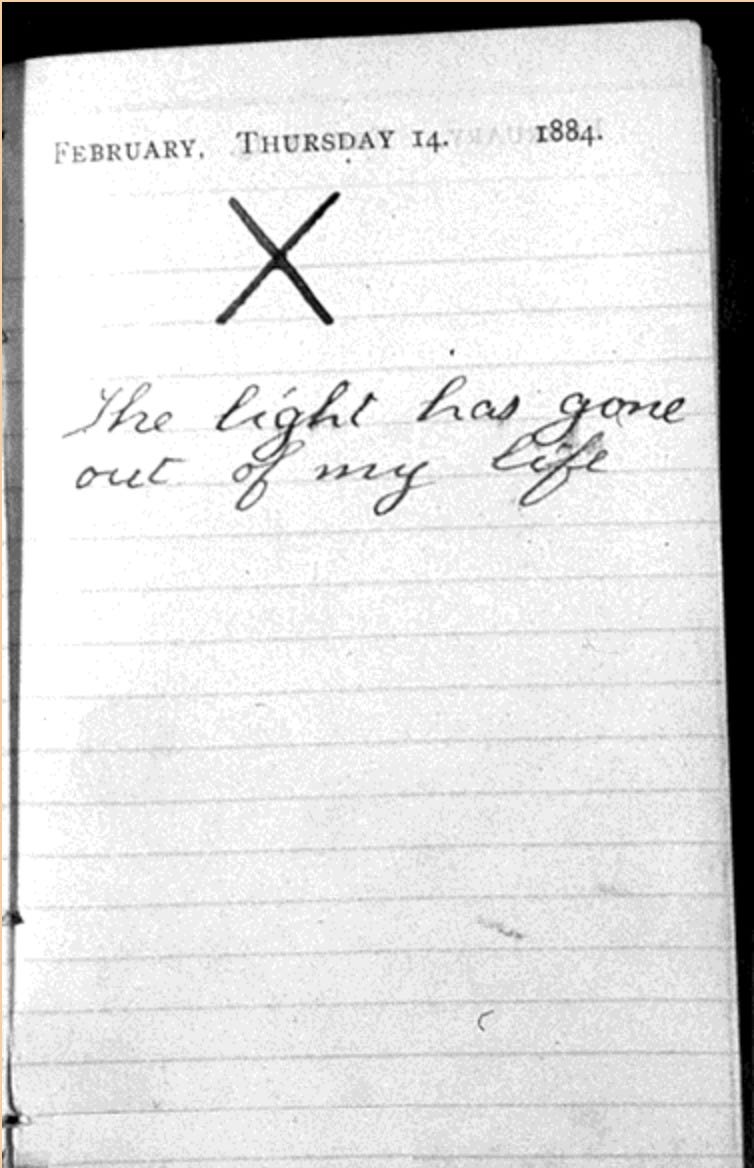
On Valentine’s Day in 1884, Theodore Roosevelt lost both his wife and his mother.
Four years before, Roosevelt could not have imagined the tragedy that would stun him in 1884. February 14, 1880, marked one of the happiest days of his life. He and the woman he had courted for more than a year, Alice Hathaway Lee, had just announced their engagement. Roosevelt was over the moon: “I can scarcely realize that I can hold her in my arms and kiss her and caress her and love her as much as I choose,” he recorded in his diary. What followed were, according to Roosevelt, “three years of happiness greater and more unalloyed than I have ever known fall to the lot of others.”
After they married in fall 1880, the Roosevelts moved into the home of Theodore’s mother, Martha Bulloch Roosevelt, in New York City. There they lived the life of wealthy young socialites, going to fancy parties and the opera and traveling to Europe. When Roosevelt was elected to the New York State Assembly in 1881, they moved to the bustling town of Albany, where the state’s political wire-pullers worked their magic. Roosevelt’s machine politician colleagues derided the rich, Harvard-educated young man as a “dude,” and they tried to ignore his irritating interest in reforming society.
In the summer of 1883, Alice discovered that she was pregnant, and that fall she moved back to New York City to live with her mother-in-law. There she awaited the birth of the child who Theodore was certain would arrive on February 14.
As headstrong as her father, Roosevelt’s daughter beat her father’s prediction by two days. On February 12, Alice gave birth to the couple’s first child, who would be named after her. Roosevelt was at work in Albany and learned the happy news by telegram. But Alice was only “fairly well,” Roosevelt noted. She soon began sliding downhill. She did not recover from the birth; she was suffering from something at the time called “Bright’s Disease,” an unspecified kidney illness.
Roosevelt rushed back to New York City, but by the time he got there at midnight on February 13, Alice was slipping into a coma. Distraught, he held her until he received word that his mother was dangerously ill downstairs. For more than a week, “Mittie” Roosevelt had been sick with typhoid. Roosevelt ran down to her room, where she died shortly after her son got to her bedside. With his mother gone, Roosevelt hurried back to Alice. Only hours later she, too, died.
On February 14, 1884, Roosevelt slashed a heavy black X in his diary and wrote “The light has gone out of my life.” He refused ever to mention Alice again.
Roosevelt’s profound personal tragedy turned out to have national significance. The diseases that killed his wife and mother were diseases of filth and crowding—the hallmarks of the growing Gilded Age American cities. Mittie contracted typhoid from either food or water that had been contaminated by sewage, since New York City did not yet treat or manage either sewage or drinking water. Alice’s disease was probably caused by a strep infection, which incubated in the teeming city’s tenements, where immigrants, whose wages barely kept food on the table, crowded together.
Roosevelt had been interested in urban reform because he worried that incessant work and unhealthy living conditions threatened the ability of young workers to become good citizens. Now, though, it was clear that he, and other rich New Yorkers, had a personal stake in cleaning up the cities and making sure employers paid workers a living wage.
The tragedy gave him a new political identity that enabled him to do just that. Ridiculed as a “dude” in his early career, Roosevelt changed his image in the wake of the events of February 1884. Desperate to bury his feelings for Alice along with her, Roosevelt left his baby daughter with his sister and escaped to Dakota Territory, to a ranch in which he had invested the previous year. There he rode horses, roped cattle, and toyed with the idea of spending the rest of his life as a western rancher. The brutal winter of 1886–1887 changed his mind. Months of blizzards and temperatures as low as –41 degrees killed off 80% of the Dakota cattle herds. More than half of Roosevelt’s cattle died.
Roosevelt decided to go back to eastern politics, but this time, no one would be able to make fun of him as a “dude.” In an era when the independent American cowboy dominated the popular imagination, Roosevelt now had credentials as a westerner. He ran for political office as a western cowboy taking on corruption in the East. And, with that cowboy image, he overtook his eastern rivals.
Eventually, Roosevelt’s successes made establishment politicians so nervous they tried to bury him in what was then seen as the graveyard of the vice presidency. Then, in 1901, an unemployed steelworker assassinated President William McKinley and put Roosevelt—“that damned cowboy,” as one of McKinley’s advisers called him—into the White House.
Once there, he worked to clean up the cities and stop the exploitation of workers, backing the urban reforms that were the hallmark of the Progressive Era.
[Photo of Theodore Roosevelt's diary, Library of Congress.]
February 13, 2023
February 13, 2023
Today, meetings began to take place before the Munich Security Conference begins in Berlin, Germany, on February 17. This conference is the world’s leading forum for talking about international security policy. Begun in 1963, it was designed to be an independent venue for experts and policymakers to discuss the most pressing security issues around the globe.
Vice President Kamala Harris will attend the conference from February 16 to 18 and is expected to talk about the continuing support of the United States for Ukraine. The anniversary of Russia’s 2022 assault on Ukraine is February 24, and today NATO Secretary-General Jens Stoltenberg warned that Russians have already begun their threatened major new offensive.
Indeed, Ukraine is at the heart of the conference this year. The Munich Security Report 2023, issued recently as a blueprint for the conference, begins by identifying Russia’s 2022 invasion of Ukraine as “a watershed moment.”
“Debates about different visions for the future international order are often abstract and theoretical,” the report begins, but “[b]y invading Ukraine, Russian President Vladimir Putin has made the clash of competing visions a brutal and deathly reality.”
The report goes on to identify a growing conflict around the globe between intensifying authoritarian regimes and a liberal, rules-based international order. It calls for shoring up that liberal order and for strengthening it by addressing the legitimate claims of countries and regions that have been excluded from that order or have even been victims of it. That many governments in Africa, Latin America, and Asia have refused to speak up against Russian aggression shows that there is deep dissatisfaction there with existing international patterns, and that dissatisfaction threatens the survival of democracy. The people of all countries must have a say in how the global future plays out.
The report notes that Russia’s “brutal and unprovoked invasion of a sovereign state” is “an attack against the foundational principles of the post–World War II order,” with “an authoritarian power” setting out “to eliminate a democracy.” But that’s not the only sign that autocracies are rising. China’s quiet support for Russia, its attempt to assert its own sphere of influence in East Asia through military shows of force, and its wide-ranging efforts “to promote an autocratic alternative to the liberal, rules-based international order” show the broad challenge of autocratic rule. “[T]he main fault line in global politics today,” the report suggests, is “that between democracies and dictators.”
Many world leaders believe that the next ten years will lay down the blueprint for the future of the international order, the report says, and it credits Ukraine and the “extraordinary resilience and determination of the Ukrainian people” with instilling “a new sense of purpose into democratic countries.” The report encourages democracies to use this momentum to re-envision the liberal, rules-based order to include countries that previously were excluded from the rulemaking. A new order “that better delivers on its promises” and “truly benefits everyone equally” has the potential to increase the coalition of those resisting autocracy. “If the revisionist moment we are currently experiencing spurs the renewal of this liberal, rules-based order,” it suggests, “President Volodymyr Zelenskyy and the people of Ukraine will have played a big part in this achievement.”
The conference organizers did not invite Russian government officials to participate in this year’s meeting, saying, "We do not want to offer a stage for those who have stamped over international law." But they did invite more leaders from emerging economies, vowing to get past the idea of an event where Europeans and Americans just talked to each other.
In a sign that many relationships are now in flux, the Chinese foreign ministry said today that China's top diplomat, Wang Yi, will go to the conference and will also visit France, Italy, Hungary, and Russia. China has been embarrassed recently by the exposure of what seems to have been an extensive spying program run by the Chinese military that included countries on five continents.
Meanwhile, in the U.S., the attention the Republican-controlled House Oversight Committee has been paying to what committee chair James Comer (R-KY) says on his website has been the Biden family’s “pattern of peddling access to the highest levels of government to enrich themselves, often to the detriment of U.S. interests,” has resurrected questions about the connections of the Trump family and Saudi leader Crown Prince Mohammed bin Salman. Popularly known as MBS, the Saudi leader in 2021 transferred $2 billion to a private equity firm that Trump’s son-in-law Jared Kushner created the day after he left the White House.
In an op-ed today in Time magazine, a former associate of Trump ally Rudy Giuliani, Lev Parnas, who had been part of the attempt to smear Hunter Biden in Ukraine, said that his “real job was to help undermine and destabilize the Ukrainian government.” Parnas was convicted of fraud, making false statements, and illegally funneling foreign money to the Trump campaign.
“I eventually realized,” he said, “that not only was I enabling Trump’s dirty tricks in the 2020 election, I was also risking that Ukraine would be essentially unarmed when Putin invaded.”
—
Notes:
https://securityconference.org/en/about-us/about-the-msc/
https://securityconference.org/en/publications/munich-security-report-2023/
https://www.nato.int/cps/en/natohq/news_211702.htm
https://www.rferl.org/a/russia-ukraine-nato-offensive/32269454.html
https://www.cnn.com/2023/02/07/politics/spy-balloon/index.html
February 12, 2023
On February 12, 1809, Abraham Lincoln was born in Kentucky. Exactly 100 years later, journalists, reformers, and scholars meeting in New York City deliberately chose the anniversary of his birth as the starting point for the National Association for the Advancement of Colored People (NAACP).
They vowed “to promote equality of rights and eradicate caste or race prejudice among citizens of the United States; to advance the interest of colored citizens; to secure for them impartial suffrage; and to increase their opportunities for securing justice in the courts, education for their children, employment according to their ability, and complete equality before the law.”
The spark for the organization of the NAACP was a race riot in Springfield, Illinois, on August 14 and 15, 1908. The violence broke out after the sheriff transferred two Black prisoners, one accused of murder and another of rape, to a different town out of concern for their safety.
Furious that they had been prevented from vengeance against the accused, a mob of white townspeople looted businesses and burned homes in Springfield’s Black neighborhood. They lynched two Black men and ran most of the Black population out of town. At least eight people died, more than 70 were injured, and at least $3 million of damage in today’s money was done before 3,700 state militia troops quelled the riot.
When he and his wife visited Springfield days later, journalist William English Walling found white citizens outraged that their Black neighbors had forgotten “their place.” Walling claimed he had heard a dozen times: “Why, [they] came to think they were as good as we are!”
“If these outrages had happened thirty years ago…, what would not have happened in the North?” wrote Walling. “Is there any doubt that the whole country would have been aflame?”
Walling warned that either the North must revive the spirit of Lincoln and the abolitionists and commit to “absolute political and social equality” or the white supremacist violence of the South would spread across the whole nation. “The day these methods become general in the North every hope of political democracy will be dead, other weaker races and classes will be persecuted in the North as in the South, public education will undergo an eclipse, and American civilization will await either a rapid degeneration or another profounder and more revolutionary civil war….”
He called for a “large and powerful body of citizens” to come to the aid of Black Americans.
Walling was the well-educated descendant of a wealthy enslaving family from Kentucky and had become deeply involved in social welfare causes at the turn of the century. His column on the Springfield riot prompted another well-educated social reformer, Mary White Ovington, to write and offer her support. Together with Walling’s friend Henry Moskowitz, a Jewish immigrant from Romania who was well connected in New York Democratic politics, Walling and Ovington met with a group of other reformers, Black and white, in the Wallings’ apartment in New York City in January 1909 to create a new civil rights organization.
In a public letter, the group noted that “If Mr. Lincoln could revisit this country in the flesh he would be disheartened and discouraged.” Black Americans had lost their right to vote and were segregated from white Americans in schools, railroad cars, and public gatherings. “Added to this, the spread of lawless attacks upon the negro, North, South and West—even in the Springfield made famous by Lincoln—often accompanied by revolting brutalities, sparing neither sex, nor age nor youth, could not but shock the author of the sentiment that ‘government of the people, by the people, for the people shall not perish from the earth.’”
The call continued, “Silence under these conditions means tacit approval,” and it warned that permitting the destruction of Black rights would destroy rights for everyone. “Hence,” it said, “we call upon all the believers in democracy to join in a national conference for the discussion of present evils, the voicing of protests, and the renewal of the struggle for civil and political liberty.”
A group of sixty people, Black and white, signed the call, prominent reformers all, and the next year an interracial group of 300 men and women met to create a permanent organization. After a second meeting in May 1910, they adopted a formal name, and the NAACP was born, although they settled on the centennial of Lincoln’s birth as their actual beginning.
Supporters of the project included muckraking journalists Ray Stannard Baker and Ida B. Wells, and sociologist W. E. B. Du Bois, who had been a founding member of the Niagara Movement, a Black civil rights organization formed in 1905. In 1910, Du Bois would choose to leave his professorship at Atlanta University to become the NAACP’s director of publicity and research. For the next 14 years, he would edit the organization’s flagship journal The Crisis.
While The Crisis was a newspaper, a literary magazine, and a cultural showcase, its key function reflected the journalistic sensibilities of those like Baker, Wells, and especially Du Bois: it constantly called attention to atrocities, discrimination, and the ways in which the United States was not living up to its stated principles. At a time when violence and suppression were mounting against Black Americans, Du Bois and his colleagues relentlessly spread knowledge of what was happening.
That use of information to rally people to the cause of equality became a hallmark of the NAACP. It challenged racial inequality by calling popular attention to racial atrocities and demanding that officials treat people equally before the law. In 1918 the NAACP published Thirty Years of Lynching in the United States, 1889–1918, reporting that of the 3,224 people lynched during that period, 702 were white and 2,522 Black. In 1922 it took out ads condemning lynching as “The Shame of America” in newspapers across the country.
When Walter Francis White took over the direction of the NAACP in 1931, the organization began to focus on lynching and sexual assault, as well as on ending segregation in schools and transportation. In 1944 the secretary of the NAACP’s Montgomery, Alabama, chapter, Rosa Parks, investigated the gang rape of 25-year-old Recy Taylor by six white men after two grand juries refused to indict the men despite their confessions. Parks pulled women’s organizations, labor unions, and Black rights groups together into a new “Committee for Equal Justice” to champion Mrs. Taylor’s rights.
In 1946 it was NAACP leader White who brought the story of World War II veteran Isaac Woodard, blinded by a police officers after talking back to a bus driver, to President Harry S. Truman. Afterward, Truman convened the President’s Committee on Civil Rights, directly asking its members to find ways to use the federal government to strengthen the civil rights of racial and religious minorities in the country.
Truman later said, “When a Mayor and City Marshal can take a… Sergeant off a bus in South Carolina, beat him up and put out… his eyes, and nothing is done about it by the State authorities, something is radically wrong with the system.” And that is what the NAACP had done, and would continue to do: highlight that the inequalities in American society were systemic rather than the work of a few bad apples, bearing witness until “the believers in democracy” could no longer remain silent.
—
Notes:
http://blackfreedom.proquest.com/wp-content/uploads/2020/09/springfield3.pdf
https://www.npr.org/templates/story/story.php?storyId=93606402
https://www.loc.gov/exhibits/naacp/prelude.html
https://www.loc.gov/exhibits/naacp/founding-and-early-years.html
https://babel.hathitrust.org/cgi/pt?id=emu.010000154224&view=1up&seq=10
https://naacp.org/find-resources/history-explained/history-crisis
Danielle L. McGuire, At the Dark End of the Street: Black Women, Rape, and Resistance—A New History of the Civil Rights Movement from Rosa Parks to the Rise of Black Power (New York: Vintage, 2011).
February 11, 2023
February 11, 2023
Since Representative Marjorie Taylor Greene (R-GA) led Republicans in shouts of “Liar!” when President Biden said in his State of the Union address that “some Republicans want Medicare and Social Security to sunset every five years,” Republicans have been swamping social and news media with accusations that Biden was lying.
In the speech, Biden continued: “That means if Congress doesn’t vote to keep them, those programs will go away. Other Republicans say if we don’t cut Social Security and Medicare, they’ll let America default on its debt for the first time in our history.”
In fact, Biden’s statement was true. It was based on Florida senator Rick Scott’s 11-point plan, released in February 2022, which promised, “All federal legislation sunsets in 5 years. If a law is worth keeping, Congress can pass it again.” (It also promised to “sell off all non-essential government assets, buildings, and land, and use the proceeds to pay down our national debt,” without defining “non-essential.”)
Since Republicans won control of the House, the extremists have also said they would not approve a clean debt ceiling increase without spending cuts. The history of Republican calls for cuts to Social Security runs long and deep, but just reaching back to 2020: Trump vowed to make cuts in his second term; former vice president Mike Pence last week called for “modest reforms in entitlements,” including privatization; Wisconsin senator Ron Johnson has called for moving the programs to annual funding so they would have to be renewed every year; and the Republican Study Committee, which includes more than 150 Republican House members, has called this year for raising the age of eligibility from 66 or 67 to 70 for Social Security and from 65 to 67 for Medicare.
Biden’s statement came from what was famously dubbed the “reality-based community” in 2002.
That year, a senior advisor to George W. Bush told journalist Ron Suskind that “guys like me were ‘in what we call the reality-based community,’ which he defined as people who ‘believe that solutions emerge from your judicious study of discernible reality.’” Suskind responded by talking about the principles of the Enlightenment—the principles on which the Founders based the Declaration of Independence—that put careful observation of reality at the center of human progress. But Bush’s aide wanted no part of that, Suskind recalled: “He cut me off. ‘That’s not the way the world really works anymore,’ he continued. ‘We’re an empire now, and when we act, we create our own reality…. We’re history's actors… and you, all of you, will be left to just study what we do.”
The statement that Biden won the 2020 presidential election also comes from the reality-based community.
Today, Josh Dawsey of the Washington Post reported that Trump’s campaign hired a consulting firm to try to prove that the election had been stolen. The Berkeley Research Group examined the election results in six swing states but could not find anything that would have changed the outcome. “They looked at everything,” a source told Dawsey: “change of addresses, illegal immigrants, ballot harvesting, people voting twice, machines being tampered with, ballots that were sent to vacant addresses that were returned and voted…. Literally anything you could think of. Voter turnout anomalies, date of birth anomalies, whether dead people voted. If there was anything under the sun that could be thought of, they looked at it.”
The consultants briefed Trump, chief of staff Mark Meadows, and others on their evidence that Biden’s election was legitimate in December 2020—before the events of January 6—but the Trump camp continued to insist the election had been stolen.
The rejection of reality has gone so far that we have in Congress Representative George Santos (R-NY), who appears to have fabricated his entire biography. Yesterday, Jacqueline Alemany and Alice Crites of the Washington Post revealed that the biography of another newly-elected right-wing representative, Anna Paulina Luna (R-FL), is also suspect. Family members dispute her stories of an isolated and impoverished youth, there is no record of a nighttime home invasion she claims was formative, and her embrace of her Hispanic heritage—her mother’s family is Mexican-American—is recent enough that in 2015 she identified herself on a voting registration form as “White, not of Hispanic origin.”
After the story appeared, Luna’s lawyer issued a statement from her saying that “anyone who is a conservative minority is a threat to Leftist control. They can try to discredit me, but unfortunately for them the facts completely blow their story out of the water.”
There is a difference between political spin—which virtually all political operatives use and which generally means making a statement without full context so it is misleading—and rejecting the reality-based community in favor of lies and attacks. Political decisions that are not based on reality rob us of our right to make informed decisions about our government and what it will do.
Social Security and Medicare are currently financially unstable. They can be stabilized by cutting benefits, raising taxes, rearranging government funding, or by some combination of the three. Biden wants to raise taxes; Republicans want to cut benefits, but they won’t say which ones and now deny they meant Social Security and Medicare.
On Friday, Scott introduced a bill to rearrange government funding, saying it would “increase funding” for the programs, but in fact, it finds the money by achieving another Republican goal: cutting the $80 billion from the Inflation Reduction Act that restored funding to the Internal Revenue Service. That funding has enabled the IRS to answer 88.6% of taxpayers’ phone calls this year, up from 13% in the 2022 tax season and 11% the year before. Adding in automated phone support and chat features, 93.3% of taxpayers have been able to get support. Democrats will almost certainly not agree to stop this program, and Scott is likely hoping to get them on record as “voting against” more money for Social Security and Medicare.
Voters need fact-based information to elect people who will enact the policies a majority of us want.
We need politicians to participate in the reality-based community.
—
Notes:
Ron Suskind, “Faith, Certainty and the Presidency of George W. Bush,” New York Times Magazine, October 17, 2004, at https://www.nytimes.com/2004/10/17/magazine/faith-certainty-and-the-presidency-of-george-w-bush.html
https://rescueamerica.com/wp-content/uploads/2022/06/RickScott-12-Point-Policy-Book.pdf
https://www.washingtonpost.com/politics/2023/02/11/trump-campaign-report-electoral-fraud/
https://www.washingtonpost.com/politics/2023/02/10/anna-paulina-luna-republican-biography/
https://thehill.com/finance/3850036-republicans-social-security-medicare-debt-ceiling/
https://www.cnn.com/2023/02/09/politics/medicare-social-security-what-matters/index.html
https://www.washingtonpost.com/politics/2023/02/10/biden-governors-brazil-president-pence-subpoena/
https://thehill.com/finance/3850036-republicans-social-security-medicare-debt-ceiling/
February 10, 2023
February 10, 2023
Over all the torrent of news these days is a fundamental struggle about the nature of human government. Is democracy still a viable form of government, or is it better for a country to have a strongman in charge?
Democracy stands on the principle of equality for all people, and those who are turning away from democracy, including the right wing in the United States, object to that equality. They worry that equal rights for women and minorities—especially LGBTQ people—will undermine traditional religion and traditional power structures. They believe democracy saps the morals of a country and are eager for a strong leader who will use the power of the government to reinforce their worldview.
But empowering a strongman ends oversight and enables those in power to think of themselves as above the law. In the short term, it permits those in power to use the apparatus of their government to enrich themselves at the expense of the people of their country. Their supporters don’t care: they are willing to accept the cost of corruption so long as the government persecutes those they see as their enemies. But that deal is vulnerable when it becomes clear the government cannot respond to an immediate public crisis.
That equation is painfully clear right now in Turkey and Syria, where more than 380,000 people are homeless after Monday’s devastating earthquakes. The death toll has climbed to more than 23,000, and more than 78,000 are injured. So far. Just a month ago, Turkey’s president President Recep Tayyip Erdoğan promised that the country had the fastest and most effective system of response to disaster in the world.
But that promise has been exposed as a lie. As Jen Kirby pointed out in Vox yesterday, Erdoğan and his ruling Justice and Development Party (AKP), who have been moving the country toward autocracy, rose to power thanks to a construction boom in the 2010s that both drove economic growth and permitted Erdoğan to hand out contracts to his supporters. The collapse of more than 6,400 buildings in Monday’s quakes have brought attention to cost cutting and bribery to get around building codes. At the same time, since a big quake in 1999, homeowners have been paying an earthquake tax that should, by now, have been worth tens of billions of dollars, but none of that money seems to be available, and Erdoğan won’t say where it went.
“This is a time for unity, solidarity,” Erdoğan told reporters. “In a period like this, I cannot stomach people conducting negative campaigns for political interest.” He has shut down media coverage of the crisis and cracked down on social media as well. Elections in Turkey are scheduled for May 14. Erdoğan was already facing a difficult reelection.
In Syria, President Bashar al-Assad also has to deal with the horrific scenario. Aid groups are having trouble getting assistance to hard-hit areas controlled by opponents of the regime during the country’s ongoing civil war. Assad has blamed western sanctions, imposed against his regime because of its murder of his opponents, for the slow response to the earthquake, but his government has blocked western aid to areas controlled by his opposition. The U.S. has issued a six-month sanctions exemption for relief in Syria.
Russia is also in trouble as its recent invasion of Ukraine has resulted in a protracted war, but it maintains it will continue to extend its new imperial project. On Tuesday, Ramzan Kadyrov, a close ally of Russian president Vladimir Putin, spoke openly of attacking Poland after conquering Ukraine. It was time, he said, for the West to fall to its knees before Russia, and he predicted Ukraine would be Russia’s before the end of 2023. Poland is a member of the North Atlantic Treaty Organization (NATO), and an attack on it would bring the rest of the NATO countries, including the U.S., to its aid.
Today, Moldova, a former Soviet republic of about 2.6 million people that borders Ukraine and has been under tremendous pressure from Russia, enduring soaring inflation, an inflow of Ukrainian refugees, and power cuts after Russian attacks on Ukraines’ grid, saw its government resign. That government has worked to move closer to European allies and has applied for admission to the European Union. Russia has sought to destabilize that government and has recently appeared to be planning to invade the country. Moldovan president Maia Sandu has nominated a new prime minister, one that intends to continue orienting the country toward Europe.
The U.S. has stood solidly against Russia’s ambitions, but our own right wing is increasingly supportive of Putin, liking his stand against LGBTQ people, his embrace of religion, and his ruthless determination to impose that vision on his country. Yesterday the president and chief executive officer of Elon Musk’s SpaceX admitted the company has blocked the ability of Ukrainian troops to use the Starlink satellite system to advance against Russia. In October, Musk drew fire for proposing a “peace” plan that would give Russia the territory it has claimed from Ukraine.
Meanwhile, President Luiz Inácio Lula da Silva of Brazil met with President Joe Biden at the White House today. (His predecessor, Jair Bolsonaro, an ally of former president Trump, staged a coup against Lula and is now hanging out in Florida hoping to score a U.S. tourist visa.) In their meeting, Biden and Lula emphasized democracy.
Biden noted that both democracies had been tested lately and that we stand together, rejecting political violence and putting great value in our democratic institutions: the rule of law, freedom, and equality.
Through an interpreter, Lula expanded on what that means. He noted that Brazil had “self-marginalized” under Bolsonaro, rejecting the world and turning inward. But, he said, “Brazil is a country that people enjoy peace, democracy, work, and Carnival, and samba, and a lot of joy. This is the Brazil that we’re trying to reposition in the world.” He called for making sure no more right-wing insurrections undermine our democracies, as well as fighting racism “so that we can guarantee some dreams for the youth.” He called for protecting the natural world to combat climate change, and creating a world governance to enable us to work together against existential threats.
“This is not a government program,” Lula said. “This is a faith commitment of someone that believes in humanism, someone that believes in solidarity. I don’t want to live in a world where humans become algorithms. I want to live in a world where human beings are human beings. And for that, we have to take care very carefully what God gave us: that is the planet Earth.”
—
https://www.cnn.com/middleeast/live-news/turkey-syria-earthquake-updates-2-9-23-intl/index.html
https://www.vox.com/world/2023/2/9/23591279/turkey-earthquake-erdogan-response-elections
https://www.euronews.com/2023/01/23/turkeys-erdogan-announces-elections-will-be-held-on-may-14
https://www.npr.org/2023/02/09/1155647266/turkey-earthquake-erdogan-government-response-criticism
https://www.washingtonpost.com/opinions/2023/02/09/earthquake-syria-sanctions-assad/
https://www.aljazeera.com/news/2023/2/10/us-issues-sanctions-general-exemption-for-aid-to-syria
https://www.npr.org/2023/02/10/1156220965/moldova-prime-minister-resigns-new-government
https://www.politico.eu/article/moldova-government-resign-pro-european-union-natalia-gavrilita/
https://www.cnn.com/2023/02/09/politics/spacex-ukrainian-troops-satellite-technology/index.html
https://www.cjr.org/the_media_today/earthquake_turkey_press_freedom.php
https://www.washingtonpost.com/weather/2023/02/07/earthquake-turkey-syria-causes-damage/
February 9, 2023
February 9, 2023
Leaving today’s classified briefing on the Chinese spy balloon, Senator Mitt Romney (R-UT) told CNN’s Manu Raju that he thinks the U.S. “made the right decision to wait and shoot down the suspected spy balloon.” “I believe that the administration, the president, our military and intelligence agencies, acted skillfully and with care. At the same time, their capabilities are extraordinarily impressive,” Romney said.
House speaker Kevin McCarthy (R-CA) and House majority leader Steve Scalise (R-LA) both continued to maintain that the administration should have shot the balloon down earlier.
Meanwhile, the House Republican majority has begun its oversight hearings, and so far, they are not yielding the results the House Republicans intended. From the “voter fraud” investigations of the 1990s to the 2016 investigations into Democratic presidential candidate Hillary Clinton’s use of a private email server, Republicans have used “investigations” to spread the idea of Democratic wrongdoing.
In 2015, McCarthy made it clear how he saw such investigations. He told Fox News Channel personality Sean Hannity that “everybody thought Hillary Clinton was unbeatable, right? But we put together a Benghazi Special Committee, a select committee. What are her numbers today? Her numbers are dropping.”
But a number of things might have drawn the fangs of such propaganda. Trump’s heavy-handed attempts to force Ukraine president Volodymyr Zelensky into announcing—but not actually performing—an investigation into Hunter Biden’s work on the board of the Ukrainian company Burisma in 2019 and the repeated “investigations” into the 2020 election, all of which have come up empty handed, have heightened awareness that such investigations are not honest. Meanwhile, the congressional investigation into the events of January 6 have illustrated what it actually looks like to engage in an investigation that produces real evidence.
At the same time, the reality that Trump himself committed many of the misdeeds Republicans are now trying to pin on Democrats, and that witnesses will say so, means that the Republican narrative will have a significant check on it. Journalists and Democratic lawmakers are already calling out Republican hypocrisy and putting on the record that Republicans are wasting time and taxpayers’ money to grandstand.
Finally, McCarthy has put on the committees a number of extremist representatives who are not well versed in the law or arguments, meaning they are reinforcing the impression that they are simply political hacks rather than serious investigators of a real problem.
Yesterday the Oversight and Accountability Committee investigated Twitter for allegations that the company hid the story of Hunter Biden’s laptop before the election of 2020. They insist that evidence will show that the government suppressed right-wing voices on Twitter. Right off the bat, there were issues with this argument. The First Amendment to the U.S. Constitution establishes that the government cannot abridge free speech or the freedom of the press. It does not demand that private entities must allow all speech.
Neither Hunter Biden nor Joe Biden was in government in 2020, and Twitter is not a government entity.
But Donald Trump was in office, and witnesses testified that the Trump White House routinely demanded that tweets be taken down. The hearing devoted time to a discussion of Trump’s attempt to get Twitter to take down a tweet by model Chrissy Teigen who, after Trump insulted her on Twitter, referred to him as a “p*ssy *ss b*tch” (a description that is now in the Congressional Record). The White House contacted Twitter immediately to ask it to take down this “derogatory statement directed toward the president.” (Twitter left it up.)
Since Biden became president, according to Twitter’s former head of safety and integrity Yoel Roth and former chief legal officer Vijaya Gadde, the Biden White House has never made such requests. Twitter’s former deputy general counsel James Baker testified: “I’m aware of no unlawful collusion with or direction from any government agency or political campaign on how Twitter should have handled the Hunter Biden laptop situation.”
The executives said Twitter initially slowed the spread of articles about Biden’s laptop from the New York Post for 24 hours because the story “at first glance bore a lot of similarities to the 2016 Russian hack and leak operation targeting the DNC.” Roth said, “[W]e made a mistake.”
Anika Collier Navaroli, a former member of Twitter’s content moderation team, told Representative Alexandria Ocasio-Cortez (D-NY) that Twitter had taken down a tweet in which Trump had called for Ocasio-Cortez and three other Democratic congresswomen to “go back and help fix the totally broken and crime-infested places from which they came,” because “go back…to where you came from” was in violation of Twitter’s policies against abuse of immigrants. Two days later, Twitter changed the policy. Navroli agreed that “Twitter changed their own policy after the president violated it in order to essentially accommodate his tweet.”
The Republicans’ questioning was less pointed. Representatives Marjorie Taylor Greene (R-GA) and Lauren Boebert (R-CO) spent their time complaining loudly to the Twitter executives about their own bans for violating the company’s policies. Greene insisted, “You violated my First Amendment rights,” and Boebert yelled, “Who the hell do you think you are?”
Bloomberg Law said the Republican probe began “with a thud.” “House Republicans failed in the opening salvo of their investigation into the finances of Joe Biden’s family to produce evidence substantiating their claims that US intelligence officials worked with Twitter Inc. to suppress an unflattering 2020 news story on the president’s son.”
Today the House Judiciary Select Subcommittee on the Weaponization of the Federal Government held its first meeting under chair Jim Jordan (R-OH), who promised to look at “the politicization of the FBI and DOJ and attacks on American civil liberties.” There are twelve Republicans and nine Democrats on the committee.
Today’s hearing began with testimony from Senator Chuck Grassley (R-IA) that Hillary Clinton and the Democratic National Committee colluded with the Russians in 2016. Senator Ron Johnson (R-WI), who has complained that the government impeded his investigation of Hunter Biden’s laptop; former Democratic representative from Hawaii and now Fox News Channel personality Tulsi Gabbard; and conservative lawyer Jonathan Turley also testified. They rehashed old complaints, but no one produced any new evidence.
The top Democrat on the committee, Stacey Plaskett, from the U.S. Virgin Islands, said: “I’m deeply concerned about the use of this select subcommittee as a place to settle scores, showcase conspiracy theories, and advance an extreme agenda that risks undermining Americans’ faith in our democracy.” Constitutional law professor Jamie Raskin (D-MD), sporting a purple bandana from his cancer treatments, pointed out the many times Trump abused his power to reward friends and punish enemies and said, “If weaponization of the Department of Justice has any meaning, this is it.”
Raskin also recalled that in August, Jordan said an investigation would “help frame up the 2024 race, when I hope and I think President Trump is going to run again. And we need to make sure that he wins.” Raskin said the committee was “all about restoring Donald Trump, the twice-impeached former president, to the office he lost by seven million votes in 2020 and tried to steal back in a political coup and violent insurrection against our constitutional order on January 6, 2021.”
Early in the proceedings, Aaron Rupar of Public Notice mused: “It is a bit odd to me that Fox News isn’t carrying the ‘weaponization’ hearing live, since it is basically Fox porn.” After Raskin testified, he wrote: “I’m beginning to understand why Fox News thought it might be a bad idea to carry this live.”
And on the topic of January 6, after months of negotiations between Pence’s lawyers and federal prosecutors, special counsel Jack Smith has issued a subpoena to former vice president Mike Pence for documents and testimony. Observers suggest this move is a sign that the investigation into former president Trump for his behavior over the attempts to overturn the 2020 presidential election is moving into a new phase.
—
Notes:
 Manu Raju @mkrajuSen. Mitt Romney, leaving a classified briefing on China, told us he believes the US made the right decision to wait and shoot down the suspected spy balloon — breaking with most Republicans.5:43 PM ∙ Feb 9, 202331,647Likes3,621Retweets
https://www.politico.com/story/2015/10/hillary-clinton-benghazi-kevin-mccarthy-214325
https://rollcall.com/2023/02/09/gop-senators-testify-on-fbi-in-first-weaponization-panel-hearing/
 Aaron Rupar @atruparRaskin: "It's all about restoring Donald Trump, the twice impeached former president to the office he lost by seven million votes in 2020 and tried to steal back in a political coup and violent insurrection against our constitutional order." 6:23 PM ∙ Feb 9, 20236,233Likes1,283Retweets
February 8, 2023
February 8, 2023
At a press conference today, Secretary of State Antony Blinken told reporters that U.S. intelligence has determined that the spy balloon was part of a larger Chinese surveillance program operating around the world. On Monday, the U.S. shared the information it gleaned from the wreckage of the balloon with around 150 people from about 40 embassies. China has launched “dozens” of such surveillance balloons since 2018. New information has made U.S. intelligence able to revisit previous objects that were classified as “unknown” and recognize them as part of this balloon program.
The news about the balloon illustrated the difference between the slow, hard work of governance and the easy hit of sound bites. From the beginning of his administration, President Joe Biden emphasized that he intended to focus on cybertechnology as a central element of national security. That focus meant that in May 2021, just four months after he took office, he issued an executive order on “improving the nation’s cybersecurity.”
According to National Security Advisor Jake Sullivan, that focus meant that the U.S. “enhanced our surveillance of our territorial airspace, we enhanced our capacity to be able to detect things that the Trump administration was unable to detect.” The Chinese apparently sent at least three of these balloons into U.S. airspace when Trump was president, but we didn’t know it until the Biden administration tightened security. Sullivan said that the surveillance improvements enabled the U.S. to “go back and look at the historical patterns” and uncover “multiple instances” during the Trump administration when similar things had happened.
During the balloon saga, Republicans complained that Biden didn’t shoot the balloon down earlier than he did, but defense officials said that they were collecting intelligence from the device (of course they were!) and that they made certain the Chinese could not get information from it.
Republicans have insisted that the balloon shows Chinese disdain for the U.S., while President Joe Biden told reporters Monday that the balloon did not change the developing patterns between the U.S. and China. “We’ve made it clear to China what we’re going to do,” he said. “They understand our position. We’re not going to back off. We did the right thing. And there’s not a question of weakening or strengthening. It’s just the reality.”
For their part, Chinese authorities appear embarrassed by the exposure of the program and by the cancellation of Blinken’s planned visit. They downplayed the balloon as an “isolated incident,” and officials expressed “regrets that the airship strayed into the United States by mistake.”
Part of what Biden was referring to when he said China knew “what we’re going to do” is that on January 28, the Biden administration inked a deal with Japan and the Netherlands to limit exports of semiconductor technologies to China. The two countries have signed on to the U.S. sanctions the Biden administration put into place last October against exports of that technology from the U.S. to China. Last week, the U.S. stopped sales of essential components to Chinese technology giant Huawei.
This shutdown of technological innovation has upset Chinese authorities, concerned about what it will mean for Chinese industry. “We hope the relevant countries will do the right thing and work together to uphold the multilateral trade regime and safeguard the stability of the global industrial and supply chains,” China’s Foreign Ministry spokesperson Wang Wenbin said earlier this month. “This will also serve to protect their own long-term interests.”
Now, suddenly eager to confront the balloon, the Republican House has come up with 17 new bills to counter China.
Meanwhile, the recent report of the Australian Lowy Institute, which for the last five years has annually ranked the power of 26 Asian countries, assessed that China’s isolation because of Covid has set it back, permitting the U.S. to retain its position as the key player in Asia. But, the report said, the idea of a multipolar region, which is what the U.S. under Biden is backing, seems so distant as to be unattainable. Finally, it assesses that Russia “risks growing irrelevance.” The 2022 invasion of Ukraine has sapped Russia in dramatic ways.
Both the Senate and the House will receive classified briefings on the balloon and Chinese intelligence this week.
Last night, during President Biden’s State of the Union address, House speaker Kevin McCarthy (R-CA) complained by tweet that Biden hadn’t mentioned China in the first hour of his speech, suggesting that the president wasn’t taking the issue seriously enough. Today, when CNN’s Manu Raju asked McCarthy if he was okay with New York representative George Santos—the serial liar who is currently under threat of an ethics investigation over where his campaign money came from—attending that classified briefing, McCarthy said, “Yes.”
All this is to say that actual governance is about a lot more than reacting to a balloon.
—
Notes:
https://abcnews.go.com/Politics/chinese-balloon-recovery-underway-amid-gop-attacks/story?id=96924402
https://www.lawfareblog.com/right-time-chip-export-controls
https://www.seattletimes.com/business...
https://power.lowyinstitute.org/
@SusannahCPatton @JackRSato and @HerveLemahieu. 1/7 ","username":"LowyInstitute","name":"The Lowy Institute","date":"Tue Feb 07 20:28:16 +0000 2023","photos":[],"quoted_tweet":{},"retweet_count":9,"like_count":33,"expanded_url":{"url":"https://power.lowyinstitute.org"... - Lowy Institute Asia Power Index","description":"Map the distribution of power across 26 countries in the Asia-Pacific with @LowyInstitute #AsiaPowerIndex","domain":"power.lowyinstitute.org"},"video_url":null,"belowTheFold":true}"> The Lowy Institute @LowyInstituteThe Asia Power Index 2023 provides the latest snapshot of comprehensive power in the Indo-Pacific region. In this thread we’ll draw together some of the analysis on this year’s Index from authors @SusannahCPatton @JackRSato and @HerveLemahieu. 1/7
  power.lowyinstitute.orgMap - Lowy Institute Asia Power IndexMap the distribution of power across 26 countries in the Asia-Pacific with @LowyInstitute #AsiaPowerIndex8:28 PM ∙ Feb 7, 202333Likes9Retweets
https://www.axios.com/2023/02/05/senate-classified-china-balloon-briefing
Manu Raju @mkrajuAsked Speaker McCarthy if he’s OK with George Santos attending tomorrow’s classified briefing on China. “Yes,” he told me9:15 PM ∙ Feb 8, 20231,219Likes405Retweets Kevin McCarthy @SpeakerMcCarthyOne hour into this speech, and President Biden hasn't mentioned China or our border once. But he's proposed raising taxes three times.Tells you where his priorities lie.3:02 AM ∙ Feb 8, 202376,806Likes12,295Retweets
https://www.cnn.com/2023/02/07/politics/house-ethics-committee-probe-george-santos/index.html
https://www.washingtonpost.com/national-security/2023/02/07/china-spy-balloon-intelligence/
February 7, 2023
February 7, 2023
And then there was President Joe Biden’s 2023 State of the Union address.
This is the annual event in our politics that gets the most viewers. Last year, 38.2 million people watched it on television and streaming services.
What viewers saw tonight was a president repeatedly offering to work across the aisle as he outlined a moderate plan for the nation with a wide range of popular programs. He sounded calm, reasonable, and upbeat, while Republicans refused to clap for his successes—800,000 new manufacturing jobs, 20,000 new infrastructure projects, lower drug prices—or his call to strengthen the middle class.
And then, when he began to talk about future areas of potential cooperation, Republicans went feral. They heckled, catcalled, and booed, ignoring House speaker Kevin McCarthy’s (R-CA) attempts to shush them. At the State of the Union, in the U.S. Capitol, our lawmakers repeatedly interrupted the president with insults, yelling “liar” and “bullsh*t.” And cameras caught it all.
Extremist Marjorie Taylor Greene (R-GA), her hands cupping her wide open mouth to scream at the president, became the face of the Republican Party.
Biden began with gracious remarks toward a number of Republicans as well as Democrats, then emphasized how Republicans and Democrats came together over the past two years to pass consequential legislation. Speaker McCarthy had asked him to take this tone, and he urged Republicans to continue to work along bipartisan lines, noting that the American people have made it clear they disapprove of “fighting for the sake of fighting, power for the sake of power, conflict for the sake of conflict.”
For the next hour the president laid out a promise to continue to rebuild the middle class, hollowed out by 40 years of policies based on the idea that cutting taxes and concentrating wealth among the “job creators” would feed the economy and create widespread prosperity. He listed the accomplishments of his administration so far: unemployment at a 50-year low, 800,000 good manufacturing jobs, lower inflation, 10 million new small businesses, the return of the chip industry to the United States, more than $300 billion in private investment in manufacturing, more than 20,000 new infrastructure projects, lower health care costs, Medicare negotiations over drug prices, investment in new technologies to combat climate change. He promised to continue to invest in the places and people who have been forgotten.
Biden described a national vision that includes everyone. It is a modernized version of President Franklin Delano Roosevelt’s New Deal, and he very clearly invited non-MAGA Republicans to embrace it. He thanked those Republicans who voted for the Bipartisan Infrastructure Law, then tweaked those who had voted against it but claimed credit for funding. He told them not to worry: “I promised to be the president for all Americans. We’ll fund your projects. And I’ll see you at the ground-breaking.”
But then he hit the key point for Republicans: taxes. To pay for this investment in the future, Biden called for higher taxes on corporations and the wealthy. He noted that “in 2020, 55 of the biggest companies in America made $40 billion in profits and paid zero in federal income taxes.” “That’s simply not fair,” he said. He signed into law the requirement that billion-dollar companies have to pay a minimum of 15%—less than a nurse pays, he pointed out—and he called for a billionaire minimum tax. While he reiterated his promise that no one making less than $400,000 a year would pay additional taxes, he said “no billionaire should pay a lower tax rate than a school teacher or a firefighter.” He also called for quadrupling the tax on corporate stock buybacks.
Republicans consider these proposals nonstarters because their whole vision is based on the idea of cutting taxes to free up capital. By committing to higher taxes on the wealthy, Biden was laying out a vision that is very much like that from the time before Reagan. It is a rejection of his policies and instead a full-throated defense of the idea that the government should work for ordinary Americans, rather than the rich.
And then he got into the specifics of legislation going forward, and Republicans lost it. The minority party has occasionally been vocal about its dislike of the State of the Union since Representative Joe Wilson (R-SC) shouted “You lie!” at President Obama in 2009 (Obama was telling the truth); a Democrat yelled “That’s not true” at Trump in 2018 as he, in fact, lied about immigration policy. But tonight was a whole new kind of performance.
Biden noted that he has cut the deficit by more than $1.7 trillion (in part because pandemic programs are expiring) and that Trump increased the deficit every year of his presidency, even before the pandemic hit. And yet, Congress responded to the rising debt under Trump by raising the debt limit, cleanly, three times.
Biden asked Congress to “commit here tonight that the full faith and credit of the United States of America will never, ever be questioned.” This, of course, is an issue that has bitterly divided Republicans, many of whom want to hold the country hostage until they get what they want. But they can’t agree on what they want, so they are now trying to insist that Biden is refusing to negotiate the budget when, in fact, he has simply said he will not negotiate over the debt ceiling. Budget negotiations are a normal part of legislating, and he has said he welcomes such talks. Tonight, once again, he asked the Republicans to tell the American people what, exactly, they propose.
And then Biden did something astonishing. He tricked the Republicans into a public declaration of support for protecting Social Security and Medicare. He noted that a number of Republicans have called for cutting, or even getting rid of, Social Security and Medicare. This is simply a fact—it is in Senator Rick Scott’s (R-FL) pre-election plan; the Republican Study Committee’s budget; statements by Senators Mike Lee (R-UT), Lindsey Graham (R-SC), and Ron Johnson (R-WI); and so on—but Republicans booed Biden and called him a liar for suggesting they would make those cuts, and they did so in public.
Seeming to enjoy himself, Biden jumped on their assertion, forcing them to agree that there would be no cuts to Social Security or Medicare. It was budget negotiation in real time, and it left Biden holding all the cards.
From then on, Republican heckling got worse, especially as Biden talked about banning assault weapons. Biden led the fight to get them banned in 1994, but when Republicans refused to reauthorize that law, it expired and mass shootings tripled. Gun safety is popular in the U.S., and Republicans, many of whom have been wearing AR-15 pins on their lapels, booed him. When he talked about more work to stop fentanyl production, one of the Republican lawmakers yelled, “It’s your fault.”
In the midst of the heckling, Biden praised Republican president George W. Bush’s bipartisan $100 billion investment in HIV/AIDS prevention and treatment.
And then, in this atmosphere, Biden talked about protecting democracy. “For the last few years our democracy has been threatened, attacked, and put at risk,” he said. “Put to the test here, in this very room, on January 6th.”
With lawmakers demonstrating the dangerous behavior he was warning against, he said: “We must all speak out. There is no place for political violence in America. In America, we must protect the right to vote, not suppress that fundamental right. We honor the results of our elections, not subvert the will of the people. We must uphold the rule of the law and restore trust in our institutions of democracy. And we must give hate and extremism in any form no safe harbor.”
“Democracy must not be a partisan issue. It must be an American issue.”
With Republicans scoffing at him, he ended with a vision of the nation as one of possibility, hope, and goodness. “We must be the nation we have always been at our best. Optimistic. Hopeful. Forward-looking. A nation that embraces light over darkness, hope over fear, unity over division. Stability over chaos.”
“We must see each other not as enemies, but as fellow Americans. We are a good people.”
Arkansas governor Sarah Huckabee Sanders gave the Republican rebuttal. Full of references to the culture wars and scathing of Biden, she reinforced the Republican stance during the speech. “The dividing line in America is no longer between right or left,” she said. “The choice is between normal or crazy.”
She is probably not the only one who is thinking along those lines after tonight’s events, but many are likely drawing a different conclusion than she intended.
—
Notes:
https://www.businessinsider.com/democrats-boo-trump-on-immigration-state-of-the-union-2018-1
February 6, 2023
February 6, 2023
The Chinese spy balloon shot down off South Carolina on Saturday after spending four days in U.S. airspace will almost certainly make the history books but not because, by itself, it is a hugely significant factor in the changing relationship between the U.S. and China under President Joe Biden. The reason the balloon will be remembered in the future is that the Republican response to it has been so completely unrelated to reality, and has been so magnified by the media, that it has provided a window into the dysfunction of modern politics.
The facts are these: On Saturday, January 28, a Chinese airship entered U.S. airspace north of the Aleutian Islands, then crossed Alaska. It left U.S. airspace, then reentered over northern Idaho on Tuesday, January 31. On February 1 it was over Montana. On February 3 it was near St. Louis, Missouri. On Saturday, February 4, the pilot of an Air Force F-22 shot the airship down in shallow water off the coast of South Carolina, where the wreckage could be recovered.
The Trump administration had an inconsistent relationship with China. Trump attacked China in a trade war early in his presidency, placing tariffs on a range of products (which induced China to retaliate, prompting Trump to pump $28 billion into the U.S. farming sector to compensate for lost revenue). But by 2019, according to Trump’s national security advisor John Bolton, Trump “pleaded” with Chinese leader Xi Jinping to help him get reelected in 2020, and inked a deal for China to buy significant amounts of the farm products it had turned to other countries to provide after the tariffs (that was why Trump downplayed China’s role in hiding Covid in the early months of 2020). According to former representative Adam Kinzinger (R-IL), Trump also asked congressional leaders to “lay off” Xi, because Trump didn’t want to disappoint Xi.
In contrast, Biden and Secretary of State Antony Blinken have worked to counter China by building Indo-Pacific cooperation, reinforced U.S. support for Taiwan, established export controls on technology that have hamstrung the Chinese semiconductor industry, worked to counter Chinese investment in Africa, and enhanced security cooperation with South Korea and Japan.
But the balloon sparked a frenzy from Republicans insisting that Biden had been weak on China or even was working for China: right-wing talk show host Mark Levin said Biden is “bought and paid for by the Communist Chinese government,” and former president Trump said that Biden “has surrendered American airspace to Communist China.” Senator Marco Rubio (R-FL) said China was showing “that the United States is once-great superpower that’s hollowed out, it’s in decline.” South Carolina Republican representative Joe Wilson—the man who shouted “You lie” at President Obama—said that Biden and Vice President Kamala Harris should resign from office because of the balloon.
In fact, U.S. standing in the world has strengthened considerably since Biden took office, and the North Atlantic Treaty Organization (NATO), which Trump tried to scuttle, is strong enough that Sweden and Finland want to join.
It also turns out that at least three similar balloons crossed into U.S. airspace while Trump was president. Today, General Glen D. VanHerck, who oversees the North American Aerospace Defense Command, or NORAD, told reporters today that this weekend’s balloon was at least the fifth that had come into U.S. airspace, including at least three during Trump’s presidency, but that NORAD didn’t know about that until the intelligence community—under Biden—notified them.
As for the fact that Biden waited to shoot the thing down until it flew over the water, the administration says it did not want to take the risk of downing it over the American people. VanHerck estimated it weighed about 2,000 pounds, carried equipment the size of a regional jet, and was about 200 feet tall. As terrorism expert Malcolm Nance wrote on Twitter: “WHY let spy balloon in our space? 1) It was 18.5 miles up, almost in space. 2) it sends data link to PRC. We can intercept that & learn what China knows. We can jam it so they see nothing new. 3) The collection system is ours & can reconstruct it. They lose asset & we win spy game[.]” Indeed, U.S. officials say they blocked the instruments from gathering intelligence, and turned the tables to gather intelligence from the equipment itself.
You would think this balloon marks terrible U.S. weakness and is the most important thing to happen in years. But, in fact, the U.S. is stronger internationally than it has been in a while, and the balloon is just one more piece of a larger story about the changing relationship between China and the United States.
The breathless attention paid to the balloon starved a story that mattered far more in the long term: the economy under Biden has shown extraordinary job growth—another 517,000 jobs added in January—and the unemployment rate is at a low that has not been seen since 1969 (not a typo). Inflation is dropping. Today, Carly Wanna at Bloomberg noted that since the Inflation Reduction Act became law, more than 100,000 clean energy jobs have been created in the U.S. After months of reports that we are on the brink of a recession, today Treasury Secretary Janet Yellen said the chances of a recession are low. “You don’t have a recession when you have 500,000 jobs and the lowest unemployment rate in 50 years,” she said.
This economic news is not a blip; it is proof that Biden’s revival of the traditional understanding of how the economy works, shared by both parties before the 1980 election of Ronald Reagan, works.
Biden has rejected the trickle-down economics of the Republicans, which is based in the idea that moving capital upward will prompt investment in the economy and help everyone. In its place he has revived the older idea that investing in ordinary Americans and infrastructure creates widespread prosperity. His plan is a reversal of 40 years of economic policy, and we need to pay attention to it.
Biden has been crystal clear about the meaning behind his policies and has challenged House speaker Kevin McCarthy (R-CA) to lay out for the American people his own policies in a proposed annual budget. Instead, McCarthy is obfuscating, mixing together the debt ceiling, on which Biden refuses to negotiate because it is about funding obligations already incurred—in large part under Trump—and the budget, on which Biden has said he’s quite happy to negotiate.
McCarthy can’t produce a budget because his conference cannot agree on the cuts they insist are imperative. Instead, Republicans are threatening to refuse to lift the debt ceiling, although they lifted it three times under Trump. That refusal would tank the economy just before the 2024 election.
A poll conducted by the Washington Post and ABC News, written up today in the Washington Post, shows that 62% of Americans think Biden has not accomplished much in his two years in office. In fact, his administration ranks as one of the most consequential since the New Deal in the 1930s. Whether you love what he’s done or hate it, to think nothing has happened suggests a terrible disconnect between image and reality. Today at a press briefing, reporters peppered White House Director of the National Economic Council Brian Deese with questions about why that disconnect exists. Washington Post columnist Jennifer Rubin later tweeted, “Ummm. Heal thyself!”
Two other stories that are in the news today will likely also be remembered. Neo-Nazi leader Brandon Russell, 27, and Sarah Clendaniel, 34, were charged with plotting to bring down the electric power grid in Maryland, hoping to “destroy” Baltimore. In September, Ilana Krill and Bennett Clifford of the Program on Extremism at George Washington University warned that violent extremist white supremacists were focusing on attacking critical infrastructure “in the hopes that it will trigger a cataclysmic confrontation in American society and collapse the country from within.” And attacks on power stations have, indeed, been rising.
Finally, thousands are dead from the 7.8 magnitude earthquake and its strong aftershocks in Turkey and Syria last night. Biden has spoken to President Recep Tayyip Erdoğan of Turkey and pledged to support our NATO ally. U.S. teams will help search and rescue teams, as well as coordinate other assistance.
—
Notes:
https://www.nytimes.com/2019/05/23/us/politics/farm-aid-package.html
 Adam Kinzinger #fella @AdamKinzingerI was in a meeting where Donald Trump asked a group of us to lay off XI and China telecom ZTE because he promised XI, and he doesn’t want to disappoint him. Bolton wrote about this, I can confirm. I was shocked. https://t.co/VX54WinVYr
 Roger Fisk @RogerFisk@MonicaCrowley 1) according to John Bolton trump begged Xi for help in 2020. Tough to be strong when begging. https://t.co/mIhmynRgj711:05 PM ∙ Feb 5, 202342,565Likes15,678Retweets
https://www.washingtonpost.com/politics/2023/02/05/china-spy-balloon-gop/
https://www.washingtonpost.com/national-security/2023/02/06/chinese-balloons-failed-detection/
https://thedispatch.com/article/ranks-of-republicans-refusing-a-clean-debt-ceiling-hike-grows/
https://www.cnn.com/2023/02/05/politics/chinese-spy-balloons-trump-administration/index.html
https://www.washingtonpost.com/politics/2023/02/06/poll-americans-dont-feel-biden-impact/
https://www.cnn.com/2023/02/06/economy/janet-yellen-recession-job-gains/index.html
@BrianDeeseNEC with the \"disconnect\" between the economy and voters' views. Ummm. Heal thyself! The neverending drum beat of recession might have something to do with it.Also with lack of serious coverage of ripple effect from infrast, CHIPs, etc","username":"JRubinBlogger","name":"Jennifer \"Pro-privacy\" Rubin","date":"Mon Feb 06 23:51:25 +0000 2023","photos":[],"quoted_tweet":{},"retweet_count":119,"like_count":543,"expanded_url":{},"video_url":null,"belowTheFold":true}"> Jennifer "Pro-privacy" Rubin @JRubinBloggerWH press corps peppered @BrianDeeseNEC with the "disconnect" between the economy and voters' views. Ummm. Heal thyself! The neverending drum beat of recession might have something to do with it.Also with lack of serious coverage of ripple effect from infrast, CHIPs, etc11:51 PM ∙ Feb 6, 2023543Likes119Retweets
 Jim Sciutto @jimsciuttoNotable: US officials say they were able to block the balloon from gathering intel during its overflight of the US, while the US military was able to turn the tables, so to speak, to gather intel on the balloon itself and its equipment.9:04 PM ∙ Feb 4, 202339,307Likes9,269Retweets
https://www.washingtonpost.com/dc-md-va/2023/02/06/maryland-power-grid-neonazi-brandon-russell/
https://extremism.gwu.edu/sites/g/files/zaxdzs2191/f/CriticalInfrastructureTargeting09072022.pdf
Thomas Catenacci, “Republican demands Joe Biden, Kamala Harris resign after ‘catastrophic Chinese spy balloon spectacle,’ Fox News, February 4, 2023.
https://www.washingtonpost.com/opinions/2023/02/06/china-balloon-war-hysteria-taiwan/
Heather Cox Richardson's Blog

- Heather Cox Richardson's profile
- 1332 followers

