
Heather Cox Richardson's Blog, page 134
December 13, 2023
December 13, 2023
In a day that was chock full of political stories in which Republicans were launching attacks on Democrats, Senator Brian Schatz (D-HI) made a key point. “We have not passed an emergency supplemental, a Farm Bill, or regular Appropriations,” he said. “The story is not what they are doing. The story is what they are not doing.”
Schatz was referring to specific, vital measures that are not getting through Congress: the outstanding funding bill for aid to Ukraine and Israel, border security, and humanitarian aid for Gaza; the Farm Bill, which governs the nation’s agricultural and food assistance programs and needs to be renewed every five years; and the regular appropriations bills that Congress must pass and that House extremists tossed out former speaker Kevin McCarthy (R-CA) over because they wanted deep cuts that he had agreed with President Joe Biden not to make.
But there is a larger point behind Schatz’s observation. Republicans, especially the extremist wing, have garnered power by promising to stop the government from acting. The extraordinary gerrymandering in Republican-dominated states following Operation REDMAP in 2010 created such safe districts that Republicans did not need to worry about losing elections. That safety meant that their role was not to offer real legislative solutions to problems, but rather to gin up support for the party nationally by pushing party talking points on right-wing media. Those talking points focused on slashing the government, which they claimed was hurting their constituents by defending secular society and providing benefits to undeserving minorities and women.
Now, though, the Republicans are in charge of the House of Representatives, and they actually need to get work done. But extremist Republicans’ skill set involves pushing talking points to create a false reality that demands gutting the government, not legislating, which requires compromise and deep understanding of issues.
We appear to be watching Republicans’ fake image crash against reality.
This morning was the scheduled date for the House Oversight Committee’s closed-door deposition from President Biden’s son Hunter. Committee chair James Comer (R-KY) subpoenaed him in early November, trying to find evidence that the president participated in illegal business deals before he became president. But, in fact, the committee is making its case entirely by innuendo—it has turned up no evidence of any such schemes—and publicly misrepresented the closed-door testimony of Hunter Biden’s former business partner to say the opposite of what it did.
So Hunter Biden’s lawyers called their bluff, saying the younger Biden would be happy to testify…but only in a public hearing, so that his testimony could not be misrepresented. The committee refused that offer, saying he must appear behind closed doors, a condition that seemed to undercut their claim they want transparency.
Today, Hunter Biden turned the tables on their habit of giving press statements by showing up himself outside of the Capitol to reiterate that he would answer “any legitimate questions” in a public hearing. “Republicans do not want an open process where Americans can see their tactics, expose their baseless inquiry, or hear what I have to say. What are they afraid of?”
He offered his own statement. “Let me state as clearly as I can,” he said. “[M]y father was not financially involved in my business, not as a practicing lawyer, not as a board member of Burisma, not in my partnership with a Chinese private businessman, not in my investments at home nor abroad, and certainly not as an artist,” he said. “There is no evidence to support the allegations that my father was financially involved in my business, because it did not happen,” he said.
He portrayed his father as a loving parent who supported him through his addiction struggle, and noted that Representative Marjorie Taylor Greene (R-GA) had showed naked photos of him in a committee hearing, taking “the light of my dad’s love for me” and presenting it “as darkness.”
Republicans say they will prosecute Hunter Biden for contempt of Congress because he defied a subpoena. But that, too, is awkward, as a number of Republican representatives—including Judiciary Committee chair Jim Jordan (R-OH)—ignored subpoenas from the House Select Committee to Investigate the January 6th Attack on the U.S. Capitol.
Pushing the idea that there is a “Biden crime family” is a transparent effort to create confusion by suggesting that the Bidens are simply the Democratic version of the Trumps, whose family business, the Trump Organization, was found guilty of tax fraud in January 2023. Judge Arthur Engoron also found that company, along with Trump and his two older sons and two other employees, liable for bank fraud in September 2023 and is currently considering fines of at least $250 million and ending the Trumps’ ability to do business in New York. Testimony in that trial concluded today.
With no comparable Biden Organization, Republicans are trying to invent one.
Their effort to convince voters that President Biden is corrupt has led to the tail wagging the dog as, after hearing constantly about how lawless Biden is, their supporters have demanded that House Republicans launch an impeachment inquiry into him. Today, House Republicans unanimously voted to open such an inquiry, though the lack of evidence made them caution that such an inquiry did not mean they would ultimately impeach the president.
When asked what he’s hoping to gain from an impeachment inquiry, Representative Troy Nehls (R-TX) answered: “All I can say is Donald J. Trump 2024, baby.”
Biden reacted with uncharacteristic anger, calling out Republicans for ignoring the many imperative issues before them in order to “waste time on this baseless political stunt that even Republicans in Congress admit is not supported by facts.” He listed the nation’s unfinished business: funding for Ukraine and Israel, immigration policy, and funding the government to avoid “self-inflicted economic crises like a government shutdown, which Republicans in Congress are driving us toward in just a few weeks because they won’t act now to fund the government and critical priorities to make life better for the American people.”
Biden pointed out that having wasted weeks after tossing out their own House speaker and “having to expel their own members”—a reference to George Santos (R-NY), whom the House expelled two weeks ago—Republicans are now “leaving for a month without doing anything to address these pressing challenges.”
Republicans’ image has met reality today in another way, as well. In 2020, former president Trump insisted that Biden would tank the economy, but in fact, under Biden it has bloomed. Today the Dow Jones Industrial Average, one of the key measures of the stock market, climbed to a new all-time high, topping out at over 37,000. At the same time, unemployment has sat below 4% for months now, and inflation has fallen, showing that “Bidenomics” has been hugely successful.
Tonight, though, Trump doubled down on Republican talking points, telling an audience in Iowa that unless he is reelected—presumably to reverse Biden’s policies—“we’ll have a depression the likes of which I don’t believe anybody has ever seen.”
But in an interesting rejection of House talking points in favor of reality, this evening the Senate passed a clean $886 billion National Defense Authorization Act, which gives a 5.2% pay raise to military personnel, by a vote of 87 to 13. House Republicans had loaded the measure up with a wish list of attacks on abortion, LGBTQ+ rights, and diversity initiatives.
Tomorrow the measure will go to the House, where extremist Republicans angrily oppose it, but experts expect it will pass nonetheless.
—
Notes:
https://crsreports.congress.gov/product/pdf/IF/IF12047
https://www.cbsnews.com/news/hunter-biden-subpoena-testimony-house-republicans-contempt-of-congress/
https://www.washingtonpost.com/politics/2023/12/13/hunter-biden-defiant-appearance/
https://www.cnn.com/2023/12/13/investing/dow-reaches-new-high/index.html
https://www.reuters.com/world/us/trump-civil-fraud-trial-testimony-concludes-2023-12-13/
https://www.cnn.com/2023/11/29/politics/house-republicans-biden-impeachment-inquiry/index.html
https://www.nytimes.com/2023/12/13/us/senate-defense-bill.html
Twitter (X):
atrupar/status/1735105231619236041
atrupar/status/1735079334203855243


December 12, 2023
Last night, Special Counsel Jack Smith asked the Supreme Court to decide Trump’s claim that he is immune from any and all criminal prosecution for anything he did while in office. That claim is central to Trump’s defense; he has requested the charges against him be dismissed because of that immunity.
When Judge Tanya S. Chutkan, who is overseeing the case in which Trump is charged with trying to overturn the 2020 presidential election, dismissed this claim, Trump’s lawyers appealed and asked for the case to be frozen while the appeal worked its way up through the courts. By going straight to the Supreme Court, Smith appears to be trying to stop Trump from delaying the trial until after the 2024 election.
The Supreme Court has agreed to consider whether it will hear the case. So far, Justice Clarence Thomas refuses to recuse himself, even though his wife Ginni was deeply involved in the attempt to overturn the 2020 presidential election. His refusal suggests that the Supreme Court’s new ethics rules are as toothless as their opponents charged.
In another filing last night, Smith revealed that the government expects to introduce the testimony of three experts who will speak to the use of cell phones by Trump and one other person after the 2020 election, including on January 6, a revelation that Los Angeles Times legal analyst Harry Litman suggested must “have the Trump camp totally freaked out.”
Inflation slowed again in November, dropping to 0.1% as gasoline prices fell, so that the annual inflation over the past year has dropped to 3.1%.
Fallout continues from the Texas Supreme Court’s decision that a woman carrying a fetus with a fatal condition cannot abort that fetus even though it threatens her own health and future fertility. President Joe Biden promised today to continue to fight to protect access to reproductive health care, saying: “No woman should be forced to go to court or flee her home state just to receive the health care she needs. But that is exactly what happened in Texas thanks to Republican elected officials, and it is simply outrageous. This should never happen in America, period.”
But for all the importance of these major stories, the outstanding story of the day is that the Republican Party appears to have decided to undermine financial support for Ukraine’s war against Russia’s invasion.
This is simply an astonishing decision. Majorities in both the House and the Senate want to pass supplemental aid to Ukraine, which both protects North Atlantic Treaty Organization countries and provides jobs in the United States, but an extremist minority in Congress is stopping passage of a measure that would provide more weapons to Ukraine.
There is no doubt previous funding has been effective. A newly declassified intelligence memo shows that Russia had an army of 360,000 before the war and that thanks to the Ukraine resistance it has lost 315,000 troops—87% of its army—forcing it to squeeze more recruits out of its civilian population. It has also lost 2,200 out of 3,500 tanks, forcing it to turn to Soviet-era equipment.
Ukraine president Volodymyr Zelensky, who was in Washington, D.C., today to try to convince Republicans to pass such a measure, noted that Ukraine has regained half the land Russia seized in the February 2022 invasion, forced Russian warships out of Ukrainian territorial waters, and opened export corridors to get Ukrainian grain to countries that desperately need it. At the same time, he said, Ukraine’s economy is growing at a 5% rate, suggesting it will be less dependent on foreign aid going forward.
In The Atlantic, David Frum, who has criticized Democrats on immigration policy, pointed out that Biden and the Democrats have made a real effort to negotiate with extremist Republicans but the Republicans are simply refusing to engage. Frum concluded that Republicans do not want to make a deal. Either they want to perform a ritual in which Republicans demand and Democrats comply, or they want to keep the border as a campaign issue, or they actually oppose aid to Ukraine. And yet, Frum reiterates, majorities in both the House and the Senate want the supplemental aid package to pass.
Republicans appear to want to keep the issue of immigration front and center in 2024, hoping that people will focus on it rather than on abortion, especially in states like Texas.
Poland’s newly elected prime minister Donald Tusk today vowed that he would “loudly and decisively demand the full mobilization of the free world, the Western world, to help Ukraine in this war,” but Russia expert Fiona Hill told Politico’s Maura Reynolds that U.S. funding will be key to determining whether Ukraine wins back control of its territory. That decision, she says, is really about our own future.
Permitting Putin to win in Ukraine, she says, would create a world in which the standing of the U.S. in the world would be diminished, Iran and North Korea would be strengthened, China would dominate the Indo-Pacific, the Middle East would be more unstable, and nuclear weapons would proliferate.
“Ukraine has become a battlefield now for America and America’s own future—whether we see it or not—for our own defensive posture and preparedness, for our reputation and our leadership,” Hill told Reynolds. “For Putin, Ukraine is a proxy war against the United States, to remove the United States from the world stage.”
“The problem is that many members of Congress don’t want to see President Biden win on any front,” Hill said. “People are incapable now of separating off ‘giving Biden a win’ from actually allowing Ukraine to win. They are thinking less about U.S. national security, European security, international security and foreign policy, and much more about how they can humiliate Biden. In that regard,” she said, “whether they like it or not, members of Congress are doing exactly the same thing as Vladimir Putin. They hate that. They want to refute that. But Vladimir Putin wants Biden to lose, and they want Biden to be seen to lose as well.”
Today, Biden noted that Russian media outlets have been cheering on the Republicans. "If you're being celebrated by Russian propagandists, it might be time to rethink what you're doing,” he said. “History will judge harshly those who turned their back on freedom's cause."
Congress is set to leave for the holiday break on Thursday, returning in the second week of January. Biden urged Congress “to pass the supplemental funding for Ukraine before they break for the holiday recess—before they give Putin the greatest Christmas gift they could possibly give him.”
—
Notes:
https://www.cnbc.com/2023/12/12/cpi-inflation-report-november-2023.html
https://www.nytimes.com/2023/12/12/us/politics/trump-jack-smith-supreme-court.html
https://storage.courtlistener.com/recap/gov.uscourts.dcd.258149/gov.uscourts.dcd.258149.183.0.pdf
https://www.politico.com/news/2023/12/11/special-counsel-trump-phone-data-trial-00131196
https://www.cbsnews.com/news/immigration-white-house-congress-border-security-detention-deportation/
https://www.politico.com/news/magazine/2023/12/12/fiona-hill-ukraine-putin-00131285
https://www.usatoday.com/story/news/politics/2023/12/12/zelenskyy-visit-ukraine-funding/71882399007/
Twitter (X):
ThePlumLineGS/status/1734559436864122981
tylerpager/status/1734696220386304223
Acyn/status/1734696551736610956
December 11, 2023
December 11, 2023
As is sometimes the case in American politics, a bill that many people are likely not paying a great deal of attention to is likely to have enormous impact on the nation’s future.
That $110.5 billion national security supplemental package was designed to provide additional funding for Ukraine in its war to fight off Russia’s invasion; security assistance to Israel, primarily for missile defense systems; humanitarian assistance to citizens in Gaza and the West Bank, Ukraine, and elsewhere; funding to replenish U.S. weapon stockpiles; assistance to regional partners in the Indo-Pacific; investments in efforts to stop illegal fentanyl from coming into the U.S. and to dismantle international drug cartels; and investment in U.S. Customs and Border Protection to enhance border security and speed up migrant processing.
President Joe Biden asked for the supplemental funding in late October. Such a package is broadly popular among lawmakers of both parties who like that Ukraine is holding back Russian expansion that would threaten countries that make up the North Atlantic Treaty Organization (NATO). If Russia attacks a NATO country, all NATO members, including the U.S., are required to respond.
Since supplying Ukraine with weapons to maintain its fight essentially means sending Ukraine outdated weapons while paying U.S. workers to build new ones, creating jobs largely in Republican-dominated states, and since Ukraine is weakening Russia for about 5% of the U.S. defense budget, it would seem to be a program both parties would want to maintain. Today, even Trump’s former Secretary of State Mike Pompeo said: “If Ukraine loses, the cost to America will be far greater than the aid we have given Ukraine. The least costly way to move forward is to provide Ukraine with the weapons needed to win and end the war.”
But now that former president Trump has made immigration a leading part of his campaign and a Trump loyalist, Mike Johnson (R-LA), is House speaker, Republican extremists are demanding their own immigration policies be added to the package.
Those demands amount to a so-called poison pill for the measure. The House Republicans' own immigration bill significantly narrows the right to apply for asylum in the U.S.—which is a right recognized in both domestic and international law—and prevents the federal government from permitting blanket asylum in emergency cases, such as for Afghan and Ukrainian refugees. It ends the asylum program that permits people to enter the U.S. with a sponsor, a program that has reduced illegal entry by up to 95%.
It requires the government to build Trump’s wall and allows the seizure of private land to do it.
When the House passed its immigration measure in May 2023, the administration responded that it “strongly supports productive efforts to reform the Nation’s immigration system” but opposed this measure, “which makes elements of our immigration system worse.”
And yet House Republicans are so determined to force the country to accept their extreme anti-immigration policies, they are willing to kill the aid to Ukraine that even their own lawmakers want, leaving that country undersupplied as it goes into the winter.
When he brought the supplemental bill up last week, Senate majority leader Chuck Schumer (D-NY) promised the Republicans that he would let them make whatever immigration amendments they wanted to the bill to be voted on, if only they would let the bill get to the floor. But all Senate Republicans refused, essentially threatening to use the filibuster to keep the measure from the floor until it includes the House Republicans' demands.
This unwillingness to fund a crucial partner in its fight against Russia has resurrected concerns that the Trump-supporting MAGA Republicans are working not for the United States but for Russian president Vladimir Putin, who badly needs the U.S. to abandon Ukraine in order to help him win his war.
Media outlets in Moscow reinforced this sense when they celebrated the Senate vote, gloating that Ukraine is now in “agony” and that it was “difficult to imagine a bigger humiliation.” One analyst said: “The downfall of Ukraine means the downfall of Biden! Two birds with one stone!” Another: “Well done, Republicans! They’re standing firm! That’s good for us.”
Today, allies of Hungary’s far-right prime minister Viktor Orbán were in Washington, D.C., where they are participating in an effort to derail further military support for Ukraine (an effort that in itself suggests Putin is concerned about how the war is going). Flora Garamvolgyi and David Smith of The Guardian explained that the right-wing Heritage Foundation think tank, which leads Project 2025—the far-right blueprint for a MAGA administration—and which strongly opposes aid to Ukraine, is hosting a two-day event about the war and about “transatlantic culture wars.”
This conference appears explicitly to tie the themes of the far right to an attack on Ukraine aid. Orbán has dismantled democracy in his own country, charging that the equality before the law established in democracies weakens a nation both by allowing immigration and by accepting that women, people of color, and LGBTQ+ people should have the same rights as heterosexual white men, principles that he maintains undermine Christianity. In Hungary, Orbán has cracked down on immigration, LGBTQ+ rights, and women’s rights while gathering power into his own hands.
In the U.S. the Conservative Political Action Conference (CPAC) and its allies—including former Fox News Channel personality Tucker Carlson and Arizona representative Paul Gosar—openly admire Orbán’s Hungary as a model for the U.S. Indeed, some of the anti-LGBTQ+ laws Florida governor Ron DeSantis has pushed through the Florida legislature appear to have been patterned directly on Hungarian laws.
Orbán—a close ally of Russia’s president Vladimir Putin, who embraces the same “illiberal democracy” or “Christian democracy” Orbán does—is currently working to stop the European Union from funding Ukraine. Now Orbán’s allies are openly urging their right-wing counterparts in the U.S. to join him in backing Putin. A diplomatic source close to the Hungarian embassy told Garamvolgyi and Smith: “Orbán is confident that the Ukraine aid will not pass in Congress. That is why he is trying to block assistance from the EU as well.”
Former U.S. ambassador to Russia Michael McFaul today noted that even the delay in funding has hurt the U.S. “Delaying a vote on aid to Ukraine, Israel, and Taiwan will do great damage to America's reputation as a reliable global leader in a very dangerous world. Delay is a gift to Putin, Xi, and the mullahs in Iran,” he wrote. “The stakes are very high.”
Republican determination to push their own immigration plan seems in part to be an attempt to come up with an issue to compete with abortion as the central concern of the 2024 election. As soon as he took office, Biden asked for funding to increase border security and process asylum seekers, and he has repeatedly said he wants to modernize the immigration system. To pass the national security supplemental appropriation, he has emphasized that he is willing to compromise on immigration, but the Republicans are insisting instead on a policy that echoes Trump’s extreme policies.
Immigration, on which Orbán rose to power, has the potential to outweigh abortion, which is hurting Republicans quite badly.
We’ll see. The story out of Texas, where 31-year-old Kate Cox has been unable to get an abortion despite the fact that the fetus she is carrying has a fatal condition and the pregnancy is endangering her health and her ability to carry another child in the future, illuminates just how dangerous the Republicans’ abortion bans are. Under Texas’s abortion ban, doctors would not perform an abortion, so Cox went to a state court for permission to obtain one.
The state court ruled in Cox’s favor, but Texas attorney general Ken Paxton immediately threatened any doctor who performed the abortion, and appealed to the Texas Supreme Court to block the lower court’s order, saying that allowing Cox to obtain an abortion would irreparably harm the people of Texas. All nine of the justices on the state supreme court are Republicans.
Late Friday night the Texas Supreme Court blocked the lower court’s order, pending review, and today, Cox’s lawyers said she had left the state to obtain urgently needed health care. This evening the Texas Supreme Court ruled against Cox, saying she was not entitled to a medical exception from the state’s abortion ban.
The image of a woman forced by the state to carry a fetus with a fatal condition at the risk of her own health and future fertility until finally she has to flee her state for medical care is one that will not be erased easily.
Meanwhile, Russian opposition leader Alexei Navalny has disappeared. His lawyer says he was told Navalny was “no longer listed” in the files of the prison where he was being held, and Navalny’s associates have not been able to contact him for six days.
—
Notes:
https://www.theguardian.com/us-news/2023/dec/10/hungary-viktor-orban-republicans-ukraine-aid
https://www.bbc.com/news/world-europe-62892596
https://www.appropriations.senate.gov/imo/media/doc/national_security_and_border_act_summary.pdf
https://www.rescue.org/article/it-legal-cross-us-border-seek-asylum
https://www.whitehouse.gov/wp-content/uploads/2023/05/SAP-H.R.-2.pdf
https://search.txcourts.gov/SearchMedia.aspx
https://www.cfr.org/article/how-much-aid-has-us-sent-ukraine-here-are-six-charts
https://www.washingtonpost.com/opinions/2023/11/29/ukraine-military-aid-american-economy-boost/
https://www.cbsnews.com/news/following-american-money-in-ukraine-60-minutes/
https://www.nytimes.com/2023/12/11/us/texas-abortion-kate-cox.html
https://www.thedailybeast.com/putins-pals-think-the-gop-just-won-them-the-war-in-ukraine
https://www.washingtonpost.com/opinions/2023/12/08/ukraine-gop-congress-aid/
https://apnews.com/article/abortion-texas-ban-7d865cdfd75bdc6b2f4186f4d1e6e8bd
https://www.appropriations.senate.gov/news/majority/murray-releases-national-security-supplemental
Twitter (X):
ReproRights/status/1734286514937381314
nexta_tv/status/1734209667989954921
mikepompeo/status/1734270635482681359
McFaul/status /1734245021191450782
IAPonomarenko/status/1733894455940280737
December 10, 2023
December 10, 2023
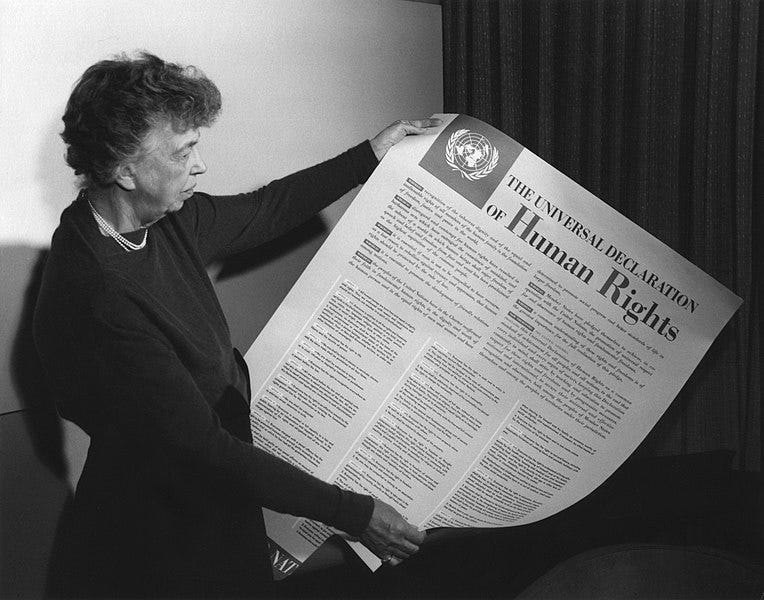
Seventy-five years ago today, on December 10, 1948, the United Nations General Assembly announced the Universal Declaration of Human Rights (UDHR).
At a time when the world was still reeling from the death and destruction of World War II, the Soviet Union was blockading Berlin, Italy and France were convulsed with communist-backed labor agitation, Arabs opposed the new state of Israel, communists and nationalists battled in China, and segregationists in the U.S. were forming their own political party to stop the government from protecting civil rights for Black Americans, the member countries of the United Nations nonetheless came together to adopt a landmark document: a common standard of fundamental rights for all human beings.
The United Nations itself was only three years old, having been formed in 1945 as a key part of an international order based on rules on which nations agreed, rather than the idea that might makes right, which had twice in just over twenty years brought wars that involved the globe. In early 1946 the United Nations Economic and Social Council organized a nine-person commission on human rights to set up the mission of a permanent Human Rights Commission. Unlike other U.N. commissions, though, the selection of its members would be based not on their national affiliations but on their personal merit.
President Harry S. Truman had appointed Eleanor Roosevelt, widow of former president Franklin Delano Roosevelt and much beloved defender of human rights in the United States, as a delegate to the United Nations. In turn, U.N. Secretary-General Trygve Lie from Norway put her on the commission to develop a plan for the formal human rights commission. That first commission, in turn, asked Roosevelt to take the chair.
“[T]he free peoples” and “all of the people liberated from slavery, put in you their confidence and their hope, so that everywhere the authority of these rights, respect of which is the essential condition of the dignity of the person, be respected,” a U.N. official told the commission at its first meeting on April 29, 1946. Their work would establish the United Nations as a centerpiece of the postwar rules-based international order.
The U.N. official noted that the commission must figure out how to define the violation of human rights not only internationally but also within a nation, and must suggest how to protect “the rights of man all over the world.” If a procedure for identifying and addressing violations “had existed a few years ago,” he said, “the human community would have been able to stop those who started the war at the moment when they were still weak and the world catastrophe would have been avoided.”
Drafted over the next two years, the final document began with a preamble explaining that a UDHR was necessary because “recognition of the inherent dignity and of the equal and inalienable rights of all members of the human family is the foundation of freedom, justice and peace in the world,” and because “disregard and contempt for human rights have resulted in barbarous acts which have outraged the conscience of mankind.” Because “the advent of a world in which human beings shall enjoy freedom of speech and belief and freedom from fear and want has been proclaimed as the highest aspiration of the common people,” the preamble said, “human rights should be protected by the rule of law.”
The thirty articles that followed established that “[a]ll human beings are born free and equal in dignity and rights…without distinction of any kind, such as race, colour, sex, language, religion, political or other opinion, national or social origin, property, birth or other status” and regardless “of the political, jurisdictional or international status of the country or territory to which a person belongs.”
Those rights included freedom from slavery, torture, degrading punishment, arbitrary arrest, exile, and “arbitrary interference with…privacy, family, home or correspondence, [and] attacks upon…honour and reputation.”
They included the right to equality before the law and to a fair trial, the right to travel both within a country and outside of it, the right to marry and to establish a family, the right to own property.
They included the “right to freedom of thought, conscience and religion,” “freedom of opinion and expression,” peaceful assembly, the right to participate in government, either “directly or through freely chosen representatives,” the right of equal access to public service. After all, the UDHR noted, the authority of government rests on the will of the people, “expressed in periodic and genuine elections which shall be by universal and equal suffrage.”
They included the right to choose how and where to work, the right to equal pay for equal work, the right to unionize, and the right to fair pay that ensures “an existence worthy of human dignity.”
They included “the right to a standard of living adequate for…health and well-being…, including food, clothing, housing and medical care and necessary social services, and the right to security in the event of unemployment, sickness, disability, widowhood, old age or other lack of livelihood in circumstances beyond [one’s] control.”
They included the right to free education that develops students fully and strengthens “respect for human rights and fundamental freedoms.” Education “shall promote understanding, tolerance and friendship among all nations, racial or religious groups, and shall further the activities of the United Nations for the maintenance of peace.”
They included the right to participate in art and science.
They included the right to live in the sort of society in which the rights and freedoms outlined in the UDHR could be realized. And, the document concluded, “Nothing in this Declaration may be interpreted as implying for any State, group or person any right to engage in any activity or to perform any act aimed at the destruction of any of the rights and freedoms set forth herein.”
Although eight countries abstained from the UDHR—six countries from the Soviet bloc, South Africa, and Saudi Arabia—no country voted against it, making the vote unanimous. The declaration was not a treaty and was not legally binding; it was a declaration of principles.
Since then, though, the UDHR has become the foundation of international human rights law. More than eighty international treaties and declarations, along with regional human rights conventions, domestic human rights bills, and constitutional provisions, make up a legally binding system to protect human rights. All of the members of the United Nations have ratified at least one of the major international human rights treaties, and four out of five have ratified four or more.
The UDHR is a vital part of the rules-based order that restrains leaders from human rights abuses, giving victims a language and a set of principles to condemn mistreatment, language and principles that were unimaginable before 1948.
But the UDHR remains aspirational. “As we look at the first 75 years of the UDHR,” Secretary of State Antony Blinken said today, “we recognize what we’ve accomplished in this time, but also know that much work remains. Too often, authorities fail to protect or—worse—trample on human rights and fundamental freedoms, often in the name of security or to maintain their grip on power. Whether arresting and wrongfully detaining journalists and dissidents, restricting an individual’s freedom of religion or belief, or committing atrocities and acts of genocide, violations and abuses of human rights undermine progress made in support of the UDHR. In the face of these actions, we must press for greater human rights protection and promote accountability whenever we see violations or abuses of human rights and fundamental freedoms.
“On its 75th anniversary, the UDHR must continue to be our guiding light as we strive to create the world in which we want to live. Its message is as important today as it was 75 years ago: human rights belong to everyone, everywhere.”
[Eleanor Roosevelt with the Universal Declaration of Human Rights, courtesy of the FDR Presidential Library & Museum, via Wikipedia Commons]
—
Notes:
https://www.nps.gov/elro/learn/historyculture/udhr.htm
https://www.un.org/ruleoflaw/thematic-areas/international-law-courts-tribunals/human-rights-law/
https://www.un.org/en/about-us/udhr/foundation-of-international-human-rights-law
https://www.state.gov/human-rights-day-3/
https://www.un.org/en/about-us/universal-declaration-of-human-rights
December 9, 2023
December 9, 2023
Am picking up my knitting by our very own woodstove, and feeling extraordinarily fortunate to be in such a position.
Turning things over tonight to my friend Nadia with a holiday picture she took in Ukraine... before 2022.
I’ll see you tomorrow.
[Picture by Nadia Povalinska.]

December 8, 2023
December 8, 2023
You all are in trouble, because I am home tonight from ten weeks on the road and am taking the night for myself, writing about one of the Very Cool Things I learned in my travels. I expect there will be more stories along these lines in the next several weeks.
Ninety years ago today, on Friday, December 8, 1933, in the first year of President Franklin Delano Roosevelt’s administration, the Advisory Committee to the Treasury on Fine Arts met for four hours in Washington, D.C., with museum directors from all over the country and leaders from the art world. For the past nine months, the administration had been building a “New Deal” for the American people, using the government to help ordinary Americans in the midst of the Great Depression.
Together with the Democrats in Congress, the administration had launched the Civilian Conservation Corps that put young men to work planting trees, fighting fires, and maintaining wilderness trails. The Federal Emergency Relief Administration provided work and cash relief for unemployed workers; the Agricultural Adjustment Administration boosted farm prices by reducing agricultural surpluses, while the Farm Credit Act made it easier for farmers to borrow. The Civil Works Administration put more than 4 million unemployed Americans to work building 44,000 miles of new roads, 1,000 miles of new water mains, and building or improving 4,000 schools.
Now it was time to help artists. Inspired by the 1920s public art movement in Mexico in which young artists were paid to decorate public buildings, FDR’s former classmate George Biddle suggested to the president that artists could be hired to “paint murals depicting the social ideals of the new administration and contemporary life on the walls of public buildings.”
This idea dovetailed with the goal of the administration to tap into the skills of ordinary Americans in rebuilding the country by making sure people had work. After all, FERA administrator Harry L. Hopkins said, artists needed “to eat just like other people.” He promised $1,039,000 to be disbursed by the Treasury “for the purpose of alleviating the distress of the American artists” while decorating public property with world-class art.
At the Washington, D.C., meeting, the attendees discussed how to “carry…forward the world of encouraging the fine arts as a function of the Federal Government.” Their first speaker was First Lady Eleanor Roosevelt, who “expressed her sympathy with the idea of the Government’s employing artists,” and all the other speakers followed suit. The following Monday, the Public Works of Art Project (PWAP) opened its doors, and artists lined up outside government offices to apply. By Saturday, December 16, artists were receiving checks. When the project ended four months later, 3,749 artists had been on the payroll, producing more than 15,000 paintings, sculptures, and public murals.
The pilot project for the PWAP was Coit Tower in San Francisco’s Telegraph Hill neighborhood, located in the city’s Pioneer Park. The 210-foot Art Deco tower of unpainted concrete had been completed and dedicated in honor of volunteer firefighters on October 8, 1933 (perhaps not coincidentally, the date of the Great Chicago Fire of 1871). When the building was finished, it had 3,691 square feet of blank concrete wall space.
By January 1934, thanks to the PWAP, twenty-six San Francisco artists and nineteen of their assistants were transforming that blank space into frescoes and murals depicting California life. Several of the artists had worked in Mexico with muralist Diego Rivera as part of the socially conscious mural movement of 1920s Mexico and adopted his techniques, creating frescoes in which the colors became part of the wall as they dried. To keep the colors at Coit Tower uniform, one artist-assistant ground the color pigments for all the different frescoes.
But while they admired Rivera’s art, the New Deal artists, for the most part, focused not on revolution, as he did, but on the possibilities of the country’s new approach to government. Roosevelt was backing artists, and they backed him, painting not about revolution but about restoring healthy social and economic conditions in the United States.
By the time the PWAP got under way, the exciting artistic experiments of the early twentieth century that had brought Picasso’s cubism, for example, had begun to seem foreign and alienating, and artists had begun to turn toward representational art in a national style. The government’s requirement that the public art be about the “American scene” in American style for American people built on that shift. Artists in the PWAP painted either as “Regionalists,” who painted rural America, or “Social Realists,” who painted the cities. The Regionalists tended to celebrate the nation, while Social Realists—most of whom came from New York City—tended to critique it, but both groups found intelligence, power, and beauty in the ordinary people and the ordinary scenes they painted.
Coit Tower showed San Francisco’s people: striking workers, farmers, cowboys, travelers reading newspapers, news stenographers, chauffeurs, a rich man being held up at gunpoint, car accidents. People of color and women were underrepresented but not entirely ignored in this celebration of the possibilities of American life under the administration's new policies (one mural had an oil can in a corner to illustrate the government oiling the machinery of the economy for the mechanics in the next panel).
The murals in Coit Tower, and the PWAP that supported them, were such a roaring success that the federal government would shortly launch four more projects to fund artists (including writers), most famously under the Works Progress Administration that operated from 1935 to 1942. Although to a modern eye, many of the fine artists’ depictions of Indigenous Americans and racial and gender minorities are eye-poppingly racist, these colorful presentations of the lives and histories of ordinary Americans that decorated libraries, schools, courthouses, bathhouses, and post offices, honoring community and hard work—and, in the edgier paintings, jabbing at stockbrokers, bankers, and industrialists—celebrated a hopeful, new, progressive America.
For many Americans, who had never had access to fine art and were astonished to see fine art in local buildings, the medium was its own message: they realized their neighbors had talent they had never imagined.
President Joe Biden has deliberately echoed FDR’s policies of the New Deal in his economic program, promising to build the economy from the middle out and the bottom up, even as Republicans have insisted the only way to build the economy is to concentrate wealth on the “supply side” by cutting taxes. Today, there was more evidence that Biden’s policies are paying off for ordinary Americans. The November jobs report showed the economy added almost 200,000 more jobs in November, making the total since Biden took office more than 14 million, while the unemployment rate has stayed below 4% for 22 months in a row and wage growth is strong.
As Harvard professor Jason Furman notes, the U.S. is now 2 million jobs and 2 million employed above the pre-pandemic projections of the Congressional Budget Office. Dan Shafer of The Recombobulation Area observed, “If these numbers were happening during a Republican presidency, the usual business community folks would be celebrating in the streets. But when there’s a D next to the president’s name, it’s tumbleweeds.” Today, on the Fox News Channel, personality Maria Bartiromo noted that “the economy is a lot stronger than anyone understands.”
The president also echoed the New Deal’s promotion of internal improvements today when he announced an investment of $8.2 billion in new funding for ten major passenger rail projects across the country to deliver the nation’s first high-speed rail projects. High-speed rail between California and Nevada, serving more than 11 million people annually; Los Angeles and San Francisco; and the Eastern Corridor, will create tens of thousands of union jobs, build communities, and promote climate-friendly transportation options.
In a speech in Las Vegas, Nevada, announcing the rail plan, Biden called out his predecessor, who “always talked about infrastructure week. Four years of infrastructure week, but it failed. He failed,” Biden said. “On my watch, instead of having infrastructure week, America is having infrastructure decade.”
“Trump just talks the talk. We walk the walk,” he said. “Look. He likes to say America is a failing nation. Frankly, he doesn’t know what the hell he’s talking about. I see shovels in the ground, cranes in the sky, people hard at work rebuilding America together.”
[Image of Coit Tower painting of striking workers, taken while I was in San Francisco.]

—
Notes:
https://livingnewdeal.org/history-of-the-new-deal/what-was-the-new-deal/timeline/
https://babel.hathitrust.org/cgi/pt?id=mdp.39015010432469&view=1up&seq=21&skin=2021
https://npgallery.nps.gov/NRHP/GetAsset/NRHP/07001468_text
https://www.npr.org/2013/02/17/172002686/armory-show-that-shocked-america-in-1913-celebrates-100
https://www.smithsonianmag.com/arts-culture/1934-the-art-of-the-new-deal-132242698/
Steven M. Gelber, “Working to Prosperity: California’s New Deal Murals,” California History 58 (Summer 1979): 98-127.
Twitter (X):
jasonfurman/status/1733122455944704283
DanRShafer/status/1733232973854416930
jasonfurman/status/1733122453834956958
December 7, 2023
December 7, 2023
On the sunny Sunday morning of December 7, 1941, Messman Doris Miller had served breakfast aboard the USS West Virginia, stationed in Pearl Harbor, Hawaii, and was collecting laundry when the first of nine Japanese torpedoes hit the ship.
In the deadly confusion, Miller reported to an officer, who told him to help move the ship’s mortally wounded captain off the bridge. Unable to move him far, Miller pulled the captain to shelter. Then another officer ordered Miller to pass ammunition to him as he started up one of the two abandoned anti-aircraft guns in front of the conning tower.
Miller had not been trained to use the weapons because, as a Black man in the U.S. Navy, he was assigned to serve the white officers. But while the officer was distracted, Miller began to fire one of the guns. He fired it until he ran out of ammunition. Then he helped to move injured sailors to safety before he and the other survivors abandoned the West Virginia, which sank to the bottom of Pearl Harbor.
That night, the United States declared war on Japan. Japan declared war on America the next day, and four days later, on December 11, 1941, both Italy and Germany declared war on America. “The powers of the steel pact, Fascist Italy and National Socialist Germany, ever closely linked, participate from today on the side of heroic Japan against the United States of America,” Italian leader Benito Mussolini said. “We shall win.” Of course they would. Mussolini and Germany’s leader, Adolf Hitler, believed the Americans had been corrupted by Jews and Black Americans and could never conquer their own organized military machine.
The steel pact, as Mussolini called it, was the vanguard of his new political ideology. That ideology was called fascism, and he and Hitler thought it would destroy democracy once and for all.
Mussolini had been a socialist as a young man and had grown terribly frustrated at how hard it was to organize people. No matter how hard socialists tried, they seemed unable to convince ordinary people that they must rise up and take over the country’s means of production.
The efficiency of World War I inspired Mussolini. He gave up on socialism and developed a new political theory that rejected the equality that defined democracy. He came to believe that a few leaders must take a nation toward progress by directing the actions of the rest. These men must organize the people as they had been organized during wartime, ruthlessly suppressing all opposition and directing the economy so that businessmen and politicians worked together. And, logically, that select group of leaders would elevate a single man, who would become an all-powerful dictator. To weld their followers into an efficient machine, they demonized opponents into an “other” that their followers could hate.
Italy adopted fascism, and Mussolini inspired others, notably Germany's Hitler. Those leaders came to believe that their system was the ideology of the future, and they set out to destroy the messy, inefficient democracy that stood in their way.
America fought World War II to defend democracy from fascism. And while fascism preserved hierarchies in society, democracy called on all people as equals. Of the more than 16 million Americans who served in the war, more than 1.2 million were African American men and women, 500,000 were Latinos, and more than 550,000 Jews were part of the military. Among the many ethnic groups who fought, Native Americans served at a higher percentage than any other ethnic group—more than a third of able-bodied men between the ages of 18 and 50 joined the service—and among those 25,000 soldiers were the men who developed the famous “Code Talk,” based in tribal languages, that codebreakers never cracked.
The American president at the time, Democrat Franklin Delano Roosevelt, hammered home that the war was about the survival of democracy. Fascists insisted that they were moving their country forward fast and efficiently—claiming the trains ran on time, for example, although in reality they didn’t—but FDR constantly noted that the people in Italy and Germany were begging for food and shelter from the soldiers of democratic countries.
Ultimately, the struggle between fascism and democracy was the question of equality. Were all men really created equal as the Declaration of Independence said, or were some born to lead the rest, whom they held subservient to their will?
Democracy, FDR reminded Americans again and again, was the best possible government. Thanks to armies made up of men and women from all races and ethnicities, the Allies won the war against fascism, and it seemed that democracy would dominate the world forever.
But as the impulse of WWII pushed Americans toward a more just and inclusive society after it, those determined not to share power warned their supporters that including people of color and women as equals in society would threaten their own liberty. Those reactionary leaders rode that fear into control of our government, and gradually they chipped away the laws that protected equality. Now, once again, democracy is under attack by those who believe some people are better than others.
The once-grand Republican Party has been captured by the right wing. It has lined up behind former president Donald Trump and his cronies, who have vowed to replace the nonpartisan civil service with loyalists and to weaponize the Department of Justice and the military against those they perceive as enemies. They have promised to incarcerate and deport millions of immigrants and children of immigrants, send federal troops into Democratic cities, ban Muslims, silence LGBTQ+ Americans, prosecute journalists, and end abortion across the country. They will put in place an autocracy in which a powerful leader and his chosen loyalists make the rules under which the rest of us must live.
Will we permit the destruction of American democracy on our watch?
When America came under attack before, people like Doris Miller refused to let that happen. For all that American democracy still discriminated against him, it gave him room to stand up for the concept of human equality—and he laid down his life for it. Promoted to cook after the Navy sent him on a publicity tour, Miller was assigned to a new ship, the USS Liscome Bay, which was struck by a Japanese torpedo on November 24, 1943. It sank within minutes, taking two thirds of the crew, including Miller, with it.
I hear a lot these days about how American democracy is doomed and the reactionaries will win. Maybe. But the beauty of our system is that it gives us people like Doris Miller.
Even better, it makes us people like Doris Miller.
—
Notes:
https://en.wikipedia.org/wiki/Italian_declaration_of_war_on_the_United_States
https://www.cbsnews.com/news/donald-trump-weaponization-justice-department-political-opponents/
https://www.theguardian.com/us-news/2023/oct/17/trump-muslim-ban-gaza-refugees
https://www.nytimes.com/2023/11/11/us/politics/trump-2025-immigration-agenda.html
https://www.latimes.com/politics/story/2023-09-24/mcmanus-column-trump-second-term-agenda
https://www.axios.com/2023/11/13/trump-loyalists-2024-presidential-election
https://www.nytimes.com/2023/12/05/us/politics/trump-kash-patel-journalists.html
December 6, 2023
In the Washington Post today, Marianne LeVine, Isaac Arnsdorf, and Josh Dawsey reported that the Trump camp is eager to get people to stop focusing on Trump’s authoritarian talk, noting that Senator Lindsey Graham (R-SC) says the presidential candidate was just joking when he said he would be a dictator on the first day of a return to the White House. While the Republican base appears to like Trump’s threats against the people they have come to hate, two Trump advisers told the reporters that “recent stories about his plans for a second term are not viewed as helpful for the general election.”
Republicans have also moved quickly to cut ties with Florida Republican Party chair Christian Ziegler, who is under police investigation for rape. Ziegler’s wife, Bridget Ziegler, co-founded Moms for Liberty, an organization that has focused on removing from schools books that they find objectionable, generally books by or about racial or ethnic minorities or LGBTQ+ people. Often Moms for Liberty members have implied, or even claimed, that those trying to protect school libraries are sexual predators or “groomers.” Ziegler herself has been active in shaping anti-LGBTQ+ policies in the state.
But the police and court documents about the case revealed that the Zieglers and the woman Ziegler allegedly raped had participated in a three-way sexual relationship in the past. The rape allegedly occurred after they had set up another encounter that Bridget could not make. The woman then canceled, telling Ziegler “I was mainly in it for her.” He went to her home anyway.
The story of a key anti-LGBTQ+ activist engaging in same-sex activity as part of a threesome sent Moms for Liberty hurrying to say that Bridget Ziegler was no longer on their board (although both Zieglers were still on their advisory board) and purge her name from their website. And though no charges have yet been filed, Florida governor Ron DeSantis has called on Christian Ziegler to resign from his position at the head of the state Republican Party.
The Zieglers helped to tie the Republican Party to Moms for Liberty shortly after the organization formed in January 2021, and DeSantis was very much on board, apparently seeing their message of taking the war against “woke” to the schools as a political winner. But, as Amanda Marcotte pointed out in Salon, the 2022 midterms revealed that most voters did not like the extremism of that group and that it was a political liability.
The fact that DeSantis is dropping his former ally Ziegler so fast suggests that DeSantis is eager to divorce himself from both the story and from the extremism of Moms for Liberty.
The Trump Republicans took another hit today as well, when a grand jury in the state of Nevada charged six people who falsely posed as electors in 2020 in order to file fake electoral votes for Trump to replace the state’s real votes for now-President Joe Biden. The six Republicans charged with filing false documents include the chair and the vice chair of the Nevada Republican Party. If convicted, they face up to nine years in prison and $15,000 in fines.
Nevada is the third state to charge the fake electors with crimes. Georgia and Michigan have also done so.
Ten fake electors in Wisconsin today settled a civil lawsuit over their own participation in Trump’s false-elector scheme. The settlement involved correcting the historical record. The ten agreed to withdraw their paperwork with the false information, explain in writing to the federal offices that the filings had been “part of an attempt to improperly overturn the 2020 presidential election results,” and acknowledge that Biden won the 2020 election. Going forward, they agreed never again to serve as presidential electors in an election in which Trump is running.
But while there are signs that even leading Republicans recognize that the extremism of the Trump Republicans is unpopular in the country, Trump Republicans are tightening their hold on Congress. Today former House speaker Kevin McCarthy (R-CA) announced that he will resign from Congress at the end of this month. Far-right MAGA Republicans ousted McCarthy from the speaker’s chair in October.
Representative Patrick McHenry (R-NC), a McCarthy ally who took over as acting House speaker after McCarthy’s removal, announced yesterday that he had changed his plans from earlier this year and will not run for reelection.
While hardly moderates—both refused to work with Democrats either to pass legislation or to elect a speaker—they appear to be ceding ground to the MAGA Republicans.
Tim Dickinson of Rolling Stone reported today that one of those MAGA Republicans, House speaker Mike Johnson (R-LA), spoke freely Tuesday night at the Museum of the Bible in Washington, D.C., at a celebration for the National Association of Christian Lawmakers. Although the address was being livestreamed, Johnson apparently believed he was speaking privately. He told the audience that the Lord called him to be “a new Moses.”
Johnson, an evangelical Christian, told the audience that the U.S. is “engaged in a battle between worldviews” and “a great struggle for the future of the Republic.” He said he believed far-right Christians would prevail.
The influence of Trump is also evident in the Senate, where there is broad, bipartisan support for supplemental funding for Ukraine, but where Republicans are refusing to pass such a measure without attaching to it an immigration package that overrides current law, replacing it with Trump’s immigration plans. Such plans could not pass on their own, as Democrats would stop them in the Senate. But by attaching them to a bill that is imperative for national security, Republicans hope to force Biden into it.
Democrats have repeatedly called for new immigration legislation, but their refusal to remake immigration policy as the hard-right wants has made Republicans balk. Now Democrats are still offering to negotiate a reasonable package, but as Senator John Cornyn (R-TX) said earlier this week: “I think there’s a misunderstanding on the part of Senator Schumer and some of our Democratic friends…. This is not a traditional negotiation, where we expect to come up with a bipartisan compromise on the border. This is a price that has to be paid in order to get the supplemental.”
In a speech this afternoon—just a day after Senator Tommy Tuberville (R-AL) finally permitted the Senate to fill 425 senior positions in the U.S. military and while he is still preventing 11 top-level positions from being filled—President Biden called it “stunning that we’ve gotten to this point…. Republicans in Congress…are willing to give [Russian president Vladimir] Putin the greatest gift he could hope for and abandon our global leadership not just to Ukraine, but beyond that.”
“If Putin takes Ukraine, he won’t stop there,” Biden warned. “It’s important to see the long run here. He’s going to keep going. He’s made that pretty clear. If Putin attacks a NATO Ally—if he keeps going and then he attacks a NATO Ally—well, we’ve committed as a NATO member that we’d defend every inch of NATO territory. Then we’ll have something that we don’t seek and that we don’t have today: American troops fighting Russian troops—American troops fighting Russian troops if he moves into other parts of NATO.
“Make no mistake: Today’s vote is going to be long remembered. And history is going to judge harshly those who turn their back on freedom’s cause.”
“Extreme Republicans are playing chicken with our national security, holding Ukraine’s funding hostage to their extreme partisan border policies,” he said.
Biden reiterated that he and the Democrats are eager to pass new immigration legislation, but “Republicans think they can get everything they want without any bipartisan compromise. That’s not the answer.... And now they’re willing to literally kneecap Ukraine on the battlefield and damage our national security in the process.” He begged Republicans to get past partisan divisions and step up to “our responsibilities as a leading nation in the world.”
Hours later, Senate Republicans voted against the supplemental aid package.
—
Notes:
https://www.washingtonpost.com/elections/2023/12/06/trump-comments-dictator-campaign-president-2024/
https://www.theguardian.com/us-news/2023/dec/06/nevada-electors-fake-charged-election-2020
https://talkingpointsmemo.com/where-things-stand/six-fake-pro-trump-electors-indicted-in-nevada
https://apnews.com/article/donald-trump-fake-electors-wisconsin-fff7cd21e3083f300874eccd69141f8d
https://talkingpointsmemo.com/edblog/what-a-tangled-web-florida-republicans-gone-wild
https://www.salon.com/2023/11/09/im-so-tired-of-these-psychos-moms-for-liberty-is-now-a-brand/
https://thehill.com/homenews/house/4342967-patrick-mchenry-not-running-for-reelection/
https://www.politico.com/news/2023/11/26/senate-vote-biden-ukraine-00128631
December 5, 2023
December 5, 2023
A new filing today by Special Counsel Jack Smith in the case United States of America v. Donald J. Trump for his attempt to overturn the results of the 2020 presidential election shows Smith’s office establishing that Trump has a longstanding pattern of refusing to accept election results he dislikes.
As early as 2012, the filing notes, Trump baselessly alleged that voting machines had switched votes intended for Republican presidential candidate Mitt Romney to Democratic presidential candidate Barack Obama. In the 2016 campaign he “claimed repeatedly, with no basis, that there was widespread voter fraud,” and publicly refused to commit to accepting the results of that election. This pattern continued in 2020, but in that election he took active steps to seize power.
The filing introduced information that Trump, an agent, and an unindicted co-conspirator tried to start a riot at the TCF Center in Detroit as vote counting showed Biden taking the lead. As Josh Kovensky of Talking Points Memo points out, this scheme sounds much like the Brooks Brothers Riot of 2000 that stopped vote counting in Miami-Dade County in Florida. Roger Stone was a participant in the Brooks Brothers Riot; in 2020 he was working to keep Trump in office.
Smith’s team shows how this pattern continued to play out in the 2020 election, with Trump urging supporters like the Proud Boys to back him, falsely asserting that the election had been stolen, and attacking former supporters who denied that the election had been stolen. The pattern has continued until the present, with Trump calling those who were found guilty of offenses related to the attack on the U.S. Capitol “hostages” and claiming they were “treated horribly.”
Smith recounts these facts to establish Trump’s motive and intent on January 6, but his identification of a longstanding pattern indicates it would be a grave mistake to think Trump has any intention of campaigning fairly or accepting any result in 2024 other than his return to the White House.
New House speaker Mike Johnson (R-LA), who has endorsed Trump for president and was a key organizer of the congressional effort to keep Trump in office, has promised to release all the surveillance footage from the U.S. Capitol on January 6. Trump supporters insist that the full tapes will reveal that the attack was not as bad as the House Select Committee to Investigate the January 6th Attack on the U.S. Capitol showed. Johnson said that the tapes must be shared publicly for “transparency.”
Today, Johnson supported Trump’s message about January 6 when he said that he was making sure the faces of rioters are blurred in the surveillance footage. "We have to blur some of the faces of persons who participated in the events of that day because we don't want them to be retaliated against and to be charged by the DOJ [Department of Justice] and to have other, you know, concerns and problems," he said. Johnson’s spokesperson quickly walked back the comment, saying Johnson meant to say that faces were blurred to prevent “all forms of retaliation against private citizens from any non-governmental actors.”
Also today, Kash Patel, who served on Trump’s national security team and is widely expected to return in a second Trump administration, expanded the authoritarian threats Trump people have been making to include the media. On former Trump ally Steve Bannon’s podcast, Patel promised that the Trump team would fill government positions from top to bottom with loyalists and would use the Department of Justice to go after those perceived to be Trump’s enemies.
“We will go out and find the conspirators, not just in government but in the media,” Patel said. “Yes, we’re going to come after the people in the media who lied about American citizens, who helped Joe Biden rig presidential elections—we’re going to come after you. Whether it’s criminally or civilly, we’ll figure that out.”
Yesterday, former representative Liz Cheney (R-WY), who is promoting her new book, Oath and Honor: A Memoir and a Warning, called out Senator Tommy Tuberville (R-AL) for his continuing hold on military appointments that kept more than 450 routine promotions from taking effect over the past ten months. Tuberville claimed his refusal to permit the nominees’ confirmations was an attempt to change Pentagon policy of permitting leave for service members in states that ban abortion to obtain abortion care elsewhere. But on NPR yesterday, Cheney wondered: “Why is Tommy Tuberville doing that? Is he holding those positions open so that Donald Trump can fill them?”
Today, under great pressure from members of his own party who worried the Democrats would change the rules to weaken the power of the Senate minority, Tuberville released his hold on most of the nominees. The Senate promptly confirmed 425 of them.
Still, Tuberville retained holds on 11 officers of the most senior rank. According to congressional reporter for Punchbowl News Andrew Desiderio, the positions left vacant are commander of Pacific Air Forces, commander of U.S. Pacific Fleet, Air Component Command for the United States Indo-Pacific Command, commander for Air Combat Command, the head of the Navy’s Nuclear Propulsion Program, the head of Northern Command (which defends the United States and coordinates defenses with Canada, Mexico, and the Bahamas), the head of the U.S. Cyber Command, vice chief of staff of the Army, vice chief of staff of the Air Force, vice chief of Space Operations, and vice chief of Naval Operations.
Last night, Cheney explained to political commentator and television host Rachel Maddow exactly what a second Trump presidency would look like, Cheney said: "He would take those people who are the most radical, the most dangerous, who had the proposals that were the most dangerous, and he will put them in positions of supreme power. That's a risk that we simply cannot take."
Mark Joyella of Forbes took note of Maddow’s introduction last night, in which the host stressed the importance of protecting democracy. She began by emphasizing how much she and Cheney disagreed about everything in politics, so much so that it was as if they were on different planets at war with each other.
Maddow made that point, she said, because “in civic terms, in sort of American citizenship terms, I think it's really important how much we disagree. It's important how far apart we are in every policy issue imaginable. It is important that Liz Cheney is infinity and I am negative infinity on the ideological number line. It's important because that tells you how serious and big something has to be to put us, to put me and Liz Cheney, together on the same side of something in American life.”
The Rachel Maddow Show was the most watched news show on cable television last night, with 3.15 million viewers. The Fox News Channel’s show Hannity, hosted by personality Sean Hannity, had just under 2 million viewers.
It seems clear Americans are waking up to Trump’s threats to stack the government with loyalists, weaponize the Justice Department and military, deport 10 million people, and prosecute those he perceives to be his enemies in politics and the media. Interviewing Trump tonight, Hannity tried to downplay Trump’s statements about his authoritarian plans for a second term by getting him to commit to staying within the normal bounds of a president should he be elected in 2024. The first time he was asked, Trump sidestepped the question. So Hannity asked again. “Under no circumstances, you are promising America tonight, you would never abuse power as retribution against anybody?” he asked.
“Except for day one,” Trump responded.
—
Notes:
https://abcnews.go.com/Politics/mike-johnson-walks-back-blurring-jan-6-footage/story?id=105394429
https://storage.courtlistener.com/recap/gov.uscourts.dcd.258149/gov.uscourts.dcd.258149.176.0_6.pdf
https://www.nytimes.com/2023/12/05/us/politics/trump-kash-patel-journalists.html
Twitter (X):
AccountableGOP/status/1731869441028133267
Acyn/status/1732069208404730041
NPRinskeep/status/1731651972837638166
December 4, 2023
When my friend Joanne Freeman and I were hosting the Now & Then podcast, it became a joke at our weekly planning meetings that I almost always suggested we should focus the following week’s episode on tax policy. Since it appeared that other people have a lower tolerance for tax policy than I do, we usually didn’t end up landing on that topic.
But I remain fascinated by it. Tax policy shows what a society values.
Tomorrow the Supreme Court will hear arguments in the case of Moore v. United States. The case illustrates today’s Supreme Court’s tendency to hear cases based on fictional stories in order to shape society to a right-wing ideology.
As Lisa Needham points out in Public Notice today, the plaintiffs in the case, Charles and Kathleen Moore, have presented themselves as “minority shareholders without any role in” the management of an Indian company that works to provide power tools to small farmers in India. But according to Ann E. Marimow and Julie Zauzmer Weil of the Washington Post, Charles Moore was a director of the company from April 2012 until March 2017, had contributed about $250,000 to the company and been repaid at 12% interest, and in 2019, the year after he filed the lawsuit, sold about 20% of his holdings for close to $300,000.
The court is supposed to decide cases based only on facts, not fiction, but this court has shown a willingness to overlook fictions that enable actions the majority wants to take. As Needham notes, earlier this year it decided 303 Creative v. Elenis protecting a web designer from having to make a wedding website for a gay couple, even though it turned out that the alleged gay client in the case was actually a man who had been married to a woman for years, had never asked anyone to design a website for a wedding, and had no idea he had been named in the case.
Such lies permit these test cases to get before the court, Needham writes, teeing up court decisions to change the United States.
These cases, based on fictional accounts, dovetail with the fictional history in amicus briefs. These are so-called friend-of-the-court briefs from someone who is not a party in the case to offer analysis of the issues. Yesterday, Heidi Przybyla of Politico showed how right-wing lawyers connected to Leonard Leo, co-chair of the board of the activist right-wing Federalist Society, have filed amicus briefs that invent a past that the right-wing justices then lift into the decisions themselves to shape modern society.
The Moore v. U.S. case concerns the federal government’s ability to tax wealthy people. The Moores argue that the federal government cannot tax wealth until it has been “realized.” That is, increased value of stock, for example, cannot be taxed until it is realized through that stock’s sale.
According to Ian Millhiser of Vox, what is really at stake is the ability of the government to tax the wealthy to begin to address the extremes of wealth that have expanded since 1981.
Forestalling the use of tax policy to address how drastically our laws have redistributed wealth upward fits with Republican lawmakers’ exclusive focus on addressing the nation’s budget deficit by cutting services. At last month’s Republican presidential primary debate, for example, the candidates expressed support for cutting Social Security benefits, with former South Carolina governor Nikki Haley telling the audience that “any candidate who tells you that they’re not going to take on entitlements is not being serious.”
But it is tax cuts, primarily those of presidents George W. Bush and Donald Trump, that have been the primary drivers of the budget deficit, so it would seem logical to end them, especially since they have never boosted the economy as promised. And yet, rather than ending them, the Republicans are eager to extend them. They embrace the idea that the best course for the nation is to slash taxes and services and to concentrate wealth at the top of the economy.
Ironically, it was the early Republican Party that set out the blueprint for rejecting that idea. When the outbreak of the Civil War in 1861 created a crisis in the cash-strapped U.S. Treasury, Republicans in Congress invented the nation’s first national income tax.
Initially, they levied a 3% tax on income over $800; in 1862, concerned that the level of taxation necessary to pay for the war would be too much for most Americans to bear, they created a progressive income tax, taxing income over $600 at 3% and income over $10,000 at 5%. “The weight must be distributed equally,” Representative Justin Smith Morrill (R-VT) said, “not upon each man an equal amount, but a tax proportionate to his ability to pay.” In 1864, Congress revised those numbers upward.
Morrill claimed that the federal government had a right to “demand” 99% of a man’s property for an urgent necessity. When the nation required it, he said, “the property of the people…belongs to the Government.”
With their money behind the war effort, Americans became more and more committed to their nation. As the war costs mounted, far from objecting to taxes, Americans concerned about the growing national debt asked their congressmen to raise them. In 1864, Senator John P. Hale (R-NH) said: “The condition of the country is singular…I venture to say it is an anomaly in the history of the world. What do the people of the United States ask of this Congress? To take off taxes? No, sir, they ask you to put them on. The universal cry of this people is to be taxed.”
The Civil War income tax expired in 1872, and by the 1890s, after money had concentrated at the top of the economy, wealthy industrialists and others thriving in the new economy rejected their earlier understanding of tax policy.
In 1894, in the midst of a depression that was crushing farmers and workers, Democrats in Congress levied a 2% tax on incomes over $4,000. Immediately, Republicans said the measure was unconstitutional because it gave too much power to the federal government and would force states like New York, which had financial centers, to pay more in taxes than states like Mississippi. “The income tax was born of a mixture of sectionalism, communism, and demagogy,” wrote the Pittsburgh Gazette.
In 1895 a staunchly pro-business Supreme Court agreed with opponents of the tax, deciding in Pollock v. Farmers' Loan & Trust Company that the income tax was unconstitutional, giving far too much power to the federal government. In 1909, as Democrats and progressive Republicans continued to call for an income tax to address the concentration of wealth, those hoping to kill the idea once and for all proposed a constitutional amendment for one, thinking it could never be ratified.
They were wrong. State legislatures backed the Sixteenth Amendment, which became part of the U.S. Constitution in 1913, an important symbol of the Progressive Era.
—
Notes:
https://www.washingtonpost.com/politics/2023/11/27/supreme-court-tax-case-offshore-earnings/
 Public NoticeSCOTUS is making major decisions based on outright liesRead morea day ago · 236 likes · 4 comments · Lisa Needham
https://www.politico.com/news/2023/12/03/supreme-court-amicus-briefs-leonard-leo-00127497
https://www.vox.com/scotus/23845702/supreme-court-fifth-circuit-term-cfpb-guns-voting-chevron
https://www.vox.com/scotus/2023/11/27/23970859/supreme-court-wealth-tax-moore-united-states
https://twitter.com/ReallyAmerican1/status/1730257627173486846
https://www.npr.org/2023/11/09/1211715610/third-republican-debate-miami
https://www.nytimes.com/2023/10/20/business/federal-budget-deficit-trillion.html
https://www.archives.gov/milestone-documents/16th-amendment
Justin Smith Morrill, Congressional Globe, 37th Congress, 2nd session, p. 1194.
Heather Cox Richardson's Blog

- Heather Cox Richardson's profile
- 1332 followers

