
Heather Cox Richardson's Blog, page 127
February 15, 2024


February 14, 2024
February 14, 2024
I am at home for a short break, and Buddy and I have spent the day taking it easy, a plan I intend to continue for the next several hours. But rather than posting a picture and taking the night off, I am reposting one of my favorite pieces ever because of what it says about love, loss, humanity... and history.
It feels appropriate these days.
On Valentine’s Day in 1884, Theodore Roosevelt lost both his wife and his mother.
Four years before, Roosevelt could not have imagined the tragedy that would stun him in 1884. February 14, 1880, marked one of the happiest days of his life. He and the woman he had courted for more than a year, Alice Hathaway Lee, had just announced their engagement. Roosevelt was over the moon: “I can scarcely realize that I can hold her in my arms and kiss her and caress her and love her as much as I choose,” he recorded in his diary. What followed were, according to Roosevelt, “three years of happiness greater and more unalloyed than I have ever known fall to the lot of others.”
After they married in fall 1880, the Roosevelts moved into the home of Theodore’s mother, Martha Bulloch Roosevelt, in New York City. There they lived the life of wealthy young socialites, going to fancy parties and the opera and traveling to Europe.
When Roosevelt was elected to the New York State Assembly in 1881, they moved to the bustling town of Albany, where the state’s political wire-pullers worked their magic. Roosevelt’s machine politician colleagues derided the rich, Harvard-educated young man as a “dude,” and they tried to ignore his irritating interest in reforming society.
In the summer of 1883, Alice discovered that she was pregnant, and that fall she moved back to New York City to live with her mother-in-law. There she awaited the birth of the child who Theodore was certain would arrive on February 14.
As headstrong as her father, Roosevelt’s daughter beat her father’s prediction by two days. On February 12, Alice gave birth to the couple’s first child, who would be named after her. Roosevelt was at work in Albany and learned the happy news by telegram. But Alice was only “fairly well,” Roosevelt noted. She soon began sliding downhill. She did not recover from the birth; she was suffering from something at the time called “Bright’s Disease,” an unspecified kidney illness.
Roosevelt rushed back to New York City, but by the time he got there at midnight on February 13, Alice was slipping into a coma. Distraught, he held her until he received word that his mother was dangerously ill downstairs. For more than a week, “Mittie” Roosevelt had been sick with typhoid. Roosevelt ran down to her room, where she died shortly after her son got to her bedside. With his mother gone, Roosevelt hurried back to Alice. Only hours later she, too, died.
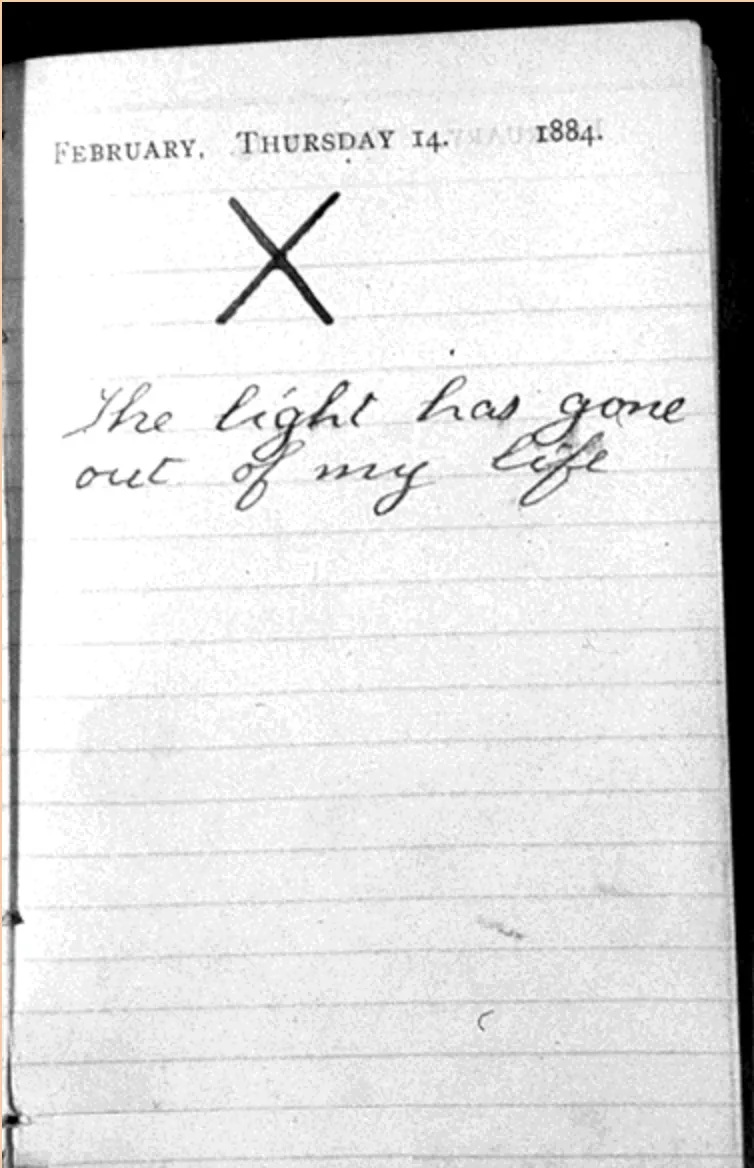
On February 14, 1884, Roosevelt slashed a heavy black X in his diary and wrote “The light has gone out of my life.” He refused ever to mention Alice again.
Roosevelt’s profound personal tragedy turned out to have national significance. The diseases that killed his wife and mother were diseases of filth and crowding—the hallmarks of the growing Gilded Age American cities. Mittie contracted typhoid from either food or water that had been contaminated by sewage, since New York City did not yet treat or manage either sewage or drinking water. Alice’s disease was probably caused by a strep infection, which incubated in the teeming city’s tenements, where immigrants, whose wages barely kept food on the table, crowded together.
Roosevelt had been interested in urban reform because he worried that incessant work and unhealthy living conditions threatened the ability of young workers to become good citizens. Now, though, it was clear that he, and other rich New Yorkers, had a personal stake in cleaning up the cities and making sure employers paid workers a living wage.
The tragedy gave him a new political identity that enabled him to do just that. Ridiculed as a “dude” in his early career, Roosevelt changed his image in the wake of the events of February 1884. Desperate to bury his feelings for Alice along with her, Roosevelt escaped to Dakota Territory, to a ranch in which he had invested the previous year. There he rode horses, roped cattle, and toyed with the idea of spending the rest of his life as a western rancher. The brutal winter of 1886–1887 changed his mind. Months of blizzards and temperatures as low as –41 degrees killed off 80% of the Dakota cattle herds. More than half of Roosevelt’s cattle died.
Roosevelt decided to go back to eastern politics, but this time, no one would be able to make fun of him as a “dude.” In an era when the independent American cowboy dominated the popular imagination, Roosevelt now had credentials as a westerner. He ran for political office as a western cowboy taking on corruption in the East. And, with that cowboy image, he overtook his eastern rivals.
Eventually, Roosevelt’s successes made establishment politicians so nervous they tried to bury him in what was then seen as the graveyard of the vice presidency. Then, in 1901, an unemployed steelworker assassinated President William McKinley and put Roosevelt—“that damned cowboy,” as one of McKinley’s advisers called him—into the White House.
Once there, he worked to clean up the cities and stop the exploitation of workers, backing the urban reforms that were the hallmark of the Progressive Era.
[Photo of Theodore Roosevelt's diary, Library of Congress.]
—
Notes:
These letters are now available (for free) in audio.
On Substack: https://heathercoxrichardson.substack.com/podcast
On Apple Podcasts: https://podcasts.apple.com/.../letters-from.../id1730358737
February 13, 2024
February 13, 2024
“History is watching,” President Joe Biden said this afternoon. He warned “Republicans in Congress who think they can oppose funding for Ukraine and not be held accountable” that “[f]ailure to support Ukraine at this critical moment will never be forgotten.”
At about 5:00 this morning, the Senate passed a $95 billion national security supplemental bill, providing funding for Ukraine, Israel, Taiwan, and humanitarian aid to Gaza. Most of the money in the measure will stay in the United States, paying defense contractors to restock the matériel the U.S. sends to Ukraine.
The vote was 70–29 and was strongly bipartisan. Twenty-two Republicans joined Democrats in support of the bill, overcoming the opposition of far-right Republicans.
The measure went to the House of Representatives, where House speaker Mike Johnson (R-LA) said he will not take it up, even though his far-right supporters acknowledged that a majority of the representatives supported it and that if it did come to the floor, it would pass.
Yesterday, House Intelligence Committee chair Mike Turner (R-OH)—who had just returned from his third trip to Ukraine, where he told President Volodymyr Zelensky that reinforcements were coming—told Politico’s Rachel Bade: “We have to get this done…. This is no longer an issue of, ‘When do we support Ukraine?’ If we do not move, this will be abandoning Ukraine.”
“The speaker will need to bring it to the floor,” Turner said. “You’re either for or against the authoritarian governments invading democratic countries.… You’re either for or against the killing of innocent civilians. You’re either for or against Russia reconstituting the Soviet Union.”
Today, Biden spoke to the press to “call on the Speaker to let the full House speak its mind and not allow a minority of the most extreme voices in the House to block this bill even from being voted on—even from being voted on. This is a critical act for the House to move. It needs to move.”
Bipartisan support for Ukraine “sends a clear message to Ukrainians and to our partners and to our allies around the world: America can be trusted, America can be relied upon, and America stands up for freedom,” he said. “We stand strong for our allies. We never bow down to anyone, and certainly not to Vladimir Putin.”
“Supporting this bill is standing up to Putin. Opposing it is playing into Putin’s hands.”
“The stakes were already high for American security before this bill was passed in the Senate last night,” Biden said. “But in recent days, those stakes have risen. And that’s because the former President has sent a dangerous and shockingly, frankly, un-American signal to the world” Biden said, referring to Trump’s statement on Saturday night that he would “encourage [Russia] to do whatever the hell they want” to countries that are part of the North Atlantic Treaty Organization (NATO)—the 75-year-old collective security organization that spans North America and Europe—but are not devoting 2% of the gross domestic product to their militaries.
Trump’s invitation to Putin to invade our NATO allies was “dumb,…shameful,…dangerous, [and] un-American,” Biden said. “When America gives its word, it means something. When we make a commitment, we keep it. And NATO is a sacred commitment.” NATO, Biden said, is “the alliance that protects America and the world.”
“[O]ur adversaries have long sought to create cracks in the Alliance. The greatest hope of all those who wish America harm is for NATO to fall apart. And you can be sure that they all cheered when they heard [what] Donald Trump…said.”
“Our nation stands at…an inflection point in history…where the decisions we make now are going to determine the course of our future for decades to come. This is one of those moments.
And I say to the House members, House Republicans: You’ve got to decide. Are you going to stand up for freedom, or are you going to side with terror and tyranny? Are you going to stand with Ukraine, or are you going to stand with Putin? Will we stand with America or…with Trump?”
“Republicans and Democrats in the Senate came together to send a message of unity to the world. It’s time for the House Republicans to do the same thing: to pass this bill immediately, to stand for decency, stand for democracy, to stand up to a so-called leader hellbent on weakening American security,” Biden said.
“And I mean this sincerely: History is watching. History is watching.”
But instead of taking up the supplemental national security bill tonight, House speaker Johnson took advantage of the fact that Representative Steve Scalise (R-LA) has returned to Washington after a stem cell transplant to battle his multiple myeloma and that Judy Chu (D-CA) is absent because she has Covid to make a second attempt to impeach Homeland Security Secretary Alejandro Mayorkas for “high crimes and misdemeanors” for his oversight of the southern border of the United States.
Republicans voted to impeach Mayorkas by a vote of 214 to 213. The vote catered to far-right Republicans, but impeachment will go nowhere in the Senate.
“History will not look kindly on House Republicans for their blatant act of unconstitutional partisanship that has targeted an honorable public servant in order to play petty political games,” Biden said in a statement. He called on the House to pass the border security measure Republicans killed last week on Trump’s orders, and to pass the national security supplemental bill.
House minority leader Hakeem Jeffries (D-NY) has said he will use every possible tool to force a vote on the national security supplemental bill. In contrast, as Biden noted, House Republicans are taking their cue from former president Trump, who does not want aid to Ukraine to pass and who last night demonstrated that he is trying to consolidate his power over the party by installing hand-picked loyalists, including his daughter-in-law, Lara Trump, who is married to his son Eric, at the head of the Republican National Committee (RNC).
This move is likely due in part to outgoing RNC chair Ronna McDaniel’s having said the RNC could not pay Trump’s legal bills once he declared himself a presidential candidate. After his political action committees dropped $50 million on legal fees last year, he could likely use another pipeline, and even closer loyalists might give him one.
In addition, Trump probably recognizes that he might well lose the protective legal bulwark of the Trump Organization when Judge Arthur Engoron hands down his verdict in Trump’s $370 million civil fraud trial. New York attorney general Letitia James is seeking not only monetary penalties but also a ban on Trump’s ability to conduct business in the New York real estate industry. In that event, the RNC could become a base of operations for Trump if he succeeds in taking it over entirely.
But it is not clear that all Republican lawmakers will follow him into that takeover, as his demands from the party not only put it out of step with the majority of the American people but also now clearly threaten to blow up global security. “Our base cannot possibly know what’s at stake at the level that any well-briefed U.S. senator should know about what’s at stake if Putin wins,” Senator Thom Tillis (R-NC) told his colleagues as he urged them to vote for the national security supplemental bill.
Politicians should recognize that Trump’s determination to win doesn’t help them much: it is all about him and does not extend to any down-ballot races.
Indeed, the attempt of a Republican minority to impose its will on the majority of Americans appears to be sparking a backlash. In today’s election in New York’s Third Congressional District to replace indicted serial liar George Santos, a loyal Trump Republican, voters chose Democrat Tom Suozzi by about 8 points. CNN’s Dana Bash tonight said voters had told her they voted against the Republican candidate because Republicans, on Trump’s orders, killed the bipartisan border deal. The shift both cuts down the Republican majority in the House and suggests that going into 2024, suburban swing voters are breaking for Democrats.
As Trump tries to complete his takeover of the formerly grand old Republican Party, its members have to decide whether to capitulate.
History is watching.
—
[If you prefer to hear me read this letter, it will be available tomorrow, at about noon, at these sites (for free):
On Substack: https://heathercoxrichardson.substack.com/podcast
On Apple Podcasts: https://podcasts.apple.com/.../letters-from.../id1730358737 ]
—
Notes:
https://www.politico.com/news/2024/02/06/border-bill-ukraine-aid-military-00139870
https://www.politico.com/news/2024/02/12/mike-turner-ukraine-funding-00140924
https://www.congress.gov/bill/118th-congress/house-resolution/996/text
https://www.cnn.com/politics/live-news/mayorkas-impeachment-house-vote-02-13-24/index.html
https://www.businessinsider.com/ronna-mcdaniel-rnc-cannot-pay-legal-bills-donald-trump-runs-2022-11
https://www.cbsnews.com/newyork/news/george-santos-donald-trump-republican-primary/
https://punchbowl.news/article/senate-republican-hawks-dig-in/
 The BulwarkAn Outbreak of Republican Truth-TellingLAST WEEK A GOP SENATOR suggested that a president could defy a Supreme Court ruling and that Congress should be able to decide presidential elections. A Republica…Read morea day ago · 130 likes · A.B. Stoddard
https://www.cnn.com/politics/live-news/ny-special-election-santos-02-13-24/index.html
https://www.nytimes.com/interactive/2024/02/13/us/elections/results-new-york-us-house-3-special.html
https://talkingpointsmemo.com/news/democrats-george-santos-suozzi
Twitter (X):
fritschner/status/1757567423048192498
mkraju/status/1757518473234673843
Reminder that I'm recording audio podcasts
of the letters the morning after I post them.
Links here:
https://heathercoxrichardson.substack...
And here:
As you know, I loathe the idea of spamming your inboxes, so I will do so only sparingly, and only for these first three experimental weeks.
H.
February 12, 2024
February 12, 2024
Today’s big story continues to be Trump’s statement that he “would encourage [Russia] to do whatever the hell they want” to countries that are part of the North Atlantic Treaty Organization (NATO) if those countries are, in his words, “delinquent.” Both Democrats and Republicans have stood firm behind NATO since Dwight D. Eisenhower ran for president in 1952 to put down the isolationist wing of the Republican Party, and won.
National security specialist Tom Nichols of The Atlantic expressed starkly just what this means: “The leader of one of America’s two major political parties has just signaled to the Kremlin that if elected, he would not only refuse to defend Europe, but he would gladly support Vladimir Putin during World War III and even encourage him to do as he pleases to America’s allies.” Former NATO supreme commander Wesley Clark called Trump’s comments “treasonous.”
To be clear, Trump’s beef with NATO has nothing to do with money. Trump has always misrepresented NATO as a sort of protection racket, but as Nick Paton Walsh of CNN put it today: “NATO is not an alliance based on dues: it is the largest military bloc in history, formed to face down the Soviet threat, based on the collective defense that an attack on one is an attack on all—a principle enshrined in Article 5 of NATO’s founding treaty.”
On April 4, 1949, the United States and eleven other nations in North America and Europe came together to sign the original NATO declaration. It established a military alliance that guaranteed collective security because all of the member states agreed to defend each other against an attack by a third party. At the time, their main concern was resisting Soviet aggression, but with the fall of the Soviet Union and the rise of Russian president Vladimir Putin, NATO resisted Russian aggression instead.
Article 5 of the treaty requires every nation to come to the aid of any one of them if it is attacked militarily. That article has been invoked only once: after the September 11, 2001, attacks on the United States, after which NATO-led troops went to Afghanistan.
In 2006, NATO members agreed to commit at least 2% of their gross domestic product (GDP, a measure of national production) to their own defense spending in order to make sure that NATO remained ready for combat. The economic crash of 2007–2008 meant a number of governments did not meet this commitment, and in 2014, allies pledged to do so. Although most still do not invest 2% of their GDP in their militaries, Russia’s invasion of Ukraine and annexation of Crimea in 2014 motivated countries to speed up that investment.
On the day NATO went into effect, President Harry S. Truman said, “If there is anything inevitable in the future, it is the will of the people of the world for freedom and for peace.” In the years since 1949, his observation seems to have proven correct. NATO now has 31 member nations.
Crucially, NATO acts not only as a response to attack, but also as a deterrent, and its strength has always been backstopped by the military strength of the U.S., including its nuclear weapons. Trump has repeatedly attacked NATO and said he would take the U.S. out of it in a second term, alarming Congress enough that last year it put into the National Defense Authorization Act a measure prohibiting any president from leaving NATO without the approval of two thirds of the Senate or a congressional law.
But as Russia specialist Anne Applebaum noted in The Atlantic last month, even though Trump might have trouble actually tossing out a long-standing treaty that has safeguarded national security for 75 years, the realization that the U.S. is abandoning its commitment to collective defense would make the treaty itself worthless. Chancellor of Germany Olaf Scholtz called the attack on NATO’s mutual defense guarantee “irresponsible and dangerous,” and NATO Secretary-General Jens Stoltenberg said, “Any suggestion that allies will not defend each other undermines our security.”
Applebaum noted on social media that “Trump's rant…will persuade Russia to keep fighting in Ukraine and, in time, to attack a NATO country too.” She urged people not to “let [Florida senator Marco] Rubio, [South Carolina senator Lindsey] Graham or anyone try to downplay or alter the meaning of what Trump did: He invited Russia to invade NATO. It was not a joke and it will certainly not be understood that way in Moscow.”
She wrote last month that the loss of the U.S. as an ally would force European countries to “cozy up to Russia,” with its authoritarian system, while Senator Tim Kaine (D-VA) suggested that many Asian countries would turn to China as a matter of self-preservation. Countries already attacking democracy “would have a compelling new argument in favor of autocratic methods and tactics.” Trade agreements would wither, and the U.S. economy would falter and shrink.
Former governor of South Carolina and Republican presidential candidate Nikki Haley, whose husband is in the military and is currently deployed overseas, noted: “He just put every military member at risk and every one of our allies at risk just by saying something at a rally.” Conservative political commentator and former Bulwark editor in chief Charlie Sykes noted that Trump is “signaling weakness,… appeasement,… surrender…. One of the consistent things about Donald Trump has been his willingness to bow his knee to Vladimir Putin. To ask for favors from Vladimir Putin…. This comes amid his campaign to basically kneecap the aid to Ukraine right now. People ought to take this very, very seriously because it feels as if we are sleepwalking into a global catastrophe…. ”
President Joe Biden asked Congress to pass a supplemental national security bill back in October of last year to provide additional funding for Ukraine and Israel, as well as for the Indo-Pacific. MAGA Republicans insisted they would not pass such a measure unless it contained border security protections, but when Senate negotiators actually produced such protections earlier this month, Trump opposed the measure and Republicans promptly killed it.
There remains a bipartisan majority in favor of aid to Ukraine, and the Senate appears on the verge of passing a $95 billion funding package for Ukraine, Israel, and Taiwan. In part, this appears to be an attempt by Republican senators to demonstrate their independence from Trump, who has made his opposition to the measure clear and, according to Katherine Tulluy-McManus and Ursula Perano of Politico, spent the weekend telling senators not to pass it. South Carolina senator Lindsey Graham, previously a Ukraine supporter, tonight released a statement saying he will vote no on the measure.
Andrew Desiderio of Punchbowl News recorded how Senator Thom Tillis (R-NC) weighed in on the issue during debate today: “This is not a stalemate. This guy [Putin] is on life support… He will not survive if NATO gets stronger.” If the bill does not pass, Tillis said, “You will see the alliance that is supporting Ukraine crumble.” For his part, Tillis wanted no part of that future: “I am not going to be on that page in history.”
If the Senate passes the bill, it will go to the House, where MAGA Republicans who oppose Ukraine funding have so far managed to keep the measure from being taken up. Although it appears likely there is a majority in favor of the bill, House speaker Mike Johnson (R-LA) tonight preemptively rejected the measure, saying that it is nonstarter because it does not address border security.
Tonight, Trump signaled his complete takeover of the Republican Party. He released a statement confirming that, having pressured Ronna McDaniel to resign as head of the Republican National Committee, he is backing as co-chairs fervent loyalists Michael Whatley, who loudly supported Trump’s claims of fraud after the 2020 presidential election, and his own daughter-in-law Lara Trump, wife of Trump’s second son, Eric. Lara has never held a leadership position in the party. Trump also wants senior advisor to the Trump campaign Chris LaCivita to become the chief operating officer of the Republican National Committee.
This evening, Trump’s lawyers took the question of whether he is immune from prosecution for trying to overturn the 2020 presidential election to the Supreme Court. Trump has asked the court to stay last week’s ruling of the Washington, D.C., Circuit Court of Appeals that he is not immune. A stay would delay the case even further than the two months it already has been delayed by his litigation of the immunity issue. Trump’s approach has always been to stall the cases against him for as long as possible. If the justices deny his request, the case will go back to the trial court and Trump could stand trial.
—
Notes:
https://www.washingtonpost.com/politics/2024/02/10/trump-nato-allies-russia/
https://www.nato.int/cps/en/natohq/topics_67655.htm
https://www.cnn.com/2024/02/12/europe/trump-nato-putin-europe-analysis-intl/index.html
https://www.theatlantic.com/ideas/archive/2024/02/trump-rally-nato/677426/
https://www.reuters.com/world/what-did-trump-say-about-nato-funding-what-is-article-5-2024-02-12/
https://www.politico.eu/article/donald-trump-nato-threat-denounced-across-europe/
https://www.washingtonpost.com/national-security/2023/12/16/congress-nato-exit-trump/
https://foreignpolicy.com/2024/02/12/trump-nato-comments-europe-2024/
https://www.politico.com/news/2024/02/12/trump-immunity-ruling-supreme-court-00141034
https://www.whitehouse.gov/briefing-r...
https://www.politico.com/live-updates/2024/02/12/congress/johnsons-options-00141063
https://www.politico.com/news/2024/02/11/gop-senators-defy-trump-by-advancing-foreign-aid-00140868
https://www.cnn.com/2024/02/12/politics/trump-supreme-court-immunity-filing/index.html
https://www.washingtonpost.com/politics/2024/02/12/house-ukraine-johnson-senate/
https://www.reuters.com/world/us/inside-trumps-election-a-team-lean-mean-largely-unseen-2024-02-01/
https://www.cbsnews.com/news/donald-trump-new-rnc-leadership-michael-whatley-lara-trump/
Twitter (X):
anneapplebaum/status/1757028967607844907
Bundeskanzler/status/1757123987610431836
kyledcheney/status/1757156000467959967
AccountableGOP/status/1757101837285499341
BidensWins/status/1757107286328119693
SenWhitehouse/status/1756837885326578068
Sky_Lee_1/status/1756730642232905798
AndrewDesiderio/status/1757175879195660514
BidenHQ/status/1757064814323532053/video/1
February 11, 2024
February 11, 2024
On February 12, 1809, Nancy Hanks Lincoln gave birth to her second child, a son: Abraham.
Abraham Lincoln grew up to become the nation’s sixteenth president, leading the country from March 1861 until his assassination in April 1865, a little over a month into his second term. He piloted the country through the Civil War, preserving the concept of American democracy. It was a system that had never been fully realized but that he still saw as “the last, best hope of earth” to prove that people could govern themselves.
“Four score and seven years ago,” he told an audience at Gettysburg, Pennsylvania, in November 1863, “our fathers brought forth on this continent a new nation, conceived in liberty and dedicated to the proposition that all men are created equal.”
Lincoln dated the founding of the nation from the Declaration of Independence rather than the Constitution, the document enslavers preferred because of that document’s protection of property. In the Declaration, the Founders wrote that they held certain “truths to be self-evident, that all men are created equal, that they are endowed by their Creator with certain unalienable Rights, that among these are Life, Liberty and the pursuit of Happiness.—That to secure these rights, Governments are instituted among Men, deriving their just powers from the consent of the governed….”
But in Lincoln’s day, fabulously wealthy enslavers had gained control over the government and had begun to argue that the Founders had gotten their worldview terribly wrong. They insisted that their system of human enslavement, which had enabled them to amass fortunes previously unimaginable, was the right one. Most men were dull drudges who must be led by their betters for their own good, southern leaders said. As South Carolina senator and enslaver James Henry Hammond put it, “I repudiate, as ridiculously absurd, that much-lauded but nowhere accredited dogma of Mr. Jefferson, that ‘all men are born equal.’”
In 1858, Abraham Lincoln, then a candidate for the Senate, warned that arguments limiting American equality to white men were the same arguments “that kings have made for enslaving the people in all ages of the world…. Turn in whatever way you will—whether it come from the mouth of a King, an excuse for enslaving the people of his country, or from the mouth of men of one race as a reason for enslaving the men of another race, it is all the same old serpent.” Either people—men, in his day—were equal, or they were not. Lincoln went on, “I should like to know if taking this old Declaration of Independence, which declares that all men are equal upon principle and making exceptions to it…where will it stop?”
Lincoln had thought deeply about the logic of equality. In his 1860 campaign biography, he permitted the biographer to identify six books that had influenced him. One was a book published in 1817 and wildly popular in the Midwest in the 1830s: Capt. Riley’s Narrative. The book was written by James Riley, and the full title of the book was “An Authentic Narrative of the Loss of the American Brig Commerce, Wrecked on the Western Coast of Africa, in the Month of August, 1815, With the Sufferings of Her Surviving Officers and Crew, Who Were Enslaved by the Wandering Arabs on the Great African Desart [sic], or Zahahrah.” The story was exactly what the title indicated: the tale of white men enslaved in Africa.
In the 1850s, on a fragment of paper, Lincoln figured out the logic of a world that permitted the law to sort people into different places in a hierarchy, applying the reasoning he heard around him. “If A. can prove, however conclusively, that he may, of right, enslave B.—why may not B. snatch the same argument, and prove equally, that he may enslave A?” Lincoln wrote. “You say A. is white, and B. is black. It is color, then; the lighter, having the right to enslave the darker? Take care. By this rule, you are to be slave to the first man you meet, with a fairer skin than your own. You do not mean color exactly?—You mean the whites are intellectually the superiors of the blacks, and, therefore have the right to enslave them? Take care again. By this rule, you are to be slave to the first man you meet, with an intellect superior to your own. But, say you, it is a question of interest; and, if you can make it your interest, you have the right to enslave another. Very well. And if he can make it his interest, he has the right to enslave you.”
Lincoln saw clearly that if we give up the principle of equality before the law, we have given up the whole game. We have admitted the principle that people are unequal and that some people are better than others. Once we have replaced the principle of equality with the idea that humans are unequal, we have granted approval to the idea of rulers and ruled. At that point, all any of us can do is to hope that no one in power decides that we belong in one of the lesser groups.
In 1863, Lincoln reminded his audience at Gettysburg that the Founders had created a nation “dedicated to the proposition that all men are created equal,” but it was no longer clear whether “any nation so conceived and so dedicated, can long endure.” During the Civil War, the people of the United States were defending that principle against those who were trying to create a new nation based, as the Confederacy’s vice president Alexander Stephens said, “upon the great truth” that men were not, in fact, created equal, that the “great physical, philosophical, and moral truth” was that there was a “superior race.”
In the midst of the Civil War, Lincoln called for Americans to understand what was at stake, and to “highly resolve…that this nation, under God, shall have a new birth of freedom—and that government of the people, by the people, for the people, shall not perish from the earth.”
[Photo of Abraham Lincoln by Alexander Gardner, November 8, 1863]

Audio version of Letters from an American
Hi Folks:
First off: Everything that already exists will stay exactly the same!
But here’s the news: after years of requests, we are finally adding audio versions of Letters from an American. The audio version will appear the morning after I post the letter. They will live on this Substack page, if you want to get them here, but they will also be available on the Apple Podcast Channel, and elsewhere, as we get our ducks in a row.
Like the Letters, they are free.
We’ve committed to trying this for three weeks, to see how it goes. Please let me know if you think it’s worthwhile, and do spread the word to those who might be interested.
Trying to get solid information in front of as many people as we can heading into this election.
Links here:
Where the episodes will be stored on Substack:
https://heathercoxrichardson.substack.com/.../february-10...
Apple Podcast Channel:
Heather Cox Richardson's Blog

- Heather Cox Richardson's profile
- 1332 followers

