Rob Sargeant's Blog, page 3
January 21, 2017
Running with Terry Fox
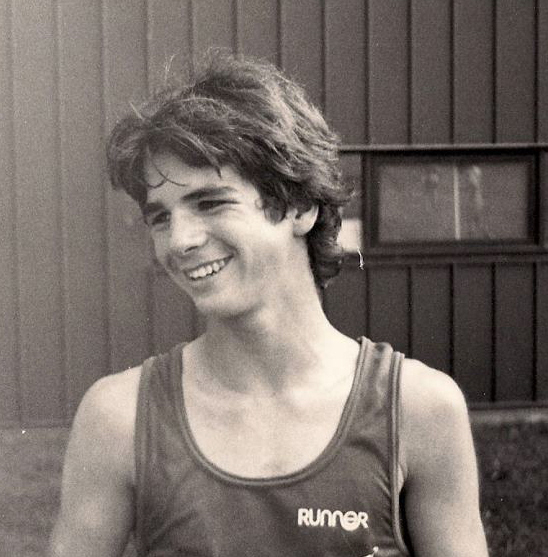 It was near the end of grade six at Edmison Heights Public School in Peterborough, Ontario, that I first heard the name of Terry Fox, and his quest to run across Canada on one leg, on the radio. I found the news of interest because at the time I considered myself a long distance cross-country runner. I ran most days in the early morning before school from my house on Royal Drive down to the Peterborough Zoo trails that snaked along beside the Trent River. These were the days when Bill Rodgers was at his prime, having won the Boston Marathon, three straight years, 1978-1980. I purchased every issue of Runner’s World to learn the latest tips for diet and training regimes.
 When I heard that Terry Fox would be running through Peterborough I eagerly arranged to have my parents take me to where he would be heading. The meeting place was on George Street out in front of the public library. I was one of about a dozen runners who showed up to run with him.
He smiled, but looked weary when he arrived, running with an unusual gait, ahead of his support vehicle. We continued with him down George Street. Some of us had plastic buckets that we used to collect donations from pedestrians, who curiously watched us from the sidewalk. There weren’t many people who gave that day. I was discouraged that more of a crowd hadn’t turned out for his reception. We ran with him to the steps of the hotel where he would be spending the night. He took the time to thank us, and shook our hands, before he starting to answer the questions from the media scrum gathered by the main entrance.
I was so inspired by this meeting with Terry Fox that I upped my training efforts that summer. When I heard that Terry’s cancer had returned, and he had to cut his run short, I convinced a friend that we should run a marathon distance for him and collect pledges.
We wrote on white t-shirts in permanent black marker, “We Are Running For Terry” and set out on a cool autumn Saturday morning. I had only run a ½ marathon once before, so this ended up being a challenge. My parents followed us in their car, and provided snacks and drinks along the way. We began the run on Armour Road in Peterborough, and followed it until it joined another street that meandered through Trent University. We turned onto Nassau Mills Road that runs along beside the Otonabee River, and continued to press on to Lakefield. Looping back on Lakefield Road, fatigue began to set in. To keep motivated the last hours of the run we spent talking about what we would eat when we were finished (A can of Chef Boyardee beef ravioli had never tasted so good).
By the time we were back to my home in Peterborough the car speedometer said that we had exceeded the marathon distance. We ended up collecting over a hundred and twenty five dollars in pledges, and donated it to cancer research.


October 23, 2016
Altra Olympus 1.5 - My First Zero Drop Trail Running Shoe
 The Altra Olympus shoes were constructed as a "Zero Drop" trail running shoe. This means that there is no change in the stack height difference between the heal and toe. It takes a few weeks to adjust your running style in order to fully appreciate what the Altra Olympus has to offer. I would suggest you use your old shoes on every other run for about the first month unitl you get used to them. The toe box in these is also wider than other shoes I've run in. It's shaped like a foot, which is good, because my toes aren't pinched after running for hours. I find, too, that the wider toe box helps to increase stability. The rainy season has begun on the island but I have never felt unstable as I cross the roots, rocks, and narrow wooden bridges, following the forest trail systems around here. I crossed these obstacles with ease.

I would highly recommend these shoes to ultra-marathoners, and to anyone doing training runs that are ninety minutes or more. They save the feet a lot of pounding, and are easy on the joints once you're able to adjust your running style.
May 21, 2016
Elk Beaver 50 Mile Ultra 2016
 The sky was overcast at 6 a.m. as we gathered behind the starting line at Hamsterley Park on the edge of Elk Lake in Victoria. I had set up my aid station with the help of two friends, Michael Burton, and Randy Hughes. They had committed to man it for the duration of the eight loop, 80km (50 mile), ultra. As usual, with most early morning ultras, I wasn't able to get much sleep the night before. I was up at 4 a.m. to get a boost of carbs, eating a couple of re-heated protein powder pancakes, a cup of coffee, and several cups of water. After running three or four kilometers I shook off my tiredness, and started to feel the Victoria vibe, taking in the pleasant scents of Spring on the forest trail.
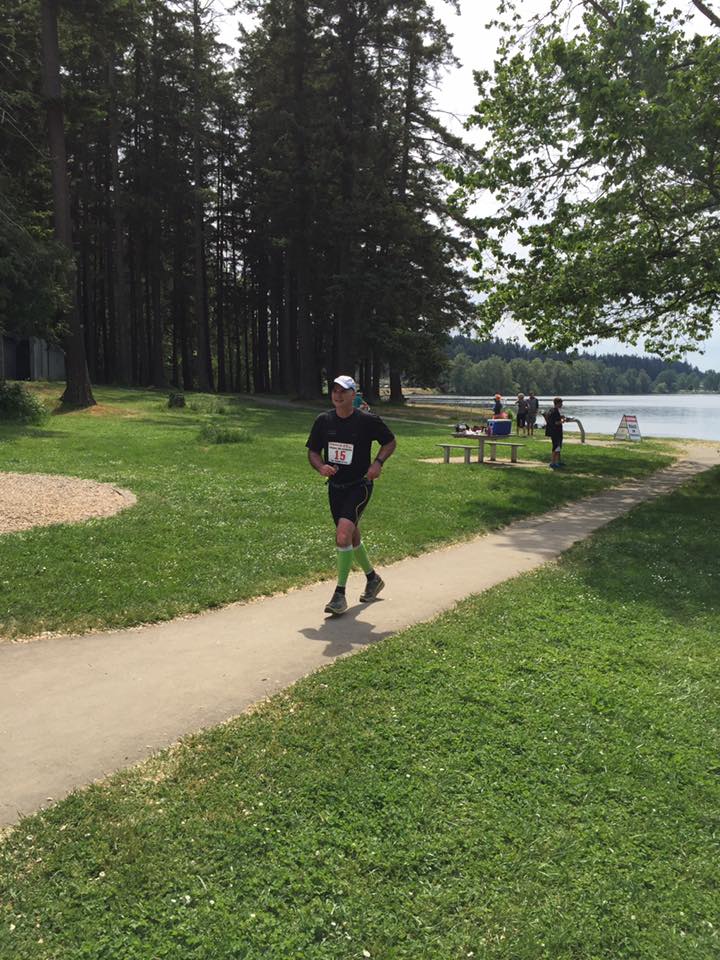 The first 10km loop was right on pace, finished in just under one hour. I wanted to get the first four loops done in around four hours, before the heat of the day hit. Heading out on the second loop I thought of the weeks of training I had put in for this event, how my wife had driven our van as a support vehicle while I was on two long training runs in March and April. I had also been training with the 19 Wing Njimegen marching team, for over almost two months completing many 10-25km marches, with a 25lb backpack. This had all helped to contribute to my preparation. I also had the support of many friends and family behind me. I thought of the verse from the Bible, in Hebrews 12:1 "Since we are surrounded by such a great cloud of witnesses, let us also lay aside every weight, an sin which clings so closely, and let us run with endurance the race that is set before us," (English Standard Version).
 The volunteers at my aid station were great. They even prepared thick cut bacon for me to munch on, that I could take along with me on the fourth loop. It went down so well. I began to eat a mix of sweet potato and honey after loop three, as the power gels I was taking every 1/2 hour weren't settling so well. The sweet potato and bacon helped to give me a boost as I was over the half-way point feeling a lot of energy, on the fifth loop.
 At around the 60km mark I felt a pebble in my shoe. As I took a quick seat in my aid station, I asked Randy to check my shoe, but he couldn't find anything. Turns out, it was the start of a blister. It wasn't unbearable, so I pushed through the remaining 20kms trying to ignore the discomfort. The wind picked up, and the skies grew darker during the last loop. A couple of groups I passed on the trail, cheered me on, breaking into applause, when they heard it was my final loop. I had estimated that I would finish in 10 hours, and I came through the finish line at 10:21, close to my goal, and ended up placing 3rd in men's masters. I was elated.
 In the evening, after a relaxing soak in the whirlpool, and a dip in the pool back at Howard Johnson's, Randy took us to John's Place, an eatery in Victoria. The restaurant has a lot of character, and a great menu, but since my stomach had almost shut down during the ultra I only could handle the soup of the day - black beans and bacon. It came with fresh baked bread too, all I could eat, which wasn't much. A great way to end the day though.
2016 Ultra Training Videos
February 21, 2016
Koro Island, Fiji, battered by Tropical Cyclone Winston

Anyone who has read my pre-tribulation fictional novel, Raptured, will recognize Koro Island, Fiji, as the featured setting where the climatic final chapter of the book takes place. Tropical Cyclone Winston, a category five storm, hit Koro Island on February 20th. Wind gusts up to 325km/h pummeled the island, leveling villages, and stripped away trees. It was the strongest storm on record to have hit the island nation of Fiji. Six people are reported to have died, but that number is expected to climb as rescuers gain access to remote villages.
I checked photos posted online of the aftermath, and was shocked by the devastation. Much of the beautiful tropical paradise that I observed while doing research for my book has now been stripped away. It looks like whole sections of the forests were crushed, and many buildings appear to be roofless or totally stripped away from their foundations. I imagine that the coconut trees, and crops, the locals rely on for income must be severely damaged.
I encourage readers to donate to the International Federation of Red Cross, which already have a society in Fiji and can quickly spearhead support efforts.
Thank you,
Author Rob Sargeant
January 10, 2016
Running with Sasquatch
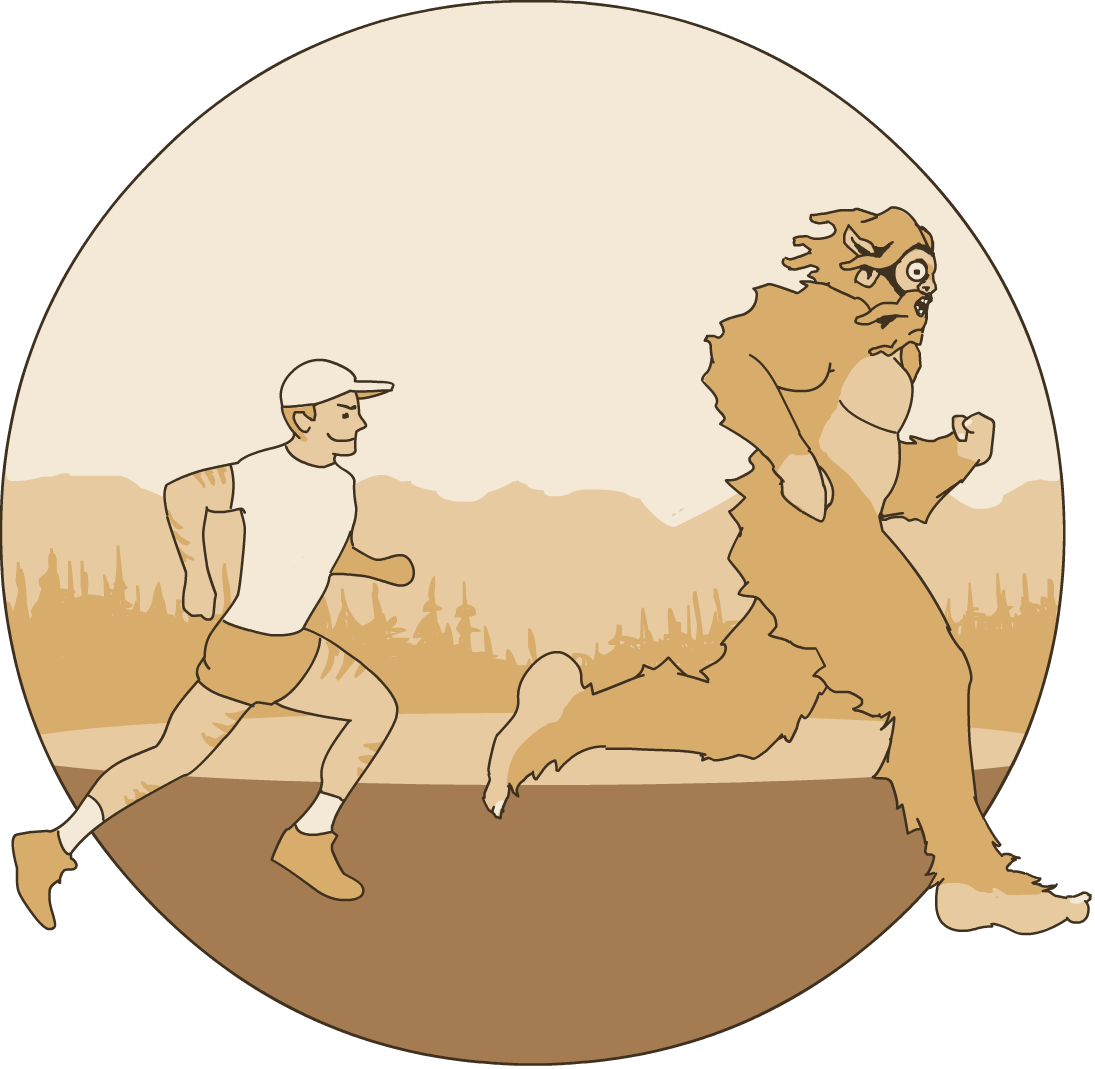
Above illustrated by Andre Sargeant
I know some of you won't believe this, but for the past three years I've been trail running with a Sasquatch. When I first encountered the timid creature, it occurred early one summer morning on a narrow forest trail in the Comox Valley of Vancouver Island. I regularly ran this route on Saturdays, during four to five hour training sessions. Since few in the local community are crazy enough to join me running this long of a distance, I usually do it alone. 
For weeks as I ran this route solo I had the feeling I was being watched, and a couple of times I heard footsteps and deep breathing behind me, but in the few seconds it would take me to stop, and turn to look back, whoever was following me would disappear into the thick underbrush. I gained my pursuer's trust one day by offering him bites of Cliff energy bars I had stashed in my Camel Pack, luring him into the open. Amazingly, it turned out to be a Sasquatch. He was able to communicate with simple grunts and rudimentary sign language. I gave him a Power Bar gel, but he didn't seem to like the taste. After taking a few sips he made a face, and tossed it to the ground, stomping on it with his big foot.
I slowly backed away, and carried on with my run. To my surprise, he followed me, keeping up with my pace. When he became thirsty, he stooped down on all fours at the river's edge to drink. We ran together for almost two hours that first day. I didn't know that Sasquatches were so fleet footed. Since then, he has joined me on numerous training runs.
When I qualify for the Western States 100 I'm going to bring him along as my pacer.
November 27, 2015
Training with the FITBIT HR
 I've been using the FITBIT HR for close to two weeks now. This training aid is quite user friendly and so far has proved to be fairly accurate. I've taken it on runs following low lying, and mountainous trails. Most of the runs were around an hour long and fairly equal in distance according to the steps and distance logged. The heart rate monitor mode indicates how the trail terrain effected the workout, showing that an hour running in the mountain trails has more impact, bringing the heart rate up to and above the 140 pbm range. Pushing the heart rate to its peak cardio range is a great way to build up endurance.
 The FITBIT HR also monitors the quality of your sleep, showing how many times you were restless and awake throughout the night. It records your resting heart rate too, which is always useful to know as an athlete. The transfer of this information all happens through a wireless connection because the FITBIT HR uses Bluetooth technology. It also comes with a 'wireless dongle' that you insert into the USB port and leave there (hopefully you have some to spare on your desktop computer) so whenever you come within 10 feet of it the data from your FITBIT can sync to the Fitbit Connect dashboard. Distance goals are adjustable through the dashboard. When you're running or walking and you reach that goal distance the FITBIT HR vibrates for several seconds to let you know that you've surpassed it.
Care and maintenance: I find I have to recharge the FITBIT HR at least once every four to five days. I have a rapid USB charger so this takes less than two hours to complete. The owners manual states that the FITBIT HR is NOT waterproof but splash proof. They don't recommend that you take it swimming or into a bathtub soak with you. I wear it around the house washing dishes, and have showered with it on my wrist, without any problems so far (might not be a good idea to take it into the shower). Wipe the underside of the FITBIT HR down (the part that makes contact with your skin) with a cloth or Kleenex after exercise. Keeping it clean will ensure more accurate readings, according to the website.

October 22, 2015
The joys of risk
 It can take years to finish writing a great book, and it can take years of training to build up the endurance to finish strong as a runner in an ultramarathon. I began writing my latest book, RAPTURED in 2011, the same year I attempted my first ultramarathon - The Burning Boot Ultra. The course was a challenge with 64kms of mountainous logging roads winding from Gold River to Tahsis B.C.. At around 21kms I twisted my knee bounding down a steep incline, and was forced to walk. The walk quickly turned into a limp. I eventually had to give-up due to the inflammation.
 The next year, in 2013, I was determined to complete The Burning Boot. I found a 16 week ultramarathon training plan online and followed it as closely as I could. The diligence paid off later that year. I finished with the top 15 runners with a time of 7:35. Three months after this, in September, I entered the 56km Great Lake Ultra in Cowichan, and finished 11th overall. It took discipline. I had to push my body through pain, and keep track of my fluid and calorie intake. At times I questioned, "Why am I doing this?". I tried to think of a good excuse to give up, but I didn't find one that would stop me. I pressed on and finished just outside the top ten with a time of 6:03.
 Since then I have gone on to complete three, 50 mile ultras (80kms). My best time was 9:13 at the Elk Beaver Ultra in 2014. I placed 2nd in the Men's Masters age category.
I finished writing RAPTURED this summer. To complete it, I required a determination and resilience like what I used to complete an ultramarathon. Risk was a big motivating factor too with both of these endeavors. You try to minimize the risk as a runner by training properly and having sufficient calories and fluids at hand on long run days. But there's always this risk on the race days, partly because of the terrain, and partly because of the distance. I could break if I push myself too hard. Call me crazy, but I enjoy this. I brought this same element into the books that I've written. It's important for me to have at least one character in my stories under some threat. Either their life or their livlihood is at risk.
 In LOST ARK FOUND five preteen boys head out on a two-week treasure hunt with a grandfather on Vancouver Island, facing all the dangers present in the wilderness. The opening sentence of the book sets up the risk at hand:"This story begins with the opening of a book, and ancient manuscript, found centuries ago on the dead body of a frozen traveler, high on the mountain glaciers of Vancouver island."
Brad, an ambitious surveillance expert, one of the characters in A SILENT VIOLENCE risks loosing a lucrative contract with the CIA when he discovers why a world famous rock star has invited over a hundred of the richest and poorest people of the world to a secret meeting in Toronto.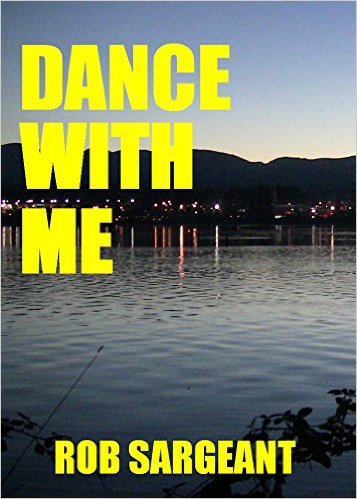
Carl, the protagonist in DANCE WITH ME is left for dead, dumped in a river. The Fallen Angels gang attempted to kill him because he wanted to close the tavern they had helped to finance (without Carl's knowledge). Luckily, the bullet hit the Bible tucked into the breast pocket of Carl's leather jacket. He survives the hit, but is forced to live as a fugitive until he can find a way to bring justice to this powerful biker gang.
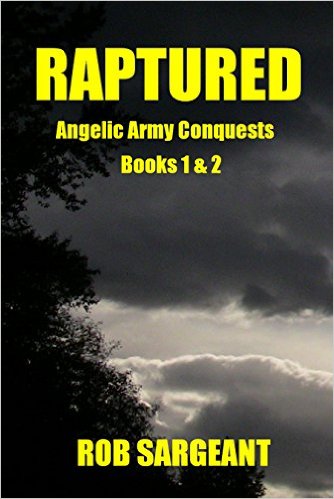 RAPTURED: Angelic Army Conquests Books 1 & 2
Book 1
A teenager's life is in danger, and Rob, a recently deceased Canadian soldier in heaven, is recruited by God to join the angelic army on a rescue mission to save him.
Book 2
The new believers after the rapture are at risk of being annihilated. Plans are in underway by the UN for the establishment of a secret death camp on a tropical island where they will be interrogated and exterminated. Rob and his angelic platoon are tasked with the mission of securing the nuptials of a WTA tennis pro to one of the wealthiest men in the world, Russ King. Their marriage could save millions of Christians from slaughter.
I've learned that risk can be exciting. It adds joy to life in the real world, and in the world of fiction. Don't let the fear of failure or the 'what if's' immobilize you. Take the first steps, lace up the running shoes and jog around the block. Put the pen to paper and write the first paragraph. Create an interesting character whose life is under risk. You'll be amazed how far you can go once you get started.
September 14, 2015
Exciting journeys kayaking and writing
 August 26th, a day after the e-book release of my latest book, "Raptured", I left for an overnight kayaking trip on the east coast of Vancouver Island. My goal was to kayak from Deep Bay and circumnavigate Hornby Island, a paddle that would turn out to be thirty seven kilometers. I prayed for good weather as I climbed into my sleeping bag at Deep Bay Resort, where I was camping, so I could get an early start.
Waking up at 5:00 a.m., through the tent's entrance I could see the rising sun breaking through the clouds on the horizon. I ate a quick breakfast of muesli and coffee, and then waded into the shallow surf with my kayak and some supplies, just after the tide had turned.
 The water was calm. The only sounds for the first hour were made by my kayak paddle and the calls of distant seagulls. As I neared Ford Cove, a few anglers in small fishing boats puttered past. Upon reaching the island's coast, I spotted seals laid out on the sandstone, soaking in the morning sun.
By midday I had reached the north side of Hornby Island, but ran into trouble because the tide had receded too far. I had to take a much longer detour around the exposed rocky shoreline to continue. It was worth it though, because while doing this I spotted more seals. A group of over twenty of them bobbed in the water, curiously watching me as I kayaked past.
 I stopped briefly to have lunch, and take drink breaks at various spots along the way. When the wind picked up, coming around the east side of Hornby Island, I had to put some heavy large rocks in the bow of the kayak to keep the keel submerged and the kayak under control. To wait out the wind and waves I sheltered in Ford Cove, having a coffee and some locally made carrot cake at the small variety store/cafe there. One of my books, "Dance With Me" had scenes that took place at the wharf, so it was extra special to sit, and sip my coffee, thinking of what my fictional character experienced at the marina.
By the time I returned to my campsite at Deep Bay the whole trip had taken just under ten hours. Tired, but excited by the accomplishment, I enjoyed a hot shower in the resort washroom. What a journey.
The next day, after I returned home, I checked my new book on Amazon, and saw that it was selling, and moving up the best-selling hot new releases for its genre, ranking as high as #4 by mid September. Over two years of writing work went into "Raptured" - another long journey. It felt good to know that people, anywhere, were now able to read it.
I took some video clips of the kayaking trip. If you're interested you can watch it below.
August 10, 2015
Hiking the North Coast Trail - Summer 2015
 Hauling backpacks, we disembarked from a water taxi at the North Coast Trail head at Shushartie Bay, July 31st around 2 p.m.. Twelve members of 407 Squadron, including, Cpl Caron, MCpl Horwood, MCpl Larouche, Sgt Nadeau, MCpl Proulx, Cpl Smith, Maj Smith, Cpl St-Pierre, 2Lt Tang, Sgt Toth, Cpl Ward, and myself, started off with a great sense of excitement. It was diminished a bit when we found we immediately had a ten metre steep climb by rope into the rain forest.
The first two days of hiking crossed difficult terrain. We averaged a pace of a little over 1km/hour due to the technical challenge of climbing over tree root systems, and slippery rock faces. Though there were some wooden boardwalks and steps built along the first two sections of the “trail” we crossed, it seemed more of an obstacle course than a “trail”.
 The first night we camped at Skinner Creek I accidentally burned three of my toes with boiling hot water. The next day, while crossing Cape Sutil, I was stung by four mud wasps within five seconds. Even though I cried out for those ahead of me to “Run!!” it did no good because we were hiking a difficult uphill in close ranks. Later that day I slid down a slimy cliff scraping my elbow. The North Coast Trail was becoming somewhat more of a “trial” to endure than a “trail” to trek. But we all persevered, and by day three we were hiking scenic long stretches of sandy, and pebble stone beaches. For about an hour we were followed by a humpback whale a few hundred metres off shore. The whale would rise to the ocean’s surface and release a blasting spout of mist into the air every few minutes.
While trekking the North Coast Trail you’re stripped of most amenities. With no cellular reception the smart phones become just useful tools to take photos, or for use as and e-readers and pedometers. Our minds focused on more basic things, like finding fresh drinking water, getting shelter, and making fire.
During the inland crossings when I found myself alone, after the sound of the rumbling surf faded, the mossy bogs soaked up the shuffle of my footsteps and my deep breathing as I pressed on lugging my backpack. When I did stop to listen, the silence was dramatic, almost unearthly, like I was standing on some lifeless planet.
 By the fifth day we had completed the North Coast Trail section and were able to camp two nights at Nels Bight beach on the Cape Scott Trail. The following day most of the team took a 14-km roundtrip day hike to the Cape Scott lighthouse (I stayed behind to tend to my three burned toes).
 Thursday morning greeted us with a rainbow in the sky and more humpback whales feeding offshore. I watched them as I ate a quick breakfast of hot oats and coffee readying myself for the final 19-km hiking leg that would take us near to the Cape Scott Trail head (where the shuttle bus would be picking us up the next day). I couldn’t think of a better way to depart, being able to witness such beauty. It was worth a few wasp stings, and burned toes.
All together throughout the trek we covered around 70-km, and those who went on to the lighthouse completed another 14-km. Overall, I figured we each burned around 21,000 calories. Our total food intake was closer to 10,000 calories each, so we were famished by the time the shuttle bus picked us up at the Cape Scott trail head the final day. A couple of hours later when we stopped at a mall in Port Hardy for lunch I was elated to have an A&W Uncle burger in my grasp. One has never tasted so good.
June 26, 2015
Tough enough for the Kusam Klimb 2015

The night before race day, rain fell as I crawled into my tent at the Fisherboy Campground around 10 p.m.. The patter of the drops lulled me to sleep. It stopped before I awoke around 4:15 a.m., giving me plenty of time to prepare.
To prevent blistering on the descent I lubed up my toes, and feet, with a mix of Body Glide and Chamois Cream. Since it was going to be a warm day I filled my Camel Pack to its 2 litre capacity.
The skies cleared, as we crowded behind the start just before 7 a.m.. After the countdown, for the first 11-12 minutes, we dashed up a gently slopping paved road to the trail head. I watched Nick Elson, the eventual winner, speed ahead of the chase pack, and disappear into the forest.
I decided early on not to push too hard. My left knee still had a bit of inflammation, and I didn't want to aggravate it further. I was careful on the climb, stopping to have drink breaks, and even paused to take some photos. My Hoka Mafate Speed trail running shoes worked well. I only had to stop one time to tighten the speed laces, as they came loose at one of the very steep rock climbing sections. The rain the night before was enough to get keep the dust down but not so much that things became slippery.

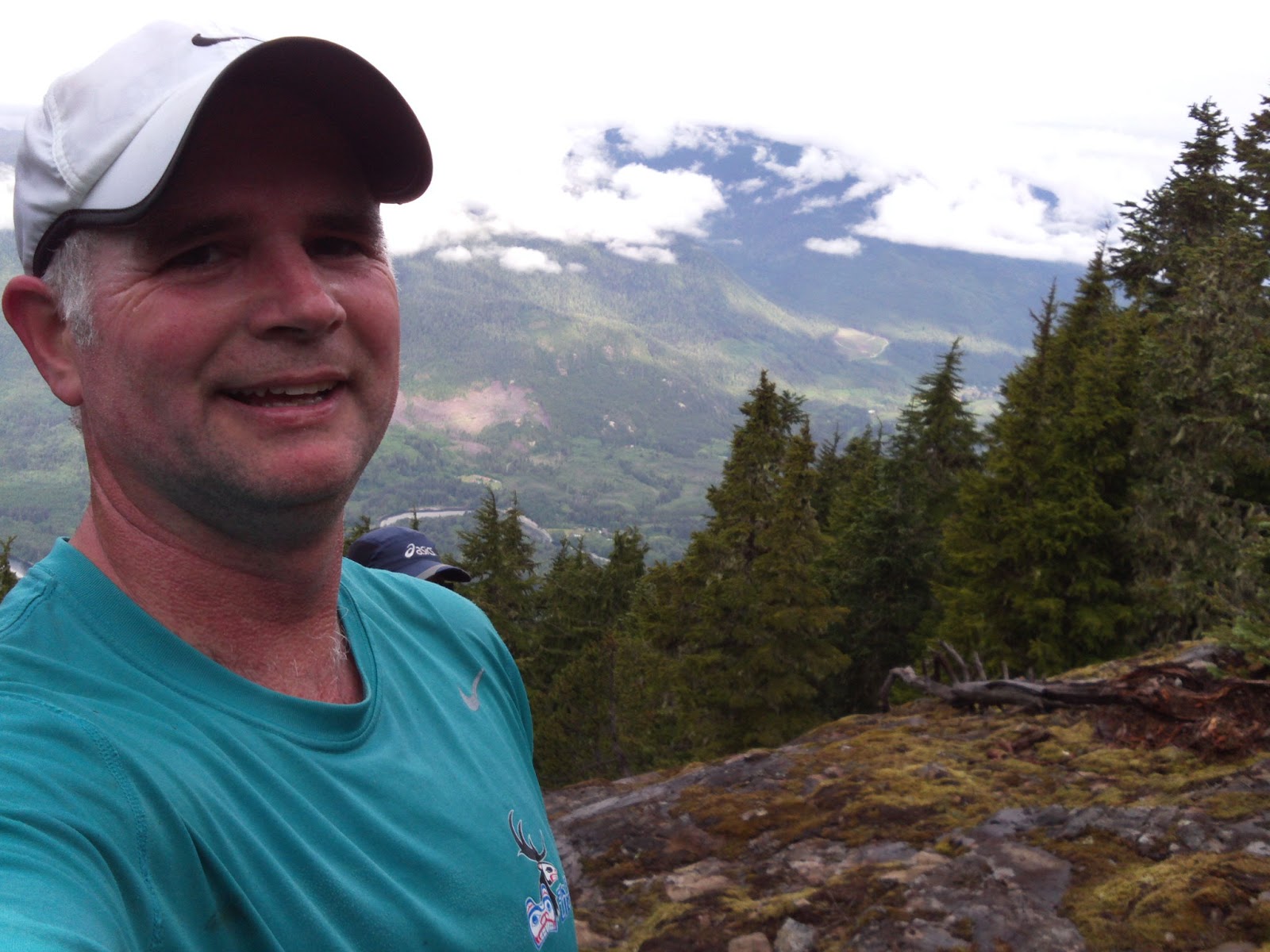
As we climbed to the summit, above the clouds, I saw the exposed rock of the peaks for the first time. Other years when I had reached this section in the trail it was still covered in snow. The backside of the mountain was snow-less as well. Because of this descending the "cliff's of insanity" sections with the long ropes took longer than other years, since there was no way to slide by the lines (unless you wanted to get scrapped with rocks and stones). I slipped on a slimy stone as I jumped across a creek in the swampy sections of the lower back forest. It sent a cutting pain across my right calf muscle, and for several seconds of pain I thought I was finished. I slowly moved ahead, and was able to walk it off. Thirty seconds later I was back to running again, and entered the wider, exposed trail, on the switch-backs leading down to aid station three (where Nanaimo bars and Gatorade were waiting for me).
 I ran out of water with about 5km to go, so I gulped down an extra cup of Gatorade at the second last aid station. Soon after this, I heard a familiar voice call out behind me. It was my friend and co-worker Louis Nadeau, running a personal best Kusam Klimb pace. We decided to finish the course together, encouraging each other, as we continued to descend the trails. We could hear blasting rock music the last few kilometers, and raised our hands in victory as we rounded the last turn toward the finish.