Zilla Novikov's Blog, page 6
March 18, 2025
Behind the Screens: Tuesday Author Interview
Every Tuesday, get to know a bit about the stories behind the books you love, and discover your next favourite novel.
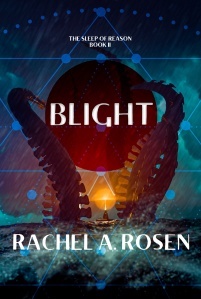
Zilla: I am so ridiculously excited for this interview—I’ve been waiting (somewhat) patiently for Rachel A. Rosen to be read to share the second book in her Sleep of Reason series with the world. And it’s finally here! Rachel, please introduce us to Blight.
Rachel: Reader, meet Blight. Blight, meet Reader. Blight is the sequel to Cascade, my first novel. Kind of a grim fella but I promise you there’s a sense of humour under there, not too far beneath the spiky surface. Cascade follows the attempts of the various characters, inside and outside systems of governmental power, to stop a climate-induced magical disaster from overrunning Canada and the world. Since there are three books in a trilogy, it’s not too big a spoiler to say that they fail at that, and Blight, which takes place three years later, is about picking up and living in the ruins.
Zilla: Among the many, many things that fascinated me about this book was how much magic derived from the power of true names, whether they protect us from demons or deliver us to sorcerers. What drove you to write your fantasy this way?
Rachel: I was Ursula K. LeGuin-pilled early in life, but of course she wasn’t the first person to write a form of magic in which one’s true name should be carefully guarded, lest the speaker end up with power over you. In Cascade, it’s established that several of the main characters have buried their true names, a type of curse that makes everyone incapable of even thinking of it; in Blight, we are about to find out why that’s important. My version of demons, people and animals who have been corrupted by magic to become monstrous, lure their victims to their deaths by whispering their true names. But humans are always worse than that, and we see what the power of a true name can be in the hands of a magician with malicious intent.
Identity is a form of armour. It’s not a coincidence that the far right weaponizes words—woke, antifa, fake news—twisting their original meanings to corrupt them. If we are going to survive the next few years, battles will not only have to be fought in the streets, but on the terrain of speech. I’ve just made it somewhat more literal for my characters, who risk being turned inside out should the wrong word get said.
Zilla: I love the subtle world building you used to show how life changes under fascism. Could you tell us about some of the inspirations there—for example, for the two types of money your characters use, Canadian dollars & DEC?
Rachel: We often get caught up on definitions, but fascism has never been a coherent ideology. When fascism comes to Canada, to paraphrase George Carlin, it will be polite and couch its atrocities in language about national pride, tradition, and orderliness.
You can convince people to accept massive socio-political and economic changes through framing particular issues as not political. You can still vote, but why would you? The issues most critical to your wellbeing—say, do we light the planet on fire in pursuit of shareholder value—have been decided amongst the ruling class by consensus, and you won’t be consulted on them. This is managed democracy, and it’s on its way here too. It’s no wonder that North Americans are exhausted by traditional electoral politics.
The levers of power are financial, so I wanted to look at how the currency would work in a post-apocalyptic authoritarian regime. One model was China, which adopted a dual currency in its transition to capitalism. In Blight, most characters use a devalued Canadian currency, but Dominion Exchange Credits—DEC—are available for luxury goods. These, being digital, are easier for the state to control, and the list of what constitutes luxury is always growing. You end up with people selling their souls for health care, something that of course would never happen here.
Zilla: Speaking of fascism (and who isn’t, these days), I noticed that at the beginning of the novel, characters had a range of methods of resistance, from large to small. By the end, all our heroes had chosen to opt out and actively resist. Is this a choice for narrative arcs, or does it speak to broader realities activists need to confront?
Rachel: Activists want to be inclusive, and the struggle has many levels. Protesting in the streets is activism. Is feeding people activism? It’s one of the most fundamental forms of activism. Creating art? Maybe, if it inspires action rather than just making people feel better about their political opinions. Is teaching the next generation critical thinking activism? As a teacher, I believe that’s just kicking the can down the road a bit. Ultimately, you have to stand in front of the bulldozer to prevent the machine from doing its job. The arc of one character goes from singing the wrong note, in the first book, to machine-gunning brownshirts by the end of the second, and to a degree that’s all of our arcs, if we’re going to be honest.
Zilla: On a more personal note, I’d like to ask, HOW DARE YOU KILL [REDACTED], HOW DARE YOU MAKE ME FEEL FEELINGS?
Rachel: Because I am a monster. Every time someone complains about the character deaths in Cascade, I am gleeful, because that means I made a little person who a reader likes enough that they are sad to see them die. To be real with you, I like that character too and gave myself a big sad whilst writing that scene.
Zilla: Is there a happy ending to the trilogy? WILL ANYONE EVER BE HAPPY AGAIN???
Rachel: I won’t reveal much about the ending beyond that there is one. I’m not going to pull a George R.R. Martin—I’ve plotted out The Sleep of Reason to the third and final book. But in terms of whether anyone will ever be happy, the disaster gays at least get to swap spit and witticisms in this one, which should make at least some people happy.
Zilla : Thanks for sharing your story and your process. We’re looking forward to reading! Where can the Night Beats community find you and your book?
Rachel: I am firehosing social media in an attempt to make these books discoverable. A good place to follow me is right here on Night Beats, since any updates will go directly to your inbox. You can sign up for the Night Beats Newsletter here.
You can also find me on:
My website is rachelrosen.ca and my podcast is at wizardsandspaceships.ca, or wherever you get your podcasts.
You can buy the book at this universal link, The BumblePuppy Press, or order it at your local bookstore or library!


March 11, 2025
Behind the Screens: Tuesday Author Interview
Every Tuesday, get to know a bit about the stories behind the books you love, and discover your next favourite novel.
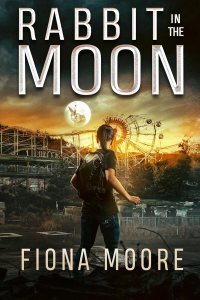
Zilla: If you’re in the mood for a science fiction adventure, you are in luck, because Fiona Moore is here to tell us about their novel, Rabbit in the Moon . Fiona, take it away!
Fiona: Here’s the blurb:
Ken Usagi, a daring young journalist from the icy wilderness of Nunavut, is thrust into a perilous journey through the war-ravaged remnants of the former United States. Haunted by a chilling encounter with a mysterious biotechnical machine—a relic from his troubled childhood—he becomes convinced it holds the key to ending the devastating conflict tearing the world apart.
Far to the south, Totchli, a brilliant young biotechnician from a Mesoamerican society pummeled by catastrophic climate change, receives a desperate order. He must venture north to uncover the fate of a critical colonial expedition, a mission that once carried the last hopes of his people’s survival. Communication channels with the expedition have fallen eerily Silent.
As Ken and Totchli embark on their separate quests, the very fabric of reality begins to unravel. Their paths converge, leading to a fateful encounter where the boundaries of their worlds blur and shatter.
Zilla : What inspired you to write this book?
Fiona: The initial inspiration was something of a mashup. I had been watching Apocalypse Now while also reading the Raffles novels and Castle Keep, and I had an irresistible image of a riverboat going through a jungle, crewed by Harry Manders from the Raffles novels and Alfred Benjamin from Castle Keep. When I have an image like that, I start exploring it. How did it happen? Where are they going? What are they looking for? It all just came from there.
Zilla : I love that! Were there any other images that inspired you?
Fiona: As well as that mental image, there was another source. A friend of mine told me a story about how, on an early morning walk, he’d seen two magpies herding a rabbit. One driving it from behind, the other hopping in front. That struck me as a very sinister image, but also one that tied in with the novel—these people, symbolically associated with rabbits, being driven by forces they don’t understand towards conclusions that might be disturbing.
Zilla : How much research did you need to do for your book?
Fiona: On the one hand, a lot—on the other, hardly any! I’m a university professor in my day job, and I’m very interested in Indigenous approaches to economics as an alternative to the growth-focused model. This is one of the reasons why the novel centres on two futures, one in which the Inuit are the most stable and successful society in North America, and another, where an Aztec-influenced post-human society dominates.
Zilla: Thanks for sharing your story and your process. We’re looking forward to reading! Where can the Night Beats community find you and your book?
Fiona: You can buy the book here: https://books2read.com/u/mVLQgp and I am drfionamoore on Facebook, LinkedIn, Twitter, Instagram, BlueSky and TikTok. My blog is www.adoctorofmanythings.com.
March 6, 2025
Book Report Corner
by Rachel A. Rosen
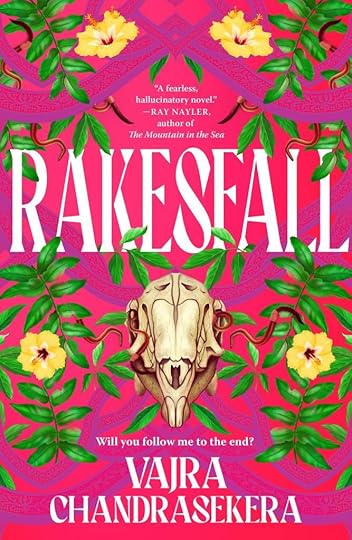
Vajra Chandrasekera’s first novel, The Saint of Bright Doors, is probably the best fantasy novel I’ve read in a decade. So it is unsurprising that I bought his second, Rakesfall, without even knowing what the book was about.
Rakesfall is WILD and defies description, veering from the 1970s to the end of the world, written with the kind of narrative confidence that you’d expect from an author after they’ve won a lifetime of prestigious literary prizes. I made people stop what they were doing so that I could read parts of it to them. It’s a story about struggle—often in a way that is very visceral and brutal—love and death and reincarnation and science and nationalism and climate collapse.
Can I explain what I just read? Maybe if I took a course in it. Did it blow me away? Absolutely.
March 4, 2025
Behind the Screens: Tuesday Author Interview
Every Tuesday, get to know a bit about the stories behind the books you love, and discover your next favourite novel.
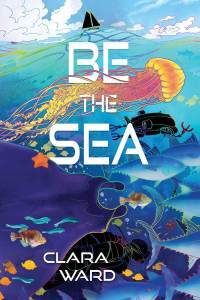
Zilla: We can all use some beauty in our lives—the open ocean, teeming with life, the unshackled consciousness we call dreams, and the joy of sharing both with each other. Clara Ward’s ecofiction gives us all of these in their book, Be the Sea . Clara, can you introduce us to your book?
Clara: Be the Sea dips into a queer neuro-inclusive future with chosen family, sea creatures, and mysterious dreams.
In November 2039, marine scientist Wend Taylor heaves themself aboard a zero-emissions boat skippered by elusive nature photographer Viola Yang. Guided by instinct, ocean dreams, and a shared birthday in 1972, they barter stories for passage across the Pacific. Aljon, Viola’s younger cousin, keeps a watchful eye and an innovative galley. Story by story, the trio rethink secrets, flying dreams, and how they experience their own minds.
Zilla : What inspired you to write this book?
Clara: My earliest memories are of the ocean. I was born in Kāneʻohe, Hawai’i, back when loving the ocean meant fighting to protect Kāneʻohe reefs from human sewage.
Rocking on a boat or standing with surf lapping at bare feet has always been my happy place. After half a century, I realized that wherever life threw me, I always returned to the ocean. My fight has grown to include climate change, ocean acidification, plastic and other pollutants—too much for a single person or a single lifetime. Alongside this realization came the characters for my story, a near-future chosen family drawn together by mysterious forces and their love of the sea.
Zilla : Who did you imagine reading your book as you wrote it—your own chosen family of readers?
Clara: While writing, my head was full of characters who cared enough to act. Whether a teacher, scientist, sailor, photographer, lawyer, or marine lifestyle entrepreneur, each found their own path to preserving the ocean. I wrote my characters’ grief over losing the coral reefs alongside their drive to protect a giant manta ray. I believed readers as diverse as my characters could share a sense of wonder and be inspired with love for the ocean, the earth, and each other. People want to save what they love. I pledged all my royalties to Conservation International and launched Be the Sea out into the world.
I found plenty of kindred spirits while speaking on environmental and marine science panels. However, the readers who embraced the book most fiercely from the start, some literally hugging the book to their chests, were those who saw themselves in my neurodivergent, nonbinary, and queer protagonist. Those readers not only changed my connection to our community, but they literally changed the trajectory of Be the Sea a month after it came out. Neurodivergent readers especially told me they, or someone they wanted to share the book with, needed an audiobook version right away. I told my tiny indie publisher, Atthis Arts, and they supported this shift in scheduling. The audiobook for Be the Sea came out in December!
Zilla : If your characters met you, what would they say to you?
Clara: I live in Silicon Valley now, and half the young people I know have jobs that could be read as science fiction by outsiders. They challenge society to accept them as they are: queer, trans, neurodivergent, proud. They ask when—not if—sea level will rise a meter, and they take for granted that we need alternatives to fossil fuels and plastic packaging as soon as possible. It has become common to hear people of all ages say that we need a solution for these problems yesterday. Sadly, although my book takes place fifteen years in our future, that’s what I hear my characters saying to me. I did the best I could, and wrote Be the Sea for them, yesterday.
Zilla: I love this. Thanks for sharing your story and your process. We’re looking forward to reading! Where can the Night Beats community find you and your book?
Clara: You can find me (and lots of bonus material for my book!) on my website (https://clarawardauthor.wordpress.com/novels/be-the-sea/). Be the Sea is available at your favorite online or brick-and-mortar bookseller. Or go directly to my small press publisher, Atthis Arts (https://www.atthisarts.com/product/be-the-sea/) and use code BETHESEA this week only to get 20% off your entire order and a free Sea Creature postcard!
February 25, 2025
Behind the Screens: Tuesday Author Interview
Every Tuesday, get to know a bit about the stories behind the books you love, and discover your next favourite novel.
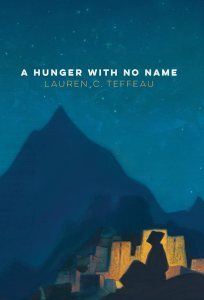
Zilla: Some stories are so real, so important, that we turn to fantasy and fable to give them life. Lauren C. Teffeau gives us a book like this in her environmental fantasy novella A Hunger with No Name . Lauren, can you tell us a bit about your book?
Lauren: A Hunger with No Name is a coming-of-age tale with an environmental focus featuring an immersive fantasy setting inspired in part by the high desert of New Mexico.
Thurava of Astrava is intended to become a herder, a most honored position for her dwindling community that clings to life on the banks of the Najimov, the river that’s the lifeblood of the high desert. But the Glass City on the horizon threatens the delicate balance the Astravans have managed to hold on to for centuries, polluting the air and water as the city grows bigger and bigger. The Glass City’s clockwork liaisons offer to bring the Astravans into the Glass City’s walls, but they will have to give up their ways and their precious herds to do so. Thurava must decide who she is without her animals, using the stars as her guide, putting herself on a collision course with the secrets the Glass City holds dear.
Zilla : Is there a visual image that inspired this book?
Lauren: I had a dream of a young woman staring off toward the horizon and being both horrified and fascinated by what she saw. When I woke, I started writing the story that ultimately became the book.
Zilla : Is your work more plot-driven or character-driven?
Lauren: No story is exactly the same, but I seem to have developed two writing modes: possession projects and battle projects. Battle projects are usually idea- or world-forward in that I have an idea or story world I want to explore in a narrative way. The trick is finding the right point-of-view character to bring that idea or world to life. That process can often feel like a battle as I try to fit all the pieces together into a cohesive whole and find a compelling character to chart the way. My debut novel Implanted was like this—I had a very ambitious idea for a world, but it took a while to settle on my main character.
In contrast, possession projects like A Hunger with No Name are story ideas that are more character-forward. And once I know the character, I usually have an idea of how the story should be structured to best capture their arc. Once those pieces are in place, the writing process often feels like the story is possessing me until I fully get it out of my system and onto the page.
Zilla : I love that description of writing projects—I relate to that a lot. Who did you imagine reading your book as you wrote it?
Lauren: I was thinking of my daughter and things I wanted to know about how the world worked when I was growing up. The book examines a lot of different types of female relationships: mothers and daughters, female friendships, encounters with women from different generations, and I hope the book provides some insights on how to navigate those relationships. It’s too early to know who will read the book as it’s only been out a few weeks, but I hope it finds readers interested in folklore, science fantasy, automatons, and the high desert.
Zilla: Thanks for sharing your story and your process. We’re looking forward to reading! Where can the Night Beats community find you and your book?
Lauren: You can find me at my website, or on Instagram, Bluesky, or Linktree. My book is for sale at the , as well as , , and on .
February 20, 2025
Book Report Corner
by Rachel A. Rosen
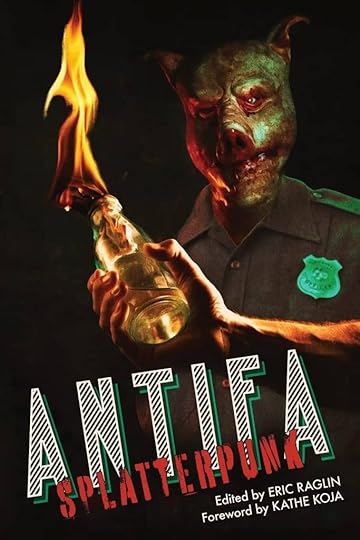
Antifa Splatterpunk somehow fell under my radar when it came out a few years ago, despite being entirely my kind of thing. It’s exactly what it says on the tin—an anthology of short stories about fascists dying in gruesome, often hilarious ways, occasionally at the hands of our friends in black. In this collection, far-right extremism is portrayed as the monster it is, a tradition going back to Marx and his vampiric capitalists.
Like any anthology, some of the stories are stronger than others. The highlight for me was “Ay, Carmela,” about an old woman whose anarchist family was murdered when she was a child during the Spanish Civil War, and who lives long enough to see justice done. “The Chad Show,” in which the conservative tendency to play the victim is hilariously and grotesquely lampooned, was another standout. And “Lutznau’s Opus,” a cosmic horror set in the real horror of the Holocaust, is a trippy and haunting ride.
If you like your horror with a side of radical politics, you’ll enjoy this cathartic collection.
February 18, 2025
Behind the Screens: Tuesday Author Interview
Every Tuesday, get to know a bit about the stories behind the books you love, and discover your next favourite novel.
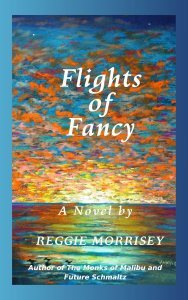
Zilla: Night Beats contains plenty of writers, so what about a story starring one? Reggie Morrisey is here to tell us about her contemporary novel, Flights of Fancy, that offers us exactly that! Reggie, can you tell us about your book?
Reggie: The painting The Last Supper, by my artist husband Vincent Mancuso, graces the eBook cover, realizing in pastels my vision of the life of Sage Anthony.
I started to imagine her life on a 2014 transatlantic flight to New York and filed away my notes in a folder labeled ‘Tomorrow File.’ For literary purposes, let’s say I imagined her story on a flight from Paris to New York.
Sage Anthony is a mystery writer, pigeonholed into a genre that bores her. Murder in medieval convents and abbeys are her stock and trade, but she cannot write gore anymore. After growing up in New York’s Hudson Valley minus a biological father, taunted by a homicide-detective stepfather and wary of Stepfather #2, Sage has a mind rife with suspicion. Blunt trauma to her head makes her thirty-something life tortured, even though she lives in a loft apartment on the New Paltz, New York estate of an aging billionaire who is obsessed with her––but then, so was his wife.
Unconditional love eludes Sage. Guarded affairs and a fixation with finding her “Dad” consume her. Her Irish-born mother is similarly guarded in her affairs, critical of Sage’s choices, and she fumes as a 21st century American patriot. Her daughter is not tuned into politics or current events, only the weather.
Sage’s life proves the maxim, “What you think about expands.” Up against a book deadline, her creativity kicks in an unlikely direction. Luck follows as Sage strikes it rich and does whatever she fancies at her own New Paltz estate and in France.
The book takes you to France more than once. The last trip is capped by a February 2020 stopover in Milan for Fashion Week. Remember what happened in the winter of 2020 in Milan and the rest of the world? Yes. That.
Zilla: What’s the link between music and your book?
Reggie: Music plays a role in all my books. Characters reveal themselves in the music that feeds their souls, and it even hints at their moods and ulterior motives.
Zilla: What author do you wish would read your books?
Reggie: Amor Towles is my ideal choice to read my books. The author of A Gentleman in Moscow is a master of plot, dialogue, pace and eras, and when it comes to surprise endings, Towles has the instincts of Edgar Allen Poe.
Zilla: What role does the setting play in your book?
Reggie: Location is so vital in my stories that each setting could be called a character.
Zilla: What’s your next writing project?
Reggie: The sequel, Gossamer Wings, launches in 2025.
Sabitha : Thanks for sharing your story and your process. We’re looking forward to reading! Where can the Night Beats community find you and your book?
Reggie: You can find Flights of Fancy by clicking on my Amazon Author Page, or aim your device camera to scan the QR-code.

Follow me on Instagram@OfTwoMinds2, and find me on Goodreads. Check out my Reading Nook interview about my 2022 eBook, The Monks of Malibu. And visit my website to read short stories and essays, read or listen to my poetry, see works of art and learn more about Flights of Fancy
February 11, 2025
Behind the Screens: Tuesday Author Interview
Every Tuesday, get to know a bit about the stories behind the books you love, and discover your next favourite novel.

Zilla: There’s a lot of doom and gloom in the world, and sometimes what we need is a reminder that more hopeful futures exist. Brightflame is here to tell us about their solarpunk fantasy, The Working , which offers us just that spark we need.
Brightflame: A modern coven must thwart a looming eco-cataclysm and find the key to the bright futures we need.
Betsy’s a modern-day Witch with an ageless problem: she’s worried about screwing up her coven’s ritual. Again. But the coven has a bigger issue to face—a greed-fueled entity will soon obliterate Earth’s ability to support life.
Zilla : What inspired you to write this book?
Brightflame: I wrote The Working to answer my own burning question: what can we do about the massive ills of the world, not only our climate emergency, but all the intertwined ills that include fascism, racism, and greed? What is the Working to counteract this and restore a vibrant, regenerative Web of Life? I didn’t have an answer when I began to write.
I also wanted to embed real magical practice and ritual for younger Witches and covens—or anyone drawn to an Earth-based spiritual path.
Zilla : I love that, but let’s delve deeper into your inspiration. Is there a visual image that inspired you?
Brightflame: A pentacle—the five-pointed star—inspired the structure of The Working. There are five coven members in the story, each with their own point of view. A pentacle represents interconnection—each point is connected to every other point. The number five also represents the Elements: Air, Fire, Water, Earth, and Spirit.
Zilla : If you could meet your characters, what would you say to them?
Brightflame: I would thank them for their wisdom and allowing me to tell their stories. Yes, this is a work of fiction. Still, I got to know Betsy, Sail, Fire, Mari, and Tal as dear friends through the years of writing the book. And the five Old Ones in the story are based on my actual Ancestors who I met in the astral realm and who told me to get this story out to the world!
Zilla : And what would they respond back!
Brightflame: I fear the five coveners would ask who my favorite is. But that would be like asking who my favorite child is. I love them all!
Zilla : What’s your next writing project?
Brightflame: I’m shopping my story collection that forms a mosaic novel—the stories are all set in the same solarpunk future through time. Some of them are published—links on my website. And I’m working on a nonfiction Solarpunk Witchcraft book.
Zilla: Thanks for sharing your story and your process. We’re looking forward to reading! Where can the Night Beats community find you and your book?
Brightflame: Visit my site https://brightflame.com and consider subscribing to my newsletter and blog. My book: https://waterdragonpublishing.com/product/working/ Follow me on Instagram (@brightflame.2), Bluesky (@BrightFlame), Facebook (@brightflame.1), and Mastodon (wandering.shop/@BrightFlame)
February 6, 2025
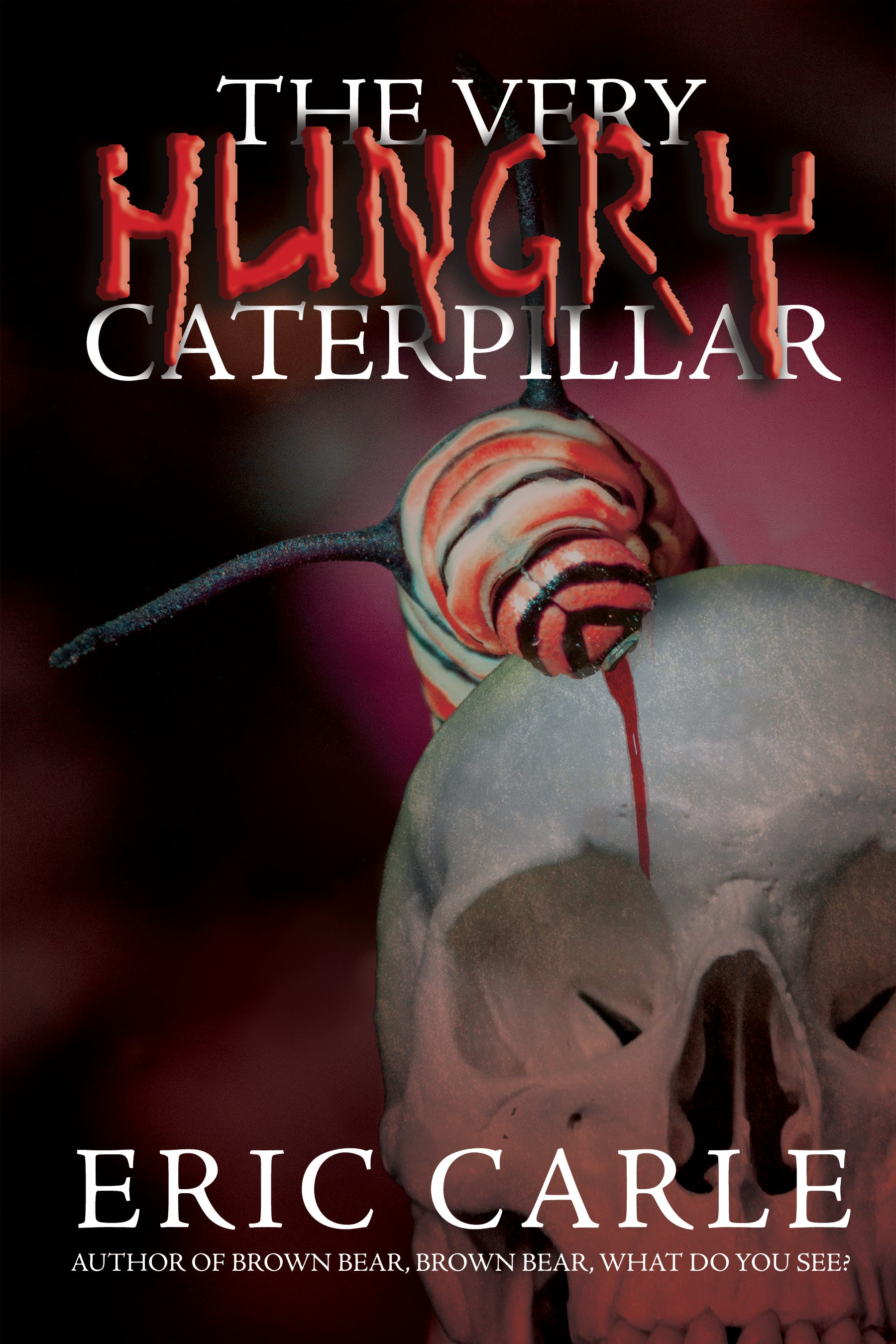
Wrong Genre Covers
February 4, 2025
Behind the Screens: Tuesday Author Interview
Every Tuesday, get to know a bit about the stories behind the books you love, and discover your next favourite novel.
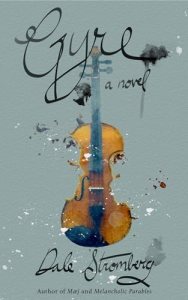
Zilla: Rachel and I both absolutely adored Gyre, Dale Stomberg’s literary fiction novella about abuse, fate, the creative urge, and repeating our mistakes. We had to bring Dale in to talk about this work of art, so here he is! Dale, give us your best shot at putting the magic into words.
Dale: The story begins when Abigail is born with a fully formed adult consciousness and an awareness that she has lived a prior lifetime, albeit with no specific memories of her past life. As an adult mind in a baby’s body, she is physically helpless but also impossibly precocious. Her father, Raj, is overjoyed at how special she seems; her mother, Faye, is disquieted.
As Abigail grows up, scraps of memory from her prior life begin to return to her. She comes to understand that she did something terrible back then, and her wonder at being reborn clashes against her deep sense of shame and worthlessness. A family tragedy exacerbates the strain in Abigail and Faye’s relationship, and things start to spiral downward.
So the book ends up being a meditation on cycles of mistreatment, on the ways we struggle against our own pasts and ingrained predilections, and on how a sense of fate’s inescapability can come to tyrannise us.
Rachel: Can people change? The commercial fiction model is about a protagonist who changes as a result of their experience, and Gyre almost seems like a grim rebuttal to that narrative arc. How important was realism in this story?
Dale: The real world is given to us by evolution, by history, and by the ongoing machinations of disunited masses of individual minds. Fiction, on the other hand, generally takes place in a world created by a single mind. So it stands to reason that fiction will tend to be more orderly than reality. I think the stereotypical “tidy-change arc” is a symptom of this bent toward orderliness. There isn’t anything necessarily wrong with this kind of arc, but there’s also no law demanding that every story conform to it.
Can people change? (Yes! We’ve all seen people change for the worse. Your fascist uncle used to be hip.) I’d reframe the question: how much of the way we change is under our conscious control? To say, “I shall now change,” and expect to just up and change is of course about as realistic as deciding to forget your native language, on the presumption that it will be wiped from memory on the spot. We all know this, but this fact is also weird because supposedly “I” (and no one else) am in charge of “my” decisions. So we recognise that our behaviour derives only in part from the in-the-moment choices of a sovereign will.
Speaking only for myself, to attempt to control my own mind can feel like being in the pilot’s seat of a spaceship whose autopilot system fights me, sometimes allowing me to exert a certain amount of manual control or at least influence, but other times not. I think of the quarrels I’ve repeated “a thousand times” with someone close, quarrels which inexorably end up running along the same awful, habitual grooves—despite the fact nobody involved wants them to. I think especially of certain shortcomings of mine (thoughtlessness, forgetfulness, habitual failures to duly notice) whose core characteristic is precisely that they are outside subjugation to the conscious will in the moment they occur. So you might read the overarching situation in Gyre as an exploration of the feeling of self-heteronomy, of being unfree vis-à-vis your own self. The story has a magical-realist setup which makes its protagonist literally unfree, yet I also think the way it reads is that, within this unfreedom, she has some latitude of action, and what constrains her (at times) is not a monolithic external fate but an internally imposed fatedness. Does the fact it comes from within make it more, or less, unshakeable? Hard to say. But I think it is noteworthy that Abigail normally doesn’t say she is unfree—instead, she insists she is worthless.
Zilla: Abigail is unfree in some respects, though. She’s a victim of the cycle of abuse, she’s predisposed to alcohol abuse—though she’s also a victim of her own choice not to try to escape the cycle. How much did you intend to show her as doomed by the narrative vs doomed by her own choices?
Dale: The premise in Gyre, that Abigail knows she has been reborn, turns the whole story into, as it were, an extended metaphor, or in other words a story with two simultaneously possible readings. In the story’s reality, fate has mandated her path, so she is of course trapped by the narrative. To readers standing outside that narrative, I think this will be overlaid with a sense, perhaps familiar from their own lives, of existing hemmed within the consequences of a million prior decisions others have made, and of having before them only a very limited palette of available choices, a narrow range of freedoms within which to act, with not every freedom equally available: the cost of getting things wrong is higher for some paths than others, and our level of confidence that a path will lead to a good outcome likewise differs for each. Escape from is also escape to, and what is on the other side can be frightening in its unknowability.
In the face of such anxiety, the self erects defences. Abigail indulges in a dichotomy between blame and responsibility. The more harshly and pitilessly she blames herself, the more she damns herself as doomed never to change—which of course “absolves” her of responsibility to change, since you can’t very well escape your doom. I find it remarkable and difficult to explain why some of us cling so strongly to our own intense feelings of self-dislike. Perhaps this helps clarify it: a strong self-dislike can be easier to face than the fear of trying and failing to make forthright choices, even including choices which could offer us escape or liberation.
Zilla: One line that’s stuck with me is when Abigail suggests, “Perhaps a computer could be taught to write songs, but it would do it only when you told it to. A songwriter would write songs even if you told her not to.” It’s an interesting counterpoint to her mother Faye’ song writing, which is described that, “She wrote for the satisfaction of a puzzle well solved.” Is this the same kind of restless creativity, or is this a different flavour?
Dale: I think a fair number of would-be creatives (musicians, artists, writers, &c.) hit a snag in the gap between the initial urge to make something and the laborious process of seeing it to its conclusion. What sparks the creative notion and what drives the creative work can be different things.
Some creators I’ve known have had the ability (necessary in order for them to make a living) to create things according to someone else’s specifications. Think TV writers, or 3D animators, or pro songwriters. Because nearly any other job would have been easier to get into, they would never have become creatives if they hadn’t been driven by the pure need to create—but they are also able, for example, to revise dialogue (initially written by someone else) in response to notes given by the showrunner: to create art specifically to solve a problem set before them.
Faye is the sort of songwriter who has a knack for this. Doing so involves effacing the self, and (as the story shows) Faye has plenty of reasons for wanting to escape herself. But she also, when not working for hire, compulsively explores sound in a highly solipsistic way, a retreat-from-the-world that can be keenly personal. I think this latter personal exploration comes out of the restlessness Abigail mentions, but with Faye it’s a two-sided thing.
Zilla: I thought it was fascinating how Faye enjoyed the construction of a public persona. Could you tell us a bit about your thoughts on public vs private identities?
Dale: This ties quite nicely to that concept of two-sided-ness. Faye, like many entertainers, maintains two faces: one private, one public. I think many of us, though not famous, nonetheless might recognise this in ourselves. When I was a teenager, I was one person around my parents, a rather different person around my friends; I recall a situation once in which I, my mother, and a certain school friend were all in one place for the first time, and I experienced an uncanny weirdness that made me hesitant even to speak—I was unsure which version of me I should be. Each of those me’s was, in a sense, a construct, and they were not very compatible with each other.
The special thing about a public persona is that it is designed to ease you past such uncanny paralysis. The world will know you as, not the bumbling screw-up you are, but the manicured image you would rather be. The less fond you are of the person you imagine yourself to be, the more attractive you will find the possibility of donning a mask, and Faye knows that there is something festering down in her core, something she feels she must, at all costs, conceal. We were just talking about Faye’s two different modes of songwriting, and this ties in to that: for the most part, her personal explorations of sound and music stay concealed from the world. What the world sees are the songs she writes for others.
The mask can also pose a danger. However professionally detached Faye may be when writing for hire, when it comes to her passion projects, she has not risked exposure and thus has not developed any callouses. A point comes in the story when she reveals her private self to the world in a pair of songs but is unprepared for the attention, especially the criticism. She’s taken a rash risk and been unsteeled for the outcome—thrown herself from the pinnacle of the temple and expected angels to break her fall, as it were—in a kind of ill-considered gamble that to give the world a glimpse of what’s behind the mask will not bring disaster. But eventually her mask slips entirely off. The consequences are ruinous.
Rachel: Thanks for sharing your story and your process. Where can the Night Beats community find you and your book?
Dale: The best way to keep up with me is to sign up for my newsletter. It’s called The Seldom because I send it only seldom, but when I do, I include my own and my comrades’ writing and publishing news.
Or, for anyone who’d like to cut to the chase, Gyre is available as a paperback ($8 on Amazon) and an ebook ($3 on Kobo, Smashwords, Barnes & Noble, Apple Books, Amazon &c).