Paula Stone Williams's Blog, page 6
April 9, 2024
Experiences and Knows

This post is a continuation of last week’s post on gender. This week we will explore the ways in which men and women lead. While we do not know exactly how much of that difference is biological and how much is socialization, we do know the differences are significant.
During the first phase of the coronavirus pandemic, six countries did extremely well responding to the crisis – Norway, Finland, Germany, Iceland, Taiwan, and New Zealand. All six had a female head of state. They all worked collaboratively with their health departments, seeing them as co-workers, not subordinates. They were willing to compromise, without ego need getting in the way of good decisions. They were also willing to admit when they were wrong. Jacinda Ardern was particularly adept at that, quickly switching directions when necessary.
Compare those nations to three countries that did spectacularly poorly in the early phase of the pandemic – Brazil, the United States, and England. All three had heads of state at the time who did not work collaboratively, did not compromise, and could not admit they had been wrong. To make broad generalizations from nine examples is a stretch. Nevertheless, by most measures women are better leaders than men.
Women show more empathy than men. Women are more decisive than men, taking energy from action. They work more hours and are better at multi-tasking, while taking fewer unnecessary risks. Women complain less often than men, because they are more accustomed to deferring to others. Women are better at embracing nuance, because they tend to have a higher emotional intelligence.
Women comprise more easily than men. Women are more open to being corrected when they are wrong than men. They have more humility. Women are more resilient than men, and are more communicative than men. They are also more collaborative and inclusive than men.
How much of that difference in leadership is socially determined, and how much is a matter of inherently biological differences between male and female brain functioning, particularly as it relates to the two hemispheres of the human brain?
There are three parts to the human brain. The brain stem (reptilian brain) takes care of bodily functions, including breathing. The midbrain, also known as the limbic system, includes the amygdala and hippocampus. When we are in crisis, the limbic system decides whether fight, flight, or freeze are the appropriate response. These decisions are made in a split second by the amygdala, and the hippocampus responds by recording the circumstances.
If the amygdala has decided upon fight or flight, the hippocampus goes into heightened memory mode. If the amygdala decides the danger is too great for fight or flight, the body goes into freeze mode and the hippocampus erases conscious memory so the brain does not have to experience the trauma. Unfortunately, the trauma does not leave by some hidden portal. It moves from the brain into the body. The body remembers the trauma. This keeps therapists in business.
The prefrontal cortex is the thinking part of the brain. When a significant threat occurs, the cerebral cortex is overpowered by the midbrain. Under normal circumstances the prefrontal cortex is constantly processing every stimulus, both internal and external.
The brain is also divided into two hemispheres, the right and left. People often say the right hemisphere is where images are stored and the left is where words are stored. The truth is that both hemispheres trade in words and images. It is how the two hemispheres process those words and images that is markedly different.
The human right brain develops earlier than the left, and therefore has a kind of primacy in our development as a species. The right brain is online in early childhood and much of the work done in depth psychology is focused on those early right brain experiences. As I say to my clients, “We focus on the past for the same reason a bank robber focuses on banks. That’s where the money is.”
Iain McGilchrist a psychiatrist, writer, and former Oxford literary scholar, says the right hemisphere is the primary hemisphere and the left hemisphere is its emissary. The right hemisphere, more connected to the brain stem and the limbic system, sees things in wholes rather than in parts. It sees things in context, in relationship to other things.
The right brain is more integrative, searching for patterns. Its take on the world is based on complex pattern recognition. The right brain has a greater capacity than the left to hold several ambiguous possibilities at the same time without prematurely choosing a particular outcome or interpretation. It prefers metaphor over literal meaning. It understands the world based on empathy, inter-subjectivity, and metaphor.
The right brain is where EQ resides, and is more concerned with meaning as a whole, in context. Metaphor, irony, humor, and poetry are all the realm of the right brain. Awe, mystery, otherness and paradox are also right brain phenomena. The right hemisphere is deeply connected to the self as embodied. It is where the child’s early sense of identity is determined through interaction with the mother’s face.
The right brain is primarily concerned with what it experiences. The left brain is primarily concerned with what it knows. The right brain is more focused on feelings, while the left brain is more interested in turning those feelings into thoughts.
The left brain removes information from context and analyzes the information in bits, assigning words to the bits and organizing them into categories. McGilchrist calls it the hemisphere of abstraction.The left brain allows us to control, manipulate, and use the world. It breaks wholeness into parts for categorization, creating a hierarchically organized world.
The right brain processes information first, then sends it to the left brain for analysis and organization into categories and thoughts. A healthy person is then able to return that processed information to the right brain, where wholeness is created from what both hemispheres have processed. Wholeness occurs when we achieve balance between the hemispheres.
Is it possible that men have a greater tendency to function within hemispheres, while women have an easier time crossing between hemispheres? Is it easier for women to move information from the analytical left brain back to the holistic right brain, or are men equally capable of placing information in context? We will take a look at that next week.
Kay and Shipman, The Confidence Code – Harper Collins, 2014
Quarterly Journal of Economics 116 No. 1 February, 2001
Journal of Applied Psychology 95 No. 1 January 2010
Facebook symposium on diversity
McGilchrist, Ian. The Master and his Emissary: The Divided Brain and the Making of the Western World, New Haven, Connecticut, University Press, 2009, page 49.
ibid, 82.
ibid, 51.
ibid, 70.
ibid, 48.
ibid, 50.


April 4, 2024
Do The Gender Wars Matter?

J.K. Rowling has again spoken out against transgender women, taking an extreme binary position on gender. She, comedian Dave Chapelle, and other anti-trans activists fight against all transgender rights, especially the extreme position that gender is a social construct, a perspective born of the work of French postmodern philosopher Michel Foucault and more recently American philosopher Judith Butler.
I believe the truth, as is so often the case, is in the radical middle. I call it radical because our human tendency is to go from one extreme to the other. I believe the manner in which we are socialized greatly affects our expression of gender. In the ten years I have lived as Paula, I have lost a lot of confidence, because the world does not encourage women in the same way it supports men. It does not empower women as much as men. There is a reason women are always apologizing for themselves. It is expected of them.
At the same time, so much of gender is, in fact, biologically determined. Only women can give birth. Men’s bodies are more powerful than women’s, and there are significantly different ways in which our gendered bodies respond to a myriad of human experiences and stimuli.
If a person has one of the many conditions that are collectively referred to as intersex, there are bodily ways in which that individual has physical characteristics of both sexes. If the sexual differences are primarily in the brain, as is true with the majority of transgender people, it is more difficult to know how to approach the physical bodies that have developed. I tried for decades to live responsibly and peacefully in my male body. My brain, however, had other ideas.
The way in which my brain responded to the departure of testosterone and the arrival of estrogen, and the changes that brought to my body, is all the proof I needed to know I am transgender. A cisgender male would be greatly distraught to have his body begin to appear female, or to lose the effects of testosterone. In my case, it felt like my brain had been screaming for a lifetime to feel the effects of estrogen and the absence of testosterone. It is as if my brain said, “Finally, this is the way things are supposed to be. I told you the body you had did not match what I knew myself to be.”
I do not know the cause of gender dysphoria. There are indications it happens in the second trimester of pregnancy when the developing brain does not make a complete connection to the body that is being created. The truth is that we do not know the exact cause of this brain disconnect. We do know it has a powerfully negative effect on the individual. Transgender people have a 41 percent suicide attempt rate, six times higher than any other condition in the DSMV. I do not have to understand causation to understand the mental distress of being transgender.
What I know to be true is that I personally feel like I come from the borderlands, the liminal space between genders. I also know I am much happier being seen by the world as a woman than I was being received by the world as a man. I am much more at peace in this body, living in this gender.
While I do not personally need to know any more about the causation of my gender dysphoria, I am interested in what the current studies are telling us about the differences between male and female brain function, particularly as it relates to how information is processed in the hemispheres of the brain.
A study, Structural Connectivity Networks of Transgender People, was published in the journal Cerebral Cortex (October 25, 2015) compared the brain functioning of 93 people, 23 of whom were male to female transgender individuals and 21who were female to male. The study compared the transgender people with a group of 25 cisgender males and 25 cisgender females. The 44 transgender people were studied prior to hormonal treatment. Using fMRI ,the study determined that the brains of transgender people function about halfway between male and female. Post hormonal treatment, transgender women’s brain functioned more closely to cisgender women. The same is true for trans men; after hormonal treatment they functioned more like cisgender men. I resonate with those findings.
Gender is a spectrum, and everyone has more masculine and feminine qualities in specific areas of their lives. For example, the human voice typically functions between 80 hertz and 255 hertz. Women’s voices usually register between 165 hz and 255 hz, while men’s voices register between 80 hz and 180 hz. As you can see, between 165 hz and 180 hz a voice can be either male or female. We decide which it is based on visual and verbal clues. How are words pronounced? Where in the body are they formed, the chest or the throat? What gender does the person appear to be? The process is not nearly as easy as we think. People of both genders are often misgendered on the telephone.
All of that to say that gender is fluid. Nevertheless, there are characteristics that are more common among those with XY chromosomes than those with XX chromosomes. Women are more likely to fire neurons across the two halves of the brain than men. Men’s brains tend to function within hemispheres, but have a more difficult time crossing between hemispheres. Women’s neuron activity looks more like a ball of yarn across the hemispheres of the brain, while men’s activity is more linear, within hemispheres.
This difference in brain functioning accounts for how differently men and women tend to lead. In my next post, I will talk about those differences.
March 27, 2024
Where Did They Get All That Passion?

Is the right more passionate about the positions they hold than the left? In his book, The Righteous Mind, Jonathan Haidt identified six moral passions of our species. His perspective might provide an answer to my question. The six moral passions he describes are, Care versus Harm, Fairness versus Cheating, Liberty versus Oppression, Loyalty versus Betrayal, Authority versus Subversion, and Sanctity versus Degradation
The first moral passion is care versus harm. When we see a child being mistreated, we all experience moral revulsion and are driven to intervene. We want to see children being cared for, not harmed. That is the strongest moral passion for most people.
The second is fairness versus unfairness. We all know life is unfair, but nevertheless, it bothers us. In the United States women earn 84 cents on the dollar of what men earn.. African-American women earn 67 cents on the dollar, Native American women 64 cents on the dollar, and Hispanic-American women 57 cents on the dollar. That is not fair, and we want to bring about change.
The third moral passion is freedom versus oppression. The desire to be free birthed the US as a nation. The fight against oppression continues today, as people of color, the LGBTQ+ population, and others fight for the right to be free from oppression.
All three of these moral passions are held by all Americans in fairly equal measure. But while we all want care versus harm, fairness versus unfairness, and freedom versus oppression, how we define care, fairness, and freedom and for whom differs greatly from one group to another.
The remaining three moral passions are more often held by the right than the left. The fourth is loyalty versus betrayal. To understand this passion, we need to shift for a moment from moral passions to moral standards. While there are six moral passions, there are three moral standards for our species.
The first and oldest moral standard is that there is no greater moral good than to protect the integrity of the tribe. The second, common to all forms of religious fundamentalism, is that there is no greater moral good than to obey the teachings of the gods. Those on the right often hold to one or both of those moral standards.
Those who lean politically left hold to the third moral standard, that there is no greater moral good than to protect the freedom of the individual. This is the youngest of the three, though it is the most common standard in Europe and the secular US. It is in the very core of the US Constitution and Declaration of Independence: We hold these truths to be self-evident, that all men are created equal,, that we are endowed by our creator with certain inalienable rights.
Those who hold to this third moral standard, that there is no greater good than to protect the freedom of the individual, speak often of a person living their truth, which is an indication that we believe, all things being equal, that the locus of control should be within the individual..
If you hold one of the first two moral standards, then the moral passion of loyalty versus betrayal is in the warp and woof of your moral standard. Loyalty to the tribe and/or the gods is paramount.
If your moral standard is the freedom of the individual, then you are more likely to accept the likelihood that individuals will change their loyalties as they grow and develop. A switched loyalty may have nothing to do with betrayal. It may be moving from one stage of faith to the next, or one hierarchy of need to the next. It’s nothing personal, just an outcome of personal growth.
A fifth moral passion is similar to the fourth. It is authority versus subversion. Growing up as an evangelical Christian, my insatiable curiosity was not seen as a positive trait. The Bill and Gloria Gaither tune, “God said it, I believe it, and that settles it for me” was the mantra of college and seminary classmates and professors.
If you hold to the third moral standard, that there is no greater good than to protect the freedom of the individual, then subversion is a way of life. Disrupting systems is in your DNA. Calling out injustice is imperative.
For those on the right, questioning authority is anathema. You decide which tribe is yours, which god is yours, and you unquestionably follow them.
Derek Flood in his book Disarming Scripture says that in the Judeo-Christian tradition there were always two different kinds of religious followers. One group was unquestionably obedient and comfortable letting someone else do their thinking for them. The other group could be called faithful questioners, understanding there is a trajectory to religion that will bring about changes in understanding and practice over time, based on the growth and development of the species over time. It is interesting to note that when he quoted Hebrew scripture texts, Jesus quoted the faithful questioners, not those who were unquestionably obedient.
The current cultural wars have been initiated by those who are unquestionably obedient. They are not interested in the conclusions of science or common human understanding. They are not open to questioning, because that would be subverting authority.
The sixth moral passion, also the realm of the religious right, is sanctity versus degradation. This is the logical outcome of viewing scripture as sacrosanct and set in stone. Any adjustment of views is not due to accumulated knowledge leading to new conclusions. It is degrading the perfection of the original.
This view of scripture did not come into being until the Modern age arrived with the Renaissance and carried through the Enlightenment. After 1500 years of Western civilization’s focus being on God, the focus shifted to science. As science became more respected and religion less respected, religious leaders sought respectability according to the scientific method popularized during the Modern age. Scripture went from being seen as a narrative history of God’s people to being seen as a book of facts, rules, and regulations.
This led to woefully inadequate attempts to prove the world was created in seven twenty-four hour days, that the earth is six thousand years old, and that every species was saved on Noah’s Ark. It also led to the very unfortunate doctrine of inerrancy, the belief that the original copies of scripture were without error in every jot and tittle. Never mind that we don’t have the original copies of scripture. The closest we have are fragments of copies of copies. Nevertheless, the Southern Baptist Convention purged its seminaries of “liberals” who did not believe in inerrancy.
The truth is that scripture never claimed to be inerrant. The notion of inerrancy hadn’t been invented yet. It was a Modern age adaptation of the wrongly understood scientific method toward a Christian end. To accept anything other than the conviction that the original copies of the Bible were without error was a degradation of the Christian message.
Unfortunately, what that entire Modern age Christian agenda accomplished was not to make Christianity respectable. It was to take the focus off of Jesus and place it on the inerrant Bible. We moved from worshipping Jesus to worshipping the Bible, from Christology to bibliolatry.
These last three moral passions do help us understand why the religious right is more dedicated to their platform and ideology than the religious left. One group works from all six moral passions, while the other only works from the first three.
What is the solution to this dilemma. Yeah, I’m not sure. I keep waiting for Jonathan Haidt to write a new book that lays out a path forward for the left, but so far that hasn’t happened, though his book, The Coddling of the American Mind did give us a starting point. His newest book, focused on the damage smartphones are doing to our young people, looks promising, but not within this realm.
If you know if someone addressing this issue, let me know. I’d be happy to bring that information to all of you.
March 14, 2024
Those Pesky Assumptions
I was in a situation recently in which people chastised a group of us for making a decision we had not, in fact, made. Some were soft-spoken and thoughtful. Others were angry and accusatory. Most had already reached a conclusion not supported by all of the facts. Decisions were made on partial information, taken out of context.
When partial information is taken out of context, you can assume almost anything. If I told you I was freezing as I write this, you might accurately assume I am not actually freezing, I’m just cold. That would be correct. You might also assume it must be a very cold day. That is not correct. It’s a relatively warm late winter day, but when I got dressed this morning I somehow thought it was much warmer than it is, and I’ve not yet gone to get a sweater. I am cold, but not cold enough to go get the sweater. As I write this, it occurs to me that I am, in fact, cold enough to get that sweater. Hang on a minute.
Okay, now I’m back and much warmer. The sweater is crew neck, blue and white horizontal stripes. I got it at PacSun when I was in Soho with my granddaughters last winter. Now where was I? Oh yeah.
In my counseling practice, I often recommend the little book, The Four Agreements. One of the agreements is, Do Not Make Assumptions. The human mind is inclined to make assumptions, particularly in a left-brain oriented world. For eons, our species received information in the right brain, sent it to the left brain for analysis, and then returned it to the right brain to place the information in context. That works quite well. Unfortunately, since the modern age arrived about 500 years ago, we have been fixated with the left brain. From Descartes to John Locke to the present day, the left hemisphere of the brain has been valued over the more wholistic right brain.
The problem is that purely left brain thinking leads to premature conclusions not placed in context. The right hemisphere is able to hold competing ideas without jumping to premature conclusions. The left is not.
All of this gets worse when there is no arbiter of truth trusted by the majority of people. As an analogy in a recent article in The Atlantic states, once we no longer trust metallurgists or jewelers or any other group of experts that can tell us if that ring on our finger is truly made of gold, we begin to question whether or not real gold even exists. Is everything fake gold? Is the social media influencer who writes about gold the person I want to trust on the matter, even if he is a college dropout who has never read a book on metallurgy?
You see the problem. I do not know where the folks in the meeting got their information, but I have a hunch it was not by contacting those who actually had the information necessary to draw a fact-based conclusion. As one who was in a position to have that information, I find it interesting that no one bothered to come to me before drawing their conclusions.
It is easy to point fingers, but I have been guilty of the same behavior. I recently had a delightful conversation with a person with whom I disagree about many things. It was interesting how subtly my perspective changed when I moved from viewing him as a right wing “other” to a person with whom I have a lot in common.
Maybe it’s a good time to remind myself of the Four Agreements. First, use impeccable words. Second, do not take it personally. Third, do not make assumptions. Fourth, do your best.
I always say the truth will set you free, but it will make you miserable first. Maybe I should add another sentence to that. The truth will set you free, but you have to do the work to discern it first. The truth matters, and it always will.
And so it goes.
March 4, 2024
Outflanked on the Left

Last month I wrote about Yascha Mounk’s book, The Identity Trap. He writes about the origins and problem of standpoint theory, cultural appropriation, limits on free speech, progressive separatism and identity sensitive public policy.
Given the current political environment, with anti-woke attacks from the right and cancel culture from the left, Mounk was pretty brave to tiptoe into these controversial waters. As a professor at Johns Hopkins and a Contributing Editor at The Atlantic, Mounk comes from a supportive environment. Nevertheless, I have no doubt he will be attacked from both the right and the left.
My longtime friend David and I have a phrase we have been using for years – The Radical Middle. Mounk speaks from the radical middle. The radical middle is radical because it is a hard position to hold. Humans have a tendency to think in binary categories. You are either with me or against me. And if you are in the middle, well then, you are against me.
I have been receiving attacks from the far right for a decade. There are over 13,000 comments on my first TED Talk. I’ve never looked at any of them. I’m told it’s not a pretty sight. Over the last year, for the first time, I have been attacked from the left. All of it has come from one stance I have taken.
If from a very early age a child has consistently and persistently claimed to be the gender not on their birth certificate, I believe it is all right to consider medical intervention for that child as soon as they reach puberty. These adolescents are transgender, and every indication is that they will always identify as such.
On the other hand, studies done in Europe and elsewhere are consistently showing that adolescents who first identify as transgender or nonbinary during their teen years are often no longer identifying that way when they are older. The majority of these individuals were identified female at birth. According to the 2022 US Transgender Survey, those identified female at birth are almost four times as likely to identify as nonbinary as those identified male at birth. All of these studies lead me to the same conclusion.
The World Professional Association of Transgender Health (WPATH) Standards of Care previously said no medical treatment should begin before age 16. Their new standards have removed any specific age, but state that no medical treatment should be started before natal puberty has begun, and in all cases, comprehensive multidisciplinary evaluation must be completed before treatment begins. I believe that evaluation should be informed by the latest peer reviewed studies regarding the medical treatment of transgender adolescents.
I have always been cautious in what I do and do not say on this subject, not only because it is controversial, but because not enough research has been done to draw ironclad conclusions. However, I have not been cautious enough.
I will no longer publicly comment on the issue. I am accustomed to being attacked from the right. I am not accustomed to being attacked from the left. Being attacked from either direction for sharing legitimate concerns is troubling.
Cancel culture says if you are not with us in every jot and tittle, you are not with us at all. I am a transgender woman, but if I do not agree with the currently popular positions regarding transgender medical treatment in every way, then I must be cancelled, no opportunity for rebuttal or continuing discourse. That is similar to what I have experienced from the far right, where attacks do not come with an opportunity for response or rebuttal. Whether from the right or the left, these attacks accumulate, and I no longer have the energy to fight back. I am weary.
It is not easy being transgender and Christian. It is even harder when you are prepared for a frontal attack, and receive one from the flank.
And so it goes.
February 20, 2024
Legitimate Suffering – Sounds Fun!

Carl Jung said the foundation of all mental illness is the unwillingness to experience legitimate suffering.
Jungian analyst James Hollis writes about what he calls existential guilt. He says, “The ironic consciousness can see the flawed choices, can understand their consequences, but this knowledge is neither redemptive nor avoidable. Such a person is always left with a troubled consciousness, but at least, as Jung pointed out, he or she is thereby less like to contribute to the burdens of society.”
What he calls existential guilt, I call abiding shadows, those parts of ourselves that got us in trouble at 18, again at 38 and 58, and will probably still be getting us in trouble at 88. Try as we might, we just can’t rid ourselves of these tendencies. They are often the shadows sides of our strengths. One of mine is a tendency to speak when it would have been better to keep my mouth shut. I have a plaque that reads, “It’s all right to have an unexpressed thought.” I keep it in a prominent place because I need to keep it in a prominent place.
Hollis writes, “Perhaps this existential guilt is the most difficult to bear. To know oneself responsible, not only for the things done, but the many undone, may broaden one’s humanity but it also deepens the pain.”
His words remind me of a stanza I have committed to memory from William Butler Yeats’ poem, Vacillation:
Though summer sunlight gild cloudy leafage of the sky
Or wintry moonlight sink the field in storm-scattered intricacy
I cannot look thereon, responsibility so weighs me down
Things said or done long years ago or things I did not do or say
But thought that I might say or do weigh me down
And not a day but something is recalled
My conscience or my vanity appalled
In the previous stanza he talked about the great sense of wonder experienced after he turned 50, that he was blessed and could bless. He kept both parts of himself in close proximity in the poem, I suppose because they are in close proximity in real life.
In her book, Own Your Self, Dr. Kelly Brogan writes about how modern medicine rushes to treat people struggling through depression by prescribing SSRIs and other medications. Anti-depressants have been very helpful to me over the years. In my opinion, the problem is not their use. It is that we rush to use them, and even more problematic, we use them to avoid doing the work to which depression calls us.
Most of my clients who experience depression are working through legitimate existential issues that are depressing. Ultimately, a good bit of life is working through such issues. Brogan writes supportively of the work of Carl Jung and depth psychotherapists who focus on working through problems, not medicating them into submission.
A couple of years ago, for about six months, I went through a period of great struggle. There were decisions I had made born of my own abiding shadows. As I worked through my issues, friends and family were concerned. “You’re not okay,” they said. I did not disagree. I was not okay.
I preached about it more than I should have, but that period of struggle was absolutely necessary for my personal growth. I remember saying to Cathy, “I must be fundamentally different as Paula than I was as Paul. I never had to deal with these kinds of personal issues before.” She said, “Actually, you’ve always been this way. As a man, you just got a free pass, that’s all. Now people are calling you on your shit.” That was a sobering revelation. Powerful white men get a free pass. Women do not.
Did I like going through that period? Of course not, it was awful. I lost 15 pounds and wore out my welcome with my closest friends. Was it necessary? Absolutely. Well, if I want to keep growing it was necessary.
Too often people are delivered by fate, or the gods, or their prayers into the desert, but retreat as soon as they arrive. I see people do this in therapy all the time. The second we get close to the real issues, they bolt for the door, occasionally literally.
The only way through the desert is through the desert, and the wisdom gained in that dry land is essential for the accumulation of wisdom. Great successes make you a little wiser. Great failures are the birthplace of greater wisdom, but only if you abide in those failure, until your ego is broken and your soul can rise. Those experiences do not destroy your sense of self. They hone your sense of self.
None of us can go through the dark night without honest, steadfast companions and spiritual guides. Those folks have been there and know that while religion is for those afraid of hell, spirituality is for those who have already been there.
My doctorate is in pastor care, a variation of pastoral counseling. We have the same training as LPCs, MSWs, or psychologists. In our case, woven through our education is a spiritual perspective, often appearing as a crimson thread through the tapestry of the therapy experience.
We are inherently spiritual creatures. Our spirituality is driven by the right hemisphere of the brain, the part of the brain that is more holistic and focused on experiences, not facts, the left brain’s focus. Since the beginning of the modern age, religion sought respectability by making itself a left brain endeavor full of facts, rules, and regulations. It failed miserably. Religion should have stayed in the right brain, where it finds is greatest expression.
The right brain came online in the species long before the left. It comes online in infants earlier than the left. Pastoral counselors tend to focus on the right brain because, well, as a therapist, that’s where the money is. Most unresolved issues that result in suffering are born of unintegrated experiences.
The Buddha said life is suffering. The only path to true wisdom, the kind that leaves the world a better place than you found it, is through suffering. If we choose to suffer well, not only will we find a more redemptive life, we will be living our lives for the greater good.
January 24, 2024
One Hundred Years Ago
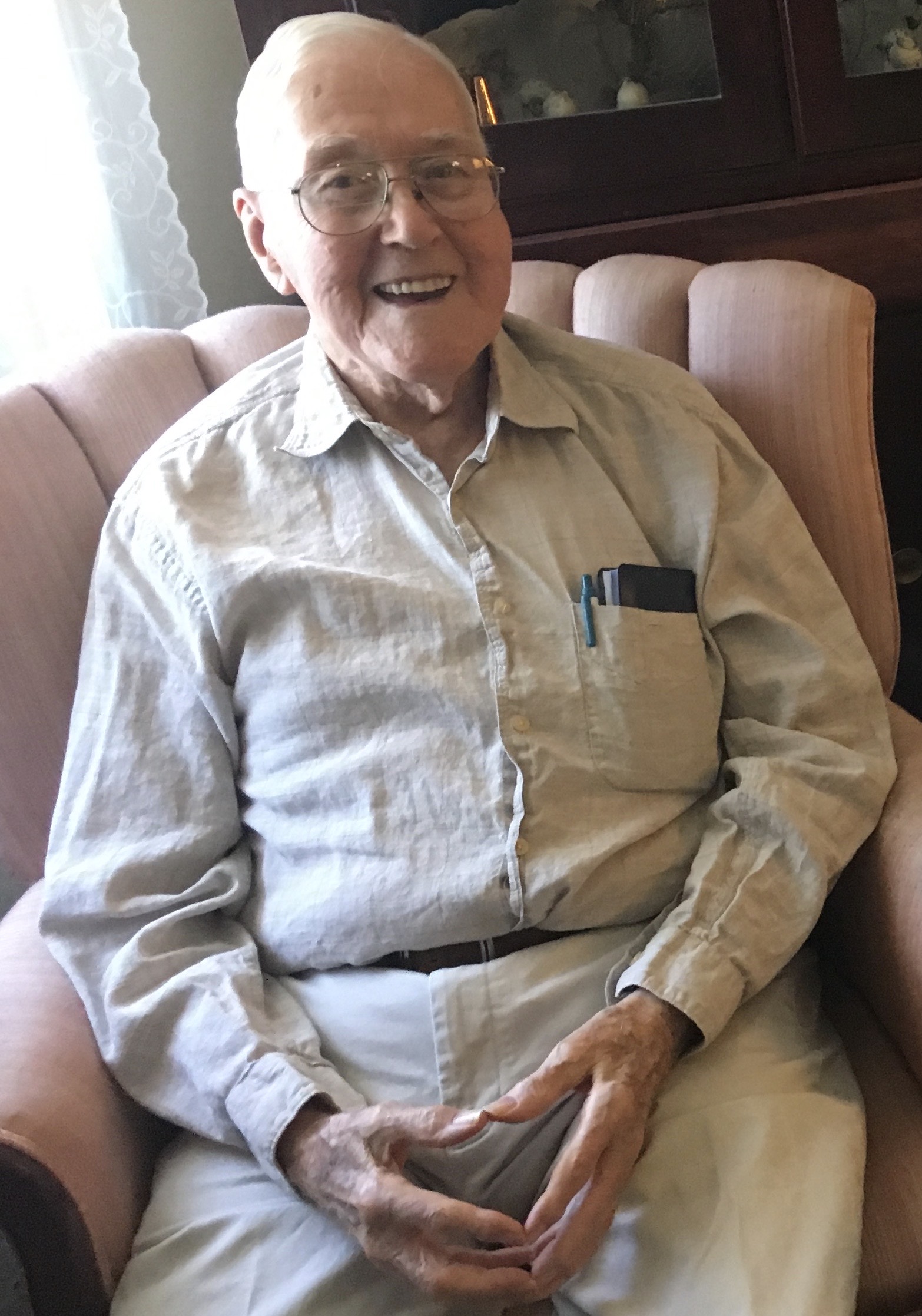
Sunday, January 28, is the date on which my father would have turned 100. He was 96 when he passed away in May of 2020. Dad died during the early days of Covid. My last visit was two months before the pandemic. Being with him at the time of his death was not possible. We were also unable to have a memorial service. My brother and his family live a couple of hours away, and were able to be at the graveside where they had a small ceremony.
There was no real closure for me. A memorial service would have been packed. Dad ministered in Grayson, Kentucky for 22 years. He was loved in that town, as well as in Lexington, where my parents lived in retirement for 31 years.
A few years before he passed, Dad told me how his sister, Virginia, would tell everyone, “My kid brother is going to be a preacher.” The decision had been made for him early in life. Fortunately, he was amenable to it. He was a natural pastor, the kind that comes out of central casting.
My father attended Kentucky Christian College, my alma mater. He met my mother there and they were married shortly after graduation. Dad’s first ministry was in Advance, Indiana, where he served while he worked on a master’s degree at Butler School of Religion. He moved to Huntington, West Virginia and served a church there for seven years. That is where I was born.
We moved to Akron, Ohio in the fall of 1955, and for the next twelve years my father pastored at the West Akron Church of Christ, a healthy, growing congregation. During his ministry the church built a new building, and grew to an attendance of about 350. During those years he joined the board of Kentucky Christian College, served on the Continuation Committee of the North American Christian Convention, and served as the dean of senior high camp at Round Lake Christian Assembly.
In January of 1967, my father accepted a new ministry at my mother’s home church, First Church of Christ in Grayson, Kentucky. He served there for 22 years, until he retired on his 65th birthday in 1989.
Outside of Grayson, Dad was not well-known. He was not a great preacher, but he was a wonderful pastor. He loved everyone. When people showed up in his life, whether it be a Sunday worship service or a chance encounter at Rupert’s Department Store, Dad always looked like he had been expecting them. He warmly greeted everyone and had a great interest in their lives, whether they were highway construction workers, or the superintendent of schools.
A lot of the confidence I have gained began in my childhood home, where my father delighted in me. Whether it was a band concert in the 9th grade, or the first time I preached at the North American Christian Convention, Dad was in the audience, beaming. When I became a disc jockey at the radio station in town, Dad listened all the time, and came to the station often to watch me spin vinyl and read the news straight off the AP wire.
When I was doing play-by-play or color at basketball games, Dad listened to the broadcast from beginning to end, and when I got home, encouraged me. As far as he was concerned, I was a sure successor to the legendary University of Kentucky broadcaster, Cawood Ledford.
Long after I’d graduated from college and moved away, Dad became the announcer for the local high school’s basketball games. They gave him a jacket with “Voice of the Raiders” embroidered on the front chest pocket. He proudly wore that jacket for the rest of his life.
When I became the editor-at-large of the weekly magazine of our denomination, the Christian Standard, Dad reminded me that it had been published since 1866, and that there had been only a handful of editors. There was a part of me that took that part-time job because I knew it would please my father.
I write about the actions of his life and the places in which he served because I never knew much about the interior life of my father. He was very private. He did not share his deepest self with anyone. You had to read between the lines to determine the state of his soul. In that regard we were polar opposites. I used to have a plaque in my bedroom that said, “It’s all right to have an unexpressed thought.” Dad did not need that plaque.
Dad was always open to conversations about politics or theology. I’d have delightful conversations with him, as long as the topic was something “out there.” When he did open up more intimately and transparently, it was usually with me. I considered that quite an honor. I never knew when he would grace me with words from his soul. It might be on a plane to the North American Christian Convention, or driving to the grocery store on Long Island, or visiting me at the radio station. I treasured those moments and began to think of them as having won the intimacy lottery, and wonder what I might do that would hasten the return of those times of deep conversation.
My dad was always on the move. He walked miles, intuitively embodying solvitur ambulando, “It is solved by walking.” I do understand that propensity. I run at least six days a week for at least 45 minutes. Most weeks I run seven days. I edit and memorize sermons or keynote speeches while running. Walking and running get your brain firing neurons across both hemispheres, which is a good thing.
A lot of memories have been surfacing lately as I think about Dad’s one-hundredth birthday. Wrestling on the floor after we’d had popcorn, which we did every Thursday evening. Riding in the car with him anywhere, because that was when he was most inclined to talk. Thoroughly enjoying his homemade donuts, delicious for exactly six hours until magically turning into door stops in hour seven. Still, I happily emptied the pan in which those hard as a rock donuts were stored. Telling stories at bedtime about cowboys Jim and Jiggles. Every story ended with Jiggles singing Home on the Range. Dad had a beautiful voice, but Jiggles did not. I loved the way he sang that song.
When Dad was with me he was rarely distracted. For me, he was present. What that did for my self-esteem was profoundly important. He loved my singing, my preaching, my broadcast work, my writing skills, and my leaderships. Dad loved me and I always knew it. Not many people receive that kind of adoration from their father. I shall be eternally grateful for his steadfast love.
My first TED Talk tells the story of the first time I visited with my parents after I had transitioned. I tell the story all the time. I cannot tell it without crying, because it was a moment of profound love, the kind that makes the world go round. I am glad millions of people have heard it.
I miss my father. The world is a better place because he was in it. His legacy was one of warmth. He warmed hearts with lasting effect. Mention his name and all who knew him will smile. Often they will say what I always knew to be true. “Ah yes, Dave Williams, the epitome of a gentleman.”
And so it goes.
January 16, 2024
All About You and Not About You

Back in the 80s I read Ernest Becker’s masterful 1973 book, The Denial of Death. In fact, I was reading the book while the New York Mets were winning Game Six of the 1986 World Series, one of the most astonishing comebacks in the history of Major League Baseball. Most agree that the book stands the test of time, as does the game.
In his book Becker devoted many pages to the work of Otto Rank, a protege of Sigmund Freud. Rank’s work doesn’t have quite the hold it did fifty years ago, but one of his books, The Myth of the Birth of the Hero, is still quite helpful. Rank collected over 70 examples of hero myths and identified five common elements:
An infant is born to noble or divine parents or is the child of a deity and an earthly maiden. His or her origin is preceded by difficulties in the parents or within their community.The extraordinary signs attending the birth of the infant arouses anxiety in the ruling king or the infant’s father, who set out to kill or banish him.The infant is exposed to die, or surrendered to the sea in a basket, or is sent away or escapes because of the intervention of benevolent forces.The infant is rescued, sometimes by animals or a humble woman or a fisherman, and is brought up in another land.The hero, now a young man, returns to either overthrow the father or renew the community through his leadership.In the Denial of Death, Becker wrote about the universal call toward heroism that is contained in these myths, a call that is innate to our species. Joseph Campbell popularized these elements in his definition of the Hero’s Journey.
As Campbell described the Hero’s Journey, an ordinary citizen is called onto an extraordinary journey onto the road of trials. Initially she rejects the call because hey, it’s a road of trials! But now she’s miserable because she knows she has been called and has rejected the call. I’ve been there more than once in my life. You’d think one would learn, right?
In the midst of misery because of a lack of courage to answer the call onto the Hero’s Journey, a spiritual advisor comes into her life and gives her the courage to answer the call. It is always a Yoda type figure, someone with great wisdom gained through adversity. The wisdom figure gives the hero the courage to answer the call onto the road of trials and sure enough, it’s a road of trials. No surprise there. But now it gets worse. She finds herself in a deep, dark cave, totally lost.
It is Dante at the beginning of the Divine Comedy. “In the middle of the road of my life I awoke in a dark wood where the true way was wholly lost.” It is Shakespeare’s MacBeth. “Life is but a tale, told by an idiot, full of sound and fury, signifying nothing.” It is John of the Cross’s Dark Night of the Soul.
You are completely and utterly lost, but that is when you realize it is all right, because lost is a place too. My favorite television show of all time was the show Lost. The characters, marooned and time-traveling on a mysterious island somewhere in the Pacific, spent six seasons coming to grips with and accepting their lot as one of those among the many who are lost.
As the seasons progressed they came to peace with their time in the place called lost, and that is when they begin to discern a path forward. The final season brought redemption to each of the characters, with the protagonist (Jack, if you are a Lost fan) being the last to find his way.
The show was rather spiritual, and in the final analysis, Christian. Carlton Kuse, one of the two show runners (Damon Lindelof was the other) is a Catholic. The final season gave an interesting spin to the notion of purgatory. If you’ve read my memoir, you know the show played a significant part in my decision to transition genders.
Spending time in the place called lost is an important part of the Hero’s Journey. After you learn the lessons that can only be learned in that difficult place, you finally see the light at the end of the tunnel, and this time it is not an oncoming train. You are back on the ordinary road of trials, which feels like nothing given what you’ve gone through.
This is when you realize your destination has never been the Holy Grail. It has always been to bring back the Holy Grail, once found, and gift it to those from whom you have departed. The Hero’s Journey is at the same time all about you, and not all about you.
After returning with the offering there may or may not be another journey to which the hero is called. For Odysseus, after his journey across the sea his final call took him inland, so far from the sea that no one knew what an oar was. Only after he returned from that journey was he free to move into “sleek old age.”
It does not feel like I am free to move into sleek old age. I am still in the midst of this present journey. I’ve lost track of how many I’ve been on since I woke up to the fact that a life that does not bring you alive is too small for you.
I am yet again in the place called lost, which is all right, because, well, it has to be. There is no use fighting against it. I must live into it, and the lessons it is trying to bestow on my ever resistant soul.
The current themes of my days are meaning, wisdom, love, and on off days, ennui and acedia. You know, the little stuff. At this age there are no throw away experiences. Everything counts. You have no idea the number of your days, and you best approach each with great seriousness of purpose.
Some significant existential realities occupy my time. The closing of the church is having a bigger emotional impact, now that the acute phase is complete. The church has proven to be the single biggest area in which my transition has put me at a disadvantage. A lot of obstacles were placed on the path that seem to have been related to nothing other than lack of appreciation of my knowledge about what it takes to create a growing church.
In sixty years as a male, I never faced such obstacles. For all thirty-five of the years I directed a church planting ministry, that ministry had a steady upward trajectory, uninterrupted. Who knew changing genders would render one untrustworthy, because you used to be a man and therefore all of your initiatives must have been stained by the patriarchy? I am aware of the mistakes I made, and they were many. I have also learned that when you do not have the authority of the CEO, it is amazing what a handful of contrarians can do to stop momentum. The whole experience was a lesson in navigating through relative powerlessness.
Those with whom I worked might have different perspectives. You can ask them if you like. For me, I am sure grace will inform a healthier perspective over time.
I was watching a movie last night in which the protagonist was lamenting the pain that accompanies the loss of community and one’s legacy. Just the previous night I had turned to the pages of the magazine I used to serve as editor-at-large. I look at it occasionally to see what is happening and who has passed on. For sixty years it was my world. It does not look to me like the denomination is doing very well, especially its educational institutions. I was surprised how saddened I was. This is the denomination that discarded me faster than the hope one harbors every spring for the hapless New York Mets, yet I still care about the denomination’s health. Whether one’s Christian denomination or baseball, loyalty runs deep through these bones. With a few exceptions, it has not been reciprocated.
The biggest problem of that is the loss of community and legacy. It is hard to feel good about the work I did over those 35 years, because today most of those churches would never allow me through their doors. And now the one I helped to start is gone. There must be a lesson there somewhere.
But it’s -11 degrees outside and snowing, and I complain too much.
I am still able to observe life and make observations that seem to be helpful to others. I mean, you are reading this post, right? And I still get to rub shoulders with really smart people and receive a constant stream of new, fascinating information. And if I can wait a couple of days until it is 50 degrees again and go running in the ever-present Colorado sunshine, all manner of things shall once again be well.
And so it goes.
January 11, 2024
I’m Running for Office Again!

This April I will finish my first term as a member of the Board of Trustees of the Town of Lyons, Colorado. I entered office not sure of the difference between an ordinance and a resolution. I knew Lyons was a statutory town, but I did not know there were four other types of municipalities in the state. About 2,250 people live in the 1.2 square miles of Lyons. Our town was incorporated in 1891.
I’ve learned much during my first two years of government service. I have a great respect for our town administrator and employees, as well as the elected officials with whom I serve. I find it an honor to serve with our mayor, Hollie Rogan. She has led with efficiency, thoughtfulness, and a keen eye for what really matters. I hope I am able to serve with her for another two years.
Most of the time, our six trustee members have been on the same page as the mayor. We are focused on affordable housing, wildfire mitigation, and finding sources of revenue that do not unduly tax the members of our community. People value the quality of life they experience in Lyons, and love the supportive community that has been born of adversity, whether the devastating thousand-year flood in 2013, or wildfires north and south of town in 2020.
I have spent most of my life working in the religious non-profit world. For 35 years I was CEO and chair of a large and growing New York based non-profit. I also taught as adjunct faculty or as a visiting instructor at seven colleges and seminaries. I have worked in the broadcasting world as an announcer at two radio stations and one television network. I coach with TEDxMileHigh and volunteer with TED. I’ve had the honor of speaking for both. I served as an editor-at-large for a publishing company, and published books with that company and two others. I have worked in the corporate world, and have served on the boards of more non-profits than I can count. But until two years ago, I had never worked in government.
I read everything I can about finding good work and creative meaning as you progress through the decades of life. Now I focus my attention on what many call an “encore life.” An encore life is when the world considers you as retired from your “career” and embarking on a new journey. I chose to run for public office two years ago because I wanted to serve my community, and work in an area in which I had not worked before.
In the non-profit world, I was accustomed to board meetings that lasted less than two hours. Much of the time I was chairing those meetings. That is not the case with town board meetings. Between workshops before the meetings and the board meetings themselves, it is not unusual to be at town hall for four hours or longer on a Monday evening. All of it starts at 5:30 pm, after our board members have already finished their regular work day.
In a town the size of Lyons, we do not spend our time flying at 30,000 feet. We fly at 300 feet, debating the merits of issues as minute as whether or not to use bollards to separate traffic from pedestrians on Railroad Avenue after turning it into a one-way street, or the width of a pedestrian path behind a major highway. I have enjoyed my service on the town board more than I anticipated. It’s a lot of work, but you know you are making a difference at a local level.
There has been virtually no pushback about being a transgender person. In fact, when I mentioned that I was planning to run again and wondered whether or not my gender identity would be an issue, our mayor and the two board members I was talking with said, “Oh that’s right, we always forget you’re trans.” None of us expect my gender to be an issue this election either. If I am not reelected, it will likely be because folks do not like how I voted, not because of my gender.
I love living in Lyons, and take seriously my responsibility to help make our town an even better place in which to live. Now that I have learned the ropes of the job, I hope to be even more effective over the next two years.
An ancillary benefit of my service is the chance to add government service to the long list of ways in which I have served over the past fifty plus years. When it is all said and done, I’m probably most comfortable in the non-profit world. That is where I’ve spent most of my time. I spent 35 years with one non-profit, 25 as chair and CEO. After 35 years of service, I was gone seven days after coming out as transgender. Nothing about that seems strange if you live within the bubble of evangelicalism. If you are from outside of that insular bubble, you simply cannot believe something like that can still happen in the 21st century. It still does, and regularly, as a matter of fact.
If I’m not elected to the Board of Trustees, will I be disappointed? Sure. I’ve worked hard over the last two years to serve well. But after losing all of my jobs within a week just ten short years ago, not being elected to office would be far down the list of life’s disappointments.
And so it goes.
December 20, 2023
Quite an Evening

I preach occasionally at The Village Church, a wonderful post-evangelical congregation in Atlanta. My friend Ray Waters is the pastor. Ray and I have similar interests and backgrounds. We both worked as radio station announcers back in the day, and we sang and maintain a love for Southern Gospel music. Get us into a conversation about The Stamps, the Oak Ridge Boys during their Southern Gospel days, or any iteration of the Imperials, and we will talk until the cows come home.
I spoke at The Village Church earlier this month. When I got into town Ray said, “Ernie Haase and Signature Sound are in Gainesville tomorrow night, doing their Christmas show at a Baptist Church. Interested?”
When it comes to traditional Southern Gospel, they are one of my favorite groups. Since it was their Christmas show, I knew they’d be singing What Child Is This, so I figured, “I’m in.” Then it occurred to me, I’d be at a Southern Baptist Church in Gainesville, Georgia, not exactly the most welcoming environment for a transgender woman.
Unless people know of my circumstances before we meet, around 99.9 percent of the time I am identified by others as female. I am very rarely misgendered. But about nine million people have seen one of my TED Talks. I’ve been on Good Morning America, NBC, CBS and a host of other media likely viewed by Southern Baptists. I thought, “What if I am recognized?“
Ray was good with whatever I decided. He understood the problem. I decided to go. We got to the church just as the concert was beginning and sat safely toward the back. I had to use the restroom as soon as I got there, which was a little surreal – using a women’s restroom at a Southern Baptist church in Georgia. Not something I do every day.
The vast majority of the people were very white and very old. Come to think of it, I am very white and very old. It’s been ten years and three months since I was in an evangelical church. The last one was a megachurch and I was preaching.
It felt unsettling to be in a place in which, had they known who I was, I most certainly would have been asked to leave. It felt especially ironic to know that all of that would likely happen even though I am still a Christian and still a pastor.
As it turned out, no one knew who I was, and all was well. As I expected, the concert was excellent. I thoroughly enjoyed myself and yes, they did sing What Child Is This. I waited around afterwards as people quickly filed out. Not many CDs were being sold. Turns out even old people download their music nowadays.
Ray knows Ernie Haase, so I waited until they had a chance to talk. I took a picture of Ray, his wife and mother-in-law standing with Ernie. He wanted me to join them, but that didn’t feel right. We went to Cracker Barrel afterwards, because, well, we had just attended a Southern Gospel concert, and that’s where you go to eat after a Southern Gospel concert.
Evangelicalism is very removed from my current existence. It has been a long time since I’ve been in a big traditional Southern Baptist church building with very Southern Baptist people. I grew up on Southern Gospel music. I started my own group when I was 17. I joined another at 18, and started yet another at 21. We made five albums and managed to earn a living singing for the better part of a decade.
I do not read music well, but I do hear parts. I did vocal arrangements for all of the bands of which I was a part. I could have sung pretty much every part at the concert that night, though the tenor and bass lines might have been a stretch every now and again. I would love to sing that kind of music again, but since pretty much everyone singing it is a fundamentalist Christian, I’m thinking my chances are pretty slim.
When I transitioned I lost a lot. At the concert I was reminded I have lost the ability to feel comfortable in a church building where I once would have been very much at home. I would not be allowed through the door of any of the churches I attended as a child, or those I served before my transition.
Sometimes I wonder why I keep writing about this stuff. Maybe I’m gonna be working through these losses until the cows come home.
And there it is. I managed to work in the line, “until the cows come home” twice in a single post. I mean, I spent a good bit of my growing up years in the rural south. Those metaphors stay with you.
And so it goes.