Les Edgerton's Blog, page 30
December 29, 2013


December 21, 2013
BOOK REVIEW - KEITH NIXON'S "THE FIX"
Hi folks,
I love me some good black comedy and I just read one of the best of the year in Keith Nixon’s THE FIX. Josh Dedman is pretty much that—a deadman. His girlfriend cheats on him and then dumps him. He gets blamed when 20 million pounds comes up missing from the bank he works at and he’s blamed for that.
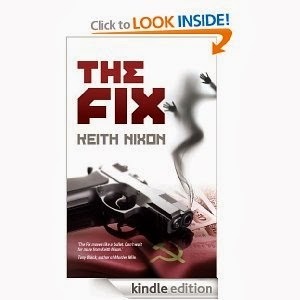
But, all is not doom and gloom. There are a few bright spots in his life. He goes out of his way each day to get mugged by a homeless Russian bum, accommodating the thief to the extent that he buys cheap wallets to defray his mugging costs, and he meets an irritating guy on his daily commute who tries his best to bore him to death. There’s a mysterious sexy blonde… And, yeah, those are the fun parts of his life.
And then, just when it seems like it couldn’t get any worse for him, his boss is whacked and he’s the number one suspect. With each development, I kept shaking my head and muttering, “It couldhappen, it could happen…”
This is the kind of corporate caper Joseph Finder might write if he spent a week studying everything Tim Dorsey ever wrote and then they collaborated.
In fact, the Russian bum Konstantine (who just happens to be an ex-KGB agent who’s fallen on hard times) and who mugs him daily, can find his long-lost twin brother in Florida. Just ask around for Serge Storm…
This laugh-out-loud novel is more than just entertainment—it’s an object lesson for parents who wish to keep their sons away from a career in banking.
This is one of those novels that I usually preface at the watercooler at work by saying, “You gotta read this book!” You really do. And then, once you’ve finished it, join me in petitioning Mr. Dixon to write a new novel starring Konstantine—this is a character who surely deserves his very own novel.
Blue skies,Les
December 18, 2013
LIAM SWEENY'S "SPEAKEASY" - Review of THE BITCH
Hi folks,
Just got a wonderful surprise. Liam Sweeny just posted a review of my forthcoming novel, THE BITCH, on his blog SPEAKEASY.
Here's what Liam had to say:
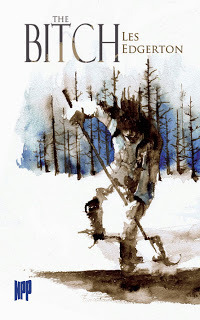
Liam Sweeny's Review: THE BITCH, by Les EdgertonI haven't posted in a while. Sorry... Holidays. Hard to type when you're plastered.
Les Edgerton's "The Bitch" is about Jake Bishop, a two-time felon with a Bitch dangling around his neck: Ha-BITCH-ual criminal, two strikes and one away from life without parole in Indiana's Correctional System. With a new business in the works, a loving wife and a baby on the way, Jake feels the glow of the sun, a chance to be a "straight" (law-abiding citizen).
But then he gets the call from Walker Joy.
Former cellmate and trusted inside-friend, Walker is out and back to tricks. He's in a bind, and Jake owes him. Walker's in with Sydney Spencer, a shady black market jeweler, and there's a "piece of cake" job that Jake is uniquely suited to do. But Jake's tasted the dawn, and as the darkness begins to creep up at his heels he wants to run. Jake soon finds that running's not as easy as it should be, and with the Bitch hanging over his head, the night looms.
There is so much to this book. It's the perspective. It's the sublime wisdom embedded in Jake's narration. It's the madness that you can taste as Edgerton guides you through twists and turns that stain the carpets and trunk liners. It's the little things that throw you because the story keeps you looking the other way. It makes Jake's descent real.
Edgerton's style is dynamic, never giving you the time to get easy with the drudgery of getting through some passage. I had to re-read a paragraph or two because I was still stunned by the one sentence that came before it. Yeah, it's that kind of book.
Read it on a day off. Clear the day. Put on a pot of coffee. Trust me.
I will recommend The Bitch to anyone who's capable of enjoying darkness, or just a good book. I would also recommend this to anyone thinking of a life of crime.
This is coming out in January. I will post the links once it does.
Merry Christmas and a Happy New Year, everyone.
Liam SweenyThank you so much, Liam. This really made my day!
Blue skies,Les
December 16, 2013
EARLY CHRISTMAS PRESENT!
Hi folks,
Just got a couple of early Christmas presents! First, Frank Nowatzke, owner of the German press, Pulpmaster, just sent me the cover of THE RAPIST by artist 4000 and it's really cool. Can't show it yet as he wants to get up the preorder lists first.
I also just signed and sent back the contract to Pulpmaster for my black comedy crime caper novel, THE GENUINE, IMITATION, PLASTIC KIDNAPPING. Frank has also entered it in the Berlinale, the companion film festival held in Europe along with the Frankfort Book Festival. He's hoping a studio along the lines of the Coen Brothers are there as he thinks that kind of studio would be perfect for it (I totally agree!).
And then, for a couple of years Eric Campbell, the publisher of Down and Out Books and I have been trying to get together for him to publish one of my books and we've reached an agreement to have him publish the aforementioned THE GENUINE, IMITATION, PLASTIC KIDNAPPING. I'm really happy with Eric running with this one. It's one of my favorite novels and I'm writing a sequel to it. It began life as a short story in The South Carolina Review and then I wrote the novel. And then I wrote a screenplay for it and it ended up as a Finalist in both the Writer's Guild and Best of Austin screenwriting competitions.
Eric came up to me a couple of years ago in Cleveland at Bouchercon. Actually, he came to a Noir@TheBar function Eric Beetner had created and at which I was one of the readers. After my reading, he approached me and introduced himself and told me he'd been following my career and wanted to talk to me about placing one of my novels with them. What really impressed me about Eric--other than he was a super nice guy and actually bought copies of about four of my books I had with me--was that he was such a wonderful throwback to the old-time publishers in that he'd traveled to the convention with the purpose of scouting and contacting authors! Who does that nowadays? During our conversation, he said he'd had trouble hearing my reading (the sound system in the bar was horrific!), and that he could only make out about every other word, but that he was convinced he had to have me publish with him as even only hearing every other word was transfixing for him so he could tell from that it was powerful stuff. What writer doesn't like to hear things like that?!
Then, I began to read his slate of authors and, just like Jon Bassoff of New Pulp Press, he'd assembled a truly fantastic group of writers.
And then, the last great Christmas present is that Jon Bassoff contacted me to let me know that he'd already gotten an impressive list of reviewers for the January release of THE BITCH. The launch promises to be successful and I'm really stoked!
I'm just so thankful for the support of guys like Jon and Eric. These are guys who not only know literature but do everything in their power to support authors.
Hope you folks are getting great gifts like this this year also!
Blue skies,
Les
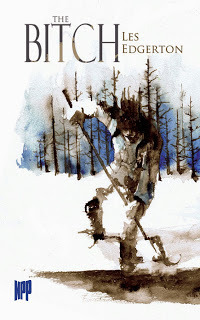 Coming in January from New Pulp Press in paperback and ebook formats. Put it on your list!
Just got a couple of early Christmas presents! First, Frank Nowatzke, owner of the German press, Pulpmaster, just sent me the cover of THE RAPIST by artist 4000 and it's really cool. Can't show it yet as he wants to get up the preorder lists first.
I also just signed and sent back the contract to Pulpmaster for my black comedy crime caper novel, THE GENUINE, IMITATION, PLASTIC KIDNAPPING. Frank has also entered it in the Berlinale, the companion film festival held in Europe along with the Frankfort Book Festival. He's hoping a studio along the lines of the Coen Brothers are there as he thinks that kind of studio would be perfect for it (I totally agree!).
And then, for a couple of years Eric Campbell, the publisher of Down and Out Books and I have been trying to get together for him to publish one of my books and we've reached an agreement to have him publish the aforementioned THE GENUINE, IMITATION, PLASTIC KIDNAPPING. I'm really happy with Eric running with this one. It's one of my favorite novels and I'm writing a sequel to it. It began life as a short story in The South Carolina Review and then I wrote the novel. And then I wrote a screenplay for it and it ended up as a Finalist in both the Writer's Guild and Best of Austin screenwriting competitions.
Eric came up to me a couple of years ago in Cleveland at Bouchercon. Actually, he came to a Noir@TheBar function Eric Beetner had created and at which I was one of the readers. After my reading, he approached me and introduced himself and told me he'd been following my career and wanted to talk to me about placing one of my novels with them. What really impressed me about Eric--other than he was a super nice guy and actually bought copies of about four of my books I had with me--was that he was such a wonderful throwback to the old-time publishers in that he'd traveled to the convention with the purpose of scouting and contacting authors! Who does that nowadays? During our conversation, he said he'd had trouble hearing my reading (the sound system in the bar was horrific!), and that he could only make out about every other word, but that he was convinced he had to have me publish with him as even only hearing every other word was transfixing for him so he could tell from that it was powerful stuff. What writer doesn't like to hear things like that?!
Then, I began to read his slate of authors and, just like Jon Bassoff of New Pulp Press, he'd assembled a truly fantastic group of writers.
And then, the last great Christmas present is that Jon Bassoff contacted me to let me know that he'd already gotten an impressive list of reviewers for the January release of THE BITCH. The launch promises to be successful and I'm really stoked!
I'm just so thankful for the support of guys like Jon and Eric. These are guys who not only know literature but do everything in their power to support authors.
Hope you folks are getting great gifts like this this year also!
Blue skies,
Les
 Coming in January from New Pulp Press in paperback and ebook formats. Put it on your list!
December 9, 2013
One Bite at a Time: Twenty Questions With Les Edgerton
One Bite at a Time: Twenty Questions With Les Edgerton: It’s hard to spend time in the company of crime writers and not be know of Les Edgerton. I’d been aware of him for several years as one of t...
I had a lot of fun with this one! Check it out if you have time.
Blue skies,
Les
I had a lot of fun with this one! Check it out if you have time.
Blue skies,
Les
December 8, 2013
BigAl's Books and Pals: Just Like That / Les Edgerton
BigAl's Books and Pals: Just Like That / Les Edgerton: Reviewed by: Keith Nixon Genre: Crime Approximate word count : 60 -65,000 words Availability Kindle US: YES UK: Y...
December 1, 2013
LOST COMPUTER!
Hi folks,
Just wanted to let as many know as I can--last Thursday I lost my computer--bit the big one! Have a guy coming out Monday to hopefully restore it so may be back up by Tuesday. Borrowed a computer and came to a local bar to get this out and try to answer some emails today. Thank God for friends... and REALLY thank God for bars...
Hope to rejoin the conversation soon!
Blue skies,
Les
Just wanted to let as many know as I can--last Thursday I lost my computer--bit the big one! Have a guy coming out Monday to hopefully restore it so may be back up by Tuesday. Borrowed a computer and came to a local bar to get this out and try to answer some emails today. Thank God for friends... and REALLY thank God for bars...
Hope to rejoin the conversation soon!
Blue skies,
Les
November 26, 2013
INTERVIEW WITH ANDREA HURST AND KATIE FLANAGAN
Hi folks,
I thought it might be of interest to post an interview I did a year or so ago on literary agent Andrea Hurst's blog.
AUTHORNOMICS Interview with Les EdgertonBy: Andrea HurstMarch 26th, 2012 Posted in AUTHORNOMICS Interview Series, Blog With a publishing industry that is ever in flux, it can be hard for an aspiring author to figure out what information is relevant and what she needs to do to be successful. Recognizing this, literary agent Andrea Hurst and writer and blogger Katie Flanagan present a series of weekly interviews with publishing industry specialists. The AUTHORNOMICS Series features literary agents, editors, authors, marketing experts and more talking about their opinions on the publishing industry, writing, and what a writer needs to know.
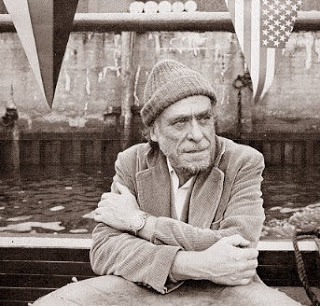
Interview with Author Les Edgerton
Les Edgerton is an ex-con, matriculating at Pendleton Reformatory for a couple of years in the sixties for burglary (plea-bargained down from multiple counts of burglary, armed robbery, strong-armed robbery and possession with intent). He’s since taken a vow of poverty (became a writer) with 14 books in print. 2011 was a good year for him as he published two novels with StoneGate Ink—Just Like That and The Perfect Crime, along with noir novel The Bitch from Bare Knuckles Press, as well as a new short story collection, Gumbo Ya-Ya, from Snubnose Press. He just sold his existential novella, The Rapist to New Pulp Press, which will be released in 2013. He is also editor-at-large for Noir Nation International Crime Magazine. Work of his has been nominated for or won: the Pushcart Prize, O. Henry Award, Edgar Allan Poe Award (short story category), PEN/Faulkner Award, Texas Institute of Letters Jesse Jones Book Award, the Violet Crown Book Award, and others. He holds the MFA in Writing degree from Vermont College and a Certificate in Barbering from Pendleton Reformatory. He writes because he hates… a lot… and hard. Injustice and bullying are what he hates the most.
1. As a prolific author with 14 books in print so far, can you elaborate on how the publishing process has changed since your first book?
It’s changed tremendously in some ways and barely at all in others. I’m old-school, so I don’t count self-publishing as publishing. A horse by any other name is still a horse. In my opinion, it’s just another name for vanity publishing, which is not publishing but… printing (abeit in electronic form). I’m not including in that assessment legitimate publishers who publish ebooks, but I am including those who simply publish the work themselves. I have friends who’ve chosen to self-publish and while they’re still my friends, I’m not going to purchase their books any more than I would the person who has stacks of their vanity or subsidy-published books in their garage. Just want to define the terms. And, there are degrees and shadings within even the self-published category. For instance, I’m getting ready to self-publish a book… but it’s a book that has been published and done well. It just never came out in ebook form, so my agent got the ebook rights from the publisher and we’re going to put it out. That, to me, isn’t the kind of self-published “vanity” book I’m referring to.Definitions provided, to answer your question, let me address what’s changed first. The biggest changes have come about because of the advent of ebooks.
What’s changed is that if there was any doubt that mid-list authors have disappeared, now there’s no doubt. At one time, legacy publishers would publish a writer’s books knowing that they probably wouldn’t make any money on that particular book, but they saw something in the writer that made them think that eventually an audience would build for that author and down the road, they’d all make money on his or her novels. As Roberto Durante said, in another context: “No mas.”
The Big Six, in particular, are almost exclusively interested in brand names. Proven winners who have a sizable audience already in place. Here’s a prime example. A few months ago, I was told in confidence by someone who is in the “know,” that a top editor for a major publisher, who has his own imprint, was told by his boss (yes, even top editors have bosses), that if he signed any novel that didn’t earn at least $30,000 he’d be fired. Not chastised, not given a talking to, or a slap on the wrist, but… fired. Think this guy is going to want to sign the brilliant novel by the unknown author or do you supposed he might opt instead for the same-as-the-last book by Mr. Brand Name? Fugedaboutit.
That’s one change.
The second change I’ve observed is that so-called “literary novels” are just about over. Remember: I’m just the messenger. Don’t kill the messenger! Here’s how I know this. For almost thirty years, my wife and I and our son until he moved out of the house, visited a local bookstore every single week. Never missed a week. Our favorite was Borders and our second favorite was one of the two B&N outlets. One Saturday, we walked into Borders and stood in shock at the change. The biggest single area the week before was the space devoted to what was labeled “Mainstream fiction.” Mainstream encompasses literary fiction in bookstore terminology. They’d reduced that space fully by three-fourths. The area that used to house literary fiction and other fiction that didn’t fit a particular genre was reassigned. To two areas. Genre fiction was one. The other was greeting cards, wrapping paper, novelty items. Cute little stuffed animals. I talked to the manager and she said she hated to do it, but all the Borders stores were under corporate mandate to do the same. Literary and mainstream fiction just weren’t selling. They couldn’t justify the space devoted to it, so they reassigned it to genre fiction which was selling and significantly. It’s a cold, hard fact, but the marketplace is what determines what’s selling to publishers. Literary novels today are infinitely tougher to sell than ever before and that market is shrinking monthly. If you want to know what the literary tastes of a nation are, simply gaze about at a national chain’s brick and mortar outlet and see what’s on the shelves. The category area that has the most shelf space is the area that’s selling.
Does this mean so-called “literary” novels are impossible to get published? No; it just means it’s much harder. They’ll continue to get published because legacy publishers in this instance are the same as major film studios. Major film studios will put out 85 movies that appeal to the biggest audience demographic—teenaged boys—and the remaining 15 movies will be devoted to a mix of other kinds of films. Among those will be a couple of “artsy” movies. The ones that will be nominated for Golden Globes and Oscars. Most of which they know they’ll lose money on. Then why make em? Because, studios want to be thought of as intellectual, “arty” enterprises. Kind of an ego thing. They know most of what they produce is mindless schlock, but if they get an Oscar winner or even a nominee, they feel justified that they produce “art.” And, for the one movie that does get nominated or win, they’ll actually make money on it because of the publicity. It’s mostly a way for studio execs to feel good about themselves and be able to delude themselves into thinking that they’re actually engaged in quality work. Makes ‘em walk tall when they walk into Spagos.
Well, publishers do the same thing. For all the vampire novels selling in the bazillions, all the formulaic cartoonish novels about bigger-than-life vigilante superheroes, that maintain a healthy bottom line, they’ll all put out a few literary books that are published mostly because they’ll be up for the National Book Award, the Pulitzer, even the Nobel. For the same motivation as the film studios. So they can feel like they’re “literary” and providing “good literature.” Makes ‘em feel proud when they walk into the Russian Tea Room or Elaine’s or wherever they gather these days.
Am I cynical? You bet.
What are the things that have remained the same? Well, the legacy publishers still employ the best gatekeepers in the business. If you get published by a legacy publisher, you’ve achieved something. You’re truly validated by people who actually know something about quality in writing. If you self-publish, your validation is going to come from your relatives, friends, and how effective you are at marketing, for the most part. Sales seem to be the biggest factor in ebook publishing and sales are a poor barometer of quality. For example, there is an author who was, at best, a mid-list author when he was being published by legacy publishers—his work is truly mediocre, at best—who has become a huge marketing success since he opted for self-publishing. He’s making lots of money—and that’s fine—but his work is still godawful. If sales are your measure of success, he’s a good model to emulate. If being regarded as a good writer is your measure, he’s probably not the guy whose bust you want gracing your mantel. There’s a reason he went to self-publishing and it has to do with writing ability. His sales ability is off the charts. His writing ability is… what’s the word?… oh, yeah… pure do-do.
There are other changes and other things that remain the same, but those are some of the biggest.
2. You write novels, short fiction, nonfiction, and screenplays. What is your favorite genre to work in and why?
Novels, by far. They require the most creativity and the most ability. Short fiction would be second. Nonfiction for the money. Screenplays are last. The reason is, screenplays aren’t about writing. No one picks up a screenplay to go sit in the hammock for a lazy-crazy afternoon of losing themselves in a fictional world. And, screenplays are ridiculously easy to write. I wrote my first screenplay literally in two days. Took seven hours the first day, put it aside for two weeks, and then finished it in a nine-hour day when I picked it back up. Now, it’s easy to write a bad screenplay in two days, so that doesn’t mean much. However, this particular screenplay placed as a semifinalist in the Nicholl’s competition and Greg Beals, the director of the foundation told me it would have won if I’d sent it in the year before, but the previous year’s winner was remarkably close to mine and he said they never picked two screenplays in a row that were this much alike. But, it placed in the top 100 out of 4,500 entries. So, I take that as validation that it was a good screenplay. Written in two days. Don’t think I could write a novel like that. And, I’d just learned formatting the week before and had read my first screenplay ever that same week. As Gore Vidal said about Jack Kerouac: “That’s not writing; that’s typing.” I don’t write them anymore because I’m too old. After the age of 35, it’s virtually impossible to sell a screenplay to Hollywood. Notice I didn’t say “impossible.” I said “virtually” impossible. And, it is. Hollywood is clearly an ageist society in every segment of the business except for producing.
3. How did you go about mastering the craft of writing?
That’s easy! By reading. That’s the only way to learn how to write. There are no “secrets” in learning how to write. The “secrets” are right out in the open. They’re on the page of the book you have open before you. All you have to do is see how the author accomplished what they did and you’re learning to write. I regularly get writers in my classes who haven’t read a book in months or even years and I know there’s no way they’ll ever be a writer. But, I’ll also encounter a student who has read voraciously from the age of five or six and never stopped, and I know that person has a chance at becoming a writer.
4. How important do you think it is for fiction writers to obtain an MFA?
Again, an easy question. I think it’s totally unimportant. In fact, I think most programs destroy more writers than help them. I kind of agree with Flannery O’Connor who, when asked if writing programs discouraged writers, said: “Not enough of them.” And I have one. I have two degrees—(well, three—I also have a B.A.)—an MFA and a Certificate in Barbering from Pendleton Reformatory. Of the two, I value my barbering certificate much, much more. I’ve made far more money, enjoyed far more success with that one.
First, take a look at who the teachers and professors are in most programs. What have they done and what have they sold? If Stephen King ever showed up in an MFA program it would only be because he was slumming and bored and wanted a change. Most of the folks (not all!) teaching in many such programs are writing the kind of books Kurt Vonnegut was referring to when he said, “Literature is in danger of disappearing up its own asshole.”
And, most MFA programs are dedicated to teaching “literary” fiction. I don’t know about you, but do I want to spend thousands of dollars and use up a couple years of my life to learn to write something that’s basically dying? I don’t know what your I.Q. is but mine’s over 160 and I try to put it to use, especially for questions like this.
Years ago, an Ivy League college performed a study in which they looked at a random group of a hundred professional writers. They identified them as “professional” by the only legitimate definition of the term—writers who earned their entire income from writing. They discovered that almost exactly half of these writers had a high school diploma or less… and the other half had a college bachelor’s degree or higher. There’s really no correlation between writing education and writing success. What an MFA degree does do is give the student access to decision-makers. Lots of publishers and editors visit these campuses and lots of editor’s eyes light up when they see “MFA” in the writer’s query letter. However, most of these editors are the ones who are still looking for literary novels and believe there’s a decent market for such. A shrinking number…
These programs used to have more value even a few years ago than they do today. These days, they’re seen by many universities and colleges as “cash cows” and they’re springing up everywhere. And, like anything that gets bigger like this, the quality goes down, commensurately. At one time, there were perhaps five-six pretty good programs. Now there are hundreds. If anyone thinks they’re as good and as beneficial for writers as they used to be, well I’d like their phone number because I have this terrific bridge in Brooklyn I’m trying to move…
That said, there is one program I think is a great one and one I wish had been around when I got mine. Seton Hill focuses on genre writing (about time somebody did!), and everything I hear about it is positive. They appear to be a program that’s aware that it’s now 2012.
5. As a creative writing teacher, what are some of the most common mistakes that you see beginning writers making in both fiction and nonfiction?
Not following the two elements that are always present in good writing. Be interesting and be clear. Of the two, being interesting is the most important. After that, there are structural problems that are very common. Most writers have never been taught story structure, or if they have, often it’s an archaic structure. Most English classes, most college writing classes, many MFA programs are focused on “parts” or writing. All these “exercises” on description, or characterization or dialog or whatever. Yuch! Listen, one doesn’t get to Carnegie Hall by practicing the scales. They get there by understanding what a symphony is and how to write a complete symphony. I hate it when writers refer to what they’re writing as the “piece” they’re working on. What in the hell is a “piece” of writing? Dude! Dudette! Write something that’s complete and entire. A short story. A novel. Talk about your novel, not the “piece” you’re working on.
The two biggest mistakes beginning writers make are not using their own, particular, unique voice, and not beginning the story of nonfiction article or book in the right place. After that, the next biggest problem is not striving for and achieving what Flannery O’Connor said about the best of novels (badly paraphrased) that they be: “All of a piece; all of a unified effect.” So many novels end up episodic with no through-line. In other words, a mish-mash of scenes and quirky characters. That’s a novel of which the author can say, truthfully, that it’s “only available in my room.”
6. One of your well-known writing books is Hooked: Write Fiction that Grabs the Reader at Page One and Never Lets Them Go. What are the important elements in hooking a reader early?
To begin where the story begins. It’s that simple. A contemporary story is about one thing and one thing only. Trouble. That means the story should begin—when the trouble begins. Not the week before, not two years before, not even two minutes before. When the trouble begins. Period. And, that seems to be a difficult concept for many to master. Something has to create and/or reveal that trouble to the protagonist. That event is the inciting incident. And, that’s where stories today need to begin.There was a time in our culture when novels could begin more leisurely. This was a time before television and movies and CNN and iPods and all the other entertainment venues were upon us. Today’s reader doesn’t have the attention span nor the interest in picking up novels with leisurely openings. That doesn’t mean stories should begin with gunfights, stabbings, bombs blowing up, kidnappings, murders, or any of that melodramatic stuff. It means they have to open with conflict—the major conflict that forms the core of the story. It can be a quiet conflict, but what it can’t be is a lengthy account of the protagonist’s bucolic life for the ten years before the trouble began. It has to begin with the trouble. Period.
When movies began, they had no structural models, so they used novels as their models. Today, it’s been reversed. Novels have to imitate film structure. Years ago, screenwriting how-to books insisted the first ten minutes of a screenplay be “devoted to the setup.” No mas, again quoting Roberto Duran. Those days are, in the words of my son, “so five minutes ago.” Films today begin… when the trouble begins. As should novels.
We read a novel for one reason. To see if and how the protagonist is going to resolve the story problem. If there’s no problem on the page, for that novel the reader is going to become… a nonreader. Count on it. Very few (and they don’t count) readers pick up a book just to encounter in the beginning a nifty shooting in an alley. If they don’t know the characters or the protagonist’s story problem, why would they care? There are a million places to see someone get shot. Just click on the nightly news. There has to be a reason to turn to Page 2. That reason is we see a character with a compelling problem—one we can relate to—on Page 1.
7. Beginnings are so important, especially in today’s marketplace. How does a writer determine if they have started their novel in the right place? Do you have an opinion on using prologues?If they’ve begun with the introduction of the event that created and/or revealed the problem that’s going to occupy the protagonist for the following 349 pages, they’ve begun in the right place. If they’ve begun anywhere else—they haven’t.
Also, that needs to be written in a scene. Everything truly important in a novel needs to be delivered via a scene. Not through the character’s ruminations or thoughts or that kind of thing. A scene. When I pick up a manuscript and it’s the character thinking on the page, my Nexium starts to malfunction and I can feel the bile beginning to rise and voila! I’m throwing up in my mouth.
The reason so many writers fail, is that they don’t write scenes. They write a character’s thoughts and ruminations. They deliver descriptions of emotions based on events the reader hasn’t been witness to, via a scene. Doesn’t work. I see this in high school students beginning to write poetry. They deliver all these descriptions of emotions based on something the reader hasn’t been privy to and think that that’s poetry. It isn’t. The only way the reader is impacted emotionally is by living through the event right along with the character and at the same time. Period.
Prologues? I think the vast majority… what’s the word?… oh, yeah… suck. Most aren’t needed. Now, for those who practice selective reading, I didn’t say “all.” I said “most.” Occasionally, one might work—although I can’t think of any offhand. Most, I suspect, come from a writer who’s been admonished not to begin with setup or backstory and just has to provide that crap… so they create a prologue. I use an example of one in a brilliant book. Larry Watson’s Montana 1948. He uses one in his terrific novel and it won major awards and is one of my favorite books. But, it wasn’t needed. Not at all.
I feel the same about epilogues. Mostly, I think they come from writers who don’t know how to tie up the loose ends with the plot, so they stick ‘em on to accomplish that. I think most would be better served in learning how to plot better…
8. How important do you think it is for authors to maintain a strong social media presence? What tips do you have for keeping a successful writing blog?
Mostly depends on who you are. If you’re Joyce Carol Oates, it’s probably not important in the least. If you’re Les Edgerton, it might be…
I’m probably the wrong person to ask what it takes for keeping a successful writing blog. I have one and I don’t know if I’d call it successful or not! I mean, I only have 250+ followers. I’ve had more people watch me pull off a crime… If numbers aren’t important, then I feel it’s successful. I’ve made wonderful contacts through it and many that have helped me not only sell my books but even helped me get them published. As to what makes it successful, I think it’s to base it on the same elements I feel important in a good novel. Be interesting and be clear. I don’t know if it’s always clear, but I do try hard to make it interesting. After all, there are about sixteen bazillion blogs out there and if yours ain’t interesting, then who’s going to want to read it? I figure it it’s interesting to me, then it might be interesting to others. Maybe not… I have weird tastes… I also have a mean, contrarian side to me. I don’t believe in telling people necessarily what they want to hear. There are enough people out there in writing telling folks they’re great and that writing’s easy and all that stuff. There are just lots of folks who aren’t great and their writing sucks and somebody maybe ought to tell them that. How else do we get better if we don’t know we’re bad?
9. On your blog, you have posted the first chapter of your new writing book, A Fiction Writer’s Workshop at the Bijou. Do you think giving away the first chapter is helpful for building sales?
Good question! And, the answer is—I don’t know. I hope so. If the readers see it as valuable information—and early responses say it is—then I think it’ll prove helpful. Plus, although I plan on self-publishing it, chances are some editor or other gatekeeper will come across it and think: “Hey, I can sell that puppy.” And then ring me up on the telly. Who knows? After all, those folks whose first meeting with Ed McMahon was on their front porches were real people getting those giant checks…
10. Many authors are choosing to self-publish now. Do you see that as a viable option? What are the pros and cons?
Only under very special circumstances would I self-publish. And, I am for two books. One isn’t really self-publishing. We’ve obtained the rights from Writer’s Digest for a very successful book they published of mine—Finding Your Voice—and I’m publishing an ebook version of it since they opted not to. I’m pretty sure there’s a sizeable audience. It earned out its advance of $8,000 within six weeks of its release way back when and every year has paid me excellent royalties. I’m pretty sure there’s an audience for that book, particularly since it hasn’t appeared in ebook format.
The second instance is the Bijou book you referred to above. If I was a beginning writer with no street cred, there’s no way I’d self-publish it. But, I’ve got a pretty decent track record with sales of my other two writer’s how-tos, so I’m fairly confident that will translate into decent sales. Hooked just doesn’t let up in sales, year after year, so that tells me I have an audience. Plus, I’ve delivered and continue to deliver, a four-hour workshop on the film I use as the basis of the book—Thelma & Louise—to writing groups and workshops and draw absolutely rave reviews for the presentation, so I know there’s a significant audience for it and that it fills what I see as a hole in the writing how-to canon. Hope so, anyway!
11. Do you have any upcoming workshops, classes or author services to share with us?
I’ve been invited to appear and do a reading of my work at Noir at the Bar in St. Louis at Subterranean Books on April 28 that I’m pretty jazzed about. Great, famous venue! One of my publishers, Cort McMeel of Bare Knuckles Press got me the gig via the host, Jed Ayres, to help promote my novel, The Bitch. I’m really excited as I’m told folks like Scott Phillips and Nick Arvin will also be there to read and I’m a huge Scott Phillips fan! Details should show up at http://spaceythompson.blogspot.com/or at http://store.subbooks.com/
I co-teach a class with author Jenny Milchman via Skype for the New York Writer’s Workshop and we’ll be taking applications for the next class shortly. It’s titled: Beginnings: The Start of Your Novel, Your Career, & Your Writing Life.
You can check out the class at http://newyorkwritersworkshop.com/online-course-beginnings-the-start-of-your-novel-your-career-your-writing-life
I also teach a private workshop online on novel writing. The next class will begin in approximately two months. Anyone interested can email me at butchedgerton@comcast.net.
Kristen Lamb has asked I join her world-wide network of writing teachers to provide video lessons for writers. Plans are still being formulated, but anyone who might be interested, I’d suggest following her blog at http://warriorwriters.wordpress.com/as she’ll post information once it’s all set up.
And, please visit me at my own blog at www.lesedgertononwriting.blogspot.com/
The winner of Susan Wingate’s DROWNING is Carol Anita Ryan! Thanks for reading our blog!
Andrea Hurst has over 25 years experience as a published author, developmental editor for publishers, and skilled literary agent. She works with both major and regional publishing houses, and her client list includes emerging new voices and New York Times best-selling authors. Andrea represents high profile Adult Nonfiction and well crafted fiction. Her clients and their books have appeared on the Oprah Show, Ellen DeGeneres Show, Good Morning America, National Geographic network and in the New York Times.
Katie Flanagan is a fiction major at Northwestern University. She is currently an editor with Booktrope Publishing and Pink Fish Press. In the past, she has interned with Andrea Hurst Literary Management and the Northwest Institute of Literary Arts. Her favorite genre is women’s fiction, but she reads any fiction put in front of her. Check out her blog about the writing life at katieflanagan.wordpress.com and follow her on Twitter at @K_Flanagan.
Comments Bob Stewart says: March 26, 2012 at 9:12 am Well done, Les. I just wish you’d tell the folks what you think. You’re just too shy.
But, you’re one of the best writers around, not to mention a great guy. Paul D Brazill says: March 26, 2012 at 9:14 am Fantastic stuff from a brilliant writer. Bailey Alexander says: March 26, 2012 at 10:55 am Great questions and really interesting answers. As Flaubert said, “no such thing as truth, only perceptions…” ; ) Jackie Shannon Hollis says: March 26, 2012 at 11:28 am Wow, Les is great. No bs…direct and funny. I like what you say about self publishing and the absence of vetting in the process. Especially when it comes to fiction.Robin Billlings says: March 26, 2012 at 11:35 am Les, I appreciate your honesty, and agree with what you said! Great to see the truth of how things are now. laid out so well. Les Edgerton says: March 26, 2012 at 11:43 am Thanks, folks. Full disclosure–I know Bob and Paul and they’re friends… and I know where they live.. Thanks, guys. Bailey, Flaubert got it right and I agree. Hope people realize these are just my opinions–nothing more, nothing less. One of the reasons I love being a writer-unlike insurance salesfolks and politicians we get to express our true opinions. Plus, I’ve reached an age where it’s more important to me to be truthful than tactful. Jackie, right on! Folks love to talk about Hemingway and his b.s. detector, but often, when they come up against someone who actually employs one, some don’t like it. I don’t hate people who use vanity publishing, but don’t claim it’s something else. The cost is just less with ebooks. It’s still vanity press books. The thing is no one is “entitled” to having a legitimate publisher put out their books, especially if they’re crummy. Often, they are. There’s really a reason no one’s discovered some of these people’s genius. It’s because… there isn’t any. It’s never been easy to get published and it shouldn’t be. Ask Fitzgerald who was told by Zelda that she wouldn’t marry him until he published something and he papered his walls with rejections.At a time when it was easier to get published than today… It’s how you learn what’s good. By getting rejected. You either get good, or… you get gone. Until self-publishing…I better shut up now… Andrea Hurst says: March 26, 2012 at 11:50 am Just to add a bit of spice here, even though I am a literary agent, I am considering self publishing my first novel.
Traditional publishing is in transition and there is a lot of opportunity out there in eBook land. Saw short memoir published on Kindle only last year, sell over 40,000 in six months. I don’t think a publisher would have even signed it.
What do readers want? We have to seriously ask that question now. anna quinn says: March 26, 2012 at 12:17 pm Interesting interview-I nodded my head in several places and wanted to argue with him in others, which made it a good read. I follow Edgerton’s blog and glean many an interesting gem from it. We’ve heard his opinion on self-publishing and the legacy publishers-now I’d like to hear what he thinks about all the thousands of independent presses popping up. Les Edgerton says: March 26, 2012 at 12:23 pm Andrea, have you considered publishing an ebook version with one of the publishers who are doing well (and aren’t self-publishing) like Aaron Patterson over at StoneGate? Several others I’m aware of (and you most likely know far more than I do!) would be delighted to publish you, I’d think. Andrea Hurst says: March 26, 2012 at 12:44 pm Let’s talk Andrea Hurst says: March 26, 2012 at 12:45 pm Go ahead and argue, let’s see what you think. Les Edgerton says: March 26, 2012 at 1:44 pm Before I’d self-publish, I’d look at legitimate ebook publishers, especially those who are doing significant things. Just two that come to mind are Aaron Patterson’s StoneGate Publishing and Cort McMeel’s and Eddie Vega’s Bare Knuckles Press. Eddie has several other imprints under the BKP umbrella, one which would fit what you’re doing well.The thing is, folks this are vetting the books they publish, much as legacy publishers do, but they have a couple of advantages. One, they can take chances on books that may not be as commercial as legacy publishers require. Most of these publishers adhere closer to what I suspect more publishers would like to do–publish books more on their quality than their commercialism. Two, they can and do move much quicker than a print press. Sign with them and a month or two later your book is out there. Three, these two as well as others, also do print runs in addition to the ebook versions. Four, the editorial quality is as high as it is with legacy publishers. Top-notch. Four, the royalty rates are much higher and fairer to the author than what we get with legacies. I’ve also found the author is afforded a much greater degree of control over his/her book than with a legacy publisher for which the author has almost no controlAndrea, I didn’t know if you meant for me to argue it here on in private, but I have these and other very sound reasons why I’d suggest you investigate what these publishers offer. I think you’d be very surprised.Hope this helps!Blue skies,
Les Helen Ginger says: March 26, 2012 at 1:50 pm Les, this would have been more valuable if you could just learn to speak your mind. (I’d type a smiley face, but I fear retribution.)Enjoyed your post and learned a lot. I don’t agree with you about ebooks. I think there are legitimate authors doing their own publishing. I also think they’re getting lost among the thousands, perhaps millions, of other ebooks. Les Edgerton says: March 26, 2012 at 1:54 pm Anna, I love all the indie publishers springing up. What’s going on is just an accelerated version of what’s always gone on, both in books and in films. When writers like Bukowski couldn’t get published in America, along came a guy who founded a small, independent press to do so. When Warner Bros. became a conglomerate, and would only do “safe” movies, along came the Coen Brothers. It happens constantly in media. When companies–publishers and film companies–get too big, they get top-heavy and can’t move quickly or they'll upset their stockholders. They begin to pass on taking chances. Indies come along and while most fail, a few make it, and they begin to grow. For instance, the Coen Brothers are still calling themselves “indies” but they haven’t been an indie for a long time. They’re not yet approaching the critical mass of a 20th Century yet, but they will… and then they’ll begin acting the same. And, then, another filmmaker will come along and… Same with publishers. It’s all healthy and keeps the dead wood cleaned out. All of it is cyclic and has happened before and will continue to happen. For those outside the mean or average, it’s always good news. And, those daring young men with their press machines will someday grow fat and old and someone else will come along and take their lunch away. As writers… it’s all good, imo! Les Edgerton says: March 26, 2012 at 2:56 pm Hi Helen,
I agree with you that there are legitimate authors self-publishing… just as there are and have been legitimate authors who self-published print versions of their books with vanity publishers. I can only speak for me when I say I wouldn’t buy their print self-published books and I wouldn’t buy their self-published ebooks. In certain instances, self-publishing is legitimate–as I said, I’m self-publishing two books myself. But, one has already been successful as a legacy published book and the other hasn’t, but it has been offered contracts twice and an advance of 10K and I turned it down because I didn’t want to write it the way they wanted. What I’m not willing to support is the writer who’s been turned down a handful of times, if they’ve even sent it out, and feels they’re “entitled” to being published. They’re entitled to publishing it themselves but I’m also entitled to not buying it. I’m not the only writer who feels like this–I’ve heard from many of my fellow writers who feel the same way, but don’t want to hurt anyone’s feelings. My feeling is we’re lowering standards in the field of letters. But… it’s just an opinion! Not anything else. Margaret Duarte says: March 26, 2012 at 4:47 pm I’m glad I stopped by to read this valuable interview, Les. I appreciate they way you “say it like it is.” I happen to agree with you on just about every point. I loved your books, “Hooked” and “Finding Your Voice,” and highly recommend them. I haven’t read any of your fiction–yet. Will do so soon. Les Edgerton says: March 27, 2012 at 6:00 am Thanks, Margaret! Hope you enjoy the fiction. I’d suggest THE BITCH and JUST LIKE THAT, and if those don’t make you call the cops to lock me up, then some of the others…
So there you have it. I imagine some will agree with me and others won't. And, that's good. Hope you enjoyed our little interview.
Blue skies,Les
I thought it might be of interest to post an interview I did a year or so ago on literary agent Andrea Hurst's blog.
AUTHORNOMICS Interview with Les EdgertonBy: Andrea HurstMarch 26th, 2012 Posted in AUTHORNOMICS Interview Series, Blog With a publishing industry that is ever in flux, it can be hard for an aspiring author to figure out what information is relevant and what she needs to do to be successful. Recognizing this, literary agent Andrea Hurst and writer and blogger Katie Flanagan present a series of weekly interviews with publishing industry specialists. The AUTHORNOMICS Series features literary agents, editors, authors, marketing experts and more talking about their opinions on the publishing industry, writing, and what a writer needs to know.
Interview with Author Les Edgerton
Les Edgerton is an ex-con, matriculating at Pendleton Reformatory for a couple of years in the sixties for burglary (plea-bargained down from multiple counts of burglary, armed robbery, strong-armed robbery and possession with intent). He’s since taken a vow of poverty (became a writer) with 14 books in print. 2011 was a good year for him as he published two novels with StoneGate Ink—Just Like That and The Perfect Crime, along with noir novel The Bitch from Bare Knuckles Press, as well as a new short story collection, Gumbo Ya-Ya, from Snubnose Press. He just sold his existential novella, The Rapist to New Pulp Press, which will be released in 2013. He is also editor-at-large for Noir Nation International Crime Magazine. Work of his has been nominated for or won: the Pushcart Prize, O. Henry Award, Edgar Allan Poe Award (short story category), PEN/Faulkner Award, Texas Institute of Letters Jesse Jones Book Award, the Violet Crown Book Award, and others. He holds the MFA in Writing degree from Vermont College and a Certificate in Barbering from Pendleton Reformatory. He writes because he hates… a lot… and hard. Injustice and bullying are what he hates the most.
1. As a prolific author with 14 books in print so far, can you elaborate on how the publishing process has changed since your first book?
It’s changed tremendously in some ways and barely at all in others. I’m old-school, so I don’t count self-publishing as publishing. A horse by any other name is still a horse. In my opinion, it’s just another name for vanity publishing, which is not publishing but… printing (abeit in electronic form). I’m not including in that assessment legitimate publishers who publish ebooks, but I am including those who simply publish the work themselves. I have friends who’ve chosen to self-publish and while they’re still my friends, I’m not going to purchase their books any more than I would the person who has stacks of their vanity or subsidy-published books in their garage. Just want to define the terms. And, there are degrees and shadings within even the self-published category. For instance, I’m getting ready to self-publish a book… but it’s a book that has been published and done well. It just never came out in ebook form, so my agent got the ebook rights from the publisher and we’re going to put it out. That, to me, isn’t the kind of self-published “vanity” book I’m referring to.Definitions provided, to answer your question, let me address what’s changed first. The biggest changes have come about because of the advent of ebooks.
What’s changed is that if there was any doubt that mid-list authors have disappeared, now there’s no doubt. At one time, legacy publishers would publish a writer’s books knowing that they probably wouldn’t make any money on that particular book, but they saw something in the writer that made them think that eventually an audience would build for that author and down the road, they’d all make money on his or her novels. As Roberto Durante said, in another context: “No mas.”
The Big Six, in particular, are almost exclusively interested in brand names. Proven winners who have a sizable audience already in place. Here’s a prime example. A few months ago, I was told in confidence by someone who is in the “know,” that a top editor for a major publisher, who has his own imprint, was told by his boss (yes, even top editors have bosses), that if he signed any novel that didn’t earn at least $30,000 he’d be fired. Not chastised, not given a talking to, or a slap on the wrist, but… fired. Think this guy is going to want to sign the brilliant novel by the unknown author or do you supposed he might opt instead for the same-as-the-last book by Mr. Brand Name? Fugedaboutit.
That’s one change.
The second change I’ve observed is that so-called “literary novels” are just about over. Remember: I’m just the messenger. Don’t kill the messenger! Here’s how I know this. For almost thirty years, my wife and I and our son until he moved out of the house, visited a local bookstore every single week. Never missed a week. Our favorite was Borders and our second favorite was one of the two B&N outlets. One Saturday, we walked into Borders and stood in shock at the change. The biggest single area the week before was the space devoted to what was labeled “Mainstream fiction.” Mainstream encompasses literary fiction in bookstore terminology. They’d reduced that space fully by three-fourths. The area that used to house literary fiction and other fiction that didn’t fit a particular genre was reassigned. To two areas. Genre fiction was one. The other was greeting cards, wrapping paper, novelty items. Cute little stuffed animals. I talked to the manager and she said she hated to do it, but all the Borders stores were under corporate mandate to do the same. Literary and mainstream fiction just weren’t selling. They couldn’t justify the space devoted to it, so they reassigned it to genre fiction which was selling and significantly. It’s a cold, hard fact, but the marketplace is what determines what’s selling to publishers. Literary novels today are infinitely tougher to sell than ever before and that market is shrinking monthly. If you want to know what the literary tastes of a nation are, simply gaze about at a national chain’s brick and mortar outlet and see what’s on the shelves. The category area that has the most shelf space is the area that’s selling.
Does this mean so-called “literary” novels are impossible to get published? No; it just means it’s much harder. They’ll continue to get published because legacy publishers in this instance are the same as major film studios. Major film studios will put out 85 movies that appeal to the biggest audience demographic—teenaged boys—and the remaining 15 movies will be devoted to a mix of other kinds of films. Among those will be a couple of “artsy” movies. The ones that will be nominated for Golden Globes and Oscars. Most of which they know they’ll lose money on. Then why make em? Because, studios want to be thought of as intellectual, “arty” enterprises. Kind of an ego thing. They know most of what they produce is mindless schlock, but if they get an Oscar winner or even a nominee, they feel justified that they produce “art.” And, for the one movie that does get nominated or win, they’ll actually make money on it because of the publicity. It’s mostly a way for studio execs to feel good about themselves and be able to delude themselves into thinking that they’re actually engaged in quality work. Makes ‘em walk tall when they walk into Spagos.
Well, publishers do the same thing. For all the vampire novels selling in the bazillions, all the formulaic cartoonish novels about bigger-than-life vigilante superheroes, that maintain a healthy bottom line, they’ll all put out a few literary books that are published mostly because they’ll be up for the National Book Award, the Pulitzer, even the Nobel. For the same motivation as the film studios. So they can feel like they’re “literary” and providing “good literature.” Makes ‘em feel proud when they walk into the Russian Tea Room or Elaine’s or wherever they gather these days.
Am I cynical? You bet.
What are the things that have remained the same? Well, the legacy publishers still employ the best gatekeepers in the business. If you get published by a legacy publisher, you’ve achieved something. You’re truly validated by people who actually know something about quality in writing. If you self-publish, your validation is going to come from your relatives, friends, and how effective you are at marketing, for the most part. Sales seem to be the biggest factor in ebook publishing and sales are a poor barometer of quality. For example, there is an author who was, at best, a mid-list author when he was being published by legacy publishers—his work is truly mediocre, at best—who has become a huge marketing success since he opted for self-publishing. He’s making lots of money—and that’s fine—but his work is still godawful. If sales are your measure of success, he’s a good model to emulate. If being regarded as a good writer is your measure, he’s probably not the guy whose bust you want gracing your mantel. There’s a reason he went to self-publishing and it has to do with writing ability. His sales ability is off the charts. His writing ability is… what’s the word?… oh, yeah… pure do-do.
There are other changes and other things that remain the same, but those are some of the biggest.
2. You write novels, short fiction, nonfiction, and screenplays. What is your favorite genre to work in and why?
Novels, by far. They require the most creativity and the most ability. Short fiction would be second. Nonfiction for the money. Screenplays are last. The reason is, screenplays aren’t about writing. No one picks up a screenplay to go sit in the hammock for a lazy-crazy afternoon of losing themselves in a fictional world. And, screenplays are ridiculously easy to write. I wrote my first screenplay literally in two days. Took seven hours the first day, put it aside for two weeks, and then finished it in a nine-hour day when I picked it back up. Now, it’s easy to write a bad screenplay in two days, so that doesn’t mean much. However, this particular screenplay placed as a semifinalist in the Nicholl’s competition and Greg Beals, the director of the foundation told me it would have won if I’d sent it in the year before, but the previous year’s winner was remarkably close to mine and he said they never picked two screenplays in a row that were this much alike. But, it placed in the top 100 out of 4,500 entries. So, I take that as validation that it was a good screenplay. Written in two days. Don’t think I could write a novel like that. And, I’d just learned formatting the week before and had read my first screenplay ever that same week. As Gore Vidal said about Jack Kerouac: “That’s not writing; that’s typing.” I don’t write them anymore because I’m too old. After the age of 35, it’s virtually impossible to sell a screenplay to Hollywood. Notice I didn’t say “impossible.” I said “virtually” impossible. And, it is. Hollywood is clearly an ageist society in every segment of the business except for producing.
3. How did you go about mastering the craft of writing?
That’s easy! By reading. That’s the only way to learn how to write. There are no “secrets” in learning how to write. The “secrets” are right out in the open. They’re on the page of the book you have open before you. All you have to do is see how the author accomplished what they did and you’re learning to write. I regularly get writers in my classes who haven’t read a book in months or even years and I know there’s no way they’ll ever be a writer. But, I’ll also encounter a student who has read voraciously from the age of five or six and never stopped, and I know that person has a chance at becoming a writer.
4. How important do you think it is for fiction writers to obtain an MFA?
Again, an easy question. I think it’s totally unimportant. In fact, I think most programs destroy more writers than help them. I kind of agree with Flannery O’Connor who, when asked if writing programs discouraged writers, said: “Not enough of them.” And I have one. I have two degrees—(well, three—I also have a B.A.)—an MFA and a Certificate in Barbering from Pendleton Reformatory. Of the two, I value my barbering certificate much, much more. I’ve made far more money, enjoyed far more success with that one.
First, take a look at who the teachers and professors are in most programs. What have they done and what have they sold? If Stephen King ever showed up in an MFA program it would only be because he was slumming and bored and wanted a change. Most of the folks (not all!) teaching in many such programs are writing the kind of books Kurt Vonnegut was referring to when he said, “Literature is in danger of disappearing up its own asshole.”
And, most MFA programs are dedicated to teaching “literary” fiction. I don’t know about you, but do I want to spend thousands of dollars and use up a couple years of my life to learn to write something that’s basically dying? I don’t know what your I.Q. is but mine’s over 160 and I try to put it to use, especially for questions like this.
Years ago, an Ivy League college performed a study in which they looked at a random group of a hundred professional writers. They identified them as “professional” by the only legitimate definition of the term—writers who earned their entire income from writing. They discovered that almost exactly half of these writers had a high school diploma or less… and the other half had a college bachelor’s degree or higher. There’s really no correlation between writing education and writing success. What an MFA degree does do is give the student access to decision-makers. Lots of publishers and editors visit these campuses and lots of editor’s eyes light up when they see “MFA” in the writer’s query letter. However, most of these editors are the ones who are still looking for literary novels and believe there’s a decent market for such. A shrinking number…
These programs used to have more value even a few years ago than they do today. These days, they’re seen by many universities and colleges as “cash cows” and they’re springing up everywhere. And, like anything that gets bigger like this, the quality goes down, commensurately. At one time, there were perhaps five-six pretty good programs. Now there are hundreds. If anyone thinks they’re as good and as beneficial for writers as they used to be, well I’d like their phone number because I have this terrific bridge in Brooklyn I’m trying to move…
That said, there is one program I think is a great one and one I wish had been around when I got mine. Seton Hill focuses on genre writing (about time somebody did!), and everything I hear about it is positive. They appear to be a program that’s aware that it’s now 2012.
5. As a creative writing teacher, what are some of the most common mistakes that you see beginning writers making in both fiction and nonfiction?
Not following the two elements that are always present in good writing. Be interesting and be clear. Of the two, being interesting is the most important. After that, there are structural problems that are very common. Most writers have never been taught story structure, or if they have, often it’s an archaic structure. Most English classes, most college writing classes, many MFA programs are focused on “parts” or writing. All these “exercises” on description, or characterization or dialog or whatever. Yuch! Listen, one doesn’t get to Carnegie Hall by practicing the scales. They get there by understanding what a symphony is and how to write a complete symphony. I hate it when writers refer to what they’re writing as the “piece” they’re working on. What in the hell is a “piece” of writing? Dude! Dudette! Write something that’s complete and entire. A short story. A novel. Talk about your novel, not the “piece” you’re working on.
The two biggest mistakes beginning writers make are not using their own, particular, unique voice, and not beginning the story of nonfiction article or book in the right place. After that, the next biggest problem is not striving for and achieving what Flannery O’Connor said about the best of novels (badly paraphrased) that they be: “All of a piece; all of a unified effect.” So many novels end up episodic with no through-line. In other words, a mish-mash of scenes and quirky characters. That’s a novel of which the author can say, truthfully, that it’s “only available in my room.”
6. One of your well-known writing books is Hooked: Write Fiction that Grabs the Reader at Page One and Never Lets Them Go. What are the important elements in hooking a reader early?
To begin where the story begins. It’s that simple. A contemporary story is about one thing and one thing only. Trouble. That means the story should begin—when the trouble begins. Not the week before, not two years before, not even two minutes before. When the trouble begins. Period. And, that seems to be a difficult concept for many to master. Something has to create and/or reveal that trouble to the protagonist. That event is the inciting incident. And, that’s where stories today need to begin.There was a time in our culture when novels could begin more leisurely. This was a time before television and movies and CNN and iPods and all the other entertainment venues were upon us. Today’s reader doesn’t have the attention span nor the interest in picking up novels with leisurely openings. That doesn’t mean stories should begin with gunfights, stabbings, bombs blowing up, kidnappings, murders, or any of that melodramatic stuff. It means they have to open with conflict—the major conflict that forms the core of the story. It can be a quiet conflict, but what it can’t be is a lengthy account of the protagonist’s bucolic life for the ten years before the trouble began. It has to begin with the trouble. Period.
When movies began, they had no structural models, so they used novels as their models. Today, it’s been reversed. Novels have to imitate film structure. Years ago, screenwriting how-to books insisted the first ten minutes of a screenplay be “devoted to the setup.” No mas, again quoting Roberto Duran. Those days are, in the words of my son, “so five minutes ago.” Films today begin… when the trouble begins. As should novels.
We read a novel for one reason. To see if and how the protagonist is going to resolve the story problem. If there’s no problem on the page, for that novel the reader is going to become… a nonreader. Count on it. Very few (and they don’t count) readers pick up a book just to encounter in the beginning a nifty shooting in an alley. If they don’t know the characters or the protagonist’s story problem, why would they care? There are a million places to see someone get shot. Just click on the nightly news. There has to be a reason to turn to Page 2. That reason is we see a character with a compelling problem—one we can relate to—on Page 1.
7. Beginnings are so important, especially in today’s marketplace. How does a writer determine if they have started their novel in the right place? Do you have an opinion on using prologues?If they’ve begun with the introduction of the event that created and/or revealed the problem that’s going to occupy the protagonist for the following 349 pages, they’ve begun in the right place. If they’ve begun anywhere else—they haven’t.
Also, that needs to be written in a scene. Everything truly important in a novel needs to be delivered via a scene. Not through the character’s ruminations or thoughts or that kind of thing. A scene. When I pick up a manuscript and it’s the character thinking on the page, my Nexium starts to malfunction and I can feel the bile beginning to rise and voila! I’m throwing up in my mouth.
The reason so many writers fail, is that they don’t write scenes. They write a character’s thoughts and ruminations. They deliver descriptions of emotions based on events the reader hasn’t been witness to, via a scene. Doesn’t work. I see this in high school students beginning to write poetry. They deliver all these descriptions of emotions based on something the reader hasn’t been privy to and think that that’s poetry. It isn’t. The only way the reader is impacted emotionally is by living through the event right along with the character and at the same time. Period.
Prologues? I think the vast majority… what’s the word?… oh, yeah… suck. Most aren’t needed. Now, for those who practice selective reading, I didn’t say “all.” I said “most.” Occasionally, one might work—although I can’t think of any offhand. Most, I suspect, come from a writer who’s been admonished not to begin with setup or backstory and just has to provide that crap… so they create a prologue. I use an example of one in a brilliant book. Larry Watson’s Montana 1948. He uses one in his terrific novel and it won major awards and is one of my favorite books. But, it wasn’t needed. Not at all.
I feel the same about epilogues. Mostly, I think they come from writers who don’t know how to tie up the loose ends with the plot, so they stick ‘em on to accomplish that. I think most would be better served in learning how to plot better…
8. How important do you think it is for authors to maintain a strong social media presence? What tips do you have for keeping a successful writing blog?
Mostly depends on who you are. If you’re Joyce Carol Oates, it’s probably not important in the least. If you’re Les Edgerton, it might be…
I’m probably the wrong person to ask what it takes for keeping a successful writing blog. I have one and I don’t know if I’d call it successful or not! I mean, I only have 250+ followers. I’ve had more people watch me pull off a crime… If numbers aren’t important, then I feel it’s successful. I’ve made wonderful contacts through it and many that have helped me not only sell my books but even helped me get them published. As to what makes it successful, I think it’s to base it on the same elements I feel important in a good novel. Be interesting and be clear. I don’t know if it’s always clear, but I do try hard to make it interesting. After all, there are about sixteen bazillion blogs out there and if yours ain’t interesting, then who’s going to want to read it? I figure it it’s interesting to me, then it might be interesting to others. Maybe not… I have weird tastes… I also have a mean, contrarian side to me. I don’t believe in telling people necessarily what they want to hear. There are enough people out there in writing telling folks they’re great and that writing’s easy and all that stuff. There are just lots of folks who aren’t great and their writing sucks and somebody maybe ought to tell them that. How else do we get better if we don’t know we’re bad?
9. On your blog, you have posted the first chapter of your new writing book, A Fiction Writer’s Workshop at the Bijou. Do you think giving away the first chapter is helpful for building sales?
Good question! And, the answer is—I don’t know. I hope so. If the readers see it as valuable information—and early responses say it is—then I think it’ll prove helpful. Plus, although I plan on self-publishing it, chances are some editor or other gatekeeper will come across it and think: “Hey, I can sell that puppy.” And then ring me up on the telly. Who knows? After all, those folks whose first meeting with Ed McMahon was on their front porches were real people getting those giant checks…
10. Many authors are choosing to self-publish now. Do you see that as a viable option? What are the pros and cons?
Only under very special circumstances would I self-publish. And, I am for two books. One isn’t really self-publishing. We’ve obtained the rights from Writer’s Digest for a very successful book they published of mine—Finding Your Voice—and I’m publishing an ebook version of it since they opted not to. I’m pretty sure there’s a sizeable audience. It earned out its advance of $8,000 within six weeks of its release way back when and every year has paid me excellent royalties. I’m pretty sure there’s an audience for that book, particularly since it hasn’t appeared in ebook format.
The second instance is the Bijou book you referred to above. If I was a beginning writer with no street cred, there’s no way I’d self-publish it. But, I’ve got a pretty decent track record with sales of my other two writer’s how-tos, so I’m fairly confident that will translate into decent sales. Hooked just doesn’t let up in sales, year after year, so that tells me I have an audience. Plus, I’ve delivered and continue to deliver, a four-hour workshop on the film I use as the basis of the book—Thelma & Louise—to writing groups and workshops and draw absolutely rave reviews for the presentation, so I know there’s a significant audience for it and that it fills what I see as a hole in the writing how-to canon. Hope so, anyway!
11. Do you have any upcoming workshops, classes or author services to share with us?
I’ve been invited to appear and do a reading of my work at Noir at the Bar in St. Louis at Subterranean Books on April 28 that I’m pretty jazzed about. Great, famous venue! One of my publishers, Cort McMeel of Bare Knuckles Press got me the gig via the host, Jed Ayres, to help promote my novel, The Bitch. I’m really excited as I’m told folks like Scott Phillips and Nick Arvin will also be there to read and I’m a huge Scott Phillips fan! Details should show up at http://spaceythompson.blogspot.com/or at http://store.subbooks.com/
I co-teach a class with author Jenny Milchman via Skype for the New York Writer’s Workshop and we’ll be taking applications for the next class shortly. It’s titled: Beginnings: The Start of Your Novel, Your Career, & Your Writing Life.
You can check out the class at http://newyorkwritersworkshop.com/online-course-beginnings-the-start-of-your-novel-your-career-your-writing-life
I also teach a private workshop online on novel writing. The next class will begin in approximately two months. Anyone interested can email me at butchedgerton@comcast.net.
Kristen Lamb has asked I join her world-wide network of writing teachers to provide video lessons for writers. Plans are still being formulated, but anyone who might be interested, I’d suggest following her blog at http://warriorwriters.wordpress.com/as she’ll post information once it’s all set up.
And, please visit me at my own blog at www.lesedgertononwriting.blogspot.com/
The winner of Susan Wingate’s DROWNING is Carol Anita Ryan! Thanks for reading our blog!
Andrea Hurst has over 25 years experience as a published author, developmental editor for publishers, and skilled literary agent. She works with both major and regional publishing houses, and her client list includes emerging new voices and New York Times best-selling authors. Andrea represents high profile Adult Nonfiction and well crafted fiction. Her clients and their books have appeared on the Oprah Show, Ellen DeGeneres Show, Good Morning America, National Geographic network and in the New York Times.
Katie Flanagan is a fiction major at Northwestern University. She is currently an editor with Booktrope Publishing and Pink Fish Press. In the past, she has interned with Andrea Hurst Literary Management and the Northwest Institute of Literary Arts. Her favorite genre is women’s fiction, but she reads any fiction put in front of her. Check out her blog about the writing life at katieflanagan.wordpress.com and follow her on Twitter at @K_Flanagan.
Comments Bob Stewart says: March 26, 2012 at 9:12 am Well done, Les. I just wish you’d tell the folks what you think. You’re just too shy.
But, you’re one of the best writers around, not to mention a great guy. Paul D Brazill says: March 26, 2012 at 9:14 am Fantastic stuff from a brilliant writer. Bailey Alexander says: March 26, 2012 at 10:55 am Great questions and really interesting answers. As Flaubert said, “no such thing as truth, only perceptions…” ; ) Jackie Shannon Hollis says: March 26, 2012 at 11:28 am Wow, Les is great. No bs…direct and funny. I like what you say about self publishing and the absence of vetting in the process. Especially when it comes to fiction.Robin Billlings says: March 26, 2012 at 11:35 am Les, I appreciate your honesty, and agree with what you said! Great to see the truth of how things are now. laid out so well. Les Edgerton says: March 26, 2012 at 11:43 am Thanks, folks. Full disclosure–I know Bob and Paul and they’re friends… and I know where they live.. Thanks, guys. Bailey, Flaubert got it right and I agree. Hope people realize these are just my opinions–nothing more, nothing less. One of the reasons I love being a writer-unlike insurance salesfolks and politicians we get to express our true opinions. Plus, I’ve reached an age where it’s more important to me to be truthful than tactful. Jackie, right on! Folks love to talk about Hemingway and his b.s. detector, but often, when they come up against someone who actually employs one, some don’t like it. I don’t hate people who use vanity publishing, but don’t claim it’s something else. The cost is just less with ebooks. It’s still vanity press books. The thing is no one is “entitled” to having a legitimate publisher put out their books, especially if they’re crummy. Often, they are. There’s really a reason no one’s discovered some of these people’s genius. It’s because… there isn’t any. It’s never been easy to get published and it shouldn’t be. Ask Fitzgerald who was told by Zelda that she wouldn’t marry him until he published something and he papered his walls with rejections.At a time when it was easier to get published than today… It’s how you learn what’s good. By getting rejected. You either get good, or… you get gone. Until self-publishing…I better shut up now… Andrea Hurst says: March 26, 2012 at 11:50 am Just to add a bit of spice here, even though I am a literary agent, I am considering self publishing my first novel.
Traditional publishing is in transition and there is a lot of opportunity out there in eBook land. Saw short memoir published on Kindle only last year, sell over 40,000 in six months. I don’t think a publisher would have even signed it.
What do readers want? We have to seriously ask that question now. anna quinn says: March 26, 2012 at 12:17 pm Interesting interview-I nodded my head in several places and wanted to argue with him in others, which made it a good read. I follow Edgerton’s blog and glean many an interesting gem from it. We’ve heard his opinion on self-publishing and the legacy publishers-now I’d like to hear what he thinks about all the thousands of independent presses popping up. Les Edgerton says: March 26, 2012 at 12:23 pm Andrea, have you considered publishing an ebook version with one of the publishers who are doing well (and aren’t self-publishing) like Aaron Patterson over at StoneGate? Several others I’m aware of (and you most likely know far more than I do!) would be delighted to publish you, I’d think. Andrea Hurst says: March 26, 2012 at 12:44 pm Let’s talk Andrea Hurst says: March 26, 2012 at 12:45 pm Go ahead and argue, let’s see what you think. Les Edgerton says: March 26, 2012 at 1:44 pm Before I’d self-publish, I’d look at legitimate ebook publishers, especially those who are doing significant things. Just two that come to mind are Aaron Patterson’s StoneGate Publishing and Cort McMeel’s and Eddie Vega’s Bare Knuckles Press. Eddie has several other imprints under the BKP umbrella, one which would fit what you’re doing well.The thing is, folks this are vetting the books they publish, much as legacy publishers do, but they have a couple of advantages. One, they can take chances on books that may not be as commercial as legacy publishers require. Most of these publishers adhere closer to what I suspect more publishers would like to do–publish books more on their quality than their commercialism. Two, they can and do move much quicker than a print press. Sign with them and a month or two later your book is out there. Three, these two as well as others, also do print runs in addition to the ebook versions. Four, the editorial quality is as high as it is with legacy publishers. Top-notch. Four, the royalty rates are much higher and fairer to the author than what we get with legacies. I’ve also found the author is afforded a much greater degree of control over his/her book than with a legacy publisher for which the author has almost no controlAndrea, I didn’t know if you meant for me to argue it here on in private, but I have these and other very sound reasons why I’d suggest you investigate what these publishers offer. I think you’d be very surprised.Hope this helps!Blue skies,
Les Helen Ginger says: March 26, 2012 at 1:50 pm Les, this would have been more valuable if you could just learn to speak your mind. (I’d type a smiley face, but I fear retribution.)Enjoyed your post and learned a lot. I don’t agree with you about ebooks. I think there are legitimate authors doing their own publishing. I also think they’re getting lost among the thousands, perhaps millions, of other ebooks. Les Edgerton says: March 26, 2012 at 1:54 pm Anna, I love all the indie publishers springing up. What’s going on is just an accelerated version of what’s always gone on, both in books and in films. When writers like Bukowski couldn’t get published in America, along came a guy who founded a small, independent press to do so. When Warner Bros. became a conglomerate, and would only do “safe” movies, along came the Coen Brothers. It happens constantly in media. When companies–publishers and film companies–get too big, they get top-heavy and can’t move quickly or they'll upset their stockholders. They begin to pass on taking chances. Indies come along and while most fail, a few make it, and they begin to grow. For instance, the Coen Brothers are still calling themselves “indies” but they haven’t been an indie for a long time. They’re not yet approaching the critical mass of a 20th Century yet, but they will… and then they’ll begin acting the same. And, then, another filmmaker will come along and… Same with publishers. It’s all healthy and keeps the dead wood cleaned out. All of it is cyclic and has happened before and will continue to happen. For those outside the mean or average, it’s always good news. And, those daring young men with their press machines will someday grow fat and old and someone else will come along and take their lunch away. As writers… it’s all good, imo! Les Edgerton says: March 26, 2012 at 2:56 pm Hi Helen,
I agree with you that there are legitimate authors self-publishing… just as there are and have been legitimate authors who self-published print versions of their books with vanity publishers. I can only speak for me when I say I wouldn’t buy their print self-published books and I wouldn’t buy their self-published ebooks. In certain instances, self-publishing is legitimate–as I said, I’m self-publishing two books myself. But, one has already been successful as a legacy published book and the other hasn’t, but it has been offered contracts twice and an advance of 10K and I turned it down because I didn’t want to write it the way they wanted. What I’m not willing to support is the writer who’s been turned down a handful of times, if they’ve even sent it out, and feels they’re “entitled” to being published. They’re entitled to publishing it themselves but I’m also entitled to not buying it. I’m not the only writer who feels like this–I’ve heard from many of my fellow writers who feel the same way, but don’t want to hurt anyone’s feelings. My feeling is we’re lowering standards in the field of letters. But… it’s just an opinion! Not anything else. Margaret Duarte says: March 26, 2012 at 4:47 pm I’m glad I stopped by to read this valuable interview, Les. I appreciate they way you “say it like it is.” I happen to agree with you on just about every point. I loved your books, “Hooked” and “Finding Your Voice,” and highly recommend them. I haven’t read any of your fiction–yet. Will do so soon. Les Edgerton says: March 27, 2012 at 6:00 am Thanks, Margaret! Hope you enjoy the fiction. I’d suggest THE BITCH and JUST LIKE THAT, and if those don’t make you call the cops to lock me up, then some of the others…
So there you have it. I imagine some will agree with me and others won't. And, that's good. Hope you enjoyed our little interview.
Blue skies,Les
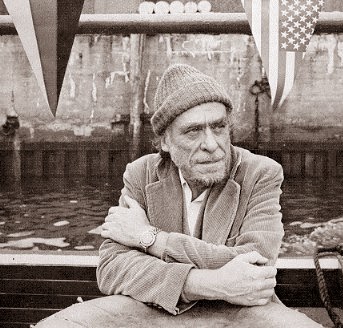
November 21, 2013
Bad stuff, good stuff...
Hi folks,
Another week of ups and downs! Spent most of yesterday attending my wife Mary’s dad’s funeral and a dinner afterwards. Don’t want any more of these! Three weeks ago, Mary buried her mother. She’s hung tough through all of it, but enough is enough!
Good stuff…The recording of myself and Scott Phillips reading at the Indy Noir@The Bar is available for listening here. Hope you enjoy it!
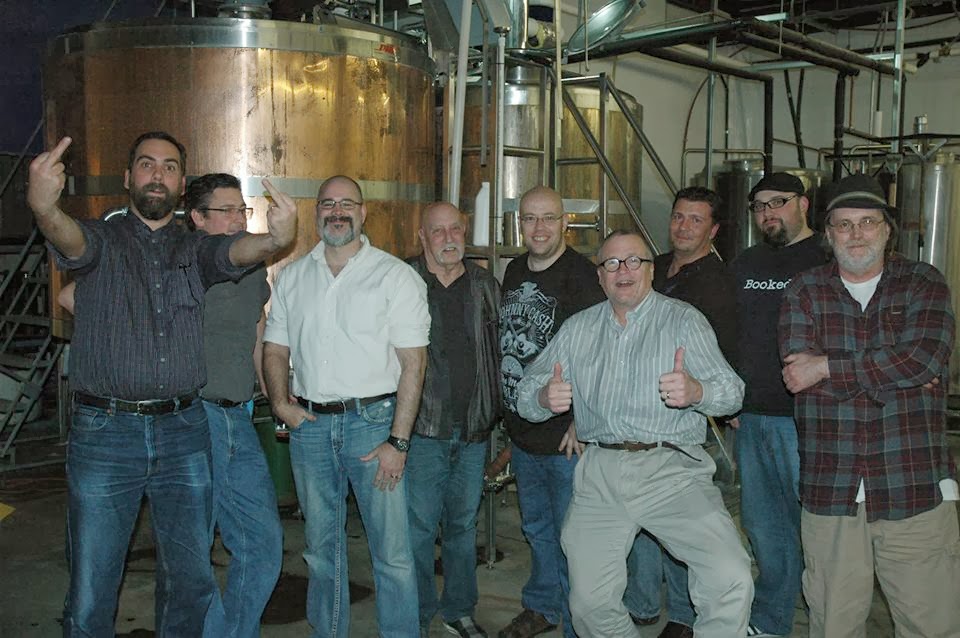 From L-R:Jed Ayres, Clayton Lindemuth, David James Keaton, moi, CJ Edwards (host), Scott Phillips, Livius Nedin (Booked Podcaster), Robb Olson (Booked Podcaster), and James Ward Kirk.
Just received a great review of my forthcoming (January) novel, THE BITCH in Publisher’s Weekly.
The Bitch
Les Edgerton. New Pulp (www.newpulppress.com), $14.95 trade paper (294p) ISBN 978-0-9899323-0-1First published as an e-book in 2011, this sharp crime thriller from Edgerton (The Rapist) offers a plot as inevitable as an avalanche. Ex-con Jake Bishop, now gainfully employed, married with a child on the way, and on the verge of opening his own hair salon, has the problems of any law-abiding middle-class man, until the appearance of an old cellmate and friend from Indiana’s Pendleton Reformatory, Walker Joy. Desperate to pay off a looming $100,000 debt, Walker begs for Jake’s help on one last job, which he promises is “a piece of cake.” That Jake has a choice is an illusion. Walker’s crooked boss, Sydney Spencer, would happily destroy Jake and his family if denied and, thanks to Walker, knows just what leverage to use. What follows is an inexorable descent into hell, as Jake’s attempts to salvage the life he loves take him, step by step, farther away from salvation. (Jan.) Reviewed on: 11/18/2013
It comes out in January!
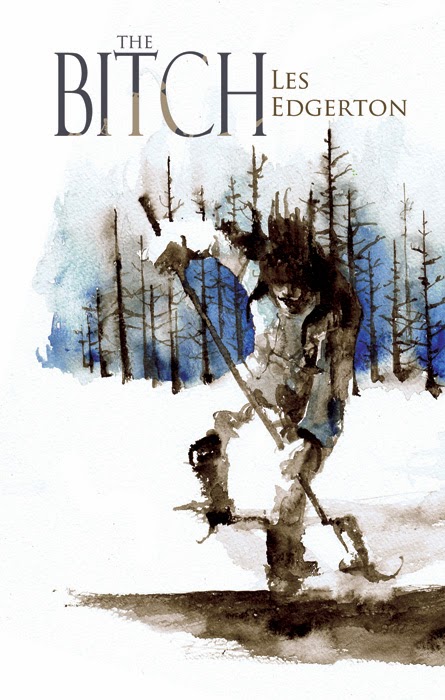
This Saturday, I’ll be conducting a workshop on the film THELMA & LOUISE at the Writer’s Center in Indianapolis from 10-4. Hope to see some of you there!
And, hope there’s no more sorrow for awhile! How about some laizzez les bon temps rouler?!
Blue skies,Les

November 19, 2013
Noir@Bar, tragedies and film news
Hi folks,It’s been kind of a bad and good week! Last Saturday, as my wife Mary and I climbed into the car to drive down to Indianapolis where I was one of the participants at the Noir @ The Bar, C.J. Edwards was hosting, Mary got a call that her father was dying. We headed over to the hospice and he was basically in a coma. Kind of déjà vu, as her mother had just passed away about three weeks ago and the scene was much the same. She got to tell him she loved him and we talked about staying and I could cancel the reading, but there was no way to know how long he’d last so we decided to go on down. Just as we got to Indy a couple of hours later, she got the phone call that informed her he’d expired.
Mary didn’t want to tell anyone there as she didn’t want to deal with folks coming up and giving her their sympathy—she appreciates it, but just didn’t want to deal with it then. Plus, she’s just the best... and toughest person I've ever known.
Anyway, we had a blast at the reading. Saw some old friends and met some new ones. If anyone’s interested, the folks from the famous Booked Podcast were there—Livius Nedin and Robb Olson—and they recorded all of us reading. You can access it at their site at: http://www.bookedpodcast.com/They’re providing in four episodes and I’d listen to them all. A great lineup of noir writers!
We got some great pub that morning. On the Indy TV news, they announced the top three events for the weekend. We were named #2 behind #1 the Tiny Tots event with Tom Petty, the Pixies, and the Grateful Dead, and ahead of the state finals for the high school marching bands. We should have been #1, but then it WAS the Grateful Dead, so...
Here’s photos of all of us except for the host, C.J. (Chris) Edwards. I have a theory why he didn’t have a picture—he’s a cop and I think he’s undercover and he knows a lot of my criminal friends visit here so he didn’t want them to know what he looks like… Chris put together a wonderful event and I hope he makes it an annual get-together. We read in the awesome club, the Fountain Square Brewery and were in the actual brewery behind the bar. Tried to find a tap but were forced to go out to the bar and buy our drinks...
Top to bottom: Clayton Lindemuth, David James Keaton, James Ward Kirk, Jed Ayres, moi, and Scott Phillips. (Missing is our host, C.J. Edwards)
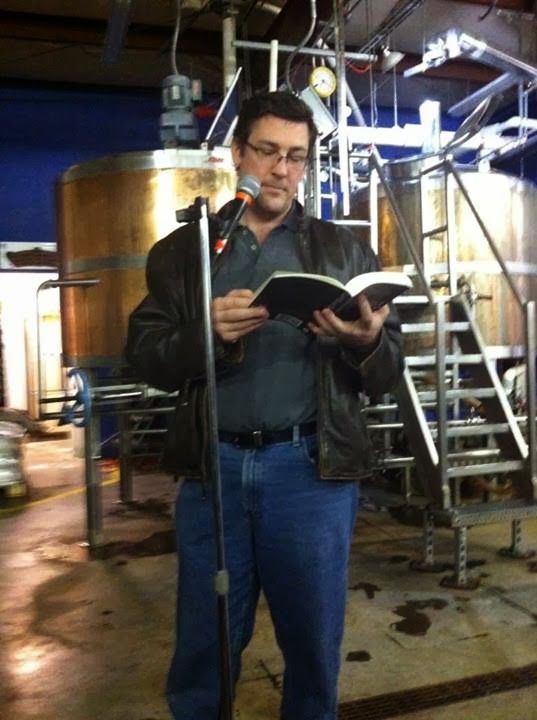


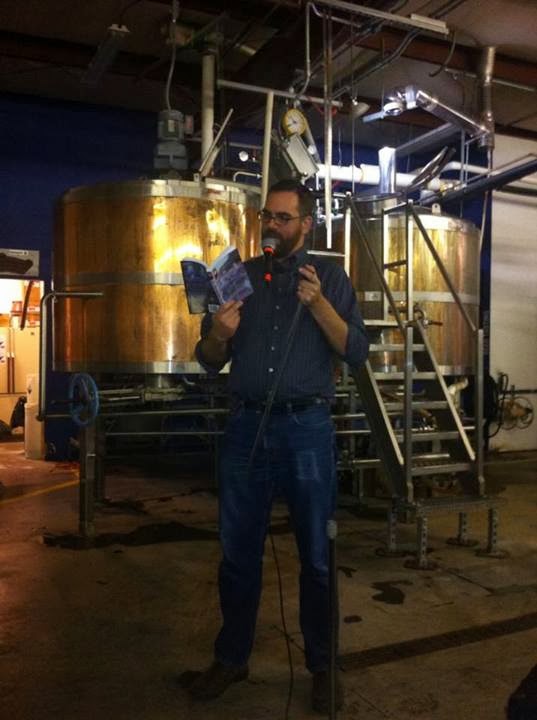
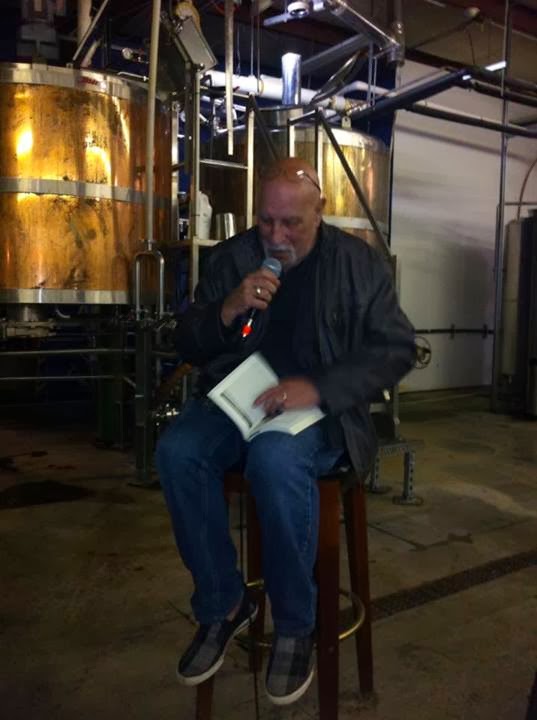
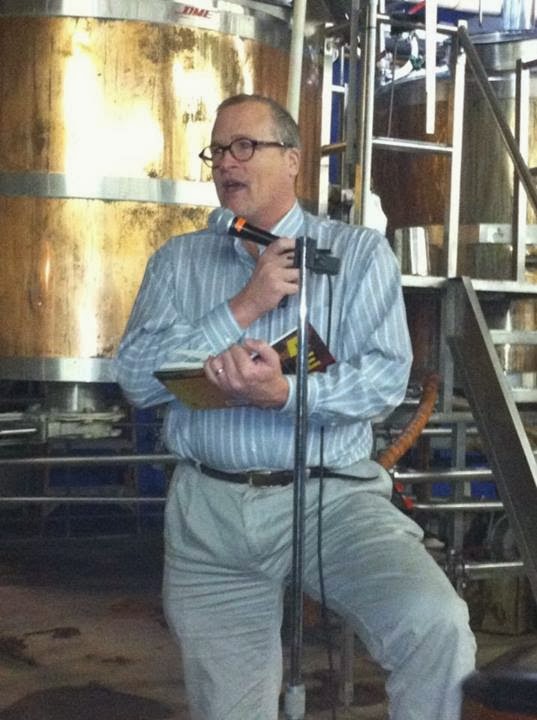
Next Saturday, I’ll be driving back down to Indy. I’m delivering my workshop on Thelma & Louise at Marion College for the Writer’s Center of Indiana. Hope to see a few of my friends from here there.
When I got back home, I got a great email from my German publisher, Frank Nowatzke of Pulpmaster, who’s submitting my black comedy crime novel THE GENUINE, IMITATION, PLASTIC KIDNAPPING that he’s publishing, to the Books at Berlinale, the Berlin-based filmfest. Here’s some info about them from the letter they send out to selected participants:
Dear Friends and Colleagues,It is our pleasure to send you the Call for Book Submissions for “Books at Berlinale”, a joint initiative of the Berlin International Film Festival and the Frankfurt Book Fair. During the 64th Berlin International Film Festival (February 6-16, 2014) within the framework of the Berlinale Co-Production Market, the 9th edition of “Books at Berlinale” will take place in order to further strengthen the network between the film and the book industries. The submission deadline is November 25, 2013.Out of all submissions, ten books will be selected. During the “Books at Berlinale” breakfast networking event these pre-selected novels will be pitched to an audience of around 80 - 100 internationally established producers. The book presentation will be moderated and the respective rights holders (publishers/literary agents) will be introduced to the audience. The presentation is followed by a casual breakfast during which contacts to interested producers can be established. Each publisher/agent has their own table and can be approached directly by the producers.The 10 selected books will also be published in the “Books at Berlinale” catalogue handed out to all attending producers. If you wish to have your novel considered for “Books at Berlinale” at the Berlinale Co-Production Market please send us the attached submission form by Monday, November 25, 2013. You should be the film rights holder of the novel. Your book proposal should be either a best-selling or brandnew, yet to be published novel with great potential for screen adaptation. Please bear in mind when deciding which book to submit that the international producers attending the Berlinale Co-Production Market mainly work in the independent arthouse sector. Their average budgets for realising a film range from 1-8 million Euros. An English translation or a sample translation of the novel should exist for the selection, and also in order to be handed out by you to interested producers upon request.If you are not sure which book to submit, please do not hesitate to contact us anytime to discuss your suggestions! We’ll be glad to help (+49-30-25920-517 or books@berlinale.de) in order to find the right one.The selection for “Books at Berlinale” will be made shortly before Christmas. The “Books at Berlinale” presentation will take place on Tuesday, February 11, 2014, in the morning, during the Berlinale Co-Production Market.If your book is selected, you are very welcome to participate in the Berlinale Co-ProductionMarket already on February 9 and 10, 2014.Some general information about the Berlinale Co-Production Market:The Berlinale Co-Production Market takes place as part of the Berlin International Film Festival from February 9-11, 2014 in the Berlin House of Representatives. It is a 2 1/2-day event for producers, film financiers, broadcasting representatives, distributors and sales agents who work in the field of international co-productions. Film producers are given a platform here to find co-production partners and financiers for their selected film projects. In 2013, more than 450 industry professionals from around the world attended the Berlinale Co-Production Market of which “Books at Berlinale” is a special part.
I’m just pleased and happy that Frank feels this book has a good chance of being selected and then filmed! Cross your fingers for me, willya?! Last year, he submitted a book he published by Rick DeMarinis and here’s what he said about that: “Last year we had no luck with Rick DeMarinis on account of the fixed setting in the southwest but they were at least impressed by the quality of the story. You never know. Maybe somebody shows up who works with the Coen brothers.”
That echoes my own thoughts. I’ve always thought this book would be a good fit with the Coen’s… hope they’re there! Hi Joel! Hi Ethan! I'll work for beer...
Frank’s purchased the German publishing rights to this book for Pulpmaster along with THE RAPIST and THE BITCH, both published by New Pulp Press in the U.S.. We’re looking for a U.S. publisher for KIDNAPPED and am pretty sure we have one and will be announcing it shortly.
All in all, this has been a draining weekend! I’m ready for a dose of boring now!
Blue skies,Les