
Mitali Perkins's Blog, page 15
April 25, 2014
Launching a Book in a Digital Age: A Call for Tips and Tricks
In the age of shrinking in-house publicity budgets, how might a writer or illustrator use social media to launch a book? I'll be presenting a session called "Launching a Book in a Digital Age" at the forthcoming
New England Society of Children's Book Writers and Illustrators 2014 Conference
, and I need your input.
What are some creative ideas and strategies that have worked for you or for others in launching a new book? Do you have practical tips on how to use tools like blogs, twitter, Facebook, etc. to draw attention to a title and make it stand out from the crowd? Please leave your suggestions in the comments below or tweet them with the hashtag #booklaunchtips. Come visit me on the Fire Escape!


What are some creative ideas and strategies that have worked for you or for others in launching a new book? Do you have practical tips on how to use tools like blogs, twitter, Facebook, etc. to draw attention to a title and make it stand out from the crowd? Please leave your suggestions in the comments below or tweet them with the hashtag #booklaunchtips. Come visit me on the Fire Escape!


April 24, 2014
This OPEN MIC Book Trailer Rocks My World
I usually try and create trailers for my books but what with our big move to California, I didn't get one together for
OPEN MIC: RIFFS ON LIFE BETWEEN CULTURES IN TEN VOICES
(Candlewick). That's why I was delighted when K.T. Horning of the University of Madison-Wisconsin's Cooperative Children's Book Center told me about this trailer created by Ali Khan, a brilliant, funny teen writer in the Madison Public Library's "Bubbler." I think you'll enjoy it as much as I did:
Ali, I love you! I will be the little old lady who hobbles up for an autograph some day, so don't forget me. Here's another video he made about rejecting stereotypes:
About the book trailer project :
Thanks to a recent Madison Civics Club Youth Grant , Madison Public Library and the Cooperative Children’s Book Center (CCBC) were able to pilot an 8-week workshop series with teen writers at Simpson Street Free Press. The project highlighted titles from Read On Wisconsin , CCBC's literacy program that promotes high-quality books for children and teens throughout Wisconsin.Come visit me on the Fire Escape!

Ali, I love you! I will be the little old lady who hobbles up for an autograph some day, so don't forget me. Here's another video he made about rejecting stereotypes:
About the book trailer project :
Thanks to a recent Madison Civics Club Youth Grant , Madison Public Library and the Cooperative Children’s Book Center (CCBC) were able to pilot an 8-week workshop series with teen writers at Simpson Street Free Press. The project highlighted titles from Read On Wisconsin , CCBC's literacy program that promotes high-quality books for children and teens throughout Wisconsin.Come visit me on the Fire Escape!
April 23, 2014
A Midwestern Girl at Heart
I thoroughly enjoyed my week of events in the Midwest. I presented the
8th annual lecture on Multicultural Children's Literature
at the University of Wisconsin-LaCrosse, hosted by the Murphy Library. Next I headed for Grand Rapids, Michigan, where I attended the
Festival of Faith and Writing
to sit on a couple of panels as well as offer a solo talk entitled "
It's Just Fiction: Ten Tips on Reading and Writing about Race, Culture, and Power
."
In both communities, everyone was so ... nice. I know that can be a bland adjective, but believe me, after living in or near big cities my whole life, I delighted in the courtesies extended to me in these smaller college towns. If it wasn't for the W-word, I'd consider making my home in one of North America's so-called "flyover states." But I dumped my shovels in Boston before moving to the San Francisco Bay Area, and I never want to see them again. Besides, I can always visit, right?
Three Great Days in Wisconsin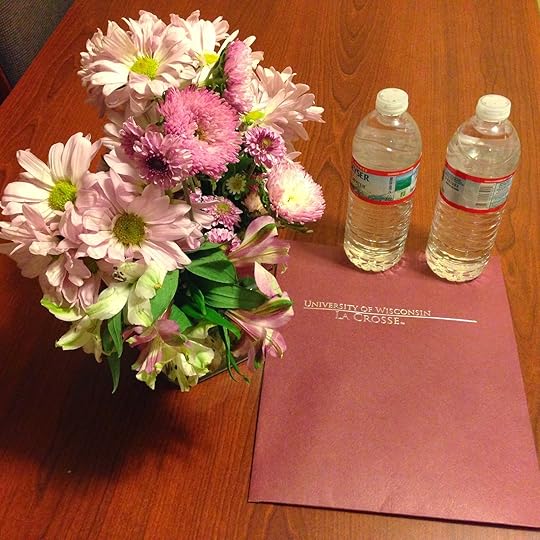 Welcome bouquet in my hotel room? Nice start!
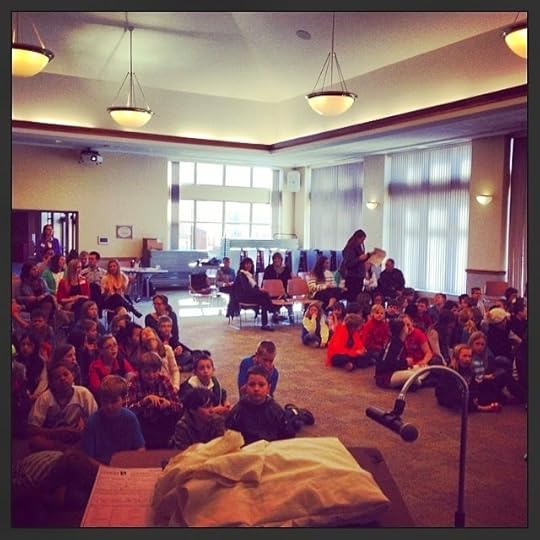 4th and 5th graders getting settled before my presentation.
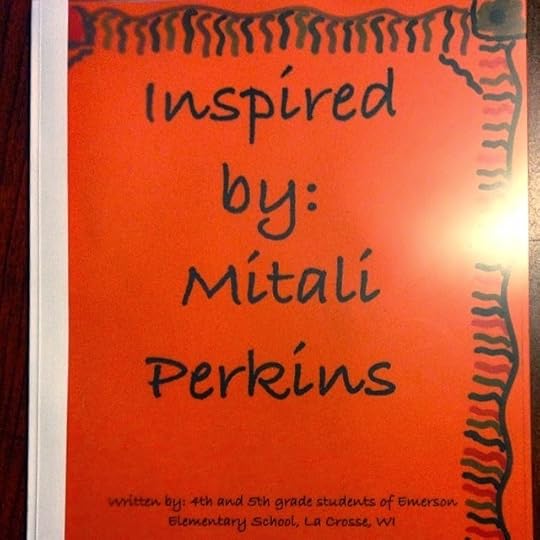 Received this book of stories and poems prepared by the students.
Great teachers are the key to successful author visits.
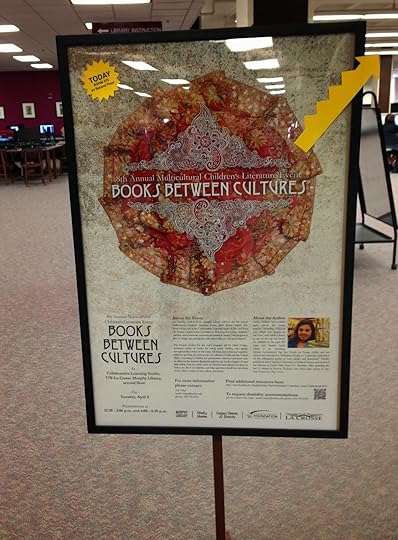 Time for my lectures at the Murphy Library. Good signage, right?
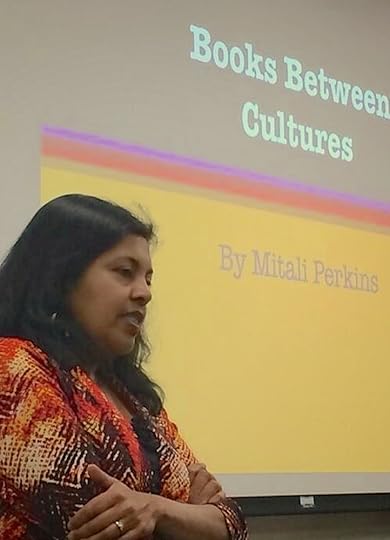 Fielding good questions is more than half the fun.
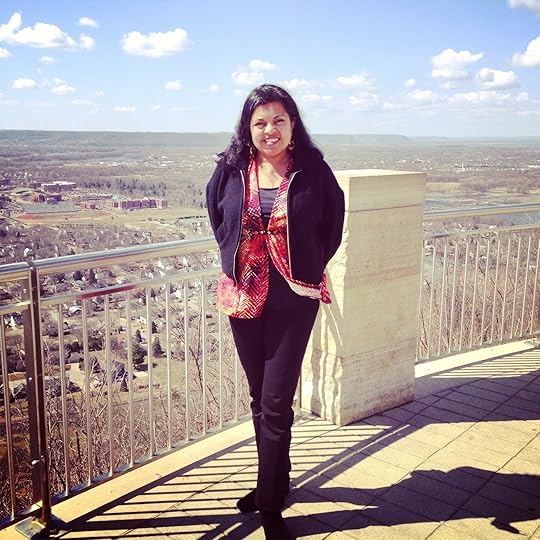 On my lunch break, I drove up to Grandad Bluff Park to enjoy the view.
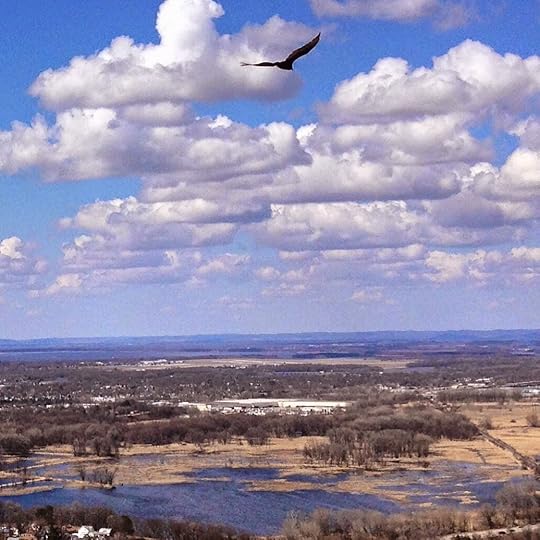 The University of Wisconsin—La Crosse from the Bluff.
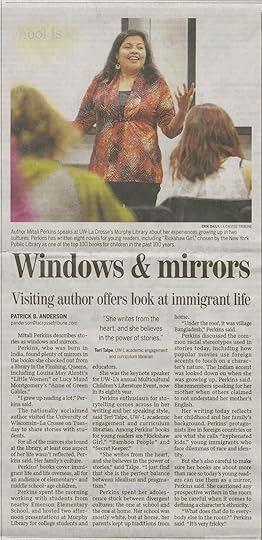 Patrick Anderson of the LaCrosse Tribune attended and reported about the event.
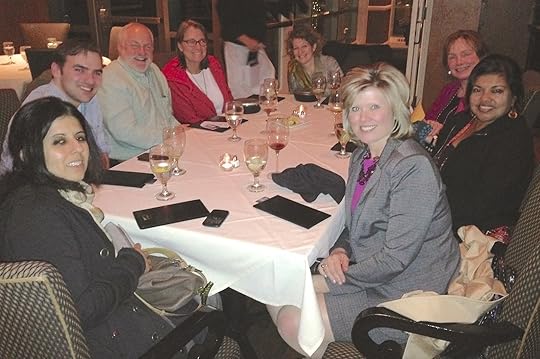 It takes a village to host an author. Here's the planning team of librarians and School of Education leaders at
The Waterfront Restaurant
(highly recommended for dinner). Thank you, friends!
It takes a village to host an author. Here's the planning team of librarians and School of Education leaders at
The Waterfront Restaurant
(highly recommended for dinner). Thank you, friends!
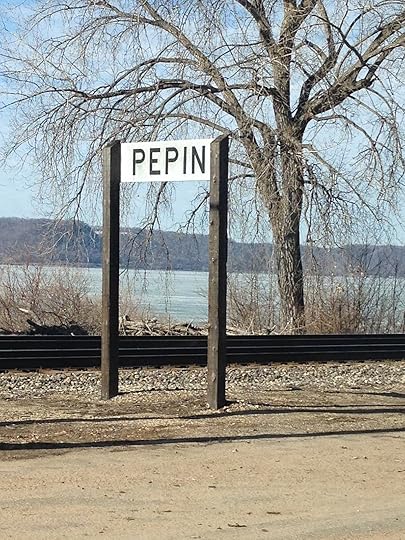 The route to the airport in St. Paul took me through this town. Remember who lived here?
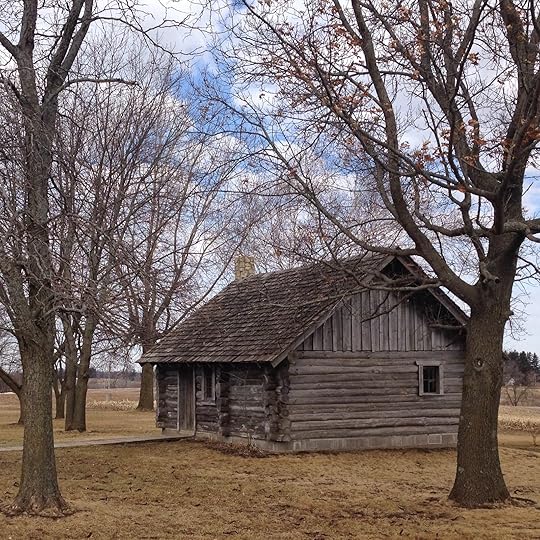 Yep, it's the Little House in the Big Woods.
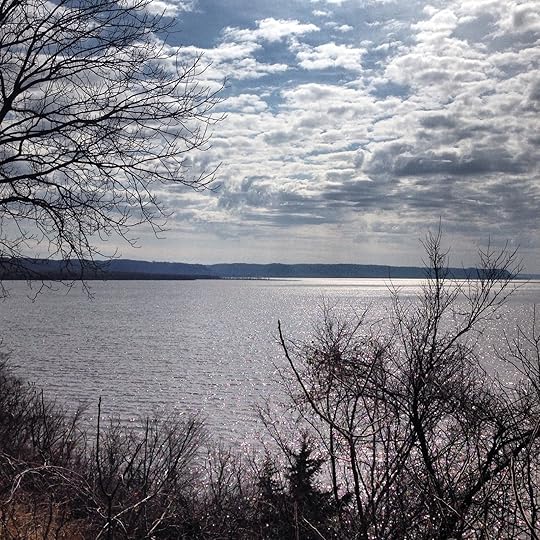 Lake Pepin.Three Great Days in Michigan
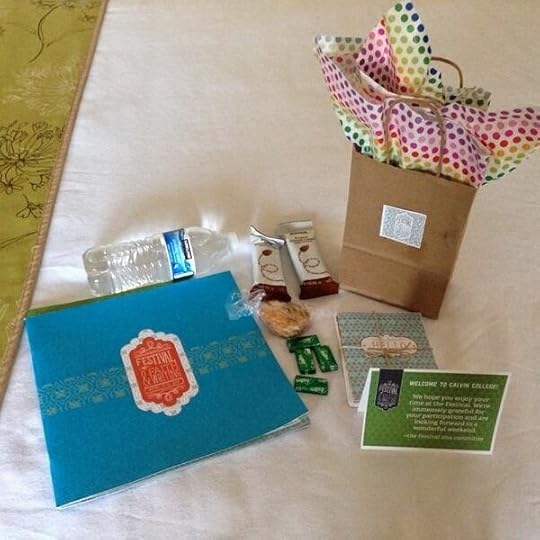 Confession: I love conference swag. This gift bag was waiting in my room at Calvin College's Prince Conference Center and Hotel, where Festival speakers were housed, fed, and basically cosseted.
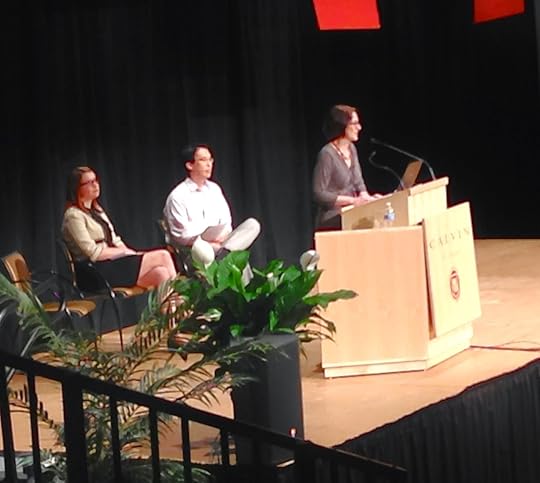 The Festival kicked off with a plenary by Gene Luen Yang, "Is Art Selfish?" Other keynote speakers included James McBride, Miroslav Volf, and Anne Lamott.
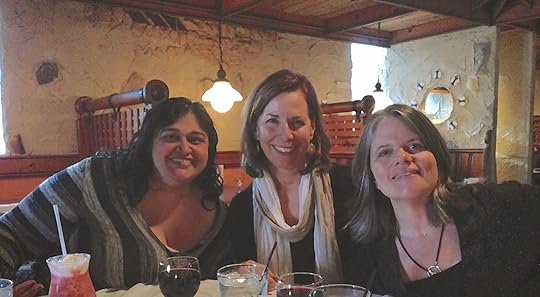 Children's and YA authors abounded at the Festival, and as usual we enjoyed laughing, eating, and drinking. (From L to R: Swati Avasthi | CHASING SHADOWS, Pam Muñoz Ryan | THE DREAMER, and Deborah Heiligman | INTENTIONS.)
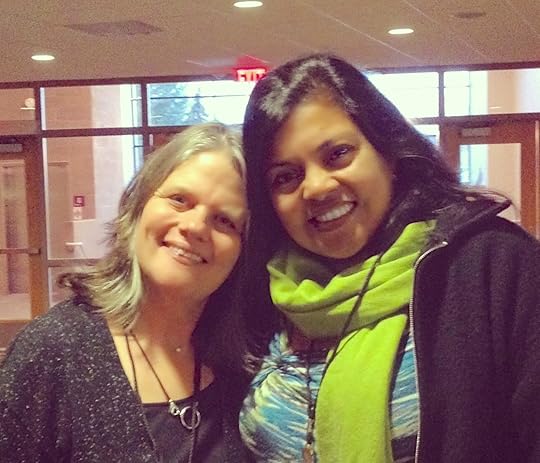 Enjoyed hearing Deb Heiligman talk about faith and science as presented in her award-winning book, CHARLES AND EMMA. "The Darwins' relationship is a microcosm of how people can talk about different views with deep love," she said.
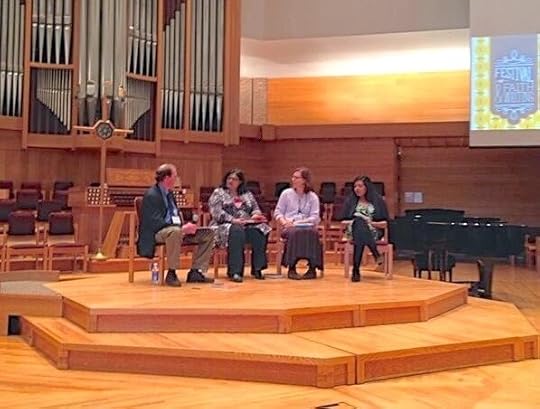 Two-time Newbery honoree Gary Schmidt, who is on the faculty at Calvin, moderated a panel on writing young adult fiction. (from L to R: Gary Schmidt, Swati Avasthi, Pam Muñoz Ryan, and me.)
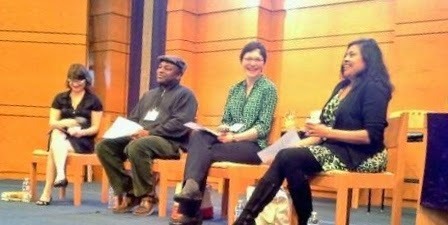 I participated in another discussion, "Power of the Word: Writing Towards Justice." (From L to R: Moderator Sarina Moore, Uwem Akpan | SAY YOU'RE ONE OF THEM, Ashley Lucas | RAZOR WIRE WOMEN, and me.)
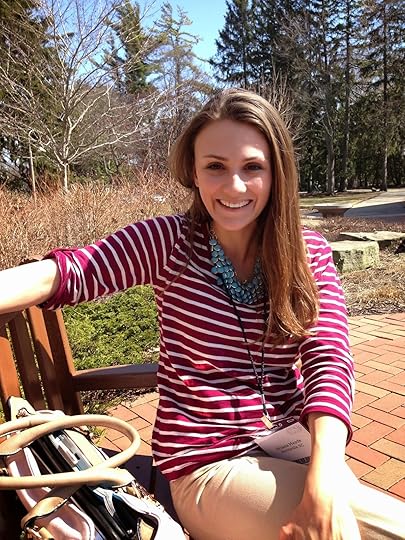 Last but not least, the Festival was full of young talents, including
Come visit me on the Fire Escape!

In both communities, everyone was so ... nice. I know that can be a bland adjective, but believe me, after living in or near big cities my whole life, I delighted in the courtesies extended to me in these smaller college towns. If it wasn't for the W-word, I'd consider making my home in one of North America's so-called "flyover states." But I dumped my shovels in Boston before moving to the San Francisco Bay Area, and I never want to see them again. Besides, I can always visit, right?
Three Great Days in Wisconsin
 Welcome bouquet in my hotel room? Nice start!
 4th and 5th graders getting settled before my presentation.
 Received this book of stories and poems prepared by the students.
Great teachers are the key to successful author visits.
 Time for my lectures at the Murphy Library. Good signage, right?
 Fielding good questions is more than half the fun.
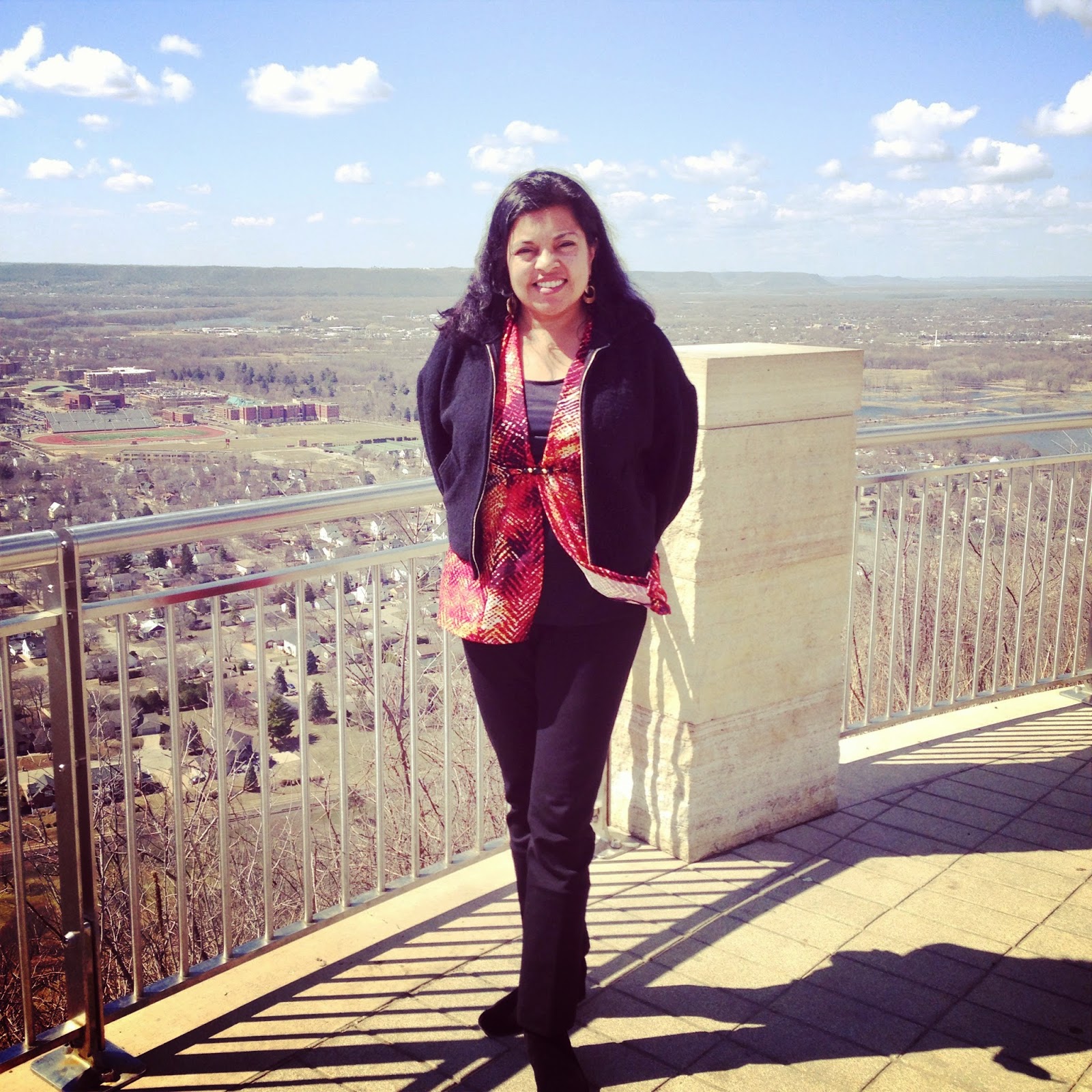 On my lunch break, I drove up to Grandad Bluff Park to enjoy the view.
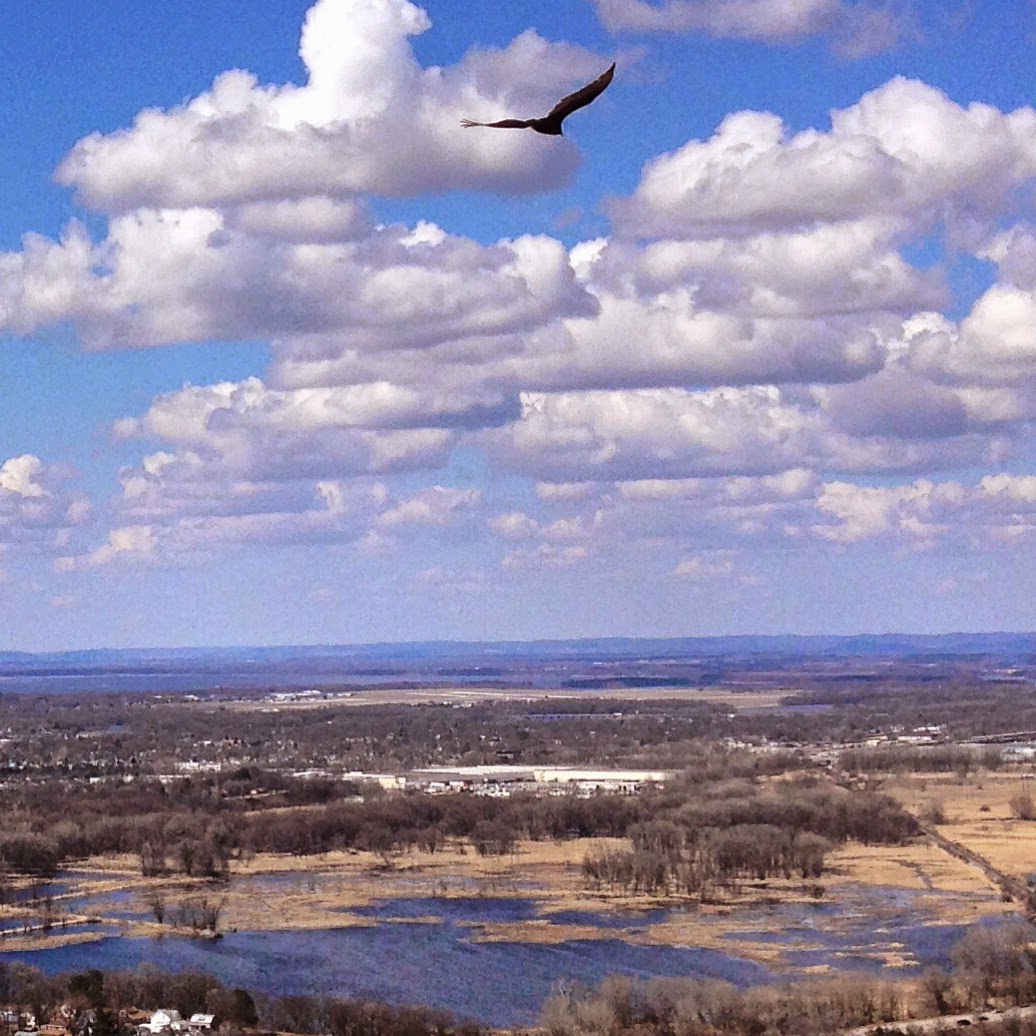 The University of Wisconsin—La Crosse from the Bluff.
 Patrick Anderson of the LaCrosse Tribune attended and reported about the event.
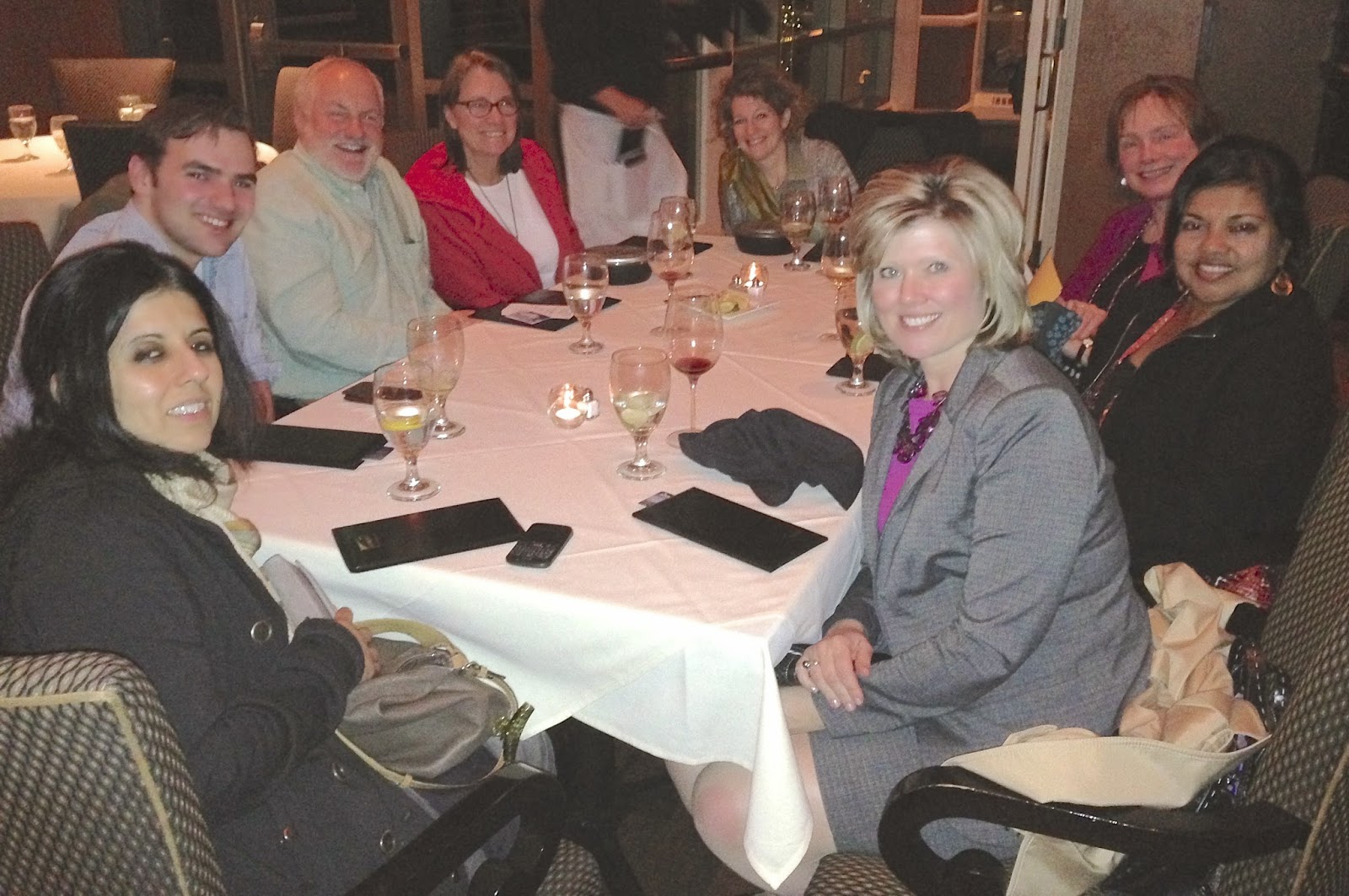 It takes a village to host an author. Here's the planning team of librarians and School of Education leaders at
The Waterfront Restaurant
(highly recommended for dinner). Thank you, friends!
It takes a village to host an author. Here's the planning team of librarians and School of Education leaders at
The Waterfront Restaurant
(highly recommended for dinner). Thank you, friends! The route to the airport in St. Paul took me through this town. Remember who lived here?
 Yep, it's the Little House in the Big Woods.
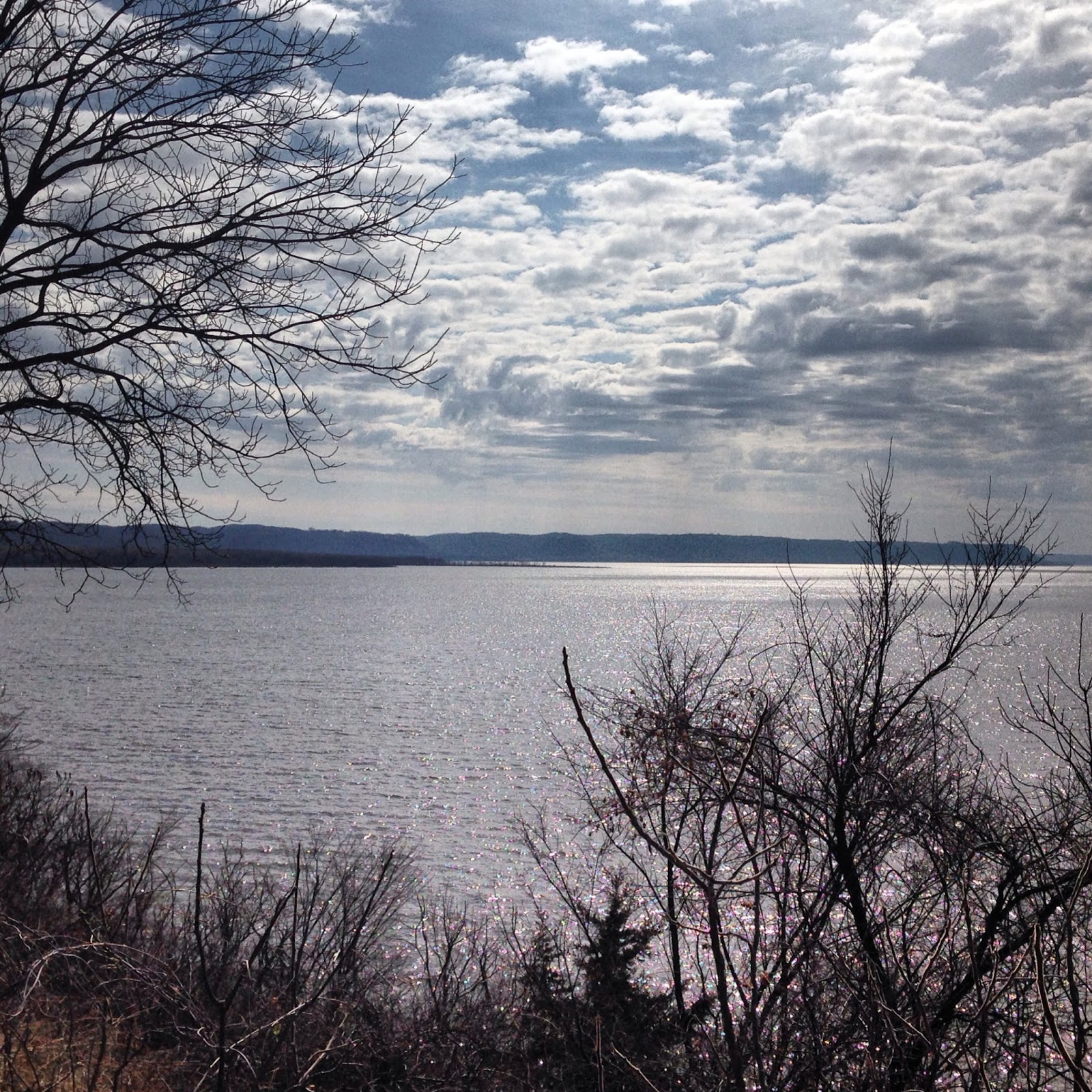 Lake Pepin.Three Great Days in Michigan
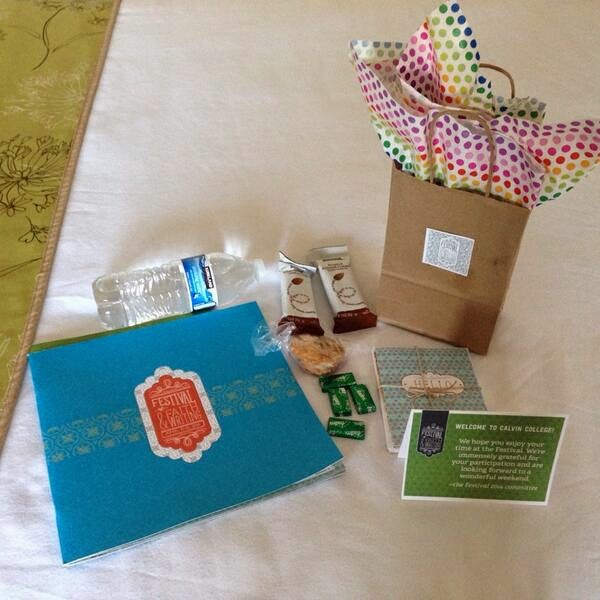 Confession: I love conference swag. This gift bag was waiting in my room at Calvin College's Prince Conference Center and Hotel, where Festival speakers were housed, fed, and basically cosseted.
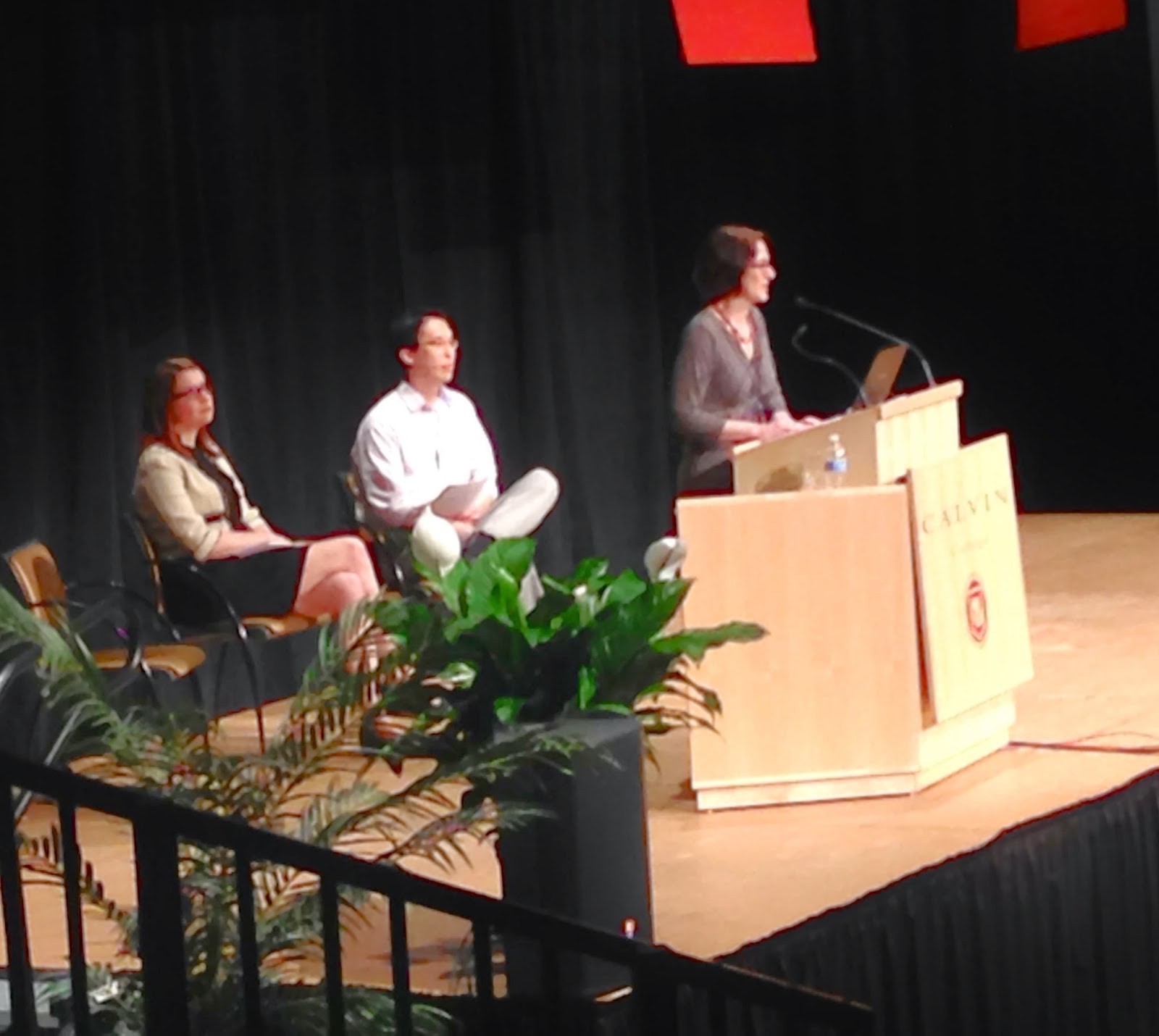 The Festival kicked off with a plenary by Gene Luen Yang, "Is Art Selfish?" Other keynote speakers included James McBride, Miroslav Volf, and Anne Lamott.
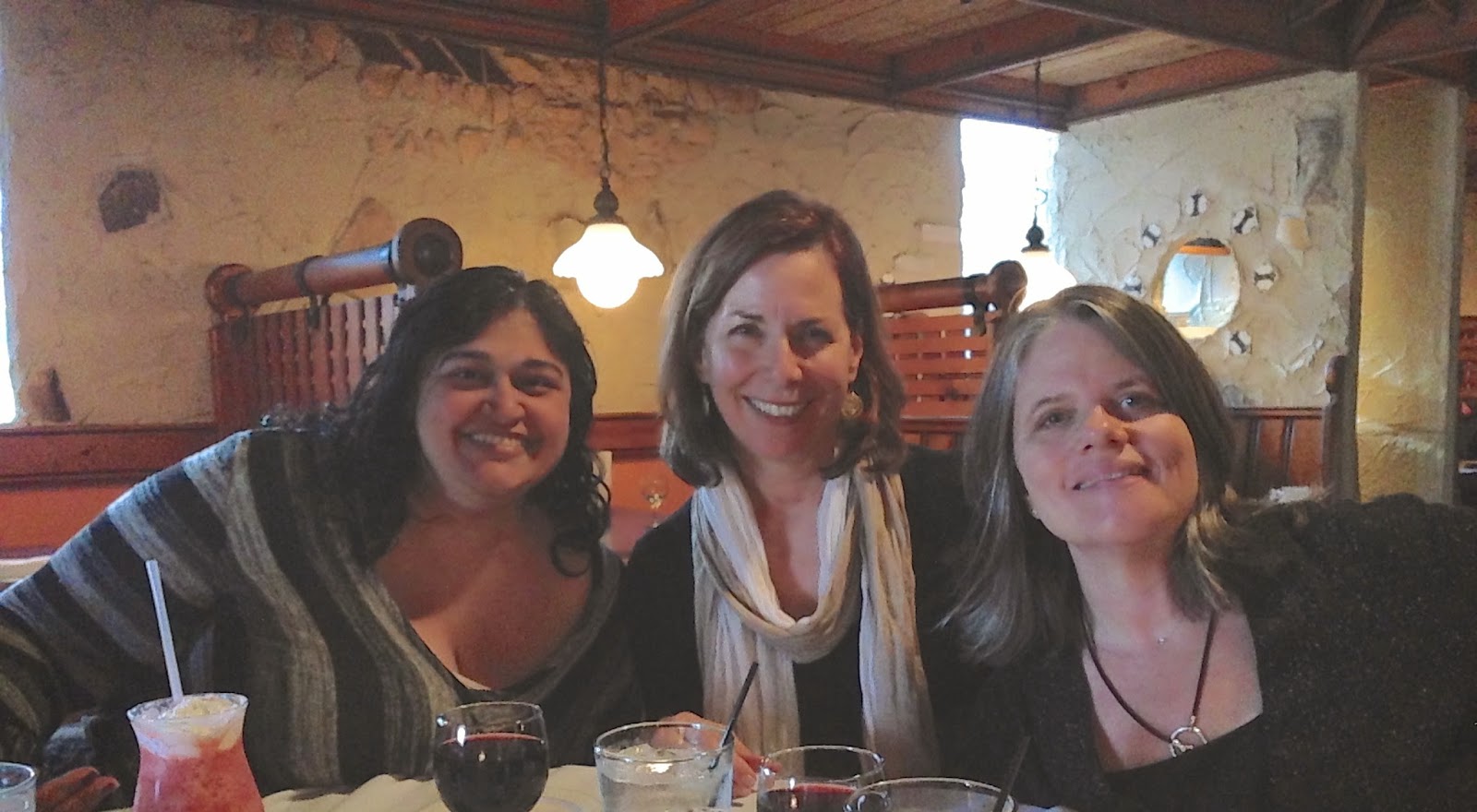 Children's and YA authors abounded at the Festival, and as usual we enjoyed laughing, eating, and drinking. (From L to R: Swati Avasthi | CHASING SHADOWS, Pam Muñoz Ryan | THE DREAMER, and Deborah Heiligman | INTENTIONS.)
 Enjoyed hearing Deb Heiligman talk about faith and science as presented in her award-winning book, CHARLES AND EMMA. "The Darwins' relationship is a microcosm of how people can talk about different views with deep love," she said.
 Two-time Newbery honoree Gary Schmidt, who is on the faculty at Calvin, moderated a panel on writing young adult fiction. (from L to R: Gary Schmidt, Swati Avasthi, Pam Muñoz Ryan, and me.)
 I participated in another discussion, "Power of the Word: Writing Towards Justice." (From L to R: Moderator Sarina Moore, Uwem Akpan | SAY YOU'RE ONE OF THEM, Ashley Lucas | RAZOR WIRE WOMEN, and me.)
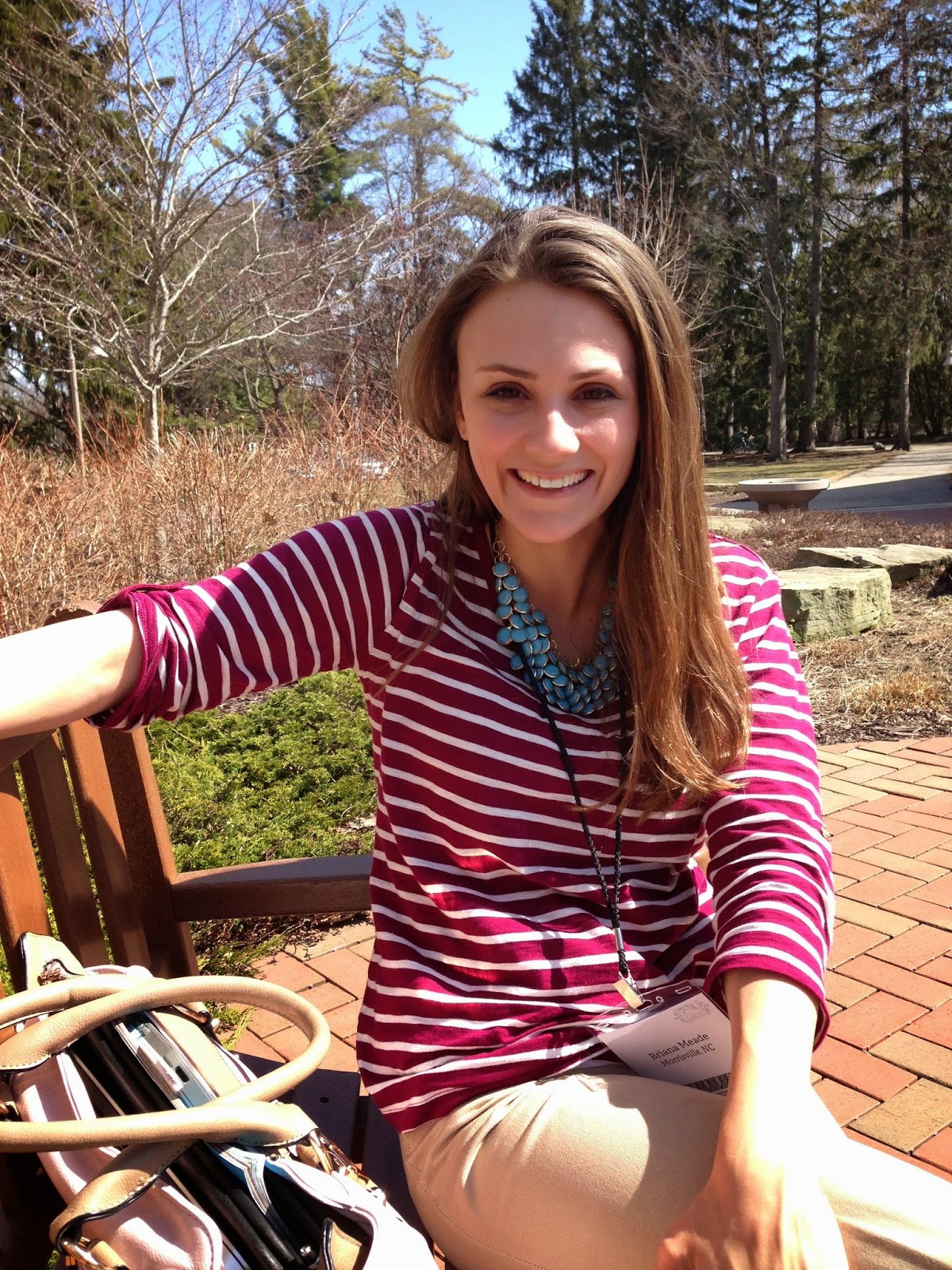 Last but not least, the Festival was full of young talents, including
Come visit me on the Fire Escape!
April 17, 2014
Shattering the Multicultural Myth of the Market. Let's go.
"A young adult book featuring a protagonist who isn't of European descent will never become a bestseller."
"The majority of readers won't read a young adult novel featuring a protagonist who isn't of European descent."
We imagine these kinds of comments, spoken or unspoken, governing the publishing industry. In our guts, we know they're not true. We gripe about this issue. We try to disprove such claims through social media and conferences, panels and articles, speeches and radio shows. Unfortunately, nothing so far has resulted in such a young adult novel breaking through into widespread success.
The truth is that, for all of our good intentions, publishing is a for-profit industry.
Money changes minds.
"Adults don't read books for young readers." Harry Potter shattered that one, didn't it?
"Boys don't read girl books." Along came Suzanne Collins with Katniss, and middle-aged men were tearing through The Hunger Games trilogy.
Yesterday I tweeted this:
But Ellen raised a good question:
First, storytellers — RISE UP! Write a great story that rings with authenticity featuring a protagonist we love who is not of European descent (I know the label stinks, but you get my drift.) It must be a page-turner. It must knock our story-hungry socks off. By the last page, not only are we are ready to read it again, we are reaching into our wallets to pre-order the sequel. We are tweeting, texting, status-ing, and insta-ing that book until our friends are convinced they must buy it right now or their quality of life will diminish.
I may complain about the market and choose to blame my lack of breakthrough success on the r-word, but let's get real—I need to write an AMAZING STORY. Once I've achieved this (and the veracity of such a claim has been thoroughly verified by countless words and reviews of readers who don't know me), I might be able to question why it didn't become a blockbuster.
I know that one part of us believes our mothers and thinks our books are beyond incredible, but another part says, "Maybe it was good, but get better, get better." Let's listen to that—time is short.
Second, readers, be on the hunt for such a story. In the old days, we relied solely on publishing houses to put publicity and marketing big bucks behind fiction. These days, social media and virality are increasingly key to launching a novel into bestseller status, which feels like the collective "we" have a bit more power. How can we use that power to get behind a title? Maybe we can add our small voice of influence to help it sell like crazy.
Who is likely to discover a young adult novel with blockbuster potential featuring culturally marginalized protagonists (gosh, I hate race labels—what do you think of that one)? I trust indie booksellers and librarians. That's why I tune into their voices on twitter (feel free to follow my lists of 197 booksellers and 359 librarians .) If booksellers like Elizabeth Bluemle and librarians like Betsy Bird , champions of "add-your-own-label-here" books for years, don't discover this myth-shattering story, nobody will.
I believe that changing the market can and will happen. And when it does, I promise you I'll say I told you so.
Come visit me on the Fire Escape!

"The majority of readers won't read a young adult novel featuring a protagonist who isn't of European descent."
We imagine these kinds of comments, spoken or unspoken, governing the publishing industry. In our guts, we know they're not true. We gripe about this issue. We try to disprove such claims through social media and conferences, panels and articles, speeches and radio shows. Unfortunately, nothing so far has resulted in such a young adult novel breaking through into widespread success.
The truth is that, for all of our good intentions, publishing is a for-profit industry.
Money changes minds.
"Adults don't read books for young readers." Harry Potter shattered that one, didn't it?
"Boys don't read girl books." Along came Suzanne Collins with Katniss, and middle-aged men were tearing through The Hunger Games trilogy.
Yesterday I tweeted this:
To shatter the "multicultural" myth of the market, a breakthrough novel must capture the collective imagination--and haul in a lot of cash.
— Mitali Perkins @MitaliPerkins April 16, 2014
If you know a quality YA novel with blockbuster potential featuring a black or Native protagonist, we'll try to help it go viral.I got several suggestions including books like Joseph Bruchac's Killer of Enemies, The Living by Matt De La Peña, Fake ID by Lamar Giles, and Prophecy by Ellen Oh.
— Mitali Perkins @MitaliPerkins April 16, 2014
But Ellen raised a good question:
@MitaliPerkins Problem is what is blockbuster potential? We can't even predict what is the next blockbuster in general.I do think that film can take a book to the next level, but it must achieve some widespread market success before moviemakers begin to pay attention. There are two necessities to achieve this kind of success.
— Ellen Oh (@elloecho) April 17, 2014
First, storytellers — RISE UP! Write a great story that rings with authenticity featuring a protagonist we love who is not of European descent (I know the label stinks, but you get my drift.) It must be a page-turner. It must knock our story-hungry socks off. By the last page, not only are we are ready to read it again, we are reaching into our wallets to pre-order the sequel. We are tweeting, texting, status-ing, and insta-ing that book until our friends are convinced they must buy it right now or their quality of life will diminish.
I may complain about the market and choose to blame my lack of breakthrough success on the r-word, but let's get real—I need to write an AMAZING STORY. Once I've achieved this (and the veracity of such a claim has been thoroughly verified by countless words and reviews of readers who don't know me), I might be able to question why it didn't become a blockbuster.
I know that one part of us believes our mothers and thinks our books are beyond incredible, but another part says, "Maybe it was good, but get better, get better." Let's listen to that—time is short.
Second, readers, be on the hunt for such a story. In the old days, we relied solely on publishing houses to put publicity and marketing big bucks behind fiction. These days, social media and virality are increasingly key to launching a novel into bestseller status, which feels like the collective "we" have a bit more power. How can we use that power to get behind a title? Maybe we can add our small voice of influence to help it sell like crazy.
Who is likely to discover a young adult novel with blockbuster potential featuring culturally marginalized protagonists (gosh, I hate race labels—what do you think of that one)? I trust indie booksellers and librarians. That's why I tune into their voices on twitter (feel free to follow my lists of 197 booksellers and 359 librarians .) If booksellers like Elizabeth Bluemle and librarians like Betsy Bird , champions of "add-your-own-label-here" books for years, don't discover this myth-shattering story, nobody will.
I believe that changing the market can and will happen. And when it does, I promise you I'll say I told you so.
Come visit me on the Fire Escape!
April 15, 2014
It’s Just Fiction: Reading and Writing about Race, Culture, and Power
At the recent
Festival of Faith and Writing
in Grand Rapids, MI, I had to tweak a presentation I've given over the past several years. A previous version focused on empowering writers with questions related to race, culture, and power to ask of ourselves and our stories. The Festival brings together writers and readers, so I presented "Ten Tips To See
'Below the Waterline' of Stories," hoping that they might be useful while reading another person's story as well as in the revision of one's own work.
My goal is for us to SEE themes related to race, culture, and power with our conscious minds. Fiction is powerful, as propagandists know, and a "single story" of a group of people ( as Chimamanda Ngozi Adichie eloquently argued ) transmitted "below the waterline" can be dangerous.
TEN TIPS FOR READERS AND WRITERS:
1. Look for an older magical negro or noble savage.
2. Notice a smart/good peer from a marginalized group who serves as a foil for a flawed hero.
3. Check the cover or illustrations for misrepresentations of exoticization or whitewashing.
4. Ask when and how race is defined , if at all.
5. Notice if the setting, plot, and characters are in charge of the casting (because they must be.)
6. Pay attention to how beauty is defined (i.e, straight, silky hair; big, wide eyes, etc.)
7. Check for a “single story" that identifies a community or person on the margins of power.
8. Notice the presence of bridge characters .
9. Ask who has the power to bring about change and who has the power to be changed.
10. Question the storyteller’s (your) authenticity, privilege, and power, but not for the purposes of setting up an arbitrary apartheid system about who can tell the story.
For me, none of these lead to a deal-breaker when it comes to a book. In fact, I hate censorship. I want to encourage us to see the powerful act of storytelling through slightly different eyes. It's helpful to consider the perspective from the margins, and to comprehend that the privilege of power (whether derived from class, nationality, education, accent, ethnicity, etc.) often enables us not to see.
Come visit me on the Fire Escape!

My goal is for us to SEE themes related to race, culture, and power with our conscious minds. Fiction is powerful, as propagandists know, and a "single story" of a group of people ( as Chimamanda Ngozi Adichie eloquently argued ) transmitted "below the waterline" can be dangerous.
TEN TIPS FOR READERS AND WRITERS:
1. Look for an older magical negro or noble savage.
2. Notice a smart/good peer from a marginalized group who serves as a foil for a flawed hero.
3. Check the cover or illustrations for misrepresentations of exoticization or whitewashing.
4. Ask when and how race is defined , if at all.
5. Notice if the setting, plot, and characters are in charge of the casting (because they must be.)
6. Pay attention to how beauty is defined (i.e, straight, silky hair; big, wide eyes, etc.)
7. Check for a “single story" that identifies a community or person on the margins of power.
8. Notice the presence of bridge characters .
9. Ask who has the power to bring about change and who has the power to be changed.
10. Question the storyteller’s (your) authenticity, privilege, and power, but not for the purposes of setting up an arbitrary apartheid system about who can tell the story.
For me, none of these lead to a deal-breaker when it comes to a book. In fact, I hate censorship. I want to encourage us to see the powerful act of storytelling through slightly different eyes. It's helpful to consider the perspective from the margins, and to comprehend that the privilege of power (whether derived from class, nationality, education, accent, ethnicity, etc.) often enables us not to see.
Come visit me on the Fire Escape!
April 14, 2014
Device-Free Day. You In?
I returned from the inspiring
Festival of Faith and Writing
at Calvin College yesterday to this tweet from Elizabeth Law, reader and editor extraordinaire:
In an age of digital hullabaloo, one of my life goals is to avoid screens and plugs from sundown Saturday to sundown Sunday. Apparently, I've discoursed about that publicly. The problem was that I was reading the tweet first thing Sunday morning.
At the Festival, I was reminded again that maintaining a 24/7 digital connection can suck the storytelling right out of you. Creative work flourishes with the age-old practice of a weekly day of rest, during which we enjoy a five-senses attentive delight in the present.
That's why I am going to renew my device-free habit from sundown Saturday to sundown Sunday.
But this time, I don't want to do it just for me and my stories. I want to invite you into this practice with me (not exactly with my rules and schedule—feel free to make up your own), so that many, many good stories might emerge.
Join me in taking a one-day-a-week break from email, social media, and internet browsing, and/or refraining from screens and plugs altogether. During our digital break, let's rest, play, and be present in our places with our people. Let the stories come!Come visit me on the Fire Escape!

@MitaliPerkins, do you still practice one internet free day a week? Or is it even more rigorous, are you entirely device free? I'm intrigued.If I could blush, I would have.
— Elizabeth Law (@ElawReads) April 13, 2014
In an age of digital hullabaloo, one of my life goals is to avoid screens and plugs from sundown Saturday to sundown Sunday. Apparently, I've discoursed about that publicly. The problem was that I was reading the tweet first thing Sunday morning.
At the Festival, I was reminded again that maintaining a 24/7 digital connection can suck the storytelling right out of you. Creative work flourishes with the age-old practice of a weekly day of rest, during which we enjoy a five-senses attentive delight in the present.
That's why I am going to renew my device-free habit from sundown Saturday to sundown Sunday.
But this time, I don't want to do it just for me and my stories. I want to invite you into this practice with me (not exactly with my rules and schedule—feel free to make up your own), so that many, many good stories might emerge.
Join me in taking a one-day-a-week break from email, social media, and internet browsing, and/or refraining from screens and plugs altogether. During our digital break, let's rest, play, and be present in our places with our people. Let the stories come!Come visit me on the Fire Escape!
April 1, 2014
Hey, Grand Rapids! Is Spring There Yet?
 Next week (April 10-14, 2014), I'm delighted to be participating in the
Festival of Faith and Writing
, "the biennial writing festival at Calvin College in Grand Rapids, Michigan, celebrating matters of faith."
Next week (April 10-14, 2014), I'm delighted to be participating in the
Festival of Faith and Writing
, "the biennial writing festival at Calvin College in Grand Rapids, Michigan, celebrating matters of faith."I'll be presenting a solo talk called "It's Just Fiction: Reading and Writing about Race, Culture, and Power," and am participating in a panel discussion on YA fiction with Swathi Avasti and Pam Muñoz Ryan . I'm also sitting on a panel focusing on writing and social justice with Uwem Akpan , a writer of fiction and Jesuit priest serving in Nigeria, and playwright Ashley Lucas . The framing question will be something like this: "To what extent can—or should—art serve to shine a light on injustice?"
Other Kid/YA book folks will be presenting at the Festival, including Gene Luen Yang (keynoting), Ron Koertge, Michele Wood, and Deborah Heiligman. Literary luminaries who write for adults, including Anne Lamott, James McBride, Miroslav Wolf, will also be there. Follow the Festival on twitter with this hashtag: #ffwgr , and here's the schedule of events and full list of speakers .Come visit me on the Fire Escape!

March 31, 2014
Introducing OPEN MIC contributor Francisco X. Stork
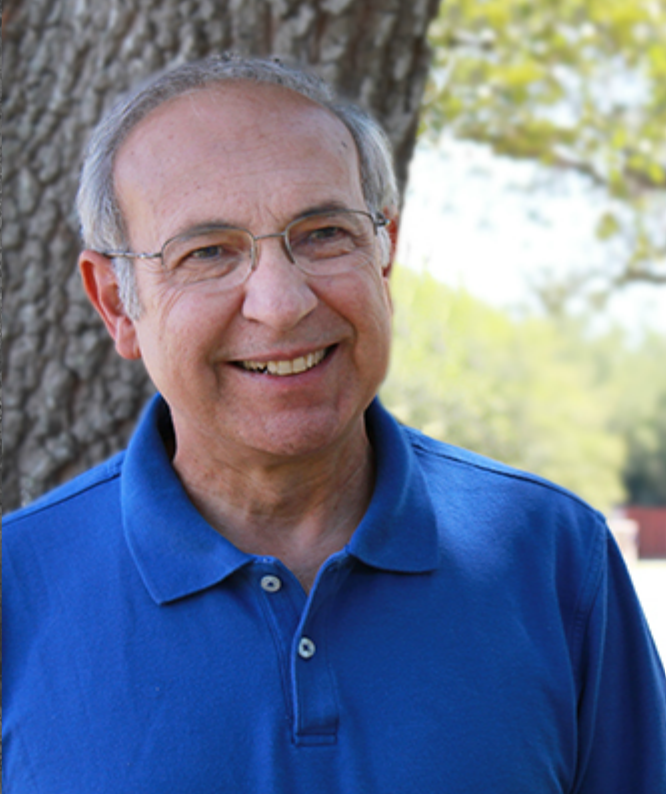 YA Author Francisco X. StorkI'm delighted to continue to showcase the
nine authors
who collaborated with me on
OPEN MIC: RIFFS ON LIFE BETWEEN CULTURES IN TEN VOICES
(published by Candlewick Press). Today I'm featuring the brilliant Francisco X. Stork, author of the piece called "Brotherly Love," a fictional look at the limits of traditional Latino masculinity.
YA Author Francisco X. StorkI'm delighted to continue to showcase the
nine authors
who collaborated with me on
OPEN MIC: RIFFS ON LIFE BETWEEN CULTURES IN TEN VOICES
(published by Candlewick Press). Today I'm featuring the brilliant Francisco X. Stork, author of the piece called "Brotherly Love," a fictional look at the limits of traditional Latino masculinity.
VOYA had this to say about our book and, more specifically, about Francisco's piece:
"... Perkins organizes the stories wisely in this collection that hopes to put a humorous spin on a topical, deeply uncomfortable subject: Race. ... In Francisco X. Stork's "Brotherly Love," siblings Luis and Rosalinda have a revealing conversation about their brother Bernie. These tales in particular dance between humor and heartache, ending on notes of triumph as we look toward a hopeful future. ..."Here are the opening paragraphs from his short story in OPEN MIC, which tell so much about the close bonds Luis has with his siblings and his relationship with their father:
The day I talked to my sister started out as an ordinary Sunday. Papá began yellign at us to get ready two hours before we needed to leave for church. I know Rosalinda would be staying home because I had heard her battle with Papá earlier that morning. Once a month, Papá reluctantly agreed to let Rosalinda stay home on account of "problemas de mujer."
"Luis, let's go!" I heard Papá yell all the way from his room. I covered my face with my pillow.
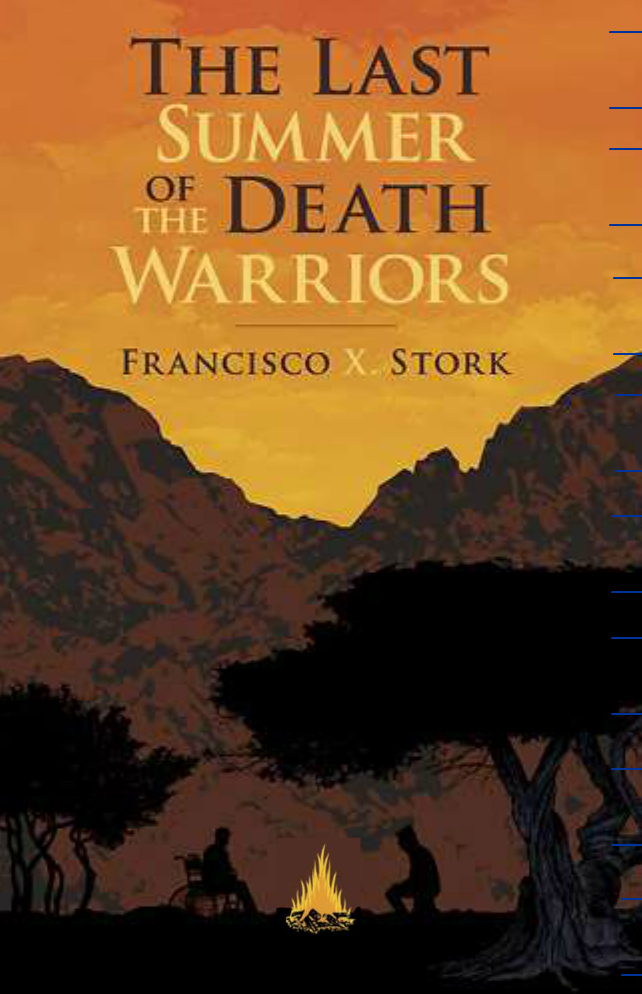
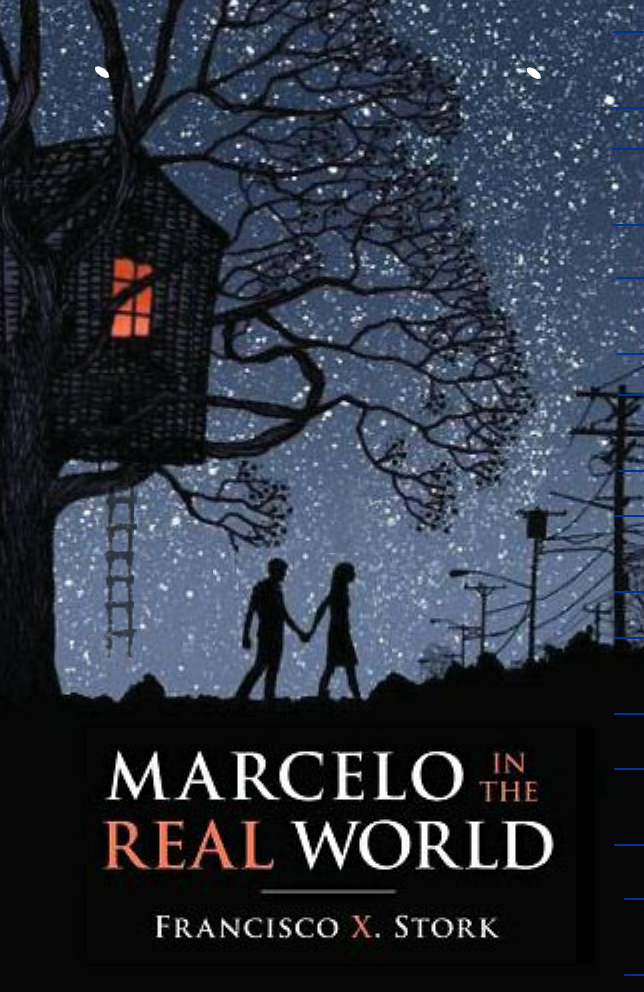
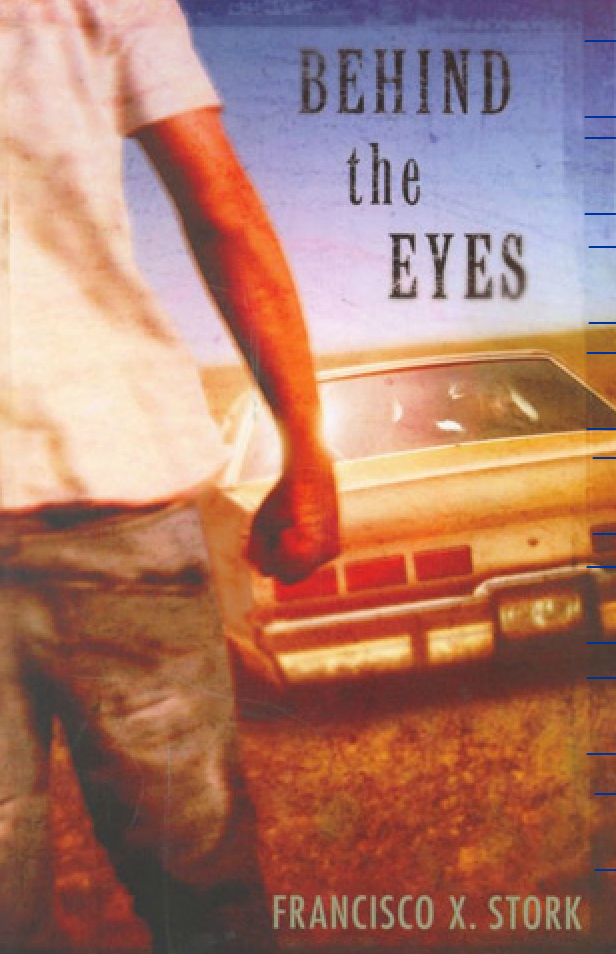
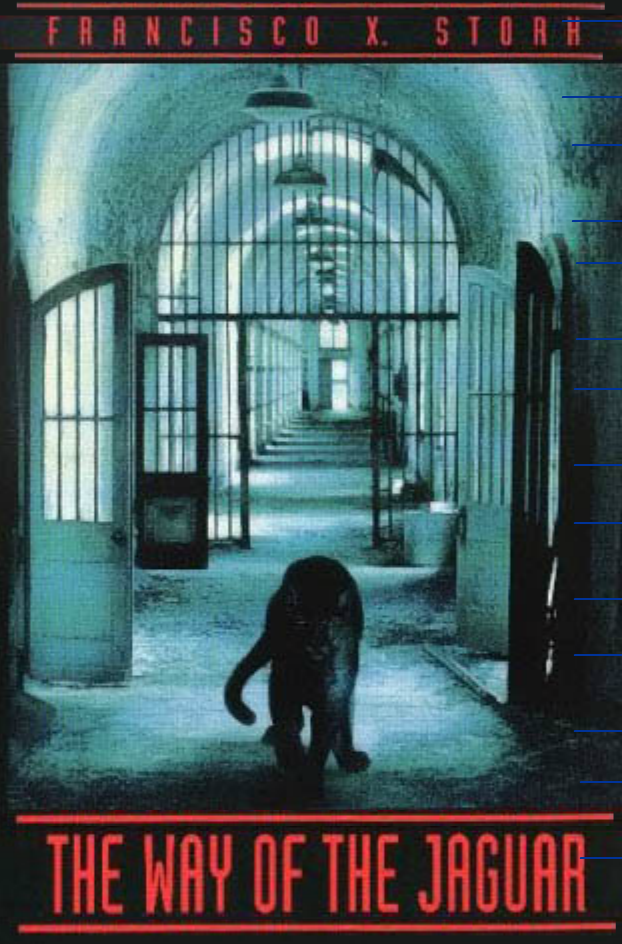
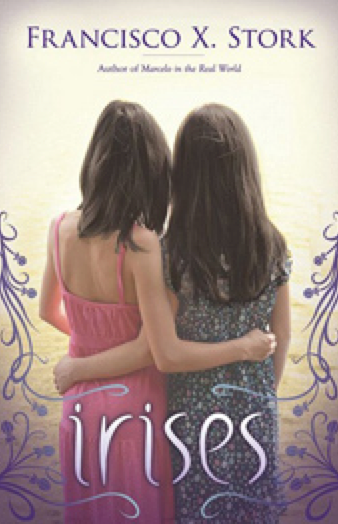
"You all right?" Bernie was standing over my bed. He had a worried look on his face. He and I had shared a room since forever. "You haven't been yourself lately. Is everything okay?"Francisco's award-winning books include The Last Summer of the Death Warriors, Marcelo in the Real World, Behind the Eyes, Way of the Jaguar, and Irises. He works in Boston as a lawyer for a state agency that develops affordable housing. Francisco was born in Monterrey, Mexico, to Ruth Arguelles, a single mother from a middle-class family in Tampico, a city on the Gulf of Mexico. Find out more about this critically-acclaimed author and his work here .
 Come visit me on the Fire Escape!

March 28, 2014
Wisconsin, Here I Come
On Tuesday, April 8, I'm honored to offer the keynote at this year's
conference
on multicultural literature at the University of Wisconsin, La Crosse. Come and join us if you're nearby.
Tuesday April 8, 2014- at -the Collaborative Learning Studio,UW-La Crosse Murphy Library, second floor.- Presentations at -12:30 - 2:00 pm and 4:00 - 5:30 pmThe program is free of charge, and participants may attend either of two presentations.
 Come visit me on the Fire Escape!

Tuesday April 8, 2014- at -the Collaborative Learning Studio,UW-La Crosse Murphy Library, second floor.- Presentations at -12:30 - 2:00 pm and 4:00 - 5:30 pmThe program is free of charge, and participants may attend either of two presentations.
 Come visit me on the Fire Escape!
March 26, 2014
KQED Hosts a Panel on Children's Literature and People of Color
On Monday, I was honored to be part of a group invited by
KQED Forum
to speak on the radio about the Cooperative Children's Book Center's (CCBC)
2013 findings on diversity in children's literature
. I joined host Mina Kim,
Nina Lindsay
, children's librarian at Oakland Public Library, and illustrator
LeUyen Pham
in the studio. K.T. Horning of the CCBC provided a pre-recorded introduction, and Christopher Myers, whose recent New York Times article, "
The Apartheid of Children's Literature
," precipitated the public interest, joined us live from Brooklyn.
Let me offer some thoughts on live radio. First, it moves fast—the hour barreled by. Second, a good host must be excellent at multi-tasking; it was fascinating to watch Mina's brain and body move in marvelous synchronicity as she steered the conversation. Three, you can't edit your words.
I said things with which I generally agree but left wishing I could have tweaked a sentence or two. For example, I wish I could clarify that I encourage authors to hold back from writing main characters from historically marginalized communities if we didn't grow up in those communities. And that I invite us to hold back only to ask tough, self-reflective questions about the reasons to write that story—as all powerful storytellers must when writing about less powerful children—but that I see no hard and fast rule about who can write for whom.
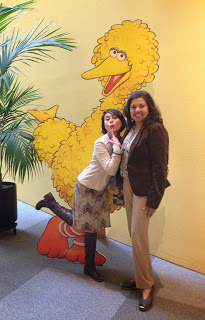
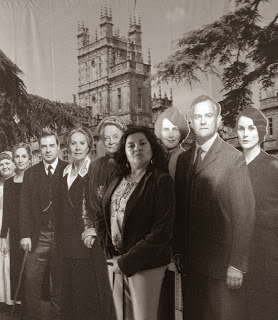
Afterwards, to celebrate that it was all done, LeUyen and I partied with Big Bird, and I schmoozed with the aristocrats of Downton Abbey.
Here's the show , or you may listen below if you'd like. Come visit me on the Fire Escape!

Let me offer some thoughts on live radio. First, it moves fast—the hour barreled by. Second, a good host must be excellent at multi-tasking; it was fascinating to watch Mina's brain and body move in marvelous synchronicity as she steered the conversation. Three, you can't edit your words.
I said things with which I generally agree but left wishing I could have tweaked a sentence or two. For example, I wish I could clarify that I encourage authors to hold back from writing main characters from historically marginalized communities if we didn't grow up in those communities. And that I invite us to hold back only to ask tough, self-reflective questions about the reasons to write that story—as all powerful storytellers must when writing about less powerful children—but that I see no hard and fast rule about who can write for whom.
Afterwards, to celebrate that it was all done, LeUyen and I partied with Big Bird, and I schmoozed with the aristocrats of Downton Abbey.


Here's the show , or you may listen below if you'd like. Come visit me on the Fire Escape!


