Sarah Townsend's Blog, page 3
August 21, 2023
Suppose vs supposed: easy ways to remember the difference
The words SUPPOSE and SUPPOSED are easy to mix up because of their obvious similarity. Here are my simple tips to help you remember the difference between SUPPOSE and SUPPOSED.
When to use SUPPOSESUPPOSE is a verb, meaning ‘to presume’.
It’s often used in a sentence like this:
“I SUPPOSE so.”
OR
“Do you SUPPOSE he’ll be coming along tonight?”
When to use SUPPOSEDSUPPOSED can be an adjective or a verb.
As an adjective, it describes something that’s generally accepted as truth.
It can be used in a sentence like this:
“This is the SUPPOSED method.”
As a verb, SUPPOSED is the past participle of SUPPOSE, meaning ‘presumed’.
SUPPOSE and SUPPOSED are most commonly confused in the expression ‘SUPPOSED to happen’.
It’s always wrong to write ‘SUPPOSE to happen’.
Remember the ED at the end of SUPPOSED and presumED to remember that SUPPOSED is past tense.
Now you know the difference between SUPPOSE and SUPPOSED. I hope these tips help you to remember the difference between these commonly confused words in the future.
Get more tips in The Little Book of ConfusablesFun, memorable spelling and usage tips for 600 commonly confused words, packed into 300+ gorgeous pages for just £11.95. You’ll wonder how you managed without it!
2023 GOLD award winner at the eLit book awards.
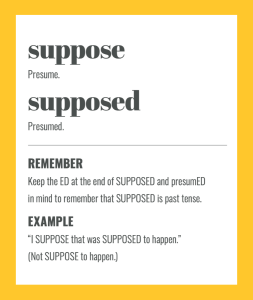
SUPPOSE and SUPPOSED. Excerpt from The Little Book of Confusables by Sarah Townsend.
The post Suppose vs supposed: easy ways to remember the difference first appeared on Sarah Townsend Editorial.
The post Suppose vs supposed: easy ways to remember the difference appeared first on Sarah Townsend Editorial.


August 14, 2023
Libel and slander: simple tips to help you remember the difference
The words LIBEL and SLANDER are commonly confused. Both are legal terms that are easy to get mixed up!
Here are my simple tips to help you learn and remember the difference between LIBEL and SLANDER.
First, you need to know that defamation is the act of saying something false and malicious about someone else.
When to use LIBEL
LIBEL can be a noun or a verb.
It relates to defamation in writing.
It can be used in a sentence like this:
“They’ve printed it in the papers now – this is LIBEL!”
To help you remember that LIBEL – or a LIBELLOUS statement – is written, think of a LIBrary (which is full of written books).
When to use SLANDERSLANDER can be a noun or a verb.
It relates to defamation in speech.
It can be used in a sentence like this:
“What you said isn’t true. It’s SLANDER.”
To remember that SLANDER is spoken, think of the S in SLANDER and Spoken.
I hope these tips help you remember the difference between LIBEL and SLANDER in the future.
Get more tips in The Little Book of ConfusablesFun, memorable spelling and usage tips for 600 commonly confused words, packed into 300+ gorgeous pages for just £11.95. You’ll wonder how you managed without it!
2023 GOLD award winner at the eLit book awards.

LIBEL vs SLANDER. Excerpt from The Little Book of Confusables by Sarah Townsend.
The post Libel and slander: simple tips to help you remember the difference appeared first on Sarah Townsend Editorial.
August 7, 2023
Holey vs holy vs wholly: simple tips to remember the difference
The words HOLEY, HOLY and WHOLLY are easy to confuse. They’re homophones – which means they sound the same – but their meanings are very different.
Here are my simple tips to help you remember the difference between HOLEY, HOLY and WHOLLY.
When to use HOLEYHOLEY is an adjective that describes something that’s full of holes.
It can be used in a sentence like this:
“This Swiss cheese is very HOLEY.”
OR
“You’re wearing HOLEY socks!”
When to use HOLYHOLY is an adjective that describes something sacred or associated with God. It’s commonly used with ‘spirit’.
It can be used in a sentence like this:
“The Bible and the Qur’an are both HOLY books.”
OR
“She was baptised by the HOLY spirit.”
When to use WHOLLYWHOLLY is an adverb that means entirely or completely.
It can be used in a sentence like this:
“I am WHOLLY committed to this idea.”
OR
“Hmm. I’m not WHOLLY convinced by your argument.”
Now you know the difference between HOLEY, HOLY and WHOLLY, you’ll remember that sponges and sieves are WHOLLY HOLEY, and that churches and temples are WHOLLY HOLY!
I hope these tips help you to remember the difference between these commonly confused words in the future.
Get more tips in The Little Book of ConfusablesFun, memorable spelling and usage tips for 600 commonly confused words, packed into 300+ gorgeous pages for just £11.95. You’ll wonder how you managed without it!
2023 GOLD award winner at the eLit book awards.
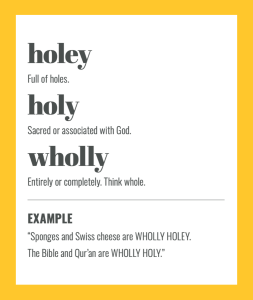
HOLEY vs HOLY vs WHOLLY. Excerpt from The Little Book of Confusables by Sarah Townsend.
The post Holey vs holy vs wholly: simple tips to remember the difference appeared first on Sarah Townsend Editorial.
July 31, 2023
Acute vs chronic: simple tips to remember the difference
The words ACUTE and CHRONIC are easy to confuse and frequently used in the wrong way.
ACUTE and CHRONIC are often used in the same context – to describe a medical condition – but their meanings are different. These tips will help you remember the difference between ACUTE and CHRONIC.
When to use ACUTEACUTE can be an adjective or a noun.
As an adjective, ACUTE means sudden or severe – often when referring to illness.
It can be used in a sentence like this:
“I’ve been experiencing ACUTE abdominal pain. It came on so suddenly!”
OR
“I have an ACUTE sense of smell.”
As an noun, ACUTE is a type of accent.
It can be used in a sentence like this:
“An ACUTE accent is a small mark that changes the pronunciation of word, such as café and financé.”
When to use CHRONICCHRONIC is an adjective.
In a medical context, it means worsening over time or recurring.
It can be used in a sentence like this:
“The doctor told me I have CHRONIC rhinitis.”
To remember CHRONIC, it helps to know that the prefix CHRON always relates to time (as in CHRONological and anaCHRONistic).
Knowing the difference between ACUTE and CHRONIC could help you better understand a medical diagnosis – or just keep up with your favourite TV drama!
I hope these tips help you to tell these commonly confused words apart in future.
Get more tips in The Little Book of ConfusablesFun, memorable spelling and usage tips for 600 commonly confused words, packed into 300+ gorgeous pages for just £11.95. You’ll wonder how you managed without it!
2023 GOLD award winner at the eLit book awards.
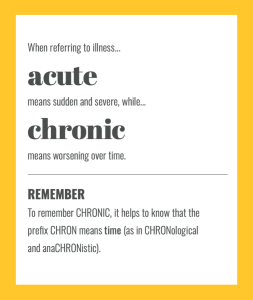
ACUTE vs CHRONIC. Excerpt from The Little Book of Confusables by Sarah Townsend.
The post Acute vs chronic: simple tips to remember the difference appeared first on Sarah Townsend Editorial.
November 7, 2022
Lost in language? Caught in confusion? You need The Little Book of Confusables
English is a messy, confusing language, and we all have blind spots – however confident you are as a writer.
For you, it could be knowing the difference between LETS or LET’S, PRACTICE or PRACTISE, EFFECT or AFFECT.
Maybe you’ve spent your life saying ‘off your own BACK‘. (It’s BAT, actually.)
Or perhaps you didn’t realise there were two spellings – and two different meanings! – of DISCRETE/DISCREET, HOARD/HORDE and REIN/REIGN.
You’re not alone!In the 30 years I’ve been a copywriter and editor, I’ve worked with thousands of smart people – many of whom simply don’t find language easy to grasp.
It’s really no surprise. Our language is full of lookalike and soundalike words that have different meanings. The problem is, using the wrong word can completely change your message – and lead to embarrassing mistakes!
BALD men aren’t always BOLD.DISEASED may be bad, but DECEASED is a whole lot worse.Dramatic CORDS require the fashion police.And heaven forbid you ask someone to ‘BARE with me’ – unless you’re a fan of getting naked with strangers. (Yikes!)I call these words confusables – and I’ve been sharing tips to help you remember them on social media since 2016.
In 2022, I brought them together in The Little Book of Confusables: 300 pages of tips to remember almost 600 commonly confused words.
Who is The Little Book of Confusables for?The Little Book of Confusables is now used by teachers, editors, proofreaders, copywriters, authors, graphic designers, translators… as well as anyone and everyone who ever has to write emails or social media content.
It’s a book that’ll make you laugh and learn – and one that’ll help you avoid embarrassing errors.
As Leif Kendall, Director of ProCopywriters said: “This is the perfect book for anyone who reads, writes or speaks.”
I make that all of us…
What are confusables?Confusables are any two (or more) words that trip us up when we’re writing or speaking. Here are my categories of confusing words:
Homophones: words that sound the same but have different meanings.
Homographs: words that are spelled the same but have different meanings.
Homonyms: which can be homographs, homophones or both.
Malapropisms: which occur when a similar-sounding wrong word is used instead of the right word, with nonsensical and often funny results.
Eggcorns: which occur when a word or phrase with a similar meaning is misheard or misunderstood.
Miscellaneous: the word pairs that defy categorisation but are still confusables. Words like ACUTE + CHRONIC, LIBEL + SLANDER and POISONOUS + VENOMOUS.
What’s included?The Little Book of Confusables contains fun, memorable reminders for 500+ of the words you find most confusing, so you can boost your vocabulary, write with confidence and avoid embarrassing mistakes.
Learn tips to remember the difference between homophones such as COMPLIMENT + COMPLIMENT, DEPENDANT + DEPENDENT, avoid malapropisms and eggcorns like DAMP SQUID and DOGGY DOG WORLD – plus simple grammar lessons on commonly confused terms like LESS + FEWER and NUMBER + AMOUNT
…all in a gorgeous, flickable, fits-in-your-bag format.
Where can I buy The Little Book of Confusables?The Little Book of Confusables is available on Amazon worldwide, or you can order a signed copy direct from me – and support my small business in the process!
The post Lost in language? Caught in confusion? You need The Little Book of Confusables appeared first on Sarah Townsend Editorial.
Confusables? What in the world is a confusable?!
English is a messy language, and we all have blind spots – however confident you are as a writer.
For you, it could be knowing the difference between LETS or LET’S, PRACTICE or PRACTISE, EFFECT or AFFECT.
Maybe you’ve spent your life saying ‘off your own BACK‘. (It’s BAT, actually.)
Or perhaps you didn’t realise there were two different spellings – and two different meanings! – of DISCRETE/DISCREET, HOARD/HORDE and REIN/REIGN.
You’re not alone!In the 30 years I’ve been a copywriter and editor, I’ve worked with thousands of smart people – many of whom simply don’t find language easy to grasp.
It’s really no surprise. Our language is full of similar words that have different meanings. The problem is, using the wrong word can completely change your message – and lead to embarrassing mistakes!
BALD men aren’t always BOLD.DISEASED may be bad, but DECEASED is a whole lot worse.Dramatic CORDS require the fashion police.And heaven forbid you ask someone to ‘BARE with me’ – unless you’re a fan of getting naked with strangers. (Yikes!)I call these words confusables – and I’ve been sharing tips to help you remember them on social media since 2016. In 2022, I brought my tips together in The Little Book of Confusables: 300 pages of tips to remember almost 600 commonly confused words.
Who’s The Little Book of Confusables for?The Little Book of Confusables is now used by teachers, editors, proofreaders, copywriters, authors, graphic designers, translators… as well as anyone and everyone who ever has to write emails, content for their business… you name it.
It’s a book that’ll make you laugh and learn – and one that’ll help you avoid embarrassing errors.
As Leif Kendall, Director of ProCopywriters said: “This is the perfect book for anyone who reads, writes or speaks.”
I make that all of us…
Confusables categoriesHere are some of the different types of words that trip us up when we’re writing:
Homophones: words that sound the same but have different meanings.
Homographs: words that are spelled the same but have different meanings.
Homonyms: which can be homographs, homophones or both.
Malapropisms: which occur when a similar-sounding wrong word is used instead of the right word, with nonsensical and often funny results.
Eggcorns: which occur when a word or phrase with a similar meaning is misheard or misunderstood.
Miscellaneous: the word pairs that defy categorisation but are still confusables. Words like ACUTE + CHRONIC, LIBEL + SLANDER and POISONOUS + VENOMOUS.
What’s included?The Little Book of Confusables contains fun, memorable reminders for 500+ of the words you find most confusing, so you can boost your vocabulary, write with confidence and avoid embarrassing mistakes.
Learn tips to remember the difference between homophones such as COMPLIMENT + COMPLIMENT, DEPENDANT + DEPENDENT, avoid malapropisms and eggcorns like DAMP SQUID and DOGGY DOG WORLD – plus simple grammar lessons on commonly confused terms like LESS + FEWER and NUMBER + AMOUNT
…all in a gorgeous, flickable, fits-in-your-bag format.
Where can I buy The Little Book of Confusables?The Little Book of Confusables is available on Amazon worldwide, or you can order a signed copy direct from me – and support my small business in the process!
The post Confusables? What in the world is a confusable?! appeared first on Sarah Townsend Editorial.
October 27, 2022
How writing a bestselling book (okay – two) changed my life
We hear it all the time: writing a book is the best way to position yourself as an expert in your field. Daniel Priestley* has a lot to answer for!
But I didn’t set out to do that.
Having worked in marketing for almost 30 years – and been a freelance copywriter for 23 of those years – I already had a pretty decent personal brand, and an even better social media presence.
It was never about me. (And call me cynical, but most books written with an end goal of elevating the author’s profile come across as just that.)
Unlike most people, I always believed I didn’t have a book in me, so no one was more surprised than me when the idea to write a book temporarily took over my brain.
In 2020, I wrote my first self-published bestseller, Survival Skills for Freelancers. Since its launch, it’s helped freelancers and entrepreneurs in more than 20 countries grow in confidence and get more enjoyment from self-employment – without getting sucked into the six-figure hustle.
I knew from others who’d published business books that I wouldn’t make my fortune from self-publishing. My financial expectations were – quite honestly – pretty low.
But I wasn’t motivated by money.
I was motivated by using my 20+ years of experience to help others tackle the challenges and avoid the pitfalls of self-employment. The stuff no one talks about. Because there are plenty of books on the practicalities of self-employment, but still not enough (IMO) on developing the right mindset for success.
A mindset that prioritises your mental and physical health so you can do your best, most creative and most fulfilling work. A mindset that centres on setting boundaries, saying no, outsourcing, charging your worth and dealing with imposter syndrome.
I’d lived this stuff. I’d made the mistakes.
I could share my experience to help others do better.And somehow that message just resonated.
People shared (and still share, two years later) the book on their social media. They wrote incredible reviews, explaining how Survival Skills for Freelancers had helped them grow in confidence and become more successful. They even shared stories of how the book had given them the confidence to take the leap into freelance life!
Call me naive, but I just thought I’d write the book, publish the book, and go back to the day job.
But that’s not what happened…
People invited me to talk to their book clubs, to deliver webinars and Q&As, to guest on their podcasts – even to become a mentor (which I did for both the FreelanceHER 100 project and the government’s Help To Grow scheme).
I’d never done any of this stuff before. I wasn’t sure I had the confidence to do it then, frankly – but it turned out I could. And I was pretty good at it, too!
I said a big fat yes to every opportunity that came my way.And I was loving it – but it wasn’t all positive. I became hooked on having an impact and helping others become more successful, while completely overlooking my own success.
(Plus engagement is validation, right?!)
Most of the opportunities I was saying yes to didn’t pay – and I took my eye off the ball when it came to my copywriting work: the work that pays the bills.
The situation became so bad that clients I’d worked with for years began to say, “Looks like things are going great for you. But are you still doing the copywriting?”
As a result of the confusion, my income plummeted. Like, badly.
I’d been letting other people’s expectations eat away at me, and was feeling the pressure of should.
You know what it’s like:
“You should monetise your network and create a paid membership group!”“You should design an online course, to capitalise on your knowledge.”“You should create a suite of passive income products, so you can make money while you sleep!”I even paid someone a tidy sum to help me create these things – and it was only after I’d had three sessions that I realised it wasn’t what I wanted.
I missed spending my time writing websites, and transforming my clients’ documents.My superpower. The work that makes me happy.
I’d lost my balance, but I didn’t want to let anyone down! Where did I draw the line?
Two years after the launch of Survival Skills for Freelancers, I had a lightbulb moment.
I was attending a goal-setting session run by Ruth Gilbey in her Online Business Collective, when she asked participants to write down the things we wanted to let go of – anything we’d stopped enjoying, or that wasn’t serving us.
It was time to let go of that pressure. I didn’t have to start a membership, become a coach or create an online course. I could get back to the copywriting work I love, and that I earn a good living from.
And sure – I could still do the webinars, talks and workshops… but it was time to take my own advice and stop doing them for free!
It was a revelation.Letting go freed me up the headspace and time to refocus on the work I love.
And rather than feeling pressure to write a sequel to Survival Skills for Freelancers, I found myself revisiting an idea I’d had back in 2016: to create a book that unites my much-loved #confusables tips in one place…
In August 2022, I launched The Little Book of Confusables: 300 pages jam-packed with invaluable, fun spelling and usage tips to help smart people avoid stupid mistakes with commonly confused words.
It’s become incredibly popular. To quote social media trainer, Lou Chudley: “A brilliant book! Perfect for anyone who ever has to write anything.”
There’s no doubt that publishing my books has changed my life – just not in the ways you might have expected.
This time round? I’m keeping my eye on the ball.
*Daniel Priestley wrote a well-known book called Key Person of Influence, in which he recommends writing a book as just one tool to help position yourself as a leader in your field.
A reality check!People think you can get rich from writing a book. Maybe if you have the profile, the resources and the marketing budget of a New York Times bestselling author… or the back catalogue of Stephen King!
For context, The Little Book of Confusables has a cover price of £11.95. From that, I make £7.17 a copy – that’s 60% in royalties. Not bad, eh? Until you deduct printing costs – and I’m left with a poxy £3.31 a copy!
The only way I’m getting rich from my books is if I sell them in the tens of thousands… anyone fancy placing a bulk order?! 
The post How writing a bestselling book (okay – two) changed my life appeared first on Sarah Townsend Editorial.
How writing a bestselling book (two, actually) changed my life
We hear it all the time: writing a book is the best way to position yourself as an expert in your field. Daniel Priestley has a lot to answer for!
But I didn’t set out to do that.
Having worked in marketing for almost 30 years – and been a freelance copywriter for 23 of those years – I already had a pretty decent personal brand, and an even better social media presence.
It was never about me. (And call me cynical, but most books written with an end goal of elevating the author’s profile come across as just that.)
Unlike most people, I always believed I didn’t have a book in me, so no one was more surprised than me when the idea to write a book temporarily took over my brain.
In 2020, I wrote my first self-published bestseller, Survival Skills for Freelancers. Since its launch, it’s helped freelancers and entrepreneurs in more than 20 countries grow in confidence and get more enjoyment from self-employment – without getting sucked into the six-figure hustle.
I knew from others who’d published business books that I wouldn’t make my fortune from self-publishing. My financial expectations were – quite honestly – pretty low.
But I wasn’t motivated by money.
I was motivated by using my 20+ years of experience to help others tackle the challenges and avoid the pitfalls of self-employment. The stuff no one talks about. Because there are plenty of books on the practicalities of self-employment, but still not enough (IMO) on developing the right mindset for success.
A mindset that prioritises your mental and physical health so you can do your best, most creative and most fulfilling work. A mindset that centres on setting boundaries, saying no, outsourcing, charging your worth and dealing with imposter syndrome.
I’d lived this stuff. I’d made the mistakes.
I could share my experience to help others do better.
And somehow that message just resonated.
People shared (and still share, two years later) the book on their social media. They wrote incredible reviews, explaining how Survival Skills for Freelancers had helped them grow in confidence and become more successful. They even shared stories of how the book had given them the confidence to take the leap into freelance life!
Call me naive, but I just thought I’d write the book, publish the book, and go back to the day job.
But that’s not what happened…
People invited me to talk to their book clubs, to deliver webinars and Q&As, to guest on their podcasts – even to become a mentor (which I did for both the FreelanceHER 100 project and the government’s Help To Grow scheme).
I’d never done any of this stuff before. I wasn’t sure I had the confidence to do it then, frankly – but it turned out I could. And I was pretty good at it, too!
I said a big fat yes to every opportunity that came my way. And I was loving it.
But it wasn’t all positive. I became hooked on having an impact and helping others become more successful, while completely overlooking my own success.
(Plus engagement is validation, right?!)
Most of the opportunities I was saying yes to didn’t pay – and I took my eye off the ball when it came to my copywriting work: the work that pays the bills.
The situation became so bad that clients I’d worked with for years began to say, “Looks like things are going great for you. But are you still doing the copywriting?”
As a result of the confusion, my income plummeted. Like, badly.
I’d been letting other people’s expectations eat away at me, and was feeling the pressure of should.
You know what it’s like:
“You should monetise your network and create a paid membership group!”“You should design an online course, to capitalise on your knowledge.”“You should create a suite of passive income products, so you can make money while you sleep!”I even paid someone a tidy sum to help me create these things – and it was only after I’d had three sessions that I realised it wasn’t what I wanted.
I missed spending my time writing websites, and transforming my clients’ documents.
My superpower. The work that makes me happy.
I’d lost my balance, but I didn’t want to let anyone down! Where did I draw the line?
Two years after the launch of Survival Skills for Freelancers, I had a lightbulb moment.
I was attending a goal-setting session run by Ruth Gilbey in her Online Business Collective, when she asked participants to write down the things we wanted to let go of – anything we’d stopped enjoying, or that wasn’t serving us.
It was time to let go of that pressure. I didn’t have to start a membership, become a coach or create an online course. I could get back to the copywriting work I love, and that I earn a good living from.
And sure – I could still do the webinars, talks and workshops… but it was time to take my own advice and stop doing them for free!
It was a revelation.
Letting go freed me up the headspace and time to refocus on the work I love.
And rather than feeling pressure to write a sequel to Survival Skills for Freelancers, I found myself revisiting an idea I’d had back in 2016: to create a book that unites my much-loved #confusables tips in one place…
In August 2022, I launched The Little Book of Confusables: 300 pages jam-packed with invaluable, fun spelling and usage tips to help smart people avoid stupid mistakes with commonly confused words.
It’s become incredibly popular. To quote social media trainer, Lou Chudley: “A brilliant book! Perfect for anyone who ever has to write anything.”
There’s no doubt that publishing my books has changed my life – just not in the ways you might have expected.
This time round? I’m keeping my eye on the ball.
The post How writing a bestselling book (two, actually) changed my life appeared first on Sarah Townsend Editorial.
September 28, 2022
ALLUSION vs ELUSION vs ILLUSION: simple tips to remember the difference
The words ALLUSION, ELUSION and ILLUSION are easy to confuse, given that they sound so similar – but there’s actually a world of difference in their meanings!
Here are my simple tips to remember the difference between the words ALLUSION, ELUSION and ILLUSION.
When to use ALLUSIONALLUSION is a noun meaning an indirect reference. The verb form is ALLUDE.
You can use ALLUSION in a sentence like this:
“I noticed his tactful ALLUSION to the difficult situation with your client.”
When to use ELUSIONELUSION is a noun meaning escape or avoid. The verb form is ELUDE.
To remember, think of the E of escape and ELUSION.
You can use ELUSION in a sentence like this:
“You handled that question well. Quite a tactical ELUSION!”
When to use ILLUSIONILLUSION is a noun referring to a deception – often a visual one. To remember, think of the ‘i’ in ILLUSION and the ‘eye’ you use to view an optical ILLUSION.
You can use ILLUSION in a sentence like this:
“Come see! This optical ILLUSION is really trippy!”
Pro tipRemember, while ALLUSION and ILLUSION are spelled with a double L, the word ELUSION – and the verb ELUDE – has only one L.
Now you know the difference between ALLUSION, ELUSION and ILLUSION you’ll know when and how to use phrases like ‘optical ILLUSION‘, ‘tactical ELUSION‘ and ‘tactful ALLUSION‘!
I hope my tips help you to understand and remember the difference between these commonly confused words.
Get more tips in The Little Book of Confusables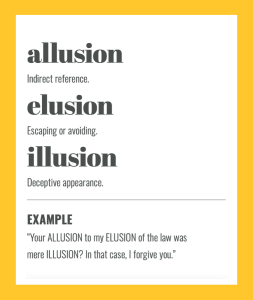
ALLUSION vs ELUSION vs ILLUSION. Excerpt from The Little Book of Confusables by Sarah Townsend. Get simple spelling tips for 500+ commonly confused words.
The post ALLUSION vs ELUSION vs ILLUSION: simple tips to remember the difference appeared first on Sarah Townsend Editorial.
September 22, 2022
PAIR vs PARE vs PEAR: simple spelling tips to remember the difference
The words PAIR, PARE and PEAR are easy to confuse because they’re homophones – words that sound the same but have different meanings.
Here are my simple tips to remember the difference between the words PAIR, PARE and PEAR.
When to use PAIRPAIR can be a noun or verb. As a noun, PAIR describes a group of two things.
As a noun, you can use PAIR in a sentence like this:
“I swear my washing machine eats socks… There’s always one sock missing from the PAIR!”
As a verb, PAIR describes the act of grouping two things.
As a verb, you can use PAIR in a sentence like this:
“I like to sit in the sunshine and PAIR my socks.”
When to use PAREPARE is a verb, meaning to trim or reduce in size. It’s often used with the word ‘down’.
Use PARE in a sentence like this:
“Let’s PARE down this budget. We’re spending way too much!”
When to use PEARPEAR is a noun, referring to the juicy green fruit.
Use PEAR in a sentence like this:
“I’m a bit bored of apples, but I wouldn’t say no to a PEAR.”
Remember, if you PARE down a PAIR of PEARS, you’ll only be left with one!
Now you know the difference between PAIR, PARE and PEAR! I hope my tips help you remember the difference between these commonly confused words in the future.
Get more tips in The Little Book of Confusables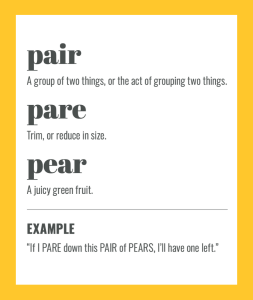
PAIR vs PARE vs PEAR. Excerpt from The Little Book of Confusables by Sarah Townsend. Get simple spelling tips for 500+ commonly confused words.
The post PAIR vs PARE vs PEAR: simple spelling tips to remember the difference appeared first on Sarah Townsend Editorial.