Sarah Townsend's Blog, page 2
January 31, 2024
Dealing with the quiet times: three simple tips to take the fear out of freelance famine
Highs and lows. Peaks and troughs. Feast or famine.
Quiet times can feel like an inevitable part of freelance life – and the unpredictability of self-employment can be relentless, however experienced you are.
But there’s a lot you can do to take the fear out of the famine.
Here are three simple tips to make your next quiet spell feel like a gift – not a curse.
ReframeStop focusing on the lack of work.
Easier said than done, I know. Being quiet can drag around with you like a dark cloud that impacts your every thought – particularly if you’re someone for whom your self-esteem feels inexorably linked to how busy you are (err, hello!).
But, as Tony Robbins says, “Energy flows where attention goes.”
And when you focus on the lack of something, you get more of that lack.
Instead, switch your focus to positive, proactive activity.
Start a list of projects and tasks you’d love to focus on but can never find the time. Next time work dries up, turn to this list and pick just one – rather than sinking into the inevitable doom and gloom that all too often accompanies a quiet spell.
You could:
Give your website a much-needed overhaul so you can start attracting more of the work you love. Start drafting that business book you’ve always planned to write.Improve your Canva skills so you can post eye-catching graphics on social media – or teach yourself Facebook ads.Work your way through that growing TBR pile of inspiring business books you never have time to read.Streamline and automate your processes so you’re more efficient when work picks up.Think about starting your own podcast – or catch up with episodes of your favourite show.

December 11, 2023
Will you get a gold star from Santa this year? Take my fun spelling quiz and find out…
(Yes – spelling and fun in the same sentence. That’s how I roll…)
Pick the correct spelling from the options below and scroll down for the answers when you’re done.
Be warned – this year’s spelling quiz is more fiendish than ever 
a) “It’ll soon be Christmas! Have you wrapped all your presence yet?”
b) “It’ll soon be Christmas! Have you wrapped all your presents yet?”
c) “It’ll soon be Christmas! Have you rapped all your presence yet?”
d) “It’ll soon be Christmas! Have you rapped all your presents yet?”
Question 2a) “Getting a large amount of presents is dependent on being good all year!”
b) “Getting a large amount of presents is dependant on being good all year!”
c) “Getting a large number of presence is dependent on being good all year!”
d) “Getting a large number of presents is dependent on being good all year!”
Question 3a) “Tickets to the Christmas bizarre are £10 and include complimentary mince pies”
b) “Tickets to the Christmas bazaar are £10 and include complimentary mint spies”
c) “Tickets to the Christmas bazaar are £10 and include complimentary mince pies”
d) “Tickets to the Christmas bizarre are £10 and include complementary mince pies”
Question 4a) “I wonder who’s doing the Alternate Christmas Message on Channel 4 this year!”
b) “I wonder whose doing the Alternate Christmas Message on Channel 4 this year!”
c) “I wander who’s doing the Alternative Christmas Message on Channel 4 this year!”
d) “I wonder who’s doing the Alternative Christmas Message on Channel 4 this year!”
Question 5a) “Let’s have a cheeky glass of sherry while watching the King’s speech”
b) “Let’s have a cheeky glass of sherry while watching the King’s peach”
c) “Lets have a cheeky glass of sherry while watching the King’s speech”
d) “Lets have a cheeky glass of sherry while watching the King’s peach”
Question 6a) “I had one too many at the new year party. It’s led to a hangover!”
b) “I had one too many at the new year party. It’s lead to a hangover!”
c) “I had one to many at the new year party. It’s lead to a hangover!”
d) “I had one too many at the new year party. Its led to a hangover!”
Question 7a) “The holly berries look beautiful, but be warned – they’re venomous!”
b) “The holly berries look beautiful, but be warned – there poisonous!”
c) “The holly berries look beautiful, but be warned – their poisonous!”
d) “The holly berries look beautiful, but be warned – they’re poisonous!”
Question 8a) “Lets stay off our devises and enjoy the day together”
b) “Let’s stay of our devices and enjoy the day together”
c) “Let’s stay off our devices and enjoy the day together”
d) “Lets stay off our devices and enjoy the day together”
Question 9a) “I’m finely getting the nut roast in the oven. Bear with me!”
b) “I’m finally getting the nut roast in the oven. Bear with me!”
c) “I’m finely getting the nut roast in the oven. Bare with me!”
d) “I’m finally getting the nut roast in the oven. Bare with me!”
Question 10a) “I wish you patients, peace and wander this Christmas”
b) “I wish you patience, piece and wonder this Christmas”
c) “I wish you patience, peas and wander this Christmas”
d) “I wish you patience, peace and wonder this Christmas”
How did you get on? Scroll down for the answers…
Answers
Q1) b
Q2) d
Q3) c
Q4) d
Q5) a
Q6) a
Q7) d
Q8) c
Q9) b
Q10) d
How did you go-ho-ho?
9 to 10: Gold star for you – that was tricky!
6 to 8: Pretty good! The Little Book of Confusables has you covered
0 to 5: The Little Book of Confusables is your new best friend
Love a dose of nerdy, wordy fun? Get 600 confusing words demystified in 300+ gorgeous, fun pages here.
The post Will you get a gold star from Santa this year? Take my fun spelling quiz and find out… first appeared on Sarah Townsend Editorial.
The post Will you get a gold star from Santa this year? Take my fun spelling quiz and find out… appeared first on Sarah Townsend Editorial.
December 7, 2023
BESIDE vs BESIDES: simple tips to help you remember the difference
Here are my simple tips to remember the difference between BESIDE and BESIDES.
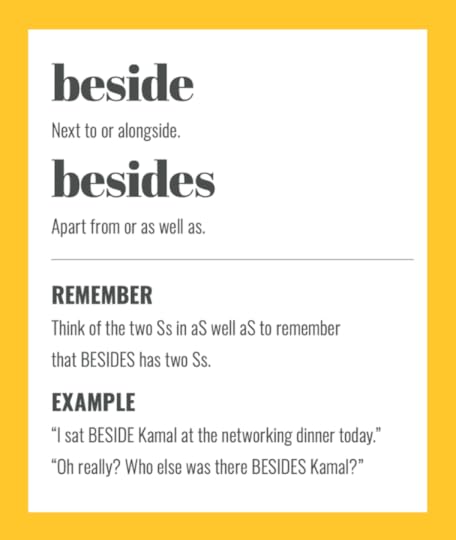
When to use BESIDEBESIDE is a preposition used to describe where something is. It means ‘next to’ or ‘alongside’.
You can use BESIDE in a sentence like this:
“I sat BESIDE my brother on the bus.”
OR
“The glasses are in the cupboard BESIDE the mugs.”
When to use BESIDESAs a preposition, BESIDES means ‘apart from’ or ‘as well as’. As an adverb, it means ‘in addition’ or ‘as well’.
To help you remember the difference, think of the two Ss in aS well aS to remember that BESIDES has two Ss.
As a preposition, you can use BESIDES in a sentence like this:
“I wear no jewellery BESIDES this necklace.”
OR
“BESIDES my sister, I have no other siblings.”
As an adverb, you can use BESIDES in a sentence like this:“She was talented in music, and a lot more BESIDES.”
Here’s an example of BESIDE and BESIDES in use:
“I sat BESIDE Kamal at the networking dinner today.”
“Oh really? Who else was there BESIDES Kamal?”
Wondering how to write the common expression used to say something is irrelevant?
It’s always ‘BESIDE the point’ – never ‘BESIDES the point’.
BUY NOW
Get more tips in The Little Book of ConfusablesFun, memorable spelling tips for 600 commonly confused words, packed into 300+ gorgeous pages: just £11.95.
You’ll wonder how you managed without it!
GOLD award winner: 2023 eLit book awards/Distinguished Favorite: 2023 NYC Big Book Awards.
The post BESIDE vs BESIDES: simple tips to help you remember the difference first appeared on Sarah Townsend Editorial.
The post BESIDE vs BESIDES: simple tips to help you remember the difference appeared first on Sarah Townsend Editorial.
November 30, 2023
BOUGHT vs BROUGHT: simple spelling tips to remember the difference
Here are my simple tips to remember the difference between BOUGHT and BROUGHT.
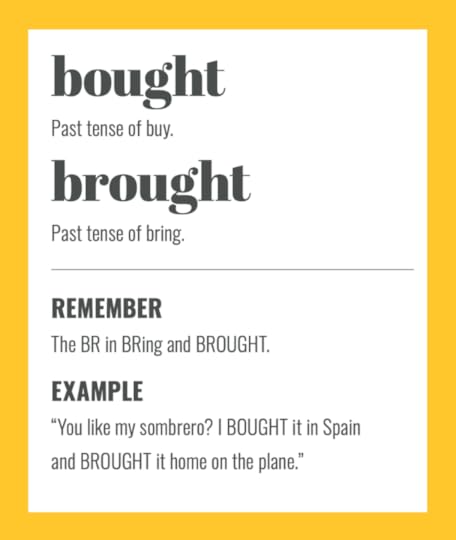
When to use BOUGHTBOUGHT is the past tense of the verb buy.
You can use BOUGHT in a sentence like this:
“I BOUGHT a kilo of apples to make the pie.”
OR
“The new glasses I BOUGHT are in the cupboard.”
When to use BROUGHTBROUGHT is the past tense of the verb bring.
You can use BROUGHT in a sentence like this:
“I BROUGHT you some soup to help you feel better.”
OR
“Last year he BROUGHT a delicious chocolate cake to the party.”
Here’s another example of BOUGHT and BROUGHT in use:
“You like my Sombrero? I BOUGHT it in Spain and BROUGHT it home on the plane”
Remember this simple tip to know the difference between BOUGHT and BROUGHT:
Think of the BR in BRing and BRought.
BUY NOW
Get more tips in The Little Book of ConfusablesFun, memorable spelling tips for 600 commonly confused words, packed into 300+ gorgeous pages: just £11.95.
You’ll wonder how you managed without it!
GOLD award winner: 2023 eLit book awards/Distinguished Favorite: 2023 NYC Big Book Awards.
The post BOUGHT vs BROUGHT: simple spelling tips to remember the difference first appeared on Sarah Townsend Editorial.
The post BOUGHT vs BROUGHT: simple spelling tips to remember the difference appeared first on Sarah Townsend Editorial.
November 23, 2023
ADVERSE vs AVERSE: simple spelling tips to remember the difference
Here are my simple tips to remember the difference between ADVERSE and AVERSE.
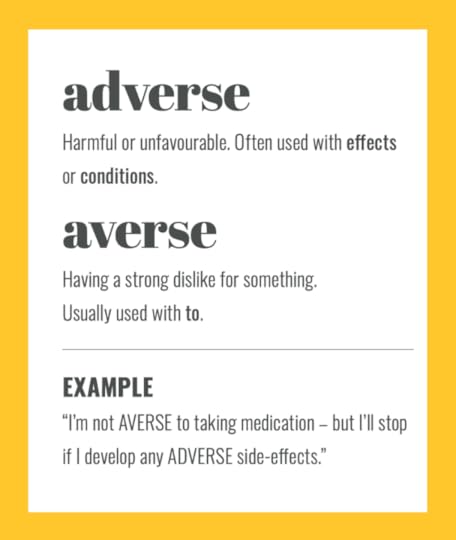
When to use ADVERSEADVERSE is an adjective that means harmful or unfavourable. It’s often used with the word ‘effects’ or ‘conditions’.
You can use ADVERSE in a sentence like this:
“The prescribed medicine had an ADVERSE effect on the patient.”
OR
“The strike had an ADVERSE effect on production.”
When to use AVERSEAVERSE is an adjective that describes the feeling of having a strong dislike for something.
It’s often used with the preposition ‘to’, like this:
“I became vegan because I’m AVERSE to eating meat.”
But it can also be used in a compound adjective, like this:“When it comes to investing my money, I’m fairly risk-AVERSE.”
This sentence shows the difference between ADVERSE and AVERSE in use:
“I’m not AVERSE to taking medication – but I’ll stop if I develop any ADVERSE side-effects.”
BUY NOW
Get more tips in The Little Book of ConfusablesFun, memorable spelling tips for 600 commonly confused words, packed into 300+ gorgeous pages: just £11.95.
You’ll wonder how you managed without it!
GOLD award winner: 2023 eLit book awards/Distinguished Favorite: 2023 NYC Big Book Awards.
The post ADVERSE vs AVERSE: simple spelling tips to remember the difference first appeared on Sarah Townsend Editorial.
The post ADVERSE vs AVERSE: simple spelling tips to remember the difference appeared first on Sarah Townsend Editorial.
October 22, 2023
BREATH vs BREATHE vs BREADTH: simple spelling tips to remember the difference
Here are my simple tips to remember the difference between BREATH, BREATHE and BREADTH.
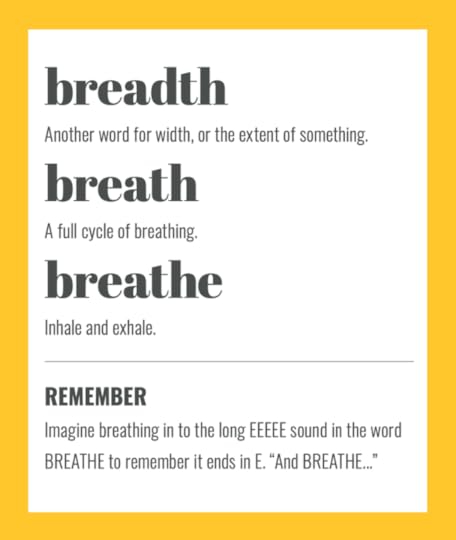
When to use BREATHBREATH is a noun that refers to the full cycle of breathing.
You can use BREATH in a sentence like this:
“Take a deep BREATH before you respond.”
OR
“I ran all the way home. I’m out of BREATH now!”
When to use BREATHEBREATHE is a verb that describes the action of inhaling and exhaling air from the lungs.
You can use BREATHE in a sentence like this:
“Please BREATHE in deeply.”
OR
“And BREATHE…”
Here’s a simple tip to help you remember how to spell BREATHE:When to use BREADTHImagine breathing in to the long EEEEE sound in the word BREATHE to remember it ends in E.
BREADTH is another word for width, or the extent of something.
You can use BREADTH in a sentence like this:
“Don’t underestimate the new lecturer. The BREADTH of his knowledge is incredible!”
OR
“The BREADTH of the boat made it hard to navigate the canal.”
I hope these tips help you remember the difference between BREATH, BREATHE and BREADTH in future!
Get your copy
Get more tips in The Little Book of ConfusablesFun, memorable spelling and usage tips for 600 commonly confused words, packed into 300+ gorgeous pages for just £11.95. You’ll wonder how you managed without it!
GOLD award winner at the 2023 eLit book awards/Distinguished Favorite in the 2023 NYC Big Book Awards.
The post BREATH vs BREATHE vs BREADTH: simple spelling tips to remember the difference first appeared on Sarah Townsend Editorial.
The post BREATH vs BREATHE vs BREADTH: simple spelling tips to remember the difference appeared first on Sarah Townsend Editorial.
September 18, 2023
Wander vs wonder: simple spelling tips to help you remember the difference
The words WANDER and WONDER are easy to confuse because they’re homophones. Despite the fact they sound the same, their meanings are very different!
Here’s my advice to help you remember the difference between WANDER and WONDER.
When to use WANDERWANDER is a verb that describes the action of moving aimlessly.
It can be used in a sentence like this:
“We WANDERED around the town with no destination in mind.”
OR
The famous poem from William Wordsworth:
“I WANDERED lonely as a cloud”
When to use WONDERWONDER can be a verb or a noun.
As a verb, WONDER describes the action of pondering or being curious.
It can be used like this:
“I WONDER what we’ll have for dinner.”
As a noun, WONDER describes something exceptional to be marvelled at, like the Seven Wonders of the Ancient World.
It can be used in a sentence like this:
“Her eyes were filled with WONDER at the beautiful view.”
Remember that WONDER is synonymous with pONDER, which shares the same ending – and that WANDER contains the A of Aimless.
I hope my tips help you remember the difference between WONDER and WANDER in the future!
Get more tips in The Little Book of ConfusablesFun, memorable spelling and usage tips for 600 commonly confused words, packed into 300+ gorgeous pages for just £11.95. You’ll wonder how you managed without it!
2023 GOLD award winner at the eLit book awards.
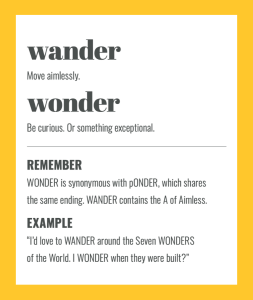
WANDER and WONDER. Excerpt from The Little Book of Confusables by Sarah Townsend.
The post Wander vs wonder: simple spelling tips to help you remember the difference first appeared on Sarah Townsend Editorial.
The post Wander vs wonder: simple spelling tips to help you remember the difference appeared first on Sarah Townsend Editorial.
September 11, 2023
Vain vs vane vs vein: simple tips to remember the difference
The words VAIN, VANE and VEIN are easy to confuse because they sound the same – they’re homophones – but their meanings are very different!
These simple spelling and usage tips will help you remember the difference between VAIN, VANE and VEIN.
When to use VAINVAIN is an adjective that describes someone who’s conceited – like the guy in the famous Carly Simon song, You’re So Vain.
VAIN can be used in a sentence like this:
“He was arrogant and VAIN.”
VAIN is also used in the phrase ‘in VAIN’, which describes a fruitless task.
(Don’t write ‘in VEIN’ unless you mean intravenous. There’s a big difference!)
When to use VANEThe word VANE usually proceeds ‘weather’.
A weather VANE is a device that indicates wind direction. You’ve probably seen them on the top of churches.
VANE can be used in a sentence like this:
“The class made their own weather VANES from paper and a straw.”
When to use VEINVEIN is a noun that describes a blood vessel.
It can be used in a sentence like this:
“I tried giving blood but they couldn’t find a VEIN!”
VEIN is also used in the phrase ‘in the same VEIN’, which implies likeness.
I hope these tips help you to remember the difference between these commonly confused words in the future.
Get more tips in The Little Book of ConfusablesFun, memorable spelling and usage tips for 600 commonly confused words, packed into 300+ gorgeous pages for just £11.95. You’ll wonder how you managed without it!
2023 GOLD award winner at the eLit book awards.
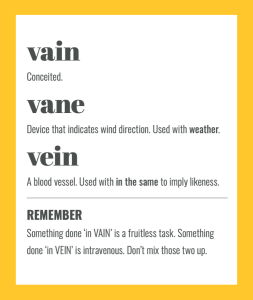
VAIN, VANE and VEIN. Excerpt from The Little Book of Confusables by Sarah Townsend.
The post Vain vs vane vs vein: simple tips to remember the difference first appeared on Sarah Townsend Editorial.
The post Vain vs vane vs vein: simple tips to remember the difference appeared first on Sarah Townsend Editorial.
September 4, 2023
Unkempt vs unkept: easy ways to remember the difference
The words UNKEMPT and UNKEPT are easy to confuse because of their similarity. But there are important differences in their meanings, which you don’t want to get wrong!
Here are my simple tips to remember the difference between UNKEMPT and UNKEPT.
When to use UNKEMPTUNKEMPT is an adjective that describes something messy or dishevelled. It’s often used to describe hair, or someone’s appearance.
It can be used in a sentence like this:
“He rolled out of bed, his hair UNKEMPT.”
When to use UNKEPTUNKEPT is an adjective that describes something neglected and uncared for. It also relates to broken promises or commitments.
It can be used in a sentence like this:
“The garden used to be beautiful. Today it’s overgrown and UNKEPT.”
While UNKEMPT and UNKEPT can relate to appearance, UNKEMPT is commonly used to describe people, while UNKEPT is more often used to describe places.
To help you remember the difference, think of the M in UNKEMPT and uncoMbed – and the fact that both words sound similar.
Now you know the difference between UNKEMPT and UNKEPT. I hope these tips help you to remember the difference between these commonly confused words in the future.
Get more tips in The Little Book of ConfusablesFun, memorable spelling and usage tips for 600 commonly confused words, packed into 300+ gorgeous pages for just £11.95. You’ll wonder how you managed without it!
2023 GOLD award winner at the eLit book awards.
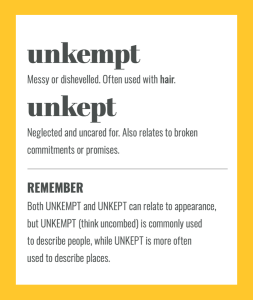
UNKEMPT and UNKEPT. Excerpt from The Little Book of Confusables by Sarah Townsend.
The post Unkempt vs unkept: easy ways to remember the difference first appeared on Sarah Townsend Editorial.
The post Unkempt vs unkept: easy ways to remember the difference appeared first on Sarah Townsend Editorial.
August 28, 2023
Tenant vs tenet: simple tips to remember the difference
The words TENANT and TENET look and sound very similar. They’re easy to confuse but their meanings are very different!
Here are my simple tips to remember the difference between TENANT and TENET.
When to use TENANTTENANT is a noun.
It describes the inhabitant of a rented property.
It can be used in a sentence like this:
“My TENANTS are polite and quiet. I’ve had no complaints.”
To remember, think of the ANT in both TENANT and inhabitANT. (Picture a home filled with ants if it helps you to remember!)
When to use TENETTENET is a noun.
It describes a central belief or principle.
It can be used in a sentence like this:
“Giving to charity is one of my core TENETS.”
Now you know the difference between TENANT and TENET, you’ll understand when your landlord tells you one of his core TENETS is giving back his TENANTS their full deposit!
I hope these tips help you to remember the difference between these commonly confused words in the future.
Get more tips in The Little Book of ConfusablesFun, memorable spelling and usage tips for 600 commonly confused words, packed into 300+ gorgeous pages for just £11.95. You’ll wonder how you managed without it!
2023 GOLD award winner at the eLit book awards.
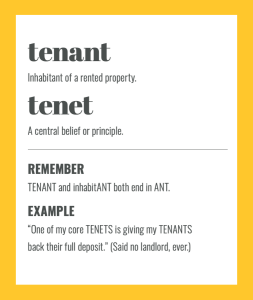
TENANT and TENET. Excerpt from The Little Book of Confusables by Sarah Townsend.
The post Tenant vs tenet: simple tips to remember the difference first appeared on Sarah Townsend Editorial.
The post Tenant vs tenet: simple tips to remember the difference appeared first on Sarah Townsend Editorial.