Peter Smith's Blog, page 35
March 2, 2022
Beginning Category Theory: NOT Chs 1 to 3
I wanted to be reminded of a different Russia. And so picked up our old Penguin copy of Turgenev’s Home of the Gentry to start re-reading. And it has fallen quite to pieces. Which somehow seems rather symbolic.
We must all distract ourselves from the dire state of the world for some of the time as best we can. Mathematics still works for me: as Russell remarks, “it has nothing to do with life and death and human sordidness”. So I have been starting working again on my notes on category theory which, as I’ve said before, are downloaded rather embarrassingly often given their current half-baked state. It will help keep my mind off other things, trying to get them into better shape.
Things are going slowly, as I need to do a lot of (re)reading. But for those who might like the distraction, here are the first three chapters (under 30 pages). Chapter 3 is mostly new, and the previous chapters have been significantly revised.
[Update: the Preface has now been revised too.]
[Further update: Hmmmmmmmm. I think a more radical rethink of the opening chapters is needed …. so I’ve dropped the link, and am banging my head on the desk ….]
The post Beginning Category Theory: NOT Chs 1 to 3 appeared first on Logic Matters.


Beginning Category Theory: Chs 1 to 3
I wanted to be reminded of a different Russia. And so picked up our old Penguin copy of Turgenev’s Home of the Gentry to start re-reading. And it has fallen quite to pieces. Which somehow seems rather symbolic ….
We must all distract ourselves from the dire state of the world for some of the time as best we can. Mathematics still works for me: as Russell remarks, “it has nothing to do with life and death and human sordidness”. So I have been starting working again on my notes on category theory which, as I’ve said before, are downloaded rather embarrassingly often given their current half-baked state. It will help keep my mind off other things, trying to get them into better shape.
Things are going slowly, as I need to do a lot of (re)reading. But for those who might like the distraction, here are the very largely re-written first three chapters (under 30 pages).
The post Beginning Category Theory: Chs 1 to 3 appeared first on Logic Matters.
February 26, 2022
War plates


From a series of six at the Ai Weiwei exhibition in Cambridge. Extraordinarily evocative, appallingly timely.
The post War plates appeared first on Logic Matters.
February 24, 2022
Schubert for dark days
Dark days. For consolation, inspiration, a reminder of better things, a great performance of Schubert’s G major Fantasy Sonata D894 by Pavel Kolesnikov at Wigmore Hall a couple of weeks ago.
The first movement starts at 5.00; the remaining movements start at 1.17.00.
Kolesnikov’s full programme, as if a musical evening with Proust, is very worth listening to; but the Schubert is stupendous. Here is Frances Wilson on her fine blog:
Kolesnikov … launched into the serene first movement of Schubert’s ‘Fantasy’ Sonata, D894, a mesmerizingly spacious account so carefully, subtly nuanced that as each new subject was introduced it took on a special character of its own, as if one was opening a little secret door into another room, another world where we glimpsed, momentarily, people dancing a gentle waltz, unaware they were being observed, or overheard the delicate tinkling sounds of a music box…..Kolesnikov flexes tempos, applies stringendo, pulls back again, allowing the music to ebb and flow, creating an extraordinary sense of time suspended, yet never once sounding contrived nor insincere; this was coupled with a powerful intimacy, as if we had exchanged the Wigmore Hall for an elegant Parisian salon. For a composer for whom pauses and silences are so meaningful, this for me was some of the most sensitive Schubert playing I have ever encountered.
That seems exactly right.
The post Schubert for dark days appeared first on Logic Matters.
February 18, 2022
Update of BML
 Oh dear. That’s very embarrassing. I spotted a horrid thinko at the top of p. 77 of printed version of Beginning Mathematical Logic. I can hardly believe that I wrote, concerning infinite binary strings and real numbers between 0 and 1, that “different strings represent different reals”. Ouch. So replace the para numbered “2.” by
Note too that a real number between 0 and 1 can be represented in binary by an infinite string. And, by the same argument as before, for any countable list of reals-in-binary between 0 and 1, there will be another such real not on the list. Hence the set of real numbers between 0 and 1 is again not countably infinite. Hence neither is the set of all the reals.
I’ve updated the online PDF, and uploaded a corrected file to Amazon which will take a couple of days to work through the system). And I’ll start a corrections page for those who have the first printings of the book.
I’m not going to fret about every minor typo. But I will correct major mistakes that could mislead the reader (and then, when I do, I’ll take the opportunity to correct any smaller errors I know about). I won’t add new content though: that can wait until a second edition …!
The post Update of BML appeared first on Logic Matters.
February 17, 2022
Sharon Berry, Potentialist Set Theory
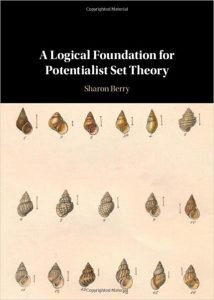 Among the newly published books in the CUP bookshop today, here’s one that could well be of interest to some readers of this blog, namely Sharon Berry’s A Logical Foundation for Potentialist Set Theory.
It is, as is now the default for new CUP monographs, published at a ludicrous price. However, it is good to report that there is a late draft downloadable from Berry’s website here (though a Word document, sad to relate, so some of the symbolism is a bit gruesome).
The headline news is that Berry advocates a version of potentialist set theory — as she nicely puts it, “the key idea … is that, rather than taking set theory to be the study of a single hierarchy of sets which stops at some particular point …, we should instead interpret set theorists as making modal claims about what hierarchy-of-sets-like structures are possible and how such structures could (in some sense) be extended.” The virtue of this idea is supposed to be that we can avoid problems that arise from assuming that the height of the universe is fixed (giving us baffling questions along the lines of “fixed how?”, “why stop there?”). There are already potentialist set theories out there in the literature; but Berry gives a new version which depends on deploying a certain natural generalization of the logical possibility operator. Then,
I show that, working in this framework, we can justify mathematicians’ use of the ZFC axioms from general modal principles which (unlike those used in prior potentialist justifications for use of the ZFC axioms) all seem clearly true. This provides an appealing answer to classic questions about how anyone (realist or potentialist) can satisfyingly justify use of the axiom of replacement.
The main work is done in the first two Parts of the book, a bit over a hundred pages. This is indeed interesting stuff. And there is a shorter but attractive exposition of key ideas available here, in a paper jointly by Sharon Berry and Peter Gerdes. (See also and compare Tim Button on potentialism in the second paper of his trilogy linked here.)
The third Part of Berry’s book, another hundred pages, looks beyond set theory, and “turn[s] to larger philosophical questions”. That’s perhaps a mistake, though; from what I have read it might have been better to take some of the Part II topics in a slightly more relaxed and expansive way, increasingly accessibility, and then kept only the most immediately set-theory relevant sections on Part III.
The post Sharon Berry, Potentialist Set Theory appeared first on Logic Matters.
February 14, 2022
Frege and Tarski on quantification
My eye was caught by this new paper ‘Against Fregean Quantification’ by Bryan Pickel and Brian Rabern. From the Abstract:
There are two dominant approaches to quantification: the Fregean and the Tarskian. While the Tarskian approach is standard and familiar, deep conceptual objections have been pressed against its employment of variables as genuine syntactic and semantic units. Because they do not explicitly rely on variables, Fregean approaches are held to avoid these worries. The apparent result is that the Fregean can deliver something that the Tarskian is unable to, namely a compositional semantic treatment of quantification centered on truth and reference. We argue that the Fregean approach faces the same choice: abandon compositionality or abandon the centrality of truth and reference to semantic theory. …
Now, the treatment of quantification in my IFL is Frege-flavoured, in the way that Benson Mates’s classic treatment was. So I need to work out whether I should feel challenged by the arguments here. At a first pass, my hunch is not. But I’ll certainly put this on my list of things to worry about when I get back to reworking IFL for a third-and-last edition! And if inspiration strikes, I may return to it here rather sooner.
The paper’s headline news is also available in a somewhat lugubrious 27 minute YouTube video.
The post Frege and Tarski on quantification appeared first on Logic Matters.
February 9, 2022
Telling your monos from your epis
Reposting from many many moons ago ….
Ok, so how do you remember which are the epimorphisms, which are the monomorphisms, and which way around the funny arrows get used?
Since the textbooks don’t seem eager to offer helpful mnemonics, I offer a forgetful world the following: go by alphabetical proximity!
L-for-left goes with M-for-mono, and P-almost-for-epi goes almost next to R-for-right. OK?
But what does that mean? Simple.
A mono is of course a left-cancellable morphism, and you signal one using an arrow with an extra decoration (a tail) on the left.
Dually, an epi is a right-cancellable morphism, and you signal one of those using an arrow with an extra decoration (another head) on the right.
Easy, huh? Well, it works for me — and these days, I’m grateful for all the props I can get. You can thank me later.
The post Telling your monos from your epis appeared first on Logic Matters.
February 5, 2022
One of the ten greatest? PHQ play Dvorak
Of course, these sorts of listings shouldn’t be taken too seriously. But the BBC Music Magazine has just suggested a list of the ten greatest string quartets of all time (that’s ensembles, not compositions). It runs, in chronological order,
Busch Quartet (1912-51)Borodin Quartet (1945-present)Quartetto Italiano (1945-80)Amadeus Quartet (1947-87)Alban Berg Quartet (1970-2008)Kronos Quartet (1973-present)Takács Quartet (1975-present)Emerson Quartet (1976-2023)Ébène Quartet (1999-present)Pavel Haas Quartet (2002-present)I certainly wouldn’t have included the Kronos in my top ten (I don’t go for their kind of pretentious repertoire), and I do find the Emerson’s impressive gloss not particularly appealing either. Who would I substitute? Certainly, the truly great Smetana Quartet (1945-1989). And probably the Lindsays (1965-2005), who on their best, take-no-prisoners evenings, could be simply stunning in their emotional intensity, and whose recordings still make wonderful listening.
And of course, I am all for the tenth entry! “Stylistically powerful and richly sonorous, the group is known for its passionate and fearless performances,” says the magazine. And certainly, the PHQ have provided some of the most intense musical experiences of my life. Here they are, from a lockdown recording last year, playing my favourite Dvorak quartet, the ‘American’. (At that point, they were between permanent violists, and are joined by their founder-member Pavel Nikl, who sadly had to leave the quartet a few years ago for family reasons.) Enjoy!
The post One of the ten greatest? PHQ play Dvorak appeared first on Logic Matters.
February 2, 2022
Monica Vitti 1931–2022

Fifteen years ago, as I mentioned here, I chanced on this photo of Monica Vitti on the web. A sudden jolt from the past, as I had a framed copy of that very shot on my wall as a student for five or six terms.
About the same time, I saw L’Avventura again after a gap of many, many years. I’m not sure why, but I wasn’t really expecting the film to stand up after four decades, and had expected that it would seem too mannered and pretentious. But I was completely bowled over anew: bleak but stunning still.
The image of the young woman who played Claudia in L’Avventura and Vittoria in L’Ecclise, so beautiful and so touching, haunted and entranced many of us who watched her back then. And yes, it was an image. But still, a moment of real sadness to hear today of Monica Vitti’s death.
The post Monica Vitti 1931–2022 appeared first on Logic Matters.