Peter Smith's Blog, page 33
April 18, 2022
Radu Lupu, 1945–2022
The post Radu Lupu, 1945–2022 appeared first on Logic Matters.


Beginning Category Theory: Chs 1 to 13 (etc.)
Here are the revised Chapters 1 to 13 of Beginning Category Theory — together in one PDF with the remaining unrevised chapters from the 2015/2018 Gentle Intro. [As always you may need to force a reload to get the latest version, dated April 18.]
So, the updated chapters are now these:
Introduction [The categorial imperative!]One structured family of structures. [Revision about groups, and categories of groups introduced]Groups and sets [Why I don’t want to assume straight off the bat that structures are sets]Categories defined [General definition, and lots of standard examples]Diagrams [Reading commutative diagrams]Categories beget categories [Duals of categories, subcategories, products, slice categories, etc.]Kinds of arrows [Monos, epics, inverses]Isomorphisms [why they get defined as they do]Initial and terminal objectsPairs and products, pre-categorially [Motivational background]Categorial products introduced [Definitions, examples, and coproducts too]Binary products explored [A few more techie results]Products more generally [Ternary, more finite products, infinite products]Since the last posting, Chapter 10 has had very minor tinkering. Chapter 11 is, however, improved and expanded (pulling a few more interesting things from what was the following chapter). That leaves a few somewhat fiddly results for the short Chapter 12 (some will be used later, and others give a bit of practice with characteristic styles of argument — but really at this point you can skip this!). And now results about finite products and infinite products more generally are separated out from that more boring stuff to become their own Chapter 13.
The post Beginning Category Theory: Chs 1 to 13 (etc.) appeared first on Logic Matters.
April 14, 2022
Like it or not, again
I experimented with a ‘like’ button for blog posts for ten days. I thought it probably wouldn’t be used much, and it turns out I was right (for I know that each post is actually read hundreds of times). So I’ve decluttered and removed the button again.
In fact, everything about “user engagement”, as they say, remains a bit of a mystery to me. It is very nice to know, for example, that the Beginning Math Logic study guide has already been downloaded almost a thousand times this month. But how the word gets around, who the readers are, what they make of the guide, is all pretty unfathomable.
Never mind. The overall site statistics (whatever they mean in absolute terms) continue to look perfectly healthy. So as long as I’m not entirely talking to myself, on we go …
The post Like it or not, again appeared first on Logic Matters.
April 13, 2022
Juliette Kennedy, Gödel’s Incompleteness Theorems
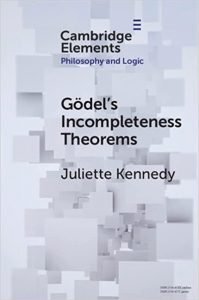 I was in the CUP Bookshop the other day, and saw physical copies of the Elements series for the first time. I have to say that the books are suprisingly poorly produced, and very expensive for what they are. I suspect that the Elements are primarily designed for online reading; and I certainly won’t be buying physical copies.
I’ve now read Juliette Kennedy’s contribution on Gödel’s Incompleteness Theorems. Who knows who the reader is supposed to be? It is apparently someone who needs the notion of a primitive recursive function explained on p. 11, while on p. 24 we get a hard-core forcing argument to prove that “There is no Borel function F(s) from infinite sequences of reals to reals such that if ran(s) = ran(s’), then F(s) = F(s’), and moreover F(s) is always outside ran(s)” (‘ran’ isn’t explained). This is just bizarre. What were the editors of this particular series thinking?
Whatever the author’s strengths, they don’t include the knack of attractive exposition. So I can’t recommend this for reading as a book. But if you already know your way around the Gödelian themes, you could perhaps treat this Element as an occasionally useful scrapbook to dip into, to follow up various references (indeed, some new to me). And I’ll leave it at that.
The post Juliette Kennedy, Gödel’s Incompleteness Theorems appeared first on Logic Matters.
April 12, 2022
Birthday treats
 Another birthday yesterday, a quite daft number, but much better than the alternative. A few treats, and two of them anyone else can enjoy too for a relatively modest outlay.
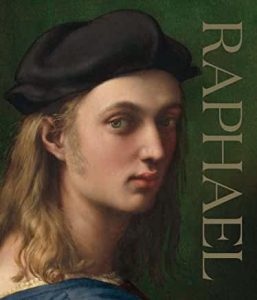
 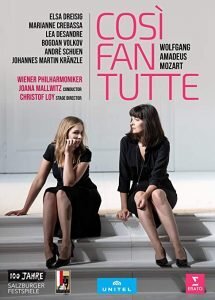 One was the book accompanying the new Raphael exhibition at the National Gallery. Will we brave the covid-ridden crowds to go up to the exhibition ourselves? As asking the question that way suggests, I rather doubt it. But the catalogue book, as nearly always for the National Gallery’s major events, is pretty terrific, and will be a lasting pleasure in itself. And the DVD of the 2020 Salzburg Festival Così fan Tutte which we watched last night is just a delight. Hugely enjoyable, very engagingly acted, with some wonderful singing, in particular from Elsa Dreisig. So both the book and the DVD are very warmly recommended; we all need cheering.
The post Birthday treats appeared first on Logic Matters.
April 11, 2022
The Leonkoro Quartet, winners at Wigmore Hall
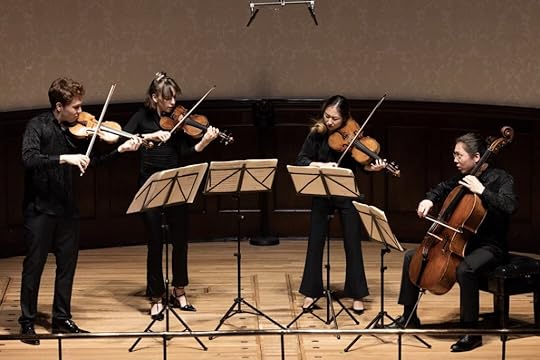
The Leonkoro Quartet won the 2022 Wigmore Hall International String Quartet Competition last night. Here they are in the final, playing the 3rd Rasumovsky quartet (starting at 6 minutes in). Ridiculously young, ridiculously recently formed, ridiculously good. And in these dark days, a shining light of hope.
The post The Leonkoro Quartet, winners at Wigmore Hall appeared first on Logic Matters.
April 9, 2022
Beginning Category Theory: Chs 1 to 11 (and more)
To avoid readers having to juggle two PDFs, and to keep at least some cross-references between new and old material functioning, I have decided to put the newly revised chapters together with the old unrevised chapters from the Gentle Intro into one long document. So here is Beginning Category Theory which starts with eleven revised chapters, followed by all the remaining old chapters [with prominent headline warnings about their unrevised status].
The two newly revised chapters are
Pairs and products, pre-categorially [Motivational background]Categorial products introduced [Definitions, examples, and coproducts too]Note: these early revised chapters are not final versions. Revised chapters get incorporated when I think that they are at least better than what they replace, not when I think they are as good as they could be. So, needless to say, all comments and corrections will be very gratefully received. Onwards!
The post Beginning Category Theory: Chs 1 to 11 (and more) appeared first on Logic Matters.
April 7, 2022
Greg Restall, Proofs and Models in Philosophical Logic
 I notice that Juliette Kennedy’s book on Gödel’s incompleteness theorems in the Cambridge Elements series has now also been published. I’ll no doubt get round to commenting on that in due course, along with John Bell’s short book on type theory. But first, let me say something about Greg Restall’s contribution to the series: as I said, for the coming few days you can freely download a PDF here.
There does seem little consistency in the level/intended audience of the various books in this series. As we will see, Bell’s book is pretty hard-core graduate level, and mathematical in style and approach. Burgess’s book I found to be a bit of a mixed bag: the earlier sections are nicely approachable at an introductory level; but the later overview of topics in higher set theory — though indeed interesting and well done — seems written for a different, significantly more mathematically sophisticated, audience. It is good to report, then, that Greg Restall — as his title promises — does keep philosophers and philosophical issues firmly in mind; he writes with great clarity at a level that should be pretty consistently accessible to someone who has done a first formal logic course.
After a short scene-setting introduction to the context, there are three main sections, titled ‘Proofs’, ‘Models’ and ‘Connections’. So, the first section is predictably on proof-styles — Frege-Hilbert proofs, Gentzen natural deduction, single-conclusion sequent calculi, multi-conclusion sequent calculi — with, along the way, discussions of ‘tonk’, of the role of contraction in deriving certain paradoxes, and more. I enjoyed reading this, and it strikes me as extremely well done (a definite recommendation for motivational reading in the proof-theory chapter of the Beginning Math Logic guide).
I can’t myself muster quite the same enthusiasm for the ‘Models’ section — though it is written with the same enviable clarity and zest. For what we get here is a discussion of variant models (at the level of propositional logic) with three values, with truth-value gaps, and truth-value gluts, and with (re)-definitions of logical consequence to match, discussed with an eye on the treatment of various paradoxes (the Liar, the Curry paradox, the Sorites). I know there are many philosophers who get really excited by this sort of thing. Not me. However, if you are one, then you’ll find Restall’s discussion a very nicely organized introductory overview.
The shorter ‘Connections’ section, as you’d expect, says something technical about soundness and completeness proofs; but it also makes interesting remarks about the philosophical significance of such proofs, depending on whether you take a truth-first or inferentialist approach to semantics. (And then this is related back to the discussion of the paradoxes.)
If you aren’t a paradox-monger and think that truth-value gluts and the like are the work of the devil, you can skim some bits and still get a lot out of reading Restall’s book. For it is always good to stand back and see an area — even one you know quite well — being organised by an insightful and eminently clear logician. Overall, then, an excellent and very welcome Element.
The post Greg Restall, Proofs and Models in Philosophical Logic appeared first on Logic Matters.
April 4, 2022
John Burgess, Set Theory
Of making many logic books there is no end. So a project like the Beginning Mathematical Logic study guide has no terminus. I hit the “pause” button at an arbitrary moment, and published the first book edition a couple of months ago, because I wanted to concentrate for a while on other things. But needless to say, there are already a number of new publications which are possible candidates for being mentioned in the next edition. In particular there are the four first books in the Cambridge Elements series on Philosophy and Logic. Three have already been published — in fact, the first of them just as I was finishing the guide, namely John Burgess’s Set Theory. Then we have John Bell on Higher-Order Logic and Type Theory, and Greg Restall on Proofs and Models in Philosophical Logic. Juliette Kennedy’s Gödel’s Incompleteness Theorems is due any day. The first three should already be accessible, then, via Cambridge Core if your library has a subscription, and indeed Proofs and Models is free to download here for another week. I’ll try to say something brief about each of these books over the coming days.
 First then Burgess on sets. Like other Elements, this little book is about seventy, not-very-packed, pages (perhaps 30K words?). More than an encyclopedia article, or a handbook chapter, but half the length of a short book like my Gödel Without Tears. Books in the series are aimed at providing “a dynamic reference resource for graduate students [and] researchers”. And that’s already a tall order for a book like this: for most graduate students in philosophy (even if logic-minded) are likely to be pretty much beginners when it comes to tackling some set theory — and a book accessible to such beginners isn’t likely to also to be of much interest to researchers.
OK, forget the impossible prospectus, and let me try to assess the book in its own terms. I certainly enjoyed a quick read. It is engagingly written; and at various points in the later pages Burgess very helpfully put some order into my fragmentary knowledge, or offered genuinely illuminating remarks. However, although set theory isn’t my special thing, I didn’t exactly come to this innocent of prior knowledge. And I do have to doubt whether the second half of the book will really be accessible to many of the intended student audience. OK, if may be that all the materials have officially been given to understand e.g. the Levy Reflection Principle on p. 55: but I suspect that a significant amount of mathematical maturity, as they say, would be needed to really appreciate what’s going on.
In headline terms, then, I don’t think that the book as a whole would work as advertised for many students. Still, the first half does make a nice motivating introduction, but one to be followed by reading a standard accessible introduction to set theory like Goldrei or Enderton. And then the enthusiast can return to try from §8 “Topics in Higher Set Theory” onwards to get a first overview of a few further more advanced topics, with a hope of understanding what some of the interesting issues might be, before tackling a second-level set theory text.
The post John Burgess, Set Theory appeared first on Logic Matters.
April 2, 2022
Like it or not ….
Drat, I missed the blog’s birthday. Now sweet sixteen!
In an experimental way, I have just added a “like” button to appear on blog posts. So please “like” what you do like enough. I’ll find it interesting to know what finds the most favour, and that might even affect a bit what I choose to blog about. Or not, as the case might be …
The post Like it or not …. appeared first on Logic Matters.