Sandy Rosenthal's Blog, page 15
July 23, 2020
Eric Paulsen with WWL-TV interviews founder Rosenthal about her new book
Eric Paulsen with WWL-TV’s Eyewitness Morning News Show interviewed founder Sandy Rosenthal about her new book, “Words Whispered in Water; Why the Levees Broke in Hurricane Katrina (Mango Publishing, 2020).


July 21, 2020
Founder Rosenthal’s book now available at Octavia Books in New Orleans

Jacket cover designed by M Styborski of New Orleans
Today, Levees.org founder Sandy Rosenthal’s book hits the shelves at Octavia Books (513 Octavia Street) in New Orleans.
Words Whispered in Water: Why the Levees Broke in Hurricane Katrina (Mango Publishing) documents how the Army Corps of Engineers spent millions––in cooperation with the media––to fool the American public on why New Orleans flooded in 2005.
Rosenthal is well-known in New Orleans for her role leading the grassroots group Levees.org in search of the true culprit in the disastrous flooding during Hurricane Katrina.
On Tuesday August 11 from 10-6, obeying covid rules, Rosenthal will be available outside Octavia Books (corner of Laurel and Octavia) to sign copies of her book.
The book is selected by Publishers Weekly in Politics and Current Events for Fall of 2020. It has also been a #1 New Release on Amazon.com for 26 weeks.
The book arrives on time for the 15th anniversary of the flooding disaster which took 1,577 lives according to the National Hurricane Center.
Those wanting a signed copy shipped to them can use this link.
July 16, 2020
Founder Rosenthal featured on national TV about the Michigan dam failures
This week, founder Sandy Rosenthal was featured by NTD-TV News in New York City to comment on the Michigan dam failures which affected over 11,000 people.
Rosenthal’s interview by Don Tran of NDT-TV was a followup to her commentary on May 25, 2020 in which she questioned the logic of having the dam owner––Boyce Hydro––lead and manage the investigation into what went wrong.
For more about the Michigan dam failures, and Rosenthal’s commentary about it, click here.
July 15, 2020
Levees.org founder to be featured author at 2020 Louisiana Book Festival
 Levees.org founder Sandy Rosenthal will be a featured author this coming autumn at the 2020 Louisiana Book Festival.
The annual festival is a celebration of readers, writers, and books, to be held on Saturday, Oct. 31, 2020, at the State Capitol, State Library, Capitol Park Museum, and the Capitol Park Welcome Center in Baton Rouge.
The festival, free and open to all, is presented by the Louisiana Center for the Book in the State Library of Louisiana, an agency of the Louisiana Department of Culture, Recreation & Tourism.
To learn about the festival, click here.
July 14, 2020
Go Ahead, Sue Me; 3rd of 4 Excerpts from ‘Words Whispered in Water’ by founder Sandy Rosenthal
Levees.org founder Sandy Rosenthal has released the third of four excerpts from her upcoming book, Words Whispered in Water: Why the Levees Broke in Hurricane Katrina (Mango Publishing, August 2020).
The excerpt is called Go Ahead, Sue Me. It comes from Chapter 7; Figuring out the Allies.
———-
Saturday, November 10, 2007, dawned sunny and cold, but windless. I put on my tennis clothes and headed to a tennis match with Debbie Cobb. Even during busy weeks, I refused to give up my precious exercise. After I returned, showered, and ate some lunch, I got back to my desktop computer and the ever-present incoming emails.
I noticed an email with the subject heading, “Cease and Desist Letter,” which was sent from an attorney representing the ASCE. The headmaster of Newman School was also copied. I opened the attachment and discovered that the ASCE didn’t like the Levee Spin 101 video very much and were ordering me to take it down from YouTube. After a lengthy description of the history of the ASCE, the letter ended with this: “… should you ignore this letter and continue to disseminate this defamatory material, please be advised that ASCE intends to take appropriate legal action to protect its interests.”
This was a technical way of saying, “If you don’t stop, we will sue you.”
My initial reaction to this letter was that we must be on the right track! I thought it was quite remarkable that an in-house counsel attorney felt fine about harassing a fledgling grassroots group and a bunch of high-school kids. This was likely the first time in ASCE’s history that the society had to deal with negative press of this magnitude.
I wrote to ASCE’s in-counsel Tom Smith and told him that we would be in touch on Monday, November 12. Then, I disseminated the cease-and-desist letter to Cheron Brylski (my pro bono publicist), my advisors, the Levees.org board, and, of course, Dr. [Ray] Seed. All responded within minutes, including Paul Harrison, an attorney for the Environmental Defense Fund and an ally in Washington, DC.
Harrison remarked, “I’d expect that this would be an appealing pro-bono cause for one of the big guys.”
***
At midday on Thanksgiving Day (November 22, 2007), I saw one of the most important emails I would ever receive during my leadership with Levees.org. The three-day-old email had a subject heading, “the video fracas,” and it was from Samantha Everett, a California attorney who let me know that her firm, Cooley, had offices in Reston, Virginia — the same location of the ASCE headquarters.
Ms. Everett had received my email, forwarded from a Levees.org supporter, where I had explained that we didn’t have the resources to fight a lawsuit in Reston, Virginia. She wrote, “I’ll do everything I can to find you excellent, free legal assistance.”
Even though it was Thanksgiving Day, I responded immediately: “I am very interested in your offer. Though we have received a half-dozen offers of pro bono service, we had to acquiesce to the ASCE because if the ASCE sued, it would likely be in Reston VA. Clearly, your offer changes everything. …”
I forwarded Ms. Everett’s note to Martin Stern, who emailed back early the next morning (November 23, 2007). He said that Adams and Reese would be happy to partner with Cooley and that he would call Ms. Everett. In subsequent three-way phone conversations with the attorneys, we determined that the ASCE’s threat of a lawsuit had fit the legal definition of a strategic lawsuit against public participation (SLAPP). In other words, the ASCE’s threat of a lawsuit was intended to intimidate and silence us by threatening to burden us with the cost of a legal defense. Cooley, in partnership with Adams and Reese, was prepared to defend us by relying on anti-SLAPP legislation, which was designed to protect citizens like me from such abuse of power. The two attorneys asked me to take some time to think it about it since nothing was ever a sure thing.
Feeling that I needed some outside guidance, I reached out to Adam Babich with the Tulane Environmental Law Clinic whose mission was to assist nonprofit organizations like Levees.org. On Tuesday, December 11, 2007, I drove to the Tulane campus and met with the bespectacled man, who had thick, black hair touched with gray. He was already familiar with our case, and he advised me that, since we had gotten so much press, we had accomplished our goal, and that the best course of action was to not repost the video.
I replied without hesitation. “If the press you speak of was national press, like the New York Times, I might have followed that counsel. But this is the Times-Picayune! This is not what I consider significant press!”
I thanked Babich for his time and felt, for the first time, utterly certain that we would publicly and ceremoniously thumb our noses at the ASCE’s threat of a lawsuit and repost the video. All I needed was a time and place. I called Wendy Carlton, a Levees.org supporter who lived near the breach of the 17th Street Canal floodwall. Her family had just rebuilt their flooded home in the Lakeview neighborhood and the house was still bereft of furniture, making it a good venue for television cameras with plenty of space for invited guests.
Next, I called Martin Stern with Adams and Reese and told him that it was a go. Levees.org would repost Levee Spin 101 on YouTube at a press conference on Friday, December 14, 2007, at 10:30 a.m.
The next day (December 12, 2007), Ms. Everett sent a letter to Tom Smith, the ASCE’s in-house counsel. The letter told Smith that his November 10 letter to Levees.org, copying Isidore Newman School, was an attempt to bully a small nonprofit organization out of exercising its First Amendment rights and that Levees.org would repost the video to YouTube in two days. The short letter closed with this statement: “… we believe that the Anti-SLAPP statute of Louisiana will apply to this case. Please be aware that should you file suit against Levees.org, we will vigorously pursue a judgment against ASCE for all of the fees and costs incurred by this Firm and Adams and Reese, LLP.”
On the same day (December 12, 2007), I issued a press release to local and national media announcing our plans. Christi Lu, a staffer with the Army Corps’ New Orleans District Public Affairs Office, intercepted my press release and forwarded it to the top of the chain: the Army Corps headquarters in Washington, DC.
The next day (December 13, 2007), Steven Wright, also with the New Orleans office sent an urgent message to three staffers in the DC office (Eugene Pawlik, Suzanne Fournier, and Gregory Bishop): “This is a national Corps issue and requires a USACE level response to query. Should you get media calls on this subject please refer callers to Mr. Gene Pawlik 202-761-7690.”
Meanwhile, Pawlik forwarded the email to Joan Buhrman, an ASCE spokesperson in Reston, and asked her, “Do you have any information that we might be able to share with our leaders if they ask?”
Pawlik’s “leaders” would be none other than Donald Rumsfeld, the U.S. Secretary of Defense.
***
On Friday, December 14, 2007, reporters and camera operators for every television station in town showed up in addition to the Times-Picayune and WWL (AM) radio. Flanked by attorneys from Adams and Reese — Martin Stern and Lauren Delery — the press conference began.
I started with a recap of why Levees.org partnered with Isidore Newman School to create the satirical video spoofing the cozy relationship between the Army Corps and the ASCE, an elite trade group. I then discussed the threat of a lawsuit by the ASCE to silence us. The legislative director from Levees.org, Vince Pasquantonio, spoke for a few minutes on the need for a truly independent levee investigation. Then, with camera crew in tow, I walked upstairs to Ms. Carlton’s home office, sat down at her desktop computer, and, with a click of a mouse, changed the status of Levee Spin 101 from private to public.
I stood up, turned to the cameras, and declared, “Today, Levees.org showed New Orleans, Louisiana, and the whole nation that the American Society of Civil Engineers shall not bully, shall not intimidate a little grassroots group and a bunch of high school kids out of exercising our First Amendment rights.”
That night, according to Harry Shearer, the story of our thumbing our noses at the powerful ASCE was the subject of every news media in town, including print, television, and radio. WWL-TV Channel 4 did its first-ever news story about our work. And, once again, the students from Ms. Bush’s U.S. Government and Politics course at Isidore Newman School were local celebrities.
Letter from Tom Smith to the author, November 10, 2007. http://levees.org/wp-content/uploads/....
Email from Paul Harrison to the author, November 11, 2007. http://levees.org/2/wp-content/upload....
Email from Samantha Everett to the author, November 18, 2007. http://levees.org/2/wp-content/uploads/2019/01/Email-Samantha-Everett-to-author-11-18-2007.pdf.
Email from the author to Samantha Everett, November 22, 2007. http://levees.org/2/wp-content/upload....
Letter from Samantha Everett to Tom Smith, December 12, 2007. http://levees.org/wp-content/uploads/....
Email from Lu Christi to USACE DC HQ, December 12, 2007. http://levees.org/2/wp-content/upload....
Email from Steven Wright to Eugene Pawlik, December 13, 2007. http://levees.org/2/wp-content/upload....
Email from Eugene Pawlik to Joan Burhman, December 12, 2007. http://levees.org/2/wp-content/upload....
Eugene (Gene) Pawlik’s LinkedIn profile states that he is currently Supervisory Public Affairs Specialist at the U.S. Army Corps of Engineers.
July 9, 2020
Thank you Gov John Bel Edwards; Words Do Matter
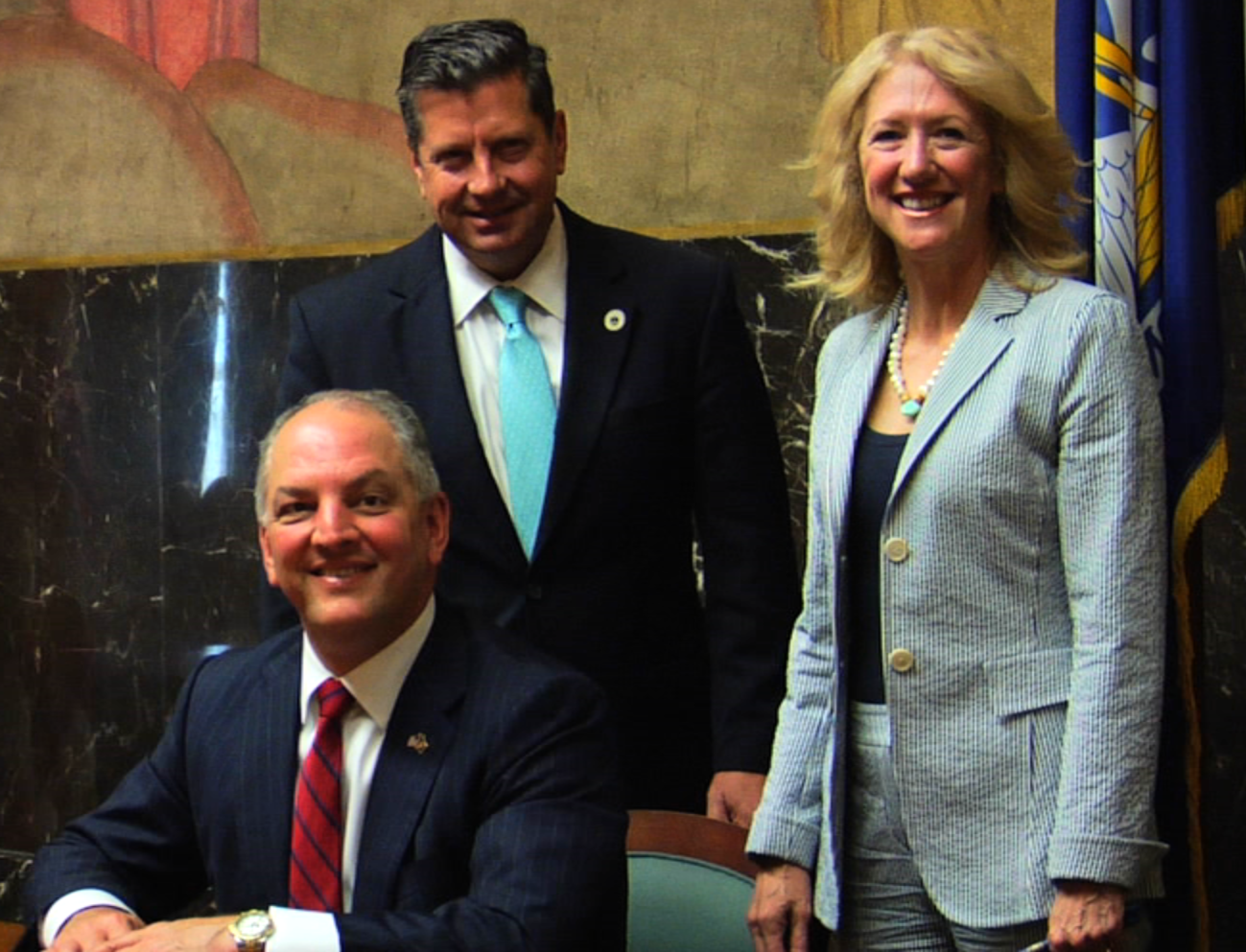
Louisiana Governor John Bel Edwards, Rep Patrick Connick and Sandy Rosenthal shown in 2017. Photo/Ralph Madison
Every anniversary of the worst civil engineering disaster in US history is worth full observance.
We are surprised that we missed this story about Louisiana Governor Kathleen Blanco published a year ago.
But we are glad the story by the Associated Press was brought to our attention.
In the story, which marked the passing of Governor Blanco, we are drawn to this statement by current Louisiana Governor John Bel Edwards:
“She led Louisiana through one of our darkest hours, when hurricanes and the failure of the federal levee system devastated much of our state,” Edwards said in a statement Sunday.
It is encouraging when our leaders take the time to get the story right about what nearly destroyed New Orleans in August 2005 during Hurricane Katrina.
Thank you Governor Edwards. Because words do matter.
For the full story, click here.
June 29, 2020
Just Seven Weeks; 2nd of 4 Excerpts from Words Whispered in Water by founder Sandy Rosenthal
 Levees.org founder Sandy Rosenthal has released the second of four excerpts from her upcoming book, Words Whispered in Water: Why the Levees Broke in Hurricane Katrina (Mango Publishing, August 2020).
The excerpt is called Just Seven Seeks. It comes from Chapter 3; The Fairy Tale.
———-
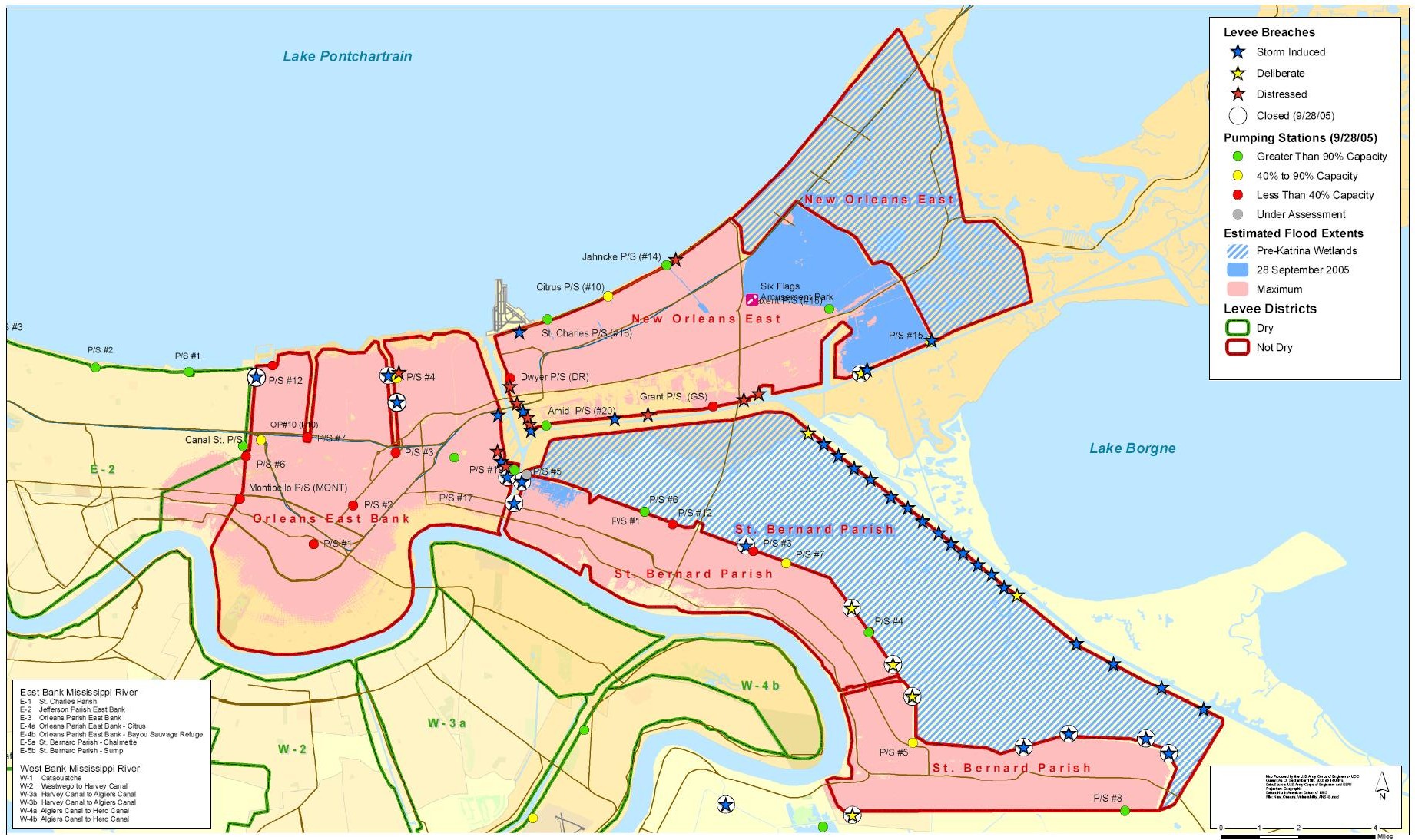
Seven weeks after the 2005 flood, despite four different investigating teams, the surface had yet to be scratched on the who, what, where, and why of the levee-breach event. If one were to count the breaches on a graphic map created by the Army Corps, they would find a total of 52 breaches in the region.[i] It was simply not possible for any human being or group of human beings to explain what happened in so complex a scenario. Communication lines were still down, breaches needed to be plugged, and roads were impassable. Truth be told, it would be many years before all the facts were laid out for everyone to see.
Yet, just seven weeks after the 2005 flood, a small group of business people had decided where the fault lay. They called themselves the Business Council of New Orleans. On the day the floodwalls broke, this group had no phone number, no staff, no meeting minutes, no list of expenses, and no membership list. But, with the city barely dewatered, they had apparently already decided that blame belonged to local officials — people whose chief responsibility regarding floodwalls and levees was maintaining them after the Army Corps built them. By October 20, while some souls were yet to be discovered in their attics, this group had already devised a plan to reorganize the way levee officials (the Orleans Levee Board) were selected.[ii]
Just seven weeks after the 2005 flood, plans were already on paper for “levee-board reform.” The group of businessmen had lined up state Senator Walter Boasso of St. Bernard Parish, to sponsor it. Boasso, a successful business owner, was an “every man’s man.” Before the flood, he was a member of a krewe (an organization that puts on a parade or ball for the Carnival season) called Druids, but soon he would become a member of Rex, one of the city’s most elite krewes.
On November 11, when Boasso’s Senate Bill 95 was introduced in the legislature — and when I was able to read it — I was, as usual, perplexed. It conflicted with information that I had found in a GAO report released in late September.[iii] According to the GAO report, the Army Corps was tasked with designing and building levee protection for the Greater New Orleans area. And the Orleans Levee Board staff was responsible for maintenance of completed structures and for operation (closing gates when hurricanes approached). It seemed to me that, if the levees broke, one should look to the architect and to the contractor, which, in this case, was the Army Corps. To me, blaming the local Orleans Levee Board was like blaming the janitor if a building fell to the ground. Furthermore, I had seen no stories documenting that the Orleans Levee Board had not done its levee maintenance properly. In my mind, it was too soon to be passing laws that required a change to the Louisiana constitution.
The business community was loud in its condemnation of the Orleans Levee Board, yet it named no names. The many dozens of men and women, who had served for decades, had no faces. By looking at the list of 84 men and women who had served on the Orleans Levee Board since 1925, one would see all kinds of upstanding people: city mayors, city councilpersons, and philanthropists. One commissioner who served from 1997 to 2001 was a Catholic nun: Sister Kathleen Cain, a provincial with the Franciscan Missionaries of Our Lady.[iv] But the Business Council of New Orleans had lumped them together as one giant cohort of corruption.
At this exact time, Jim Letten, U.S. Attorney for the Eastern District of Louisiana, told the Associated Press that he would pursue tips that he had received about corruption relating to building and maintaining the levees. Letten said that his office was focused on possible illegal conduct in the political and business relationships of those involved in building the levees.[v]
The Associated Press reporter added, “Local agencies handle most of the building and maintenance of levees.” This is simply wrong. The local agencies controlled none of the building. This news article was circulated coast to coast and fed what the American people already believed. Fingers continued to point toward local agencies and away from the federal agency — the Army Corps. The same Associated Press article closed by pointing out that State Attorney General Charles Foti and Orleans Parish District Attorney (DA) Eddie Jordan were also conducting similar investigations of their own. When the media reports that federal, state, and local DAs are announcing an investigation, that is what is remembered. But, as famously stated by reporter Megan Carter played by Sally Field in the 1981 movie classic Absence of Malice, the government does not tell the media that an investigation is halted.
Sure enough, the investigations by Letten, Foti, and Jordan were eventually closed with no indictments and no press. But the damage done — at a time when the story was under public scrutiny and when the Army Corps refused to answer questions — was incalculable.
——-
[i] Map: “Levee Breaches,” created by the U.S. Army Corps of Engineers, September 28, 2005. http://levees.org/wp-content/uploads/2011/07/LeveeBreachesMap-NO-2-1-e1309608321488.jpg.
[ii] Jim Tucker, “Press Release: Louisiana Republican Legislative Delegation,” November 22, 2005. http://levees.org/2/wp-content/uploads/2017/04/LA-Republican-Legislative-Delegation.pdf.
[iii] Anu Mittal, “GAO Testimony: Lake Pontchartrain and Vicinity Hurricane Protection Project,” September 28, 2005.
[iv] List of Orleans Levee Board commissioners provided from the files of Wilma Heaton, Director of Governmental Affairs for Southeast Louisiana Flood Protection Authority, May 21, 2018.
[v] Brett Martel, “Investigations into La. levee breaks mount,” Associated Press, November 10, 2005.
[vi] Ibid.
June 25, 2020
Storycorps releases podcast featuring Sandy and Stanford Rosenthal
In this podcast created by Storycorps for the New Orleans Tricentennial, Stanford Rosenthal and his mother talk about the icons of New Orleans culture as well as the investigative project––Levees.org––and Stanford’s critical role in co-founding it.
Storycorps is an independently funded nonprofit organization whose mission is to “preserve and share humanity’s stories in order to build connections between people and create a more just and compassionate world.”
The podcast with Stanford and Sandy Rosenthal came about as a collaboration between Greater New Orleans, Inc., the New Orleans Tourism Marketing Corporation and Storycorps in honor of the Tricentennial. The podcast was recorded in January of 2018.
The below is from Storycorps’ mission statement on its website:
The goal was to record, preserve, and share the many stories that make up the fabric of the vibrant city of New Orleans. The stories from the Tricentennial project have formed a collective portrait of the resilient people, the creative spirit, the rich culinary and cultural history, and the business innovation that make New Orleans an inimitable city.
June 24, 2020
Words Whispered in Water is selected by Publishers Weekly
 Founder Rosenthal’s book was selected by Publishers Weekly in its quarterly listing of titles in Politics & Current Events.
Being selected by Publishers Weekly means the book is considered important and needs to be included in all libraries.
The book––coming out August 11 in paperback––is published by the Florida-based Mango Publishing.
Here is what Publishers Weekly had to say about the book.
Words Whispered in Water: Why the Levees Broke in Hurricane Katrina by Sandy Rosenthal documents the author’s battle to hold the Army Corps of Engineers to account for the flooding of New Orleans during Hurricane Katrina.
This is a splendid development for the debut author.
For the full listing of titles in Publishers Weekly’s Fall 2020 Announcement, click here.
June 22, 2020
The Big Lie and How it All Started; 1st of 4 Excerpts from Words Whispered in Water by founder Sandy Rosenthal
Jacket cover
Levees.org founder Sandy Rosenthal has released the first of four excerpts from her debut book, Words Whispered in Water: Why the Levees Broke in Hurricane Katrina (Mango Publishing, August 2020).
The excerpt is called The Big Lie and How it All Started. It comes from Chapter 2; The Flood.
————
In Washington, DC, (September 28, 2005) the House Appropriations Subcommittee on Energy and Water Development hosted a hearing on the costs associated with the August 2005 flood. Members of Congress, who were responsible for how much aid the people of Greater New Orleans would receive, needed accurate information.
Anu Mittal, Director of Natural Resources and Environment, testified on why the levees were still not complete when storm surge arrived. She read from a script, which she later destroyed, and which bore little resemblance to the General Accounting Office (GAO) report she had submitted that day. Here is the key excerpt:
“… After the (levee) project was authorized in 1965, the Corps started building the barrier plan … parts of the project faced significant opposition from local sponsors and they did not provide the rights of way that the corps needed to build the project on schedule. But most importantly there were serious concerns relating to environmental impacts of the control barriers that were supposed to be constructed … on the tidal passages to the lake. This ultimately resulted in a legal challenge and in 1977, the courts enjoined the corps from constructing the barrier complexes. …” [Emphasis added.]
The effect of the testimony was lethal.
The clear takeaway was that, in the years leading up to the levee breaks, the Army Corps of Engineers struggled to complete the flood protection properly and on schedule but were hamstrung by local officials and environmentalists. In fact, Ms. Mittal’s accompanying GAO report stated none of these things. But the damage was done.
In the videotaped recording, the listeners sitting directly behind Ms. Mittal can be seen registering expressions first of being appalled and then indignation.
Members of Congress at this hearing were clearly led to believe that the people of New Orleans had brought this levee-breach situation upon themselves. One Congress member in the video stated, “It’s obvious. It’s their fault!”
Where did Ms. Mittal’s verbal testimony come from? Years later, after painstaking research, I figured out that the material Ms. Mittal presented in her verbal remarks was loosely based on a 22-year-old GAO report. Ms. Mittal had apparently presented cherry-picked data from a 1982 report which even with its neutral “government speak” tone, actually reprimanded the Army Corps officials for their glacial pace in building the levee-protection system for New Orleans in light of the critical need for project completion.
In a recorded audio 10 years later, Ms. Mittal readily admitted that her verbal testimony in September 2005 was “from three or four decades ago.” When asked if she still had a copy of her verbal testimony from September 28, 2005, she said no. When asked if she remembered who assisted in the preparation of the verbal testimony and the written GAO report, she said it was not retained. In this day of digital records, there is no excuse for not retaining information on the worst civil engineering disaster in our nation’s history. Someone had clearly coached Ms. Mittal.
The Army Corps has an established policy of creating talking points specifically for influencing people in high places. The damage from Ms. Mittal’s early verbal testimony cannot be understated, at a time when all eyes were watching, and all ears were listening.
In a phone interview on November 10, 2015, Sen. Mary Landrieu (D-LA) confirmed that videos of postdisaster congressional hearings — like Ms. Mittal’s — were widely circulated and highly influential on members of Congress. When queried on whether Senator Landrieu believed that this testimony may have biased or prejudiced Congress members against the people of New Orleans, the senator responded, “It was well understood that there was pressure from the White House, constantly and early on, to assign blame on the residents of New Orleans for the failure of the levee system.”
So, it began. Four weeks after the flooding that directly and indirectly killed at least 1,577 people and nearly drowned an entire city, our Congress — whether intentionally or not — were given a false perception. And every resident of New Orleans would soon pay the price because it created an early prejudice in the minds of our Congress members.
The local officials were considered guilty until it was proven that they were not. I searched the internet and could locate no congressional record of Ms. Mittal’s verbal testimony. After searching for six weeks, we learned that no transcript of the hearing was sent to the Government Publishing Office. The hearing was also missing from a list compiled by the American Geosciences Institute. If it were not for C-SPAN — a private company — all information about the early congressional hearing may have been gone forever.
“Army Corps of Engineers and Hurricane Katrina,” C-SPAN, September 28, 2005.
“Anu Mittal with GAO,” C-SPAN, clip by the author, September 28, 2005.
Ibid.
Ibid.
W.H. Sheley, Jr., “Improved Planning Needed By The Corps Of Engineers To Resolve Environmental, Technical, And Financial Issues On The Lake Pontchartrain Hurricane Protection Project,” U.S. General Accounting Office, August 17, 1982. http://levees.org/2/wp-content/upload....
Hector San Miguel, “1982 report faulted protection plan,” American Press, September 8, 2005. http://levees.org/2/wp-content/upload....
Audio recording by the author.
Email from Suzanne Fournier to Eugene Pawlik and Wayne Stroupe, March 26, 2008. http://levees.org/2/wp-content/upload....
“Tropical Cyclone Report, Hurricane Katrina,” National Hurricane Center, December 20, 2005, 11. http://levees.org/2/wp-content/uploads/2018/08/Tropical-Cycline-Report-Hurricane-Katrina-UPDATED-14-Sept-2011.pdf.
“Summary of Hearings on Hurricane Katrina (2-8-06).” http://levees.org/2/wp-content/uploads/2018/08/Summary-of-Katrina-Hearings-Compiled-by-American-Geosciences-Institute.pdf.