Sneha Jaiswal's Blog, page 60
December 29, 2024
Love in the Big City Movie Review: Friendship Shrouds Romance

Sneha Jaiswal (Twitter | Instagram)
“How can being yourself be your weakness?”
When Jang Heung Su is approached by Koo Jae Hui, an infamous girl on campus known for ‘using’ men, he warns her that he won’t bend to her will just because she found out his ‘weakness’. However, within days, the two become best-friends, united in their rebellion against what’s considered ‘normal’. While Jae Hui falls in love too easily, constantly changing boyfriends, ready to try ‘everything’, Heung So grasps his ‘love’ card too tightly, unwilling to commit to a serious relationship.
Based on Sang Young Park’s novel “Love in the Big City”, the 2024 Korean film by the same name stars Kim Go Eun and Steve Noh as lead protagonists Koo Jae Hui and Jang Heung Su respectively. But unlike the title, the movie adaptation takes a deep dive into the tumultous friendship between Koo Jae Hui and Jang Heung Su and only fleetingly explores their love lives. For a more faithful adaptation of the book, viewers will have to watch the series version of “Love in the Big City” starring Nam Yoon Su.
Unlike the novel, the movie tends to focus a wee bit more on Koo Jae Hui, the free-spirited college student, often victim to campus rumors and slander. Jang Heung Su on the other hand tries to keep a very low profile. He is in the closet and doesn’t want anybody to uncover the truth about his sexual preferences. So, when Jae Hui accidentally finds out Heung Su’s secret, instead of judging him or outing him, she becomes an ally, and very soon – his best-friend & flatmate.
Love in the Big City begins with a memorably striking sequence of Jae Hui in a stunning bridal dress, smoking on a terrace, while Heung Su joins her, dressed sharply in a suit, as her best-man. The background music swells nostalgically, striking an emotional chord even before the story begins. From the very first seconds, the creators get their visual and audio elements just right. However, the plot has its highs and lows, spanning several years, which are clearly marked by numerical graphics on the screen showing the protagonists’ ages. We see them evolve from carefree 20-year-old university students, partying the nights away, to struggling 30-somethings facing the challenges of their careers and the mundanities of adult life.

Through its protagonists, Love in the Big City delivers an emotional, feminist, sex-positive tale set against the conservative, homophobic backdrop of Korean society. While Koo Jae is branded a ‘slut’ by her peers for exploring all her options, Heung Su is shackled by his own fears of being discriminated against for being gay. Their problems are ironically different: Koo Jae loves too much, while Heung Su holds back too much.
Kim Go Eun is a firecracker as the spirited, bold Koo Jae, rarely afraid of trying anything new but almost always falling for the wrong guy – until the right one comes along. Steve Noh as the handsome Heung Su is charming, however, the character isn’t explored fully. The writers make a huge change from the novel by showing Heung Su dating the same guy for almost a decade, yet, we learn very little about the couple’s dynamic, except that Heung Su if afraid of commitment and being outed. Things already established at the beginning of the runtime.
Although Love in the Big City makes several nods to iconic queer artists and films, such as Leslie Cheung and Call Me By Your Name, it ironically holds back from boldly exploring Heung Su’s love life. If you’re watching for romance, you might be disappointed, but the deep friendship between the leads will likely leave you feeling fulfilled. The climax features a perfectly chosen song that Heung Su sings for Koo Jae at her wedding, bringing their story to an uplifting and celebratory conclusion.
Rating: 3.5 stars on 5.
Read Next: Exhuma Review: Shamans, Spirits & a Grave Mistake
Also Read: Sikandar Ka Muqaddar Review: A Heist of Time (Audio Version Below)


December 28, 2024
John Betjeman: Poems Selected by Hugo Williams – Review
Sneha Jaiswal (Twitter | Instagram)
He took me on long silent walks
In country lanes when young.
He knew the names of ev’ry bird
But not the song it sung.
And when he could not hear me speak
He smiled and looked so wise
That now I do not like to think
Of maggots in his eyes.
It’s hard to pinpoint exactly why, but the rhyming lines about a man who ‘looked so wise’ and reminded the poet ‘of maggots in his eyes’ struck me as the wittiest and most entertaining in the entire collection of John Betjeman’s poetry, selected by Hugo Williams.
I am not going to be able to rate this hardback edition, because, quite frankly, some of John Betjeman’s poems flew over my head. They were too British, colloquial, confined to regional phrases, references, whose meaning I couldn’t grasp as an international reader.
The opening poem, Death in Leamington, stands out as one of the most easy to understand pieces in the collection – a somber, melancholic account of a nurse discovering a woman’s lifeless body in her bedroom. Funnily, I initially misinterpreted the ending: the final line mentions the nurse turning “down the gas in the hall,” which led me to briefly assume the woman had taken her own life by leaving the gas on. However, it simply refers to the gas used for heating the room. Although my initial misinterpretation made me appreciate the poem even more. It added a layer of tragedy to the mundane death of the woman, with the final line serving as an unexpected twist (through my perspective).
From expressing harsh disgust over the excessive industrialization of towns and reliance on tinned goods to paying odes to town ghosts, this collection of poetry is definitely an interesting pick for both fans and newcomers to John Betjeman’s work. His rhymes, meters, and choice of words and phrases in most poems are entertainingly excellent, playful, and, most of all, poetic.
Read Next: In Utero: Graphic Novel Review
Also Read: ‘The Easy Life in Kamusari’ – Book Review (Audio Version Below)
Carry-On Movie Review: Dangerous Baggage and an Overpacked Runtime
Sneha Jaiswal (Twitter | Instagram)
Ethan Kopek, an unambitious TSA agent, decides to turn his life around after learning his girlfriend is pregnant. However, on his very first day assigned to carry-on baggage scanning, a mysterious traveler blackmails him into allowing a dangerous bag to pass through undetected.
Created by Jaume Collet-Serra (director) and T.J. Fixman (writer), the 2024 thriller Carry-On stars Taron Egerton as protagonist Ethan Kopek, with Jason Bateman portraying an unnamed traveler who forces Ethan into committing a deadly security breach. Theo Rossi plays the traveler’s accomplice, with eyes on Ethan’s girlfriend Nora (Sofia Carson), their leverage against the TSA agent.
Set in Los Angeles Airport on Christmas Eve, Carry-On begins with a prologue scene where the traveler murders a Russian goon and sets fire to a massive greenhouse. Ethan Kopek and girlfriend Nora are then introduced as a young couple excited to have a baby. While Nora works in operations, Ethan is a tardy, low-level security officer with zero promotions in three years, so he practically begs his bosses to give him more responsibility to prove himself. The timing couldn’t be worse. At his new role at the baggage screening desk, someone hands him an earpiece, claiming it’s not theirs. Just as Ethan heads to put the earpiece in the ‘lost and found’ section, he receives ominous texts instructing him to put it on… and thus, the thriller begins.
Almost two hours long, Carry-On has a bloated runtime packed with several conversation-heavy exchanges between Ethan and the mysterious traveler who threatens him. In a thriller like this, you want to see more action and less verbiage. The creators should’ve trimmed some of the interactions between Ethan and the traveler, which come across as merely annoying attempts by a terrorist to familiarize himself with his target.
A minor subplot follows Danielle Deadwyler as police detective Elena Cole, who investigates the murder shown at the beginning of the film. How Elena Cole connects the dots between the murder and a possible security breach at Los Angeles Airport is quite intriguing. The writers manage to maintain tight suspense until the climactic moments of Carry-On regarding the real target and motive of the mysterious traveler.
Taron Egerton is all right as the observant TSA agent Ethan Kopek, who originally wanted to become a cop but couldn’t pass the test. Ethan does all he can to outwit the traveler and prevent him from carrying out his nefarious plan with the suspicious carry-on bag, so the movie largely remains an interesting race against time and resources. However, some ill-timed romantic moments between Ethan and Nora disrupt the film’s tense mood more than once. Sofia Carson was completely miscast in her role, she is wooden and feels more like a wealthy model ready to board her business class flight than a regular airport employee.
Overall, Carry-On is a decent enough one-time watch, with a very ’90s vibe. It’s larger than life, with some scenes and coincidences making little sense, but you’ll want to stick around until the end to see how things conclude.
Rating: 3 on 5. Watch Carry-On on Netflix.
Read Next: La Palma Review: Family Vacay Drama Eclipses Volcanic Tension
Also Read: Sikandar Ka Muqaddar Review: A Heist of Time (Audio Version Below)
December 27, 2024
One Hundred Years of Solitude Series Review: Of Mothers, Memories, Monsters
Sneha Jaiswal (Twitter | Instagram)
Madly in love, cousins Jose Arcadio Buendía and Úrsula Iguarín get married against their parents wishes, who strongly fear their union would lead to the birth of iguanas or monsters. Well, that’s one way to spook people against inbreeding…! Scorned by his family, and mocked by some others, Arcadio decides to leave his village, and find a new place to settle by the sea. A large group of friends follow the newly wed couple, and after weeks of walking, camping, and living like nomads, they finally give up hopes of finding the sea, and settle for founding a village by the river. Arcadio names it Macondo, and thus begins an multi-generational saga of the Buendía family, their trials, triumphs, and tragedies.
Based on Gabriel García Márquez’s famous 1967 novel of the same name, Netflix series “One Hundred Years of Solitude” spans eight episodes, and is a slowburn show that flits between being an engaging cinematic treat and a mildly boring family drama. Marco González plays the young José Arcadio Buendía in the first few episodes, a passionate, ambitious young man, who is more of a dreamer than doer, much to the chagrin of his fierce wife Ursula (Susana Morales Cañas). For several years, Macondo is located in a maze-like swamp area, largely cut off from the world, except for an annual visit by a troupe of gypsies, thus the title – One Hundred Years of Solitude, more metaphorical, than literal.
Leisurely paced, the eight-episode series is a visually engaging offering that captures a forgotten slice of Colombia, a time when people lived in tightly knit communities and shared their food, beliefs, and superstitions. However, some of the set pieces depicting the idyllic town of Macondo appear overly neat and organized, as if it were a miniature diorama created by university students. Spanning several decades, the story remains rooted in Macondo, charting its transformation from a small community of mud houses to a bustling town adorned with beautiful Spanish villas.
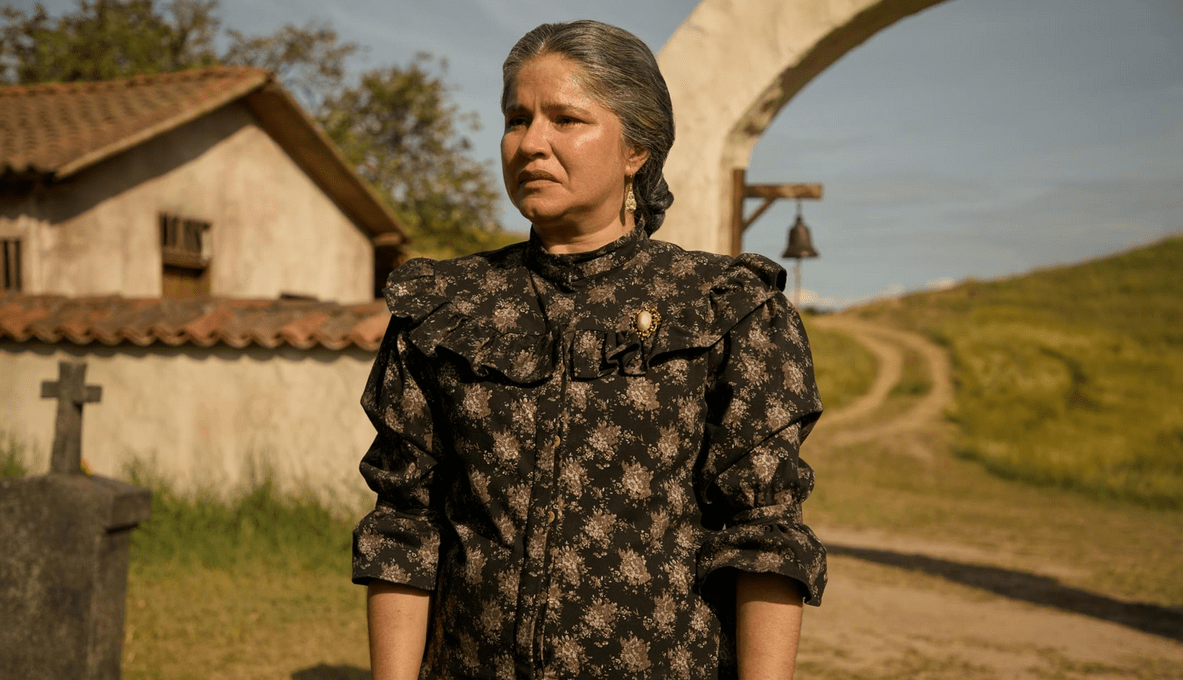
While José Arcadio Buendía initially appears to be the primary protagonist, it is his wife, Úrsula, who emerges as the true matriarch of the family. She holds the family together, establishes a thriving candy business, and provides stability, all while her husband becomes consumed by his obsession with scientific knick-knacks, isolating himself in his private laboratory until he ultimately loses his sanity. In-fact, most Buendía men are lost to different obsessions, mostly women, usually cousins, sisters or someone equally ‘forbidden’. Ursula’s daughters too find themselves entangled in a bitter love-triangle, ironically complicated by the arrival of Christianity in Macondo. And even though religion isn’t a dominant theme, the subtle infiltration of Christianity in the otherwise secular community serves as an interesting reminder of how easy it is to sway non-believers with the fear of God.
Susana Morales Cañas as the young Ursula wears a perpetually disappointed look on her face through the early episodes, even in scenes where more facial variations would’ve been preferred. Marleyda Soto as the older Ursula is more memorable, and while she too looks angered or disappointed most of the runtime, at least her embittered experiences earn the weather-worn expressions. The only other female character that comes close to Ursula’s tempestuous personality is her adopted daughter Rebeca, who arrives as a wild little child (Nicole Montenegro Sánchez) at the Buendía household, a girl with a weird affliction – she eats mud when upset. Rebeca grows into a young, beautiful, amorous woman, whose impassioned screams shake the entire house, a loud protest against the delay in her marriage to her sweetheart. Loren Sofía plays Amaranta, Ursula’s youngest daughter, who unfortunately falls for the same man as Rebeca and schemes to keep the couple apart.
Ursuala’s middle-child Aureliano Buendía is the most colorful, complex, and problematic character of “One Hundred Years of Solitude” and the actors are aptly cast for the role. While a young Aureliano (Jerónimo Barón) is a shy, quiet, introvert who spends all his time in his father’s lab and under his older brother Arcadio’s shadow, the older Aureliano (Claudio Cataño) becomes a Colonel, leading a band of rebels against a violent political struggle for power in Macondo. Janer Villareal plays Arcadio, Ursula’s illegitimate grandson, born to her eldest son José Arcadio (yes, too many Arcadios in the show!), who is raised in the same house without knowing who his parents are.
In one of the stranger, comedic chapters of Netflix series “One Hundred Years of Solitude”, an odd plague engulfs the small town where the story is set in, one that turns all residents into insomniacs. While the first few nights are like one big town party, slowly, people start to lose their memories, and start labelling most things, ‘wall’, ‘anvil’, or the stove is labelled as “stove: all food must be heated”. But despite rigorous labeling of things, people lose a sense of their self and all their surroundings, leading to madness, rioting, until someone finds a cure. It takes a few seconds for the real significance of this insomnia plague to become apparent, perhaps it is Gabriel García Márquez’s way of displaying the fragility of human memory, the ease with which people can forget their roots and identity. The consequence? Chaos.
Through the experiences of the Buendía family, Macondo transforms into a microcosm of a shifting society. Initially isolated from the outside world, it gradually becomes entangled in the broader political struggles of the nation. Overall, “One Hundred Years of Solitude” is an easy to watch tale of family, love, secrets, desires, heartbreak, and violence. Episode eight, the final chapter, concludes with a gripping cliffhanger, setting the stage for a potential second season. However, for those seeking closure, the episode also brings the story full circle, culminating in Úrsula’s haunting realization that she truly gave birth to a monster.
Rating: 7 on 10. Watch the series on Netflix.
Read Next: La Palma Review: Family Vacay Drama Eclipses Volcanic Tension
Also Read: Sikandar Ka Muqaddar Review: A Heist of Time (Audio Version Below)
December 26, 2024
Shubeik Lubeik Review: Fantastic Blend of Magical Quirks & Realities
Sneha Jaiswal (Twitter | Instagram)
Set in an alternate world where people can buy and make wishes – the kind of wishes genies/djinns grant in fantasy fiction – Shubeik Lubeik is a truly memorable graphic novel where creator Deena Mohamed wittily blends unpredictable magic and mundane realities. Shubeik Lubeik means ‘Your Wish is My Command’ in Arabic, a phrase made widely popular by Disney’s Aladdin.
Over 500 pages long, Shubeik Lubeik does justice the graphic novel genre, it’s a beautifully illustrated book that doesn’t get over in a blink. Divided into three parts, the book follows how three different protagonists make use of their ‘first class wishes’. The class divide among humans is subtly highlighted through the division of commercial wishes – third class wishes, known as delesseps, are very affordable, sold in cans, but are the trickiest, where the user rarely gets what they want and often ends up getting physically hurt. For instance, if you wish for a house, a third class wish could give a miniature house the size of a brick, that lands on your head and gives you a bruise. If you wish to be beautiful, it might just make a tattoo on your face which says ‘beautiful’. These events do not happen in the book (keeping this review as ‘spoiler-free’ as I can) and are just fun examples.
In-fact, ‘Shubeik Lubeik’ begins with a hilariously dark public service advertisement against ‘Delesseps’, the third class wishes, which are described as ‘dangerous’ and ‘a hazard to your health’ in the ad. A colorful prologue establishes the common thread between the three stories in the graphic novel, which is a small kiosk, where three first class wishes are up for sale. Who ends up using these first class wishes and what happens to them forms the story. The primary chapters are black-and-white, but vividly expressive, breathing life into an alternate chaotic Cairo, where genies are literally sold in a bottle!

The first chapter follows Aziza, a poor woman who works tirelessly to save enough money to buy a first-class wish, only to find herself trapped in a bureaucratic nightmare while trying to register it. Yes, the story is set in a world where wishes are heavily regulated. Conversely, the second story follows Nour, a wealthy college student who buys a first-class wish on a whim and then grapples with a moral dilemma over whether someone privileged like her should use it. Interestingly, the third story focuses on the kiosk owner’s journey – how he came to possess the three ‘first-class wishes’ and his plan to give his last remaining wish to a vibrant old granny who often buys smokes at his kiosk. In fact, the old lady, called ‘hagga’ (an Arabic term of endearment for older women) by the shop owner, has the most fascinating past, filled with feuding villages, dragons, and strife.
“While the Hagga was perhaps the ‘coolest’ character of Shubeik Lubeik, I love how Deena Mohammad illustrates the personal struggles of Nour, a regular, cheery college kid on the surface, but who is completely listless, unhappy, and perhaps even clinically depressed. Nour’s self-awareness of both her problems and privileges can be relatable to many readers. Besides, it’s comically refreshing how practically Nour tries to tackle her state of ‘unhappiness.’ From making mood graphs to seeing a mental health professional, Nour tries a bunch of things before giving in to the temptation of using her first-class wish.
The artwork by Deena Mohamed in ‘Shubeik Lubeik’ is expressive, and I was in love with the comic strips. In-fact, this is one of the rare graphic novels, where the black-and-white art stands out better than the colored panels, because the prologue chapter was in color, and the palette was far too loud and jarring. Instead, the bold monochrome chapters were much more fun to read. The reader won’t miss color in ‘Shubeik Lubeik’ since its twists, turns, and varied characters bring enough flavor to the tale!
The biggest irony in this graphic novel is how despite having access to wishes, how rarely the characters resort to using these special powers. Deena Mohamed brilliantly displays how the world would only be far more chaotic if wish-granting djinns were real and that humans are better off without dragon granting genies. I absolutely loved this graphic novel!
Rating: 5 on 5 stars.
Read Next: In Utero: Graphic Novel Review
Also Read: ‘The Easy Life in Kamusari’ – Book Review (Audio Version Below)
December 25, 2024
La Palma Review: Family Vacay Drama Eclipses Volcanic Tension
Sneha Jaiswal (Twitter | Instagram)
“Ever since 1949, the peaceful and quiet island of La Palma has been a ticking time bomb.”
La Palma is a disaster drama that begins with an intense prologue scene about a group of tourists who die on a boat. The title rolls in with a montage of volcanic eruptions, falling rocks, and violent waves, promising a dark rollercoaster ride of death and destruction. But what the creators deliver is an outdated drama that feels ridiculously contrived, complete with the kind of overly positive ending that even regular family dramas would envy.
The four-episode series follows the family of Frederik (Anders Baasmo) and Jennifer (Ingrid Bolsø Berdal), who arrive from Norway with their kids, Sara (Alma Günther) and Tobias (Bernard Storm Lager), at the beautiful island of La Palma to spend their Christmas vacation, unaware of the impending doom about to engulf the region. While the family is caught up in their holiday highs and lows, Marie Ekdal (Thea Sofie Loch Næss), a young researcher on another part of the island, discovers an alarming crack along a mountain that could signal an imminent volcanic eruption and a devastating tsunami. However, the administration demands 100% proof of disaster before issuing warnings, something the researchers cannot guarantee.
The short length of La Palma initially gave me the impression it would be a fast-paced, crisp, nail-biting show. Instead, it’s often frustratingly slow, weighed down by an unnecessary romantic subplot about teen Sara falling for a vacationer. Aside from some diversity, including a queer teen and a neurodivergent child, the primary family is fairly dull, even though the actors pull off their roles. The creators shouldn’t have focused so much on Sara’s family and should have given more screen time to Marie Ekdal and the other researchers monitoring the volcano. In fact, the only theme that truly stands out in La Palma is the moral and social dilemmas authorities face when dealing with uncertain natural disasters.

What makes La Palma a tolerable one-time watch is the exciting premise of an impending catastrophe and the scenic cinematography, which engagingly captures the island’s charms. The special effects were pretty impressive too, particularly during the volcanic eruption and tsunami sequences. Some drone shots through the episodes are very impressive in the series.
Story-wise, the climactic episode of La Palma turned out to be the most disappointing chapter, packed with far too many “too good to be true” coincidences, some of which practically qualify as miracles. For instance, early in the series, during a mild eruption, nearby campers struggle to breathe due to low oxygen levels. Yet, in the final episode, after a much larger eruption, a pair unable to evacuate decides to get up close to the volcanic activity, and nothing seems to affect them for quite some time, at least not until their part of the mountain completely explodes.
A little more attention to detail and more risks in the script would have made this series far more engaging. Overall, La Palma might prove to be a decent one-time watch for viewers looking for a short series with an easy-to-follow plot.
Rating: 2.5 on 5 stars. Watch ‘La Palma’ on Netflix.
Read Next: No Good Deed Series Review: Mildly Amusing Acts
Also Read: Sikandar Ka Muqaddar Review: A Heist of Time (Audio Version Below)
A Fire Story: Graphic Novel Review
Sneha Jaiswal (Twitter | Instagram)
‘ON MONDAY, MY HOUSE DISAPPEARED.’
That’s the first, big, bold line of A Fire Story, the graphic novel memoir where artist Brian Fies recollects losing his home to the devastating California wildfires in 2017 and the aftermath.
Brian Fies takes readers to 1 a.m. on October 9, 2017, when he and his wife woke up in their home to the smell of smoke and an ominously glowing sky. As panic set in, the couple quickly grabbed whatever they thought was necessary and rushed to safety, not knowing it would be the last time they would see the home they had planned to spend the rest of their lives in.
A Fire Story largely focuses on Brian’s personal experience of coming to terms with the fire and losing all his belongings. Fortunately, he and his wife had the option to immediately move in with their twin daughters, who hosted them throughout the crisis. Some of the other survivor stories, briefly mentioned in the graphic novel like news features, are even more interesting than Brian’s account. For instance, there’s Dottie Wilson, a senior citizen who lived in a mobile-home park for low-income seniors. Dottie faced a nightmarish ordeal trying to find alternative accommodation after the fire. Ironically, while the mobile-home park wasn’t destroyed, it was deemed unsafe to inhabit, and insurance companies refused to pay because the homes hadn’t been burned down. “It was a catch-22”, in Dottie’s words.
The artwork in A Fire Story is simple, and Brian Fies vividly illustrates his experiences, from the day of the fire to the following weeks as his family struggled to rebuild and restart. However, the color scheme in the graphic novel feels a little jarring and doesn’t fully complement the sombre tone of the story. One of the highlights of the book is the inclusion of real-life photos of the Fies family’s burned house and belongings within the panels, adding authenticity to the narrative. It would’ve been more engaging, though, if Brian had illustrated the other survivors’ stories instead of presenting their accounts in text-heavy sections.
Overall, A Fire Story is an engaging graphic memoir where the author neither embellishes details nor exaggerates his loss for emotional effect. While it’s evident that he comes from a place of privilege, with his primary concerns after the fire being materialistic, such as the loss of heirlooms and memories, it’s a reminder that, for many, their home represents their life and identity. Whether or not readers share Brian’s perspective, the story highlights the profound impact such a loss can have, and that’s something worth reflecting on.
A Fire Story is also on Kindle Unlimited.
Read Next: In Utero: Graphic Novel Review
Also Read: ‘The Easy Life in Kamusari’ – Book Review (Audio Version Below)
December 24, 2024
Ron Kamonohashi’s Forbidden Deductions Episode 25 Review
Follow us on Twitter | Instagram
“This is the first time Ron has shown no interest in a case. But it’s understandable…”
Genius detective Ron Kamonohashi is completely shaken after learning that his father was a member of the House of M (short for Moriarty), a truth that makes him feel unworthy of solving crimes. Equally devastated is his crime-solving partner Totomaru Isshiki, AKA Toto, who cannot believe Ron has lost the spark to crack murder cases as effortlessly as opening a packet of his favorite brown sugar syrup.
Episode 25 of Ron Kamonohashi’s Forbidden Deductions opens with Toto trying to calm the guests at the Auberge after they discover a third murder victim on the premises. Karen Lily, the lockpicker among the group, is extremely suspicious of Ron, adamant that he must be the serial killer—a claim she strongly made in episode 24 as well. Luckily for Ron, he has Toto as a solid alibi, so at least Toto and the viewers can be pretty sure the killings are not his doing. That still leaves four suspects: Karen Lily, the cook, Tiger Dan, and Mia Costa. The episode maintains solid suspense in the first half over who the culprit might be.

The Auberge serial murder case proves to be the most important of Ron’s detective career so far, potentially a big ‘make or break’ moment for him. Those who’ve been following the manga by Akira Amano obviously know where things are headed next, but for anime fans, this is a tense juncture in Ron Kamonohashi’s Forbidden Deductions. Ron, of course, makes some interesting deductions to zero in on the most likely suspect, and quite frankly, the deductions felt a wee bit contrived. However, it’s the emotional impact of the case that stands out best in this episode.
It’s already been established that the House of M is behind the elaborate murder spree. But what is it that they truly want? Do they simply want Ron to stop solving cases to keep their criminal activities free from his deductions, or do they want him to join their side, like his father? The House of M is yet to reveal their cards, and perhaps everything will become much clearer in the next episode.
Stream the series (Kamonohashi Ron no Kindan Suiri) on Netflix or CrunchyRoll.
Read Next: Mononoke Movie Review: Mad, Mad, Visuals
Yakuza Fiancé: Raise wa Tanin ga Ii Episode 12 Review
Follow us on Twitter | Instagram
It’s barely been a day since Yoshino and Kirishima became ‘boyfriend-girlfriend,’ and they are already locked in their first major fight. Sort of!
Episode 11 of Yakuza Fiancé: Raise wa Tanin ga Ii ended with Yoshino intervening between Kirishima and Shoma and asking her new boyfriend to leave her alone with her childhood friend. And who can forget how the chapter ended with Yoshino thinking out loud about how it would be a whole lot easier for her to date Shoma than Tokyo hothead Kirishima? That’s unlikely to happen, from the looks of it, but the ‘love triangle’ tension continues to loom in the horizon.
Titled “When She’s Upset the Rain Falls and the Dark Night Descends,” episode 12 of Yakuza Fiancé: Raise wa Tanin ga Ii is set in Tokyo, with the lead couple back to attending their high school. However, in a little twist, Yoshino ignores Kirishima so badly that he begins to wonder if she has developed a neurological condition where she cannot see some people. L-O-L.
Fun and relaxed in tone, episode 12 explores the changing dynamics between the teens, who are officially a couple now. Yoshino’s cousin Tsubaki is emerging as a confidante for both sides, so just like she belted out some advice to Kirishima about dating, she once again gives a few tips on how to navigate his new situation. The second half of the episode is surprisingly romantic in tone (depending on how you view it) and once again cements how obsessively serious Kirishima is about being in love with Yoshino. Meanwhile, new trouble seems to be brewing in the Yakuza ranks in Osaka, which might mean bad news for the protagonists.
Yakuza Fiancé: Raise wa Tanin ga Ii is available to stream on Crunchyroll.
Read Next: Mononoke Movie Review: Mad, Mad, Visuals
Also Read: Sikandar Ka Muqaddar Review: A Heist of Time (Audio Version Below)
December 23, 2024
Exhuma Review: Shamans, Spirits & a Grave Mistake
Sneha Jaiswal (Twitter | Instagram)
When a wealthy Korean American’s baby is on the brink of death, the family flies a renowned shamanic duo all the way from Seoul to help them. What follows is a series of terrifying events after the shamans dig up a suspiciously eerie grave in an attempt to end a family curse and save the baby.
Written and directed by Jang Jae-hyun, the Korean horror film Exhuma (Original title: Pamyo) stars Kim Go-eun and Lee Do-hyun as shamans Lee Hwa-rim and Yoon Bong-gil, who team up with experienced geomancers Kim Sang-deok (Choi Min-sik) and Go Yeong-geun (Yoo Hae-jin) to perform an exhumation ritual that goes horribly wrong.
Exhuma begins with a casual scene of Lee Hwa-rim and Yoon Bong-gil flying business class to the U.S. for their latest supernatural case. When the flight attendant speaks to Hwa-rim in Japanese while asking if she would like a refill, the shaman responds in the same language but asserts that she is Korean, not Japanese. This scene subtly establishes Hwa-rim’s pride in her national roots, which becomes a significant theme in the latter half of the movie.
The core suspense of the story, at least in the first half of Exhuma, revolves around the strange location of the grave and the exact identity of the corpse. To make matters worse, the family who hires the shamans is either unwilling to reveal more details about their past or weirdly unaware as to why their ancestor is buried in a strangely remote property with bad feng shui.

The shamanic rituals performed by Kim Go-eun and Lee Do-hyun, along with a host of other people hired for the exhumation ceremony, are among the most visually engaging sequences in the film. These scenes include live music, traditional drumming, ritualistic dancing, and some animal mutilation. For those averse to gore, it’s worth noting that these moments aren’t excessively violent or bloody.
What proves most irksome about Exhuma is that the story keeps building expectations that viewers will receive flashbacks explaining why the spirit is so malevolent it won’t even spare an infant descendant. However, apart from a brief glimpse of old images, the film never provides a solid backstory. While it’s possible to fill in the blanks, it just doesn’t feel very satisfactory. Instead, a new supernatural twist, albeit an intriguing one, pivots the focus of Exhuma towards the climax. Unfortunately, its execution feels a little off, and the special effects are foggily weak. The supernatural antagonist who hounds the protagonists looks like it was inspired from old 1990s horror flicks, so its presence might be unwittingly comical for older horror fans.
Overall, Exhuma delivers few spine-chilling scares, but it remains a well-acted thriller about old ghosts with a few new tricks.
Rating: 3 stars on 5. You can watch Exhuma on Prime Video.
Read Next: Immaculate Review: Sydney Sweeney Makes You Root For The Nun
Also Read: Sikandar Ka Muqaddar Review: A Heist of Time (Audio Version Below)