
Andy Littleton's Blog: Shorts by Andy Littleton, page 3
January 3, 2025
The Church Needs Missional Professionals
 Image by Alex Parisi
Merten De Keyser, as he was known to the Dutch, was a Frenchman born Martin Lempereur. He was a printer, due to having married into the Le Rouge family printing business in Paris with it’s well equipped print shop and state of the art equipment. Upon his father-in-law Guillame’s death he inherited the business. Merten was a Christian and a devoted one. We know this. We know this because he didn’t just publish the safe books of his day. At great cost, he published the Bible in, then unauthorized, foreign languages and books that exposed the abuses of corrupt Church leaders and systems.
Many students of religion have heard of men such as Myles Coverdale, William Tyndale, even Erasmus of Rotterdam or Ulrich Zwingle. We’ve heard of them because they were ministers or scholars. But who printed their work? De Keyser printed works by them all, most notably the Coverdale Bible, some of Tyndale’s early books, and the second edition of Tyndale’s English New Testament. De Keyser printed the Bibles that opened the door for most of our predecessors in faith to read it themselves. Many of our modern translations still bear impressions of these old printed texts.
If you know the stories of Coverdale and Tyndale, you know their fate. You know they wrote and taught at risk of their lives. Coverdale died in poverty. Tyndale strangled and burned as a heretic. To print their books was to risk your life and career. It was not the path of success, it was a path walked bearing a cross. To walk it, one had to possess vibrant and resolute faith. Faith that overcame suffering, hardship, and stood firm in the face of potential persecution, from within the Church itself.
Merton De Keyser, discovered in Tyndale’s story, has become a motivation for Infuse (a missional idea cohort that I co-facilitate). My question became; how would Tyndale have even produced his work without this man with inherited capital assets, and a skill that placed him on the cutting edge of the technology of his day, and a faith robust enough to empower him to suffer for the sake of the gospel and the souls of people he would never meet? I later discovered that after De Keyser’s death, nineteen years after he inherited the business, his widow Francoise took the helm and continued the work. It had evidently been a joint venture all along and she became an oft overlooked woman running a successful and critical business that she likely learned from her father.
The De Keyser family therefore becomes a model to imagine. They were blessed with capital, they were skilled, they were educated in a cutting edge technology, and they are business minded enough to begin and pass down a successful enterprise. It isn’t surprising that such people would publish works they believed in, but, when trials came we saw the depths of their faith. When the government outlawed Bible translation in Paris, they moved their shop to Antwerp. This could not have been a painless move. To simply pivot their business in the direction of the accepted academy would have saved their moving costs and kept them close to home, but instead they prioritized their gospel witness. When their authors were accused of heresy, they continued to print their works. They must have been “serpently” wise, for they were willing to print in secret and with untraceable monikers, yet they still participated, meeting with their authors under the veil of darkness when necessary.
Imagine if we raised up deeply faithful Christians who were also excellent in their field of work. We already know such people! What if we could see, affirm, and invest in their missional work? What if, as God allows, we had the opportunity to help move their work in an increasingly missional direction? Perhaps we know the next De Keyser family now. The world may never know their names or realize the impact they had but we in the church most definitely should. We should, not just because we discovered them buried in the story of a minister, but because we invested in their faith and work.
Andy Littleton pastors Mission Church in Tucson, AZ. He also serves as a mission leader for Resonate Global Mission. He has written on bivocational ministry in the book Part-Time Pastoring with Dr. Sean Benesh.Pastoral SabbaticalLimericks For Our Senseis: a not new non-model for leadership developmentChristian; Your “What’s Next” is Impacting How You Feel About Current Events.Part-Time Pastoring: Leading God's People by Integrating Faith and WorkWell-Equipped Christians are Checking Out, Right when Churches Need Them MostThe Little Man: A Father's Legacy Of Smallness[image error]

November 5, 2024
Those Type of People
…and how they behave on election day.
 Photo by Jorge Simmons-Valenzuela on Unsplash
Election day makes us think about the types of people out there. You know the types. The type that votes one way or the other. The type that…perhaps drive a souped-up Dodge Charger with a loud exhaust, like the one that dead stopped in the middle of 5th Avenue this morning. This annoyed me. I had places to be. I slowed to sneak in behind the contractor’s truck in the other lane. We crept forward as other cars decided whether on not to merge right. The mint green Kia with the bike rack just couldn’t make the move. They remained directly behind the Charger.
And then, the door of the Charger flys open and the young man, in all black, jumps out. Just the type of the guy we all expected. Is he headed toward the Kia? I couldn’t hear if there was honking, or yelling just before. My fingers tense around the steering wheel as I am now the vehicle right next to the action.
And then I see the rock. The large jagged rock, capable of severe damage. I realize that this situation could get far worse. Far worse, if this young man hadn’t stopped in the middle of the road…if he’d just driven past the rock, like all the cars before him.
As the young man sprinted around his car, avoiding traffic in the very narrow lanes, he grabbed the rock and heaved it, shot-put style, onto the side of the road. He could have easily just swerved around the rock, but he chose to protect the rest of us. He chose to make sure nobody damaged their car today, or reacted into causing a devastating accident. You know the type. The type of people who love their neighbor. I’m inspired today, to be that type of person.
Andy Littleton pastors Mission Church in Tucson, AZ. He also co-owns a retail store and serves as a mission leader for the Christian Reformed Church. He has also written The Little Man, a travel memoir chronicling his journey to discover the power of “little” people like his quiet father while driving an Old Ford truck through small town America.Christian; Your “What’s Next” is Impacting How You Feel About Current Events.If Jesus Was Born in Tucson[image error]March 27, 2024
De-Sacralized — A Good Friday Meditation
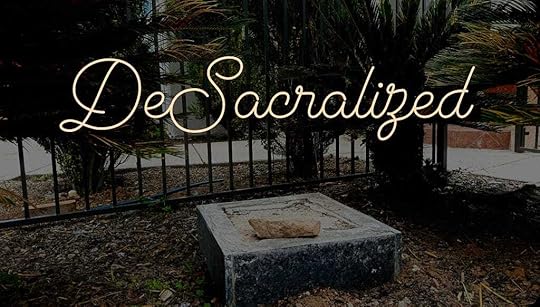
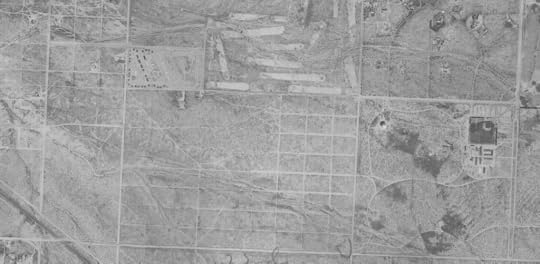
We have a wonderful new property at Mission Church! Well, it’s new to us. Technically, its the oldest house in the neighborhood. We have an amazing aerial photo from the mid 1920’s showing this house, with nothing but desert grasslands below it. This aligns with the stories we gleaned from our neighbors, about the days when horses grazed the area and native spinach grew in the flowing arroyo. We are calling the house, Tree House, in honor of Rod Hugen. Rod has been a wonderful mentor and friend to us, and was told years ago that God had made him a “tree in the field” where others could find rest and refreshment. Between those early days of the house being the ranch house of the area, and it’s new identity today…it’s had quite the history!
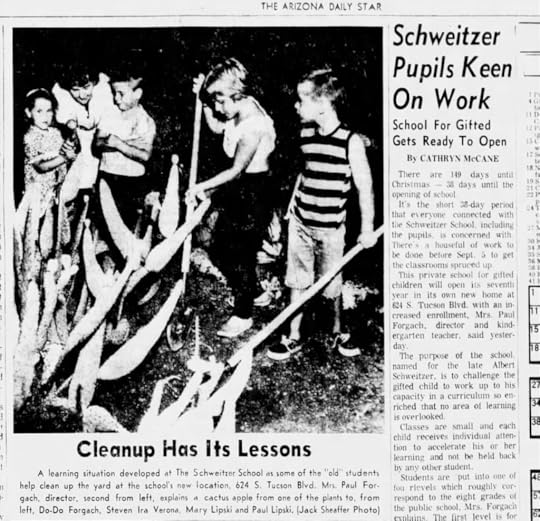
The next notable era of the house seems to come about beginning in 1967, when Mr. and Mrs. Paul Forgach moved their seven-year-old school for the gifted into the house. The Schweitzer School for Gifted Children (named for the late philanthropist and Nobel Prize winner Albert Schweitzer) sought to “challenge the gifted children to work to their capacity in a curriculum so enriched that no area of learning is overlooked.” The Arizona Daily Star featured the school as it expanded operations in it’s new house and the legacy of the school has even impacted my own family. My daughter’s maternal grandmother is a graduate.
At some point, the old boiler in the basement caught fire, and severe damage resulted. The wooden floor burned out, and if the house weren’t constructed of double red brick, it would have likely collapsed. It sat in disrepair for some time, awaiting a new owner with enough money to not only repair it, but bring it up to modern standards. In the early 2010’s that owner came along, and it was the Roman Catholic Church, who needed a new home for their Vietnamese priest at the Our Lady of Lavang Parish a few streets to the south.
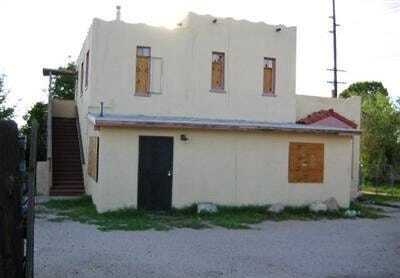
Teams of parishioners from Our Lady of Lavang stripped the house down, re-plumbed, wired, and drywalled it to modern standard. Not only that, they prepared it for the presence of a man of God and his guests. A central room of the house, at mid-level with a stairwell descending into it, would be home to a new alter for prayer and penance. The north yard, where the gifted children once gardened and played, would become a garden dedicated to the Virgin Mary, with a Virgin and Christchild statue of white granite standing tall above a large pool with an impressive showering water feature. Once complete, the priest sacralized the home. He declared that it was set apart by God, for his purposes.
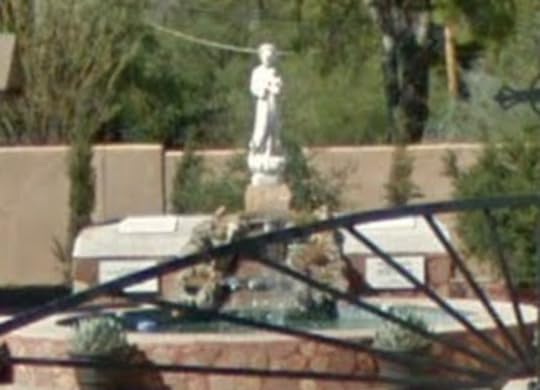
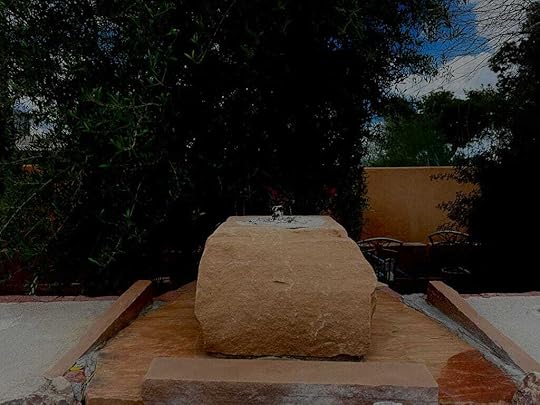
Around ten years passed and the home was again experiencing a bit of disrepair. Some of the work was flawed. No one properly sealed the parapet, and water leaked down into the new drywall. The concrete driveway pitched toward the house, and when the monsoon rains came, water rose until it crested the foundation, and flowed down into the walls of the basement. The parish was aging too, and the church decided it was time to move. Time to move to a better location, left empty by another parish, and closer to the north side. We noticed that the house seemed to be empty, the pool below Christ and Mary’s statue now covered by warping panels of wooden siding. So, we inquired of the Catholic Church. after about a year, we were able to negotiate a price, and purchase the property. The church made an official decree that it was no longer theirs, and the priest de-sacralized it. No longer, in their minds, was it set apart for God’s purposes. It re-entered the secular realm.

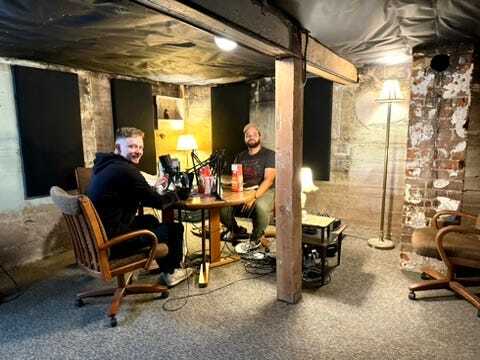
Today, after over a year of renovation work to rid the house of mold and re-configure it, we have it fully occupied. On the front, we have a church office and a conference room to share, especially with marketplace leaders moving through Infuse Cohorts. We modified the upstairs bedroom and office into a full apartment, which now houses one of our pastors and his wife. A portion of the downstairs porch is now another studio, housing a beloved member of our community who stuggles to maintain housing due to a disability. The “main house” in the rear is set aside for pastoral residents, and is currently home to a sweet Chilean couple, training to plant a Spanish language church in the States. The old boiler room, is a podcast studio. The garage will house a packing and shipping operation for a local business, and a small workshop that the church members will share and use to bless others. We are about to hold a Good Friday Service in the yard, where the fountain is now filled, capped over, and readied to be a stage for small worship services, weddings, and the like. We have not Re-Sacralized the space.
I wonder how often we De-Sacralize something, that God is not finished with? How often, do we misunderstand the ways and purposes of God? Good Friday uniquely illustrates the possibility. Those who sought to cleanse the world of Jesus, his betrayer, accusers, and the crowds who turned on him, believed that they were making the world more sacred. They were removing a problematic figure, a friend of sinners, a man who was too secular. In-so-doing, they placed the “holy and righteous one” on a Roman cross, and abused him. We think we are different. We think that we know what the world really needs. So did they.
Jesus was taken down from that cross, and buried in a rich man’s tomb. The world was sacred again, cleansed of the divisive figure. The priests and people went back to their temple rituals, swearing their allegiance to the God of Israel with the nod of approval of the Roman Empire. On the third day, Jesus arose from the grave, defeating death. When we De-Sacralized him, he was doing his most sacred work. God’s presence used to dwell in the Holy Place, of the temple. But Jesus pitched his tent among us, and after his resurrection, he revealed himself to his disciples. A crowd of the curious watched him ascend to the right hand of the Father. He told them, “behold, I am with you…always.”
See, in our de-sacralizing of Jesus, he did his most sacred and redemptive work, and now the sacred is spilling out into the streets. Now the dwelling of God is within his people, and the kingdom of God is growing like a tree in the field, that bears fruit and becomes a haven of rest for the nations. Now, places become sacred wherever two or three are gathered in Jesus’ name. The sacred is filling the secular, and God’s kingdom is being sewn among the nations, and only Jesus can sort out the harvest.
So, how should we respond on Good Friday? It’s easy to look back and condemn the people who crucified Jesus. We’d condemn anybody who crucified anybody. Chances are though, we would have done the same to him back then, and likely in the name of all things sacred. Today, we should examine ourselves. Do we understand his mission? Are we carrying his sacred name out to the people he did? Are we liable to being labeled friends of sinners? Are we willing to be about his most sacred work, of bringing sinners near to God, and offering them costly mercy. Mercy, that could only come through suffering on a cross, in our place?
Think about these things.
Who’s To Blame? — A reflection from Good Friday at Bike ChurchWhat We Do With Jesus — #1[image error]March 1, 2024
Talking Tucson Toros, Autographs, and the Quest for Friendship Lost
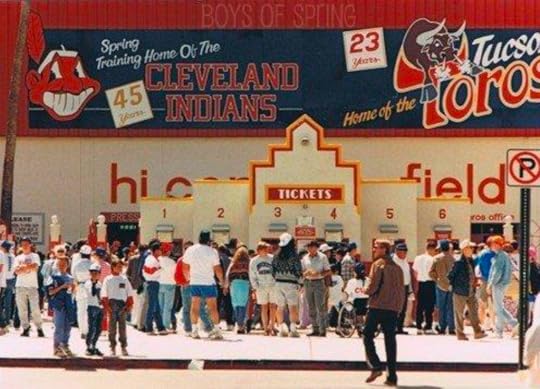 Hi Corbett Field’s entrance, as I remember it. From hicorbettfield.pdf by the City of Tucson. The group of boys by the curb remind me of my little crew back in the day.
I am honored that Anna DiTommaso took the time to interview and feature my story on the Baseball Bucketlist Podcast. The interview reminded me of one thing I miss (professional baseball in Tucson), impressed the profundity of something that hadn’t dawned on me before (the idea of getting autographs), and gave me the opportunity to gauge someone’s response to a story I hope to tell.
Episode 140 - Andy Littleton: Heartbreak, Hope, & Healing Through Baseball | Baseball Bucket List
For the readers out there, here are a few post podcast reflections in reverse order of their appearance in the podcast.
We Need to Talk More About FriendshipI am a Cubs fan because of Samuel Hartwell Zawada and his family, who listened to Cubs radio broadcast while WGN played muted in the background. At the time I was an A’s fan, but I loved hanging out at my friend’s house and they were Cubs fans. Harry Carry, Ron Santo, and a young Pat Hughes were the voices in the background as Sam and I played NBA Jam, AOL messaged girls on the computer in the living room, and fought over where to ride our bikes. Later, in our early 20’s, Sam enforced the fact that I had to go to a game at Wrigley Field while I was away for a year of school in Chicago. He was right! The game was incredible. A packed house at 1:20pm, the perfect hot dog, a prize-winning ticket, and a grand slam! I grabbed us a pair of slate blue and yellow Wrigley Field bootleg shirts on my way back to the South Side.
None of that though, is why I’m a Cubs fan. I am a Cubs fan because my friend died in a tragic accident along with his wonderful fiance on the way back down to Tucson for their wedding. I have never experienced such a stunning loss. I didn’t know how to handle it, and it took me a long time to re-enter the story and open up the wounds of losing the closest friendship I’d ever known. I’ve processed bits and pieces of the story throughout adulthood. Early in the 2022 baseball season I was trying think of an activity I could invest in for the sake of rest and joy. I decided to get back into baseball and immediately I knew which team I’d be a fan of. I would be a Cubs fan. And I am a Cubs fan because I want the regulr reminder of my friend every time I go to my team’s game. I’m learning to grieve, and hope, and remember well.
Anna asked me what’s left on my baseball bucketlist. I do want to go to all the parks and see some historic moments like any other fan, but I have one more and very specific item on my list. I want to drive Sam’s 1971 Volkswagen to Wrigley Field and meet a group of friends there for a game. I want to write about it, and reflect on and remember the friendships we long for, lose, and hope for again. I want to go where I’ve never gone before, to the place where my friend died, and into the interior experience of remembering him well amidst the company of friends old and new. I’ve actually begun the journey by writing about our early years together. Look out for more to come!
Autographs Point to Our LongingsMy favorite surprise topic in the podcast came when Anna asked me more about getting autographs. I was an autograph hound back when Tucson had the AAA Toros and several teams in town for Spring Training every summer. I have a box full of cards, many of guys (and even one of baseball’s rare female stars!) who you’ve never heard of, but some of minor leaguers who went on to be great! I had the joy of meeting stars during rehab assignments and Spring Training. Before being a Cubs fan, I had a great experience of the stars of the Chicago Cubs including Ryne Sandberg and Sammy Sosa. The stars of my beloved Oakland A’s didn’t take any time to interact with us kids the time I saw them. If Jose Canseco would have acknowledged me at all, I would have run twice as hard at Little League practice.
Why is it that people like to get autographs? What is it about meeting famous people, bringing home mementos or pictures from big events or the “stars” we see out in public? Anna and I stumbled into a far deeper conversation than we expected. Now I am wondering how much our desire for these artifacts ties to our longings to be known and be significant. I’m not saying this is a negative thing. We legitimately want to be seen, known, and acknowledged. For a famous person, our favorite player, to see us, stop, and entrust us with their name on our item seems to impact us very much. What does this tell us about the human heart? How does this tie to our longing for relationships with seemingly great people? Our conversation’s got me thinking it tells us a lot more than I’d realized.
Bring Back the Tucson Toros!I place this one last because, well, not everyone is from Tucson. Many towns and cities have endured the pain of once having something and then living life without it. Sports are such a cultural event, a bond, and an economic driver that we often feel them more. I made it to the Oakland Coliseum for the first time this past year, and the feeling of loss around Oakland is palpable. For them though, it’s the Raiders, the Warriors, and the A’s. Their massive monuments to the glories of the past stand deteriorating, reminding everyone that things aren’t the way they used to be. Tucson’s beloved Hi Corbett Field is hidden away in the central city park, but the loss is no less substantial though subtle.
At first, when the University of Arizona took over the field, I didn’t want to go to any games. It’s not the same. The seats aren’t full of crusty old guys with score cards and cowbells. Tuffy the Toro isn’t standing on the dugout. The bull isn’t out there on the outfield wall, daring a power hitter to tag him with a ball and make him blow smoke out of his nostrils. Super Dave isn’t there selling Eegee’s with Bruce Springsteen’s Glory Days blaring over the PA System. Finally though, I had to move on. On a small scale, it was like remembering friendship lost. I had to move into the experience, and toward the pain. Now I look forward to mediocre college games, sparsely attended, with a great view of A Mountain beyond the palm trees.
I keep dreaming that one day someone will catch a vision to bring professional baseball back to this city. With our proximity to Mexico, and the love of the game in our city’s story and deep in the collective soul of our largest ethnic group, it seems we could overcome the summer temperatures. We could embrace night games, like the Cubs embrace games at 1:20. We have two ballparks, but Hi Corbett belongs to the Wildcats and Kino Stadium belongs to…I don’t know…whoever will take it. Maybe Tucson can’t catch the vision, but South Tucson could! Imagine for moment, just close your eyes and dream, of south 4th Avenue as the meandering drive toward a little Single A ballpark for a beloved west coast team like the Padres, Dodgers, or the A’s. Visualize a beautiful little ballpark, surrounded by Sonoran dog and taco carts as fans line up to catch a night game. And what if…that team is called the Tucson Toros. We can dream!
Andy Littleton - MediumThe Little Man: A Father's Legacy Of Smallness[image error]January 1, 2024
Why I Needed a Pastoral Retreat, and 6 Reasons You do Too.
 Calming Waters — Puerto Rico — Andy Littleton
As my family headed into 2022 we were licking our wounds from a very painful and contentious ministry experience in 2021, in which all the divisions discovered during Covid lockdown began to tear at our little beloved church plant. At that time, we really didn’t understand how all of this would impact us and other ministry leaders. Two experiences began to wake me up to the reality.
First, one of my family members expressed his feelings about some groups of people (newly labeled post-Covid) in terms that I had only heard from people recalling the events of the 1960’s. It dawned on me that we had gone through a period that would be that defining. In my lifetime, as similar flashpoint was 9/11. I remember thinking that everything would go back to normal after that, you know…things like security checks at the airport would be eventually phased out. I was wrong about 9/11 and I began to wonder if Covid was a similar flashpoint, leading to a new normal as opposed to the way it used to be. I now believe that we will look back on the year 2020 far into the future, and be reminded of it in subtle ways. As with the 60’s, we’ll refer to people using labels we made up or codified in 2020. As with 9/11, we’ll deal with years of distrust and anger toward specific types of people, and safety precautions to assuage our fears, that we would have never imagined beforehand.
Second, a friend in our church sent me a New York Times podcast about a pastor who’d hit a wall after 2020, and had to leave the ministry for a time. That pastor, Dan White Jr., and his wife Tonya ended up founding a retreat center to help other leaders process their journeys after seeking a period of respite in Puerto Rico. As Dan told his story to the reporter, I began to recognize numerous themes that I and friends in ministry were experiencing too. Though I didn’t manifest the same signs of trauma (a word I was hesitant to own) as Dan, I began to wonder if some of my other feelings and struggles were stemming from our experiences. I then listened to a podcast about the impact of technology on our society, and in it Jonathan Haidt pinned the year 2014 as the year academia began to shift as a result of technology. That was the same year we planted our church. I began to realize, that we are and had been ministering in a uniquely challenging time and that we were going to need more support than any of us had suspected.
As I moved toward my planned sabbatical, I hoped that I would be able to move into all of that and find healing. As I shared in a previous article, that didn’t go well, and I learned a lot of lessons from that experience. When my church elders asked how to help me in the wake of that experience, I recalled the podcast I’d heard, and began to explore the possibility of doing a retreat with Dan and Tonya. It was exactly what I needed, and I suspect you may need something like it too. Here are six of the many possible reasons why I think this is so.
We Need Pastoring TooWe do! Leadership is lonely, but pastoring can be especially perilous. I am so fortunate to have other pastors in my life, many who are older, and who know me well. I realize that many friends of mine in ministry do not have this built in for them, and this idea becomes even more crucial! Unique to ministry is the idea that the leaders are shepherds, but also sheep. We all have Jesus as our great shepherd, but some are called to under-shepherd others. Sometimes we under-shepherds forget that we also walk the same pathways, sometimes through rocky terrain, and even the valley of the shadow of death, as sheep. In those times, even in preparation for those times, we need shepherding too. A guided pastoral retreat is an opportunity to receive the shepherding of a fellow under-shepherd. When you can’t be on retreat, seek this out from another trusted pastor who isn’t functioning as your friend or from a spiritual director.
We Need to Get AwayDan and Tonya knew they could find respite in Puerto Rico, because they’d been there before on a previous sabbatical. Puerto Rico is uniquely beautiful and accessible. You don’t need to have a passport or speak another language, but it’s also a completely different world from what they experienced as church planters in Syracuse. The culture is more slow, familial, and generous. The environment is teeming with new life and refreshment. You’re never far from the beautiful clear ocean waters or the lush picturesque rainforest. When they stumbled on an incredible historic inn and restaurant for sale in the rainforest, they knew the destination itself would serve weary leaders. When we are hurting and tired, we need to rest and encounter beauty. We need to get away. It doesn’t have to be across the ocean, but it needs to be a change of pace and scenery from your ministry context.
We Need to Be UnderstoodDan and Tonya make space for weary leaders to come and just be in their jungle hideaway, but they also offer guided sessions for married couple relationships, or for leaders who have experienced loss and pain. I took the Pain and Possibilities track, which I would highly recommend! For me, the most important moment came early. Dan invited me to just “dump” everything that happened to myself, our family, and our church over the last three years. I had prepared to talk about the last decade, so I thought it would go fast. It felt fast, but took well over an hour. Dan looked me straight in the eye and acknowledged just how insane and overwhelming it all must have been. Honestly, I had felt bad about feeling bad. Nobody had died in the last three years, and there weren’t any scandals or lawsuits or anything like that. Dan’s acknowledgment though, was a game changer. I felt like my feelings mattered, and that the one listening to me got me. Ministry leaders are a unique breed, with a unique calling. We need to be understood, to move toward healing and health!
We Need to Process PainIn ministry, you are often the one who needs to have it all together. The primary reason for calling you, is usually going to be to receive some form of support. When this is the case, it can feel as if there aren’t a lot of places for you to go to grieve, complain, fret, or just cry out in agony. Pain comes with the territory of ministry. It’s to be expected, and Jesus told us we’d be rejected and potentially even persecuted for his name’s sake. This fact though, doesn’t mean that we don’t get to feel and struggle like all other human beings. When people in our ministries struggle, we show compassion and help them process their pain with a loving God. We need to do the same, and we need the same kind of help!
We Need CeremonyMany losses in life come with some form of conclusive ceremony. A death is usually ceremonialized in a funeral. You have a final hearing when you get a divorce. Even when you lose a job, you usually have a meeting in which you get formally fired. In ministry though, many of the relationships end or change without resolution. This is not always the case, but it’s not uncommon for a person to seemingly drift away or share a sharp critique and then disappear. This wears on a leader and their family especially. Often the effect sneaks up on you.
In my family, I’ve noticed a reticence to let people in and close to us since 2021. It’s not that we don’t want relationships. We want them very much! But we also remember the pain of the losses, and struggle to accept the possibility of that pain in the future. This was a cumulative impact, of numerous and significant losses, all left un-processed. Dan and Tonya helped me name the losses and prayerfully lay them to rest in the river that flows through their property. I have found that, as small as this may seem, it has become a point in time and space that I can look back to and acknowledge that something has died and that God is with us. I can’t emphasize the importance of this enough!
We Need Help in TransitionTraumatic times aren’t the only things that can wear upon a leader’s soul. The sheer weight of responsibility can have the same effect. On top of that, we age and we change as we move through life, and these changes can cause us to suffer under unexpected burdens. For me, this was also at play. When I went on my retreat, I had just turned 41 and had been sensing that I needed to shift my way of operating. I once functioned primarily out of my own bank of energy and level commitment, but I have been sensing a desire to see others take on the mantle of responsibility and myself to have more space and time to reflect and process. This was new for me! On my retreat, Dan and Tonya helped me process what comes next. The pain I’d experienced wasn’t simply a loss. Some of it was leading to lessons learned. Some of it was a byproduct of my own way of being in the world, and I needed to reflect and seek renewal myself. I needed insight and guidance for this, and I needed it from outside of my ministry context, where people were used to me operating in a certain way.
No story is the same, but I hope you will consider getting help and support through something like a pastoral retreat. You can always reach out to Dan and Tonya to see what times they have available down in their jungle hideaway! Wherever you go shepherds, don’t be too afraid or proud to let Jesus shepherd you through someone else who gets it!
 Kineo Center — Puerto Rico — Andy LittletonAndy Littleton co-pastors Mission Church in Tucson, AZ. He also serves as a mission leader for Resonate Global Mission. He has written on bivocational ministry in the book Part-Time Pastoring with Dr. Sean Benesh.Pastoral SabbaticalPart-Time Pastoring: Leading God's People by Integrating Faith and WorkChristian; Your “What’s Next” is Impacting How You Feel About Current Events.The Little Man: A Father's Legacy Of Smallness[image error]
December 29, 2023
Pastoral Sabbatical
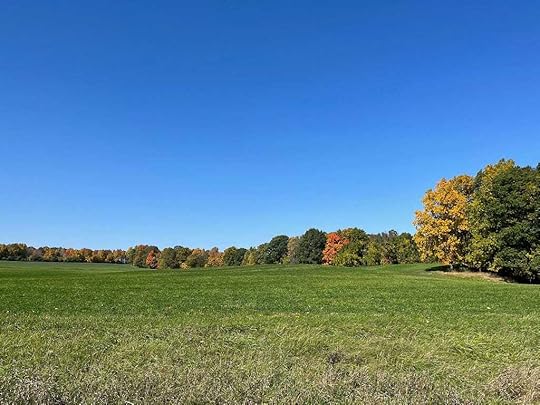 Green Fields in Fall — Upstate NY — Photo by Andy Littleton
My Backstory
I had to take a retreat to recover from my very rough sabbatical. This is not what I was hoping for. Not at all!
So what do I know about sabbaticals? Well, in my ten years as a church planter and pastor, I have now taken two. The first felt deeply meaningful, like a landmark life experience, and it even led to my first foray into memoir writing. The second felt like a complete unraveling, in which I dipped further into depression than ever before and felt nearly unfit to return. The retreat afterward though, revealed that it was also good and the difficult process was very needed. If I hadn’t done the sabbatical, I would still be unaware of how poorly I was doing at the soul level. My church planting mentor planted a church that “failed” and one that did not. There’s something to knowing the experience of both. So that’s what I have to offer.
I’ll begin with the most difficult question. What IS a sabbatical?
1. Sabbatical is Soul Rest
At the core of the call to Sabbath, is the call to rest. Even the land of the ancients was to lay fallow, to cease it’s striving. The trouble with ministry, is that much of the work is internal. Like the land, the work is fueled from beneath the surface, where the roots take hold, in the realm of the unseen. Sure, we may run around to some meetings, plan events, and deliver a message, but the work of the true minister is what fuels the activity. The work is mental, spiritual, and emotional. It’s the same work from which one engages with God, nourishes a marriage, parents a child, and fosters a friendship. It’s the work that often continues in the background when you sit down for coffee. It shapes the way you read a book or an article, on the hunt for nuggets of wisdom, sermon illustrations, and bridge concepts to help an unbeliever connect to the language of faith.
What does it look like to rest from this work? I suppose that depends on you to some degree. I don’t have a favorite personality test, but most of us have done one. If the one you did was thorough, you may have some clues here. If not, you can probably imagine the feeling. The feeling of lightheartedness or, at least, the feeling of shedding spiritual weight. My first sabbatical landed, quite by God’s mercy, just after the death of my father. There would be no lightheartedness for me, or so I thought. What I did find, was God’s lifting of my burden upon to his own shoulders. Did not Jesus say, that we will “find rest” for our souls when we experience him bearing our burden with us? So how do YOU get to the place where that experience is possible?
Here you need to ask yourself questions about how you re-charge and clear the decks. For me, and I know this from experience and several assessments (Birkman / Enneagram), I need time alone AND something alternative to do. Here, it’s important to grasp what it looks like to enter the place of being at rest in your soul and to lay down the inner work of ministry. If I only have space and time abundant, my head will be doing what it does when I work. I’ve found that it’s helpful for me to engage in a creative alternative. On my first sabbatical, I went on a road trip and journaled about my father. My intention was to turn it into a memoir. I found that the most soul restful parts were the adventures, the type-setting and graphic design, and the restoration work I did on an old Ford truck. That would be utterly unrestful for some! This is why you need to ask yourself, and a few others who want to see you rest, what that might look like for you.
2. Sabbatical Requires Space
On my second sabbatical, I failed to make space for these things to occur. This time, I had just passed through the fires of doing ministry mid and post-Covid. The year 2021 for us, as it was for many, included the most relational losses of my lifetime. I’ve heard (though am yet to find the original source) that most people lose five to seven relationships in a lifetime, and a pastor loses five to seven a year. I catalogued my ministry losses, and my average is 7.5. The year that pushed that number up, was 2021. We didn’t just lose church members, but core friendships. And we had a number of other significant challenges as a church and family. It was awful. I knew this was the case, and that I needed to reflect and recover, but I wasn’t able to make the space during my sabbatical months. My months off being in the same town, same neighborhood, and same house where it all happened were torturous. There I was, with nothing to do, but sit in the reminders of all that we’d lost and been through.
Though I have just acknowledged that everyone is different, it’s nearly impossible for me to think of a scenario in which a sabbatical can be effective without creating significant space from the contexts in which your mind is doing the work of ministry, especially if it’s weighing on your soul. I highly recommend finding a way to take in something that you experience as profound, beautiful, relaxing, or joyous. I highly recommend that you vacate places full of complexity, and spend time in spaces that refresh you, or are neutral at least.
A sabbatical is not a family or couples vacation. I highly recommend that you define it as such for those you lead alongside. Everyone should vacate from time to time, to visit friends, family, and interesting places. A sabbatical is different. Depending on your family, a vacation may be devoid of space for soul rest, and full of demand upon the ministerial parts of your mind and heart. Some people can take sabbatical with their family, others cannot and it’s ok to consider which is your scenario. If you don’t, you risk spending a lot of time not resting your soul at all.
3. Sabbatical must be Substantial
At our church, we’ve built in that pastors and elders on staff receive two weeks of sabbatical per year, and can bank those weeks for up to four years. My practice, which I highly recommend, is to take at least a two month block off for sabbatical, which does not diminish your vacation time for the year. If the time isn’t substantial, the chances of you entering soul rest are very low. It also takes time to transition into and out of an effective sabbatical.
For this reason, expect and plan for an on-ramp and off-ramp period. For me, and I suspect for many, it is impossible to slam on the brakes spiritually, without inertia pushing you forward. If you expect this, it will be less frustrating. For me, a long trip from one place to another may suffice as an on-ramp. For others, it may require more time. During this time, you should expect to think and even worry about your ministry context. You may remember something you must do before you continue sabbatical, and it’s ok to do it. The goal is to do this less and less. The off-ramp is similar. It’s probably not best to re-enter with a full regularly scheduled day and the expectation that you’d process months of emails. Ideally, re-enter with a stripped down schedule, allowing yourself to catch up with the tasks and re-orient to being around your co-workers and parishioners.
4. Sabbatical is best when Simple
One of the hallmark characteristics of ministry is the diversity of roles that get lumped under the singular title. For bivocational ministers such as myself, this is even more acute. A typical pastor may be required to do what the business world would label customer service, public speaking, administration, therapy, business administration, and many are also the church handyman. This diversity of roles to play can be great for those who love variety, and absolutely overwhelming for those who don’t. No matter your experience, a sabbatical should be far more simple. Don’t try to do too much, even if it may feel like respite from your regular work. If there’s way too much that you desire to do on your mind, you probably need to add elements of those activities into your weekly practice of sabbath. In my case, I am attempting to add more regular and non-income producing creativity and handiwork.
Here I’ll add a note to the bivocational among us, and those who truly do more than one job even if it is under the umbrella word “pastor.” Taking sabbatical may be a little more difficult for you. In my case, since being a lead pastor, I have owned and operated the entities I worked for alongside my pastoral role. This made it possible for me to break from almost all of it. I say almost, because owning comes with it’s own extra layers of responsibility. During my last sabbatical I ended up having to do some business administration I didn’t want to do, but had nobody else with my combination of permission and skill to make it happen. If you don’t have the luxury of being your own boss, I highly recommend that you get ahead of the process and ask for as much time off as possible. Bank sick time and vacation time if you have to, and use the time you can’t get off to be part of your on and off ramps, to the effect that you are able to incrementally move toward and out of the soul rest pattern.
5. Sabbatical Unravels when not Structured
Structure? Isn’t this what we are trying to get away from? Perhaps it may feel like that, but it’s true that if you don’t plan to do something, you probably won’t do it in the end, and this includes rest for your soul. It’s quite ingenious that God gave us a structure for the week, including a command to rest as a creation ordinance. Without this structure, how much worse at rest and worship would we be? I submit that the same is true for a sabbatical. It must be a part of the structure of your job description, of the year in which you take it, and it should be planned out ahead of time as much as possible.
If you don’t have a built-in sabbatical in your job description, you need to start there! A pastor I met recently reached his limits according to his wife, and went to the church to ask for a sabbatical. They called him in for a special meeting mid-way because they were afraid he was in the midst of quitting. Planning for a sabbatical is best for you, and the other people of your church. It helps you all agree beforehand that this is necessary, not just when you’re on the brink of burnout. Don’t build one based merely on your felt needs, or the sense of plausibility in the minds of your board or co-leaders. Refer to the best practices of others, and design something that isn’t limited by your current sense of it’s necessity.
Once sabbatical is built-in, you’ll need to make sure you’re able to move into it well. This does not happen best at the last minute. My first sabbatical had to be mapped out early because it involved travel and accommodations. This worked to my advantage. I was able to rest within the preparation I’d done before. An unplanned sabbatical will be one in which you problem solve along the way, and this will become your new ministry to yourself. Designing a year that supports your sabbatical is huge. My last sabbatical ended up disrupted because of delays in a small building project at the church. You can’t avoid all mishaps, but better planning could have made a difference in my case. If at all possible, delegate the authority needed to stand in your place and make decisions for you to a trusted person or team in your ministry. This can help where you fall short.
6. Sabbatical Requires Support
You can’t go on sabbatical without support; simple as that. But the support you need isn’t limited to covering your tasks. You need people cheering you on, and encouraging you to remain committed to finding rest for your soul. I am beyond grateful to say, that for the most part, I have had this level of encouragement from the people and co-leaders of my church during both sabbaticals. It’s made a huge difference. They have granted me space when I’ve asked for it, and stepped in to listen to and encourage me when it wasn’t going so well. When I opened with the fact that I needed a retreat to recover from my second sabbatical, the beautiful part of the story is that it was my elders’ idea and I heard about nothing but prayerful support from our people. I realize how fortunate I am, but no matter what, you’ll need some level of support to make this work!
At the very least, you do need others to step in to do your tasks. You may need to reach out to your body of churches, leaders of other churches, retired ministers in your area, or mature believers in your congregation. I was very nervous about entrusting others to lead during my first sabbatical, but was far more encouraged to return and find that everything was fine. Exactly how I would have done it? Nope. But fine. And to find rest for your soul, you’ll have to live with that! Beyond your tasks, delegate your authority to specific people for the duration of the time. This is critical. If there are issues you won’t allow to be handled without you, then clearly define which ones are which and let them handle as much as possible. If you can (I still aspire to this) let someone else handle your emails and voicemails.
Finally, ask your congregation and leaders to pray for you before and after your sabbatical. Though the idea of sabbatical is rest for your soul, you’ll often find that dark visions emerge when the dust of life settles. Often there are un-explored feelings and thoughts that get tamped down by the work of ministry, and the process of resting allows them to emerge and confront us. My second sabbatical was far more haunted than the first, and I could sense the enemy’s intent to harm me. The truth is, that these areas of darkness had been there all along, but I just wasn’t able to see them. It is a mercy of God to see spiritual reality, and our Good Shepherd comforts and protects us in the valley of the shadow of death. Anticipate this possibility, and invite your people to pray for your strengthening and protection, as well as for times of joy in God’s presence.
 Clear Waters — Puerto Rico — Photo by Andy LittletonAndy Littleton co-pastors Mission Church in Tucson, AZ. He also serves as a mission leader for Resonate Global Mission. He has written on bivocational ministry in the book Part-Time Pastoring with Dr. Sean Benesh.The Little Man: A Father's Legacy Of SmallnessChristian; Your “What’s Next” is Impacting How You Feel About Current Events.Part-Time Pastoring: Leading God's People by Integrating Faith and WorkWell-Equipped Christians are Checking Out, Right when Churches Need Them MostBivocational Pastor at a Bad Religion Concert (+ ministry thoughts @ end)[image error]
November 23, 2023
Glutton for Cranberry Sauce
 Flickr: Alexa
I may never live down the day I finished off the cranberry sauce.
I should never have told my wife. Now she gives me the side eye every time we go out to dinner with friends. She deals with anxiety when we’re served a small appetizer.
It was an innocent mistake! What kind of family only has one can of cranberry sauce at Thanksgiving dinner? Sure, it was my family. But how was I supposed to know? And what do you do once you’ve flopped half a can of cranberry sauce smack in the middle of your turkey gravy? You can’t really put it back. Are you supposed to ask people if they want some off the plate? Truth be told, I didn’t even think to ask! I love cranberry sauce! It was the first thing I shoved my spoon into, and it was gone in 2.5 seconds.
For goodness sake people, I was a child!!!! Dad just handed me the little six inch white plate with half a can of sauce left on it, and I slipped it right over on top of my potatoes. I wasn’t wise enough to peek across the table to the empty pantry to check the status of grandma’s stock of various gelatinous fruits. No one had taught me to make sure that you’re taking the last of something, that you have to make sure there’s more or that everyone got as much as they wanted. I’d never been schooled in the art of acting like I was looking out for the good of others, even though I was really only thinking about how much I wanted that slippery, sugary tart goodness in my mouth. That’s taken me years to learn!
I didn’t know my grandparents were poor! I knew their house was smaller than most of my friend’s houses. I knew it had spiders inside, all over the light switches and all over the wall next to the toilet paper. I knew it was out in the middle of nowheresville, where it’s dusty and dry and covered in snakes. But how was I supposed to know they were poor! They were the ones who had the whole family over for dinner for every holiday! My grandpa built the house. Didn’t they own the land? We didn’t own our house at all, so how was I supposed to know you could be poor and own two hundreds cars like my grandparents. I know they didn’t run, but they owned them! My parents only had two! They had dogs, like ten dogs! I didn’t even have a dog!
I may never live down that day, but only because I outlived my dad, who flopped the other half of the can onto his plate, right before I did.
Andy Littleton - MediumThe Little Man: A Father's Legacy Of SmallnessOut in Left FieldAndy Littleton - Pastor, Writer, Small Buisness Owner, Podcaster[image error]October 27, 2023
Out in Left Field
The year my Phillies won the championship.
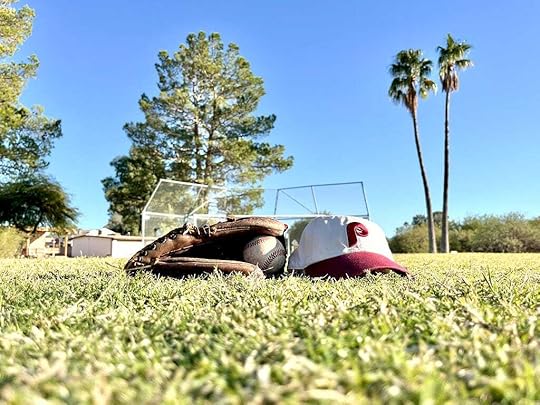 Photo: Andy Littleton
It had been the absolute worst season of little league that I’d ever experienced. I later learned that my coach benched me because my parents couldn’t afford the uniforms. It turns out that the coach owned the uniform shop, and wanted our team to look like the real life Philadelphia Phillies with their candy cane pinstriped fitted pants, thick long socks with stirrups flaring out at the ankles, finely lettered jerseys with buttons heavy as nickels and, of course, fitted caps with thick stitched logos. For just five hundred dollars we could be Darren Daulton and our coach could be as rich as William Giles.
Thornydale Little League required coaches to play all players at least one inning a game. The previous year I was the best pitcher in the league, flame throwing past all the poor little boys who choked up on their bats and stood in the back of the box to no avail. But this year, I played one inning a game in left field as my coach coaxed my parents to pay their dues.
We were good. We made it to the championship game, and stayed one run ahead into the bottom of the ninth inning. Coach put in his son Connor to save the game, of course. Connor, the naturally built catcher who did everything half-heartedly. He strode mechanically to the mound to face the heart of the Dodgers order. The coach glanced over my way. He had no choice. “Left field Littleton.” he sighed.
A one run lead is paper thin, and the anxiety pulsed through the ballpark. I wanted it all to be over. I’d already decided I was done. No more dreams of the big show, the roar of the crowd as the batter swings late and under the high heat. Taking my place in the outfield grass, I stood meaningless and disposable. My perfect uniform unmarred due to lack of use, with the only signs of wear being the sweaty crumpled folds of the fabric under my skinny rear end. The first batter struck out on purported fastballs, presenting as changeups. The second hit a hard grounder to short, and Billy threw him out easily at first. The last batter was Ryan Dunner, the best hitter in the league, who I’d pitched past many times.
As I stood in the sweltering heat of that summer day in left field, I had a sinking feeling. Hard hitters pull the ball against mediocre pitchers, and Ryan batted righty. All signs pointed my direction, and I was done. Connor flung the ball right down the middle high. Ryan cocked back like a loaded revolved and unleashed on the ball, launching it like a space shuttle headed directly into the spotlight sun we all stood sweltering under, in my direction…of course. As the ball hung, invisible in the blazing sky, I felt it again; the rush of the competitor. The urge to dominate, to taste the spoils of victory, the terror of imminent demoralization. And then my body responded like the bench warmer I’d become, as if frozen under the incessant spotlight.
In a split second the ball reappeared from amidst the blinding orb. My body released and thrust forward and slightly to the right. The ball plummeted into the pristine pocket of my faded red Rawlings infielders glove.
We had won the game, and I was the hero. Coach, with much fanfare, dragged me up in front of all the parents and presented me with the game ball. It was everything I’d ever dreamed of. And I quit playing baseball the next year.
 Photo: Andy LittletonAndy Littleton - MediumThe Little Man: A Father's Legacy Of SmallnessWhat We Do With Jesus — #1What We Do With Jesus: Reflections on Modern Faith through the History of Tucson's Garden of GethsemaneAndy Littleton - Pastor, Writer, Small Buisness Owner, Podcaster[image error]
April 22, 2023
Who’s To Blame? — A reflection from Good Friday at Bike Church
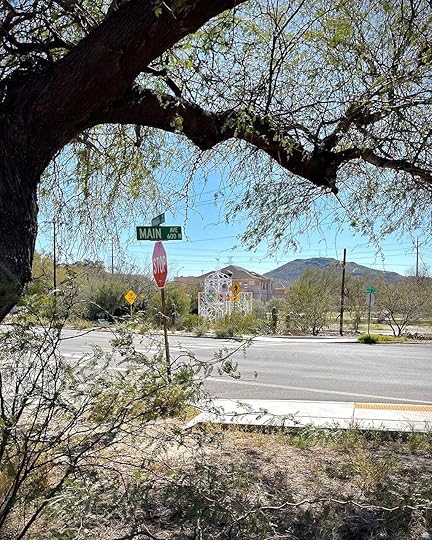 Bike Church sits at the edge of the Barrio Anita neighborhood — Photo by Andy Littleton
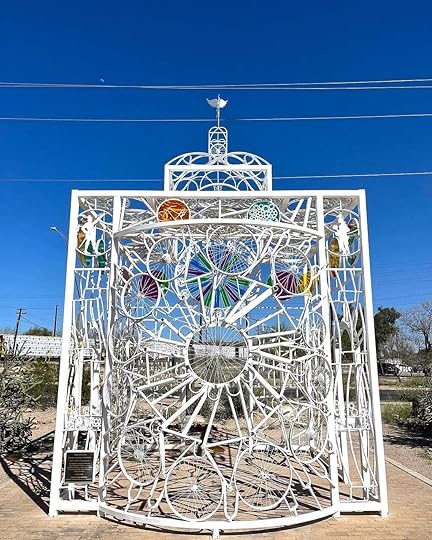
Every Good Friday my church finds a place in our city where the spiritual longings of our friends and neighbors are already on display. This year, we held our service at Bike Church. Creative Machines built Bike Church to be an ecumenical invitation to remember people who have died in biking accidents. It’s also a beautiful and compelling piece of public art; it’s interwoven recycled bike parts, powder coated white, decorated with multi-colored glass catching the eye of commuters on their way downtown.
We opened our service by singing the song How Deep the Father’s Love for Us. The song ends with the words “his wounds have paid our ransom.” We Christians believe that Jesus’ wounds have paid our ransom. Ransom, in the Bible, is to redeem from punishment by paying an equivalent of the debt that is deserved. It is not to cancel a debt, but to absorb it. It is not to let something go, but to ensure that justice is upheld, while also extending mercy. The Father’s love for us, we believe, is deep indeed.
 Bike Church’s ecumenical stained glass — Photo by Andy Littleton
One of the ways we’ve learned to display the love of God our Father here in Tucson is through volunteering for Cyclovia. Our loving father made us creative and relational beings. He made us to enjoy our world together. He made us in his image, so we’ve created all sort of transportation devices. We see these at Cyclovia. Hybrid bikes, tall bikes, decorated bikes, cargo bikes filled with smiling children…the trike with the drum set on the back! It’s always a beautiful and fun afternoon where we see that transportation and community don’t have to be separate…they unify. We zip-tie baseball cards on spokes, share snacks and drinks, play giant jenga, and hold caution tape across the intersection to keep people safe. That’s our job, to keep our interception safe. And we do our best. God, our father, smiles upon it, and we have a good time in the sun.
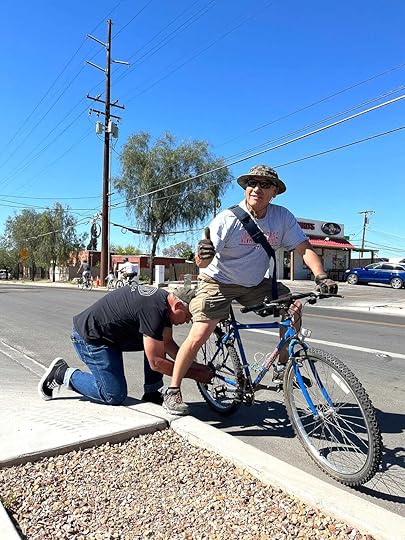 Baseball cards for your bike spokes at Cyclovia — Photo by Andy Littleton
Except…that one time, when we thought we were witnessing horror. We were at an intersection in South Tucson several years ago; doing our thing. When BANG…a vehicle backed into the pillar of the old gas station turned repair shop we were standing next to. We all turned our heads, surprised at the noise. “Whew, it’s just a little accident.” Except now, the massive SUV with dark tinted windows is lurching forward, peeling out, racing onto the street we have blocked off toward hundreds of people, children, on their bikes. It’s careening back and forth. Bodies are flying to the left and right. My co-pastor Nick and I begin sprinting down the street expecting the worst. In those split seconds I began to prepare myself for dead bodies, and weeping, and chaos.
The vehicle, thank God, did not strike any people. Eventually the driver swerved off the Cyclovia path and, though people were shaken up from diving or scrambling to safety, nobody was seriously injured. I’ll never forget that moment, but it’s not nearly as seared into my memory as it could have been. It could have ranked as one of, if not THE, worst moments of my life. And who’s fault would that have been?
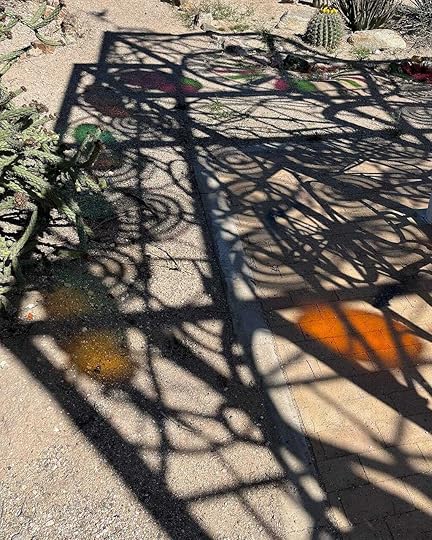 Shadows and light in the late afternoon — Photo by Andy Littleton
Some have said that Cyclovia is too idealistic, and that the event should happen in areas like South Tucson, where the community doesn’t completely embrace the idea of having it’s streets flooded with bikers from all over town. Maybe it’s their fault, for setting up such a possibility. Maybe it was us. If we’d made the boundaries of that intersection more clear, it may not have happened. We speculate that the driver of the vehicle freaked out when he saw the police who were at the intersection, and was trying to get away from them. Maybe it’s their fault…the police. Maybe that driver had negative experiences. And then there’s the simple answer; it’s the driver’s fault. He was either doing something wrong in the first place (stolen car, or illegal cargo?) so they responded in a very erratic way. Maybe the driver wasn’t sober! But that doesn’t exhaust the possibilities, because even if they were to blame; Why were they in that state? Why does one live a drastic life and engage in criminal activity? How were they raised? What economic factors were present? What opportunities to do the right thing even existed?
This is a complicated question…Who’s to blame? Bike Church stands to help us remember the dead. Those who died riding their bikes. All over our city Ghost Bikes stand to commemorate those who died on bikes, where they died. Tucson loves bikes. In 2016, we were rated the for bike riding in the nation. One year later, we were rated the second most deadly city for bike riders. We die doing what we do best. But, who’s to blame? Bikers not wearing helmets, riding intoxicated, not being careful? Motorists not being aware of bikers, deciding to drive instead of the more economical and sustainable mode of bike riding? Sometimes it’s far more complicated to discern. Sometimes, the biker loses their balance because they just run over a rock that happens to be sitting in the wrong place.
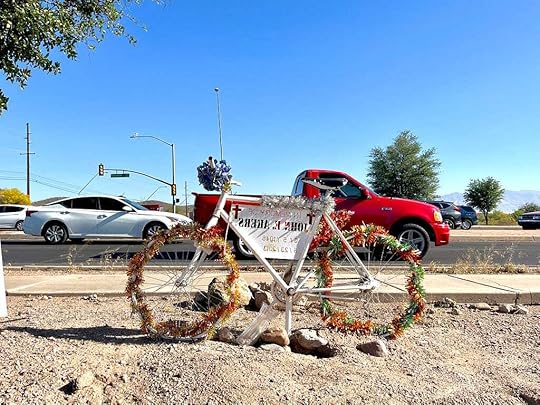 A ghost bike reminds passers-by of a life lost — Photo by Andy Littleton
This isn’t the only reason people die. People die in school shootings, car-on-car accidents, hiking accidents, altercations; the list goes on. On Good Friday, we remember Roman Crucifixion. Jesus, who claimed to be God come in the flesh, was killed. Who’s to blame? When Jesus hung on the cross he prayed for forgiveness for those who killed him. Forgiveness only comes where there was a debt.
What’s the difference between the motorist who struck and killed a cyclist, and me? Depends on the situation I suppose. Let me tell you though, in my case, it’s not much. When I was young I had a lowered mini-truck. I loved that truck. I fixed it up with rims, stereo and limo tint. I got it tinted extra dark on the south side, where some shops will even even tint your windshield so people can’t see in to see your stereo equipment or YOU. I used to love the feeling of sitting in my truck, and nobody noticing I was in there. One night, late, I was driving home from a friend’s house in the rain. I approached a turn I took all the time, and eased into it, until in a split second, I hammered the brakes because a cyclist appeared out of nowhere right in front of me. I missed him by inches. What’s the difference between me, and the people who killed the cyclists we remember at Bike Church? Inches.
Who’s fault would that have been? Most logically, mine. I was operating the vehicle, I chose the window tint. But then again, the shop that tinted the windows did so illegally (and told me not to disclose). The biker was riding in the rain with no lights! But none of that would have mattered. If I’d killed a man on his bicycle that night, my life would have never been the same. And it doesn’t stop there. A family would have lost a son, a father, a brother, an uncle, a cousin, and my family would have had a killer in their home, someone guilty of accidental manslaughter. The death would have led to death upon death; the death of relationships and the death of dreams. That’s not what happened, but I’m still the guy who almost did it. I am the same as those who have done it.
We crucified Jesus on a Roman Cross. Roman soldiers executed their orders, lived out of their cultural values, and killed Jesus. One of them punctured his side and finished the job. He finished the killing of him. The earth shook. It became dark for three horrific hours. Jesus had cried out to his Father, “Into your hands I commit my spirit!” A crowd gathered, the historian Luke says, “for the spectacle.” The Roman Centurion made the great confession “Truly this was the Son of God.” The killer makes the great confession.
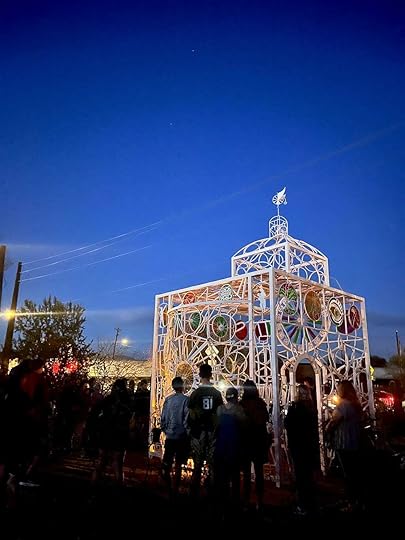 Good Friday worshippers — Photo by Andy Littleton
What problem in the world disturbs you the most? Bike accidents? Or is it something else? The list is inexhaustible. Who do you blame? What’s the problem? Can you figure it out? Where do you factor in? Could it even be solved, or is it one of those metaphorical rocks in the road; all the fault fixing in the world, wouldn’t stop it from happening?
As we remembered Jesus’ death that Good Friday, we placed rocks in our pockets, to remind us that even the most incidental impacts of sin, were placed upon Jesus on the cross. He paid our ransom. Our mourning, even our anger at the realities of sin and death are not unreasonable. But also, Jesus died to pay our ransom. We kept the rocks with us until Easter evening, when we savored the good ending God has in store.
Cyclovia wants to make the possible visible; the harmonious use of public space. The Bible declares that restoration is possible, even in the face of death. Death, and all of it’s causes are all around us! Bike Church reminds us that this is true. Even the night we were there, a broken vehicle mirror lay inside the structure. Did that mirror strike another bicyclist? Who’s to blame? Jesus died on a Roman Cross, and innocent man. What does this mean? What beauty might arise from this broken world?
 Andy Littleton co-pastors Mission Church in Tucson, AZ. He also serves as a mission leader for Resonate Global Mission. He has also written on Tucson’s Garden of Gethsemane in What We Do With Jesus.[image error]
January 6, 2023
Christian; Your “What’s Next” is Impacting How You Feel About Current Events.
 Photo by Joice Kelly on Unsplash
What happens next in redemptive history? Let me dial that question in. When you think about your view of God’s plan and activity in the cosmos, what is the next significant event on planet earth? How does that make you feel about the most recent event in the news, or election cycle?
I pastor a small church in what’s called a “post-Christian” context. This means that, by and large, my friends and neighbors grew up outside of the influence of Christian assumptions. We planted a church meant to be an outpost of the Church. By this we mean that we hope to engage people on the Church’s edge, either exploring faith from the outside or questioning it from the inside. As a result, we are mishmash of theological backgrounds. To some degree we know this because of our stated strategy. Still, during times of change or upheaval I have noticed a distinct difference between the way our people with Christian backgrounds react. As I’ve listened and queried over the past several years a trend has emerged. We have different assumptions about what’s next.
I don’t think we are alone in this. It’s increasingly less likely that you go to church with people raised with uniform theological assumptions. To some degree this is beautiful. To some degree this can be very confusing when unexamined. Recently I heard a political commentator suggest that the views of Christians in the news weren’t being parsed out according to their traditions. I agree. It’s unfair to assume that a Pentecostal and a Conservative Baptist think the same. Terms like “evangelical” don’t define the group well enough. Interestingly though, today, people who grew up Pentecostal may go to church with people who grew up Conservative Baptist, and the two may not understand the differences in their assumptions. I believe this is especially true when we consider the question; What’s next?
In 2021 I had a number of conversations with people who were upset, unhappy or leaving church. A theme emerged. They all were clearly experiencing acute anxiety. Almost everyone I knew had concerns or low level anxieties, but this was different. I observed something else. They were not only afraid about what was happening in our country, but what that meant about the world’s spiritual trajectory. When asked, they assumed things were about to get very bad. They were listening to teachers who were warning that it was so, and imminent. I began to ask others, who seemed less afraid, what they assumed God would do next. Some said they didn’t really know or think we could know, but they didn’t seem particularly focused on that question. Some of them actually seemed to anticipate what came next, that Jesus would return and make things right somehow.
[Trust me, I understand that what I am about to share is grossly oversimplified. Innumerable books have been written on the forthcoming concepts, and I am not trying to write a new one. Here is a suggested starting point for learning about the options if you don’t understand them or need to brush up on the terminology.]
When I ask you “what’s next?” I am engaging your views on something usually categorized as eschatology in theological study. It’s the views you hold of last things. Everyone has an eschatological view, some shaped more by the teachings of the Bible than others. Even if you don’t believe in God you have assumptions about what comes next in history. These views drive our decisions around topics such as environmental stewardship and the priority of modern military gun ownership. They shape our priorities and they impact our sense of safety. In Christian theology there are major camps of eschatological assumptions, and then numerous sub-camps within the major camps. Do you know which camp you are most influenced by, and what it has shaped you to assume is coming next?
Some Christians assume that the next events to come are terrible, and that God’s people will be reduced to a tiny community very soon as the world cascades into chaos under some form of evil dictator. Within that camp, sub-camps believe that some Christians can avoid that most difficult time by being found faithful before it starts, while others don’t think that’s an option. Other Christians assume that, while evil is a strong force and will continue to wreak havoc, that God’s Church will grow too. Folks in these camps vary in their assumptions about how much longer the timeline is, but they tend to all be weary to predict such things. Still others assume a long timeline that lends to gradual but continual growth of God’s Church and it’s influence. The next major event in their view is the return of Jesus victorious, greeted by a Church in the best shape it’s ever been in. The urgency for them, is to move toward the better future. Within this camp, there are diverse views on the methods one should employ in accomplishing God’s will.
Of course, these are flyover descriptions of these views. Each of them are built on numerous other theological assumptions and Scriptural interpretations. Do you know which one has been most influential in your life, or which one your church tends to teach from? Many people don’t. Have you examined the other options and sought to choose wisely? Many people haven’t. Examined or not, there’s a solid chance your assumptions are impacting how you feel about current events. Can you see how, and understand how it’s different for others? I share this in the hope that you will examine your own views and also consider that your brother or sister in Christ may be acting on differing assumptions. Maybe it’s worth asking your pastor and friends in your community about their thoughts.
So, do I think we should all sort ourselves according to our end times views? I don’t. To be honest, I haven’t come down hard on one myself. I see strengths and weaknesses in several of the views that I haven’t cleared up yet. One has a number of major issues from my perspective, and I actively try to convince people to re-think their acceptance of it, but I still go to church with people who believe it. I may never choose one ultimate view. What’s next is clearly not entirely “clear” in the teaching of Scripture. If it was, we’d be able to be in more agreement than we are. I think it is wise to be aware of the views, work according to the assumptions of the one that seems most wise to you, and remain open to being wrong. It’s especially wise to learn, and consider the options you are unfamiliar with.
What is clear, no matter your view, is how Christians should live in light of the gospel. The gospel, good news, assures us of the ultimate goodness of God’s plan, and our security as Christians who see and experience God’s grace. We not only experience it personally, but we see that God’s plan and gracious character are good for the entire creation. So what do we do? Well, we all have the same marching orders to follow. We are all commissioned to fill the earth, subdue it (calling of all people made in God’s image — Genesis 1:28), and make disciples of Jesus by teaching them everything he’s taught us (Jesus’ commission to his followers — Matthew 28:18–20).
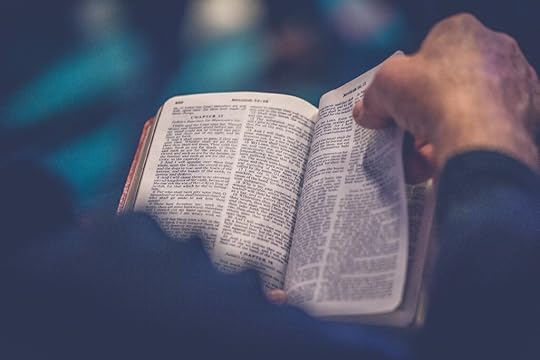 Photo by Rod Long on Unsplash
What has he taught us? Well, he affirmed the law of God (Old Testament) that taught us to love the Lord our God and love our neighbor as ourselves along with many details on how to do so. He drove the law down to the heart level, applying it not only to our actions but our motives. Contemplate Jesus’ teachings in the New Testament, especially the sermon on the mount. One of his key teachings, of course, was that we didn’t need to be anxious in light of the good character and will of God the Father (Matthew 6:25–34). So, we should be productive and live responsibly. We should move toward a deeper love of God and others. We should be moving toward being more grounded in hope than afraid. All of this comes from cultivating trust in the promises of God, especially the fact that Jesus’ resurrection signals the renewal of all things (Revelation 21).
So whether things get better or worse. Whether Jesus comes back soon, or in a thousand years. No matter what, we know what to do tomorrow. Hint; it isn’t to dive down an online conspiracy rabbit hole, overthrow an institution, stockpile provisions, hunker down for dear-life, buy another weapon, or seek the scientific solution to everything…or anything like that. Second hint; It isn’t to walk away from God because his people are crazy and become a better moral person without Jesus either. The ancient Proverb probably sums up the call of God on our lives better than I ever could;
“Trust in the LORD with all your heart, and do not lean on your own understanding. In all your ways acknowledge him, and he will make straight your paths. Be not wise in your own eyes; fear the LORD, and turn away from evil. It will be healing to your flesh and refreshment to your bones.” (Proverbs 3:5–8 ESV)
We are people who believe in a God of grace who’s plan is good and full of hope. Let us cultivate hearts that live in light of these truths.
“May the God of hope fill you with all joy and peace in believing, so that by the power of the Holy Spirit you may abound in hope.” — Romans 15:13 ESV.Andy Littleton co-pastors Mission Church in Tucson, AZ. He also serves as a mission leader for Resonate Global Mission. He has written on bivocational ministry in the book Part-Time Pastoring with Dr. Sean Benesh.[image error]
Shorts by Andy Littleton

- Andy Littleton's profile
- 13 followers

