Jane Bow's Blog, page 2
February 16, 2014
Watch Out, Oak Island Treasure Hunters!
Beware, Marty and Rick Lagina, Oak Island treasure hunting brothers from Michigan! Brigit has just escaped from The Oak Island Affair and she’s sailing towards you.
 Brigit: Hi guys. Remember your first starry-eyed, wet-behind-the-ears summer on Oak Island? I was there. Me and Vanessa sailed right into Joudrey’s Cove. Not that you noticed, being tied up in meetings, deciding when and where to sink yet another fortune into this tiny Nova Scotia island.
 Oak Island. White structure is major dig site, Borehole 10X
Brigit: We walked the beach--
Me: Shsh, Brigit!
Brigit: No! Damn it Jane, six people have already died on Oak Island, and you know what happened to Vanessa down that sinkhole. What nearly happened to me. Do you think the Michigan brothers' new History Channel series is going to talk about that?
 One of many shafts leading deep into the island's heart.
Me: What happened to you was your own fault, Brigit. And why should the Lagina brothers care? You know the Oak Island history, how team after team of men, including Franklin D. Roosevelt, have been pouring millions into the search for gold ever since 1795, because clearly something lies hidden--
Brigit: Beyond the reach of greed! If they would just talk to Vanessa--!
Me: Talk to a character in a book? Yeah, right.
Brigit: Why not? Fiction is all about the real truths, isn't it? And obviously they talk to their dreams. So what’s the difference?
Me: Hmmm. :-D
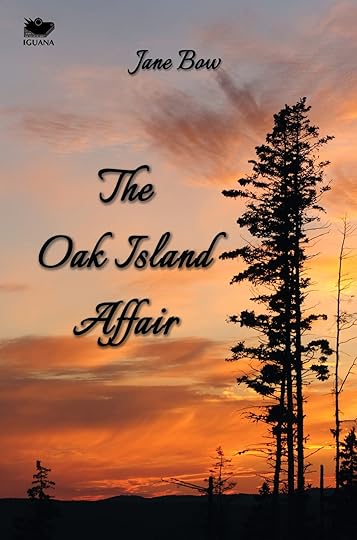 New print or ebook here or here. Want to talk to Brigit while she's here? Send her a comment, and thanks for visiting!
Jane
 Brigit: Hi guys. Remember your first starry-eyed, wet-behind-the-ears summer on Oak Island? I was there. Me and Vanessa sailed right into Joudrey’s Cove. Not that you noticed, being tied up in meetings, deciding when and where to sink yet another fortune into this tiny Nova Scotia island.
 Oak Island. White structure is major dig site, Borehole 10X
Brigit: We walked the beach--
Me: Shsh, Brigit!
Brigit: No! Damn it Jane, six people have already died on Oak Island, and you know what happened to Vanessa down that sinkhole. What nearly happened to me. Do you think the Michigan brothers' new History Channel series is going to talk about that?
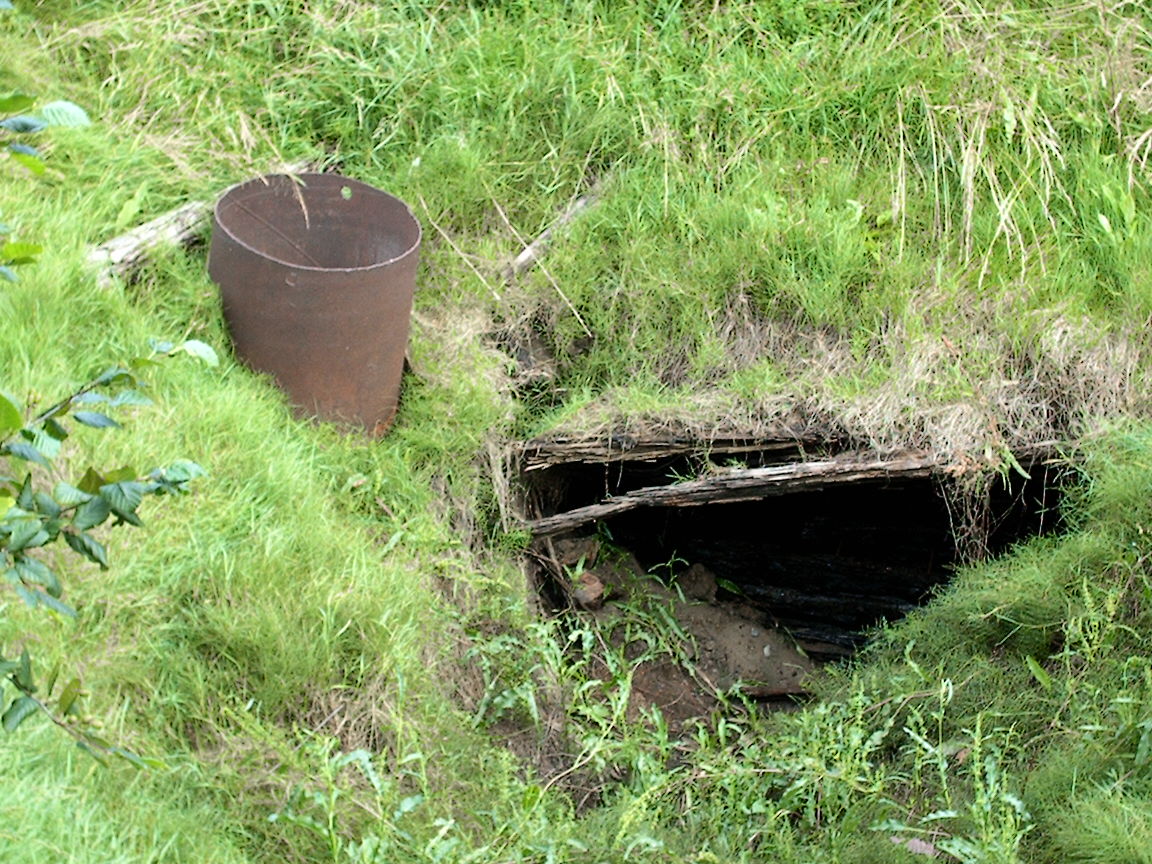 One of many shafts leading deep into the island's heart.
Me: What happened to you was your own fault, Brigit. And why should the Lagina brothers care? You know the Oak Island history, how team after team of men, including Franklin D. Roosevelt, have been pouring millions into the search for gold ever since 1795, because clearly something lies hidden--
Brigit: Beyond the reach of greed! If they would just talk to Vanessa--!
Me: Talk to a character in a book? Yeah, right.
Brigit: Why not? Fiction is all about the real truths, isn't it? And obviously they talk to their dreams. So what’s the difference?
Me: Hmmm. :-D
 New print or ebook here or here. Want to talk to Brigit while she's here? Send her a comment, and thanks for visiting!
Jane


Watch Out Oak Island Treasure Hunters!
Beware Marty and Rick Lagina, Oak Island treasure hunting brothers from Michigan! Brigit has just escaped from The Oak Island Affair and she’s sailing towards you.
Brigit: Hi guys. Remember your first starry-eyed, wet-behind-the-ears summer on Oak Island? I was there. Me and Vanessa sailed right into Joudrey’s Cove, not that you noticed, being tied up in meetings, deciding when and where to sink yet another fortune into this tiny Nova Scotia island.
Oak Island. White structure is major dig site, Borehole 10XBrigit: We walked the beach--
Me: Shush, Brigit!
Brigit: No! Damn it Jane, six people have already died on Oak Island, and you know what happened to Vanessa down that sinkhole. What nearly happened to me. Will the Michigan brothers' new History Channel series talk about that?
One of many abandoned shafts, leading where?Me: What happened to you was your own fault, Brigit. Anyway, why should the Lagina brothers care? You know the Oak Island history, how team after team of men, including Franklin D. Roosevelt, have been pouring millions into the search for gold ever since 1795, because clearly something lies hidden-- Brigit: Beyond the reach of greed! If they would just talk to Vanessa--!
Me: Talk to a character in a book. Like that’s going to happen.
Brigit: Fiction is all about the real truths, isn't it? And they’re talking to their dreams. What’s the difference?
Me: Hmmm. :-D
New print or ebook here or here. Thanks for visiting,
Jane
Brigit: Hi guys. Remember your first starry-eyed, wet-behind-the-ears summer on Oak Island? I was there. Me and Vanessa sailed right into Joudrey’s Cove, not that you noticed, being tied up in meetings, deciding when and where to sink yet another fortune into this tiny Nova Scotia island.
Oak Island. White structure is major dig site, Borehole 10XBrigit: We walked the beach--Me: Shush, Brigit!
Brigit: No! Damn it Jane, six people have already died on Oak Island, and you know what happened to Vanessa down that sinkhole. What nearly happened to me. Will the Michigan brothers' new History Channel series talk about that?
One of many abandoned shafts, leading where?Me: What happened to you was your own fault, Brigit. Anyway, why should the Lagina brothers care? You know the Oak Island history, how team after team of men, including Franklin D. Roosevelt, have been pouring millions into the search for gold ever since 1795, because clearly something lies hidden-- Brigit: Beyond the reach of greed! If they would just talk to Vanessa--! Me: Talk to a character in a book. Like that’s going to happen.
Brigit: Fiction is all about the real truths, isn't it? And they’re talking to their dreams. What’s the difference?
Me: Hmmm. :-D
New print or ebook here or here. Thanks for visiting,Jane
January 29, 2014
Birth Of A Book
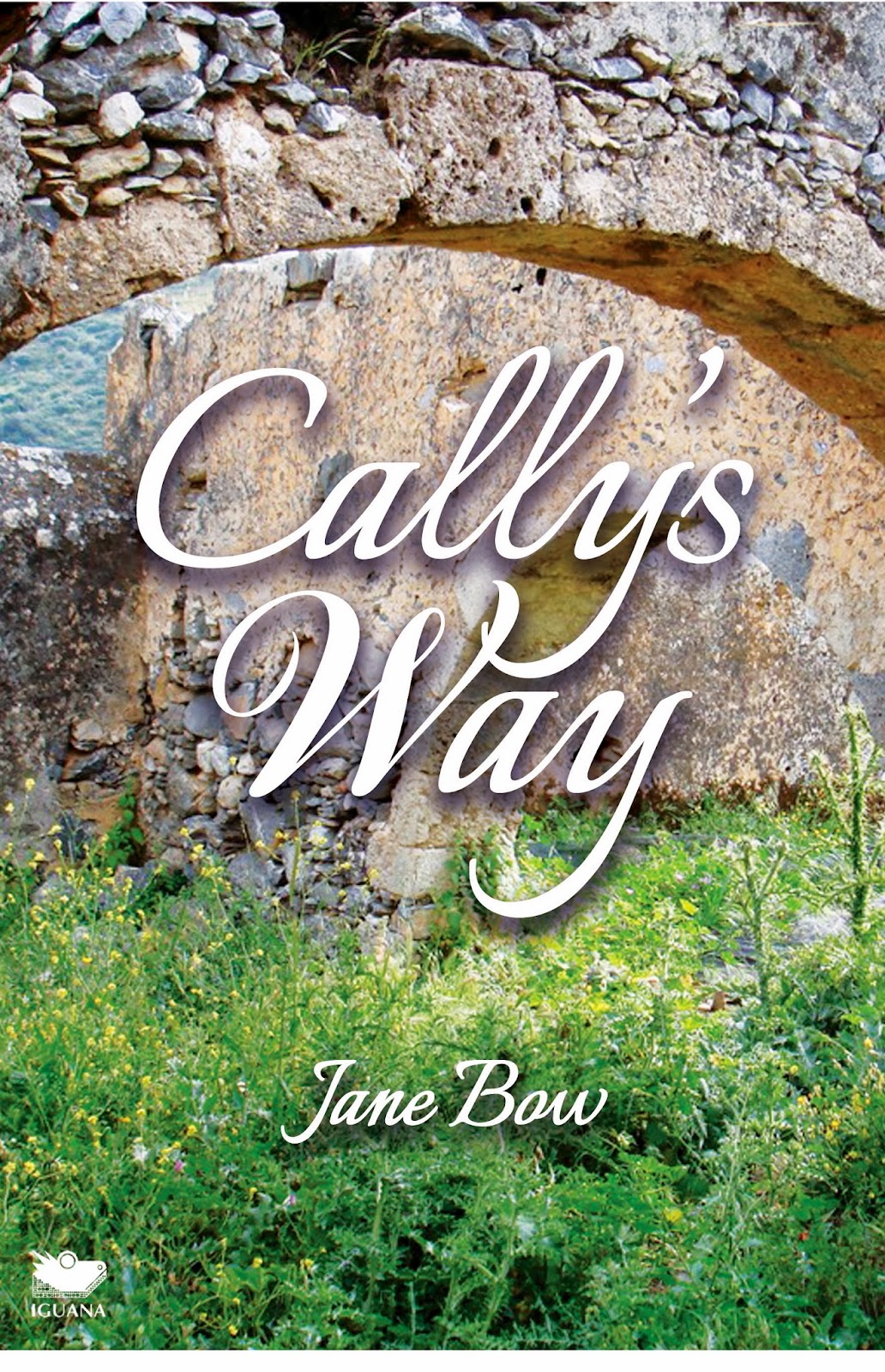 A newborn book is a touchable, lovable miracle.
Conception
Quick and wiggly, the sperm of an idea lodges itself in the moist, fertile ground of a writer’s self, often when she least expects it. It then takes over her life. She might try to deny it, plunging into floor scrubbing, cupboard reorganizing, texting, Facebooking, Tweeting and emailing. But deep inside her storywords are multiplying, taking shape, beginning to move.
Cally's Way, my new historical self-discovery novel, was conceived one morning in the kitchen of the apartment my daughter and I had rented for six weeks on the south coast of Crete.
I had been rising early every day, meditating and then writing random notes on what I was reading, seeing, thinking, feeling. In the afternoons we would drive up terrifying, guardrail-free mountain roads to visit villages where brave people, some of them teenagers like my daughter, had found ingenious ways to resist the Nazis’ brutal occupation of this ancient island during World War II. Then we would come back to Plakias beach. Behind the headland at the end of the bay archeologists have found 100,000-year old human tools.
 Plakias Bay
Sun, rock, olive oil and wine, stories of glory and horror, all of these streams of consciousness coalesced that morning in the kitchen into a force that, holding me in its grip for the next twelve years, would become Cally's Way.
Gestation
Words, like cells, grow according to some kind of pattern -- a novel has to have characters and a story -- but what characters? Which story? So many choices, of narrative and scene, style, setting and timing, of tone and pace and nuance, implication, resonance, discord, lie waiting in the place just beyond knowing. Storytelling guru Robert McKee says never be satisfied with your first idea. Sometimes he’s right, sometimes wrong. No one can tell a writer how to work.
Gestation of a novel is not seamless. Structures often sprout extraneous arms or legs and lopping them off, when characters are now as close as friends, is painful. Sometimes the heart of the story is so faint all you can hear is your memory of it.
So you get help. You also feed and nurture your creative energy and the emerging life and gradually, as construction continues, glimmers of the book’s soul appear.
 My bulletin board while I wrote
Cally's Way
Labour
My bulletin board while I wrote
Cally's Way
Labour Oh boy. Who needs the endless hours of metaphorical gut-clenching, back wrenching contractions, pushing, pushing the baby book out into a world that has no reason to care whether it lives or dies?
At least now, in the birth of both babies and books, we have some choices: doctor or midwife? Hospital or home? Rather than exposing our innermost sensitivities to agents and publishers whose choices are dictated by marketing algorithms, many writers are now opting for new publishers who are literary gatekeepers, but also offer the author some control over this critical part of the birth.
 Iguana BooksDelivery
 Iguana Books will publish Cally’s Way in March. It is my third novel and thanks to the high quality of editing, production design and marketing expertise I have received, all this baby’s fingers and toes are intact. According to advance reviews, there is also lots of colour in its cheeks and for this, like all creators at the moment of birth, I am eternally grateful.
Birth Notices
“Jane’s love for Crete, its people and customs shines through and draws the reader in. Her extensive knowledge about the history of the island adds breadth and depth to the passion and romance that we find in Cally’s Way. The questions posed by Cally’s journey of self discovery are ones that any reader will be able to connect with. This book is highly recommended not only for those who are already familiar with the island of Crete but for those who have yet to visit.”
Kate Brusten, Editor, Rethymnon Bugle
“I loved Cally’s Way, not just the fascinating history and stunning island backdrop, but also the well-drawn, endearing characters of Cally, the beautiful but troubled Oliver and Wrecks, his dog. An engaging and compelling read.”
Hilary Boyd, bestselling U.K. author of Thursdays In the Park
“Author Jane Bow gives readers an engaging and deeply poignant picture of the Greek and Cretan resistance under Nazi occupation, but she also gives her readers an equally engaging story of a young woman’s transformation through hard-won knowledge and love. Cally’s Way resonates deeply...”
Robert J. Begiebing, award-winning novelist and Professor of
English Emeritus, Southern New Hampshire University
November 26, 2013
Social Media Savvy
Have none. Need some,
says my publisher.
(iguanabooks.com)
Facebook Goodreads LinkedIn Tweets,
pages linked by clicks that eat
our time, our focus, our minds made ghosts
that cease to host
attention even for those we love.
Or so I thought,
watching drivers texting,
parents neglecting
toddlers attached to the end of their hands.
I like nature, the woods, where life is connected,
plants, animals and trees, birds, beetles and bees
thriving and dying together.
And people. I like watching faces sag and lift,
shifting, sifting
expressions ephemeral as the passing breeze.
Disability, forcing me to measure each walking step,
has taught me to see
cracks in the pavement and the tiny flowers growing there.
Resting, I read the strut and slouch of passersby,
admire youth’s fluid grace, feel the arthritic’s aching gait.
But my working world, books, is online now.
I must go there.
So I screw up my courage and hire a twenty-year old.
He looks at my Facebook LinkedIn Goodreads profiles,
my one Twitter follower, and laughs.
“You have some work to do.”
An hour later I understand:
how to make a page interesting to someone who has no reason to care, how to link my pages, and why, how to Tweet usefully, how social media take you into the heart of your field, adding colour and depth and breadth to what you know.The next day my national newspaper reports that here in North America more people than ever suffer from loneliness. Just about everybody has access to a computer, but even as we ‘tweet’ and ‘like’ and ‘friend,’ an unprecedented percentage of us is sinking into a trough of disconnected despond. I live in a city suburb but do I ever see my neighbours?
Feeding, growing, killing, dying doesn't only happen in the woods, but do I know how the kids across the street are doing, or who is sick, who has something to celebrate? No. Comfortably cocooned, isolated, we never lack for clean water or a soft bed, but we barely know each others’ names.
Our planet is a mess, yes,
here and everywhere,
but now I see that the social media are nature in action.
Nonsense and laughter, rants and support,
sometimes horror,
Twitter and Facebook and the others are
human consciousness unfolding,
ideas, theories and knowledge growing across the world,
each social media presence dancing to its own rhythms,
full of possibilities,
every bit as connected as the inhabitants of the wild woods.
So I log in. I can do this.
I want to do this, want to reach
across national, racial, religious, political, economic divides.
Want to help show and tell and build and sell
whatever comes next in the mystery that is Earth.
For one designated hour a day.
Then I hope I'll log out,
bundle myself into my overcoat, mitts and boots
and take a walk.
says my publisher.
(iguanabooks.com)
Facebook Goodreads LinkedIn Tweets,
pages linked by clicks that eat
our time, our focus, our minds made ghosts
that cease to host
attention even for those we love.
Or so I thought,
watching drivers texting,
parents neglecting
toddlers attached to the end of their hands.
I like nature, the woods, where life is connected,
plants, animals and trees, birds, beetles and bees
thriving and dying together.

And people. I like watching faces sag and lift,
shifting, sifting
expressions ephemeral as the passing breeze.
Disability, forcing me to measure each walking step,
has taught me to see
cracks in the pavement and the tiny flowers growing there.
Resting, I read the strut and slouch of passersby,
admire youth’s fluid grace, feel the arthritic’s aching gait.
But my working world, books, is online now.
I must go there.
So I screw up my courage and hire a twenty-year old.
He looks at my Facebook LinkedIn Goodreads profiles,
my one Twitter follower, and laughs.
“You have some work to do.”
An hour later I understand:
how to make a page interesting to someone who has no reason to care, how to link my pages, and why, how to Tweet usefully, how social media take you into the heart of your field, adding colour and depth and breadth to what you know.The next day my national newspaper reports that here in North America more people than ever suffer from loneliness. Just about everybody has access to a computer, but even as we ‘tweet’ and ‘like’ and ‘friend,’ an unprecedented percentage of us is sinking into a trough of disconnected despond. I live in a city suburb but do I ever see my neighbours?
Feeding, growing, killing, dying doesn't only happen in the woods, but do I know how the kids across the street are doing, or who is sick, who has something to celebrate? No. Comfortably cocooned, isolated, we never lack for clean water or a soft bed, but we barely know each others’ names.
Our planet is a mess, yes,
here and everywhere,
but now I see that the social media are nature in action.
Nonsense and laughter, rants and support,
sometimes horror,
Twitter and Facebook and the others are
human consciousness unfolding,
ideas, theories and knowledge growing across the world,
each social media presence dancing to its own rhythms,
full of possibilities,
every bit as connected as the inhabitants of the wild woods.
So I log in. I can do this.
I want to do this, want to reach
across national, racial, religious, political, economic divides.
Want to help show and tell and build and sell
whatever comes next in the mystery that is Earth.
For one designated hour a day.
Then I hope I'll log out,
bundle myself into my overcoat, mitts and boots
and take a walk.
July 26, 2013
Dante & The Chinese Backpacks
Many of my readers are in China. This blog's for you.
A huge black and grey snake with green lines running down its sides is coiled around a ceiling on the second floor of Toronto's Art Gallery of Ontario. The snake is made of Chinese children’s backpacks, each one representing the life of one of the 5,000 children who died when their shoddily built schools collapsed in an earthquake. China’s government doesn't like to talk about this tragedy. It also doesn't like Ai Weiwei, the artist who made the snake, who has been jailed for speaking out, and is now being kept from attending openings of his art shows in Europe and Canada.
To see this extraordinary snake go to: http://www.ago.net/ai-weiweis-snake-ceiling
I saw the snake on my way into an exhibition of 14th Century Florentine Art. A hand-illustrated edition of Dante's Divine Comedy stopped me in my tracks. Made a few years after his death in 1321, this copy of his world famous poem has been carefully preserved for nearly 700 years. When he created it he was in exile.
Written in Italian, the language of the street, The Divine Comedy takes its readers down, with Dante and the Roman poet Virgil, into The Inferno’s seven circles of hell, where some of the public figures of Dante’s day are among those gruesomely tortured by sins, such as greed and avarice, that consume them. Dante and Virgil then travel up, through cold, grey Purgatorio -- a new concept in Dante’s day, where less serious sinners must suffer until they can achieve redemption -- into heavenly, love-filled Paradiso.
Dante was no more popular with his government than Weiwei is with his, but his poem was copied again and again. Anyone could read it and they did, until it became one of the great foundations of western literature.
To see a beautifully illustrated, 14th Century copy of dissident Dante Alighieri’s Divine Comedy, right after marvelling at 21st Century dissident Ai Weiwei’s sensational snake, gave me hope in the unstoppable power of art.
Once, thirty years ago, Canadian novelist Margaret Laurence was battling soul-destroying censorship of her brilliant novel, The Diviners, in her hometown. For the second time.
“Why does this keep happening?” I whined. The Diviners was a Canadian literary classic. “Can’t we do something to make it stop?”
“No,” she told me, “all we can do is keep on standing at the barricades (of repression.)”
She's right. Political and religious ideologies everywhere keep trying to smother inconvenient truths and points of view. I give thanks for the freedom I have to tap out these words today. It’s more than Canadian government scientists, or Chinese artists, or writers in many countries enjoy.
Snakes shed their skins and grow, however, and governments have no choice but to coil through Dante's journey. While blessed art, in all its forms, goes on refusing to be silenced.
A huge black and grey snake with green lines running down its sides is coiled around a ceiling on the second floor of Toronto's Art Gallery of Ontario. The snake is made of Chinese children’s backpacks, each one representing the life of one of the 5,000 children who died when their shoddily built schools collapsed in an earthquake. China’s government doesn't like to talk about this tragedy. It also doesn't like Ai Weiwei, the artist who made the snake, who has been jailed for speaking out, and is now being kept from attending openings of his art shows in Europe and Canada.
To see this extraordinary snake go to: http://www.ago.net/ai-weiweis-snake-ceiling
I saw the snake on my way into an exhibition of 14th Century Florentine Art. A hand-illustrated edition of Dante's Divine Comedy stopped me in my tracks. Made a few years after his death in 1321, this copy of his world famous poem has been carefully preserved for nearly 700 years. When he created it he was in exile.
Written in Italian, the language of the street, The Divine Comedy takes its readers down, with Dante and the Roman poet Virgil, into The Inferno’s seven circles of hell, where some of the public figures of Dante’s day are among those gruesomely tortured by sins, such as greed and avarice, that consume them. Dante and Virgil then travel up, through cold, grey Purgatorio -- a new concept in Dante’s day, where less serious sinners must suffer until they can achieve redemption -- into heavenly, love-filled Paradiso.
Dante was no more popular with his government than Weiwei is with his, but his poem was copied again and again. Anyone could read it and they did, until it became one of the great foundations of western literature.
To see a beautifully illustrated, 14th Century copy of dissident Dante Alighieri’s Divine Comedy, right after marvelling at 21st Century dissident Ai Weiwei’s sensational snake, gave me hope in the unstoppable power of art.
Once, thirty years ago, Canadian novelist Margaret Laurence was battling soul-destroying censorship of her brilliant novel, The Diviners, in her hometown. For the second time.
“Why does this keep happening?” I whined. The Diviners was a Canadian literary classic. “Can’t we do something to make it stop?”
“No,” she told me, “all we can do is keep on standing at the barricades (of repression.)”
She's right. Political and religious ideologies everywhere keep trying to smother inconvenient truths and points of view. I give thanks for the freedom I have to tap out these words today. It’s more than Canadian government scientists, or Chinese artists, or writers in many countries enjoy.
Snakes shed their skins and grow, however, and governments have no choice but to coil through Dante's journey. While blessed art, in all its forms, goes on refusing to be silenced.
May 20, 2013
Alan's Garden
Cretan roses are tough. Blooming yellow, pink, crimson and fiery orange here in Alan’s garden, they do not lose a single petal when the meltemi wind howls in from the north. While I am here a Saharan sirocco whips their heads, a thunderstorm pelts them with hailstones and still, when I come out on the patio to drink my tea the next day, there are the roses, nodding in the morning.
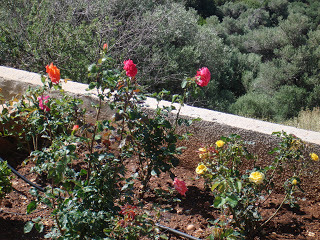 Alan's roses They remind me of this island’s language. Bending, whipping, caressing, Cretan Greek is flexible, intense, and full of colour. A single word’s meaning changes according to the pitch, tone and inflection with which it is delivered. Carol Poppinga, a trilingual jewellery artist who has training in both archeology and Greek, sits with me in her Myrthios workshop explaining a concept foreign to English.
An example is the word ‘tora.’ Spoken in a normal voice, it means ‘now.’ “Tora!” with force behind it means ‘immediately.’ “Tora?” as a question translates as “Are you sure?”or “couldn’t it wait?” “To-o-o-ora,” the elongated ‘o’ sound half sung, pitch descending, sounds like the wind. Spoken with one hand raised and waving cylindrically, it means “too late.”
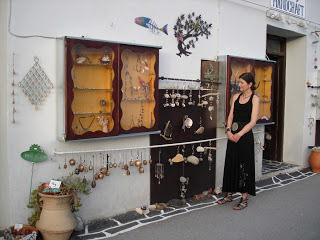 Carol outside her Myrthios workshop
(https://www.facebook.com/pages/Carols-Workshop/165498226881343?ref=ts&fref=ts)
Beyond the roses in Alan’s garden, herbs grow around the spiky spines of a yucca tree. Here, and all over mountainsides that hum with bees in spring, you can smell sage, lavender, oregano and spicy savory.
Words too, in Cretan Greek, carry a punch that changes with the way they are are pronounced. The word ‘geros,’ if pronounced GEros, means old man. GerOS means strong. Then there is the word ‘malaka.’ MaLAka means asshole. MalaKA means soft. Imagine the fun you can have playing with this kind of language.
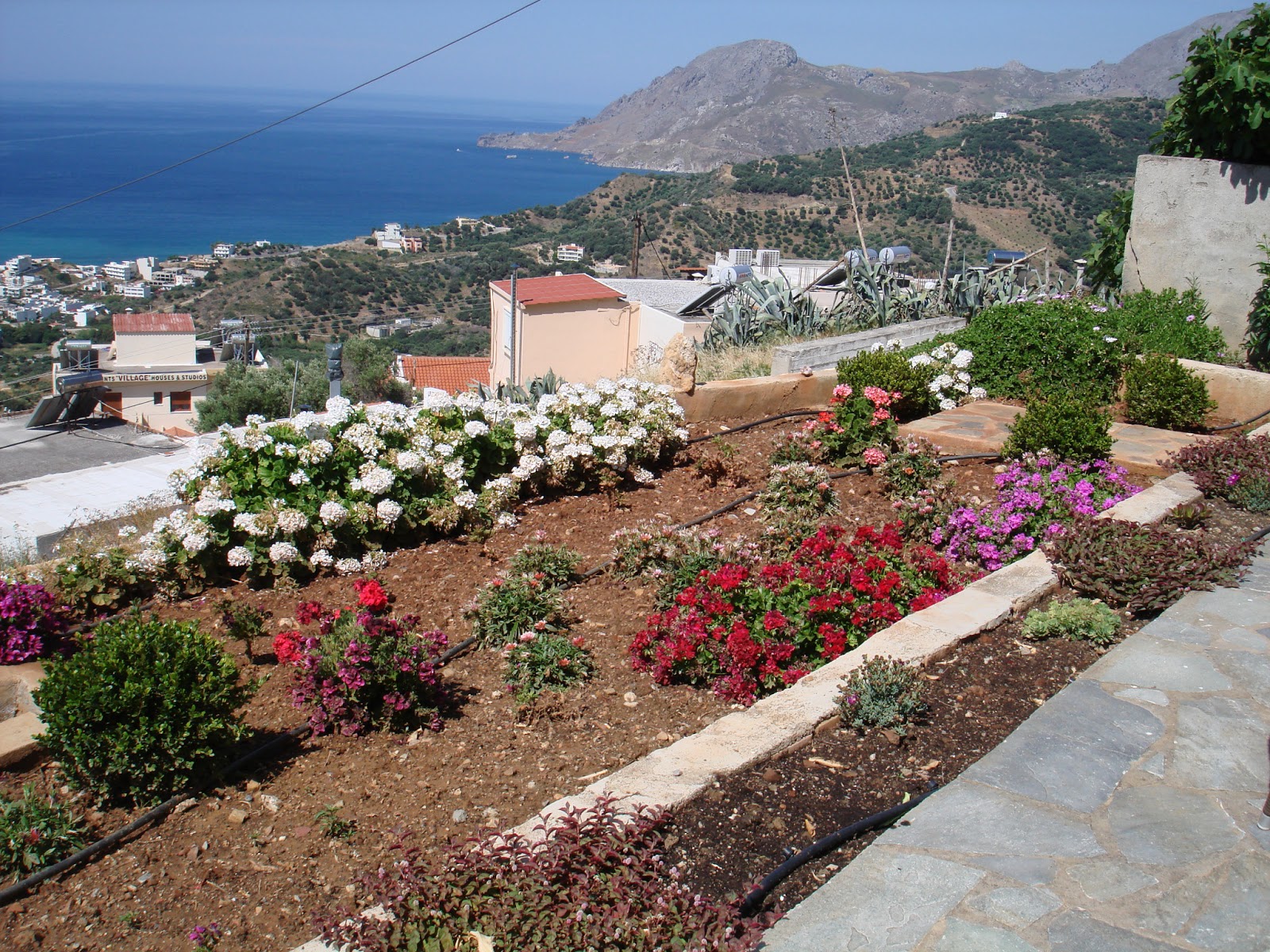
Down at the other end of his garden, Alan's blooming geraniums, interspersed with a variety of flowers, each with its own distinct personality are a riot of colour against the mountains, sea and sky.
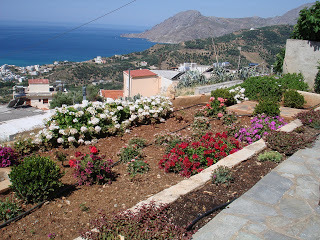
Carefully planned and beautifully cultivated, the garden does, however, have wild elements. Birds and the winds bring and sew surprises that cannot be denied. Stubborn papyrus, from which the Egyptians just across the sea made paper 4,000 years ago, has seeded itself in a concrete crack on the garden steps. Beside it a pretty snapdragon has taken root in the middle of the stairs.
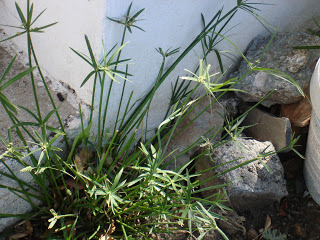 Papyrus on the stairs The soil in Alan’s garden is predominantly clay, the same clay the Minoans used more than 3,000 years ago to make models of heads wearing all kinds of different expressions. (See them in the Heraklion Archeological Museum.) They also used clay to archive the world’s first linear script on clay covered stones, at their Phaestos palace.
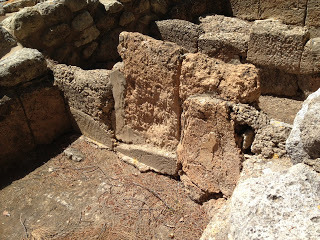 Stone and clay archives at Phaestos A peaceful, stunningly creative society, the Minoans traded with the Egyptians to the south and with the ancient Mesopotamians (Greek word) to the east until volcanoes and earthquakes twice destroyed everything they had built here. After that came the invasions, one after another after another, many of them followed by brutal occupations.
Mountain villages on this part of the south coast nestle under rock cliffs and outcroppings, the stone dwellings built one against the next hundreds of years ago. If invaders came into the bays below, the inhabitants could escape unseen, through the network of their houses into the mountains behind.
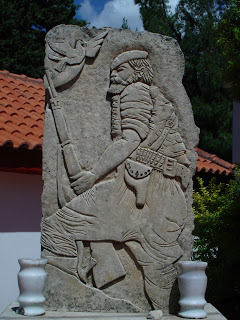 Cenotaph at Karimes
Invaders’ legacies still exist in the Greek myths set on Crete, in the Roman baths being excavated in the mountains, in graceful Venetian arches, in cenotaphs to Cretans who resisted the Turks and the Nazis. And in Greek words that have migrated into all the Western cultures: psychology, archeology, apology -- and so many other --ologies!
Alan's garden: a symbol of the tough, flexible, colourful and resistant Cretan beauty from which it all began.
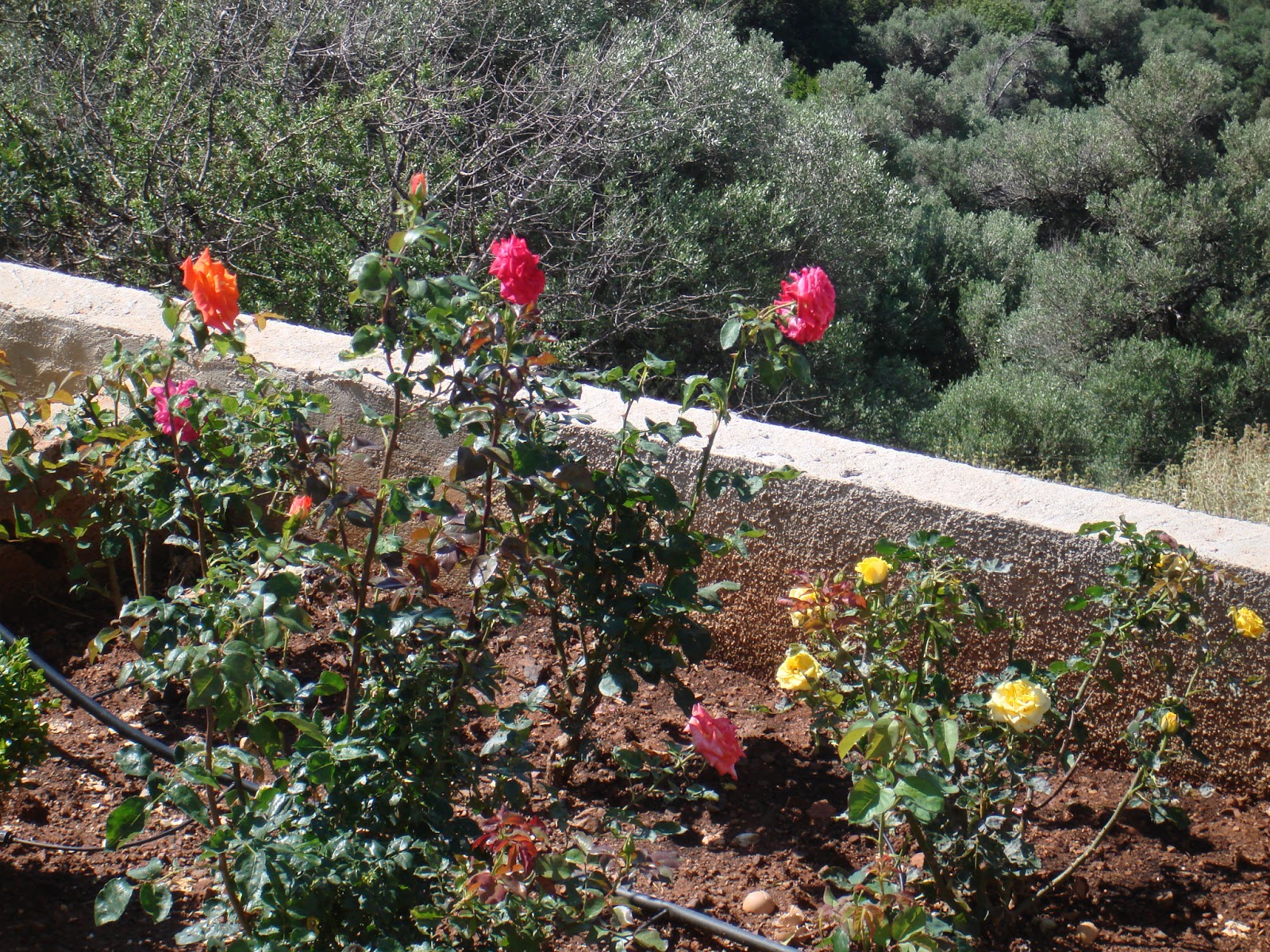 Alan's roses They remind me of this island’s language. Bending, whipping, caressing, Cretan Greek is flexible, intense, and full of colour. A single word’s meaning changes according to the pitch, tone and inflection with which it is delivered. Carol Poppinga, a trilingual jewellery artist who has training in both archeology and Greek, sits with me in her Myrthios workshop explaining a concept foreign to English.
An example is the word ‘tora.’ Spoken in a normal voice, it means ‘now.’ “Tora!” with force behind it means ‘immediately.’ “Tora?” as a question translates as “Are you sure?”or “couldn’t it wait?” “To-o-o-ora,” the elongated ‘o’ sound half sung, pitch descending, sounds like the wind. Spoken with one hand raised and waving cylindrically, it means “too late.”
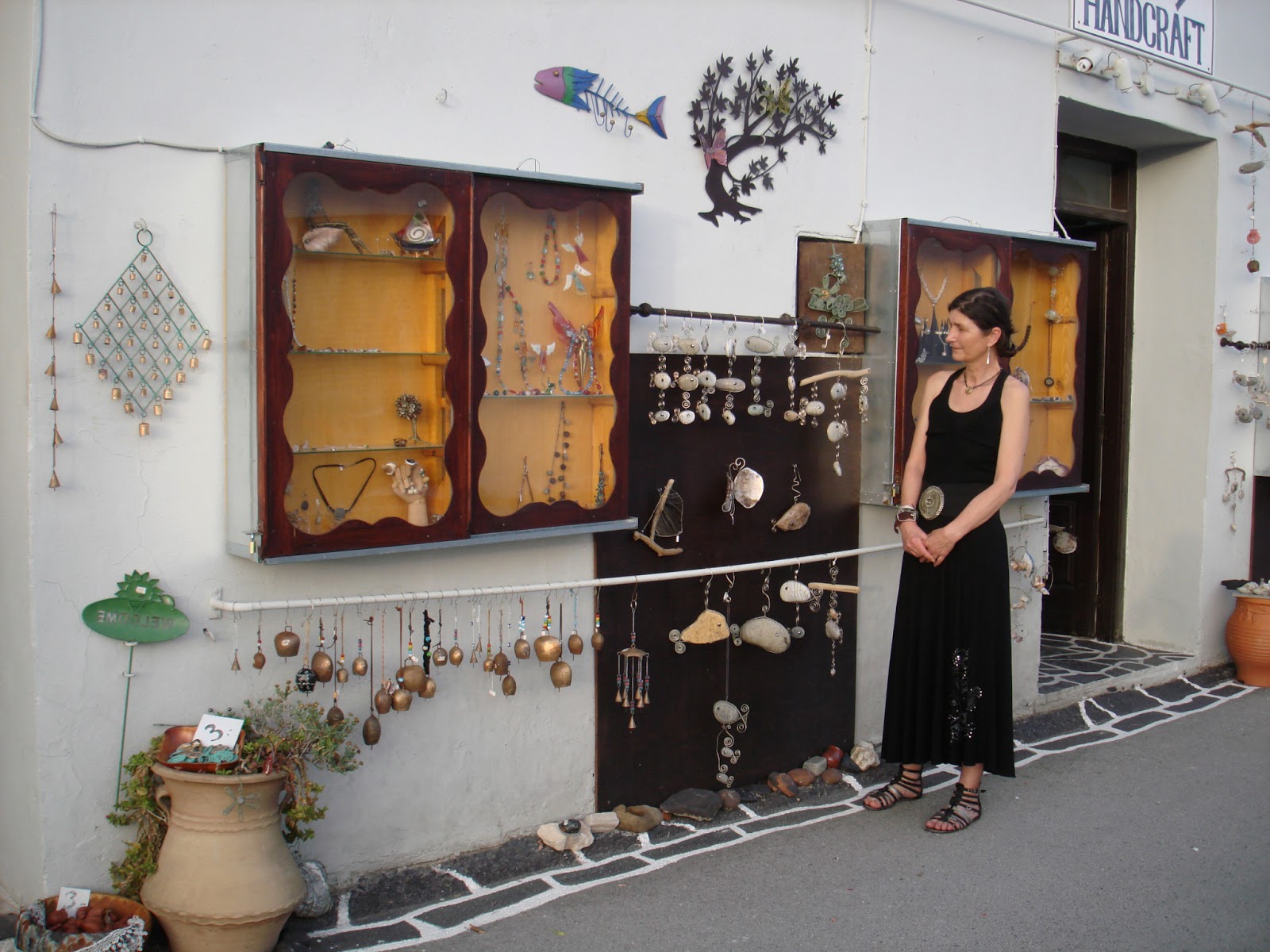 Carol outside her Myrthios workshop
 (https://www.facebook.com/pages/Carols-Workshop/165498226881343?ref=ts&fref=ts)
Beyond the roses in Alan’s garden, herbs grow around the spiky spines of a yucca tree. Here, and all over mountainsides that hum with bees in spring, you can smell sage, lavender, oregano and spicy savory.
Words too, in Cretan Greek, carry a punch that changes with the way they are are pronounced. The word ‘geros,’ if pronounced GEros, means old man. GerOS means strong. Then there is the word ‘malaka.’ MaLAka means asshole. MalaKA means soft. Imagine the fun you can have playing with this kind of language.
Down at the other end of his garden, Alan's blooming geraniums, interspersed with a variety of flowers, each with its own distinct personality are a riot of colour against the mountains, sea and sky.
Carefully planned and beautifully cultivated, the garden does, however, have wild elements. Birds and the winds bring and sew surprises that cannot be denied. Stubborn papyrus, from which the Egyptians just across the sea made paper 4,000 years ago, has seeded itself in a concrete crack on the garden steps. Beside it a pretty snapdragon has taken root in the middle of the stairs.
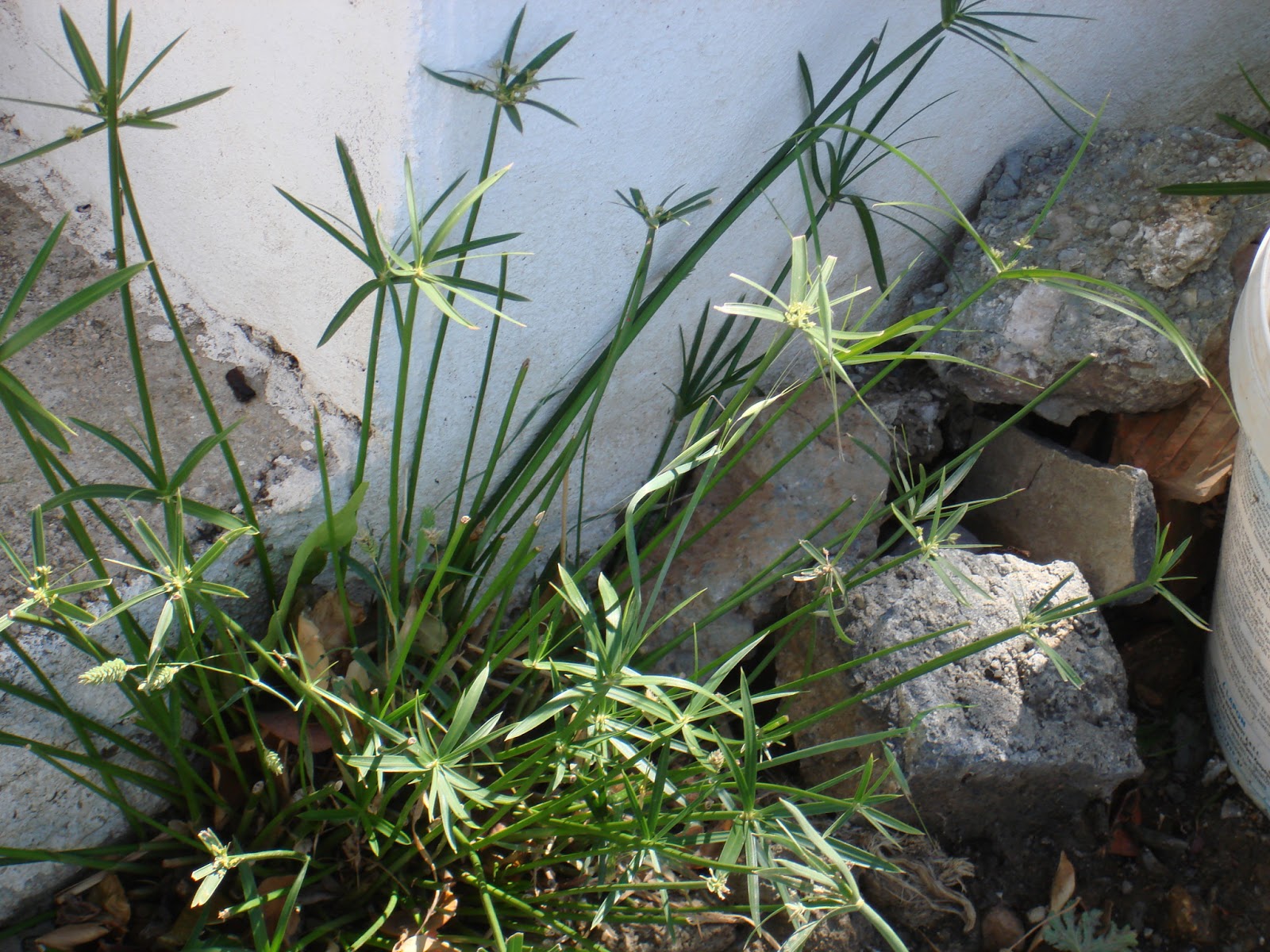 Papyrus on the stairs The soil in Alan’s garden is predominantly clay, the same clay the Minoans used more than 3,000 years ago to make models of heads wearing all kinds of different expressions. (See them in the Heraklion Archeological Museum.) They also used clay to archive the world’s first linear script on clay covered stones, at their Phaestos palace.
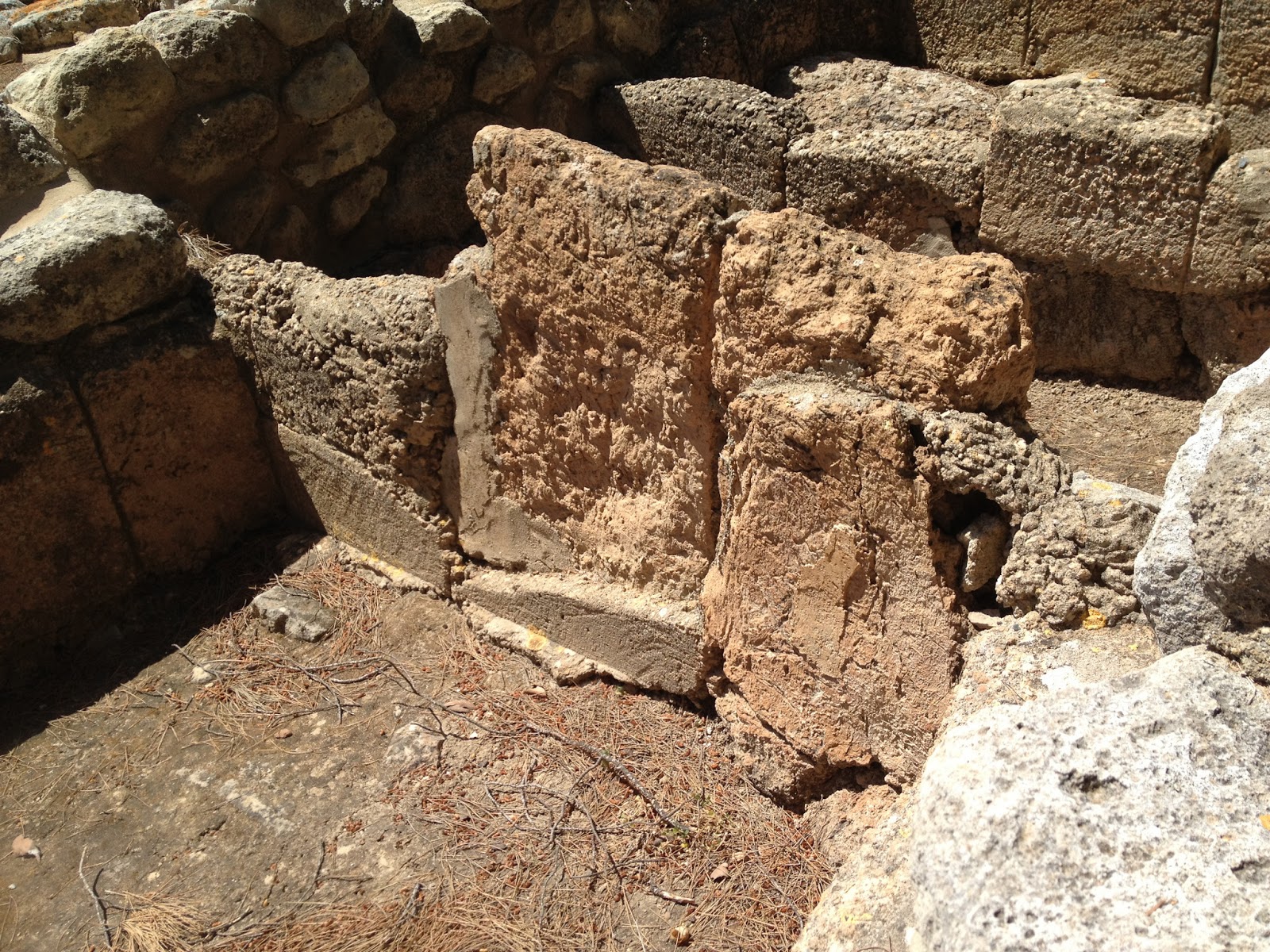 Stone and clay archives at Phaestos A peaceful, stunningly creative society, the Minoans traded with the Egyptians to the south and with the ancient Mesopotamians (Greek word) to the east until volcanoes and earthquakes twice destroyed everything they had built here. After that came the invasions, one after another after another, many of them followed by brutal occupations.
 Mountain villages on this part of the south coast nestle under rock cliffs and outcroppings, the stone dwellings built one against the next hundreds of years ago. If invaders came into the bays below, the inhabitants could escape unseen, through the network of their houses into the mountains behind.
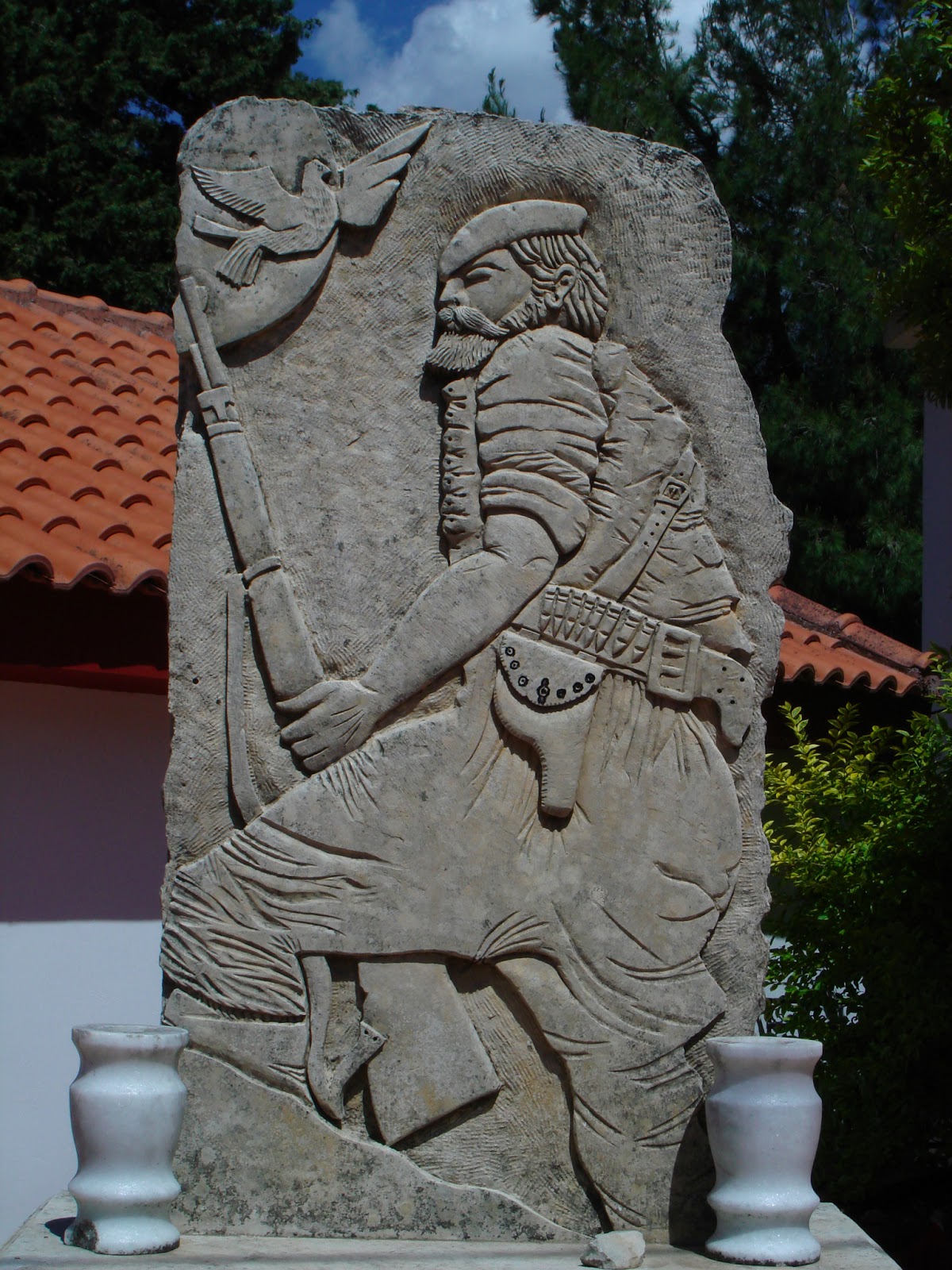 Cenotaph at Karimes
Invaders’ legacies still exist in the Greek myths set on Crete, in the Roman baths being excavated in the mountains, in graceful Venetian arches, in cenotaphs to Cretans who resisted the Turks and the Nazis. And in Greek words that have migrated into all the Western cultures: psychology, archeology, apology -- and so many other --ologies!
Alan's garden: a symbol of the tough, flexible, colourful and resistant Cretan beauty from which it all began.
March 31, 2013
Mexico papers - Conclusion
Note: This is the last of a 4-part series. Scroll down to read parts 1-3.
Our little blue Datsun climbed through the mountains of central Mexico to San Miguel de Allende, and I continued to record the odyssey:
“A national monument, this beautiful little town is a perfect mesh of old and new. The people who have lived here for centuries are among the best artisans in the world, says renown Canadian artist Leonard Brooks.”
Leonard and his wife Reva, an acclaimed photographer, had built a house and studio full of wondrous collages, stone carvings, paintings. Everything was art, every plant in the garden, every stone around the pond carefully chosen, their fence a living sculpture made of cactuses.
“Gave the Brooks’ our corn cob pipes by way of thanks.”
Two days later we arrived in San Cristobal de las Casas, the capital of Chiapas, Mexico’s southernmost state, looking for a Canadian potter who had married a Lacandon Indian and gone to live with his isolated tribe in the rainforest near the Guatemalan border. The widow of Danish anthropologist Frans Blom, who discovered the Lacandon tribe in 1951, provided guided access to the tribe, but she wanted nothing to do with two would-be Canadian journalists.
Undaunted, we set off down a long dirt road to Ocosingo, the last town at the edge of the jungle, where we had been told a man had a plane. That night a parade of blue, red, emerald green insects crossed our hotel room floor, drawn by the overhead lightbulb. Watching, terrified to get out of bed, we noted that they did not climb. Next morning they were gone.
The pilot’s little Cessna sat at on a grass runway at the edge of town. We were in luck. He was taking a load of palm leaves somewhere and was willing to drop us off near the Lacandon village of Na’Ha. We would only have a couple of hours there as clouds were closing in. I watched him use a wooden ruler, the kind I used in grade school, to check the level in his plane’s fuel tank but was too excited to be afraid.
The Lacandon Indians lived in the traditions their people, the Mayans, had espoused for thousands of years. Gorge, who heard the plane and came running to the landing strip cut out of the jungle, wore only a canvas shift. His shoulder-length hair was bushy and black and he had the most extraordinary feet. Larger than a basketball player’s they gripped the mud, bounced off sharp stones, sprang up the path. Behind him, in our hiking boots, we struggled to keep up.
Na’Ha was a collection of thatched huts, but the Canadian potter was not home. Having gone to Canada for a visit, she had been barred by the Mexican government from returning.
Chan K’in, her husband and the kind, charismatic son of the chief, spoke Spanish however, and we spent our precious hours learning about this gentle tribe that eschewed modern civilization, preferring to use farming techniques that go back thousands of years to eke out a natural living in the rainforest. Kneeling with him, we watched one of the women pound out tortillas and then cook them over the fire for us. The only sign of the potter was an Inuit calendar hanging beside the pots on the wall of her and Chan K’in’s hut -- a strange and beautiful cultural connection.
The rains held off long enough for us to fly back to Ocosingo but then the skies opened. Torrential rain pounded the roof of our little blue Datsun, and turned the road back to civilization to mud. Then the windshield wipers stopped working.
Picture jungle on both sides, no sign of human habitation anywhere, driving blind behind a curtain of water. Hiking boots have shoe laces however. We tied one to each wiper, then brought the other end of our laces in through our side windows. Yelling "Pull!" every few seconds, operating the wipers on manual, we made it to the highway.
It was time to go home. By the time we reached northern Mexico, we had one traveller’s cheque left. If we cashed it in Mexico we would lose money twice on the exchanges. But if we didn’t, where would we sleep? Not at a Mexican police station!
The answer appeared on the edge of the town we were in: a small hospital. Surely murderers and rapists would not hang out in its parking lot? The front door was locked but there were lights on inside. I knocked. No answer. I knocked again. Again. The door opened a crack. Inside was a tiny man, the night watchman. Clearly very frightened, waving a revolver, he asked what I wanted.
I told him we were two Canadian girls who needed his protection. Could we sleep in his parking lot? His chest expanded. Growing taller, he waggled the gun at the ceiling.
“Don’t worry,” he smiled, “I will keep you safe.” And he did.
The Lacandon story and several others were bought by Chatelaine. The Leonard Brooks story sold to The Toronto Star and Montreal Gazette.
Forty years later, I have published articles, plays, stories, books, and sitting here writing this, perhaps it is time Les and I thanked him and all the other beautiful souls we had the good fortune to know and record in The Mexico Papers.
If you would like to visit me in my study, go to http://studiosnapshotsblog.com/
where Judy Douglas hosts a fascinating blog about artists’ work spaces.
Let me know your thoughts, and thanks for reading,
Jane
Our little blue Datsun climbed through the mountains of central Mexico to San Miguel de Allende, and I continued to record the odyssey:
“A national monument, this beautiful little town is a perfect mesh of old and new. The people who have lived here for centuries are among the best artisans in the world, says renown Canadian artist Leonard Brooks.”
Leonard and his wife Reva, an acclaimed photographer, had built a house and studio full of wondrous collages, stone carvings, paintings. Everything was art, every plant in the garden, every stone around the pond carefully chosen, their fence a living sculpture made of cactuses.
“Gave the Brooks’ our corn cob pipes by way of thanks.”
Two days later we arrived in San Cristobal de las Casas, the capital of Chiapas, Mexico’s southernmost state, looking for a Canadian potter who had married a Lacandon Indian and gone to live with his isolated tribe in the rainforest near the Guatemalan border. The widow of Danish anthropologist Frans Blom, who discovered the Lacandon tribe in 1951, provided guided access to the tribe, but she wanted nothing to do with two would-be Canadian journalists.
Undaunted, we set off down a long dirt road to Ocosingo, the last town at the edge of the jungle, where we had been told a man had a plane. That night a parade of blue, red, emerald green insects crossed our hotel room floor, drawn by the overhead lightbulb. Watching, terrified to get out of bed, we noted that they did not climb. Next morning they were gone.
The pilot’s little Cessna sat at on a grass runway at the edge of town. We were in luck. He was taking a load of palm leaves somewhere and was willing to drop us off near the Lacandon village of Na’Ha. We would only have a couple of hours there as clouds were closing in. I watched him use a wooden ruler, the kind I used in grade school, to check the level in his plane’s fuel tank but was too excited to be afraid.
The Lacandon Indians lived in the traditions their people, the Mayans, had espoused for thousands of years. Gorge, who heard the plane and came running to the landing strip cut out of the jungle, wore only a canvas shift. His shoulder-length hair was bushy and black and he had the most extraordinary feet. Larger than a basketball player’s they gripped the mud, bounced off sharp stones, sprang up the path. Behind him, in our hiking boots, we struggled to keep up.
Na’Ha was a collection of thatched huts, but the Canadian potter was not home. Having gone to Canada for a visit, she had been barred by the Mexican government from returning.
Chan K’in, her husband and the kind, charismatic son of the chief, spoke Spanish however, and we spent our precious hours learning about this gentle tribe that eschewed modern civilization, preferring to use farming techniques that go back thousands of years to eke out a natural living in the rainforest. Kneeling with him, we watched one of the women pound out tortillas and then cook them over the fire for us. The only sign of the potter was an Inuit calendar hanging beside the pots on the wall of her and Chan K’in’s hut -- a strange and beautiful cultural connection.
The rains held off long enough for us to fly back to Ocosingo but then the skies opened. Torrential rain pounded the roof of our little blue Datsun, and turned the road back to civilization to mud. Then the windshield wipers stopped working.
Picture jungle on both sides, no sign of human habitation anywhere, driving blind behind a curtain of water. Hiking boots have shoe laces however. We tied one to each wiper, then brought the other end of our laces in through our side windows. Yelling "Pull!" every few seconds, operating the wipers on manual, we made it to the highway.
It was time to go home. By the time we reached northern Mexico, we had one traveller’s cheque left. If we cashed it in Mexico we would lose money twice on the exchanges. But if we didn’t, where would we sleep? Not at a Mexican police station!
The answer appeared on the edge of the town we were in: a small hospital. Surely murderers and rapists would not hang out in its parking lot? The front door was locked but there were lights on inside. I knocked. No answer. I knocked again. Again. The door opened a crack. Inside was a tiny man, the night watchman. Clearly very frightened, waving a revolver, he asked what I wanted.
I told him we were two Canadian girls who needed his protection. Could we sleep in his parking lot? His chest expanded. Growing taller, he waggled the gun at the ceiling.
“Don’t worry,” he smiled, “I will keep you safe.” And he did.
The Lacandon story and several others were bought by Chatelaine. The Leonard Brooks story sold to The Toronto Star and Montreal Gazette.
Forty years later, I have published articles, plays, stories, books, and sitting here writing this, perhaps it is time Les and I thanked him and all the other beautiful souls we had the good fortune to know and record in The Mexico Papers.
If you would like to visit me in my study, go to http://studiosnapshotsblog.com/
where Judy Douglas hosts a fascinating blog about artists’ work spaces.
Let me know your thoughts, and thanks for reading,
Jane
March 12, 2013
The Mexico papers - Part 3
“DO NOT DRIVE AT NIGHT IN MEXICO.” Over and over the travel guide warned that it was not safe. If hitting stray cows, pigs, horses wandering unlit highways didn’t kill us, an accident would embroil us in bribery. Bandits planted carcasses on the road too. But we had to be in Mexico City, 750 miles away, by tomorrow. My Mexico Papers, typed on a salmon pink portable typewriter in the back of our Datson hatchback home record what happened next:
“We find a nice big truck that can do 50 mph and follow it. So far, in daylight, we have seen trucks passing on curves, three abreast on mountain roads, cars pushed onto the shoulders. There are more trucks than cars. And abandoned restaurants, gas stations, little tumble down huts and adobe shacks. Lights go on in them as it gets dark.”
The truck drivers we were following kept signaling us to pass them, so when they pulled off at a roadside restaurant, we did too, to introduce ourselves. Two men in their early twenties, they said they would be delighted to run interference for us and, deep into the night our Datsun rode safely behind their tractor-trailer bulk. Until, in the middle of nowhere, the truck pulled over.
One of the drivers came back to explain that a car ahead of them had hit a cow. A family needed a ride to the nearest town. They would all fit into the truck’s sleeper space behind the seats, if one of the drivers came with us. Les and I conferred. Was this the scam we had just been reading about, a one-way ticket to rape and death?
In the end, in moments of crisis you have to trust your intuition. I moved into the passenger seat and, in the safe darkness inside our little car, the driver told us about himself and his country. Mexico in 1972 was ruled by a repressive regime. He and his partner were university student who has been expelled for being at a meeting to commemorate the death of their friend at the 1968 Olympics.
“He tells us to beware of Mexican bandidos and terrorists. And be more careful with truck drivers, he says, because many are drugados, especially those driving gas trucks. Stay away from the police. Driving through the night, my mind brings to life the stories he is telling.
“After the truck drops off the family and they buy us dinner, we pull into a truck stop at 1 am. They park us in the shelter of their truck. Our friend sleeps in a hammock under his truck. The other driver sleeps inside the cab. They tell us to yell if we are disturbed... A few hours later we are off again, 250 miles left to the capital. We leave our friends with much honking and waving. We don’t even know their names.”
Forty years later I wonder where are our saviors are now. May their lives now be full of richness.
Later in the morning “a man crosses the divided highway on a burro. So far we have dodged burros, cows, pigs, horses, chickens and dogs on this road.”
By dinner time, after a Mexico City traffic ticket delivered on the back of an envelope and paid on the spot in cash, we were luxuriating in marble bathrooms and white fleecy towels at my parents' hotel. The Mexico Papers were not shared.
Please feel free to comment below or through my Contact page, and join me next month for the trip south into Mexico’s rainforest to meet the Stone Age Lacandon Indians. In the meantime, if you own a Kobo or a Nook, you can now download my novel The Oak Island Affair by clicking on the link below.
Thanks for visiting,
Jane
 http://www.smashwords.com/books/view/291733
“We find a nice big truck that can do 50 mph and follow it. So far, in daylight, we have seen trucks passing on curves, three abreast on mountain roads, cars pushed onto the shoulders. There are more trucks than cars. And abandoned restaurants, gas stations, little tumble down huts and adobe shacks. Lights go on in them as it gets dark.”
The truck drivers we were following kept signaling us to pass them, so when they pulled off at a roadside restaurant, we did too, to introduce ourselves. Two men in their early twenties, they said they would be delighted to run interference for us and, deep into the night our Datsun rode safely behind their tractor-trailer bulk. Until, in the middle of nowhere, the truck pulled over.
One of the drivers came back to explain that a car ahead of them had hit a cow. A family needed a ride to the nearest town. They would all fit into the truck’s sleeper space behind the seats, if one of the drivers came with us. Les and I conferred. Was this the scam we had just been reading about, a one-way ticket to rape and death?
In the end, in moments of crisis you have to trust your intuition. I moved into the passenger seat and, in the safe darkness inside our little car, the driver told us about himself and his country. Mexico in 1972 was ruled by a repressive regime. He and his partner were university student who has been expelled for being at a meeting to commemorate the death of their friend at the 1968 Olympics.
“He tells us to beware of Mexican bandidos and terrorists. And be more careful with truck drivers, he says, because many are drugados, especially those driving gas trucks. Stay away from the police. Driving through the night, my mind brings to life the stories he is telling.
“After the truck drops off the family and they buy us dinner, we pull into a truck stop at 1 am. They park us in the shelter of their truck. Our friend sleeps in a hammock under his truck. The other driver sleeps inside the cab. They tell us to yell if we are disturbed... A few hours later we are off again, 250 miles left to the capital. We leave our friends with much honking and waving. We don’t even know their names.”
Forty years later I wonder where are our saviors are now. May their lives now be full of richness.
Later in the morning “a man crosses the divided highway on a burro. So far we have dodged burros, cows, pigs, horses, chickens and dogs on this road.”
By dinner time, after a Mexico City traffic ticket delivered on the back of an envelope and paid on the spot in cash, we were luxuriating in marble bathrooms and white fleecy towels at my parents' hotel. The Mexico Papers were not shared.
Please feel free to comment below or through my Contact page, and join me next month for the trip south into Mexico’s rainforest to meet the Stone Age Lacandon Indians. In the meantime, if you own a Kobo or a Nook, you can now download my novel The Oak Island Affair by clicking on the link below.
Thanks for visiting,
Jane
http://www.smashwords.com/books/view/291733February 20, 2013
The Mexico Papers - Part 2
Two people living in a ’72 Datsun hatchback, sleeping in police station parking lots, required creative attention to personal space. The front passenger seat, tipped as far back as it would go, was Les’ domain. Pushing the back of the driver’s seat forward against the steering wheel, and then collapsing both back seats gave me a head-in-the-trunk bed.
Crawling into it through the hatchback, I lowered the trunk with a piece of string and tied it, open about two inches, to the clasp. Now I could keep a secret eye on our perimeter, and breathe. If a dangerous perpetrator escaped custody, all I had to do was pull the string to lock us in.
Driving through Texas, I was scared:
“Texans are proud of their lone star state,” but, “saw a man in jeans and a check shirt wearing a holster and gun and bullets and a Stetson, no uniform... A lady in the drugstore told us they’ll rip open your car doors and yank you out at a red light in the city... Stove is broken, cooked hot dogs over a garbage fire on a rest stop barbecue grill. Have a lot of garbage by now.”
Does this explain why we went home for the night with Louise after meeting her, Leroy and Paul in a Waxahachie diner?
“Leroy has been married four times. Paul’s wife is gone. He is old, and he’s a great dancer. Louise, 55, is a widow, a really amazing woman whom all the town kids call Mom. She now 'goes with' Leroy, but she and Paul are real 'show outs' at the club where they go dancing... Slept in a real bed. Louise made us Texan biscuits with cream gravy, eggs, bacon, pork chops and coffee for breakfast.”
No intuition was needed to sense these people’s kind generosity. They were also rednecks, “their prejudice open and deep, like hunger...”
We had to reach Mexico City in time to meet my parents -- their Canadian embassy contacts would have freelance story ideas -- but we had no idea how far south of the border it was. Finding a map finally, 100 miles north of Laredo, we discovered that we still had 850 miles to drive.
“We have to make Laredo tonight... Decide to find a motel on the border side of town. Suddenly there is a bridge. We pay the toll and cross, see the sign ‘Rio Grande’ halfway across. Two policemen are chatting in the middle of the bridge. Then the signs are all in Spanish. People are yelling and blocking the street, cops at every stop light. We are in Mexico with no insurance, no tourist cards! There was no border. We panic, pay another toll and cross back into the U.S. A border guard asks us how long we have been out of the country.”
A long night with Mexican truck drivers, a plane ride into the southern jungle: join me for The Mexico Papers - Part 3 on March 14.
In the meantime, why not pick up the Kindle ebook of my second novel, The Oak Island Affair. It’s free this coming Friday and Saturday.
If you like it, write a review on Amazon.
Thanks for visiting,
Jane
Crawling into it through the hatchback, I lowered the trunk with a piece of string and tied it, open about two inches, to the clasp. Now I could keep a secret eye on our perimeter, and breathe. If a dangerous perpetrator escaped custody, all I had to do was pull the string to lock us in.
Driving through Texas, I was scared:
“Texans are proud of their lone star state,” but, “saw a man in jeans and a check shirt wearing a holster and gun and bullets and a Stetson, no uniform... A lady in the drugstore told us they’ll rip open your car doors and yank you out at a red light in the city... Stove is broken, cooked hot dogs over a garbage fire on a rest stop barbecue grill. Have a lot of garbage by now.”
Does this explain why we went home for the night with Louise after meeting her, Leroy and Paul in a Waxahachie diner?
“Leroy has been married four times. Paul’s wife is gone. He is old, and he’s a great dancer. Louise, 55, is a widow, a really amazing woman whom all the town kids call Mom. She now 'goes with' Leroy, but she and Paul are real 'show outs' at the club where they go dancing... Slept in a real bed. Louise made us Texan biscuits with cream gravy, eggs, bacon, pork chops and coffee for breakfast.”
No intuition was needed to sense these people’s kind generosity. They were also rednecks, “their prejudice open and deep, like hunger...”
We had to reach Mexico City in time to meet my parents -- their Canadian embassy contacts would have freelance story ideas -- but we had no idea how far south of the border it was. Finding a map finally, 100 miles north of Laredo, we discovered that we still had 850 miles to drive.
“We have to make Laredo tonight... Decide to find a motel on the border side of town. Suddenly there is a bridge. We pay the toll and cross, see the sign ‘Rio Grande’ halfway across. Two policemen are chatting in the middle of the bridge. Then the signs are all in Spanish. People are yelling and blocking the street, cops at every stop light. We are in Mexico with no insurance, no tourist cards! There was no border. We panic, pay another toll and cross back into the U.S. A border guard asks us how long we have been out of the country.”
A long night with Mexican truck drivers, a plane ride into the southern jungle: join me for The Mexico Papers - Part 3 on March 14.
In the meantime, why not pick up the Kindle ebook of my second novel, The Oak Island Affair. It’s free this coming Friday and Saturday.
If you like it, write a review on Amazon.
Thanks for visiting,
Jane
February 12, 2013
The Mexico Papers - Part 1
“Am lying in the back of the Datsun (blue '72 hatchback,) the smallest mobile home on the road, which now looks like a tenement, towels strung over the windows. Typing on my pillow, (on a salmon pink portable typewriter) braced on elbows, undercarriage dangerously close to Les’ stomach.”
Cameras can nail an image but word pictures let the reader into the smell-sound-feel of a place. These snapshots of the United States have been buried at the back of my closet for 40 years. Two 23-year old women, we were our way to Mexico, to make our fortunes as a journalist and a photographer.
“Met Fred from New York State, who gave us homemade apple pie and fuel for our Coleman stove... Trying to figure out what is going on in the Arab-Israeli war. A man heard us asking where to buy an Indiana newspaper and gave us his.” Then:
“It was dusk. A half-ton pickup played leapfrog with us on the highway. We turned off to visit nature, found ourselves driving down a lonely road in the bush. Suddenly there was the half-ton behind us. Scared shitless. Turned into a small side road, truck turned in too. ‘Could this really be the end?’ A small cluster of houses appeared. Turned into a driveway. Truck drove on by. Was it a coincidence, was he going home for dinner, or was he following us? We will never know.”
"Everyone says the Ozarks is hillbilly country, that you'll never get out alive, but the friendliness is overwhelming. Bought corn cob pipes, heard Spiro Agnew resigned."
We were staying off the "completely sterile" interstate highways,"trying to get a feel" for this country. "Most of our knowledge of the U.S. comes through tv, movies and songs, but where does truth end and exaggeration begin?"
In a Tuckerman diner, an Arkansas state trooper invited us to sleep in his station’s parking lot. Gratitude, joy, relief! Could there be a safer place to spend the night?
The next night, in Beebe, Arkansas, another scary man followed us, but:
“As long as we stay on the road we are all right. It’s late and we’re tired, but I can drive forever if I have to.” By the time we reached Jacksonville, it was 10:30 pm:
“We find the cop shop downtown, where there is a display of dope pipes in a glass case that also contains tools used by abortionists, and heroin needles, heavy drugs and other artifacts. Find a cop heavily laden with gun, whistle, and other goods. He was scared of us!” He did, however, let us sleep in his parking lot.
Revisiting these word pictures I feel 23 again. Thrilled and appalled. Would I do it again, knowing what I do now? In a heartbeat.
Thanks for visiting. Next time, (February 21) food, Texas, and a borderless border in The Mexico Papers - Part 2. You can make sure not to miss it by clicking the email button below.
Jane
Cameras can nail an image but word pictures let the reader into the smell-sound-feel of a place. These snapshots of the United States have been buried at the back of my closet for 40 years. Two 23-year old women, we were our way to Mexico, to make our fortunes as a journalist and a photographer.
“Met Fred from New York State, who gave us homemade apple pie and fuel for our Coleman stove... Trying to figure out what is going on in the Arab-Israeli war. A man heard us asking where to buy an Indiana newspaper and gave us his.” Then:
“It was dusk. A half-ton pickup played leapfrog with us on the highway. We turned off to visit nature, found ourselves driving down a lonely road in the bush. Suddenly there was the half-ton behind us. Scared shitless. Turned into a small side road, truck turned in too. ‘Could this really be the end?’ A small cluster of houses appeared. Turned into a driveway. Truck drove on by. Was it a coincidence, was he going home for dinner, or was he following us? We will never know.”
"Everyone says the Ozarks is hillbilly country, that you'll never get out alive, but the friendliness is overwhelming. Bought corn cob pipes, heard Spiro Agnew resigned."
We were staying off the "completely sterile" interstate highways,"trying to get a feel" for this country. "Most of our knowledge of the U.S. comes through tv, movies and songs, but where does truth end and exaggeration begin?"
In a Tuckerman diner, an Arkansas state trooper invited us to sleep in his station’s parking lot. Gratitude, joy, relief! Could there be a safer place to spend the night?
The next night, in Beebe, Arkansas, another scary man followed us, but:
“As long as we stay on the road we are all right. It’s late and we’re tired, but I can drive forever if I have to.” By the time we reached Jacksonville, it was 10:30 pm:
“We find the cop shop downtown, where there is a display of dope pipes in a glass case that also contains tools used by abortionists, and heroin needles, heavy drugs and other artifacts. Find a cop heavily laden with gun, whistle, and other goods. He was scared of us!” He did, however, let us sleep in his parking lot.
Revisiting these word pictures I feel 23 again. Thrilled and appalled. Would I do it again, knowing what I do now? In a heartbeat.
Thanks for visiting. Next time, (February 21) food, Texas, and a borderless border in The Mexico Papers - Part 2. You can make sure not to miss it by clicking the email button below.
Jane