
Tracy Stanley's Blog: Ten tips for writing a book, page 3
April 22, 2020
Building a culture to support innovation at Cisco
I love learning from case studies and plan to write a few this year on creativity and innovation.
I was delighted to work at Cisco as an Innovation Consultant in 2017. This is a technology company which has invested heavily in building processes and systems to support a culture of innovation everywhere.
In writing this blog I draw heavily on the thinking of Alex Goryachev, Global Innovation Leader at Cisco starts his book, Fearless Innovation with the opening remark that,
‘Innovation is a horrible word – The term has become so buzzy, it seems to have lost all practical meaning’
Later on, he goes on to explain that,
‘Innovation isn’t a thing, it’s a mindset and attitude made up of clear principles that help individuals, organizations and societies adapt to change, survive and grow, progress and prosper’
He explains that to keep it alive requires focused effort. In a blog on the Cisco website, Alex proposed five strategies to build an innovative culture.
1. Break down silos and foster cross-functional collaboration
Recognize that great ideas can come from anywhere inside the organisation and that innovation programs should not be limited to particular departments and that employees should be encouraged to think beyond their own job and function and across to other teams and disciplines to solve problems.
2. Gamify Innovation and Have Some Fun in the Workplace
Create friendly competitions that incentivize and reward employees and teams for identifying and developing new ideas. Encourage other employees to vote on the ideas to encourage discussion.
3. Form a Community-wide Network and Innovation Hubs
This strategy recognizes that no single company can innovate on their own. It’s recommended to invest in coaching and mentoring to develoo skills and confidence and build on strategy 1, by providing employees with channels to connect with leaders in their business community. Cisco is a prolific bringer together of customers, partners, start-ups, developers, representatives from local government, researchers and academics under one roof to discuss challenges crossing sectors. Through their various Innovation Centers they have given internal and external parties a space to meet and exchange ideas.
4. Secure Executive Commitment to Innovation
Leaders empower employees to dedicate time, away from their day-to-day responsibilities to innovate ideas they’re most passionate about creating an environment where employees feel free to experiment and take risks, without fearing repercussions. Francine Katsoudas, Chief People Officer at Cisco, suggests that managers build a culture of trust and talk about a mistake they’ve made, to model a behavior for other team members to follow. At the same time, they need to ensure that there is a metaphorical safety net there to protect employees.
5. Weave Innovation into the Everyday Fabric of Your Work Culture
Managers should set aside time for conducting meaningful discussions with their teams around persistent problems or challenges they’re seeing in the workplace and how they could be solved.
You can learn more about Cisco and what they’ve done to build an innovative culture at the links below.
References
Alex Goryachev (2020) Fearless Innovation: Going beyond the buzzword to continuously drive growth improve the bottom line, and enact change. Wiley Publishing
https://blogs.cisco.com/innovation/cultivating-innovation-within-your-organization
Jacob Morgan interviewing Francine Katsoudas
The post Building a culture to support innovation at Cisco appeared first on Tracy Stanley.


March 30, 2020
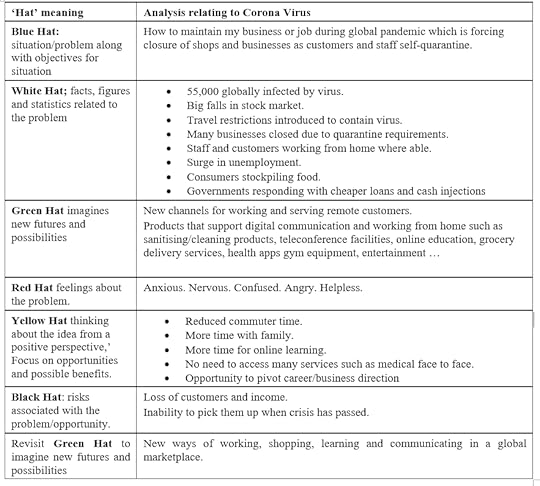
Applying Six Thinking Hats to the Corona Virus
Everyone is impacted by the Corona Virus / Covid-19 whether you are an employee or have your own business.
I recently shared a blog on how to use Edward de Bono’s Six Thinking Hats to solve complex problems.
I’ve been thinking about the challenges presented by the Corona Virus so applied the model to this problem.
Here’s what I came up with.
Hopefully it will help you to think through any opportunities that could emerge from this dreadful pandemic.
The post Applying Six Thinking Hats to the Corona Virus appeared first on Tracy Stanley.
March 8, 2020
How separating your thinking from your feelings helps solve problems
 Image from @JoshStyle on @Unsplash
Can you remember being both nervous and
excited by a new idea? It’s common to have multiple reactions to a new opportunity
or problem and for these mixed reactions to stop us in our tracks from
taking action. Today I want to talk about a tool that will help you, and your
team to separate your thinking from your feeling.
The Six Thinking Hats process helps individuals and teams to organise and classify information about a problem so that its complexity can be better understood. It also enables the team to have a conversation where everyone thinks in the same way – at the same time. As a result, everyone considers the problem from many different points of view. This is very important for a complex problem.
It was developed by Edward De Bono more than twenty years ago, and is valuable as it helps everyone to contribute, and for a problem or opportunity to be analysed from numerous perspectives. The value of the concept is in separating information, emotions and hopes so that thought processes and discussions can be more easily facilitated. You can probably remember a meeting which got out of hand because there were different aspects discussed at once and the conversation may have become adversarial. For example, one person may have been discussing the possibilities inherent in the idea while someone else felt the need to be the devil’s advocate so kept identifying problems with the idea. The discussions may have become overwhelming, confrontational and/or ‘stuck’ as a result.
The Six Thinking Hats process supports use
of the brain’s different modes of thinking. Everybody’s information, perspective
and feelings are separated into one of six categories for discussion. In each
of these directions our brain works to make us conscious of issues being
considered, such as our gut instinct, pessimistic judgement or neutral facts. As
Edward de Bono himself says,
The main difficulty of thinking is confusion. We try
to do too much at once. Emotions, information, logic, hope, and creativity all
crowd in on us.
The problem or opportunity is considered in
six ways, with each pass associated with a hat of certain colour.
Blue
Hat thinking is typically considered first. In this
phase the current situation/problem or opportunity is described along with the
goal for the activity.
The next hat you choose and the type of
thinking you engage in depends on the objective of the session. I’ll give you a few choices in a moment based
on your objectives. But first let’s look at the White Hat.
When a team puts on their White Hat, they are presenting all the
facts, figures and statistics related to the problem. Just the data is
discussed here: no opinions allowed. This information should be neutral and
objective, and an outcome could be that more objective data is needed.
When we put on our Red Hat the team is encouraged to declare how they feel about the
idea or problem. These feelings will include their ‘gut instinct’, intuition,
offering all the emotional stuff, ‘warts and all’. For example, they may say ‘I
feel nervous’ or ‘I feel angry’.
Black
Hat requires the team to think cautiously as they
explore the risks associated with the problem or opportunity. Later, once the
risks are identified, a further conversation on the steps to mitigate the risks
is important.
Yellow
Hat is when everyone thinks about the idea from a
positive perspective only. For example, ‘What is great about this idea?’ This
will help to identify the opportunities and possible benefits.
Green Hat requires the team to do their best creative or out-of-the-box thinking. Stretch thinking is applied here to imagine new futures and possibilities. Consider, ‘What could be a wonderful outcome here?
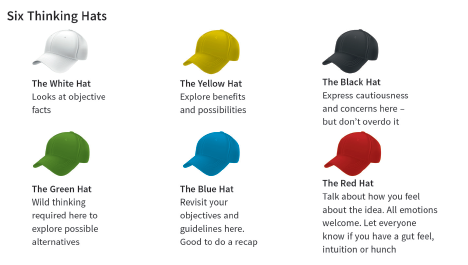
A summary of the objectives of each ‘Hat’
phase is provided below.
Tips on getting started
Run a practice Six Thinking Hats process with your team on a problem outside their area so that they become familiar with the methodology before they use it for a problem more real for them.Check in on everyone’s mindset prior to starting because people arriving in a bad mood will influence the outcomes.Hold the event off site, to stimulate new thinking in a new space.
The different ways to manage a six thinking hat session are described in the book I co-authored with Barbara Wilson called Creativity Cycling: Help your team solve complex problems with creative tools
Barbara and I discuss Six Thinking Hats and the Creative Problem Solving process on our April podcast.
The post How separating your thinking from your feelings helps solve problems appeared first on Tracy Stanley.
March 1, 2020
How processes support a creative culture

In my most recent post I discussed how leaders can create an
environment where their team feels safe to engage in creative thinking.
Today I want to describe processes you can use to encourage reflection
and learning. Build these processes into your usual way of working and you will
foster a work environment where new ideas and perspectives are welcome and failure
is recognised as an essential part of the learning process.
What is a process?
Our Google dictionary defines a process as,
a series of actions or steps taken in order to achieve a
particular end.
A dry but useful starting point for a discourse on
processes.
So why do we need processes?
In organisations we create repeatable processes so we can
work more efficiently. Work is often grouped by function with different teams
managing different parts of the process within that function. Because of
interdependencies, it’s important to have processes which are efficient,
transparent, encourage collaboration and have clear points of accountability.
If you lead a team, you’ll develop a way to plan and track
work or you may be required to use systems and processes already created in
your organisation. Processes influence the way that work is done and influence peoples
inclination to engage in creative thinking. For example, creative thinking
needs time and sometimes permission.
Interactions
Work processes influence if and when employees interact with
each other, with prompts for creativity often coming from interactions within the
group and not just from a creatively inclined individual (Hargadon and Bechky,2006). Research reveals that interactions are more
effective when all group members are focussed on the same task (Metiu &
Rothbard, 2013). When your team gathers together, you have the opportunity to use
a learning rich process. For example, end of project reviews or After-Action Reviews
(AAR) as they are called in the military, are great processes for encouraging reflection,
learning and thinking differently. This is how they work.
At the end of a project or mission, get everyone in the room (preferably), or online and ask them to think about these questions.
What went well?What were the challenges we faced?What should we do differently next time?
Give everyone the opportunity to provide their answers, in
the same time allocation and then document responses on a whiteboard. If someone
supports comments made already, tick the item listed on the whiteboard and move
the discussion on.
If a project has gone badly, some may be motivated to not
discuss what happened openly and to move on to the next project. This happens
too often in organisations and represents a lost opportunity which reinforces a
low risk culture. Experimentation and failure is a normal part of work and if
we build these types of reviews into our processes then it becomes normal to
engage in reflection with failure accepted as normal part of the learning
process.
When it comes to the question around how we could do things
differently, you have the opportunity to invite everyone to thing expansively
and creatively. There are a range of questions you could ask or tools that you
could use here, but of most importance is you giving the team permission.
Takeaways
Create or adapt the processes in your team to provide time
for reflection and the capturing of learning.
At the end of a project: Ask three questions: What went well?
What didn’t go as well? What should we do differently next time? Capture this
information, store it somewhere accessible for all and refer to it when you’re
undertaking a similar project or as a point of reference in your problem
solving and decision-making processes.
Review the types of interactions your team members have with
each other – and with other teams remembering that constant interaction with
diverse others supports creativity.
References
Metiu, A., & Rothbard, N. P. 2013. Task bubbles,
artifacts, shared emotion, and mutual focus of attention: A comparative study
of the microprocesses of group engagement. Organization Science, 24(2):
455-475.
Wilson, B.A. & Stanley, T. 2018. Creativity Cycling: Help your team
solve complex problems with creative tools by Barbara Wilson
and Tracy Stanley
Photo image from @campaign_creators on @unsplash
The post How processes support a creative culture appeared first on Tracy Stanley.
February 29, 2020
Podcast No 2 – Group-think and creativity
 Photo from @marg_cs on @Unsplash
Are you aware of how Group-think may be stifling your efforts to encourage creative thinking?
Barbara Wilson explains what Group-think is and how you can counter it in our latest podcast. you can listen to it here.
And she’s also written a blog about the influence of Group-think in organisations here.
The post Podcast No 2 – Group-think and creativity appeared first on Tracy Stanley.
February 24, 2020
What a manager can do to build a creative culture
 @knobelman on @Unsplash
When you think about why some organisations are more creative than others, you often identify culture as the driver. But what is culture and how does it impact on an individuals’ willingness to do things differently?
Culture is a big and complex concept. It covers habits, behaviours,
processes, attitudes, artefacts, among others and is often described in a
nutshell ‘as the way that things are done around here.’ Organizational culture
can manifest itself in a variety of ways, including leadership behaviours,
communication styles and decision-making processes. While it can be hard to
describe, culture is something you can often feel after a short time within an
environment.
It’s hard to be creative at work if the culture does not support thinking differently and taking risks. In this blog, I’m going to discuss a few things managers can do to build a create a team environment, for new ideas to flourish. I’ll be touching on the importance of autonomy, time for play and experimentation and expectations. My thoughts are based on my experience inside organisations and from my PhD research.
Autonomy
Giving your team members freedom and autonomy in how they
undertake their work is very important for creativity. Resist the urge to
meddle or micromanage their activities and give praise and feedback to
encourage further exploration of new ideas.
Time
Having enough time to explore a problem and to consider
alternatives, supports for discovery of new approaches. If people don’t have
discretionary time, they will resort to doing things the way they’ve always
been done. People need time to experiment and play with ideas.
Time is a curious thing. If you have no time to think
broadly and to experiment, you will do an activity as you always have. However,
if you have too much time you may lack focus. My PhD research confirmed the
findings of others that there is a ‘sweet spot’ with regard to the right amount
of time to support creativity.
Expectations
If you’re a manager, your team will quickly pick up on your interest in and desire for new ideas. Giving permission to challenge assumptions, creating openness to new ideas, and giving freedom to experiment and learn all build a creative culture, as does an acceptance that failure is a component part of the exploratory process.
As a leader you should model creative behaviours such as being curious and taking time to consider different ways of doing things. Allowing times for discussion of new ideas and reflection on past activities in team meeting will reinforce a learning culture. I’ll talk more about processes you can use to support a culture of innovation in a future article.
References
Creativity
Cycling: Help your team solve complex problems with creative tools by
Barbara Wilson and Tracy Stanley 2018
Work environments, creative behaviours and employee
engagement (Doctoral dissertation, Queensland University of Technology).
The post What a manager can do to build a creative culture appeared first on Tracy Stanley.
Ten tips for writing a book

Keep a diary
Embrace imposter syndrome
Identify your audience – Who are you writing for?
What voice do you want to write in?
Develop an outline before you start
Read ...more
- Tracy Stanley's profile
- 6 followers

