
Tracy Stanley's Blog: Ten tips for writing a book, page 2
February 15, 2021
Successful change management projects
 Photo from Unsplash by @KrakenImages
Many readers of this blog will have been involved in a change project that failed. If you’ve been around for a while it’s inevitable. Perhaps the project crashed spectacularly, or quietly faded away. The reasons for failure could have been related to a lack of time and resources or a failure to identify the multiple people and processes impacted by the change program, among many others.
From my different conversations when I was writing Change Stories: Success and Failure in changing organisations, I’ve distilled the top ten characteristics of successful change management processes and change leaders’ capability. These include:
Solid governance frameworkDeep understanding of the organisation’s environment and capacity to absorb the demands of the projectGood relationship between change manager and clientActive support of sponsors and opinion leadersUser involvement in design of new systems and processesDetailed stakeholder analyses undertakenTailored communication and engagement activitiesWorking closely with other groups including human resources, information technology and process engineeringNeeds-based skills development andCoaching of leaders.A few snippets from the conversations in my book are provided below.
Governance and leadershipIf you have a very mature project or program, and you’ve got an engaged management layer or an executive layer, you’ve got to start with governance structures, including a very clearly identified scope, understanding of constraints and risk, and all those various contributing factors that determine the success of a project. Damien
Leadership involvement and decision making are parts of the governance process. Leaders’ involvement in the change process was frequently mentioned as critical for success.
Having active sponsor helps. I think a lot of problems could have been headed off if we’d engaged the sponsor more. I mean, there’s so much a sponsor can do in a half hour or even 15 minutes. And because of their position, they can open doors. Where change practitioners need to be really clear on is what to ask and knowing that you’ve got 15 minutes once a week. Let the leader know the one thing they could do that would make a profound difference to your ability to do what needs doing next week. Helen
Understanding cultureAny change manager needs to be able to collect and analyse information that helps them understand the business and culture of that organisation. The larger and more complex the organisation, the more information needs to be collected. When two organisations are merging, you need to double that process when preparing your change management plan.
There are a myriad of cultural considerations involved during a large acquisition.
There were ten countries impacted by the acquisition. So obviously there’s a lot of different cultures and everything because they were an American company. Even though you know there’s going to be cultural differences in each of the locations, both companies understood the corporate culture versus local culture. Wayne
Engagement is keyActivities designed to win the understanding, and hopefully later, the hearts and minds of those impacted by the change program, constitute an engagement strategy. Change management programs typically start by mapping affected people and groups and identifying how they’re impacted.
People often comment on my stakeholder analysis because I spend time on it. I talk to people such as business analysts and project managers as well as the leaders within the business. I start at the top and at all the meetings I ask every person who else I should talk to. Many change managers don’t talk with all the stakeholders. Within the first few months of being in an organisation I will have spoken to all the key stakeholders in the project. Lyn
We had a representative sample of impacted groups, who then participated in the specification of the system and we involved employees from the beginning. Carrie
People are your most imperative part. If you don’t have them on board, you don’t have them aligned, you’re going nowhere. You cannot do it yourself. It’s not possible. I would say that you need to concentrate very heavily on the EQ [Emotional Quotient] on the engagement, making sure people want to do it, they’re excited to do it. That they see the challenge and that they are not daunted by it, but are encouraged. Nigel
Relationships matterTrust and a close working relationship between the change manager and their client facilitates ease of access and support for communication and engagement activities. Good relationships with other stakeholders in the organisation are also key.
Being able to build a really strong personal relationship with the people on the assignment, and then your leadership teams, you know that that is key. And I think having a customer, who is ready to also take some risks and experiment. We work a lot with very short feedback loops, so it’s a very design thinking/agile approach. It’s almost an intervention or like an experiment, and that has worked well. And we continuously measure perceptions over the following months. Kyle
CommunicationCommunication is so important and is often discussed in the context of leadership and engagement. Change managers can help leaders when conversations are hard.
Conversations are sometimes hard. With an email you get time to think about and answer a difficult question. You don’t always have time to think in a conversation. That’s OK. You won’t always know the answers. Therese
In summary, the most successful programs operate within an appropriate governance framework so people know how decisions are made and resources accessed. Engagement with key people and groups impacted by the change program will ensure their support. Communication needs to be simple messages, shared frequently through the most credible channels for the intended audience. New ways of working often require new skills, so appropriate programs and coaching sessions need to be included in the change plan. Finally, identify the project metrics that most matter and track these on an ongoing basis.
I’ve recently finished reading Managing Change Step by Step: All you need to build a plan and make it happen by Richard Newton. He made the following observations about successful change plans and managers including:
Appreciating that organisations are complex systems of interdependency.
Predicting, understanding, planning and responding to the ways different people interpret and react to change is the core challenge in managing change. And that
Selecting a great change manager is pivotal for success. This topic will be explored in greater detail in my next blog.
References
The post Successful change management projects appeared first on Tracy Stanley.


January 26, 2021
What Change Managers do
 Work photo from Christin Hume on Unsplash
Change management roles emerged in the late 1980s and early 1990s from dissatisfaction with top-down driven initiatives and from a recognition of a need for greater focus on the human side of change (Ackerman Anderson 2002). Since then the profession has continued to develop and the change management role become more common. However not all change roles are the same.
Major change in an organisation requires that individuals change. The visible measures that change has happened can be seen in people displaying new behaviours and adhering to new processes and ways of working. Predicting, understanding, planning and responding to the ways different people interpret and react to change is the core challenge (Newton, 2007). The practice of change management leverages the normal mechanisms within an organisation to influence and develop employees through broad activities such as training, communication and sponsorship, and through one-on-one activities such as coaching (Hiatt & Creasey, 2003).
Many people in organisations have change management responsibilities as a part of their remit. For others, change management is a full-time role focussed on ensuring the organisation receives the business benefits associated with the future state – whatever that is.
In my book of Change Stories, I wrote a chapter on What a change manager does. It’s important to ask this question as the role varies depending on the scope and challenges of the project and the organisational culture. Below are a few reflections on the activities of those in full time change management roles.
Keeping a finger on the pulse
As a change manager, my role involves meeting with every single division, some of them every week. There are ongoing conversations and constantly being aware of what’s going on, really unpacking it, really reading people, drawing themes together, and understanding from a program perspective what could be impacting some of those responses or reactions. And then looking at what we can do next. Fiona
Building the change leadership skills of managers
We’re co-designing and facilitating a change leadership program for 42 managers as one of the ways we’re building enterprise change management capability. We need to support them and build their change leadership. We do self-assessments and coaching sessions to help embed the learning. We’ve set up a change champion network and we get insights from people at the front line. A big thing for us is our data and insights from our people and using these to inform our change approach, or able to elevate them to the right people. We very much position ourselves as coaches and enablers and facilitators, not doers. Being clear on roles and responsibilities is important here. Leanne
Readiness assessment, communication and training implementation
If organisations want to implement a new application, a new type of software, or change from the current way of working to a new way and using a different system, my role is to make sure that when it’s implemented, the people are ready to work with what’s being implemented without too much disruption. So I’ll communicate with them. I’ll work with the sponsors, I’ll do stakeholder engagement. I’ll look at process changes. I’ll look at organisational changes. I’ll help with the implementation of the training program. I’ll do business benefits management. And I’ll do business readiness, adoption and usage measurement. Neville
Strategic change, process reengineering and running the PMO
I’ve been involved in change management programs for the last 10 years and usually do strategic change. But my very first job also had IT and business process re-engineering. I’ve met other change managers who basically run project management offices [PMOs]. Ingrid
These comments highlight the diversity of change roles. If you work in change management it would be interesting to know what you spend most of your time doing.
References
Anderson, D., & Anderson, L. A. (2002). Beyond change management: Advanced strategies for today’s transformational leaders. John Wiley & Sons.
Hiatt, J., & Creasey, T. J. (2003). Change management: The people side of change. Prosci.
Newton, R. (2007). Managing change step by step: All you need to build a plan and make it happen. Pearson Education.
Stanley, T (2020) Change Stores: Success and failure in changing organisations. Lightning Source
The post What Change Managers do appeared first on Tracy Stanley.
December 18, 2020
Veronica, My Imaginary Coach
I coach people and receive coaching from others. I also have an imaginary coach called Veronica. She looks like this.
 Via Archie comics on giphy
Just kidding. Well kind of.
She’s actually the self-talk in my head.
I was inspired by the book Be your own mentor by Shelia Wellington to be my own coach. It reminded me that you don’t need to wait to be helped by someone else, you can help yourself. You can use the power of positive self-talk to help you to sort out how you think and feel about a situation or goal, and to identify what’s holding you back from moving forward.
Self talk: Does it help or hurt us?
Now, there’s a problem with Veronica. She can be invaluable or destructive depending on her mood. I pay attention to what she’s saying to me and pull her up when she has an unhelpful tone to remind her that I need positive support and encouragement.
In this blog I want to chat about how I can train her to help me, and by doing this, to help you. As Jessica Abel says in her book, Growing Gills: How to find creative focus when you’re drowning in your daily life, you should
speak kindly to yourself in the third person because when you do this you distance yourself from yourself.
Before I describe Veronica’s value, it’s useful to revisit what a coach does.
What does a coach do?
There are different types of coaches. At one end of the spectrum, a coach can say nothing, listening while you speak, perhaps nodding while you describe all the ideas or concerns bouncing around in your head. It’s like she’s on mute in a zoom call – and there’s no way she’ll interrupt your train of thought. You as the one being coached, get the value from the unloading process.
At the opposite end the coach is more an advisor, issuing specific instructions on next steps you can take once you have described the problem.
In the middle of the range, a coach will ask you questions to help you to :
Clarify your objectives for a positive outcomeDescribe your current situation,Review options for moving forward andDevelop a plan of action.
Veronica can help with quite a few of these activities and will in all likelihood, encourage you to write the responses in a journal. This is a part of her sneaky trick to encourage deeper reflection.
Here are questions Veronica asked me about 2020 and 2021. These questions have been drawn from the questions on Ponderfy cards developed by Lena Ross.
It’s curious that one of the first questions I stumbled across was,
Who is my dream mentor and what would they say to me?
Got me thinking about all the attributes and values I want to imbue on Veronica.
Here are some of the other questions on the cards that gave me context when I was reflecting on my 2020 achievements.
Other questions promoting reflection
How do I define success and how do I celebrate it?What was the moment or moments that I was most proud of?Is there something I regret not saying or doing?What’s getting in the way of doing something I want to do?
I’d encourage you to write your responses down and revisit them on say a monthly basis.
So Veronica can be helpful – but there’s many things she can’t do.
What can’t an imaginary coach do ?
For example …
Veronica can’t place a comforting arm around your shoulder.
They can’t provide different advice to that which you are capable of identifying yourself.
What other things would you add to the list?
So the wrap…
Helping you to work with your Veronica
Become more self-aware. If you are engaging in negative self-talk, consciously quiet down the mean voice in your head.Swap roles and recognised the value in talking to yourself in the third personSpend more time identifying what success looks like for you and what are the conditions for you to be happy.Pay more attention to how you feel and think
References
Be your own mentor by Sheila Wellington
Growing Gills: How to find creative focus when you’re drowning in the daily life
The post Veronica, My Imaginary Coach appeared first on Tracy Stanley.
November 12, 2020
Rolling out the Soft Nut Bike Tour Roadshow
There was rapturous applause. There were standing ovations. We sold all our books. Well not exactly. But it was a very convivial evening with wine and reminiscing over travel stories from a time BC, i.e. before COVID-19.
Allow me to elaborate.
Last night Les and I delivered the first of what we hope will be many presentations about the cycling trip I undertook, and Les observed from afar to Thailand and Myanmar in January and February this year.
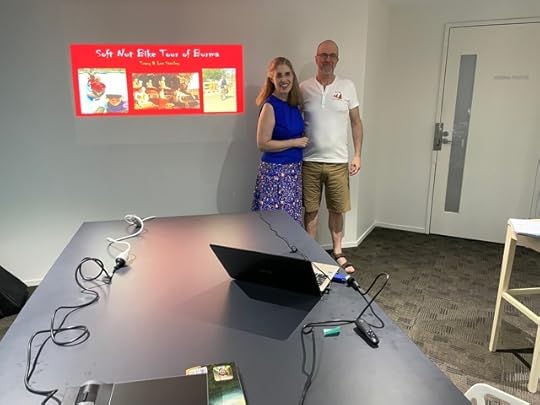
We’d chosen to present the Soft Nut Story to our neighbours in Aurora Tower in Brisbane. It’s always easier when you know the audience and can be guaranteed a smile from my Mum sitting in the front row.

I shared a few photos and a video about the trip.
Our rollout continues with a book signing at New Farm Editions Saturday 14 November from 10:00 – 2:00pm. They are located at Merthyr Village Shopping Centre, 84 Merthyr road. If you’re in the area, pop by to say hi.
And I’ve posted a few snippets from the book on the website Crazy guy on a bike.
Fingers crossed we’ll all be travelling again soon now a vaccine has been developed.
The post Rolling out the Soft Nut Bike Tour Roadshow appeared first on Tracy Stanley.
November 9, 2020
Change, Culture and Creativity

We typically want to work for an organisation with a great culture. We also choose to stay longer with organisations that facilitate learning and help bring out our best.
Many organisations want to enhance their organisational culture so that creativity and innovation flourish. For some organisations this is a huge change, while for others, reinforcing behaviours or processes and systems are needed. In this blog I’ll chat about steps you can take to change the culture of your organisation
In related news, I’ve recently published a book, Change Stories: Success and failure in changing organisations. This book describes a myriad of ways to facilitate change in an organisation including stories covering mergers, acquisitions, new systems and cultural change which is the focus of this blog.
What is culture change and why is it hard?
Cultural change is perhaps the most complex type of change program as it involves changing people’s attitudes and behaviours. As a result, it takes time. Culture is a big and complex concept and covers habits, behaviours, processes, attitudes, artefacts. It’s sometimes described ‘as the way that things are done around here’ although Ed Schein, former MIT professor and organisational culture expert, observes that this statement disguises the complexity of culture.
Those of us who’ve lived inside organisations know that culture can manifest itself in a variety of ways, including leadership and employee behaviours, communication styles, decision-making processes and office layout. While it can be hard to describe, culture is something you can feel after a short time within a new environment.
Schein, tells us that culture is built through shared learning and mutual experience. He advises that if you want to change an organisations culture you need to think about it systematically – and that culture change can evolve from small but effective changes in behaviors. In trying to change an organisation’s culture, he advises to be very specific about the behavior or behaviours that are creating a problem in the organisation and then to focus on the types of behaviors we want to see.
Cultural change stories
In my book of Change Stories I had stories shared around steps taken to more deeply embed a safety culture in a mining company, around building a more diverse organisation in a male dominated engineering company and around building a more innovative culture – which is so important as organisations need to respond to and anticipate changes in their external environment. Some of the lessons from these stories include:
Need for long-term investments in awareness raising and skills development
Importance of building small conversations around the desired change into everyday work meetings.
Have conversations that connect to the employees’ own circumstances and interests as a driver for change.
How would you know that you have an innovative culture?
There would be frequent reflection, learning fast, evidence of thinking differently and of challenging the status quo. These behaviours are typically associated with creativity. It’s also recognized that innovative organisations tend to be ahead of their customers rather than responding to them. They are much more proactive.
What attitudes and behaviour support an innovate culture?
In an innovative environment mistakes are expected.
Because innovative cultures expect to take steps into the unknown they have also developed very good risk-management processes.
Many organisations have recognised the need to encourage innovation as a way of ensuring their survival and success. While they can introduce systems and programs, building an underlying culture that supports innovation is much harder.
Innovative cultures are often described as fun. They’re characterized by a tolerance for failure and a willingness to experiment. They’re seen as being psychologically safe, highly collaborative, and non-hierarchical. And research suggests that these behaviors translate into better performance.
I’ve recently been reading Carolyn Taylor’s excellent book on how to change your organisation’s culture titled: ‘Walking the Talk: Building a culture for success’. She describes what’s needed if an organisation wants to change and embed a different culture. Some of the many things I took away from her book include
Culture journey is a long one, it requires considerable investment in both time and emotional energy and is not something to be undertaken in a hurry as a knee-jerk response.Behavioural norms evolve over long periods of time and are influenced by many factors including the values or beliefs that brought the community together in the first place; past and present leaders (We all think of the influence of Steve Jobs at Apple on building an innovative organisation).
If you’d like to know more, I propose you read the books and articles referenced below.
References
Schein, E. H. (2010). Organizational culture and leadership (Vol. 2). John Wiley & Sons.
Stanley, T. (2020). Change Stories: Success and failure in changing organisations
Taylor, C. (2005). Walking the talk: Building a culture for success. The Learning Organization.
Schein article from human synergistics
The post Change, Culture and Creativity appeared first on Tracy Stanley.
October 19, 2020
How I wrote ‘Change Stories’
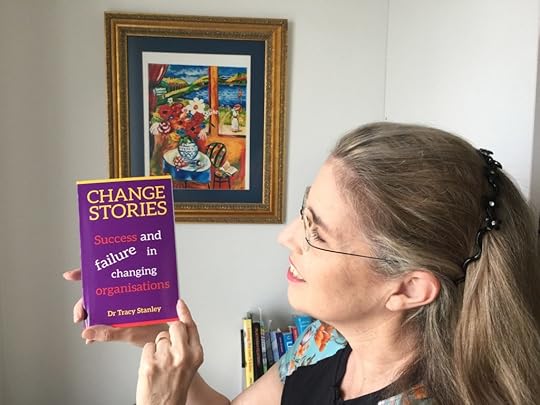
This month my latest book went live. It’s called Change Stories: Success and failure in changing organisations. So excited.
While I’ve worked on global change projects, the stories I shared in side this book were not my own.
Let me explain.
The Back Story
After a few years living overseas, I returned to Australia and became aware of the diversity of change management roles, and often short-term ones, being advertised. While I had previously undertaken a global change management role introducing new systems and ways or working in a global technology company, I wanted to learn more about what other change managers were doing.
I talked with connection in my network and asked them to recommend others I should speak with. I was motivated to get a diversity of perspective not only of change managers but of project managers, human resource managers and business leaders.
The questions I asked
I asked everyone the same questions including.
What did they understand change management to be? What was it that change managers did?What sort of projects had they been working on? From the successful projects, what the things that were critical to the project going well? For the failed projects, what were some of the early signs that the project was going astray?And then thinking about the other change petitions that worked with. What were the characteristics of the most effective change practitioners?
The stories shared were from diversity of change projects related to mergers and acquisitions; introducing new models and processes, digital transformation, building skills and driving cultural change to name a few and came from banking and financial services, energy, mining, manufacturing, telecommunications, hospitality, health, higher education, consulting, legal, state and local government, and non-government organisations.
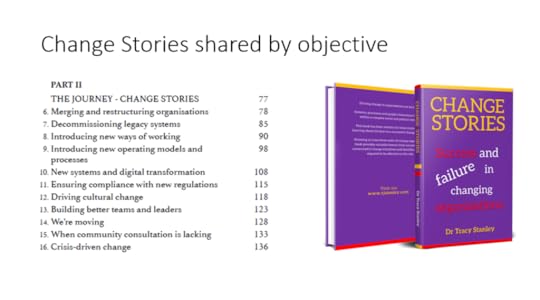
I’m proud of the book and learnt a great deal from my 24 conversations. I think that Change Stories is a valuable learning resource for people who face the challenge of driving change in their organisation.
Your copy here.
The post How I wrote ‘Change Stories’ appeared first on Tracy Stanley.
September 19, 2020
Helping your team to play with ideas
 Photo from Unsplash @Robbie36
Playing with ideas in your team
An essential part of being creative involves play, that is taking time to play with ideas and explore different scenarios. Play is a word we typically associate with children. Indeed, when I searched for pictures of play most images were of children playing, like the one above.
But play is also a mindset. The capacity to play facilitates experimentation and the exploration of ideas. It’s a perspective we can lose as we get older.
In this blog, I’m going to explore different ways you can help your team to play with ideas and things you need to consider to do this successfully. But firstly, I need to start with a definition.
Definition of Play
Play is generally considered an activity for enjoyment and recreation rather than a serious or practical purpose. Dr Stuart Brown says that play is fun, joyful and refreshing and essential to the development of social and problem-solving skills, while David Elkind describes play as an exercise for imagination, curiosity and fantasy. He observed that in our hurried society, we have come to think of play as a luxury at best and a waste of precious time at worst. This view is supported by Sir Ken Robinson who adds that play has a deeply important role in the development of intellectual and social skills, in developing empathy, in stretching our imagination and exploring our creativity.
There’s something about the ‘not for a serious or practical purpose’ that frees our thinking. It’s a mindset where you relax ‘the rules’ around will I look silly or can we afford this. The act of playing gives you freedom to try new things in a safe space.
But it can be hard to play at work because, as Brene Brown says, ‘I feel behind if I’m not using every last moment to be productive’.
Examples of how you can play with your team
So what are examples of how you can play with your team?
Types of play
Being the Hero
Playing Superman or Superwoman and acting out what it would look like if all problems were overcome and the scenario was 100% successful
Opposite thinking
Imagining the worst-case scenario – and experiencing everything that results from this outcome. You can paint it, sculpt it or act it out.
Reframing the scenario in a metaphor
Describing the situation or desired solution as a metaphor or through a well-known fairy tale. This could be illustrated through Rich Picture or collage. Barbara Wilson and I explain how you can use these tools and processes in our book, Creativity Cycling: Help your team solve complex problems with creative tools.
Now maybe you’re thinking, my team won’t be comfortable doing this. That’s possible, particularly if you’ve not created a habit or culture for encouraging creative thinking. People need to feel safe to play and not be concerned about appearing silly. It could also be the case that members of your team have been brought up to behave in a way that is contrary to being playful. Understanding each person’s unique socialisation will give you insights into their mindset. And these mindsets are created based on beliefs, assumptions and past experiences.
Different physical spaces support play
Barbara Wilson and I recommend using a different physical space if you want to encourage play and creative thinking. A room or space should be set up to feel different to typical meeting rooms. For example, put tables against the wall and place chairs in a circle. If you can’t access a different room then take the team to a beautiful physical space outside.
How your team shows up
Remember that on any day, a person can have a lot going on in their life. A worry from home or work could be distracting them and limiting their ability to engage in play. Check in with the team at the start of the meeting to discuss how they are feeling on turning up that day. This simple acknowledgement will help to free up their thinking.
Barbara talks about the importance of paying attention to the 4 Ps including passion, playfulness, persistence and positivity as precursors for play. She talks more about playfulness here.
Setting the expectations for the exercise
Remind everyone this is a safe space. There’ll be wild thinking as a part of the play process and everyone will be asked to withhold judgement.
Key takeaways
Helping your team to play will reveal new perspectives.
If it’s not a habit – it may be harder for some than others.
There are many benefits of play including stimulating creativity, problem solving and developing empathy.
And of course, playing is fun.
References
Importance of Play – Brene Brown
Importance of playfulness – Barbara Wilson
Rethinking childhood – Ken Robinson
The post Helping your team to play with ideas appeared first on Tracy Stanley.
September 6, 2020
One bike ride. Two diaries. Exploring the less travelled roads of Myanmar
Earlier this year, just as the pandemic was breaking, I set off with a few friends on a bike ride through Southern Myanmar. My husband was unable to join me as he had hurt his back.
We both kept diaries from the trip which we have shared in our book, Soft Nut Bike Tour of Burma, exploring the less travelled roads of Myanmar. Les recounted how he was spending his days in Brisbane, while I described (perhaps in too much detail sometimes), what I was experiencing as I flew from Brisbane to Bangkok and to Mae Sot for the start of the adventure into Myanmar. The contrast in experiences and writing styles makes the book unique. It’s an insightful and occasionally irreverent read.
You’ll enjoy it if you like visiting lesser known parts of the world, like (or don’t like) group travel, and appreciate the slower-paced form of transport that cycling affords. There’s also travel by train, tuk tuk, truck and all manner of water-craft. You’ll also enjoy Soft Nut if your fed up with being ‘locked down’ and dreaming of travelling.
Below are a few photos from the tour and this is where you can pick up your copy of Soft Nut.
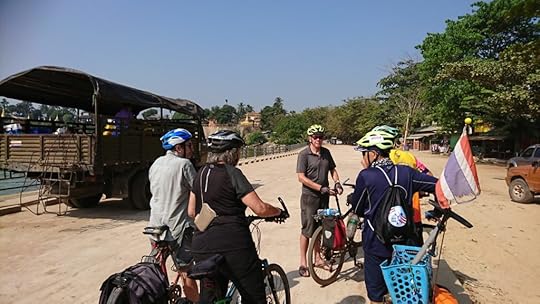 Deciding where to go next
 On the road
 We also took our bikes on the train. I snapped this at Thanbyuzat Station
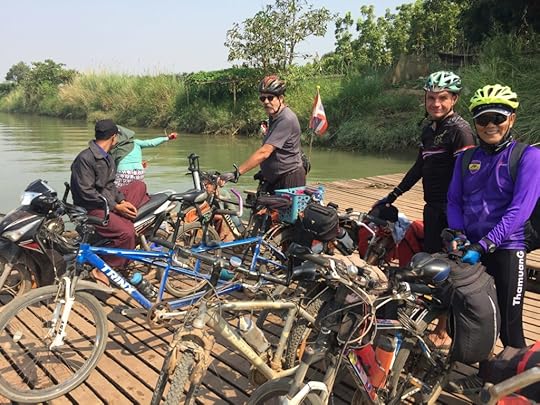 We also travelled by a variety of water-craft.
 Big Buddha at Banana Mountain, near Ye
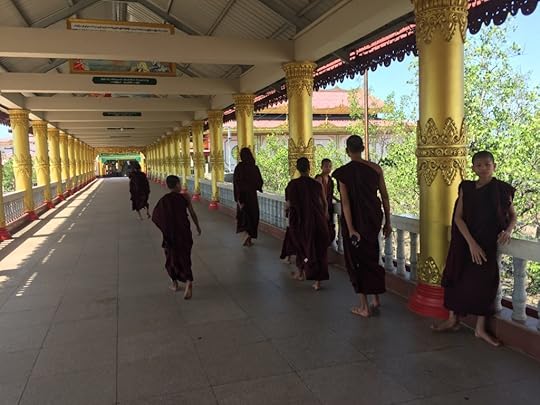 Young monks also visiting the temple at Kyaikkhami
I’ve also added two videos from the trip on my Amazon author page.
The book provides an opportunity to travel vicariously while you wait to see these wonderful places yourself, post Covid-19 quarantine.
The post One bike ride. Two diaries. Exploring the less travelled roads of Myanmar appeared first on Tracy Stanley.
July 18, 2020
Creative leadership during the time of COVID-19
 Photo from Unsplash @NCI
Creative leadership during the time of COVID-19
The world is facing a truly wicked problem as the Corona Virus spreads unabated. We watch with admiration, concern, horror, (tick which is most appropriate), as leaders grapple with what to do. It’s a problem for which there is currently no vaccine or cure and for which there are significant health management, economic and moral challenges.
Decisions being made as to how to manage during this pandemic reveal the values of leaders. I was reflecting on which leaders had employed creativity in how they have responded to this crisis. Let’s look at this by considering what is creative leadership.
What is creative leadership?
Creative leadership is a capacity to look at situations in different ways that others mightn’t have imagined. It’s also a willingness to embrace unlikely or unpopular positions. When faced with a complex problem, creative leaders bring together diverse others with deep experience. They arrive to a meeting with an open mindset, listen carefully and ask questions to more deeply understand and differentiate between facts, opinions and feelings. They give people a safe space to express what they are thinking and to offer ideas. Their goal is not so much to manage creativity, but to manage for creativity (Amabile & Khaire, 2008).
Why is creative leadership important?
In 2016, the World Economic Forum recognised that complex problem-solving skills, critical thinking and creativity were the top three skills required by our leaders. The reality is that more complex problems require new thinking. Creative leaders recognise that the best ideas do not necessarily come from the top in the organisation and they create the environment for new ideas to be seeded and encouraged throughout the organisation. This generation of new ideas is commonly identified as creativity. The bringing of these new ideas to life is called innovation.
What are the behaviors of a leader who is creative?
Firstly, they are open to learning. They are interested in unlikely and unpopular viewpoints. Innovation is more likely when people of different disciplines, backgrounds, and areas of expertise share their thinking. Creative leaders recognise the value of bringing these diverse specialists together to solve complex problems. They display behaviors of active listening, of being open to new ideas and of creating environments where people are safe to experiment and to fail. They recognise that time and resources needs to be provided for thinking differently.
Returning to the current pandemic let’s consider the following:
Which leaders have?
Worked with diverse and informed others, be they people and organisations, to better understand the nature of the problem.
Separated facts from feelings. Identified what is known and not known.
Provided time and resources for potential solutions to be experimented with.
Noted learning and admitted mistakes made.
Three leaders come to mind. Firstly, Jacinda Ardern, Prime Minister of New Zealand who quickly made the unpopular decision to move everyone into quarantine and for a long time. Angela Merkel, Chancellor in Germany has talked about how the science has influenced her decisions while Dan Andrews, Premier of Victoria in Australia has openly admitted his mistakes.
What other attributes have the best leaders displayed during this crisis? I’d love to hear what you think.
References
Amabile, T., & Khaire, M. (2008). Creativity and the role of the leader: your organization could use a bigger dose of creativity. Harvard Business School Review, December, 107-109.
Stanley, T. (2016). Work environments, creative behaviours and employee engagement (Doctoral dissertation – Queensland University of Technology)
Wilson, B. & Stanley, T (2018). Creativity Cycling: Help your team solve complex problems with creative tools
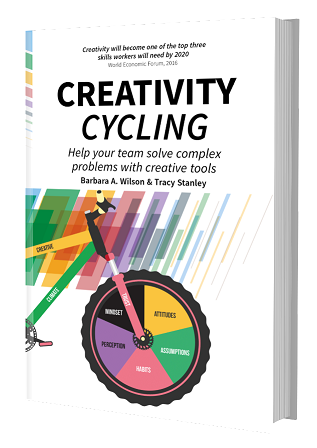
https://hbr.org/2008/10/creativity-and-the-role-of-the-leader
Creativity is the Single Most Important Leadership Skill
Who do you consider a creative leader?
The post Creative leadership during the time of COVID-19 appeared first on Tracy Stanley.
April 25, 2020
Painting the future
 Photos from Unsplash taken by @giulia_bertelli @rhondak @aaronphs
 Painting is just another way of keeping a diary
Pablo Picasso
I rather like this quote by Picasso as it presents something artistic such as painting in a more rational context, i.e. keeping a diary. It demonstrates an interesting application of an artistic process.
I want to share with you how I’ve used artistic processes to help teams solve problems and imagine a different future. It’s a process that may bring back, memories from your childhood. I hope these memories are full of experimentation and play. The goal of the exercise is to think in a different way. While the definition of art as described by Google Dictionary has two parts:
the expression or application of human creative skill and imagination, typically in a visual form such as painting or sculpture,
producing works to be appreciated primarily for their beauty or emotional power.
The goal of this exercise is focused more on the first part of the definition, applying imagination. It’s not to produce something traditionally considered beautiful. However, it’s entirely likely that when you apply your insights, you or your team will create something powerful.
Where the activity fits in the Creative Problem-Solving Process (CPS)
In this blog I’ve described how with a few simple materials like paint, straws or balloons, you can encourage others to build a range of models and metaphors that describe a problem or opportunity. This process is used within the exploration stage of CPS, i.e. the first stage and is a precursor to Stage 2 which involves the generation of ideas and plans. The third step of the process is implementing the plan.
Description of activity using paint
Ask the team to look at a problem and to,
Imagine that all the barriers had been overcome and that the perfect result had been realised.
Allow the team time to discuss, brainstorm and plan what this perfect result would look like (30 minutes), and then time to paint it (60 minutes).
Later, a spokesperson (or two) from the team then explains the meaning of the painting. Each team should have five minutes to present and five minutes to answer questions.
People can amaze you when they are given permission to represent their ideas creatively.
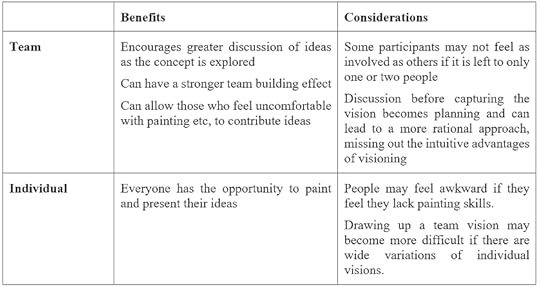
Benefits of doing the exercise individually verses as a team
This vision exercise can be done individually or as a team effort. The table below may be helpful in deciding on approach. This would apply whether the process involved painting, drawing or developing a vision through another medium such as collage.
Resources needed for painting
Large canvas
Paint, paint brushes and trays
Easel to hold canvas
Ground sheets if painting inside (very important)
Camera/Video
Participants to bring old shirts/clothes to protect their clothing
What I am saying is that we need to be willing to let our intuition guide us, and then be willing to follow that guidance directly and fearlessly
Shakti Gawain
References
Creativity Cycling: Help your team solve complex problems with creative tools by Barbara Wilson and Tracy Stanley 2018
The Artists Way, Julie Cameron 2016
The post Painting the future appeared first on Tracy Stanley.
Ten tips for writing a book

Keep a diary
Embrace imposter syndrome
Identify your audience – Who are you writing for?
What voice do you want to write in?
Develop an outline before you start
Read ...more
- Tracy Stanley's profile
- 6 followers

