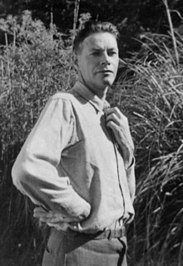
Roderick David Finlayson was born in Devonport, Auckland, on 26 April 1904. His father, John Maclennan Finlayson, was an accounts clerk in the Bank of New South Wales in Auckland. Because of gambling debts he absconded to San Francisco in 1905, effectively ending his marriage to Mary Milligan Cargo. She brought up her son in the home of her northern Irish mother in Ponsonby.
Finlayson attended Ponsonby Public School from 1909 to 1917 and Seddon Memorial Technical College from 1918 to 1921. He passed the City and Guilds of London Institute examination in mechanical engineering in 1921. AbouThis biography, written by John Muirhead, was first published in the Dictionary of New Zealand Biography in 1998.
Roderick David Finlayson was born in Devonport, Auckland, on 26 April 1904. His father, John Maclennan Finlayson, was an accounts clerk in the Bank of New South Wales in Auckland. Because of gambling debts he absconded to San Francisco in 1905, effectively ending his marriage to Mary Milligan Cargo. She brought up her son in the home of her northern Irish mother in Ponsonby.
Finlayson attended Ponsonby Public School from 1909 to 1917 and Seddon Memorial Technical College from 1918 to 1921. He passed the City and Guilds of London Institute examination in mechanical engineering in 1921. About 1923 he was apprenticed as a draughtsman to John Anderson, an Auckland architect; his duties came to include rent collecting and selling real estate. Finlayson also began night school, passing the matriculation examination in 1924. From 1926 to 1929 he studied part time in the School of Architecture at Auckland University College for an associateship in the New Zealand Institute of Architects.
With the onset of the slump, however, Anderson's business failed and Finlayson's employment ended. After unsuccessful ventures as a travelling salesman and tobacco farmer, Finlayson took up the life of a writer in the mid 1930s. He had experimented as a writer of romance as early as 1924, and published occasional journalism in the Auckland papers. In the early 1930s he turned to satire to express his disillusionment with 'our ruthlessly technological and acquisitive society', now apparently in collapse. This disillusionment had been building for some time. About 1922, a conviction for failure to attend compulsory military drill stirred Finlayson's developing radical sympathies. Despite his Unionist family background, he was drawn to the Republican cause in Ireland. Later in the 1920s he supported Samoan aspirations for self-government.
In the 1920s, too, he came to repudiate his boyhood enthusiasm for science and technology. This was the result of his childhood experience of farms managed and owned by his uncle, Arthur Wilson, in the Bay of Plenty and at Glenbrook. His uncle emphatically rejected mechanisation in his husbandry of the land; he became the model for Uncle Ted in the novel Tidal Creek. Farm life also introduced Finlayson to rural Maori. He stayed with the family of Hone Ngawhika at Pukehina for several summers during the 1920s until about 1931, learning from him traditional ways of living with the land.
In 1934 or 1935 Finlayson met the poet D'Arcy Cresswell, whose radio broadcasts he admired for their excoriation of science and modernity. He became a frequent visitor to Cresswell's Castor Bay bach, where he met his future publishers Bob Lowry and Ron and Kay Holloway, as well as Frank Sargeson and other writers. Finlayson showed Cresswell his satiric writing, but Cresswell was more impressed by some short stories, modelled on those of the Sicilian writer, Giovanni Verga. These were written about the Pukehina community from which Finlayson now felt himself to be in exile, possibly as the result of a failed love affair. Cresswell became his literary mentor, a role later shared with Sargeson; he recommended his friend's work to publishers, and provided him with exacting criticism.
Cresswell acted as best man at Finlayson's marriage to Ruth Evelyn Taylor in Auckland on 3 June 1936. He had met her when he holidayed in Rarotonga, her birthplace, in 1931. The couple moved to Weymouth, on the Manukau Harbour, in 1937, and there they raised three daughters and three sons.
The war years, during which Finlayson served in the Home Guard and worked in a woolstore under emergency regulations, brought him new friendships, including that of the younger writer David Ballantyne. It was also a time of spiritual discovery: brought up a Presbyterian, Finl...more

 Sign in with Facebook